Cramp Prevention: History and Origins
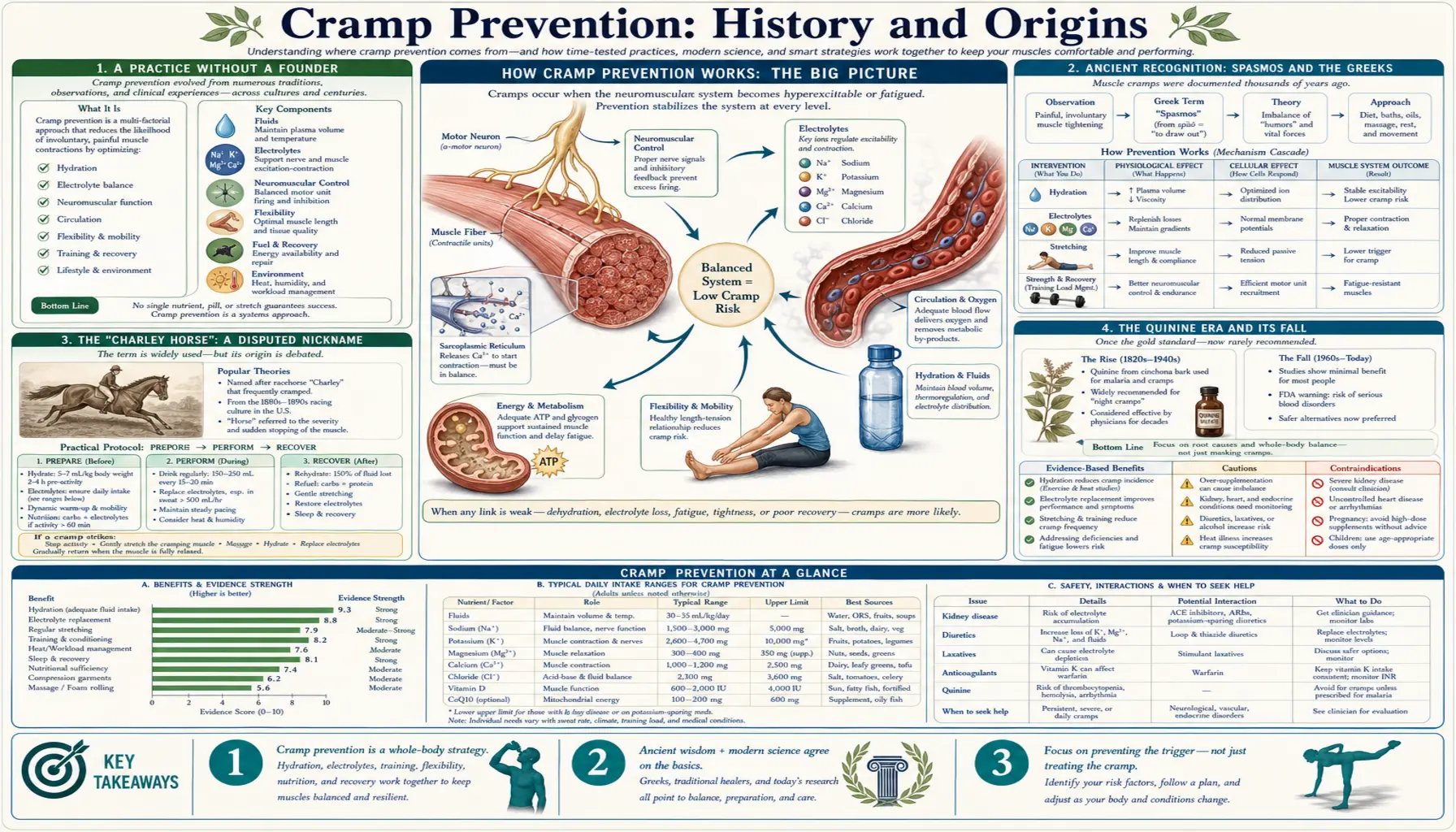
Cramp prevention is not the invention of any single person. It is a practice with no founder — a slowly assembled body of folk wisdom, drugstore habit, and laboratory science that grew up around one of the most ordinary and universal human complaints: the sudden, painful, involuntary locking of a muscle. This article traces that history honestly. It runs from the ancient Greek word spasmos, through the curious baseball-era nickname "charley horse," the long and now-discredited reign of quinine, the rise of magnesium and the electrolyte theory, a major scientific turn in the 1990s toward the idea that cramps come from the nerves rather than the muscles, and the surprising modern discovery that a mouthful of pickle juice can stop a cramp faster than any pill could possibly be absorbed. Throughout, we separate what is documented from what is folklore, and we state plainly where the evidence is strong, weak, or still argued over — because much of what people believe about preventing cramps is more tradition than proof.
Interactive Visualization Magnesium — the mineral that makes ATP work Bare ATP is useless and enzymes reject it. Watch magnesium clamp the phosphates and switch it on, plug the NMDA channel, and let a cramping muscle finally let go. Launch →
Table of Contents
- A Practice Without a Founder
- Ancient Recognition: Spasmos and the Greeks
- The "Charley Horse": A Disputed Nickname
- The Quinine Era and Its Fall
- Magnesium, Salt, and the Electrolyte Theory
- A Scientific Turn: Schwellnus and Neuromuscular Control
- Pickle Juice and the Neural-Reflex Discovery
- Evidence and Reception: What We Actually Know
- Research Papers and References
- Connections
- Featured Videos
A Practice Without a Founder
It is worth saying clearly at the outset: cramp prevention has no inventor. Unlike a named protocol built by one practitioner, or a drug traced to a single laboratory, the practice of stopping muscle cramps is a patchwork stitched together over centuries by ordinary people, athletes, trainers, family doctors, pharmacists, and — only recently — research scientists. A muscle cramp is something nearly every human experiences, so the "history" of preventing it is really the history of many separate guesses about what causes it, each guess producing its own remedy.
That matters for honesty. Because cramps usually go away on their own within seconds or minutes, almost anything done at the moment of a cramp will seem to "work" — the cramp was going to stop anyway. This single fact has haunted cramp remedies for as long as they have existed. It is why so many traditional treatments persisted for decades on the strength of personal conviction long before anyone tested them properly, and why some of the most popular interventions, when finally examined in controlled trials, turned out to be far weaker than their reputations. The sections that follow are organized around the major eras and ideas, not around heroes, because there are none — only a long, human effort to understand a problem that is more complicated than it looks.
Ancient Recognition: Spasmos and the Greeks
Muscle cramps and spasms are old enough to appear in the earliest written medicine. The Greek word spasmos — the root of the English word "spasm" — was already in use in the writings attributed to Hippocrates of Kos (about 460 to 370 BC), the physician traditionally called the father of Western medicine. In the Hippocratic texts, spasmos was a broad term covering everything from a minor involuntary twitch to a violent, full-body convulsion, and a severe spasm was generally read as a grave sign. This was not cramp prevention in any modern sense; it was the first documented recognition that involuntary muscle contraction is a distinct medical phenomenon worth naming and observing.
For most of the long stretch between antiquity and the modern era, the ordinary leg or foot cramp was treated the way any minor ache was treated: with warmth, rubbing, stretching, movement, and folk remedies that varied from place to place. These simple physical measures — massaging the knotted muscle, forcing it to lengthen, standing and walking it out — are genuinely ancient and entirely intuitive, and as later sections show, they remain among the few cramp interventions that clearly do something. What was missing for centuries was any reliable idea of why cramps happen, and therefore any rational way to prevent them rather than merely wait them out.
The "Charley Horse": A Disputed Nickname
The most distinctively American name for a muscle cramp — the "charley horse" — entered the language through baseball in the 1880s, and its exact origin is genuinely unknown. The earliest documented appearances of the phrase come from American newspapers of that decade, and from the start it referred to the kind of sudden thigh or leg cramp that strikes an athlete in motion. Beyond that, the trail goes cold, and what survives is a cluster of competing baseball folk tales rather than a settled fact.
The stories are colorful and mutually contradictory. One popular version ties the term to a lame old horse named "Charley" that pulled equipment or the roller across a ballpark's infield, its stiff limp resembling a cramped player hobbling off the field. Another links it to the shortstop Jack Glasscock, said to have strained his thigh and afterward been compared to a lame farm horse of that name. A third attaches it to the pitcher Charles "Old Hoss" Radbourn, who was reportedly plagued by cramps in the 1880s. None of these accounts can be confirmed, and reputable etymological sources treat all of them as folk etymology — plausible-sounding after-the-fact explanations rather than evidence. The honest summary is the one the dictionaries themselves give: the phrase was coined by a ballplayer in the 1880s, but we do not know which one, or why. The name stuck; its story did not survive.
The Quinine Era and Its Fall
For most of the twentieth century, the dominant medical answer to recurrent night-time leg cramps was a drug, not a mineral: quinine. Quinine is a bitter alkaloid originally derived from the bark of the South American cinchona tree, famous for centuries as the first effective treatment for malaria. Beginning in roughly the 1930s and 1940s, quinine and its close derivatives became a mainstay of treatment for idiopathic (unexplained) muscle cramps, and for decades doctors prescribed it freely for nocturnal leg cramps simply because nothing else seemed to work as well.
Modern reviews give quinine a carefully qualified verdict: it is moderately effective at reducing the frequency and intensity of leg cramps. But that modest benefit comes with a serious problem. Quinine can trigger rare but devastating blood reactions — severe drops in platelets (thrombocytopenia), hemolytic-uremic syndrome, and thrombotic thrombocytopenic purpura — that can be fatal. Over time, regulators in the United States concluded that this risk was not worth it for a benign, self-limiting complaint. The U.S. Food and Drug Administration removed quinine from over-the-counter sale, and in 2006 ordered most quinine products off the market, leaving only the branded antimalarial Qualaquin. Yet doctors kept prescribing it off-label for cramps, so on 8 July 2010 the FDA issued a pointed warning against using quinine for leg cramps at all and imposed a formal Risk Evaluation and Mitigation Strategy. The agency's position was blunt: the drug's benefit for cramps does not justify its risk of life-threatening side effects.
The fall of quinine is one of the clearest lessons in this entire history. A treatment can be genuinely, measurably effective and still be the wrong choice — because "does it work?" is not the same question as "is it worth the danger?" The collapse of quinine as a routine cramp remedy left a gap that the next era's remedies, centered on minerals, rushed to fill.
Magnesium, Salt, and the Electrolyte Theory
As quinine fell out of favor, the popular and naturopathic mind settled on a more appealing explanation for cramps: mineral deficiency. The reasoning was straightforward and physiologically sensible. Muscle contraction and relaxation depend on a handful of electrically charged minerals — magnesium, potassium, calcium, and sodium — and it is true that magnesium in particular is required for muscles to relax. From there grew the now-ubiquitous idea that cramps are a signal of low magnesium, and that taking magnesium (as supplements, Epsom-salt baths, or mineral-rich foods) will prevent them. This "electrolyte depletion" thinking also drew on a parallel observation among athletes: people who sweat heavily lose salt, and heavy sweaters who cramp tend to have higher sweat-sodium losses than those who do not.
The electrolyte and magnesium story is the most popular cramp-prevention framework in the world today, and it is the spine of the companion Cramp Prevention guide on this site. But intellectual honesty requires stating where the formal evidence actually stands — and here it is humbling. The most rigorous assessment available, a Cochrane systematic review first published in 2012 and updated in 2020 by Scott Garrison and colleagues, pooled the randomized trials of magnesium for cramps and concluded that magnesium supplementation is unlikely to provide clinically meaningful prevention of cramps in older adults — the very group that cramps most. For pregnancy-associated cramps the evidence was conflicting, and for exercise-associated and disease-related cramps there were essentially no good trials at all. In plain terms: one of the most widely recommended cramp remedies on earth has, so far, failed to show a clear, repeatable benefit when tested properly in the population that uses it most.
This does not make magnesium worthless. Magnesium deficiency is real and common, magnesium has many other documented roles, and correcting a genuine deficiency is reasonable on its own merits. But the leap from "magnesium helps muscles relax" to "magnesium prevents cramps" was made by tradition and intuition long before the trials were run, and the trials have not confirmed it. The persistence of the magnesium-for-cramps belief, despite that disappointing evidence, is a textbook example of the problem named earlier: because cramps stop on their own, a remedy can feel reliably effective without actually being so.
A Scientific Turn: Schwellnus and Neuromuscular Control
The most important conceptual shift in the modern understanding of cramps came not from a remedy but from a re-examination of the cause — and it is associated above all with the South African sports physician Martin (Tim) Schwellnus, working at the University of Cape Town's research unit for exercise science and sports medicine. In 1997, Schwellnus and colleagues proposed that exercise-associated muscle cramps are not primarily caused by dehydration or by salt and mineral loss at all, but by altered neuromuscular control — a malfunction of the nervous system's reflexes when a muscle becomes fatigued.
The mechanism he described is elegant and has reshaped the field. Inside every muscle and tendon are sensors that govern muscle tone: muscle spindles that drive contraction, and Golgi tendon organs that inhibit it. When a muscle is overworked and fatigued, especially while it is in a shortened position, this balance tips — excitatory signals from the spindles rise while the protective, inhibitory signals from the Golgi tendon organs fall. The result is an over-excited motor neuron in the spinal cord firing uncontrollably, locking the muscle in a cramp. In a 2008 review in the British Journal of Sports Medicine, Schwellnus laid out the competing theories side by side and argued that the evidence favored this neuromuscular-control model over the older dehydration and electrolyte-depletion hypotheses.
The practical implications were profound. If cramps originate in over-excited nerves rather than in depleted muscles, then drinking electrolytes is aiming at the wrong target, and the interventions that actually calm an over-firing motor neuron — above all stretching, which activates the inhibitory Golgi tendon organ — should be central to both treatment and prevention. This is the scientific reason that the oldest, simplest remedy of all (forcing the cramping muscle to lengthen) is also one of the few that genuinely works. The neuromuscular theory is not the final word — cramps are multifactorial and researchers still debate the relative weight of fatigue, salt loss, and individual susceptibility — but Schwellnus's work moved the center of gravity of cramp science from the muscle to the nervous system, and set the stage for the most surprising discovery of all.
Pickle Juice and the Neural-Reflex Discovery
If cramps are driven by over-excited nerves, then perhaps the way to stop one is to send a counter-signal into the nervous system fast — and the unlikely vehicle for testing that idea turned out to be pickle juice. Athletic trainers had long passed around the folk remedy that a swallow of pickle brine could abort a cramp, but it was treated as a curiosity until it was tested. In a landmark study published in 2010 in Medicine & Science in Sports & Exercise, the athletic-training researcher Kevin C. Miller and colleagues (including the physiologist Gary W. Mack) deliberately induced cramps in dehydrated, exercised volunteers by electrically stimulating a foot muscle, then gave them either plain water or a small dose of pickle juice.
The result was striking and, crucially, it ruled out the obvious explanation. Pickle juice relieved the cramps markedly faster than water — cramps resolved in roughly 85 seconds with pickle juice versus about 134 seconds with water — yet the volume swallowed was far too small, and acted far too quickly, to have raised blood electrolyte levels. The brine never reached the cramping muscle in time. Miller and Mack concluded that the relief was a neurally mediated reflex: something in the pickle juice (the sharp acetic acid of vinegar) stimulated sensory receptors in the mouth and throat — the oropharyngeal region — which sent an inhibitory signal back to the over-firing motor neurons and shut the cramp down. The cure was happening in the nerves, exactly as the neuromuscular theory predicted, not in the muscle chemistry.
This insight launched a small industry. Researchers connected the oropharyngeal reflex to TRP channels (transient receptor potential ion channels) — the same family of "sensor" proteins that make us register the heat of chili, the bite of mustard, and the cool of menthol. The most celebrated effort to build a deliberate cramp remedy on this principle came from an improbable pair of endurance athletes who happened to be world-class neuroscientists: Rod MacKinnon, a Nobel laureate famous for his work on the structure of ion channels, and Bruce Bean, a neurobiologist at Harvard Medical School. After both were stricken with severe arm cramps during a sea-kayaking trip off Cape Cod, they reasoned that strongly activating TRP channels in the mouth, throat, and stomach could quiet the hyperexcitable motor neurons that cause cramps. They formulated a sharp blend of TRP-activating ingredients — built around compounds like those in ginger, cinnamon, and chili peppers — which their company, Flex Pharma, brought to market as the athlete drink "HOTSHOT." A 2017 randomized trial led by Daniel Craighead and colleagues (whose senior author later served on Flex Pharma's scientific advisory board) reported that ingesting such TRP-channel agonists raised the threshold at which an electrically provoked cramp would form.
Honesty requires two cautions here. First, the pickle-juice and TRP work is real and intriguing, but it is not settled: Miller's original finding has been difficult for other groups to reproduce, and commercial TRP products have drawn pointed criticism for over-promising. Second, this research is mostly about aborting a cramp in progress in athletes, not about a proven long-term prevention strategy for everyone. What the era genuinely established is conceptual rather than commercial — the demonstration that a signal delivered through the mouth, with no electrolyte effect at all, can switch off a cramp. That overturned a century of assumption and is the most important modern chapter in this story.
Evidence and Reception: What We Actually Know
Pulled together, the history of cramp prevention is humbling, and the honest bottom line should be stated without spin. Despite how common cramps are, there is still no single, broadly proven, low-risk method that reliably prevents them in everyone. Each major era added a piece, and each left a remedy whose reputation outran its evidence.
Here is the fair scorecard. Quinine is moderately effective but carries a rare risk of fatal blood reactions, and regulators have advised against it for cramps. Magnesium, the most popular natural remedy, has repeatedly failed to show clear benefit in the best randomized trials in older adults, even though correcting a true deficiency is reasonable on other grounds. The broader electrolyte and hydration approach is physiologically sensible and clearly matters for heavy-sweating athletes, but plain dehydration is no longer thought to be the main driver of most cramps. Stretching — the oldest remedy of all — has the strongest mechanistic rationale and is the intervention the modern neuromuscular theory most directly endorses, which is why daily calf and hamstring stretching is so widely recommended for night-time cramps. And the pickle-juice / TRP-channel work is the most scientifically interesting recent development, but it concerns stopping cramps fast more than preventing them, and its commercial offshoots have been justly criticized for hype.
The mainstream medical reception of cramp remedies is, accordingly, cautious. Reputable bodies emphasize that most cramps are benign and self-limiting, that no drug should be taken routinely for them, and that simple, safe measures — regular stretching, gentle activity, adequate (not excessive) hydration, and reviewing any medications that deplete minerals — are the sensible first line, while persistent or severe cramping deserves a medical workup for an underlying cause. The fuller practical protocol, with foods, supplements, dosing, and cautions, is laid out on the main Cramp Prevention page and in the Cramp Prevention Benefits articles. The value of knowing the history is precisely this: it teaches us to hold every cramp remedy — old or new, natural or pharmaceutical — to the same standard of evidence, and to remember that a treatment which feels like it works is not the same as one that has been shown to.
Research Papers and References
The list below combines key peer-reviewed sources on the cause, treatment, and prevention of muscle cramps with curated PubMed topic-search links and authoritative regulatory and reference resources. Historical material — the Hippocratic use of spasmos, the 1880s origin of "charley horse," and the early-twentieth-century adoption of quinine — is described in the article from historical and lexicographic sources rather than cited as clinical literature. Author names, titles, and journals are given as plain text; only the stable DOI, PMID, or official page is hyperlinked, and each opens in a new tab.
- Miller KC, Mack GW, Knight KL, Hopkins JT, Draper DO, Fields PJ, Hunter I. Reflex inhibition of electrically induced muscle cramps in hypohydrated humans. Medicine & Science in Sports & Exercise. 2010;42(5):953-961. — doi:10.1249/MSS.0b013e3181c0647e · PMID: 19997012
- Schwellnus MP. Cause of exercise associated muscle cramps (EAMC) — altered neuromuscular control, dehydration or electrolyte depletion? British Journal of Sports Medicine. 2009;43(6):401-408. — doi:10.1136/bjsm.2008.050401 · PMID: 18981039
- Garrison SR, Korownyk CS, Kolber MR, Allan GM, Musini VM, Sekhon RK, Dugré N. Magnesium for skeletal muscle cramps. Cochrane Database of Systematic Reviews. 2020;9(9):CD009402. — doi:10.1002/14651858.CD009402.pub3 Search PubMed
- Craighead DH, Shank SW, Gottschall JS, Passe DH, Murray B, Alexander LM, Kenney WL. Ingestion of transient receptor potential channel agonists attenuates exercise-induced muscle cramps. Muscle & Nerve. 2017;56(3):379-385. — doi:10.1002/mus.25611 · PMID: 28192854
- Saguil A, Lauters R. Quinine for leg cramps. American Family Physician. 2016;93(3):177-178. — Search PubMed
- Muscle cramps — cause, mechanism, and management PubMed: muscle cramp pathophysiology and treatment reviews
- Exercise-associated muscle cramps — neuromuscular control vs. electrolyte hypotheses PubMed: exercise-associated muscle cramp mechanisms
External Authoritative Resources
- U.S. FDA — quinine and off-label use for leg cramps
- MedlinePlus — Muscle cramps
- PubMed — All research on muscle cramp prevention
Connections
- All Remedies
- Magnesium: The Mineral That Makes ATP Work — interactive animation
- Cramp Prevention
- Cramp Prevention Benefits
- Magnesium
- Potassium
- Calcium and Muscle Function
- Taurine
- Valerian