Tu Youyou: Artemisinin, Sweet Wormwood, and a Nobel Prize from Traditional Medicine
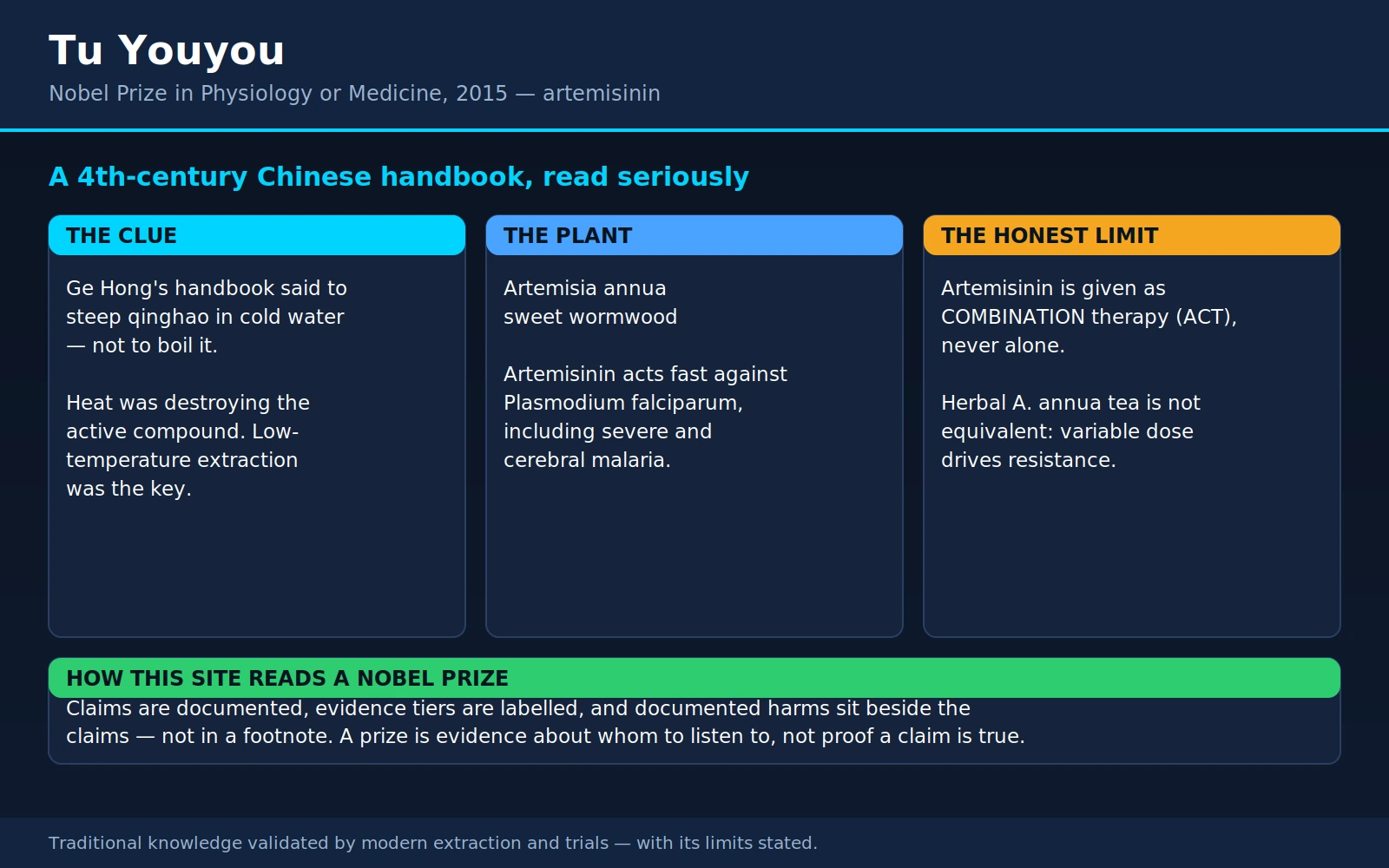
Table of Contents
- Overview
- Malaria and Project 523
- The Clue in Ge Hong's Handbook
- Sample 191
- First in Humans
- From Qinghaosu to Global Standard
- The 2015 Nobel Prize
- What This Story Proves — and What It Doesn't
- Resistance: The Story Isn't Over
- Key Research Papers
- Connections
- Featured Videos
1. Overview
Tu Youyou (屠呦呦, born 1930 in Ningbo, a port city on China's east coast) is a Chinese pharmaceutical chemist who made one of the most consequential drug discoveries of the twentieth century. Working in Beijing in the early 1970s, she isolated artemisinin — the fastest-acting class of antimalarial medicine known — from the leaves of sweet wormwood (Artemisia annua), a common roadside plant Chinese physicians had called qinghao for two millennia. And she found it by doing something almost nobody else on the project thought to do: she took a 1,600-year-old medical text seriously enough to notice what it did not say.
In 2015, Tu received the Nobel Prize in Physiology or Medicine — the first Nobel in a science category awarded to a scientist based in China for work done in China. She shared the year's prize with William C. Campbell and Satoshi Ōmura, who were honored for discovering the avermectins, the parent compounds of the antiparasitic drug ivermectin; Tu's half was awarded "for her discoveries concerning a novel therapy against malaria." Four years earlier she had received the Lasker~DeBakey Clinical Medical Research Award, often a Nobel forerunner.
Her background made her nearly unique on the project that produced the discovery. She trained as a pharmacist at Beijing Medical College, graduating in 1955, then spent her entire career at the Academy of Traditional Chinese Medicine (today's China Academy of Chinese Medical Sciences). From 1959 to 1962 she completed a full-time course in traditional Chinese medicine designed for researchers with Western scientific training — which meant that when the moment came, she could read a fourth-century prescription and run an ether extraction, and very few people on Earth could do both. Her given name, Youyou, comes from a verse in the ancient Book of Odes about deer calling youyou as they graze on wild hao — the artemisia plant — a coincidence she herself liked to point out.
This page is this site's showcase example of traditional knowledge validated by modern science — and we tell it with rigor rather than romance, because the real story is better than the legend. A classical text supplied a genuine, decisive clue. It then took systematic screening, low-temperature extraction chemistry, animal models, self-experimentation, clinical trials, crystallography, and medicinal chemistry to turn that clue into a medicine credited with saving millions of lives. Both halves of that sentence matter, and the second half is the part most retellings leave out.
2. Malaria and Project 523
Malaria is caused by Plasmodium parasites transmitted through the bite of infected mosquitoes. The parasites multiply inside red blood cells, producing waves of high fever, shaking chills, and drenching sweats; the deadliest species, Plasmodium falciparum, can progress from first fever to coma and death in days. Children under five and pregnant women bear the heaviest burden. Our Malaria section covers the disease itself in depth.
From the 1940s onward, the world's workhorse malaria drug was chloroquine — cheap, synthetic, effective. Then the parasite began to win. Chloroquine-resistant falciparum emerged in Southeast Asia and spread through the 1960s, and the Vietnam War turned that spreading resistance into a military crisis: by many accounts, malaria put more soldiers out of action in that conflict than combat did, on both sides. The United States responded with an enormous compound-screening program at the Walter Reed Army Institute of Research, which eventually produced mefloquine. North Vietnam, lacking anything comparable, asked China for help.
China's answer was Project 523 — a secret national program launched on May 23, 1967, and code-named for that date. It mobilized hundreds of researchers across dozens of institutions in the middle of the Cultural Revolution, and it ran on two parallel tracks: one screening synthetic compounds, the other combing traditional Chinese medicine for leads. In 1969, the Academy of Traditional Chinese Medicine was pulled into the project, and Tu Youyou — then in her late thirties — was appointed to lead its Project 523 research group in Beijing.
Her team began not at the lab bench but in the library and the countryside. As Tu records in her Nature Medicine memoir of the discovery, the group collected more than 2,000 traditional recipes — herbal, animal, and mineral — from classical texts, folk practitioners, and letters, and distilled 640 of them into a brochure circulated to project teams. From there, roughly 200 candidate herbs went through the grinder of actual testing: some 380 extracts, each evaluated against rodent malaria. The work was slow, most extracts did nothing, and the era exacted a personal price she spoke about plainly in later interviews: with her husband sent away to a rural labor school, she placed her young daughters with a nursery and with her parents, seeing them rarely for years.
3. The Clue in Ge Hong's Handbook
Sweet wormwood was in the screen almost from the start — qinghao appears in Chinese materia medica going back some two thousand years, recommended for intermittent fevers, the classical signature of malaria. But its early test results were maddening. As Tu later recounted, one qinghao extract at one point inhibited the rodent malaria parasite by 68 percent — a strong signal — and then the result refused to repeat. Other batches did almost nothing. A lesser scientist would have crossed the plant off the list, and for a time the project largely set it aside.
Tu went back to the texts. The decisive passage turned up in Ge Hong's Zhouhou Beiji Fang — "A Handbook of Prescriptions for Emergencies," sometimes rendered "Emergency Prescriptions Kept Up One's Sleeve" — a compact manual of treatments written in the Eastern Jin dynasty, around the fourth century CE. For intermittent fevers, Ge Hong's instruction was strikingly specific. In Tu's translation: "A handful of qinghao immersed with two liters of water, wring out the juice and drink it all."
Read casually, it is one folk remedy among hundreds. Read as a chemist, it says something remarkable: no boiling. Nearly every herbal preparation in the tradition is a decoction — the herb simmered in water, often for a long time. Ge Hong instead called for soaking the fresh herb in cold water and wringing it out. Tu's insight was that this was not a stylistic quirk but a preserved piece of hard-won practical knowledge: if the active principle were destroyed by heat, boiling would explain every failed batch and every vanished result. She also reasoned that the active material might live in the leaves rather than the stems, and that harvest season might matter — details a recipe calling for fresh, wrung juice would quietly get right.
So she redesigned the extraction around protecting a fragile molecule. Her group switched from hot water and ethanol to diethyl ether, a solvent that boils at about 35 °C — body temperature, roughly — allowing extraction at temperatures too low to cook the chemistry. They then split the ether extract into an acidic fraction, which proved inactive and toxic, and a neutral fraction, which carried the activity. That neutral ether fraction is where the modern history of malaria treatment begins.
4. Sample 191
On October 4, 1971, the 191st preparation Tu's group had tested — the neutral portion of the low-temperature ether extract of qinghao — achieved 100 percent suppression of parasitemia in mice infected with the rodent malaria parasite Plasmodium berghei. The number is documented in Tu's own memoir of the discovery in Nature Medicine, and it deserves a moment's attention: one hundred and ninety failures and partial results came first. The extract went on to show the same complete suppression in monkeys infected with Plasmodium cynomolgi. Whatever was in that fraction did not merely slow the parasite down; at adequate doses it erased it from the blood.
Through 1971 and 1972 the team worked to pull the active principle out of the extract, and in November 1972 they had it: colorless crystals of a single compound, which they named qinghaosu (青蒿素) — "the basic substance of qinghao" — known to the rest of the world as artemisinin.
The molecule turned out to be a genuine chemical surprise. Artemisinin is a sesquiterpene lactone with the formula C15H22O5, and its structure — worked out in the mid-1970s with X-ray crystallography — contains an unusual endoperoxide bridge, two oxygen atoms joined in a strained ring. Just as striking is what it lacks: a nitrogen atom. Every important antimalarial before it — quinine from cinchona bark, chloroquine and its synthetic cousins — was a nitrogen-containing alkaloid. Artemisinin belonged to no known family of antimalarial drugs, which is precisely why no compound-screening program had anything like it.
That odd peroxide bridge is the warhead. In the modern understanding, the malaria parasite lives inside red blood cells by devouring hemoglobin, and that digestion liberates iron-rich heme. Iron springs the endoperoxide open, generating reactive radicals that chemically damage the parasite's proteins where it lives. The parasite's own appetite arms the drug against it — which helps explain both artemisinin's unmatched speed and its selectivity for infected cells.
5. First in Humans
By mid-1972 the project faced a hard timing problem. Some animal tests had raised worries about possible toxicity, the results needed confirmation in humans, and the malaria season in Hainan — the tropical island province where field trials had to happen — would not wait for another year of studies. Tu's response, as she recounts in her memoir, was to volunteer: in July 1972, she and two colleagues took the qinghao extract themselves under hospital observation for a week, before any patient was asked to. They came to no harm. We present this as her own account, and it is worth being clear-eyed about it: first-in-human testing today runs through formal safety frameworks for good reasons, and self-experimentation is not a model to copy. But as a statement of conviction it still lands — she would not ask a malaria patient to swallow anything she had not swallowed first.
With safety in hand, the team went to Hainan in the autumn of 1972 and treated a first series of malaria patients — infections with both Plasmodium vivax and the deadlier Plasmodium falciparum. The results echoed the animal work: fevers subsided quickly and parasites cleared from the blood. Trials expanded in the years that followed, through the isolation of pure crystalline artemisinin and beyond, involving thousands of patients across China before the wider world had heard so much as the compound's name.
Secrecy, in fact, shaped the whole first decade. Project 523 was a classified military program, and China first published the discovery collectively and anonymously in 1977, credited to a "coordinating research group" rather than to any individual. It was not until Daniel Klayman's 1985 review in Science — "Qinghaosu (artemisinin): an antimalarial drug from China" — that Western readers got a full scientific account of what had been accomplished.
6. From Qinghaosu to Global Standard
Pure artemisinin had real limitations: it dissolves poorly in both water and oil, and it leaves the body quickly. Tu's group answered the first problem chemically, reducing artemisinin to dihydroartemisinin (DHA) — more potent than the parent compound and, just as importantly, a chemical handle for building better versions. From DHA, Project 523 chemists developed the derivatives the world now uses: artesunate, water-soluble and injectable, and artemether, oil-soluble — drugs that could be formulated for tablets, injections, and children's suppositories.
The short half-life posed a subtler problem. Artemisinin kills parasites faster than any other antimalarial, but it is gone from the bloodstream within hours, and a few stragglers can survive a short course and rebound — a relapse pattern called recrudescence. The solution became a principle: never use artemisinin alone. Pairing a fast, short-lived artemisinin derivative with a slower, long-lasting partner drug lets the artemisinin demolish the parasite population while the partner mops up survivors over the following weeks. These pairings are the artemisinin-based combination therapies (ACTs) — artemether-lumefantrine, artesunate-amodiaquine, dihydroartemisinin-piperaquine, and others.
ACTs became the World Health Organization's recommended first-line treatment for uncomplicated falciparum malaria worldwide in the 2000s, and injectable artesunate became the standard of care for severe malaria after large trials showed it saved more lives than quinine, the drug that had held that job for three centuries. A medicine that began as a cold-soaked handful of herbs in a fourth-century field manual is now the backbone of malaria treatment on every continent where the disease exists.
The human arithmetic can be stated honestly without invented precision. Malaria still kills on the order of half a million people a year, most of them African children — but global malaria deaths fell dramatically after ACTs scaled up in the 2000s alongside insecticide-treated bed nets and rapid diagnostic tests, and over the program's lifetime artemisinin-based treatment is credited with saving millions of lives. No other discovery from a traditional pharmacopeia in the modern era comes close to that footprint.
7. The 2015 Nobel Prize
In October 2015 the Karolinska Institute's Nobel Assembly split the Prize in Physiology or Medicine down a satisfying seam: one half jointly to William C. Campbell and Satoshi Ōmura for discovering the avermectins — soil-bacterium compounds whose derivative ivermectin transformed the fight against river blindness and lymphatic filariasis — and the other half to Tu Youyou for artemisinin. The committee's framing was that parasitic diseases had plagued humanity for millennia and these therapies "revolutionized" their treatment. The official summary is worth reading: nobelprize.org — 2015 Prize in Physiology or Medicine. (Ivermectin has since acquired a second, noisier life in alternative-health circles for uses far from river blindness; our Parasites section reviews what the evidence actually shows.)
In China, Tu was famous for what the press called her "three no's": no doctorate, no study abroad, no academician title — she had been passed over for membership in the Chinese academies despite her discovery. We present that as it was widely reported, because it captures something real about the award: the Nobel went to a career scientist without a single one of the credentials usually treated as prerequisites, for work done under a collective system that had published her breakthrough anonymously.
The collective nature of Project 523 also produced a genuine debate about credit — hundreds of scientists contributed, and some colleagues argued the honor belonged to the program rather than a person. The Lasker jury and later the Nobel committee looked at the documented record and concluded that three specific, personal contributions were decisive: Tu brought qinghao and the low-temperature insight from the classical literature into the project, her group produced the first fully active extract, and she obtained the pure crystals and stepped forward for the first human dosing. Malaria researchers Louis Miller and Xin-zhuan Su, whose investigation of the discovery's history helped bring her role to Western attention, laid out that case in Cell in 2011.
Tu was in her mid-eighties when the prize came, still working. Her Nobel lecture's title said exactly what she wanted the award to mean: "Artemisinin — A Gift from Traditional Chinese Medicine to the World."
8. What This Story Proves — and What It Doesn't
This site exists in large part because of stories like this one, so let us be precise about what it demonstrates. Traditional pharmacopeias can contain real pharmacology. Ge Hong's fourth-century recipe encoded three true facts the twentieth century had to rediscover: the right plant, the right indication, and — hidden in the preparation method — the right constraint, heat sensitivity. That is not folklore getting lucky; it is empirical knowledge, accumulated and transmitted without a theory to explain it. Artemisinin joins a short, distinguished lineage: quinine from cinchona bark, digitalis from the foxglove, aspirin's ancestry in willow-bark salicylates. Plants are chemists, and traditions that used them for centuries sometimes knew things worth taking seriously. That is the site's core interest, and Tu Youyou is its strongest documented case.
Now the other half, which the romantic retellings omit. The text alone cured no one. Of the more than 2,000 traditional recipes Tu's team collected, essentially one became a modern medicine — and even that one required 190 failed preparations before sample 191, then ether chemistry, fraction separation, mouse and monkey models, human trials, X-ray crystallography, semi-synthetic derivatives, industrial manufacturing, and combination-therapy design before it could save lives at scale. Traditional knowledge supplied the clue; modern science supplied the proof, the purity, the dose, and the delivery. Neither alone produced artemisinin. Anyone who cites Tu Youyou to argue that ancient texts should be trusted instead of clinical evidence has the story exactly backwards — she is the person who refused to leave the text untested.
And that distinction is a safety matter, so we will say it plainly. Drinking wormwood or sweet wormwood tea is not a treatment for malaria. The artemisinin content of plant material and teas is low and wildly variable, absorption is poor, and sub-therapeutic dosing both fails the patient and helps breed resistant parasites — which is why the World Health Organization specifically recommends against using non-pharmaceutical Artemisia preparations, teas included, for malaria treatment or prevention. Artemisinin "supplements" sold online are not a substitute for diagnosed, prescribed therapy. Malaria can kill a healthy adult in days; a fever during or after travel in a malaria region is a same-day medical problem — get a blood test, and if malaria is confirmed, take the full prescribed ACT course. Our Malaria pages cover diagnosis and treatment in detail.
One botanical footnote, because the names invite confusion: sweet wormwood (Artemisia annua) and common wormwood (Artemisia absinthium) are different species. The bitter European wormwood of absinthe and digestive tradition is not a source of artemisinin; the two herbs have separate pages here for a reason.
9. Resistance: The Story Isn't Over
In his 1945 Nobel lecture, Alexander Fleming warned that careless, under-dosed use of penicillin would teach microbes to resist it. He was right about antibiotics, and his warning transfers to antimalarials almost word for word — because the parasite, like the bacterium, is a moving target under enormous evolutionary pressure.
It is already happening. Artemisinin partial resistance — parasites that survive the drug's initial onslaught longer, clearing from the blood more slowly — was confirmed in western Cambodia in the late 2000s and has since spread through the Greater Mekong Subregion. In 2014, researchers identified its molecular signature: mutations in the parasite's kelch13 propeller-domain gene, which turned scattered clinical reports into something that could be tracked in a drop of blood. More worrying still, kelch13-mutant parasites have now emerged independently in Africa — documented in Rwanda, with further reports from Uganda and the Horn of Africa — the continent that can least afford to lose the drug. The research front moves quickly; see the live literature at artemisinin resistance kelch13.
"Partial" is doing important work in that sentence. Artemisinin still kills these parasites — more slowly — and ACTs still cure most patients, because the partner drug finishes what the artemisinin starts. The nightmare scenario is stacked resistance: when parasites resist the partner drug too, as happened with dihydroartemisinin-piperaquine in parts of Southeast Asia, cure rates collapse. That is why the combination principle is not a technicality but the load-bearing wall of global malaria treatment.
Protecting the drug is therefore a shared discipline: combination therapy only, with the WHO having pushed oral artemisinin monotherapy off the market; full treatment courses, never half; quality-assured medicines, because counterfeit and substandard pills deliver exactly the weak exposure that selects resistant parasites; and surveillance to catch kelch13 mutations early. The herbal-tea habit belongs on this list too — every low-dose exposure from home-brewed Artemisia is a small training session for the parasite. Ge Hong's handbook gave humanity a gift that took 1,600 years to unwrap; whether it still works in another fifty depends on how carefully it is used now. Fleming would have recognized the situation immediately.
10. Key Research Papers
- Tu Y. The discovery of artemisinin (qinghaosu) and gifts from Chinese medicine. Nat Med 2011;17(10):1217-20
- Klayman DL. Qinghaosu (artemisinin): an antimalarial drug from China. Science 1985;228(4703):1049-55
- Miller LH, Su X. Artemisinin: discovery from the Chinese herbal garden. Cell 2011;146(6):855-8
- Tu Y. Artemisinin — A Gift from Traditional Chinese Medicine to the World (Nobel Lecture). Angew Chem Int Ed Engl 2016;55(35):10210-26
- Dondorp AM, Nosten F, Yi P, et al. Artemisinin resistance in Plasmodium falciparum malaria. N Engl J Med 2009;361(5):455-67
- Ariey F, Witkowski B, Amaratunga C, et al. A molecular marker of artemisinin-resistant Plasmodium falciparum malaria. Nature 2014;505(7481):50-5
- Uwimana A, Legrand E, Stokes BH, et al. Emergence and clonal expansion of in vitro artemisinin-resistant Plasmodium falciparum kelch13 R561H mutant parasites in Rwanda. Nat Med 2020;26(10):1602-1608
Live PubMed Searches
- Artemisinin discovery
- Artemisinin combination therapy
- Artemisia annua antimalarial
- Artemisinin resistance kelch13
- Artesunate for severe malaria
Connections
- All Notable Doctors
- Sweet Wormwood (Artemisia annua) — the plant artemisinin comes from: botany, traditional use, and the modern evidence
- Wormwood (Artemisia absinthium) — the related bitter herb: a distinct species, and not a source of artemisinin
- Parasites & Antiparasitic Remedies — including our honest review of ivermectin, the other half of the 2015 Nobel
- All Herbs
- Alexander Fleming — penicillin, and the resistance warning this page echoes
- Linus Pauling — vitamin C, orthomolecular medicine, and a very different Nobel story
- Satoshi Ômura — her 2015 co-laureate; ivermectin from a golf-course soil sample
- William Campbell — her 2015 co-laureate; the drug hunter who made ivermectin a medicine
- Covered in depth on its own page: Malaria