Svante Pääbo: Ancient DNA, Neanderthals, and the Genes You Inherited From Them
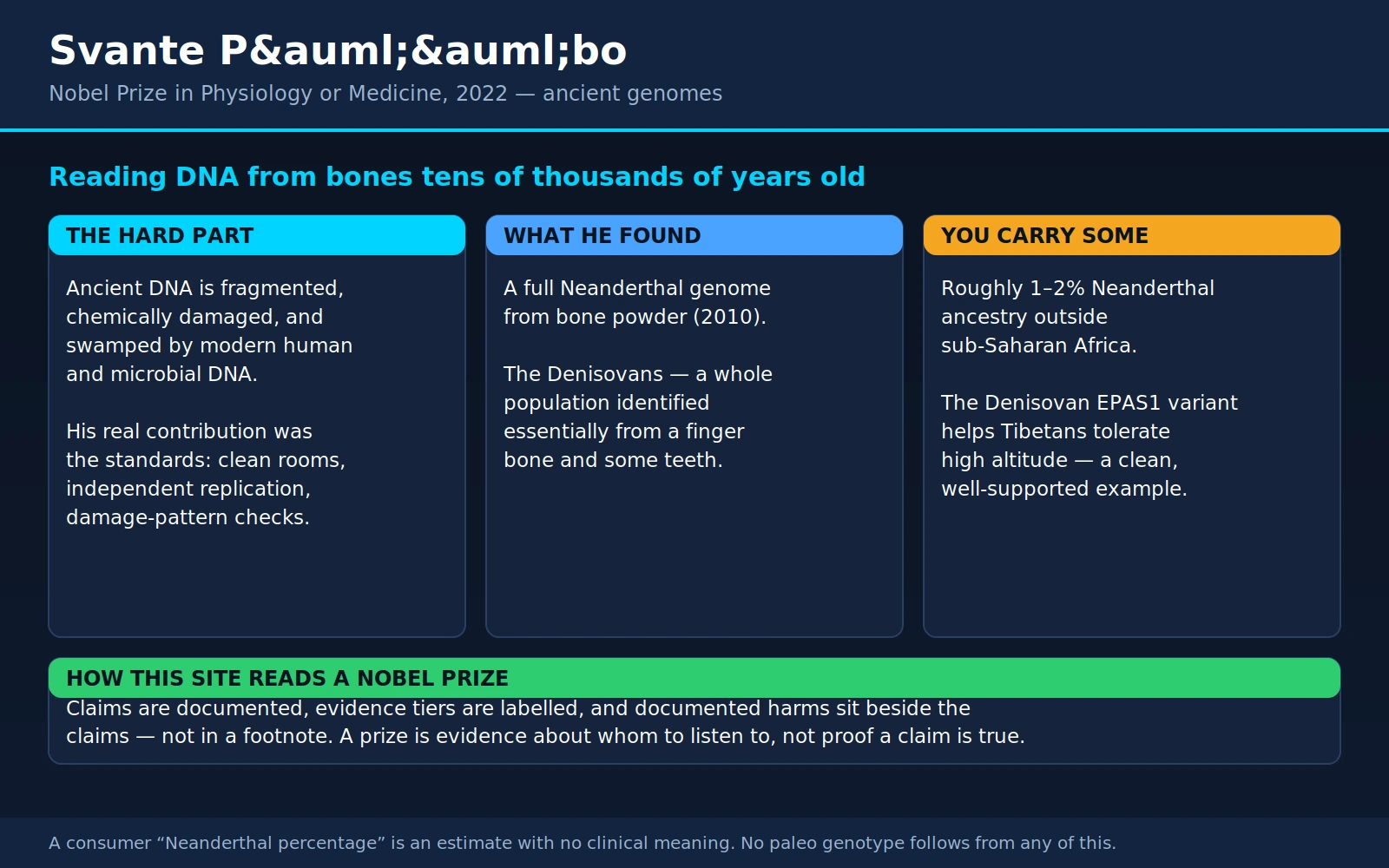
Table of Contents
- The Prize and the Man
- Why Ancient DNA Was Thought Impossible
- The Mitochondrial Breakthrough, 1997
- The Neanderthal Genome, 2010
- Denisovans: A People Found in a Genome
- What Those Genes Actually Do
- What This Does Not Mean
- Ancient DNA Beyond Hominins
- What It Means for How You Think About Health
- Where Science Agrees — and What Remains Debated
- Key Research Papers
- Connections
- Featured Videos
1. The Prize and the Man
In October 2022 the Nobel Assembly at the Karolinska Institute awarded the Nobel Prize in Physiology or Medicine to a single person: Svante Pääbo, "for his discoveries concerning the genomes of extinct hominins and human evolution." It was unusual in several ways. It went to one laureate rather than the customary two or three. It honored a field — paleogenomics — that had not existed before he essentially invented it. And it was awarded in Physiology or Medicine for work most people would file under archaeology, which tells you how thoroughly the boundary between the two has dissolved.
Pääbo was born in Stockholm on 20 April 1955 and raised by his mother, Karin Pääbo, an Estonian-born chemist who had come to Sweden as a wartime refugee. His father, Sune Bergström, was a biochemist who in 1982 shared the Nobel Prize in Physiology or Medicine with Bengt Samuelsson and John Vane for work on prostaglandins — the lipid signaling molecules that turned out to be the target of aspirin and the whole NSAID class. Bergström had a separate family, and Pääbo grew up largely apart from him; he has discussed this publicly and in his memoir, so it is part of the record rather than gossip. The result is one of a small handful of father-and-son Nobel pairs in the sciences — and a poetic one, since the father's prize explained a molecule inside living human cells and the son's read molecules out of bones forty thousand years in the ground.
The story of how he got there begins with a teenage obsession. A trip to Egypt with his mother at thirteen made him want to be an Egyptologist; he enrolled in Egyptology at Uppsala University, found the discipline drier than the romance had promised, and switched to medicine and then molecular biology. But the two interests refused to stay separate. As a doctoral student working officially on how an adenovirus protein interferes with the immune system's MHC molecules, he began — in his own account — quietly running experiments at night and on weekends that his supervisor did not know about: he had gotten hold of samples of Egyptian mummy tissue and was trying to extract DNA from them.
He was fairly sure the request would not have been approved. Extracting DNA from a corpse thousands of years old was, in 1981, not a research program but a daydream. It worked well enough to publish: in 1985 he reported in Nature that he had cloned DNA from an Egyptian mummy — Molecular cloning of Ancient Egyptian mummy DNA — and the paper made him briefly famous. It also, as he has said with characteristic bluntness since, was probably mostly his own DNA. That result and its correction are not a footnote to his career; they are the origin of the discipline he built, because the central problem of ancient DNA turned out not to be finding a signal but proving that the signal was not you.
The paper got him a postdoctoral position in Berkeley with Allan Wilson, whose lab was then the epicenter of molecular evolution. Pääbo went on to a professorship in Munich in 1990, and in 1997 became a founding director of the Max Planck Institute for Evolutionary Anthropology in Leipzig — an institute deliberately built to put geneticists, primatologists, linguists and archaeologists in one building, and the place where nearly everything described on this page was done. His 2014 memoir, Neanderthal Man: In Search of Lost Genomes, is the readable first-person account of the whole arc, including the failures. What follows is the science.
2. Why Ancient DNA Was Thought Impossible
To appreciate what Pääbo did, you have to appreciate how bad the raw material is. DNA is a molecule, and molecules fall apart. Three problems compound:
First, fragmentation. The moment an organism dies its enzymes begin cutting its DNA, and then chemistry takes over: water attacks the backbone, purine bases fall off, gaps snap. A living cell holds chromosomes tens of millions of base pairs long; DNA from a 40,000-year-old bone survives in pieces of about 30 to 70 base pairs — confetti, not text.
Second, the surviving bases are chemically damaged. The key change is deamination: cytosine loses an amino group and behaves like uracil, so a sequencer reads it as a T. Because the damage concentrates in single-stranded overhangs at fragment ends, ancient molecules carry a characteristic excess of C→T changes at their ends. Uncorrected, that manufactures fake mutations and makes a sample look artificially distant from living relatives.
Third — the killer — is contamination. A gram of ancient bone is mostly not the individual's DNA but bacterial and fungal DNA from organisms that colonized the remains: often more than 95% of what you recover, in poor samples more than 99%. Worse, that tiny endogenous fraction sits in a laboratory swimming in DNA of the very species you are studying. Every archaeologist, curator and technician who handled the bone, every skin flake shed over a bench, left behind modern human DNA that is long, intact, and vastly easier to amplify than the ancient fragments. PCR is exquisitely good at finding a rare template — which means it is exquisitely good at finding your fingertip.
Put those together and you get the reason the early years of ancient DNA were a bonfire of spectacular, irreproducible claims: a 17-million-year-old magnolia leaf in 1990, insects in amber tens of millions of years old just as Jurassic Park made the idea a cultural event, and in 1994 dinosaur DNA from Cretaceous bone, in Science. Each was electrifying. None replicated. The dinosaur sequence, on reanalysis, most closely resembled a piece of the human mitochondrial genome. The field had built a machine for detecting contamination and mistaken it for a time machine.
Pääbo's most important early contribution — arguably more important than any single genome — was to insist this had to stop, and to work out the standards that stopped it. What he and his collaborators established, and the field now takes for granted:
- Physically isolated clean rooms — positive air pressure, HEPA filtration, UV sterilization, body suits, and a one-way workflow: nobody who has been where modern DNA is amplified enters the ancient lab that day.
- Extraction blanks and negative controls at every step, so reagent contamination announces itself, and independent replication in a second laboratory from a separate piece of the same specimen before a result is believed.
- Authentication from damage patterns. This is the elegant one. Genuinely ancient molecules must show the expected signature — short fragments and elevated C→T deamination at the ends. Modern contaminating DNA does not. The damage that ruins the data also proves the data is old, and pipelines now score every fragment for it.
- Enzymatic damage repair and single-stranded library preparation. Uracil-DNA-glycosylase removes deaminated bases; a library method that captures single strands rather than requiring both recovers far more of the shattered molecules. These two advances, developed in Pääbo's group, turned the Denisovan finger bone from a curiosity into a genome sequenced better than most living people's.
- Direct estimation of contamination from the data itself, plus shotgun sequencing of the whole extract instead of PCR of chosen fragments — which removed the temptation to fish for the sequence you expect and get it.
This is not glamorous work. It is the reason the results are believed. When someone asks why ancient DNA claims from the 1990s collapsed and the ones from the 2010s did not, the answer is essentially this list.
3. The Mitochondrial Breakthrough, 1997
By the mid-1990s, Pääbo's group in Munich decided to attempt the sample that mattered most: the original Neanderthal type specimen, found in 1856 in a limestone quarry in the Neander Valley near Düsseldorf — the fossil that gave the species its name. It had been handled by generations of scientists, sat in a museum for 140 years, and was, from a contamination standpoint, close to a worst case.
They received a small piece of the right humerus. The strategy was deliberately modest: not the nuclear genome, which was unthinkable, but mitochondrial DNA. Mitochondria carry their own small circular genome, present in hundreds to thousands of copies per cell against two copies of each nuclear chromosome. If any DNA survived, that is where it would be. They targeted the fast-evolving hypervariable control region, amplified it in short overlapping pieces, and — crucially — had the result independently replicated at Mark Stoneking's laboratory before publishing.
The paper appeared in Cell in July 1997: Krings and colleagues, "Neandertal DNA sequences and the origin of modern humans." The sequence was recognizably human-like and unmistakably not modern human. Against the control regions of hundreds of living people it differed at roughly 27 positions on average, where two living humans picked at random differ at about 8. On a tree it fell cleanly outside the entire range of modern human variation, joining below the root that all living human mtDNA shares — with the two mitochondrial lineages diverging on the order of half a million years ago, long before anatomically modern humans appear in the fossil record.
It was the first genetic data ever obtained from an extinct human relative, and the field read it as an answer to a long-running argument between multiregional evolution — modern humans emerging gradually across Africa, Europe and Asia from local archaic populations — and recent African origin, in which modern humans arose in Africa and replaced the archaic populations they met. A Neanderthal lineage sitting entirely outside modern variation looked like strong support for replacement, and it was widely reported as showing that Neanderthals had contributed nothing to us.
That reading was reasonable at the time and turned out to be wrong in an important way. Mitochondrial DNA is a single locus, inherited only down the maternal line, recording one thread of ancestry out of an enormous tapestry. A population can absorb substantial gene flow and show no trace of it in mtDNA — because the incoming lineages died out, because the flow ran mostly the other way, or by chance. What Krings et al. proved beyond doubt was that Neanderthal mtDNA was distinct and that no living person carries a Neanderthal mitochondrial lineage. Both are still true. The inference that there had therefore been no interbreeding was an overreach — and the person who overturned it was Pääbo.
4. The Neanderthal Genome, 2010
Mitochondrial DNA is roughly 16,500 base pairs. The nuclear genome is about 3.2 billion, present in two copies per cell rather than thousands, and it is where essentially all the biology lives. Getting it out of a fossil required a technology that arrived in the mid-2000s: high-throughput sequencing, machines reading hundreds of millions of short fragments at once. Short fragments were precisely the problem with ancient DNA; suddenly they were the format the machines preferred.
The project ran on bone powder from three specimens from Vindija Cave in Croatia, around 38,000 to 44,000 years old, chosen after screening dozens of fossils for the rare ones with tolerable endogenous DNA content — and even in the best, most recovered sequence was microbial. The group ground through an estimated four hundred milligrams of bone to produce a genome covered about 1.3 times over: thin, but genome-wide. In May 2010, Science published "A draft sequence of the Neandertal genome" by Green, Pääbo and 54 co-authors, and it rewrote the textbooks.
The test was clean in design. If Neanderthals had contributed nothing to modern humans, the Neanderthal genome should be equally distant from every living population. It was not. It was consistently and significantly closer to Europeans and East Asians than to sub-Saharan Africans, and the asymmetry was too large and systematic to be explained by ancient African population structure alone. The straightforward explanation was the one the 1997 paper had seemed to rule out: modern humans and Neanderthals interbred, and the offspring left descendants.
The estimate: people whose ancestry lies outside sub-Saharan Africa carry approximately 1–2% Neanderthal DNA — an approximate figure that refinements since 2010 have nudged around within roughly that band, with East Asian populations tending modestly higher than European ones. The interbreeding is thought to have happened mainly in the Middle East, roughly 50,000 to 60,000 years ago, shortly after the ancestors of today's non-African populations left Africa and before they dispersed across Eurasia, which is why the signal appears in all of them at similar levels. Later work also found a small amount of Neanderthal sequence in African populations — a few tenths of a percent, mostly explained by back-migration carrying it there.
A second point matters for everything that follows. Any given non-African carries only about 1–2% Neanderthal sequence, but different people carry different 1–2%. Summed across many individuals, a substantial fraction of the Neanderthal genome — roughly a fifth to a third, by various estimates — still survives, scattered through the living population. Neanderthals are not gone. They are distributed.
Better genomes followed. In 2014 the group published a high-quality genome from a Neanderthal toe bone from Denisova Cave, sequenced to 50-fold coverage — better than most modern human genomes. It showed that this individual's parents had been close relatives, and that small, inbred, isolated populations may have been the Neanderthal norm. That genome is what made fine-grained questions about which segments introgressed, and what they do, answerable at all.
5. Denisovans: A People Found in a Genome
The next discovery has no real precedent in paleoanthropology, because a human group was identified from its DNA before anyone knew it existed from its bones.
In 2008, Russian archaeologists excavating Denisova Cave in the Altai Mountains of southern Siberia recovered an unremarkable fragment of a juvenile finger bone, the size of a corn kernel. Sent to Leipzig, it turned out to have exceptional DNA preservation, and its mitochondrial genome, published in 2010, was a shock: it fell outside both modern humans and Neanderthals, roughly twice as far from us as Neanderthal mtDNA is.
Later that year, Reich, Pääbo and colleagues published the nuclear genome in Nature — "Genetic history of an archaic hominin group from Denisova Cave in Siberia" — and in 2012 Meyer and colleagues reported an extraordinary high-coverage sequence from that same finger bone in Science, made possible by the single-stranded library method. The individual was a girl, and her genome was sequenced to a quality comparable with a present-day person's.
It showed that Denisovans were a sister group to Neanderthals: the two lineages split several hundred thousand years ago, after their common ancestor had already separated from the line leading to modern humans, with Denisovans occupying Asia while Neanderthals occupied western Eurasia. Their physical remains are still almost nonexistent — the finger bone, a few distinctly large teeth, scraps of skull, plus a Tibetan Plateau mandible identified by ancient protein rather than DNA. We know their biology far better than their anatomy, which is a strange situation and a good illustration of how much the method changed the field.
And they too interbred with us. Unlike Neanderthal ancestry, Denisovan ancestry is very unevenly distributed across living populations:
- Papuans, Aboriginal Australians and Melanesian populations carry the highest share — commonly estimated at roughly 3–5%, some analyses higher. All such figures are approximate and method-dependent.
- Parts of island Southeast Asia and the Philippines carry intermediate amounts, with some Philippine Negrito groups reported at the high end.
- Mainland East Asians and South Asians carry a small but real fraction, on the order of a few tenths of a percent; Europeans and West Asians carry very little.
That geography implies mixing somewhere in Asia along the route toward New Guinea and Australia, probably more than once with more than one Denisovan population. The cave also produced the most vivid specimen in the field: a bone fragment from a girl, nicknamed "Denny," whose 2018 genome showed a Neanderthal mother and a Denisovan father — a first-generation hybrid of two extinct human groups. Denisova Cave was occupied at different times by Denisovans, Neanderthals and modern humans, which may make it the most consequential single archaeological site on Earth.
6. What Those Genes Actually Do
This is where a health site has to be careful: the science is genuinely medical here, and the popular coverage goes furthest off the rails. The honest picture has tiers, and we label them.
Tier 1: well-established and mechanistically understood
The cleanest example in the field is EPAS1 and high-altitude adaptation in Tibetans. Above about 4,000 meters, where oxygen is roughly 40% scarcer than at sea level, most human bodies respond by making more red blood cells — which thickens the blood, raises pulmonary artery pressure, and over a lifetime causes real harm, including chronic mountain sickness and poor pregnancy outcomes. Tibetans do not respond that way. They live at extreme altitude with hemoglobin close to lowland values, and do considerably better for it.
In 2014, Huerta-Sánchez and colleagues reported in Nature that the responsible variant — a haplotype in EPAS1, which encodes the transcription factor HIF-2α — carries an unmistakable Denisovan signature. The stretch matches the Denisovan genome far more closely than chance allows, is nearly absent elsewhere in the world, and sits at very high frequency in Tibetans: a piece of Denisovan DNA that entered the modern human gene pool, sat at low frequency, then rose rapidly once a population moved onto the Tibetan Plateau, because it worked.
What it does connects directly to another Nobel Prize on this site. HIF-2α is one of the hypoxia-inducible factors — the oxygen-sensing machinery whose discovery earned Kaelin, Ratcliffe and Semenza the 2019 prize. The Tibetan variant appears to dampen the hypoxia response so it does not over-produce red cells. Two Nobel Prizes, three years apart, describing the same molecule from opposite ends.
Tier 2: solid and replicated, mechanism partly understood
Beyond EPAS1, archaic variants turn up disproportionately in a few functional categories — itself informative, since it suggests what mattered when modern humans moved into new environments:
- Immunity and pathogen response. Archaic haplotypes are enriched in immune gene clusters, notably a set of Toll-like receptor genes (TLR1/TLR6/TLR10) shaping innate responses to bacteria and fungi (Dannemann 2016); the HLA region and several antiviral families also carry archaic segments. Populations already in Eurasia had been meeting Eurasian pathogens for hundreds of thousands of years, so inheriting their immune alleles was a shortcut.
- Skin, hair and keratin biology. Genes for keratin production and skin barrier function carry archaic variants at appreciable frequency, plausibly related to higher latitudes with less ultraviolet light.
- Metabolism, fat storage and cold response. Several introgressed regions sit near lipid-metabolism and thermogenesis genes; effects are small and interpretations more tentative than for immunity.
- Miscellaneous phenotypes. Large biobank studies, notably Dannemann and Kelso's UK Biobank work, associate archaic variants with skin tone, hair color, chronotype (a tilt toward being a morning person), and mood-related measures. Individual effects are small — contributions to variation, not switches.
Tier 3: real findings that are routinely overstated — the COVID-19 haplotypes
In 2020, Pääbo and Hugo Zeberg reported in Nature that the strongest genetic risk factor then known for severe COVID-19 — a cluster of variants on chromosome 3 found by genome-wide association studies of hospitalized patients — is a haplotype about 50,000 base pairs long inherited from Neanderthals. It is carried by a substantial minority of people in South Asia, a smaller fraction in Europe, and is essentially absent in East Asia and Africa. The following year the same authors reported in PNAS that a protective region is likewise archaic: a Neanderthal-derived haplotype on chromosome 12 spanning the OAS gene cluster — enzymes that activate an antiviral pathway degrading viral RNA — associated with lower risk of severe disease, and common across much of Eurasia.
Both findings are real and both were published in first-rank journals. Now the caveats, which are not optional:
- These are associations in populations, not predictions about you. The chromosome 3 haplotype carried meaningfully higher odds of severe illness in the studied cohorts, chromosome 12 modestly lower odds. Neither is remotely deterministic; age, obesity, diabetes, immune status and vaccination all mattered more.
- Most carriers of the risk haplotype did not get severely ill, and most people who got severely ill did not carry it. That sentence is the whole of what "association" means, and it is the sentence the headlines dropped.
- The causal gene within the chromosome 3 region is still not settled — the haplotype covers several genes.
- Nobody should be tested for these, and no test will change your care. No clinical action follows from knowing your status, which is why no medical body recommends checking it. And carrying both a "risk" and a "protective" archaic segment is common — they sit on different chromosomes. Archaic ancestry is not a score.
The interesting point is not "Neanderthals gave you COVID risk." It is that an allele possibly useful against some ancient pathogen was still in the human gene pool 50,000 years later when a completely different virus arrived and made it a liability. That is instructive about how evolution works, and more interesting than the headline version.
7. What This Does Not Mean
This site covers a lot of territory where products get sold on the back of real science, and archaic ancestry is one of the most heavily marketed. So this section is deliberate, and we would rather be plain than politely vague.
Your consumer "Neanderthal percentage" is an estimate, and it has no clinical meaning
Direct-to-consumer tests report a Neanderthal figure, sometimes as a percentage and sometimes as a count of variants, often with a cheerful comparison to other customers. Behind that number is a statistical inference: your genotypes are compared against a reference archaic genome and a modern panel, and software estimates how much of your DNA plausibly came from an archaic source. It is a reasonable estimate — not a measurement. It carries real uncertainty, different companies using different panels and algorithms give different numbers, and the same company revises your number when it updates its pipeline.
More to the point: there is nothing you should do about it. No dietary change, supplement, exercise plan, screening test or medication is indicated by a Neanderthal percentage. It is a genuinely fun fact about deep ancestry — interesting, true enough, and clinically inert.
There is no "Neanderthal diet" and no "paleo genotype"
You will find products and programs built on the claim that your archaic ancestry, or your "ancestral genotype," dictates a particular way of eating — more meat, fewer grains, a specific macronutrient split, a supplement stack. No such thing follows from this research, and the science points the other way:
- The archaic segments in living people are thousands of small fragments, most non-coding, most with no known function, and none constitute a coherent "metabolic type." There is no gene set that reads out as a menu.
- Nobody carries a Paleolithic genome. Every living human descends from populations under intense selection for the last 10,000 years, and some of our best-documented adaptations are post-agricultural: lactase persistence, which arose independently more than once and is recent; expanded salivary amylase copy number associated with starch-rich diets; alcohol dehydrogenase variants; malaria-resistance alleles. A diet premised on your genome being frozen before farming is premised on something untrue.
- The archaic variants with the clearest metabolic associations have small effects and map onto no commercial dietary category.
- Whole-food, minimally processed eating is well supported for reasons that have nothing to do with Neanderthals. If a way of eating works for you, it does not need an evolutionary origin story, and the story does not make it more true.
Ancient ancestry says nothing about the worth of living people
This research gets misappropriated, reliably and predictably, and the population genetics is worth stating clearly because the facts are on the right side.
Since the earliest surveys of human genetic variation in the 1970s, confirmed repeatedly with far better data since, the central finding has been the same: the great majority of human genetic variation — roughly 85 to 90 percent of it — is found within any given human population, not between populations. Two people from the same village differ at nearly as many places as two people from opposite sides of the world. Human groups are genetically shallow and heavily overlapping; the species passed through small populations recently enough that we are, by the standards of most large mammals, remarkably uniform.
Archaic ancestry does not change that arithmetic and does not sort onto social categories — a one-to-two-percent difference in archaic content sits inside a species where the overwhelming majority of variation is individual. And the direction of the finding is worth noticing: the discovery of interbreeding replaced a clean story of replacement with a messier one in which human groups met, mixed, and had children together, repeatedly and on multiple continents. If there is a lesson in the data about human groups, that is it — and it is the part of the story the site owes you alongside the fascinating part, because the fascinating part travels much faster on its own.
8. Ancient DNA Beyond Hominins
The methods Pääbo's group developed to read Neanderthals turned out to be general-purpose, and the field they seeded now reaches well past human evolution. Several branches touch health directly.
Tracing historical epidemics
Pathogen DNA survives in the teeth of people it killed. The dental pulp chamber is a sealed reservoir of blood-borne material, so someone who died in the bacteremic phase of an infection can still hold the organism's genome in their molars centuries later. This turned the history of epidemic disease from a discipline of ambiguous written descriptions into one with molecular evidence.
Yersinia pestis, the plague bacterium, is the flagship case. Ancient genomes have been recovered from victims of the Black Death of the 1340s, the sixth-century Justinianic Plague, and — most surprisingly — Bronze Age Eurasians who died around 5,000 years ago, millennia before the first plague epidemic recorded in writing. Rasmussen and colleagues reported those early strains in Cell in 2015 and found something elegant: they lacked the ymt gene that lets the bacterium survive in a flea's gut. Plague existed long before bubonic plague did; the capacity for flea-borne transmission — the thing that made it a mass killer — was acquired later, and ancient DNA dated the acquisition. Comparable work exists for tuberculosis, leprosy, smallpox and the 1918 influenza virus. The link to Robert Koch is direct: Koch identified the organisms; paleogenomics reconstructs their genealogies.
Reconstructing past migrations
Ancient genomes from hundreds of archaeological individuals have rewritten European and Asian prehistory. Europe now resolves into at least three layers: Paleolithic and Mesolithic hunter-gatherers, Neolithic farmers spreading from Anatolia around 8,000 years ago, and a large steppe migration in the Bronze Age. The health-relevant part is that alleles now common — lactase persistence among them — can be watched rising in frequency across time, turning "this variant was selected" from an inference into an observation.
Sedimentary DNA: hominins without bones
In 2017, Slon and colleagues showed in Science that DNA from Neanderthals and Denisovans can be recovered directly from cave sediment containing no visible bone at all — mammalian DNA binds to mineral particles and persists in the dirt. The implication is enormous: most archaeological sites have layers full of stone tools and no human remains, and those sites can now be asked who was here. The method has since found Denisovans on the Tibetan Plateau and tracked which hominin occupied a cave through successive layers.
How old can DNA get — and the de-extinction question
The early field's embarrassments involved DNA claimed to be millions of years old. The record has since been pushed back legitimately: mammoth teeth from Siberian permafrost sequenced at over a million years, environmental DNA from Greenland sediments reported at around two million. What makes these credible and the amber-insect claims not is exactly the authentication framework in section 2 — damage signatures, fragment lengths, replication, and preservation conditions that make survival chemically plausible.
Which brings us to de-extinction, where an honest note is due. Headlines periodically announce the imminent return of the mammoth, the thylacine, or in wilder versions the Neanderthal. What ancient DNA gives you is a read, assembled computationally from billions of fragments against a living relative's reference — not an intact chromosome, a viable cell, or a nucleus. Current proposals amount to editing identified variants into a living relative's genome, producing an animal with some of the traits, not a resurrection. On the human version, Pääbo himself has been firmly opposed on ethical grounds, which is the right place to leave it.
9. What It Means for How You Think About Health
The human genome is a palimpsest — a manuscript written over repeatedly, earlier text still faintly legible underneath. It carries variants that arose in African environments hundreds of thousands of years ago, variants borrowed from Neanderthals and Denisovans who had been adapting to Eurasia far longer than we had, variants selected during the Neolithic when we started farming beside livestock, and variants from the last few thousand years responding to local pathogens. None were designed. Each was retained because it helped, or at least did not hurt, in the environment where it was retained.
The environment then changed faster than the genome could. This is the core of what is called evolutionary mismatch, and Pääbo's work supplies the cleanest documented examples of the mechanism. There is a defensible version of the idea and a marketing version, and they are worth separating.
The defensible version makes specific, testable claims about specific variants:
- A Neanderthal-derived immune allele that presumably helped against ancient Eurasian pathogens is associated with higher risk of severe illness from a virus that appeared in 2019. The allele did not change; the pathogen environment did.
- Variants promoting efficient energy storage were advantageous under seasonal famine and are a liability under year-round abundance — supported in outline, while noting that the strong "thrifty gene" hypothesis in its original single-gene form has not held up well.
- Immune variants tuned for a high pathogen and parasite load may contribute to allergic and autoimmune disease in a low-exposure world — the careful version of the hygiene hypothesis.
- Tibetan EPAS1 is mismatch running in reverse, and the cleanest case of all: a variant neutral at sea level and decisively advantageous at 4,000 meters. Same allele, different environment, opposite value.
The marketing version sells the idea as a prescription: eat like your ancestors, buy this supplement stack matched to your ancestral type, avoid these foods because your genome was not built for them. It has three problems. It treats "ancestral" as one fixed thing, when ancestral environments were wildly diverse. It assumes we know which variants you carry and what they do, when mostly we do not. And it ignores that the strongest recent selection in our species has been on adapting to agriculture, not away from it.
So what should you actually take from all this?
- Human variation in response is real and has deep roots. People differ in immune response, drug metabolism, altitude tolerance and disease risk, partly for reasons written into the genome tens of thousands of years ago — a reason for humility about one-size-fits-all claims, including the ones health marketing makes.
- Genetic risk is probabilistic, and usually small. The COVID haplotypes are among the largest common-variant effects known for any infectious disease, and they still shifted odds rather than determining outcomes. Nearly every consumer-facing genetic claim involves effects far smaller.
- "Natural" and "ancestral" are not arguments. Everything in your genome is natural. Some of it will kill you. The question is what the evidence shows, not what our ancestors did.
- Environment usually dominates. The mismatch framing is useful precisely because it points at the modifiable half — sleep, movement, light, food quality, chronic stress. Your genome is fixed. The environment that decides what it does is not.
10. Where Science Agrees — and What Remains Debated
Settled, and not seriously disputed
- DNA can be recovered and authenticated from remains tens of thousands of years old; the methodology is mature and independently reproduced worldwide.
- Neanderthals and Denisovans were distinct populations that split from the modern human lineage several hundred thousand years ago, more closely related to each other than either is to us.
- Modern humans interbred with both. People with ancestry outside sub-Saharan Africa carry roughly 1–2% Neanderthal DNA; Denisovan ancestry is concentrated in Oceania and parts of Asia.
- Some introgressed variants are functional and a few are demonstrably adaptive, EPAS1 being the strongest case. No living human carries Neanderthal or Denisovan mitochondrial DNA or Y chromosomes.
- The overwhelming majority of human genetic variation lies within populations rather than between them.
Actively debated
- How much interbreeding, where, and how often. The number of distinct admixture events keeps rising as data accumulate. Whether Neanderthal ancestry in East Asians is higher because of a second pulse, differing selection, or dilution in Europeans by later migrations is unresolved, and Denisovan admixture almost certainly involved several distinct populations.
- Whether specific archaic variants are adaptive or incidental. Demonstrating a segment is archaic is now routine; demonstrating it was selected is much harder, and the mechanism harder still. EPAS1 and some immune loci meet a high bar; many published "adaptive introgression" claims rest on statistical signals that could have other explanations.
- Why there are "archaic deserts" — large stretches, notably much of the X chromosome and regions near testis-expressed genes, carry almost no archaic ancestry, hinting that hybrid males had reduced fertility.
- The limits of association studies. Most claims linking archaic variants to modern traits come from biobank analyses subject to population stratification, confounding, ancestry-panel bias, and the difficulty that an association hit identifies a region rather than a cause. Effect sizes shift as cohorts grow.
- Cognition and behavior — the field's most speculative corner, to be read with maximum caution. Pääbo's own later work on genes differing between modern humans and archaics, tested in cellular and organoid models, is exploratory science far from any statement about individual people.
11. Key Research Papers
- Krings M, Stone A, Schmitz RW, et al. Neandertal DNA sequences and the origin of modern humans. Cell 1997;90(1):19-30
- Green RE, Krause J, Briggs AW, et al. A draft sequence of the Neandertal genome. Science 2010;328(5979):710-722
- Reich D, Green RE, Kircher M, et al. Genetic history of an archaic hominin group from Denisova Cave in Siberia. Nature 2010;468(7327):1053-60
- Meyer M, Kircher M, Gansauge MT, et al. A high-coverage genome sequence from an archaic Denisovan individual. Science 2012;338(6104):222-6
- Sankararaman S, Mallick S, Dannemann M, et al. The genomic landscape of Neanderthal ancestry in present-day humans. Nature 2014;507(7492):354-7
- Huerta-Sánchez E, Jin X, Asan, et al. Altitude adaptation in Tibetans caused by introgression of Denisovan-like DNA. Nature 2014;512(7513):194-7
- Dannemann M, Kelso J. The contribution of Neanderthals to phenotypic variation in modern humans. Am J Hum Genet 2017;101(4):578-589
- Slon V, Hopfe C, Weiß CL, et al. Neandertal and Denisovan DNA from Pleistocene sediments. Science 2017;356(6338):605-608
- Zeberg H, Pääbo S. The major genetic risk factor for severe COVID-19 is inherited from Neanderthals. Nature 2020;587(7835):610-612
- Zeberg H, Pääbo S. A genomic region associated with protection against severe COVID-19 is inherited from Neandertals. Proc Natl Acad Sci U S A 2021;118(9):e2026309118
- Rasmussen S, Allentoft ME, Nielsen K, et al. Early divergent strains of Yersinia pestis in Eurasia 5,000 years ago. Cell 2015;163(3):571-82
Live PubMed Searches
- Ancient DNA Neanderthal genome
- Denisovan ancestry
- EPAS1 Tibetan altitude adaptation
- Archaic introgression and immunity
- Ancient DNA and plague
12. Connections
- All Notable Doctors
- Nobel Prize in Physiology or Medicine — the complete roll of laureates, and where 2022 sits in it
- Kaelin, Ratcliffe & Semenza — oxygen sensing and HIF-2α: the mechanism behind the Denisovan EPAS1 variant
- John Vane — the 1982 prostaglandin prize, which Pääbo's father Sune Bergström shared with Vane and Samuelsson
- Watson, Crick & Wilkins — the double helix, without which none of this could be read at all
- Blackburn, Greider & Szostak — telomeres: another prize about how DNA holds together, or falls apart
- Robert Koch — who identified the organisms whose ancient genomes paleogenomics now reconstructs
- Genetic Diseases — inherited conditions, from single-gene disorders to chromosomal syndromes
- Yersinia pestis — the plague bacterium, whose 5,000-year genealogy was written by ancient DNA
- Mediterranean Diet — an eating pattern with real outcome trials behind it, rather than an ancestral origin story
- Ketogenic Diet — what the evidence supports, and where "ancestral" framing outruns it