Paul Ehrlich: The Magic Bullet, Salvarsan, and the Birth of Drug Therapy
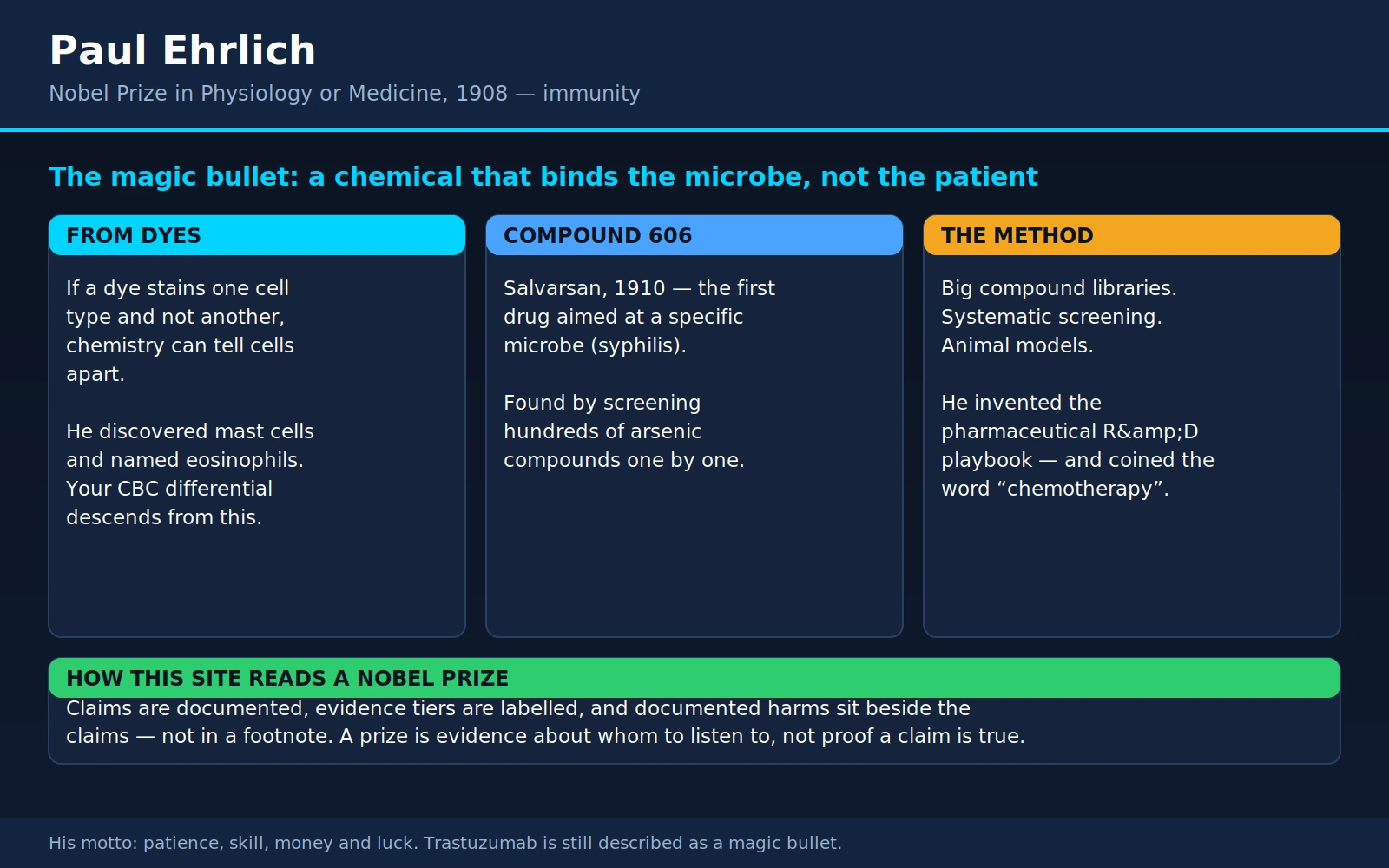
Table of Contents
- Who Paul Ehrlich Was
- The Dye-Stained Beginning
- Making Behring's Serum Dosable
- The Side-Chain Theory
- The Magic Bullet
- Salvarsan and Syphilis
- Chemotherapy, the Word
- The Ehrlich Method
- Where Mainstream Medicine Agrees — and What the Record Complicates
- What Ehrlich Means for You Today
- Key Research Papers
- Connections
- Featured Videos
1. Who Paul Ehrlich Was
Paul Ehrlich (1854–1915) is the reason the modern world has drugs. Not this drug or that drug — the idea of drugs: the conviction that somewhere in the vastness of chemistry there exists, for a given disease, a compound that will bind the thing causing it and leave the patient alone, and that the way to find it is to make hundreds of candidates and test them all. He called such a compound a Zauberkugel — a "magic bullet" — and in 1910 he produced the first one: Salvarsan, the arsenic compound that treated syphilis. Every antibiotic, antiviral, and targeted cancer therapy since has been built on the template he drew.
He was born on March 14, 1854, in Strehlen, a small town in Prussian Silesia (today Strzelin, Poland), into a comfortable Jewish family — his father ran the local inn and lottery office, and his grandfather gave popular science lectures. The decisive influence of his youth was his older cousin Karl Weigert, a pathologist and a pioneer in using the new synthetic aniline dyes — brilliant coal-tar colors pouring out of Germany's booming dye industry — to stain bacteria and tissues under the microscope. Weigert put dyes in the teenager's hands, and Ehrlich never put them down. As a medical student in Breslau, Strasbourg, Freiburg, and Leipzig he was so consumed by staining experiments that, during a visit by the then-unknown Robert Koch to the Breslau laboratories, one of his professors is said to have introduced him with the words: "That is little Ehrlich. He is very good at staining, but he will never pass his examinations." He passed, earning his medical degree in 1878 with a doctoral thesis on the theory and practice of histological staining — a document now regarded as a founding text of modern hematology and immunology.
His career traced the arc of German medicine's golden age: chief physician duties at the Charité hospital in Berlin; a bout of tuberculosis in 1888, self-diagnosed with his own staining method, and convalescence in Egypt; a call from Robert Koch around 1890 to join his new Institute for Infectious Diseases in Berlin; directorship of the world's first state serum-control institute at Steglitz in 1896; and from 1899, Frankfurt, where he led the Institute for Experimental Therapy (Institut für experimentelle Therapie). In 1906 the Georg-Speyer-Haus, a privately endowed chemotherapy research institute funded by Franziska Speyer in memory of her husband, opened next door with Ehrlich at its head — the building where the magic bullet would actually be found. In 1908 he shared the Nobel Prize in Physiology or Medicine with Élie Metchnikoff for their work on immunity. He died of a stroke on August 20, 1915, in Bad Homburg, aged 61, worn down by overwork, a lifetime of strong cigars, and — as this page will tell honestly — a final year of public attacks on his greatest achievement.
2. The Dye-Stained Beginning
Everything Ehrlich ever did grew from one observation, made while other students memorized anatomy: a dye that colors one kind of cell and not its neighbor is telling you something profound. Staining is not paint. For methylene blue to light up one structure and leave the next one colorless, the dye molecule must be binding something chemically distinctive in the first structure that the second lacks. Selective staining is selective binding — which means chemistry can tell cell types apart, and if chemistry can tell them apart, chemistry can, in principle, act on one and spare another. That single idea contains, in embryo, the side-chain theory, the receptor, the magic bullet, and the entire pharmaceutical industry. Ehrlich spent forty years unpacking it.
The staining work produced real discoveries in its own right. In his doctoral research he described a previously unrecognized cell in connective tissue whose granules soaked up aniline dyes greedily; he named it the mast cell (Mastzelle, roughly "well-fed cell"), guessing — wrongly — that the granules were stored nourishment. The guess was wrong but the cell was real: mast cells turned out to be the detonators of allergic reactions and anaphylaxis, and immunology has been studying them ever since. Working with dried blood films and his growing palette of acidic, basic, and neutral dyes, he then did for blood what Linnaeus did for plants: he classified the white blood cells by how their granules took up dye, naming the eosinophil (after its love of the rosy dye eosin) and distinguishing what we now call basophils and neutrophils. Every Complete Blood Count with a differential — the test that tells your doctor whether an infection looks bacterial, viral, or allergic, run millions of times a day — is a direct descendant of Ehrlich's staining methods. Hematology as a laboratory science begins with him.
The dyes also made him useful to the giants. In March 1882, Ehrlich sat in the audience as Robert Koch announced the discovery of the tuberculosis bacillus — he later called it his "greatest experience in science." Koch's stain for the organism was slow and temperamental; Ehrlich went home and improved it essentially overnight, using heated carbol fuchsin to force dye into the bacterium's waxy coat, which then resisted acid washing. Koch adopted the improvement, and the acid-fast stain that grew from it (refined by Ziehl and Neelsen) is still how tuberculosis is identified under a microscope today. There is a grim symmetry in what happened next: six years later Ehrlich found the same bacilli in his own sputum, using his own stain — diagnosing his own tuberculosis with the method he had invented for Koch.
3. Making Behring's Serum Dosable
In 1890, Ehrlich's colleague at Koch's institute, Emil von Behring, announced with Shibasaburo Kitasato one of the great discoveries of the era: the blood serum of animals immunized against diphtheria toxin contained an antitoxin that could be transferred to another animal — or a dying child — and neutralize the poison. Serum therapy was a miracle in waiting, and it had a fatal practical flaw: nobody could say how strong a given batch was. Antitoxin content varied wildly from horse to horse and week to week. A dose that saved one child might be uselessly weak from the next bottle. A treatment you cannot measure is a treatment you cannot trust.
Ehrlich solved it, and the solution mattered as much as the discovery. He worked out immunization schedules — escalating doses of toxin over time — that pushed horses to produce antiserum of far higher potency than before, making commercial-scale production practical. Then he did something genuinely new in medicine: he defined a unit. Antitoxin strength would be measured against a carefully preserved reference toxin in a standardized animal test, batch by batch, so that "one unit" meant the same thing in every vial, from every producer, in every year. His 1897 paper on the assay of diphtheria serum is the founding document of biological standardization — the entire machinery by which vaccines, insulins, and biologic drugs are potency-tested to this day descends from it. In 1896 Prussia made it official, opening the world's first state institute for serum research and testing at Steglitz with Ehrlich as director. When he asked about laboratory facilities, he famously replied that he could work in a barn — provided he had test tubes, a flame, and blotting paper.
One honest note belongs in this chapter, because it shaped the man. The diphtheria serum became a commercial product of the Hoechst dye works, and it made Behring rich. It did not make Ehrlich rich, and not by accident: Behring persuaded him to sign away his share of the royalties in exchange for promises — of positions and support — that never fully materialized. The first Nobel Prize in Physiology or Medicine, in 1901, likewise went to Behring alone, for serum therapy, without Ehrlich's standardization work being recognized alongside it. The two men's friendship curdled into a long estrangement. Ehrlich rarely spoke of it publicly; his letters show he never quite stopped feeling it. It is a useful reminder that the history of medicine's saints includes contracts, money, and grievance — and that the man who made serum therapy actually dosable got neither the fortune nor the first prize.
4. The Side-Chain Theory
Standardizing antitoxins forced Ehrlich to think about what an antitoxin is — how a body poisoned by a toxin comes to have, circulating in its blood, a substance that neutralizes exactly that toxin and no other. His answer, developed through the 1890s and crowned in his 1900 Croonian Lecture to the Royal Society, was the side-chain theory, the idea that won him the 1908 Nobel Prize — and it can be explained plainly.
Picture a cell as a body bristling with chemical arms — Ehrlich called them side-chains (Seitenketten), borrowing the term from dye chemistry, and by 1900 he had renamed them receptors. Each side-chain has a particular shape, evolved to grab a particular nutrient molecule the way a lock accepts one key. A toxin, in this picture, is a molecular impostor: part of it happens to fit one of the cell's side-chains, so the cell binds it — to its own harm. The cell's response, Ehrlich proposed, is overproduction: it manufactures that particular side-chain in huge excess and sheds the surplus into the bloodstream, where the free-floating side-chains grab toxin molecules before they ever reach a cell. Those shed side-chains, he said, are the antitoxins — what we now call antibodies. His Latin motto compressed the whole worldview into five words: corpora non agunt nisi fixata — substances do not act unless they are bound. Nothing in biology happens at a distance; everything begins with a specific molecular grip.
The Nobel committee split the 1908 prize between two rival visions of immunity, and the split was wiser than the rivalry: Élie Metchnikoff had found the cells of immunity — the phagocytes that hunt and devour microbes — while Ehrlich supplied its chemistry, the specific molecules that recognize and neutralize. The two camps argued for decades; immunology eventually confirmed both, welded together (your antibodies tag the microbe, your phagocytes eat what is tagged).
Was the side-chain theory right? In mechanism, only partly. Cells do not carry preformed receptors for every conceivable toxin, and antibody production works through clonal selection — a mechanism worked out in the 1950s, half a century later. But look at what survived: immune cells really do carry surface receptors; an antibody really is, in essence, a secreted receptor; and the body really does respond to a matching antigen by massively expanding production of exactly the receptor that fits. Ehrlich got the deep idea right — that biology runs on specific receptor-and-key fits between molecules — and that idea outgrew immunology entirely. Modern pharmacology describes nearly every drug in Ehrlich's vocabulary: this molecule binds that receptor. He is why the vocabulary exists.
5. The Magic Bullet
Now put the two halves of Ehrlich's life together, as he did. From the dyes: chemicals can bind selectively — this structure and not that one. From immunology: the body's antitoxins are perfectly selective weapons, "magic bullets" that fly to their target and harm nothing else. Ehrlich's leap was to ask why the chemist should not do deliberately what serum does naturally. Somewhere in the space of possible molecules, he reasoned, there must exist compounds with a strong chemical appetite for a microbe's receptors and little or none for human ones — a Zauberkugel, a charmed bullet out of German folklore that unerringly strikes the chosen target, or in his own words, agents "which strike only those objects for whose destruction they have been produced." Kill the parasite; spare the patient. It is such a familiar idea now that it takes effort to feel how audacious it was in 1900, when serious medicine had essentially no cures for infectious disease at all — only antisera for a couple of toxins, quinine for malaria, mercury for syphilis, and nursing for everything else.
He went hunting methodically, starting with trypanosomes — the wriggling parasites of African sleeping sickness. In 1904, with his Japanese co-worker Kiyoshi Shiga, he showed that a synthetic dye he named trypan red could cure trypanosome-infected mice: the first demonstration that a man-made chemical could clear a living infection from a living animal. It was a proof of principle rather than a medicine — it failed against other trypanosome strains — but the door was open. Attention then turned to atoxyl, an arsenic compound others had shown active against sleeping sickness but which carried a horrifying price: it could destroy the optic nerve and blind the patient. Where others saw a dead end, Ehrlich saw a starting material. He worked out atoxyl's true chemical structure, realized it could be systematically modified, and set the Georg-Speyer-Haus chemists to building an entire library of organic arsenic compounds — hundreds of numbered variations on the theme, each to be tested in infected animals for the widest possible gap between the dose that cured and the dose that harmed.
Two arrivals in 1909 completed the story. The first was a compound that had been sitting on the shelf for two years: preparation number 606, dioxy-diamino-arsenobenzene, synthesized in 1907 and recorded as a failure against trypanosomes in a screening judgment that turned out to be simply wrong. The second was a person: Sahachiro Hata, a meticulous young bacteriologist from Kitasato's institute in Tokyo, who arrived in Frankfurt with something precious — a reliable rabbit model of syphilis, made possible by the recent identification of the syphilis microbe itself. Ehrlich set Hata to re-screening the arsenical library against syphilis, compound by compound, and 606 came off the shelf. In Hata's rabbits it did what nothing had ever done: the spirochetes vanished, the ulcers healed, the animals were cured.
6. Salvarsan and Syphilis
To understand what happened next, you have to understand what syphilis meant in 1910. Caused by the corkscrew-shaped bacterium Treponema pallidum — identified only in 1905 by Schaudinn and Hoffmann, with the Wassermann blood test following in 1906 — syphilis was one of the most common and most dreaded infections in the Western world. It began with a painless sore and a rash, then hid for years or decades before returning to destroy what it pleased: the aorta, the bones, the face, and, in its most feared form, the brain — "general paresis of the insane," which filled a substantial share of Europe's asylum beds with formerly healthy adults descending into paralysis and dementia. It ruined marriages, blinded newborns, and carried a moral stigma so heavy that respectable medicine barely discussed it.
And the standard treatment, for four centuries, had been mercury — rubbed on as ointment, breathed as fumes, swallowed as pills. "A night with Venus, a lifetime with Mercury," went the bitter joke, and the lifetime was grim: drooling, loosened teeth, ulcerated gums, kidney damage, tremors — the classic signs of chronic mercury poisoning, inflicted deliberately, for decades, on millions, for uncertain benefit. It is worth letting that sink in, because it is the honest baseline against which Salvarsan must be judged: the reigning "cure" was itself a slow poisoning with a heavy metal.
Against that baseline, compound 606 was a thunderclap. After the animal cures of 1909, Ehrlich moved carefully into human testing — cautiously escalating, and then distributing tens of thousands of free doses to physicians (a figure of some 65,000 is recorded) so that results could accumulate across many clinics before any commercial sale. Reports flowed back of ulcers healing in days and Wassermann tests turning negative. In April 1910, at the Congress for Internal Medicine in Wiesbaden, Ehrlich announced the results, and the sensation was global; by the end of the year the Hoechst works was marketing the drug as Salvarsan — "the arsenic that saves." It was the first targeted chemotherapy in history: a synthetic chemical, deliberately sought and found, that attacked a specific microbe inside a living patient.
Honesty requires the rest of the picture, and Ehrlich himself insisted on it — he liked to say that the step from the laboratory to the patient's bedside is "extraordinarily arduous and fraught with danger." Salvarsan was genuinely difficult and genuinely toxic. It was an arsenic compound that oxidized into more poisonous forms on contact with air, so it had to be freshly dissolved and injected intravenously with real skill; clumsy preparation or injection could cause severe tissue damage, and among the hundreds of thousands treated there were serious reactions and deaths — many traceable to faulty technique or contaminated water, but not all. Treatment meant a long course of injections, not a single shot, and relapses occurred. Ehrlich responded like the standardizer he had always been: tightening manufacturing, training physicians, tracking complications, and releasing in 1912 the improved Neosalvarsan (compound 914), more soluble and considerably easier to administer. Meanwhile opposition arrived from a direction chemistry could not fix: moralists who argued, in effect, that curing syphilis would remove the wages of sin and license vice, and a Frankfurt scandal sheet whose accusations against the drug and its inventor ended in court — a story told in section 9. Salvarsan and Neosalvarsan remained the standard of care for three decades, until penicillin — the biological magic bullet found by Alexander Fleming — proved spectacularly effective against syphilis in the 1940s and retired the arsenicals for good. The torch passed, but it was Ehrlich's torch.
7. Chemotherapy, the Word
Ehrlich needed a name for what he was doing — treating disease with defined chemical substances aimed at the cause — and the name he coined was chemotherapy. In everyday speech the word has narrowed to mean cytotoxic cancer drugs, but Ehrlich meant the whole project, and by his meaning nearly the entire modern pharmacy is chemotherapy. The line of descent from compound 606 is direct and documented. Gerhard Domagk, working in the same German dye-industry tradition a generation later, screened dyes for antibacterial action exactly as Ehrlich had screened arsenicals, and found Prontosil — the first sulfa drug — in 1935. Penicillin and the antibiotic era followed, vindicating the magic-bullet concept with molecules borrowed from mold and soil. Antiviral therapy is Ehrlich's program applied to viruses: drugs built to jam a specific viral enzyme while leaving human enzymes alone.
Cancer medicine tells the story most vividly, because it spent a century earning the word Ehrlich coined. Early cytotoxic chemotherapy was a blunt instrument — poison the fast-dividing cells and accept the collateral damage — about as far from a magic bullet as chemistry gets. The modern targeted era is the return to Ehrlich: imatinib, designed to bind the single abnormal enzyme driving chronic myeloid leukemia; and the monoclonal antibodies, which are almost eerily his idea made literal — manufactured antibodies aimed at one molecular target, such as trastuzumab against the HER2 receptor in breast cancer, which the medical literature routinely and explicitly describes as a "magic bullet." The 2008 Nature Reviews Cancer centenary essay on Ehrlich (cited below) is titled exactly that: a hundred years of progress on his concept. Antibody-drug conjugates — a toxin bolted onto a targeting antibody — are the Zauberkugel with the metaphor removed: a warhead riding a guidance system.
And beyond infection and cancer stands his other, quieter conquest: the receptor. Beta-blockers for the heart, SSRIs for depression, proton-pump inhibitors, antihistamines, GLP-1 agonists — the modern formulary is a catalogue of molecules described by the receptor they bind or block, in a conceptual language Ehrlich invented to explain dye-stained cells and diphtheria antitoxin. When your prescription's leaflet says "works by binding to…", it is speaking Ehrlich.
8. The Ehrlich Method
Strip the biography away and look at the machine Ehrlich built in Frankfurt, because the machine may be his biggest invention. Its parts: (1) a large library of systematically varied compounds — hundreds of numbered arsenicals, each a deliberate structural experiment; (2) a reliable animal model of the actual disease, so that candidates could be screened against reality rather than theory; (3) optimization of the gap between the dose that cures and the dose that harms — Ehrlich framed this as the ratio of the maximum tolerated dose to the minimum curative dose, his chemotherapeutic index, the ancestor of the therapeutic index every drug developer still calculates; and (4) standardized manufacturing and dosing, carried over from his serum-institute discipline. Compound library, screening model, lead optimization, standardization: that is the pharmaceutical R&D playbook, essentially complete, in 1910. Modern drug discovery has replaced Hata's rabbits with robotic screens running millions of compounds, but it has not replaced the playbook — 606 was simply the first hit in the first screen.
The style of the place was pure Ehrlich. He directed his co-workers with daily handwritten instruction cards in colored pencil — his famous "blocks" — and read the chemical and medical literature omnivorously, cigar permanently lit (he was rarely without one, a habit his doctors and his strokes would eventually indict). He was generous with credit to collaborators like Hata and Bertheim, the chemist who actually synthesized 606, and he was frank about what research runs on. His recipe for success became famous as the four big G's: "Geduld, Geschick, Geld und Glück" — patience, skill, money, and luck. Note the third one. Ehrlich never pretended that discovery floats free of funding: it took Franziska Speyer's endowment to build the house where the magic bullet was found, and he said so plainly. Patience, skill, money, luck — a hundred and fifteen years later, no drug hunter has improved on the list.
9. Where Mainstream Medicine Agrees — and What the Record Complicates
Where the agreement is total: Ehrlich is one of the most consequential physicians who ever lived, and his standing has only grown. Mainstream medicine credits him as the founder of chemotherapy and of hematological staining, the co-founder (with Metchnikoff's cellular school) of immunology, the inventor of biological standardization, and the originator of the receptor concept that underlies modern pharmacology. His 1908 Nobel Prize is among the least disputed ever awarded, and Germany's federal vaccine-regulation agency — the Paul-Ehrlich-Institut, direct descendant of his Steglitz serum institute — carries his name on every document it issues.
What the record complicates, told straight:
The side-chain mechanism was superseded. Cells do not carry preformed receptors for every possible antigen, and antibodies arise by clonal selection of lymphocytes, a mechanism established in the 1950s. Ehrlich's theory was right in its deepest commitments (receptors exist; antibodies are secreted receptors; specificity is chemical) and wrong in its machinery. That is a normal fate for a great theory, and it is stated here because this site does not present superseded science as current.
Salvarsan was toxic, and people died. It was an unstable arsenic compound requiring skilled intravenous administration; botched preparation and injection caused injuries, and among the enormous numbers treated there were deaths — a real cost, honestly acknowledged at the time by Ehrlich himself, who worked continuously on safer formulation (Neosalvarsan) and physician training. Judged against the alternative — decades of deliberate mercury poisoning, or untreated neurosyphilis — the balance was overwhelmingly favorable; judged by modern trial and consent standards, no drug would launch that way today, and the era's treatment of vulnerable patients (hospitalized prostitutes were treated under coercive public-health rules in some cities) is rightly criticized by historians.
The 1914 libel affair. In Ehrlich's last years a Frankfurt tabloid campaign accused him and hospital physicians of forcing Salvarsan on prostitutes and profiting from a dangerous drug. The matter went to court in 1914; the accusing publisher was convicted of libel and imprisoned, and the trial vindicated Ehrlich publicly — but the strain of it, by every account, wore him down badly in the year before his fatal stroke. The episode is worth remembering as an early instance of a recurring pattern: a genuinely imperfect new therapy, real grievances about consent, and a press campaign that fused them into an attack on the science itself.
Arsenic left medicine — and made one honest comeback. After penicillin, arsenical drugs were abandoned for infections, and "arsenic" returned to being chiefly a poison in medicine's vocabulary. The one modern exception deserves its sentence: arsenic trioxide, revived from Chinese clinical work in the 1990s, is today a standard component of therapy for acute promyelocytic leukemia — combined with retinoic acid it cures the large majority of patients, in one of oncology's genuine triumphs. Ehrlich, who spent a decade persuading the world that dosage separates a poison from a drug, would have enjoyed that footnote immensely.
10. What Ehrlich Means for You Today
Start with the blood test. If you have ever had a Complete Blood Count with a differential — and if you have ever been seriously ill, you have — the laboratory classified your white cells using the staining approach Ehrlich worked out before 1880, and two of the cell names on the report (mast-cell relatives aside, the eosinophil above all) are words he coined. When an allergist talks about mast cells behind your hives or your anaphylaxis risk, that is his cell, still keeping his name.
Then open your medicine cabinet. Any antibiotic in it is a magic bullet by descent; so is an antiviral; so is a targeted cancer drug or a monoclonal antibody, if illness has brought one into your life. Any drug whose explanation involves binding, blocking, or activating a receptor — blood-pressure medicines, antidepressants, antihistamines — is speaking the conceptual language Ehrlich invented. The system that assayed the potency of your vaccines before they reached you descends from his serum institute. It is genuinely difficult to name another single person whose fingerprints are on as many objects in a modern pharmacy.
His story also carries three lessons this site cares about. First: dosage and standardization are not bureaucracy; they are the difference between a remedy and a rumor. Ehrlich's least glamorous work — units, reference standards, potency tests — is what turned both serum therapy and Salvarsan from anecdotes into medicine, and it is exactly the discipline that many modern "miracle" products, supplements included, have never submitted to. Ask of any remedy what Ehrlich asked: how much, measured how, tested against what. Second: the magic bullet has limits, and honesty about them is not defeatism. Syphilis yielded to a single well-aimed drug; most chronic disease — diabetes, heart disease, autoimmunity — has not, because there is no single target to hit. For those, the foundations this site documents (nutrition, deficiency correction, toxin avoidance) matter alongside pharmacology, and anyone selling you a lone silver bullet for a whole-body disease is selling against a century of evidence. Third: the diseases come back if you look away. Syphilis, nearly beaten mid-century, has been rising again for two decades; it is still curable — penicillin still works against Treponema pallidum — but only in people who get tested and treated. The bacterium did not retire when Salvarsan did.
One last image. In the 1930s, the government of the country Ehrlich had served all his life scrubbed his name from Frankfurt's street signs because he was a Jew. After the war the name went back up; his portrait later appeared on Germany's 200-mark banknote, held daily in millions of hands, and the institute that approves Germany's vaccines signs his name to this day. The erasure lasted a decade; the work has lasted a century and is not done growing. That is what a magic bullet actually is — not magic at all, but patience, skill, money, and luck, aimed with uncommon honesty.
11. Key Research Papers
- Kaufmann SH. Paul Ehrlich: founder of chemotherapy. Nat Rev Drug Discov 2008;7(5):373
- Strebhardt K, Ullrich A. Paul Ehrlich's magic bullet concept: 100 years of progress. Nat Rev Cancer 2008;8(6):473-80
- Bosch F, Rosich L. The contributions of Paul Ehrlich to pharmacology: a tribute on the occasion of the centenary of his Nobel Prize. Pharmacology 2008;82(3):171-9
- Valent P, Groner B, Schumacher U, et al. Paul Ehrlich (1854-1915) and His Contributions to the Foundation and Birth of Translational Medicine. J Innate Immun 2016;8(2):111-20
- Williams KJ. The introduction of 'chemotherapy' using arsphenamine — the first magic bullet. J R Soc Med 2009;102(8):343-8
- Crivellato E, Beltrami CA, Mallardi F, Ribatti D. Paul Ehrlich's doctoral thesis: a milestone in the study of mast cells. Br J Haematol 2003;123(1):19-21
- Kay AB. The early history of the eosinophil. Clin Exp Allergy 2015;45(3):575-82
- Zhu J, Chen Z, Lallemand-Breitenbach V, de Thé H. How acute promyelocytic leukaemia revived arsenic. Nat Rev Cancer 2002;2(9):705-13
- Lo-Coco F, Avvisati G, Vignetti M, et al. Retinoic acid and arsenic trioxide for acute promyelocytic leukemia. N Engl J Med 2013;369(2):111-21
Live PubMed Searches
- Paul Ehrlich magic bullet history
- Salvarsan arsphenamine syphilis
- Side-chain theory antibody
- Mast cell discovery history
- Receptor theory pharmacology history
Connections
- All Notable Doctors
- Élie Metchnikoff — his 1908 co-laureate: the cellular half of immunity to Ehrlich's chemical half
- Robert Koch — the mentor whose tuberculosis bacillus Ehrlich learned to stain, and whose institute launched his career
- Emil von Behring — diphtheria antitoxin: the discovery Ehrlich made dosable, and the royalty contract that cut him out
- Alexander Fleming — penicillin, the biological magic bullet that retired Salvarsan
- Satoshi Ōmura — the avermectins: Ehrlich-style systematic screening, applied to soil microbes
- Tu Youyou — artemisinin: 190 failed preparations before the hit, the Ehrlich method in another century
- Otto Warburg — another German Nobel laureate whose chemistry reshaped how disease is understood
- Nobel Prize in Medicine — the laureates wing: who won, for what, and why it mattered
- Treponema pallidum (Syphilis) — the corkscrew bacterium Salvarsan was aimed at, still with us and still curable
- All Bacteria — the site's bacteriology section
- Complete Blood Count (CBC) — the everyday lab test descended from Ehrlich's staining methods
- Mercury — the four-century "cure" for syphilis that was really a slow poisoning
- Covered in depth on its own page: Syphilis