Dr. Max Bircher-Benner and the Raw Food Cure
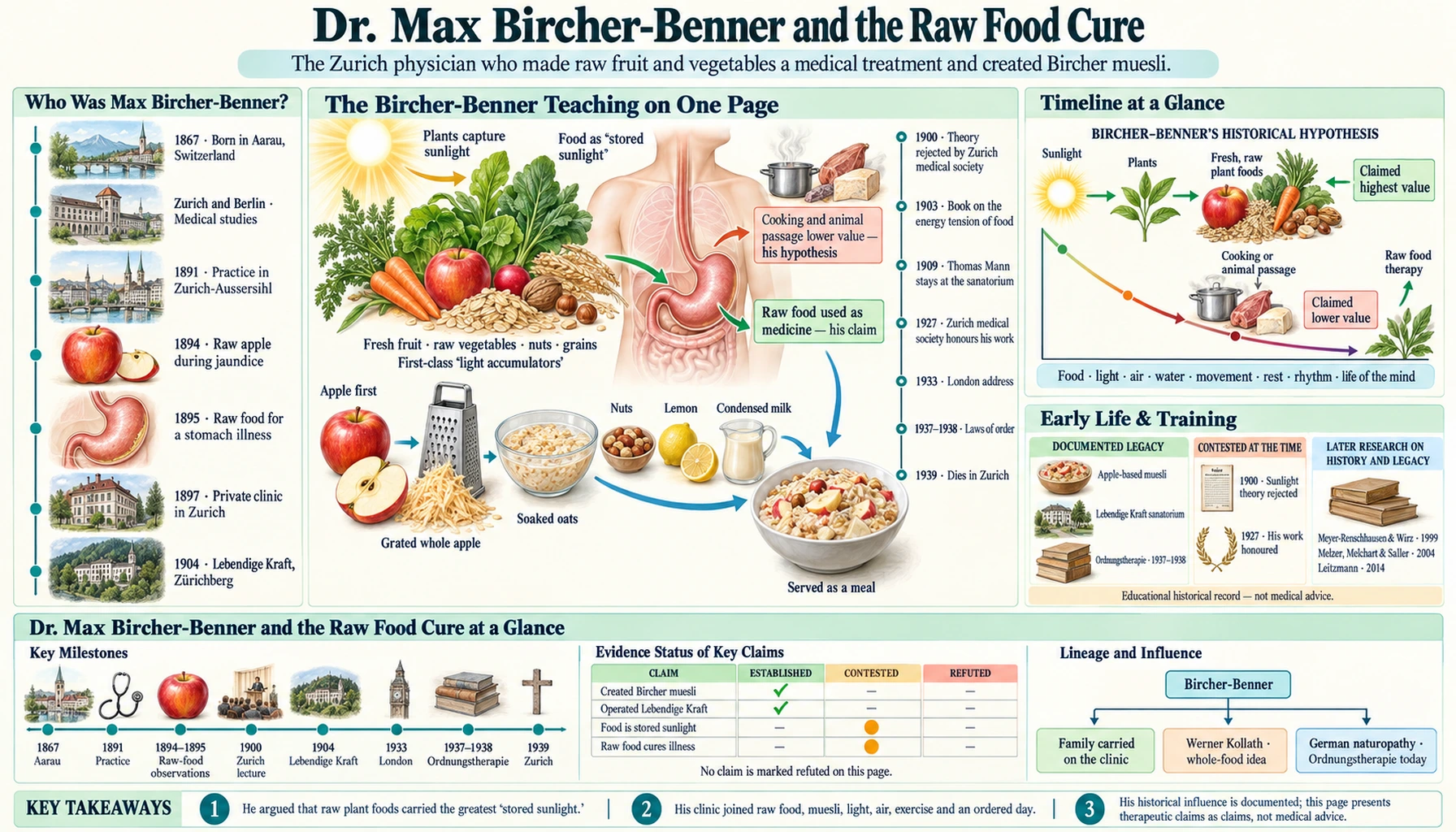
Maximilian Oskar Bircher-Benner (1867–1939) was the Zurich physician who made raw fruit and vegetables a medical treatment. After recovering from jaundice on raw apple in 1894 and curing a patient with a stomach illness on raw food the following year, he came to believe that food is stored sunlight, and that the less it is cooked or processed the more of that energy it carries. He set out the theory before the Zurich medical society in 1900, which rejected it, and practised it for nearly forty years in his clinic and in the Lebendige Kraft (“Vital Force”) sanatorium on the Zürichberg, which drew patients from across Europe.
He gave the world the dish his patients knew as d’Spys — Bircher muesli — and, late in life, the idea of Ordnungstherapie, the “laws of order” for health. This hub gathers eight deep-dive articles on his work, drawn from his own writings and from the historians of his clinic, and presented as he stated it.
Table of Contents
Deep-Dive Articles
1. Life and Career
From Aarau to Zurich: medical studies in Zurich and Berlin, the Aussersihl practice, the 1897 clinic, the 1900 lecture, Lebendige Kraft, the 1933 London address and the family that carried on — with a timeline.
Read the deep dive →2. The Raw Apple Cure
Jaundice in 1894 and the apple slices that helped him recover, the 1895 patient cured on raw food, the Alpine herdswoman’s dish, and the 1900 lecture his colleagues called heresy.
Read the deep dive →3. Sunlight Food
Food as “accumulated sunshine”: the 1903 book on the energy tension of food, his case against judging food by calories, and the three classes of light accumulators in his own words.
Read the deep dive →4. Raw Food (Rohkost) Therapy
What raw food meant in his clinic, how meals were built, meat, salt, sugar and alcohol, the illnesses he named in London in 1933, and the cookbook that spread the diet.
Read the deep dive →5. The Original Bircher Muesli
The 1929 recipe — mostly grated whole apple, a single spoon of soaked oats, nuts, lemon and condensed milk — why the apple came first, how it was served, and how it changed.
Read the deep dive →6. Ordnungstherapie: The Laws of Order
Health as order: the term he coined in 1937, the nine laws, light, air, water, rhythm and sleep, the day at Lebendige Kraft, and order therapy in German naturopathy today.
Read the deep dive →7. The Lebendige Kraft Sanatorium
From seven beds to eighty: the house on the Zürichberg, the daily routine, the treatments and fees, Thomas Mann’s 1909 stay, the Swedish patients, and the clinic’s later years.
Read the deep dive →8. Books, Successors and Legacy
His books in date order, the journal Der Wendepunkt, the family who carried on, Werner Kollath and the whole-food idea, Sweden, and where to read him today.
Read the deep dive →Who Was Max Bircher-Benner?
Bircher-Benner was born on August 22, 1867, in Aarau, Switzerland. He studied medicine in Zurich and Berlin and opened a practice in the Zurich working-class district of Aussersihl in 1891, taking the double name Bircher-Benner on his marriage to Elisabeth Benner. In 1894 he fell ill with jaundice and, as his biographers tell it, recovered on thin slices of raw apple; in 1895 he treated a woman with a stomach illness on raw food after other treatments had failed. These cases convinced him that the medical teaching of his day — meat and cooked food for strength, nothing raw for the sick — had things the wrong way round.
In 1897 he opened a small private clinic in Zurich, and in 1900 he presented his theory of food as stored sunlight to the Zurich medical society, which rejected it. In 1904 he opened the larger Lebendige Kraft sanatorium on the Zürichberg, where raw food, muesli, light, air, exercise and an ordered day were the treatment. Patients came from Switzerland, Germany, Sweden and beyond; Thomas Mann stayed in 1909. In 1927 the same medical society honoured his work, in 1933 he addressed the Food Education Society in London, and in 1937–1938 he set out his laws of order for health. He died in Zurich on January 24, 1939, and his family ran the clinic for decades after him.
The Bircher-Benner Teaching on One Page
- Food is stored sunlight. Plants capture the energy of the sun; food is valuable for the quality of that energy, not only for its calories.
- Raw plants carry the most. Fresh fruit, raw vegetables, nuts and grains are the first class of “light accumulators”; cooking and passage through an animal lower the value.
- Raw food is medicine. The more serious the illness, the larger the share of raw food in the diet.
- Little meat, salt, sugar or alcohol. He reduced and finally gave up meat himself, and took no alcohol for some forty years.
- The apple-based muesli. A small dish of grated whole apple with a little soaked oats, nuts and lemon, served as a meal in itself.
- Health follows laws of order. Food, light, air, water, movement, rest, rhythm and the life of the mind must all be kept in order.
Timeline at a Glance
- 1867 — Born August 22 in Aarau, Switzerland.
- 1891 — Opens his practice in Zurich-Aussersihl.
- 1894–1895 — Recovers from jaundice on raw apple; treats his first patient on raw food.
- 1897 — Opens a small private clinic in Zurich.
- 1900 — Presents his theory to the Zurich medical society, which rejects it.
- 1903 — Publishes his book on the energy tension of food.
- 1904 — Opens the Lebendige Kraft sanatorium on the Zürichberg.
- 1909 — Thomas Mann stays at the sanatorium.
- 1927 — The Zurich medical society honours his work.
- 1933 — Addresses the Food Education Society in London.
- 1937–1938 — Coins Ordnungstherapie and publishes his laws of order.
- 1939 — Dies January 24 in Zurich.
Key Research Papers
- Meyer-Renschhausen E, Wirz A. Dietetics, health reform and social order: vegetarianism as a moral physiology. The example of Maximilian Bircher-Benner (1867-1939). Med Hist. 1999;43(3):323-41. — PubMed PMID: 10885127
- Melzer J, Melchart D, Saller R. [Development of ‘Ordnungstherapie’ by Bircher-Benner in naturopathy of the 20th century]. Forsch Komplementarmed Klass Naturheilkd. 2004;11(5):293-303. — PubMed PMID: 15572870
- Eklöf M. [They searched help across the borders. Patients from Sweden in Switzerland at Dr Bircher-Benner’s health resort in 1928-1939]. Lakartidningen. 2008;105(3):147-50. — PubMed PMID: 18290517
- Leitzmann C. Vegetarian nutrition: past, present, future. Am J Clin Nutr. 2014;100 Suppl 1:496S-502S. — PubMed PMID: 24898226
- Bircher-Benner MO. [Why natural food?]. Veg Bode. 1948;51(9):132-4. — PubMed PMID: 18099596 (posthumous reprint of his text)
- Koning MW. [Dr. Bircher-Benner’s diet]. Veg Bode. 1948;51(9):137-40. — PubMed PMID: 18099597
- Bircher W. [Are Waerland and Dr. Bircher-Benner]. Volksgesundheit Bad Hombg. 1947;40(7):235-7. — PubMed PMID: 20258547
- Kollath W. [The whole food and its determination by growth and cell replacement]. Z Gesamte Inn Med. 1947;2(1-2):31-6. — PubMed PMID: 20254358
- Kunz-Bircher A, Liechti-von Brasch D. [Clinical significance of fresh food]. Hippokrates. 1956;27(22):705-13. — PubMed PMID: 13384929