John Vane: How Aspirin Works — Prostaglandins, Willow Bark, and the Honest Aspirin Story
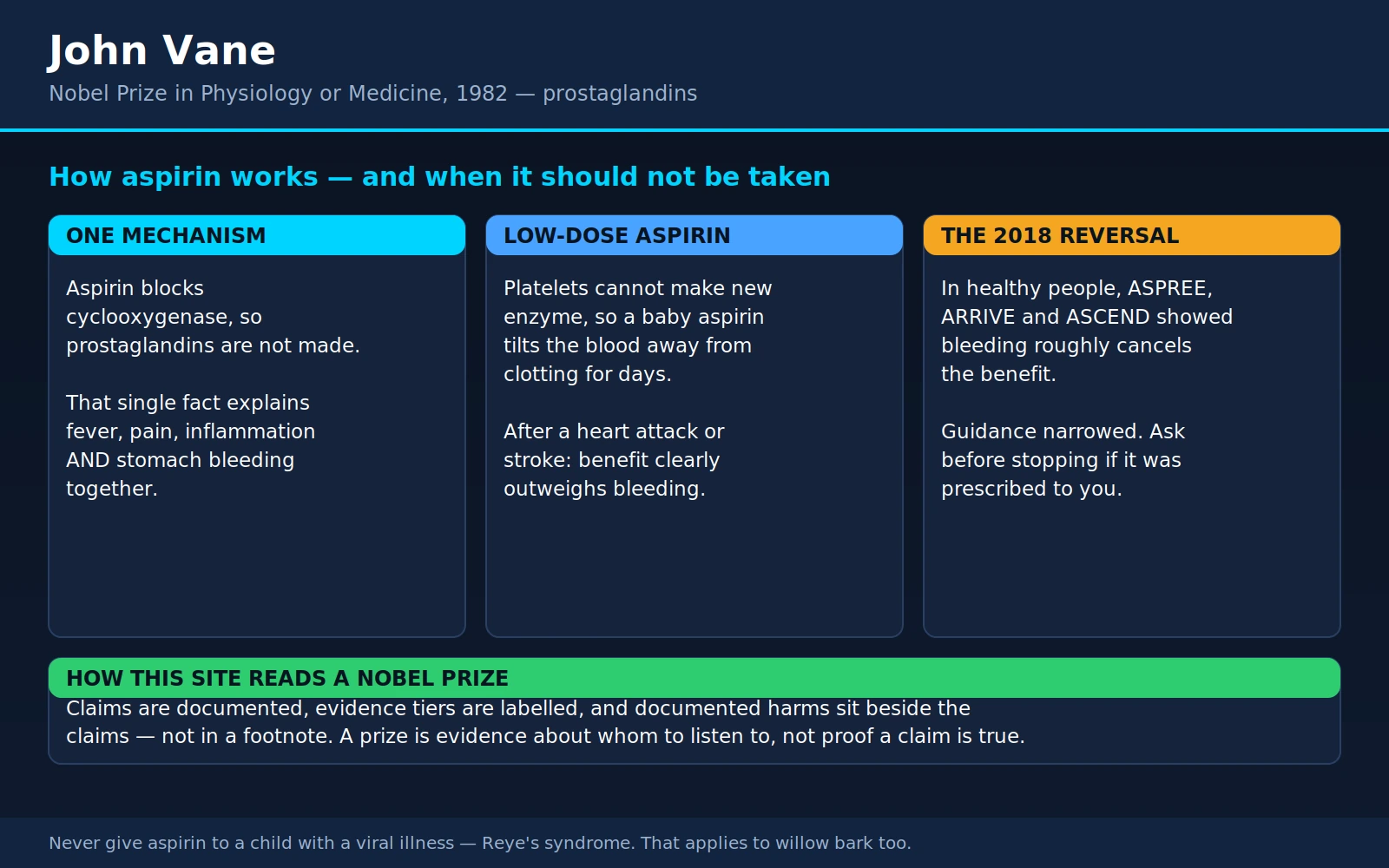
Table of Contents
- The Prize and the Three Men
- The 2,400-Year-Old Drug Nobody Understood
- Prostaglandins: One Family, Many Jobs
- Vane's 1971 Insight
- Low-Dose Aspirin and the Heart
- The 2018 Reversal, Honestly
- The Safety Ledger
- The COX-2 Cautionary Tale
- The Wider Prostaglandin Family in Your Medicine Cabinet
- Vane's Second Revolution: Captopril
- Where Mainstream Medicine Agrees — and What Remains Debated
- Key Research Papers
- Connections
- Featured Videos
1. The Prize and the Three Men
In 1982 the Nobel Prize in Physiology or Medicine went jointly to Sune K. Bergström, Bengt I. Samuelsson and Sir John R. Vane, "for their discoveries concerning prostaglandins and related biologically active substances." Stated that way it sounds like a technical prize for a technical subject. What it actually honored was the answer to a question humanity had failed to answer for twenty-four centuries: why does willow bark stop a fever, and why does the pill in your bathroom cabinet do the same thing?
John Robert Vane (1927–2004) was born in Tardebigge, Worcestershire, got a chemistry set at twelve, blew things up in a garden shed, read chemistry at Birmingham, decided he disliked it, and was rescued by a professor who suggested pharmacology at Oxford instead. There he fell in with Harold Burn, whose department had a house style that shaped everything Vane did afterwards: you learn what a chemical does by watching it act on living tissue.
Vane took that further than anyone. As Professor of Experimental Pharmacology at the Royal College of Surgeons in London through the 1960s, he built the cascade superfusion bioassay — also, memorably, the "blood-bathed organ technique." The apparatus was almost comically low-tech. Strips of isolated tissue — rat stomach, rat colon, chick rectum, rabbit aorta — hung one above another, continuously bathed by a stream of fluid, sometimes buffer, sometimes blood drawn straight from a living animal. Each strip contracted with its own particular sensitivity, so the pattern of twitches was a fingerprint of the chemicals present, read in nanogram quantities, in real time. His colleagues in Stockholm had mass spectrometers. Vane had strips of gut on a rack — and because his assay ran continuously, he could see what they could not: substances that appear and vanish within seconds. That is exactly what let his laboratory find prostacyclin, and it is why a page about a molecular discovery keeps returning to a piece of glassware.
The Stockholm half of the prize belonged to the chemists. Sune Bergström (1916–2004) took on a substance named in 1935 by the Swedish physiologist Ulf von Euler, who found that human seminal fluid contained something that lowered blood pressure and contracted smooth muscle, and who guessed — wrongly, but the name stuck — that it came from the prostate. Hence prostaglandin. For two decades nobody could get enough of it to work with. Bergström spent the 1950s grinding through enormous quantities of sheep seminal-vesicle glands and finally obtained the first pure crystalline prostaglandins, PGE1 and PGF1α, then determined their structures. Unglamorous and decisive: you cannot study a messenger you cannot hold.
Bengt Samuelsson (born 1934), Bergström's student and successor, drew the map. He showed prostaglandins are built from arachidonic acid, a twenty-carbon fatty acid sitting in the membranes of essentially every cell; identified the unstable intermediates PGG2 and PGH2 from which the whole family branches; discovered thromboxane A2 with Mats Hamberg in 1975; and in 1979 characterized the leukotrienes, solving a separate forty-year-old mystery — the "slow reacting substance of anaphylaxis" that constricts airways in asthma. Half the drugs discussed later on this page descend from that work.
Three men, one clean division of labor. Bergström held the molecules. Samuelsson drew the map. Vane worked out how to interrupt it — and discovered that humanity had been interrupting it, by accident, since antiquity.
2. The 2,400-Year-Old Drug Nobody Understood
Willow bark is one of the oldest medicines with a continuous written record. It appears in Egyptian and Sumerian sources; the school of Hippocrates in the fifth and fourth centuries BCE is traditionally credited with recommending willow leaves and bark for fever and the pains of childbirth; Dioscorides and Galen carried the practice into Roman medicine. Our page on willow bark covers the herb itself in detail. What matters here is that for twenty-four centuries everyone who used it was right about the effect and completely in the dark about the cause.
The modern chapter opens with a letter. In 1763 the Reverend Edward Stone, a country clergyman in Chipping Norton, Oxfordshire, wrote to the President of the Royal Society reporting that powdered willow bark had cured the "agues" — intermittent fevers — of some fifty parishioners. His reason for trying it was entirely wrong: he was following the doctrine of signatures, reasoning that willows grow in damp marshy ground, agues arise in damp marshy ground, and therefore Providence had planted the cure beside the disease. Bad theory, good observation, real drug. He also did something creditable — he noticed the bark's bitterness resembled that of Peruvian cinchona (the source of quinine), dried and powdered it systematically, and gave it to a substantial number of people before writing it up. That is closer to a clinical trial than most eighteenth-century therapeutics got.
Chemistry caught up next. In 1828 the Munich pharmacologist Johann Buchner isolated the bitter glycoside salicin, from the Latin salix; a decade later Raffaele Piria converted it into salicylic acid; by 1859 Hermann Kolbe could synthesize salicylic acid cheaply from phenol, and by the 1870s doctors were prescribing sodium salicylate in quantity for rheumatic fever, gout and pain. And it was brutal — effective, but at the doses required it tasted appalling, caused nausea and vomiting, and burned the stomach so badly that some patients could not stay on it long enough to be helped. That was the problem on the desk at Bayer's Elberfeld works in the 1890s: keep the effect, lose the corrosion.
The answer was acetylation — hanging an acetyl group onto salicylic acid to make acetylsalicylic acid. The compound was not new; Charles Gerhardt had made an impure version in 1853 and found it uninteresting. Bayer's contribution was to make it pure, stable, manufacturable, and then to sell it: the name Aspirin was registered in 1899, from A for acetyl and spir for Spiraea, the meadowsweet plant that was another salicylate source.
Who actually did it is genuinely disputed, and both accounts deserve airing. Bayer's official history credits the young chemist Felix Hoffmann, said to have produced pure, stable acetylsalicylic acid on 10 August 1897 — in the most-told version motivated by a father crippled with rheumatism who could no longer tolerate sodium salicylate. In 1949, however, Arthur Eichengrün, who had headed Bayer's pharmaceutical laboratory at the time, published a claim in Pharmazie that the project was his: that he devised the plan, that Hoffmann carried out the synthesis as his subordinate without knowing its purpose, and that he personally pushed the compound forward when Bayer's chief pharmacologist dismissed it as dangerous to the heart. His account has to be read alongside what happened in between. Eichengrün was Jewish; his contributions were written out of German accounts during the Nazi period, his firm was expropriated, and he was imprisoned at Theresienstadt in 1944 at the age of seventy-six. He wrote his claim shortly after surviving it and died weeks after it appeared. In 1999 the historian of pharmacy Walter Sneader re-examined the laboratory notebooks and argued in the BMJ that Eichengrün's version fits the record better; Bayer has maintained its position. The fair summary: Hoffmann's hands were at the bench, Eichengrün's claim to have directed the work is credible and was buried for reasons that had nothing to do with chemistry, and certainty is no longer available to anyone.
What happened next is the part that should stop you. Aspirin went on sale, worked, spread, and became by the middle of the twentieth century the best-selling drug in the world — tens of billions of tablets a year, swallowed for headache, fever, toothache, arthritis and hangover in every country on Earth — and nobody knew how it worked. Not the doctors prescribing it, not the chemists making it, not the pharmacologists studying it. Textbooks offered vague talk of effects on the "heat-regulating center." For the first seven decades of its life, the most widely used medicine in human history was, mechanistically, a blank.
3. Prostaglandins: One Family, Many Jobs
To see what Vane found you need a working picture of what prostaglandins are — and the useful thing is that the picture is simple, and almost everything confusing about aspirin falls straight out of it.
Sitting in the membrane of nearly every cell in your body is arachidonic acid, an omega-6 fatty acid twenty carbons long. It is not doing anything in particular; it is stock. When a cell is injured, irritated, stretched or infected, an enzyme snips it free from the membrane and the assembly line starts. The next enzyme is the one this whole page is about: cyclooxygenase, universally abbreviated COX. COX converts arachidonic acid into the unstable endoperoxides Samuelsson identified, and from those, different cells run different final steps and get different products. That is the crucial architectural fact: one shared trunk, many branches, with the branch determined by which downstream enzyme a cell happens to carry.
The products behave nothing like hormones. A hormone is made in one organ, released into the blood and acts on another far away — a letter posted across the country. Prostaglandins are made on the spot, act on the cells immediately around them, and are destroyed within seconds to minutes. They are notes shoved under the neighbor's door. That short life is why they were so hard to study, why Vane's continuously running bioassay could see them when chemistry could not, and why their effects are so intensely local.
Here is the same family doing five jobs that seem to have nothing to do with each other:
- Fever. Infection drives production of PGE2 at the hypothalamus, the brain's thermostat, which turns the set point up. Your body then does what any thermostat-driven system does when the dial moves: it shivers and vasoconstricts to reach the new target. The fever is not the infection heating you — it is your own regulator obeying a chemical instruction.
- Pain. Prostaglandins are only weakly painful themselves. What they do is sensitize pain nerve endings, lowering the threshold at which they fire, so ordinary pressure and warmth become sore. That is why a bruised or sunburned area hurts to a touch that would be unremarkable anywhere else: the amplifier has been turned up, not the signal.
- Inflammation. They widen small blood vessels and make them leaky — redness, heat and swelling, produced by chemistry rather than by damage.
- Stomach protection. The stomach lining defends itself against its own acid using prostaglandins made by COX: mucus and bicarbonate secretion, mucosal blood flow, cell turnover. This is not a footnote. It is the most consequential item on the list for anyone taking these drugs.
- Clotting. Platelets run the trunk pathway to thromboxane A2, which makes platelets sticky and constricts vessels. Blood-vessel walls run the same trunk to the opposite product, prostacyclin (PGI2), which keeps platelets apart and vessels open. The two push against each other continuously, and your blood's tendency to clot at any moment is the balance between them.
Hold that list, because in the next section a single chemical event switches all five off at once — and every benefit and every hazard of aspirin, including the ones that look like unrelated coincidences, is a consequence of that.
4. Vane's 1971 Insight
By the late 1960s several groups had noticed that aspirin-like drugs somehow reduced the prostaglandin around inflamed tissue. The prevailing assumption was that they blocked prostaglandins from acting — sitting on the receptor, the way an antihistamine sits on a histamine receptor. Vane's proposal was different and, at the time, less obvious: aspirin does not block the message, it shuts down the factory.
The experiment was elegant precisely because it was cell-free. Vane prepared a homogenate of guinea-pig lung — tissue ground up so that no intact cells, no receptors and no signaling remained, only enzymes in suspension. He added arachidonic acid; the preparation made prostaglandins, which he measured on his cascade of tissue strips. Then he added aspirin. Output fell, dose-dependently. Indomethacin did the same, more potently; sodium salicylate did it weakly. There was no organism left to have a receptor blocked — only a chemical conversion, and the drug was stopping the conversion. The paper appeared in Nature New Biology on 23 June 1971, alongside two companion papers from the same circle showing the identical effect in human platelets and in perfused dog spleen. The enzyme being inhibited was cyclooxygenase.
Aspirin's particular trick, worked out afterwards, is that it does not merely occupy COX — it acetylates it, transferring its acetyl group onto a specific serine residue in the channel through which arachidonic acid must pass, and permanently blocking the way. This is covalent, irreversible inhibition, and aspirin is nearly alone among common drugs in working this way. Ibuprofen and naproxen slot into the same channel and slot back out; when the drug leaves the blood, the enzyme resumes. Aspirin's target is destroyed. That looks like a technicality here; two sections on it will be the entire reason a low-dose aspirin protects a heart.
What makes 1971 one of the great explanatory moments in pharmacology is what happened to the list above. Every known effect of aspirin — and every known harm — collapsed into one sentence: it stops the body making prostaglandins. Fever falls because PGE2 stops pushing the hypothalamic set point up, which correctly predicts that aspirin lowers a fever without making a well person cold — it restores the dial, it does not spin it down. Pain eases because nerve endings return to their normal threshold, which is why aspirin is excellent for inflammatory pain and poor for pain with no prostaglandin component. Inflammation subsides because vessels stop leaking. Blood thins because platelets lose their thromboxane. And the stomach bleeds, because the same enzyme was making the prostaglandins that defended the stomach lining — gastric bleeding is not an impurity, an allergy or a fixable side effect, but the mechanism working correctly in the wrong tissue.
A discovery that explains the benefits and the harms with one equation is rare, and it reorganized the field: every non-steroidal anti-inflammatory drug suddenly had a named target. It also opened a new question — if harm and benefit come from the same enzyme, could you separate them? That question produced a triumph and a disaster, both below.
5. Low-Dose Aspirin and the Heart
Return to the tug-of-war at the end of section 3: thromboxane pulling toward clotting, prostacyclin pulling away from it. Aspirin blocks COX everywhere, so it should knock out both sides and change nothing. Something has to break the symmetry, and something does.
Platelets have no nucleus. They are cell fragments budded off from bone-marrow megakaryocytes, carrying no DNA and effectively no ability to build new protein. Aspirin acetylates a platelet's COX-1 irreversibly, and that platelet is finished making thromboxane — not for six hours, but for the rest of its life, about seven to ten days. The cells lining your blood vessels, by contrast, are ordinary nucleated cells: acetylate their COX and they transcribe the gene, build more, and recover prostacyclin production within hours.
So a small daily dose — the 75 mg or 81 mg "baby aspirin" — produces a beautifully lopsided result. It is enough to permanently silence the platelets it meets, and because roughly a tenth of the platelet pool is replaced each day, taking it daily keeps the whole circulating population disarmed. But it is a low, briefly present dose, so the vessel wall recovers between doses and keeps making prostacyclin. The balance tilts away from clotting and stays there. Larger doses do not help and can in principle suppress the protective side too — one of the rare cases in medicine where less drug does the job better, and it falls straight out of the mechanism.
The prostacyclin half of that story came out of Vane's own laboratory, and the credit needs stating plainly. In 1976 Salvador Moncada, working with Ryszard Gryglewski, Stuart Bunting and Vane at the Wellcome Research Laboratories, found that arteries convert the prostaglandin endoperoxides into a previously unknown, exceptionally unstable substance — provisionally "PGX," soon named prostacyclin — that powerfully inhibits platelet aggregation. Vane's continuously running bioassay was almost uniquely able to make that discovery, since prostacyclin's life in blood is measured in minutes. Moncada was first author. He was not among the 1982 laureates, and readers of this site will meet him again: in 1998, when the Nobel for nitric oxide signaling went to Robert Furchgott, Louis Ignarro and Ferid Murad, Moncada — who had identified nitric oxide as the endothelium-derived relaxing factor at Wellcome — was again left out. Twice adjacent to a prize, twice passed over. The Nobel's three-laureate limit is a rule about ceremonies, not about who did the work.
Mechanism is a promise, not a result, so the clinical question remained: does any of this save lives? The trial that answered it was ISIS-2, published in The Lancet in 1988. It enrolled 17,187 patients with suspected acute myocardial infarction and randomized them, in a two-by-two design, to intravenous streptokinase, to one month of 162.5 mg daily aspirin, to both, or to neither. Aspirin alone cut five-week vascular mortality by roughly a quarter — about the same as streptokinase alone. Together they cut it by around 42 percent, and the benefit was still visible years later. Aspirin also roughly halved non-fatal reinfarction and stroke, with no excess of cerebral hemorrhage at that dose.
Consider what that means. A drug costing a fraction of a penny, sold over the counter, in use since 1899, turned out to prevent death during a heart attack — performing comparably to a clot-dissolving drug given intravenously in hospital. This is why emergency dispatchers still tell callers with chest pain to chew an aspirin: chewing speeds absorption, and the platelets it disarms are disarmed for good. Vane's mechanism predicted it; ISIS-2 confirmed it in seventeen thousand people.
6. The 2018 Reversal, Honestly
If you are over sixty, there is a good chance a doctor once told you to take a daily aspirin, and a fair chance a different doctor has since told you to stop. That reversal was real, it was not a mistake being covered up, and it turns on a distinction that got lost between the clinic and the kitchen table.
Secondary prevention means you already have established cardiovascular disease — a prior heart attack, an ischemic stroke or TIA, a stent, a bypass, diagnosed angina. Primary prevention means you have none of that and are taking aspirin to stop something that has not happened. Same tablet, same mechanism, completely different arithmetic — because the benefit scales with how likely you are to have an event, while the bleeding risk is roughly fixed.
The clearest single view of both is the Antithrombotic Trialists' Collaboration meta-analysis in The Lancet in 2009, pooling individual patient data from six primary-prevention trials (about 95,000 people) and sixteen secondary-prevention trials (about 17,000). In secondary prevention, serious vascular events fell from roughly 8.2 to 6.7 percent per year — about a fifth fewer, in people at high absolute risk, which is a large amount of prevented disability and death. In primary prevention the proportional reduction was around 12 percent and consisted almost entirely of non-fatal heart attacks, moving events from about 0.57 to 0.51 percent per year, while major extracranial bleeds rose from roughly 0.07 to 0.10 percent per year. The benefit was real but tiny, and the harm, though also tiny, ate much of it.
Three large trials reported in 2018 and closed the question for most people. ASPREE randomized 19,114 healthy older adults, mostly aged 70 and over, to 100 mg of enteric-coated aspirin or placebo: no reduction in cardiovascular disease, and major hemorrhage rose from 2.8 to 3.8 percent. A companion analysis reported higher all-cause mortality on aspirin, driven largely by cancer deaths — an unexpected finding that has never been fully explained, and that argues at minimum against assuming a hidden bonus. ASCEND gave 100 mg daily to 15,480 people with diabetes and no known cardiovascular disease: serious vascular events fell by about 12 percent, from 9.6 to 8.5 percent over roughly seven years — a genuine benefit — but major bleeding rose from 3.2 to 4.1 percent, and the authors concluded the absolute benefits were "largely counterbalanced by the bleeding hazard." ARRIVE studied 12,546 people at estimated moderate risk and found no cardiovascular benefit at all, with gastrointestinal bleeding roughly doubled.
Guidance narrowed accordingly. The 2019 ACC/AHA primary-prevention guideline stopped recommending routine low-dose aspirin for adults over 70 or for anyone at increased bleeding risk, leaving it a possible option for selected higher-risk adults aged 40 to 70. In 2022 the US Preventive Services Task Force recommended against starting low-dose aspirin for primary prevention at age 60 or older, and said that for adults 40 to 59 with at least a 10 percent ten-year risk it should be an individual decision with, at best, a small net benefit.
None of that touched secondary prevention, and this is the sentence to carry away: if you have already had a heart attack or an ischemic stroke, or you have a stent, the benefit of aspirin still clearly outweighs the bleeding risk, and nothing in the 2018 trials changed that. The headlines said "aspirin doesn't work." What the evidence said was that aspirin works where there is enough danger for it to work against.
So your grandfather was not badly advised, and neither were you. He was told to take it in an era when the primary-prevention estimate looked favorable, before trials the size of ASPREE and ASCEND existed, and when far fewer people were on statins and blood-pressure treatment — background risk was higher, and a drug that shaves a fixed percentage off a bigger number returns more. You were told not to start because that same drug, measured against today's better-treated background, mostly trades a prevented heart attack for a bleeding episode. Both instructions followed the same principle applied to different evidence. That is medicine correcting itself in public, which is uncomfortable to watch and is the only mechanism it has.
One practical note, said once and meant: if a clinician prescribed aspirin for you, ask that clinician before stopping it. Stopping abruptly after a stent or a recent event carries real clot risk, the decision depends on facts about you that a general article cannot know, and this page is not where it should be made.
7. The Safety Ledger
Everything below is the same enzyme, doing the same thing, somewhere you did not want it done.
Gastrointestinal bleeding and ulcers. The stomach's defenses — mucus, bicarbonate, mucosal blood flow — are maintained by prostaglandins made by COX-1. Aspirin removes them, and it does so systemically: taking it with food or as an enteric-coated tablet reduces local irritation but does not abolish the risk, because the injury is delivered through the bloodstream, not by contact. Serious upper-GI bleeding occurs in roughly one to three people per thousand per year on low-dose aspirin, rising sharply with age, with a history of ulcer or Helicobacter pylori, and with anything else that thins the blood or irritates the lining. Warning signs deserve to be recognized on sight: black tarry stools, vomit that looks like coffee grounds, unexplained faintness, persistent stomach pain. Those are same-day medical problems. Risk multiplies when aspirin is combined with another NSAID, an anticoagulant, an SSRI antidepressant, or corticosteroids — and when long-term aspirin is genuinely needed in someone at higher risk, adding a proton pump inhibitor substantially reduces ulcer complications. That is a conversation worth starting.
Reye's syndrome — the rule to memorize. Do not give aspirin to anyone under 19 who has a viral illness, and in practice do not give aspirin to children at all unless a doctor has specifically prescribed it, as is done for Kawasaki disease. Reye's syndrome is a rare, catastrophic combination of acute brain swelling and fatty liver failure that struck children recovering from influenza or chickenpox, killing or disabling a large share of those it hit. Epidemiological studies in the early 1980s — the US Public Health Service study reported in JAMA in 1987 being the definitive one — found a strong association with salicylate use during the preceding illness. Warnings followed, then mandatory labeling in 1986, and reported US cases fell from hundreds a year to a handful. It is one of the most successful pharmacovigilance interventions ever run, and it is invisible precisely because it worked. Give a feverish child acetaminophen or ibuprofen instead, and check the label of any combination cold or stomach remedy: bismuth subsalicylate (Pepto-Bismol and similar) is a salicylate too, and does not say "aspirin" on the front.
Tinnitus. A persistent ringing or hissing in the ears is the classic early sign of salicylate accumulation, appearing well before anything dramatic. It is dose-related, generally reversible on stopping, and essentially never a feature of an 81 mg daily tablet — it belongs to the high-dose anti-inflammatory range once used for rheumatic disease, and to overdose. If ringing appears after starting or increasing aspirin, treat it as a message from your blood level and get the dose reviewed. Serious salicylate poisoning progresses to rapid breathing, confusion and acid–base disturbance, and is an emergency.
The ibuprofen timing interaction — the one almost nobody is told. If you take low-dose aspirin for your heart and also take ibuprofen for aches, the order matters. Ibuprofen occupies the same channel in platelet COX-1 that aspirin must reach in order to acetylate it. Ibuprofen's occupancy is temporary, but while it sits there it can shield the enzyme, and the aspirin passes through and is cleared without ever doing its permanent job. Catella-Lawson and colleagues demonstrated exactly this in the New England Journal of Medicine in 2001, and the FDA's resulting advice is straightforward: take aspirin at least 30 minutes before ibuprofen, or at least 8 hours after it. Occasional ibuprofen is not a crisis; regular daily ibuprofen alongside cardioprotective aspirin is worth raising with a pharmacist, who can usually suggest an alternative such as acetaminophen for routine pain.
Alcohol. Alcohol independently irritates the gastric mucosa and impairs platelet function, so it compounds both halves of aspirin's bleeding risk. Regular heavy drinking alongside daily aspirin is a well-documented recipe for gastric bleeding. Occasional moderate drinking on low-dose aspirin is not generally considered dangerous; three or more drinks a day plus aspirin is a genuine and underestimated hazard.
8. The COX-2 Cautionary Tale
In 1991 several laboratories found that COX is not one enzyme but two. COX-1 is constitutive — always on, in most tissues, running housekeeping jobs including stomach protection and platelet thromboxane. COX-2 is largely inducible — switched on by inflammatory signals at sites of injury, and responsible for much of the pain and swelling.
The inference was irresistible and, on its face, excellent: build a drug that inhibits COX-2 and leaves COX-1 alone, and you get the anti-inflammatory benefit without wrecking the stomach. The coxibs followed — celecoxib and rofecoxib (Vioxx) arriving in 1999 — and they delivered on that promise: less gastric ulceration, real relief in arthritis, tens of millions of patients, enormous commercial success.
The flaw was in biology already described on this page. Platelet thromboxane comes from COX-1. But a substantial share of the prostacyclin made by blood-vessel walls comes from COX-2. A selective COX-2 inhibitor therefore removes the anti-clotting side of the balance while leaving the pro-clotting side fully intact — the exact opposite of what low-dose aspirin does. It tilts the system toward clotting, in the population most likely to have arteries already narrowed by atherosclerosis. The concern was raised in the literature before the trials read out; it was not universally acted upon.
The reckoning came from a trial that was not looking for it. APPROVe was testing whether rofecoxib prevented recurrence of colorectal adenomas. In the New England Journal of Medicine in 2005 it reported that thrombotic cardiovascular events were roughly doubled on rofecoxib compared with placebo, the curves separating after about eighteen months of continuous use. Merck withdrew Vioxx worldwide on 30 September 2004 in one of the largest drug withdrawals in history; estimates of the excess cardiovascular events attributable to it ran into the tens of thousands.
Celecoxib's later history matters too, because "COX-2 inhibitors are dangerous" is too coarse a lesson. Celecoxib is less COX-2-selective than rofecoxib was, and a large randomized safety trial published in 2016 compared it head-to-head against naproxen and ibuprofen in arthritis patients at cardiovascular risk, finding it non-inferior for cardiovascular events and better for gastrointestinal ones. It remains a reasonable choice for people who need an anti-inflammatory and cannot tolerate the GI effects of the older drugs. Note the shape of that result: it also says the older NSAIDs were never as cardiovascularly innocent as their familiarity implies — a caution that applies to the ibuprofen and diclofenac in most household cupboards.
The lesson generalizes far beyond this drug class, which is why it belongs on a site about natural medicine as much as about pharmaceuticals. An elegant mechanism is a hypothesis, not an outcome. The COX-2 rationale was biochemically beautiful and taught in every pharmacology course; it was also incomplete, and the missing piece cost lives. Whenever you are told that something must work — a drug, a supplement, a diet, a protocol — because the mechanism is compelling, the honest question is whether anyone has counted what happened to the people who took it.
9. The Wider Prostaglandin Family in Your Medicine Cabinet
The 1982 prize gets described as being about aspirin. It was really about a signaling system, and once you can see the system you find its fingerprints all over the pharmacy — usually in drugs nobody connects to each other.
Misoprostol is a synthetic PGE1 analog: it does deliberately what NSAIDs accidentally undo, replacing protective prostaglandins in the stomach lining to prevent NSAID-induced ulcers. Because prostaglandins also contract the uterus, the same molecule became central to obstetrics and to medical abortion regimens — one compound, two separate clinical lives, both predictable from the biology. Latanoprost and its relatives bimatoprost and travoprost are PGF2α analogs and are first-line eye drops for glaucoma, lowering intraocular pressure by increasing outflow; millions of people instill a prostaglandin every night to keep their sight without ever hearing the word. Prostacyclin itself became a drug: epoprostenol, iloprost and treprostinil are used in pulmonary arterial hypertension, where they open the pulmonary vessels and improve survival in a once-rapidly-fatal disease. That is Moncada and Vane's 1976 unstable substance, on a hospital infusion pump. And montelukast comes from the other branch of Samuelsson's map: arachidonic acid can go down the lipoxygenase route instead, producing the leukotrienes that constrict airways in asthma. Montelukast and zafirlukast block their receptors; zileuton blocks their synthesis. Our Pain & Allergy section covers that territory.
Omega-3 fatty acids and the eicosanoid balance. This is where the prostaglandin story reaches the food on your plate, and it deserves a tiered answer rather than an enthusiastic one.
The mechanism is real and specific. COX and the lipoxygenases are not fussy about which twenty-carbon fatty acid they process. Arachidonic acid, an omega-6, yields the 2-series prostaglandins and thromboxane A2 — the strongly inflammatory, pro-aggregatory set. EPA (eicosapentaenoic acid), the marine omega-3, is also twenty carbons long, competes for the same enzymes, and displaces arachidonic acid from cell membranes when intake is high. What comes out is the 3-series prostanoids and 5-series leukotrienes — thromboxane A3 is far weaker at aggregating platelets than A2, and the corresponding leukotrienes are markedly less inflammatory. Later work added a layer: EPA and DHA are also precursors to resolvins and protectins, mediators that actively terminate inflammation rather than merely failing to start it. So "fish oil is anti-inflammatory" is not a vague wellness claim — it names a substrate-competition mechanism sitting on exactly the enzyme Vane identified. Our omega-3 fatty acids page covers dietary sources, and the Omega-3 Index page covers how membrane content is actually measured.
What the mechanism buys, honestly tiered:
- Well supported. Lowering elevated triglycerides — robust and dose-dependent at pharmacological doses. And symptomatic relief in rheumatoid arthritis: multiple randomized trials and their meta-analyses show reduced joint tenderness and morning stiffness at meaningful doses (on the order of 2.7 g or more of combined EPA plus DHA daily, given at least twelve weeks), with an NSAID-sparing effect — patients able to cut their anti-inflammatory drugs. Given everything in section 7, drug-sparing is a real clinical benefit even where it is not a cure. What the same evidence does not show is any slowing of joint erosion; omega-3 helps symptoms and reduces drug burden, and disease-modifying therapy remains a separate job.
- Mixed and actively debated. Cardiovascular event prevention. Trials of ordinary fish-oil doses in general and diabetic populations — including the omega-3 arm of ASCEND and the VITAL trial — were essentially neutral. REDUCE-IT, using 4 g daily of purified icosapent ethyl in high-risk patients with elevated triglycerides, reported a substantial reduction in events (N Engl J Med 2019;380(1):11-22) — but that result is genuinely contested, because the mineral-oil placebo raised LDL and inflammatory markers in the control group, and a trial of a different high-dose formulation was stopped for futility. The prudent reading: a specific purified EPA preparation at a prescription dose may help a specific high-risk group, and that does not transfer to over-the-counter capsules generally.
- Not supported. Fish oil as a replacement for prescribed cardioprotective aspirin, an anticoagulant, or any disease-modifying drug. The competition at COX is partial, not equivalent, and no trial has tested substitution. Note the practical corollary of the mechanism, too: high-dose fish oil does modestly reduce platelet aggregation, so it belongs on the list you tell a surgeon or dentist about, particularly alongside aspirin.
Vane's enzyme explains why dietary fat composition can influence inflammation at all, which is genuinely important — and a mechanism this good is exactly the situation section 8 warns about. Look at the outcome data anyway.
10. Vane's Second Revolution: Captopril
Most scientists are lucky to stand behind one class of drugs. Vane's laboratory stands behind two, and the second is barely known outside pharmacology.
Through the 1960s Vane used his bioassay cascade to study what the lungs do to substances passing through them — a natural question for someone who could measure short-lived mediators in flowing blood. Two findings emerged. The pulmonary circulation rapidly inactivates bradykinin, a peptide that dilates vessels and provokes pain; and the same circulation converts angiotensin I into angiotensin II, the potent vasoconstrictor that raises blood pressure. Both jobs turned out to be done by the same enzyme — angiotensin-converting enzyme, ACE — which destroys a vasodilator and creates a vasoconstrictor in one stroke. An enzyme that pushes blood pressure up by two independent routes is an obvious thing to want to block.
The tool arrived from Brazil. Sérgio Ferreira, a Brazilian pharmacologist working in Vane's laboratory, had studied the venom of the pit viper Bothrops jararaca, whose bite can drop a victim's blood pressure catastrophically. He had isolated from it a set of peptides he called bradykinin-potentiating factor. In Vane's laboratory, with his assay methods, these peptides were shown to work by inhibiting ACE — simultaneously stopping bradykinin's destruction and angiotensin II's production. The snake had, in effect, evolved an antihypertensive drug in order to kill.
The venom peptides could not themselves be made into a medicine, since peptides are digested if swallowed. The final step belonged to a team at the Squibb Institute: Miguel Ondetti, David Cushman and Bernard Rubin, who reasoned from the venom peptides to the shape of the enzyme's active site and designed a small, orally active molecule to fit it. That molecule was captopril, described in Science in 1977 (Science 1977;196(4288):441-4) — one of the earliest triumphs of structure-based drug design and the first ACE inhibitor. Its descendants — enalapril, lisinopril, ramipril — are among the most prescribed drugs on Earth, used for hypertension, heart failure, after myocardial infarction and for diabetic kidney disease. Vane's role is properly stated as fundamental rather than final: his laboratory established the lung ACE mechanism and hosted and enabled the venom-peptide work, and Squibb's chemists made the drug. Both facts belong in the sentence. (The dry cough that sends some patients from an ACE inhibitor to an ARB is itself a footnote to Vane's finding — it is bradykinin, no longer being destroyed, accumulating in the airway.)
Vane was knighted in 1984. In 1986 he founded the William Harvey Research Institute at St Bartholomew's Hospital Medical College in London — named for the physician who worked out the circulation of the blood at the same hospital, and funded largely by industrial contracts rather than grants, which suited a man who had spent a decade as research director at the Wellcome Foundation and saw no shame in the traffic between laboratory and pharmacy. He worked there until shortly before his death in 2004. Two drug classes, one bioassay, and an unbroken line from a rack of gut strips to the aspirin in your cupboard and the lisinopril in your neighbor's.
11. Where Mainstream Medicine Agrees — and What Remains Debated
Settled, and not seriously disputed by anyone:
- Aspirin and the other NSAIDs work by inhibiting cyclooxygenase and reducing prostaglandin synthesis. Vane's 1971 mechanism is textbook fact.
- Aspirin's inhibition of platelet COX-1 is irreversible, and because platelets cannot make new enzyme, a low daily dose suppresses thromboxane for the platelet's whole lifespan.
- Aspirin reduces death and reinfarction during and after acute myocardial infarction (ISIS-2 and its successors).
- In secondary prevention — established cardiovascular disease — the benefit of low-dose aspirin clearly outweighs the bleeding risk.
- In primary prevention for most healthy adults, especially from age 60 onward, it does not; guidelines now advise against routinely starting it.
- NSAID gastrointestinal injury is mechanistic and systemic, and is not prevented by taking the tablet with food or in enteric-coated form.
- Aspirin should not be given to children and adolescents during viral illness, because of Reye's syndrome.
Genuinely open or contested:
- Aspirin and cancer. Long-term use is associated with reduced colorectal cancer incidence and mortality in several long-running cohorts and trial follow-ups, and trials in Lynch syndrome have been encouraging — while the ASPREE mortality signal pointed the other way in healthy older adults. Whether aspirin should ever be taken for cancer prevention, and by whom, is unresolved.
- Who exactly benefits in primary prevention. The 40-to-59 band with elevated risk is a judgement call, not a settled answer, and it depends on individual bleeding risk.
- Aspirin resistance and dosing. Whether some people are biochemically under-treated by 81 mg, and whether dosing should be weight-adjusted or twice daily in certain groups, remains under study.
- Enteric coating. It reduces local irritation but may impair absorption; whether it meaningfully reduces serious bleeding is disputed.
- Omega-3 for cardiovascular events — discussed in section 9, and unresolved.
Willow bark versus aspirin, without the marketing. This is the question the herbal aisle raises, and it deserves a straight answer in three parts.
It is a real analgesic. Willow bark contains salicin, which gut flora and the liver convert into salicylic acid — the same active salicylate at the end of the chain. It is not a placebo, and the trial evidence is respectable for its size: Chrubasik and colleagues' randomized double-blind study in the American Journal of Medicine in 2000 found a standardized extract delivering 240 mg of salicin daily gave meaningful relief in low back pain compared with placebo, and a later randomized comparison in Rheumatology found it broadly comparable to a conventional anti-rheumatic. Salicin also appears not to be the only active component — the bark's polyphenols and flavonoids seem to contribute, which may explain why the effect exceeds what salicin content alone would predict.
It is gentler, slower, and much weaker. Because willow bark delivers salicylic acid rather than acetylsalicylic acid, it does not acetylate anything: no irreversible platelet inhibition, and correspondingly less direct gastric injury in short-term trials. It also acts more slowly, since conversion takes time. And the dose is far lower than the comparison invites you to assume — 240 mg of salicin a day, a high herbal dose, is often estimated as equivalent to somewhere around 50 to 90 mg of aspirin's worth of salicylate, against an anti-inflammatory aspirin regimen of several grams a day. Standardization is the other problem: salicin content varies with willow species, harvest season, bark age and preparation, and unstandardized bark powders and teas can deliver a small fraction of a standardized extract's dose. If you use it, an extract standardized to a stated salicin content is the only version being honest with you about what is in the capsule.
And the marketing claim needs tiering. "Nature's aspirin" is defensible if it means a mild plant analgesic with a shared active principle. It is dangerously wrong if it means a natural substitute for cardioprotective aspirin. Willow bark does not irreversibly disable platelet COX-1, has never been tested for cardiovascular event prevention, and must not be swapped in for a prescribed daily aspirin after a heart attack or stent. Nor is it free of salicylate's other liabilities: it can still upset the stomach, it carries the same interactions with anticoagulants and other NSAIDs, it should be avoided by anyone with salicylate or NSAID sensitivity including aspirin-exacerbated respiratory disease, and — this one matters — the Reye's syndrome rule applies to willow bark too. It is a salicylate. Do not give it to a child with a viral illness because it came from a plant.
There is a pleasing symmetry in ending here. Reverend Stone took willow bark for the right reason on the wrong theory. Bayer improved it without knowing why it worked. Vane finally explained it, and the explanation told us both why to take it and when not to. The plant and the pill were always the same story; it just took 2,400 years and a rack of tissue strips to read it.
12. Key Research Papers
- Vane JR. Inhibition of prostaglandin synthesis as a mechanism of action for aspirin-like drugs. Nat New Biol 1971;231(25):232-5
- Moncada S, Gryglewski R, Bunting S, Vane JR. An enzyme isolated from arteries transforms prostaglandin endoperoxides to an unstable substance that inhibits platelet aggregation. Nature 1976;263(5579):663-5
- ISIS-2 Collaborative Group. Randomised trial of intravenous streptokinase, oral aspirin, both, or neither among 17,187 cases of suspected acute myocardial infarction. Lancet 1988;2(8607):349-60
- Antithrombotic Trialists' (ATT) Collaboration. Aspirin in the primary and secondary prevention of vascular disease: collaborative meta-analysis of individual participant data from randomised trials. Lancet 2009;373(9678):1849-60
- McNeil JJ, Wolfe R, Woods RL, et al. Effect of aspirin on cardiovascular events and bleeding in the healthy elderly (ASPREE). N Engl J Med 2018;379(16):1509-1518
- ASCEND Study Collaborative Group. Effects of aspirin for primary prevention in persons with diabetes mellitus. N Engl J Med 2018;379(16):1529-1539
- Gaziano JM, Brotons C, Coppolecchia R, et al. Use of aspirin to reduce risk of initial vascular events in patients at moderate risk of cardiovascular disease (ARRIVE): a randomised, double-blind, placebo-controlled trial. Lancet 2018;392(10152):1036-1046
- Bresalier RS, Sandler RS, Quan H, et al. Cardiovascular events associated with rofecoxib in a colorectal adenoma chemoprevention trial (APPROVe). N Engl J Med 2005;352(11):1092-102
- Hurwitz ES, Barrett MJ, Bregman D, et al. Public Health Service study of Reye's syndrome and medications. Report of the main study. JAMA 1987;257(14):1905-11
- Catella-Lawson F, Reilly MP, Kapoor SC, et al. Cyclooxygenase inhibitors and the antiplatelet effects of aspirin. N Engl J Med 2001;345(25):1809-17
- Chrubasik S, Eisenberg E, Balan E, et al. Treatment of low back pain exacerbations with willow bark extract: a randomized double-blind study. Am J Med 2000;109(1):9-14
Live PubMed Searches
- Aspirin cyclooxygenase mechanism
- Aspirin primary prevention cardiovascular
- Prostacyclin thromboxane balance
- NSAID gastrointestinal bleeding risk
- Willow bark salicin for pain
Connections
- All Notable Doctors
- Nobel Prize in Medicine — the full roll of laureates, including Vane's 1982 co-recipients Bergström and Samuelsson
- Furchgott, Ignarro & Murad — nitric oxide signaling; Salvador Moncada links the two prizes, having co-discovered prostacyclin with Vane and identified NO as EDRF, and having been passed over both times
- Goldstein & Brown — the LDL receptor and statins: the other pillar of modern cardiovascular prevention alongside antiplatelet therapy
- Alexander Fleming — another British discovery that changed medicine, and another lesson in what a mechanism does and does not guarantee
- Willow Bark — the herb aspirin descends from: salicin content, standardization, trial evidence, and cautions
- Cardiology — heart and vascular conditions, where the aspirin decision is actually made
- Atherosclerosis — the plaque disease that antiplatelet therapy is aimed at
- Pain & Allergy — NSAIDs, analgesia, and the leukotriene drugs from Samuelsson's other branch
- Rheumatoid Arthritis — where NSAID burden is highest and omega-3's NSAID-sparing evidence matters most
- Omega-3 Fatty Acids — EPA competing with arachidonic acid at Vane's enzyme: the mechanism behind "anti-inflammatory fats"
- Omega-3 Index — the blood test that measures whether that membrane competition is actually happening