 — August 10, 2026
· The GRAS Loophole: What the FDA’s New Rule Would Actually Change
— August 10, 2026
· The GRAS Loophole: What the FDA’s New Rule Would Actually Change
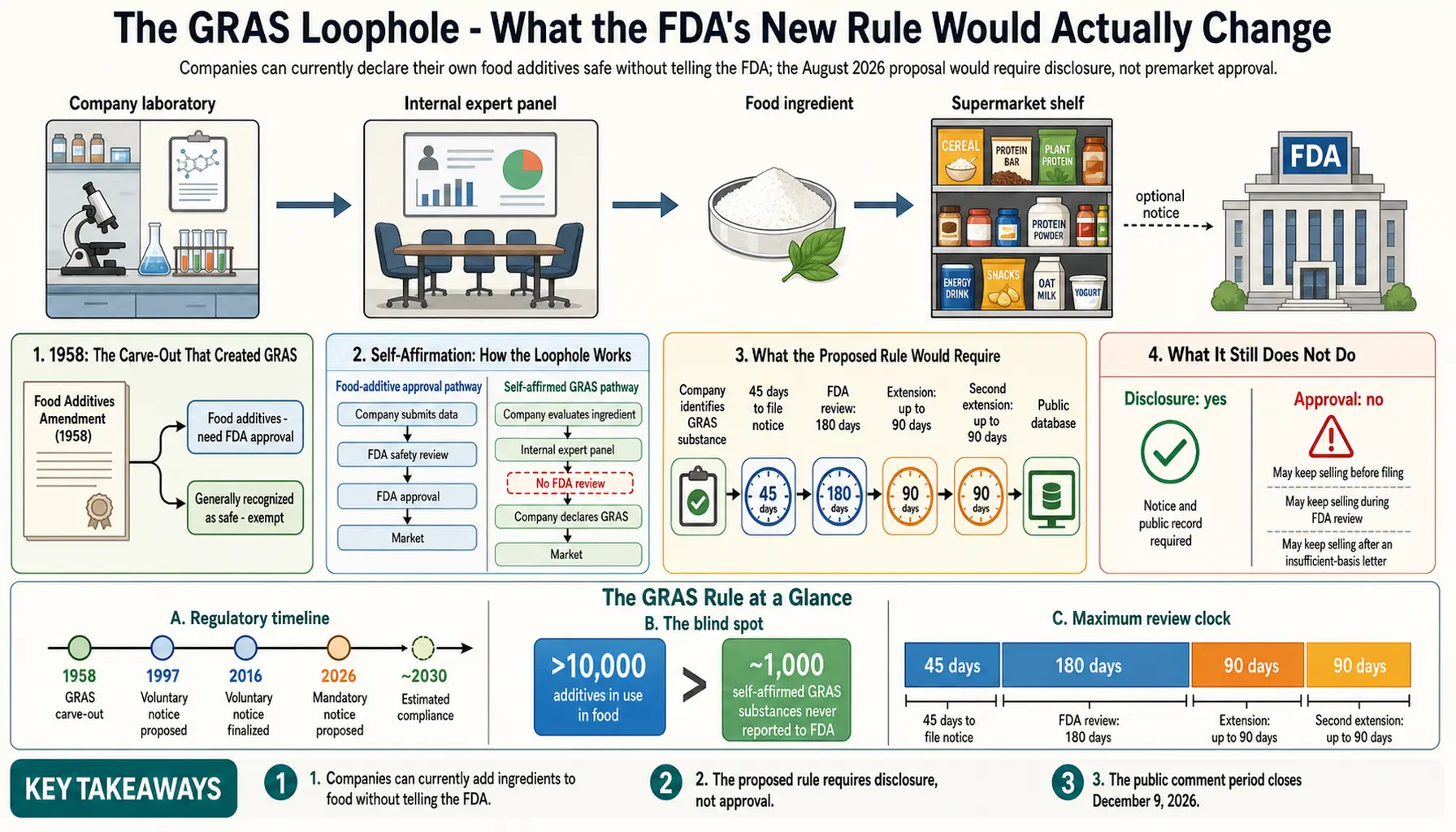
On August 10, 2026, the Department of Health and Human Services announced a proposed rule that would, for the first time in the sixty-eight years since Congress created the category, require food companies to tell the FDA when they decide on their own that an ingredient is safe. At an event at HHS headquarters, Health Secretary Robert F. Kennedy Jr. said the administration was closing the GRAS loophole “once and for all,” STAT reported.
The proposed rule itself describes something narrower. Its 140-page pre-publication text, filed for public inspection at the Federal Register on August 10, states that the mandatory notification program would “not establish a premarket review program for purportedly GRAS substances”: a company could still market such a substance before the FDA reviews it. The rule would require disclosure to the FDA; it would not require the FDA’s permission.
This article covers the mechanism critics call the GRAS loophole, what the proposal would and would not require, the consequence the rule sets out for a company that does not file, the legal questions food-regulatory lawyers have raised, and the timeline, for which one law-firm analysis expects a final rule no earlier than late 2028. A section describes the public comment process; the comment period closes December 9, 2026.
Table of Contents
- The Announcement at a Glance
- What GRAS Actually Is
- How a Grandfather Clause Became a Loophole
- How Big Is the Blind Spot?
- What the Proposed Rule Would Require
- The Streamlined Pathway for Ingredients Already on Shelves
- What the Rule Explicitly Does Not Do
- What Happens If a Company Does Not File
- The Legal Question: Can FDA Do This Without Congress?
- The Timeline: 2030 at the Earliest
- The Separate Ultra-Processed Food Announcement
- What Supporters and Critics Are Saying
- Key Points
- The Public Comment Process
- Sources and Primary Documents
- Key Research Papers
- Connections
- Featured Videos
The Announcement at a Glance
The formal document is a proposed rule titled “Substances Generally Recognized as Safe,” Docket No. FDA-2025-N-3262, RIN 0910-AJ02. It amends 21 CFR parts 170 (human food) and 570 (animal food). It was filed for public inspection on August 10 and published in the Federal Register on August 11, 2026, at 91 FR 51834–51881 (FR Doc. 2026-16296).
The proposal in six lines:
- Under current rules: a company can conclude on its own that a use of a new food ingredient is GRAS, put it in the food supply, and never tell the FDA. Notifying the FDA is voluntary.
- Under the proposal: notifying the FDA becomes required, and filed notices are posted in the FDA’s public GRAS Notice Inventory, as filed notices are today.
- Still not required: FDA permission. Companies may keep selling while the notice is pending, or before they file it at all.
- Consequence of not filing: the FDA would treat the omission as one factor when deciding which ingredients to review after they are already being sold.
- Estimated cost: about $10.5 million a year (annualized at a 3 percent discount rate; range $4.1 million to $24.6 million), counting costs to companies and to the FDA. STAT reported that the bulk would fall to companies.
- When: comments close December 9, 2026. A final rule would take effect 60 days after it is published, and the notice requirement would have a compliance date 18 months after that.
In one sentence: this is a disclosure rule, not a safety-approval rule. It would build a record of self-affirmed GRAS uses that the FDA says it lacks today; it would not create a premarket approval requirement for them.
What GRAS Actually Is
In 1958, Congress passed the Food Additives Amendment to the Federal Food, Drug, and Cosmetic Act. It created a premarket approval system for food additives: before a new additive could be used in food, its safety had to be shown to the FDA, and the FDA had to authorize it.
If “food additive” had meant anything added to food, then salt, vinegar, black pepper, baking soda and mustard seed would all have needed federal safety reviews, despite their long history of use.
So the 1958 amendment carved out an exception. A substance is not a “food additive” — and therefore does not need premarket approval — if it is generally recognized as safe among qualified experts, based on scientific procedures or, for a substance used in food before January 1, 1958, on experience based on common use in food. That is the GRAS category, defined in section 201(s) of the FD&C Act. FDA regulations give salt, pepper, vinegar, baking powder and monosodium glutamate as examples of common food ingredients the agency regards as safe for their intended use (21 CFR 182.1(a)).
The structural point the rest of the system follows from: GRAS is a legal status, not an FDA permission. A use of a substance is GRAS because qualified experts generally recognize it as safe, not because the FDA has approved it, and the statute does not require that the FDA be told when a company concludes that such recognition exists. The proposed rule adds that a company’s own conclusion “does not necessarily mean that such a use is GRAS,” and that the FDA may determine otherwise.
How a Grandfather Clause Became a Loophole
For a period, the FDA itself made the decision. It ran a GRAS affirmation petition process: a company petitioned, the FDA reviewed the science, and if it agreed it published a rule affirming the substance as GRAS. Those affirmations are still on the books in 21 CFR parts 184 and 186.
The 2026 proposed rule describes that framework as resource-intensive: each affirmation took a proposed rule and then a final rule — the full federal rulemaking process, for one ingredient.
So on April 17, 1997, the FDA proposed replacing affirmation petitions with something lighter: a voluntary notification program. Instead of asking permission, a company would tell the FDA “we have concluded this is GRAS, here is our reasoning,” and the FDA would send back a letter. That proposal was finalized on August 17, 2016.
The key word is voluntary. From 1997 onward, notification was optional, and not every company used it: the proposed rule cites an estimate of about 1,000 human food substances in use on the basis of GRAS conclusions that were never notified (see the next section). The practice acquired a name: self-affirmation, or self-GRAS. A manufacturer, often through an expert panel that it or a consultant selects, concludes that the ingredient is GRAS, the ingredient goes into the food supply, and the FDA is not told. Among 451 GRAS notices that companies did voluntarily submit to the FDA between 1997 and 2012, 64.3% of the safety assessments were made by an expert panel selected by the manufacturer or a consulting firm, and none by a standing panel selected by a third party (Neltner et al., 2013).
None of that is illegal; it is what the statute and the current regulations permit. That is why critics describe it as a loophole rather than a violation: the concern they raise is with the rules themselves, not with companies breaking them.
How Big Is the Blind Spot?
The FDA’s own answer is that it does not know, and the rule presents filling that gap as its purpose.
The proposal cites an estimate that as of January 2011, more than 10,000 additives were in use in food, including roughly 1,000 substances in human food for which companies had reached their own GRAS conclusions without ever notifying the FDA. The estimates come from a 2011 review of the U.S. food additive program (Neltner et al., 2011) and a 2013 Pew Charitable Trusts report. Those numbers are fifteen years old, and the FDA writes that it “cannot verify the accuracy of these estimates.”
The rule states that the agency “lack[s] a complete understanding of the number of substances currently on the market based on an independent conclusion of GRAS status,” and that this gap “prevents us from efficiently sharing knowledge and providing transparency to others, such as state regulators, food manufacturers, and consumers.”
It also states that firms introduce substances “without publicly disclosing the underlying safety information,” and the FDA “sometimes becomes aware of the need to take action regarding unsafe substances in food only after adverse public health events occur.”
In the FDA’s description, then, the agency sometimes learns that an ingredient is unsafe only after people have been harmed. Closing that information gap is the purpose the rule states for itself.
What the Proposed Rule Would Require
In summary, the proposal does five things.
1. It flips voluntary to mandatory. A rewritten section 170.205 would require anyone introducing a purportedly GRAS substance into interstate commerce to submit a GRAS notice explaining the basis for that conclusion, unless an exception applies. The parallel provision at 570.205 covers animal food, including feed for animals that produce meat, milk and eggs.
2. It covers indirect additives too. The requirement reaches substances added directly to food and substances that migrate into food from packaging — the food-contact materials category. That scope had been in question: a July 2026 law-firm analysis noted that the 2026 regulatory agenda entry for the rule no longer carried the Spring 2025 entry’s language on substances added indirectly, such as from food packaging.
3. It keeps the notices public and tightens confidentiality claims. Filed notices and the FDA’s response letters would continue to be posted in the FDA’s online GRAS Notice Inventory, with trade secrets and confidential commercial information withheld under the Freedom of Information Act and the FDA’s disclosure rules. Under proposed § 170.250(d), data a notifier does not identify as exempt from disclosure would be treated as not exempt. Under proposed § 170.250(e), a notifier would have to explain how there could be a basis for a GRAS conclusion for any non-public, safety-related data it identifies as exempt, given that qualified experts do not have access to such data; the FDA describes this as connecting more clearly an explanation the current rule already requires.
4. It sets review clocks. The FDA would complete an initial evaluation within 45 days to decide whether a submission is adequate to file as a GRAS notice (a new time limit), and the existing rule’s 180-day period for a substantive response after filing would remain. The proposal adds a second 90-day extension on top of the existing one, so a response could take up to 360 days after filing. The FDA gives its reason as “the expected increase in the number of GRAS notices if this rule is finalized.”
5. It tidies adjacent machinery. Electronic submission becomes mandatory, English translations are required for foreign-language supporting material, and the Threshold of Regulation exemption is updated.
The proposal lists exceptions. No new notice would be required for a use already covered by an FDA “no questions” letter for the same conditions of use, or for a substance listed or affirmed as GRAS for that use in parts 182, 184 or 186. Other exceptions cover long-standing foods of natural biological origin widely consumed before 1958 (21 CFR 170.30(d)), uses already considered through certain established FDA consultation or review programs, and uses filed through the streamlined pathway described below.
The Streamlined Pathway for Ingredients Already on Shelves
The estimated thousand or so ingredients already in the food supply on a self-affirmed basis present a practical problem, which the rule acknowledges: requiring full GRAS notices for all such uses “would likely overburden” the FDA’s resources for evaluating them.
The proposal’s answer is a time-limited streamlined submission. For one year after a final rule’s effective date, a company with an already-marketed self-affirmed use could file a short submission instead of a full notice: the submitter’s name and address, the name of the substance, its conditions of intended use (the foods, use levels and purposes), and evidence that it was already in interstate commerce for that use. The list of required contents does not include the underlying safety data. The pathway would not be open to uses that are the subject of an FDA “insufficient basis” letter or that the FDA has already found not to be GRAS.
This pathway is where most of the public list of already-marketed self-affirmed uses would come from. The FDA would post the information publicly, and the rule states that the posting “does not mean that we have reviewed the GRAS status” of the use; the agency could later require a full GRAS notice or a food additive petition. A streamlined listing records that an ingredient use exists; it is not a finding that the use is safe.
What the Rule Explicitly Does Not Do
The proposed rule states directly:
“[T]he proposed GRAS notification program generally, and proposed § 170.205(a), do not establish a premarket review program for purportedly GRAS substances… a company may continue marketing a purported GRAS substance before submitting a GRAS notice or after submitting a GRAS notice before it is filed by FDA. Similarly, a company may reach a GRAS conclusion about a new use of a substance and introduce the substance into interstate commerce before submitting a GRAS notice.”
Under that text, a company could:
- Decide internally that a new use of a substance is GRAS;
- Put it in food and start selling nationwide;
- File the notice afterwards;
- Keep selling while the FDA reviews it;
- Still be counted as having met the notice requirement if the FDA answers with an “insufficient basis” letter; the rule says such a response would be relevant to whether the substance is an unapproved food additive and “would inform any post-market action” against it.
The rule ties this to the statute. Section 201(s) of the FD&C Act says a GRAS substance is not a food additive, and section 409 — the premarket approval machinery — applies only to food additives. A use that is in fact GRAS is therefore outside premarket approval; the FDA’s route is to challenge a GRAS conclusion after the fact, by determining that a use is not GRAS and is an unapproved food additive. Acting FDA Commissioner Kyle Diamantas told reporters that the proposal would not establish “pre-market approval,” and STAT reported that Congress would need to amend the Federal Food, Drug, and Cosmetic Act to give the FDA that power.
Secretary Kennedy described the loophole as being closed “once and for all.” The rule’s text describes a requirement to disclose self-affirmed GRAS uses to the FDA, with premarket approval unchanged; STAT wrote that the announcement “stops short of closing the loophole.”
What Happens If a Company Does Not File
The consequence for a company that does not file appears in the rule’s own summary of its major provisions. According to the proposal, the FDA “would consider such noncompliance as a factor in its prioritization of food substances for post-market review.”
That is the consequence the rule states. It does not describe a fine, a recall or a presumption that an unnotified substance is unlawful; the unnotified use becomes a higher priority for review at some later date.
Peter Lurie, president of the Center for Science in the Public Interest and a former FDA associate commissioner, said in a statement that it is unclear how the FDA would enforce a provision the administration calls “mandatory,” adding: “Mandatory without enforcement is not mandatory at all.”
Product-liability litigation is a separate check on food ingredients in the United States, outside the rule. It operates after harm has occurred — the same timing problem the FDA cites as a reason for the rule.
The Legal Question: Can FDA Do This Without Congress?
The FDA cites sections 201, 402, 409 and 701 of the FD&C Act as its authority. The load-bearing one is section 701(a), which lets the Secretary issue regulations “for the efficient enforcement” of the Act. The argument runs: to enforce the food-additive provisions, the FDA needs to know which substances are claiming the GRAS exemption, so requiring notice is efficient enforcement.
Food-regulatory lawyers have raised three questions about that argument (Venable LLP, July 2026).
First, the FDA has previously taken the opposite position. Responding to comments in its 2016 final rule, the agency wrote: “We agree that we lack express statutory authority to require companies to submit GRAS notices” (81 FR 54960, at 54981–54982). An earlier position does not bind an agency, but a challenger can cite it.
Second, Congress has required notification elsewhere and not here. In the Food and Drug Administration Modernization Act of 1997, Congress mandated premarket notification for food-contact substances but did not impose the same requirement on GRAS substances, an omission the lawyers’ analysis calls conspicuous.
Third, the deference standard has changed. Loper Bright Enterprises v. Raimondo (2024) overruled Chevron deference, so a court reviewing this rule would decide for itself what the statute means rather than deferring to the FDA’s reading. The same analysis describes this as weakening the reasoning of a 2021 court decision that had upheld the voluntary program under Chevron deference.
Whether a final rule would survive a court challenge is an open question.
The Timeline: 2030 at the Earliest
The intervals the proposal specifies, with one law firm’s estimate for the final rule:
- August 11, 2026 — proposed rule published.
- December 9, 2026 — public comment period closes (120 days). Late comments will not be considered.
- Then: the FDA reviews the comments and responds to significant ones in any final rule; for a rule of this size, the Venable analysis says this “typically takes 12 to 24 months or longer.”
- Final rule: “unlikely before late 2028 or 2029 at the earliest,” in the same analysis. Legal challenges could add time.
- Effective date: 60 days after the final rule publishes.
- Compliance date: 18 months after the effective date.
On those intervals, the notice requirement would not apply before about 2030, and then only if a final rule is published on that schedule and survives any court challenge. Streamlined submissions for already-marketed uses would be due within one year of the effective date, and the public list would fill in from them.
These intervals are the standard sequence of notice-and-comment rulemaking. As a proposal, the rule has no legal effect, and nothing in the food supply is required to change because of it before a final rule takes effect.
The Separate Ultra-Processed Food Announcement
The same day, HHS and the U.S. Department of Agriculture announced that they had submitted for final review the federal government’s first proposed definition of “ultra-processed food”. This is a separate action from the GRAS rule and is at an earlier stage: the federal regulatory review website lists it as a white paper, and its text was not released with the announcement.
HHS gave its reason as “the absence of a standardized federal definition has limited research consistency across the federal government.” Much of the nutrition research on ultra-processed foods uses the NOVA classification, developed by researchers at the University of São Paulo, which groups foods by the extent and purpose of industrial processing (Monteiro et al., 2019). NOVA is a research classification, not a U.S. regulatory standard, and where its boundaries fall is debated. A federal definition could give school-meal standards, food-assistance rules and labeling requirements a common reference.
Industry objections came the same day. Rhonda Bentz, executive vice president of public affairs at the Consumer Brands Association, said in a statement quoted by FoodNavigator that “any so-called definition that captures 80% of the nation’s food supply while picking winners and losers is fundamentally flawed, not based on sound science and politically motivated.”
On the research side, a 2024 umbrella review of 45 pooled analyses from epidemiological meta-analyses graded as convincing the evidence for associations between greater ultra-processed food exposure and higher risks of cardiovascular disease-related death and of type 2 diabetes, while rating most of the pooled analyses low or very low quality under the GRADE system (Lane et al., 2024); these are observational associations. Under NOVA, a product is identified as ultra-processed when its ingredient list contains at least one item characteristic of the group, such as high-fructose corn syrup, hydrogenated oils, or additives such as flavours, emulsifiers and sweeteners (Monteiro et al., 2019), so the group spans many different kinds of products. Where a federal definition draws its line will determine which products it covers.
What Supporters and Critics Are Saying
Reactions came from officials, researchers, advocacy groups and an industry association.
Acting FDA Commissioner Kyle Diamantas framed it as a visibility fix: “By proposing mandatory GRAS notifications, we are closing critical information gaps and giving the FDA greater visibility into substances entering the food supply.”
Dariush Mozaffarian of Tufts University, a cardiologist and nutrition researcher, told the crowd at the HHS event that the two policies — “defining ultra-processed food and closing the GRAS loophole” — rank among the FDA’s most consequential nutrition actions in 50 years, STAT reported.
Jennifer Pomeranz, a public health lawyer at NYU’s School of Global Public Health, told STAT the proposal marked a “significant change,” making the point that the FDA has no method to identify self-GRAS ingredients, and so to review them after they reach the market, without such a requirement.
Vani Hari, a food activist who has advised the administration on food policy, called it “a major step forward,” with its biggest benefit being “transparency, so we can know what we are eating,” STAT reported.
Among the critics, Marion Nestle, professor emerita of nutrition, food studies, and public health at NYU, wrote to FoodNavigator: “My immediate reaction was ‘that’s all?’” — adding that companies “can still put what they like into the food supply until the FDA gets around to considering the notification.” STAT reported that she also questioned whether the FDA has the staff to review the notices, after the agency’s ranks, including in food-related divisions, were thinned the previous year.
Melanie Benesh, vice president for government affairs at the Environmental Working Group: “But true GRAS reform requires more than mandatory notification. It must also include strong, science-based safety standards and thorough, independent FDA review before chemicals are allowed in our food.”
David Kessler, FDA Commissioner under Presidents George H. W. Bush and Clinton, told STAT that the proposals “do not tackle the root causes of chronic diseases,” because they would not address the refined carbohydrates and sweeteners found in many ultra-processed foods and linked to metabolic disease. “They’re not even tackling what’s in the food supply today,” he said.
And from industry, the International Food Additives Council, which represents ingredient makers and food manufacturers, said in a statement that “there has never been a loophole,” while saying its “members are ready to work with the agency.”
Key Points
In the near term the proposal changes nothing in the food supply: it is not final, and no ingredient is removed, no label changes and no product is recalled because of it.
Several points follow from the rule’s own text.
The current system works as critics have described it. The claim that companies can add substances to food without telling the FDA is accurate under current law: the proposal states that a company that concludes a use is GRAS “may, but is not required to, notify FDA,” and it cites an estimate of about 1,000 human food substances in use on that basis.
Transparency and safety are different things. The FDA says a mandatory program would give it, state regulators and the public more information, and an “earlier opportunity” to engage with companies when questions arise about a GRAS conclusion. A notice or a listing does not by itself remove an ingredient or establish that it is safe.
Whole foods sit outside the GRAS question. A whole, single-ingredient food such as an apple has no GRAS filing; added substances, including self-affirmed ones, reach the diet through formulated and packaged foods. Individual additives and the research on them are covered on the food additives page, and US vs EU food safety regulation describes how an ingredient banned in Europe can be legal in a US product, and the part the GRAS pathway plays in that difference.
The comment period is open. Comments on the proposal are accepted until December 9, 2026 (next section).
The Public Comment Process
In notice-and-comment rulemaking, an agency must consider the comments it receives, and it responds to significant comments when it issues a final rule.
- Where: regulations.gov
- Docket number: FDA-2025-N-3262 (“Substances Generally Recognized as Safe”)
- Deadline: 11:59 p.m. Eastern, December 9, 2026. The proposal states plainly that “late, untimely filed comments will not be considered.”
- Direct link to the rule: federalregister.gov/d/2026-16296
The rule states that electronic comments are posted to the docket unchanged, including any name, contact information or other identifying information placed in the body of a comment, and that comments containing confidential information can instead be submitted on paper under its confidential-submission instructions. The proposal specifically asks for comment on alternatives that could reduce regulatory burden — for example, allowing streamlined submissions for all substances purported to be GRAS — and on its proposed 45-day pre-filing period and second 90-day review extension.
Sources and Primary Documents
The regulatory details, quoted rule text, dates, cost figures and statutory citations in this article were checked against the proposed rule as published in the Federal Register and, for the 2016 statement on statutory authority, against the 2016 final rule. Quotes from named individuals are attributed to the outlet or statement that reported them.
- U.S. Food and Drug Administration. Substances Generally Recognized as Safe. Proposed rule, 21 CFR Parts 170 and 570, Docket No. FDA-2025-N-3262, RIN 0910-AJ02. Federal Register 91 FR 51834–51881, August 11, 2026 (FR Doc. 2026-16296). federalregister.gov/d/2026-16296
- U.S. Department of Health and Human Services. Secretary Kennedy Announces Landmark Food Policy Reforms to Advance President Trump's MAHA Agenda. August 10, 2026. hhs.gov
- Cueto I, Cooney E. FDA to require notice of additives in food supply for the first time. STAT News, August 10, 2026. statnews.com
- Inklebarger T. HHS proposes new GRAS rules and addresses UPF definition. FoodNavigator, August 10, 2026. foodnavigator.com
- Henderson B. FDA Proposes Mandatory GRAS Notifications for Ingredients Introduced to U.S. Food Supply. Food Safety Magazine, August 10, 2026. food-safety.com
- Center for Science in the Public Interest. RFK Jr. leaves GRAS loophole ajar. Statement of CSPI President Peter G. Lurie, August 10, 2026. cspi.org
- Venable LLP (Harrison TA, Smith T). New Details Emerge on FDA's GRAS Rulemaking: Updated Timeline, Narrower Scope, and Open Questions on Statutory Authority. July 16, 2026. venable.com
- Food Additives Amendment of 1958, Pub. L. 85-929, 72 Stat. 1784. Codified at sections 201(s) and 409 of the Federal Food, Drug, and Cosmetic Act.
- U.S. Food and Drug Administration. Substances Generally Recognized as Safe. Final rule establishing the voluntary GRAS notification program, 81 FR 54960, August 17, 2016 (Response 28, at 81 FR 54981–54982, on statutory authority).
- U.S. Food and Drug Administration. Substances Generally Recognized as Safe. Proposed rule replacing GRAS affirmation petitions with voluntary notification, 62 FR 18938, April 17, 1997.
- Loper Bright Enterprises v. Raimondo, 603 U.S. 369 (2024).
Key Research Papers
Papers behind the figures and research findings in this article, in the order they are used; each was checked against PubMed or Crossref. The regulatory documents themselves are listed under Sources and Primary Documents.
- Neltner TG, Alger HM, O'Reilly JT, Krimsky S, Bero LA, Maffini MV (2013). Conflicts of interest in approvals of additives to food determined to be generally recognized as safe: out of balance. JAMA Internal Medicine 173(22):2032-2036. — PubMed PMID: 23925593
- Neltner TG, Kulkarni NR, Alger HM, Maffini MV, Bongard ED, Fortin ND, Olson ED (2011). Navigating the U.S. Food Additive Regulatory Program. Comprehensive Reviews in Food Science and Food Safety 10(6):342-368. — DOI: 10.1111/j.1541-4337.2011.00166.x
- Monteiro CA, Cannon G, Levy RB, Moubarac JC, Louzada ML, Rauber F, et al. (2019). Ultra-processed foods: what they are and how to identify them. Public Health Nutrition 22(5):936-941. — PubMed PMID: 30744710
- Lane MM, Gamage E, Du S, Ashtree DN, McGuinness AJ, Gauci S, et al. (2024). Ultra-processed food exposure and adverse health outcomes: umbrella review of epidemiological meta-analyses. BMJ 384:e077310. — PubMed PMID: 38418082
PubMed Topic Searches
Connections
- Food Additives — what's really in your food
- Banned Additives — legal in the US, banned elsewhere
- US vs EU Food Safety — the regulatory contrast
- Ultra-Processed Foods — the NOVA classification
- Artificial Food Dyes
- Red Dye No. 3 — the additive that was withdrawn
- Food Preservatives
- Artificial Sweeteners
- Titanium Dioxide — banned in the EU, legal here
- Potassium Bromate
- Brominated Vegetable Oil
- Carrageenan — a self-affirmed GRAS case study
- TBHQ
- Toxins — category index
- News Archive