— May 11, 2026
· Methylene Blue and the Kidneys
— May 11, 2026
· Methylene Blue and the Kidneys
Table of Contents
- Methylene Blue and the Kidneys: A Double-Edged Story
- Why Kidneys Are Central to Methylene Blue Pharmacology
- 1. Septic Shock — An Early Human Kidney Signal
- 2. Living Donor Liver Transplant AKI (2026)
- 3. Renal Ischemia–Reperfusion Injury (Animal Models)
- 4. Cisplatin-Induced Nephrotoxicity
- 5. Cyclosporine-Induced Renal Injury
- 6. The Dark Side — AKI and Toxicity Case Reports
- 7. Vasoplegia, Cardiac Surgery, and the Renal-Perfusion Question
- Mechanism: Why Methylene Blue Acts on the Kidney at All
- Dosing in Renal Impairment — What the FDA Label Says
- Key Points: What This Body of Evidence Shows
- Key Research Papers
- Related Articles on MyHealthcare.com
- Featured Videos
Methylene Blue and the Kidneys: A Double-Edged Story
Methylene blue (methylthioninium chloride, MB) is one of the oldest synthetic drugs in continuous medical use — synthesized in 1876 by Heinrich Caro as a textile dye, approved by the United States Food and Drug Administration to treat acquired methemoglobinemia (under accelerated approval, according to the current label), used off-label in critical care, and studied for mitochondrial, cognitive, and ageing-related effects. Over the past two decades, a body of literature has examined its effects specifically on the kidneys: in sepsis, in transplantation, in ischemia–reperfusion injury, in chemotherapy-induced nephrotoxicity, in cyclosporine toxicity, and — importantly — in case reports of acute kidney injury (AKI) linked to methylene blue itself.
Taken as a set, the literature does not tell a clean “methylene blue is kidney-protective” story. It tells a more nuanced one. In specific injury models — septic shock (in one small human study), reperfusion after ischemia, cisplatin-induced tubular toxicity, and cyclosporine toxicity (in rodents) — methylene blue reduced biochemical and histological markers of renal injury. In other contexts — G6PD deficiency, high doses, and pre-existing renal impairment — it has been linked to hemolysis with AKI, to methemoglobinemia, and to higher drug exposure, because about 40 percent of a dose is excreted unchanged in urine. This edition pulls those threads together: nine papers, the proposed mechanisms, and what the current FDA label for methylene blue 0.5% injection says about kidney function.
For readers tracking the broader methylene blue story, this edition is the kidney complement to the existing Methylene Blue hub, which covers mitochondrial bioenergetics, cognitive research, the serotonin-syndrome warning, G6PD deficiency, and the difference between pharmaceutical-grade and industrial-dye products. None of that is repeated here. Everything below is about the kidney.
Why Kidneys Are Central to Methylene Blue Pharmacology
Before the studies, the pharmacology. Three points anchor every kidney finding that follows.
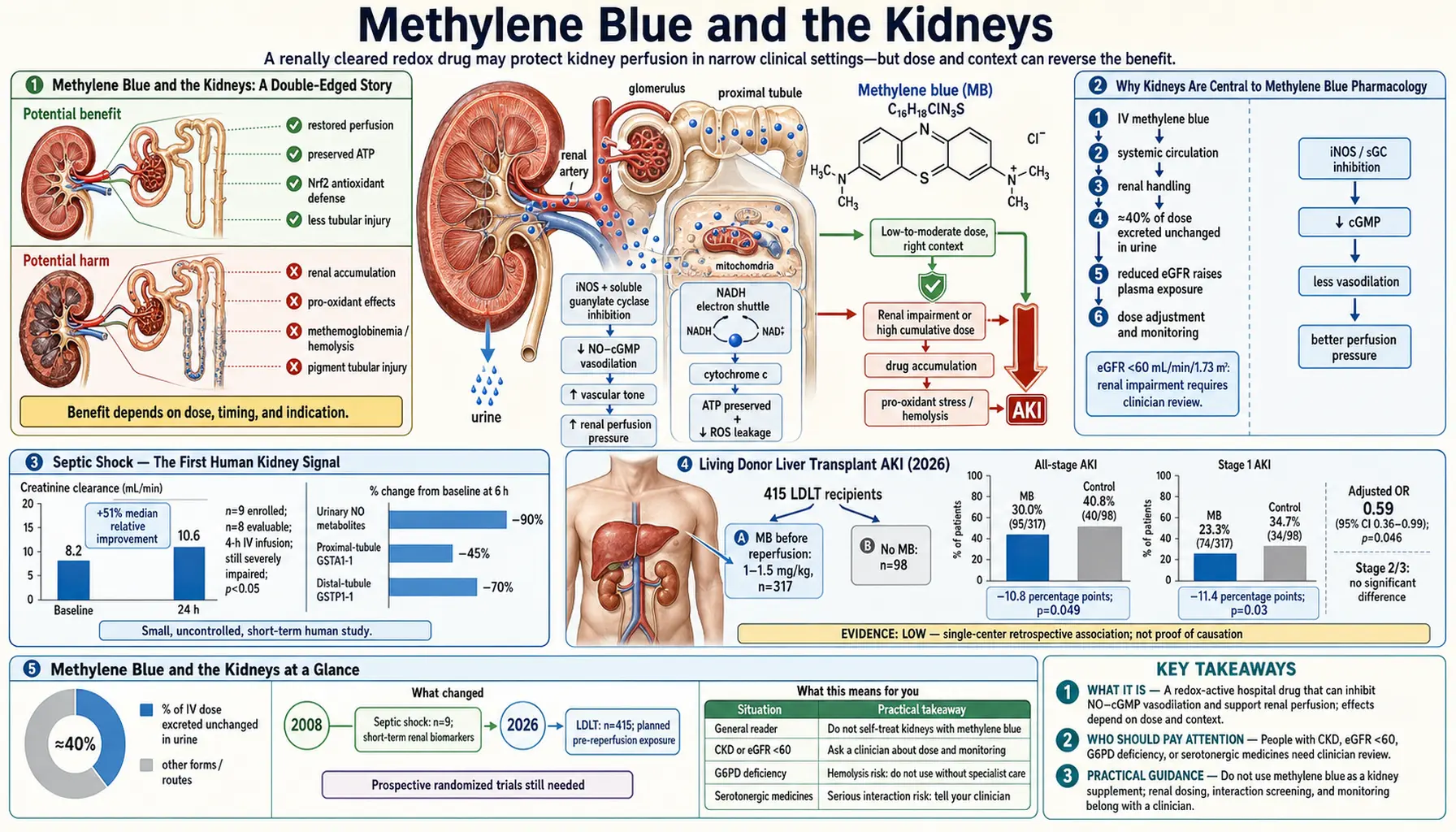
First, methylene blue is heavily renally excreted. The current FDA prescribing information for methylene blue 0.5% injection reports that approximately 40 percent of methylene blue is excreted into the urine unchanged; the drug is also extensively metabolized in the liver, and its half-life is about 24 hours. This is why methylene blue turns urine blue-green, and why kidney function affects drug exposure. After a single 1 mg/kg dose, the label reports exposure (AUC) 52%, 116%, and 192% higher in mild, moderate, and severe renal impairment, and it gives a reduced dosage for moderate and severe impairment.
Second, methylene blue acts on several pathways the kidney is sensitive to. In laboratory work it directly inhibits nitric oxide synthase and, much less potently, soluble guanylate cyclase — the nitric oxide–cGMP pathway behind vasodilation in distributive shock. In the mitochondrial electron transport chain it can reroute electrons from NADH directly to cytochrome c, increasing complex IV activity — a property studied mostly in brain and cell-culture research, and potentially relevant to proximal tubular cells, whose energy demand is high. In a 2023 mouse study it activated the Nrf2 antioxidant pathway in kidney tissue and raised expression of genes that repair mitochondrial DNA (mtDNA). The kidney is, in effect, an organ on which methylene blue has several simultaneous handles — some helpful, some potentially harmful depending on dose and context.
Third, the kidney is a redox-sensitive organ. The proximal tubule has a high oxygen demand, and oxidative stress is implicated in sepsis-, ischemia-, contrast-, cisplatin-, cyclosporine-, and aminoglycoside-associated AKI. Methylene blue’s dose–response has been described as hormetic: in a 2008 review, responses rise at low doses and fall below control at higher doses — for example, cytochrome oxidase activity increases at intermediate doses and decreases at higher ones. A drug with that profile can be expected to act differently on the kidney depending on where a given dose lands, which may account for part of the disagreement in the literature.
1. Septic Shock — An Early Human Kidney Signal
Heemskerk and colleagues at Radboud University Nijmegen Medical Centre in the Netherlands reported in 2008 (published online in October 2007) a prospective study of methylene blue’s short-term effect on kidney damage in distributive shock. The team enrolled nine patients with refractory septic shock (mean arterial pressure of 70 mmHg or less despite norepinephrine at 0.2 µg/kg per minute or more) and gave each a four-hour continuous intravenous infusion of methylene blue at 1 mg/kg per hour. They measured urinary nitric oxide metabolites, two urinary tubular injury markers, and creatinine clearance.
Three findings stand out. Urinary excretion of nitric oxide metabolites fell by a median 90% (range 75–95%) from baseline to six hours, consistent with inhibition of the nitric oxide pathway. Markers of tubular injury — urinary glutathione S-transferase A1-1 and P1-1, which signal proximal and distal tubule damage respectively — fell by 45% and 70% during the first six hours. And creatinine clearance over the first 24 hours improved by 51% (range 18–173%), although it remained strongly impaired. After the infusion ended, the nitric oxide metabolites and tubular injury markers returned to pre-treatment levels. The full text reports that neither methemoglobinemia nor hemolytic anemia developed.
The study is small, uncontrolled, and short-term, and its authors describe an association rather than a proven kidney benefit. It is a human biochemical demonstration that methylene blue, infused in septic shock, was followed by a fall in the specific kidney-injury signals that shock produces. Reviews of methylene blue in shock have focused on blood pressure and survival rather than the kidney: a 2006 systematic review by Kwok & Howes (published before this study) found that it raises mean arterial pressure and systemic vascular resistance and lowers vasopressor requirements, with effects on mortality not adequately evaluated; Pasin and colleagues’ 2013 meta-analysis of randomized trials in hypotensive patients is described in section 7.
2. Living Donor Liver Transplant AKI (2026)
The newest paper in this set is a 2026 single-center retrospective study from the University of Pittsburgh (Katayama and colleagues) of 415 adults who underwent living donor liver transplantation (LDLT) between January 2018 and June 2023. Of these, 317 received an intravenous bolus of 1–1.5 mg/kg methylene blue just before graft reperfusion and 98 did not. The premise: graft reperfusion can trigger distributive vasoplegia, the resulting systemic vasodilation lowers renal perfusion pressure, and the proximal tubule — already exposed to intraoperative hypoperfusion and inflammatory cytokine release — is at risk. The authors hypothesized that giving methylene blue before reperfusion, which inhibits NO–cGMP signaling, would lower the incidence of postoperative AKI.
Using KDIGO staging, AKI of any stage occurred in 30.0% of the methylene blue group versus 40.8% of controls (p = 0.049), and stage 1 AKI in 23.3% versus 34.7% (p = 0.03). Stage 2 and stage 3 AKI were similar between the groups. In multivariable analysis, methylene blue was independently associated with a lower incidence of stage 1 AKI (odds ratio 0.59, 95% CI 0.36–0.99). Early allograft dysfunction was also less frequent in the methylene blue group, while hospital stay and mortality at 30 days, 6 months, and 1 year did not differ. Post-reperfusion hemodynamics were similar in the two groups, so the study did not show the blood-pressure effect its premise relied on. The authors describe theirs as the first study to show this association in LDLT; being retrospective, it shows an association, not cause and effect.
The study’s design point is timing: methylene blue was given before a predictable insult rather than after organ injury was already under way. No prospective randomized trial of this use has been published.
3. Renal Ischemia–Reperfusion Injury (Animal Models)
The ischemia evidence in this set comes from rodent and laboratory models of renal ischemia–reperfusion injury (IRI) — the experimental analog of what happens during transplant cold ischemia, prolonged surgical cross-clamping, and in some cardiac arrest survivors. In these models the renal blood supply is clamped for a defined interval, then released; the resulting tissue captures the dual injury of oxygen deprivation followed by a burst of reoxygenation.
In a 2018 mouse study from Xiangyang Central Hospital in Hubei, China (PubMed PMID: 29771438), 30 male mice were divided into sham, ischemia, and methylene blue groups; the methylene blue group received it by mouth (25 mg/kg per day) from 4 to 7 months of age, after which both renal pedicles were clamped for 45 minutes. Compared with untreated ischemia, the methylene blue group had lower serum creatinine and BUN, less tubular necrosis, lower IL-1β and IL-18, higher IL-10 and TGF-β1, higher superoxide dismutase activity, and lower malondialdehyde, a lipid-peroxidation marker. The mechanism the authors emphasize is inflammatory: methylene blue reduced expression of NLRP3 inflammasome pathway proteins (NLRP3, NF-κB, caspase-1), and they conclude that it alleviated the apoptosis and inflammatory response caused by the injury.
A second paper in this set (PubMed PMID: 9815837) is not an ischemia study. It is a 1997 human study in Clinical Cancer Research that used urinary proton nuclear magnetic resonance spectroscopy to track kidney toxicity from the chemotherapy drug ifosfamide. Methylene blue appears in it only as a treatment for ifosfamide encephalopathy, and it did not reverse the neurotoxicity in the two patients who received it; the paper offers no evidence on methylene blue and kidney ischemia. An older laboratory line of work does: in 1991, Salaris and colleagues proposed methylene blue as an alternative electron acceptor for xanthine oxidase, reducing superoxide formation, and reported that it prevented free-radical damage to liver and kidney tissue in an in vitro model of ischemia and reoxygenation.
Together these papers describe a pattern seen in animal and laboratory models: methylene blue reduced the inflammatory, oxidative, and apoptotic consequences of renal ischemia. Whether that effect carries over to people — in transplantation, cardiac arrest, or cardiopulmonary bypass — has not been tested in kidney ischemia itself; the 2026 liver-transplant cohort is an observational association in a related setting.
4. Cisplatin-Induced Nephrotoxicity
Cisplatin is one of the most widely used and highly effective drugs for solid tumors, and nephrotoxicity is its best-known and most clinically important toxicity. A 2014 review puts cisplatin nephrotoxicity at approximately one-third of treated patients, despite pre-hydration and diuretics, and names oxidative stress, DNA damage, and inflammatory responses among its mechanisms; mitochondria and mtDNA are further targets. Research has long looked for agents that reduce renal injury without lowering antitumor activity, and methylene blue is one candidate studied in animals.
A 2022 rat study (PubMed PMID: 35483196) of 28 male rats in four groups gave a single 5 mg/kg dose of cisplatin followed by intraperitoneal methylene blue at 4 mg/kg for seven days. Serum creatinine and blood urea nitrogen (BUN), which rose significantly with cisplatin alone, showed no significant rise in the methylene blue plus cisplatin group compared with controls. Kidney tissue injury was significantly lower, glomerular size recovered, and expression of caspase-3, an apoptosis marker, fell on immunostaining.
A 2023 mouse study (PubMed PMID: 37047089) asked how. Mice received oral methylene blue (15 mg/kg per day) for three weeks, with cisplatin injections during the last week, alongside experiments on isolated kidney mitochondria. Cisplatin strongly damaged renal mtDNA. Methylene blue itself increased mitochondrial hydrogen peroxide production, which the authors propose activates Nrf2/ARE signaling — Nrf2 is the master transcription factor controlling the expression of glutathione synthesis enzymes, superoxide dismutases, and other antioxidant proteins. Methylene blue raised the expression of antioxidant genes and of base-excision-repair genes, the main pathway for repairing mitochondrial DNA (mtDNA), and pre-treatment prevented the cisplatin-induced mtDNA lesions. The authors present the Nrf2 link as a likely explanation rather than a proven one. Because mitochondria and mtDNA are important targets of cisplatin nephrotoxicity, this is a direct mechanistic link.
The clinical translation has not happened. No randomized trial of methylene blue as a cisplatin kidney protectant in people has been published. Kidney protection used with cisplatin rests on pre-hydration, and in a 1996 randomized trial of 242 patients with advanced ovarian cancer, amifostine pretreatment reduced protracted serum creatinine elevations and losses of creatinine clearance without reducing antitumor efficacy. The animal data on methylene blue are consistent and mechanistically coherent; they are not evidence of benefit for people receiving cisplatin.
5. Cyclosporine-Induced Renal Injury
Cyclosporine A, the calcineurin inhibitor that revolutionized organ transplantation in the 1980s, has a well-characterized dose-related nephrotoxicity profile. Chronic cyclosporine causes afferent arteriolar vasoconstriction, ischemic tubular injury, and ultimately interstitial fibrosis — the same kind of injury pattern that ultimately limits transplant graft longevity for many recipients.
A 2001 rat study from the University of Brescia (PMID 11598398) gave Wistar rats cyclosporine (15 mg/kg per day under the skin) with or without intraperitoneal methylene blue (1 mg/kg per day) for 21 days. Cyclosporine alone caused degenerative tubulointerstitial changes in the renal cortex and raised superoxide, NADPH-diaphorase, and iNOS staining; methylene blue given with it prevented those changes, preserved the structural and enzymatic integrity of the kidney, and did not blunt cyclosporine’s immunosuppressive effect on the thymus. The authors state that the mechanism is not yet clear and point to methylene blue’s ability to inhibit xanthine oxidase and to quench nitric oxide production.
This is older work, and it has not been replicated in human transplant cohorts. Its current value is conceptual: it extends the protective pattern seen in cisplatin and IRI models to a third, mechanistically distinct nephrotoxin — in animals. Whether methylene blue has any role alongside calcineurin-inhibitor therapy in people, including those with early chronic allograft nephropathy, is an open and untested question.
6. The Dark Side — AKI and Toxicity Case Reports
The literature on methylene blue and the kidneys also records harm. Two case reports in this set describe it.
The first, a 2017 report (PubMed PMID: 29217886), describes a patient treated with methylene blue for symptomatic nitrobenzene poisoning. Nitrobenzene is one of the classic causes of severe methemoglobinemia — the iron in hemoglobin is oxidized from Fe2+ to Fe3+, which cannot bind oxygen — and methylene blue is its standard antidote: the drug is converted to leucomethylene blue, which reduces methemoglobin back to functional hemoglobin. After treatment the patient developed methemoglobinemia with acute kidney injury due to hemolysis, and further testing showed glucose-6-phosphate dehydrogenase (G6PD) deficiency. He was treated with repeated blood transfusions and ascorbic acid with dialysis support, and responded. The authors conclude that G6PD deficiency is important to evaluate wherever methylene blue is planned as an antidote to nitrobenzene poisoning. The FDA label adds that methylene blue may not be effective in G6PD deficiency, that treating these patients may result in severe hemolysis and severe anemia, and that large doses can themselves produce methemoglobinemia and hemolysis (figures in the dosing section below).
The second, from 1986 (PubMed PMID: 3487723), is a short report of phenazopyridine poisoning whose title raises the “possible toxicity of methylene blue administration in renal failure”; PubMed indexes no abstract, so its case details are not summarized here. The concern it names fits the drug’s pharmacokinetics: with about 40 percent excreted unchanged in urine, reduced glomerular filtration raises exposure, and the current FDA label reports exposure (AUC) 192% higher in severe renal impairment after a single 1 mg/kg dose. The label’s dosage for moderate or severe renal impairment (eGFR 15–59 mL/min/1.73 m2) is a single 1 mg/kg dose.
The FDA label documents further kidney- and monitoring-related effects. Methylene blue in the blood may cause pulse oximetry to underestimate oxygen saturation; the label describes arterial blood testing by another method when a measurement is needed during or shortly after infusion. Treatment of patients with G6PD deficiency may result in severe hemolysis and severe anemia; hemolysis releases cell-free hemoglobin, the route to kidney injury in the 2017 case. And because the dye passes freely into the urine, it may interfere with urine tests that rely on a blue indicator, such as the dipstick test for leukocyte esterase.
7. Vasoplegia, Cardiac Surgery, and the Renal-Perfusion Question
A long-standing critical-care use of methylene blue is for vasoplegic syndrome after cardiopulmonary bypass — a refractory distributive shock state in which systemic vascular resistance falls and conventional vasopressors fail. The mechanism implicates the same NO–cGMP axis described above, and methylene blue has been used as a rescue agent. Although the indication is hemodynamic, the renal stakes are real: acute kidney injury is a recognized complication of cardiac surgery, and low blood pressure reduces renal perfusion.
Levin and colleagues (Annals of Thoracic Surgery, 2004) followed 638 consecutive cardiac surgery patients in Buenos Aires; 56 (8.8%) met vasoplegia criteria and were randomized to methylene blue 1.5 mg/kg or placebo. Mortality was 0% with methylene blue versus 21.4% (6 of 28) with placebo, and vasoplegia lasted less than six hours in all treated patients; the abstract reports reduced morbidity but does not break out kidney outcomes. A 2013 meta-analysis by Pasin and colleagues pooled 174 hypotensive patients from five randomized trials: mean arterial pressure was 6.93 mmHg higher one hour after methylene blue, and mortality (16% vs 23%) did not differ significantly. A 2016 review by Hosseinian et al. in Anesthesia & Analgesia concluded that improved blood pressure has been consistently demonstrated in small trials and case reports, but better oxygen delivery or lower mortality has not, and that large randomized trials are still needed. A 2013 retrospective study from the same Mount Sinai group (Weiner and colleagues; 226 vasoplegic cardiac surgery patients, 57 given methylene blue) found methylene blue use associated with higher in-hospital mortality, more combined morbidity, and more renal failure and hyperbilirubinemia; with propensity matching the morbidity association remained and the mortality association did not.
This is not the same as “methylene blue protects the kidney through a direct molecular effect.” In vasoplegia, any renal benefit would follow from restored systemic blood pressure. The randomized evidence measured blood pressure and mortality rather than kidney function, and the one retrospective study in this set that reported renal failure found it more often in treated patients — a design that cannot separate the drug’s effect from the severity of illness that prompted its use.
Mechanism: Why Methylene Blue Acts on the Kidney at All
Pulling the seven preceding sections together, methylene blue’s renal pharmacology has four proposed mechanistic strands, most of them shown in laboratory or animal work.
The NO–cGMP–vascular tone strand. Inducible nitric oxide synthase (iNOS) is upregulated in sepsis and after reperfusion, and the resulting NO activates soluble guanylate cyclase, raises cGMP, and produces vasodilation. Laboratory work shows that methylene blue directly inhibits nitric oxide synthase and, much less potently, soluble guanylate cyclase, which can restore vascular tone and renal perfusion pressure. This is the proposed mechanism in septic shock and vasoplegia rescue; in the 2026 LDLT cohort, post-reperfusion hemodynamics did not differ between groups.
The mitochondrial electron-transport strand. Methylene blue can reroute electrons in the mitochondrial electron transport chain directly from NADH to cytochrome c, bypassing complexes I and III and increasing complex IV activity (described in a 2018 review of neuroprotection research); in cultured human fibroblasts it raised complex IV activity by 30% and cellular oxygen consumption by 37–70%. Proximal tubule cells are rich in mitochondria, and preserved ATP production with less reactive oxygen species (ROS) leakage has been proposed as a mechanism in the kidney-injury models above. It is not what those kidney studies measured: the mouse ischemia study pointed to NLRP3 inflammasome signaling, and the cyclosporine authors to xanthine oxidase inhibition and nitric oxide quenching.
The Nrf2 antioxidant strand. Nrf2 is a transcription factor that drives expression of glutathione synthesis enzymes, superoxide dismutases, catalase, and heme oxygenase-1 — the body’s endogenous antioxidant defense system. In the 2023 cisplatin mouse study, methylene blue increased mitochondrial hydrogen peroxide production, which the authors propose activates Nrf2 and so raises antioxidant gene expression; a 2008 cell study likewise found that methylene blue induces phase-2 antioxidant enzymes.
The mitochondrial DNA repair strand. In the same 2023 mouse study, methylene blue increased expression of base-excision-repair genes — the main pathway for mtDNA repair — and prevented cisplatin-induced mtDNA lesions in the kidney. mtDNA, unlike nuclear DNA, lacks histones and has limited repair capacity, and cisplatin targets it. Whether methylene blue affects mtDNA repair in human kidneys has not been studied.
The four proposed mechanisms overlap. Restoring perfusion buys time; preserving ATP production supports tubular cell survival; antioxidant gene induction reduces ongoing oxidative damage; and mtDNA repair would support the recovering nephron. The dose–response behind these effects has been described as hormetic, and at the high end the FDA label documents methemoglobinemia, hemolysis, and other toxicity (next section).
Dosing in Renal Impairment — What the FDA Label Says
The current FDA prescribing information for methylene blue 0.5% injection (NDA 204630, revised November 2023), available at Drugs@FDA, makes these statements relevant to kidney function and safety.
- Approximately 40 percent of methylene blue is excreted into the urine unchanged. The drug is also extensively metabolized in the liver, and its half-life is about 24 hours.
- Exposure rises with renal impairment. After a single 1 mg/kg dose, exposure (AUC) was 52%, 116%, and 192% higher in mild (eGFR 60–89), moderate (eGFR 30–59), and severe (eGFR 15–29 mL/min/1.73 m2) renal impairment. The label’s dosage for moderate or severe impairment (eGFR 15–59) is a single 1 mg/kg dose; it recommends no adjustment for mild impairment.
- Methylene blue is contraindicated in severe hypersensitivity to methylene blue or any other thiazine dye, and in G6PD deficiency — the latter because of the risk of hemolytic anemia; hemolysis, when it occurs, can itself lead to pigment-related AKI through cell-free hemoglobin, as in the 2017 case above. Serotonergic drugs are the subject of a boxed warning: the label states that methylene blue may cause serious or fatal serotonin syndrome when combined with SSRIs, SNRIs, MAOIs, or opioids, and that concomitant use is to be avoided. FDA Drug Safety Communications of July 26 and October 20, 2011 reported serious central nervous system reactions in patients taking serotonergic psychiatric medications who were given methylene blue; the FDA linked them to methylene blue’s inhibition of monoamine oxidase A, and most reported cases followed intravenous methylene blue at 1–8 mg/kg used as a visualizing agent in parathyroid surgery. A 2007 laboratory study confirmed that methylene blue is a potent reversible inhibitor of MAO-A.
For acquired methemoglobinemia, the label dose is 1 mg/kg intravenously over 5 to 30 minutes; if the methemoglobin level remains above 30% or symptoms persist, a repeat dose of 1 mg/kg may be given one hour after the first, and if two doses do not resolve methemoglobinemia the label points to alternative interventions. In moderate or severe renal impairment the label gives a single dose and, if methemoglobin remains above 30% or symptoms persist an hour later, points to alternative interventions rather than a second dose. The overdosage section reports hypotension, wheezing, and reduced oxygenation after single doses of 3 mg/kg or more; nausea, chest pain, shortness of breath, confusion, mild methemoglobinemia (up to 7%), and electrocardiogram changes after cumulative intravenous doses of 7 mg/kg or more; and severe intravascular hemolysis, hyperbilirubinemia, and death after a single dose of 20 mg/kg or more. The label covers intravenous use only; oral off-label use is outside it.
For patients with end-stage renal disease on hemodialysis, the label’s renal pharmacokinetic data end at an eGFR of 15, and it gives no dialysis-specific dosing. It reports that methylene blue is about 94% bound to plasma proteins and has a large volume of distribution (about 255 L). The 2026 liver-transplant study excluded patients dependent on hemodialysis.
Key Points: What This Body of Evidence Shows
The nine papers in this set, plus the wider methylene-blue critical-care literature, do not show that methylene blue is “kidney-protective” in any general or supplement-shelf sense. What they show is narrower.
- In defined injury models — ischemia–reperfusion, cisplatin, and cyclosporine toxicity in rodents — methylene blue reduced measurable kidney injury. The human data are limited: a nine-patient uncontrolled septic-shock study and a 415-patient retrospective liver-transplant cohort, both showing associations, plus vasoplegia trials that measured blood pressure and mortality rather than kidney outcomes. One retrospective vasoplegia study found more renal failure in patients given methylene blue.
- The effects are dose-dependent and context-dependent. Methylene blue’s dose–response has been described as hormetic, and the FDA label documents mild methemoglobinemia after cumulative doses of 7 mg/kg or more and severe hemolysis after single doses of 20 mg/kg or more.
- Renal impairment changes exposure. With about 40% excreted unchanged in urine, exposure after a single dose was 52–192% higher across mild to severe renal impairment, and the label limits moderate or severe impairment to a single dose.
- Two iatrogenic harms dominate the cautionary kidney literature: dose-related methemoglobinemia (paradoxically, since methylene blue is its antidote at label doses), and G6PD-related hemolysis with secondary AKI. Both are addressed in the FDA label, where G6PD deficiency is a contraindication; the 2017 case authors point to G6PD testing wherever methylene blue is planned as an antidote. Separately, the label’s boxed warning and the FDA’s 2011 communications concern serotonin syndrome when methylene blue is combined with serotonergic drugs.
- No human randomized trial has tested oral methylene blue as a standalone kidney-protective strategy. The papers reviewed here do not address whether low-dose off-label oral use helps or harms kidney function in healthy adults. For people with chronic kidney disease, the published exposure figures come from the intravenous label, which shows exposure rising as kidney function falls.
Taken together, in narrow clinical settings where the renal threat is defined and the dose controlled, methylene blue has shown measurable effects on kidney-injury markers — mostly in animals. In the settings the label flags — renal impairment, G6PD deficiency, and combination with serotonergic drugs — the documented harms include higher drug exposure, hemolysis with acute kidney injury, and serotonin syndrome. Decisions about methylene blue belong with a clinician.
Key Research Papers
Primary Studies
- Heemskerk S, van Haren FM, Foudraine NA, Peters WH, van der Hoeven JG, Russel FG, Masereeuw R, Pickkers P. Short-Term Beneficial Effects of Methylene Blue on Kidney Damage in Septic Shock Patients. Intensive Care Medicine. 2008;34(2):350–354. — PubMed PMID: 17926021 · doi:10.1007/s00134-007-0867-9
- Katayama A, Abuelkasem E, Longhitano Y, Planinsic RM, Smith AC, Wang DW. Methylene Blue Administration Reduces Acute Kidney Injury After Living Donor Liver Transplantation: A Single-Center Retrospective Study. Health Science Reports. 2026;9(3):e72025. (retrospective cohort, 415 patients). — PubMed PMID: 41804495
- Liu JJ, Lu L, Hu FQ, Yuan H, Xu Q, Qin YF, Gong JH. Methylene Blue Attenuates Renal Ischemia-Reperfusion Injury by Negative Regulation of NLRP3 Signaling Pathway. European Review for Medical and Pharmacological Sciences. 2018;22(9):2847–2853. (mouse model). — PubMed PMID: 29771438
- Foxall PJ, Singer JM, Hartley JM, Neild GH, Lapsley M, Nicholson JK, Souhami RL. Urinary Proton Magnetic Resonance Studies of Early Ifosfamide-Induced Nephrotoxicity and Encephalopathy. Clinical Cancer Research. 1997;3(9):1507–1518. (human study; methylene blue given for encephalopathy in two patients). — PubMed PMID: 9815837
- Usefzay O, Yari S, Amiri P, Hasanein P. Evaluation of Protective Effects of Methylene Blue on Cisplatin-Induced Nephrotoxicity. Biomedicine & Pharmacotherapy. 2022;150:113023. (rat model). — PubMed PMID: 35483196
- Samoylova NA, Gureev AP, Popov VN. Methylene Blue Induces Antioxidant Defense and Reparation of Mitochondrial DNA in a Nrf2-Dependent Manner during Cisplatin-Induced Renal Toxicity. International Journal of Molecular Sciences. 2023;24(7):6118. (mouse and isolated-mitochondria study). — PubMed PMID: 37047089
- Rezzani R, Rodella L, Corsetti G, Bianchi R. Does Methylene Blue Protect the Kidney Tissues from Damage Induced by Ciclosporin A Treatment? Nephron. 2001;89(3):329–336. (rat model). — PubMed PMID: 11598398
- Balwani MR, Bawankule CP, Ramteke V, Tolani P, Vakil S, Yadav R. Methylene Blue Induced Methemoglobinemia with Acute Kidney Injury in a Glucose-6-Phosphate Dehydrogenase-deficient Patient. Indian Journal of Nephrology. 2017;27(6):465–467. (case report after nitrobenzene poisoning). — PubMed PMID: 29217886
- Sharon M, Puente G, Cohen LB. Phenazopyridine (Pyridium) Poisoning: Possible Toxicity of Methylene Blue Administration in Renal Failure. Mount Sinai Journal of Medicine. 1986;53(4):280–282. (case report; no abstract indexed). — PubMed PMID: 3487723
- Methylene Blue Injection 0.5% — FDA Prescribing Information, NDA 204630 (revised 11/2023). accessdata.fda.gov (40% excreted unchanged in urine; single-dose limit in moderate or severe renal impairment; G6PD contraindication; serotonin-syndrome boxed warning).
Additional Renal & Critical-Care Literature
- Kwok ESH, Howes D. Use of Methylene Blue in Sepsis: A Systematic Review. Journal of Intensive Care Medicine. 2006;21(6):359–363. — doi:10.1177/0885066606290671
- Levin RL, Degrange MA, Bruno GF, et al. Methylene Blue Reduces Mortality and Morbidity in Vasoplegic Patients After Cardiac Surgery. Annals of Thoracic Surgery. 2004;77(2):496–499. — doi:10.1016/S0003-4975(03)01510-8
- Pasin L, Umbrello M, Greco T, et al. Methylene Blue as a Vasopressor: A Meta-Analysis of Randomised Trials. Critical Care & Resuscitation. 2013;15(1):42–48. — PubMed PMID: 23432501
- Hosseinian L, Weiner M, Levin MA, Fischer GW. Methylene Blue: Magic Bullet for Vasoplegia? Anesthesia & Analgesia. 2016;122(1):194–201. — doi:10.1213/ANE.0000000000001045
- Donati A, Conti G, Loggi S, et al. Does Methylene Blue Administration to Septic Shock Patients Affect Vascular Permeability and Blood Volume? Critical Care Medicine. 2002;30(10):2271–2277. — doi:10.1097/00003246-200210000-00015
- Memis D, Karamanlioglu B, Yuksel M, Gemlik I, Pamukcu Z. The Influence of Methylene Blue Infusion on Cytokine Levels During Severe Sepsis. Anaesthesia and Intensive Care. 2002;30(6):755–762. — doi:10.1177/0310057X0203000606
- Mayer B, Brunner F, Schmidt K. Inhibition of Nitric Oxide Synthesis by Methylene Blue. Biochemical Pharmacology. 1993;45(2):367–374. — doi:10.1016/0006-2952(93)90072-5
- Salaris SC, Babbs CF, Voorhees WD III. Methylene Blue as an Inhibitor of Superoxide Generation by Xanthine Oxidase. Biochemical Pharmacology. 1991;42(3):499–506. — doi:10.1016/0006-2952(91)90311-R
- Ginimuge PR, Jyothi SD. Methylene Blue: Revisited. Journal of Anaesthesiology Clinical Pharmacology. 2010;26(4):517–520. — PubMed PMID: 21547182
- Ostrovsky A, Afzal M. Methylene Blue. StatPearls [Internet]. Treasure Island (FL): StatPearls Publishing; 2026 Jan–. NCBI Bookshelf NBK557593
- Ramsay RR, Dunford C, Gillman PK. Methylene Blue and Serotonin Toxicity: Inhibition of Monoamine Oxidase A (MAO A) Confirms a Theoretical Prediction. British Journal of Pharmacology. 2007;152(6):946–951. — doi:10.1038/sj.bjp.0707430
- Tucker D, Lu Y, Zhang Q. From Mitochondrial Function to Neuroprotection — An Emerging Role for Methylene Blue. Molecular Neurobiology. 2018;55(6):5137–5153. — doi:10.1007/s12035-017-0712-2
- Wischik CM, Staff RT, Wischik DJ, et al. Tau Aggregation Inhibitor Therapy: An Exploratory Phase 2 Study in Mild or Moderate Alzheimer’s Disease. Journal of Alzheimer’s Disease. 2015;44(2):705–720. — doi:10.3233/JAD-142874
- Atamna H, Nguyen A, Schultz C, et al. Methylene Blue Delays Cellular Senescence and Enhances Key Mitochondrial Biochemical Pathways. FASEB Journal. 2008;22(3):703–712. — doi:10.1096/fj.07-9610com
- Schirmer RH, Adler H, Pickhardt M, Mandelkow E. “Lest We Forget You — Methylene Blue…” Neurobiology of Aging. 2011;32(12):2325.e7–2325.e16. — doi:10.1016/j.neurobiolaging.2010.12.012
- Weiner MM, Lin HM, Danforth D, Rao S, Hosseinian L, Fischer GW. Methylene Blue Is Associated with Poor Outcomes in Vasoplegic Shock. Journal of Cardiothoracic and Vascular Anesthesia. 2013;27(6):1233–1238. — PubMed PMID: 23972738
- Wiklund L, Basu S, Miclescu A, Wiklund P, Ronquist G, Sharma HS. Neuro- and Cardioprotective Effects of Blockade of Nitric Oxide Action by Administration of Methylene Blue. Annals of the New York Academy of Sciences. 2007;1122:231–244. — PubMed PMID: 18077576
- Bruchey AK, Gonzalez-Lima F. Behavioral, Physiological and Biochemical Hormetic Responses to the Autoxidizable Dye Methylene Blue. American Journal of Pharmacology and Toxicology. 2008;3(1):72–79. — PubMed PMID: 20463863
- Oh GS, Kim HJ, Shen A, Lee SB, Khadka D, Pandit A, So HS. Cisplatin-induced Kidney Dysfunction and Perspectives on Improving Treatment Strategies. Electrolyte & Blood Pressure. 2014;12(2):55–65. — PubMed PMID: 25606044
- Kemp G, Rose P, Lurain J, Berman M, Manetta A, Roullet B, Homesley H, Belpomme D, Glick J. Amifostine Pretreatment for Protection Against Cyclophosphamide-Induced and Cisplatin-Induced Toxicities: Results of a Randomized Control Trial in Patients with Advanced Ovarian Cancer. Journal of Clinical Oncology. 1996;14(7):2101–2112. — PubMed PMID: 8683243
- U.S. Food and Drug Administration. FDA Drug Safety Communication: Serious CNS Reactions Possible When Methylene Blue Is Given to Patients Taking Certain Psychiatric Medications. July 26, 2011; updated October 20, 2011 (serotonin syndrome; MAO-A inhibition; most cases after 1–8 mg/kg IV). The FDA pages are no longer online; archived copies: July 2011 · October 2011
PubMed Topic Searches
- PubMed: methylene blue acute kidney injury
- PubMed: methylene blue nephrotoxicity
- PubMed: methylene blue septic shock kidney
- PubMed: methylene blue vasoplegia cardiac surgery
- PubMed: methylene blue renal ischemia reperfusion
- PubMed: methylene blue cisplatin nephroprotection
- PubMed: methylene blue cyclosporine kidney
- PubMed: methylene blue Nrf2 antioxidant
- PubMed: methylene blue mitochondrial DNA repair
- PubMed: methylene blue pharmacokinetics renal impairment
- PubMed: methylene blue methemoglobinemia G6PD
- PubMed: methylene blue liver transplantation AKI
Related Articles on MyHealthcare.com
- Methylene Blue — Hub Page
- Methylene Blue — Mitochondrial Mechanism
- Methylene Blue — Dosing Guide
- Methylene Blue — Drug Interactions
- Methylene Blue — Methemoglobinemia & G6PD
- Methylene Blue — Pharmaceutical vs Industrial Grade
- Nephrology & Hepatology
- Acute Kidney Injury (AKI)
- Kidney Disease
- Glomerulonephritis
- Nephrotic Syndrome
- Kidney Function Lab Tests
- Creatinine
- Blood Urea Nitrogen (BUN)
- eGFR (Estimated Glomerular Filtration Rate)
- Cystatin C
- April 27, 2026 — Gut, Brain, and the Bacteria Between Them
Featured Videos