 — May 8, 2026
· Quieting Bacterial “Chatter” Instead of Killing the Whole Mouth
— May 8, 2026
· Quieting Bacterial “Chatter” Instead of Killing the Whole Mouth
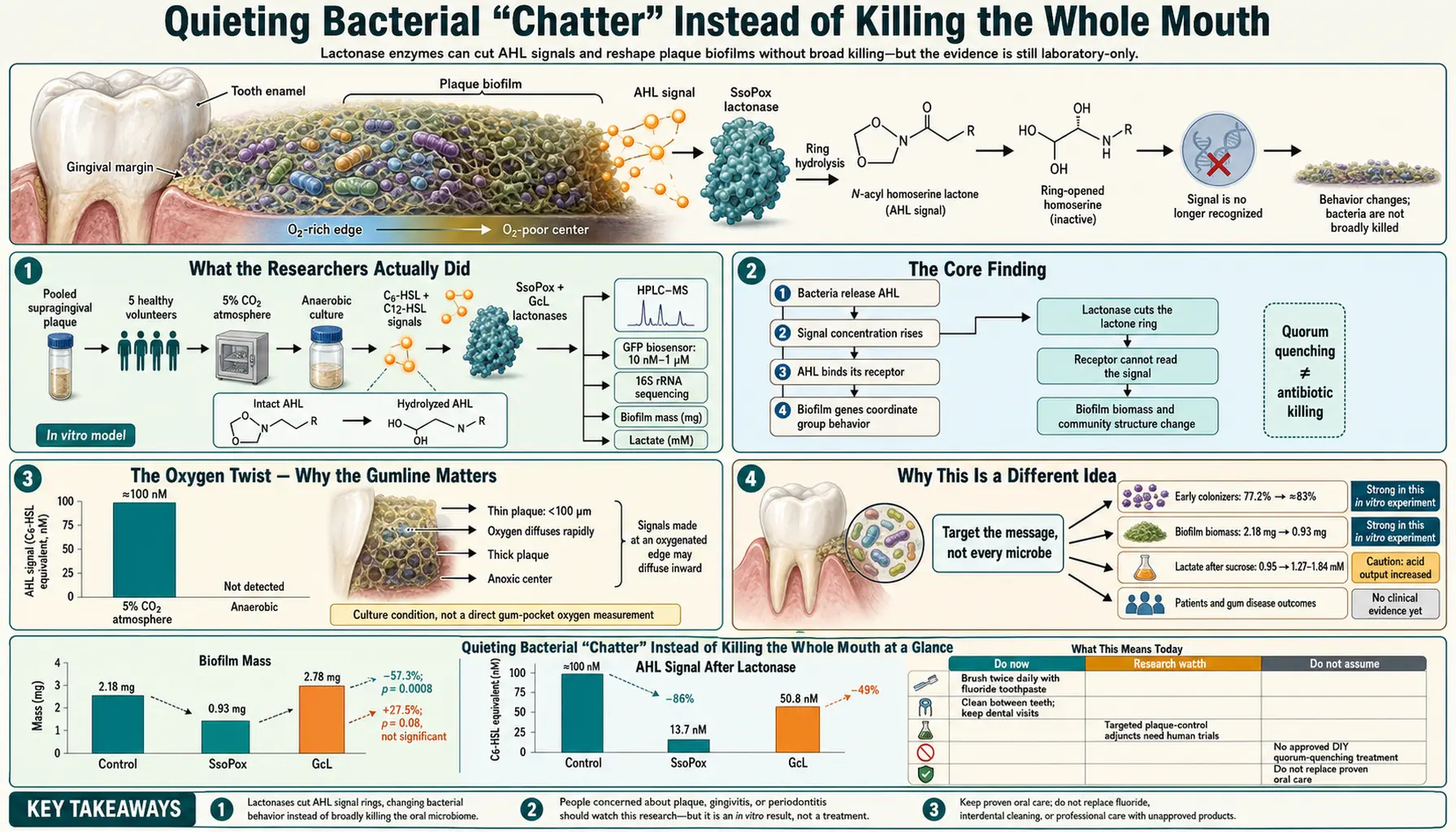
A team at the University of Minnesota, Twin Cities has reported laboratory findings suggesting that gum disease might one day be managed not by killing the bacteria in plaque, but by interfering with the chemical signals some of them use to coordinate. The paper appeared in the journal npj Biofilms and Microbiomes on 17 November 2025; the university’s news release, carried by ScienceDaily, followed on 8 May 2026. It is an in-vitro study of a cultured bacterial community derived from human dental plaque: no person was treated, and no product is described. Its subject is periodontitis; a 2014 Global Burden of Disease analysis ranked severe periodontitis the sixth-most prevalent condition in the world, with a global age-standardized prevalence that stayed at 11.2% from 1990 to 2010. The sections below set out what was shown and what was not.
Table of Contents
What the Researchers Actually Did
Bacteria coordinate group behavior through a process called quorum sensing: cells release small signaling molecules (autoinducers), and as a population grows denser the signals build up and switch on collective behaviors — among them biofilm formation (dental plaque is a biofilm). One of the three major classes of these signals is the N-acyl homoserine lactones, or AHLs, produced by a range of Gram-negative bacteria. In the mouth, other signals (AI-2 and peptide autoinducers) are the better-established ones, and AHLs have long been considered a minor or doubtful player in plaque formation.
The Minnesota group — first author Rakesh Sikdar (who shared first authorship with Mai V. Beauclaire) and senior author Mikael Elias — worked with a previously characterized laboratory community of bacteria derived from the pooled supragingival (above-the-gumline) plaque of five healthy volunteers. It was grown for 18–22 hours, depending on the assay, in plastic culture wells in a medium made mostly of sterile human saliva, with six replicate cultures per treatment. The team manipulated AHL signaling in two directions, under two different atmospheres:
- Signal off, under 5% CO2 (which the authors call “aerobic” for simplicity): they added one of two lactonases (200 µg/mL) — enzymes that hydrolyze the lactone ring of AHLs and so disrupt AHL signaling, an approach known as quorum quenching. SsoPox preferentially degrades long-chain AHLs (C8 or longer); GcL has broad substrate specificity. An inactive mutant enzyme served as the control.
- Signal on, under anaerobic conditions: they added one of two AHLs, C6-HSL or C12-HSL (10 µM), against a solvent-only control.
They then read each community’s composition by 16S rRNA gene sequencing (V4 region; the authors note this limited taxonomic resolution, and results are reported mainly at genus level) and measured biofilm mass, lactate production from sucrose and carbon-source use.
The Core Finding
Plaque assembles in a sequence. Early “pioneer” colonizers — mainly Streptococcus, Lactobacillales and Actinomyces — settle first, and the paper describes their abundance as an indicator of a healthy oral microbiota. Later colonizers include Fusobacterium, Prevotella, Veillonella and the “red complex” of Porphyromonas gingivalis, Tannerella forsythia (then named Bacteroides forsythus) and Treponema denticola. In a 1998 analysis of 13,261 subgingival plaque samples from 185 people with or without periodontitis, that complex “related strikingly to clinical measures of periodontal disease particularly pocket depth and bleeding on probing.”
The paper reports two main results, each under a different atmosphere:
- Under 5% CO2, degrading AHLs with lactonases enriched the commensal pioneer colonizers. In the biofilms, both enzymes raised the combined share of Lactobacillales, Actinomyces and Streptococcus from about 77.2% of sequencing reads in controls to about 83%. Changes in the free-floating (planktonic) cells were smaller.
- Under anaerobic conditions, adding AHLs favored late colonizers. In the biofilms, the Porphyromonas share rose from about 7.0% to about 7.6% with C6-HSL and to about 7.7% with C12-HSL; C6-HSL also raised Veillonella (from 8.5% to about 8.8%), and both AHLs eliminated Haemophilus, a commensal that made up about 5.3% of control biofilms. The authors describe these shifts as “numerically modest” but statistically significant.
Lactonases target the signal molecule rather than the bacteria themselves. The authors note, however, that the taxa that changed most under lactonase treatment were Gram-positive bacteria that generally do not use AHL signaling, which suggests indirect effects, and they do not rule out a direct effect of the enzymes “through yet unidentified mechanisms.” Both lactonases also significantly reduced the diversity of the biofilm community.
The Oxygen Twist — Why the Gumline Matters
Oxygen changed the picture. The community made detectable AHLs only when grown under 5% CO2: mass spectrometry found C6-HSL, and a biosensor read a signal equivalent to roughly 100 nM of C6-HSL (an indicative estimate, the authors note), which SsoPox cut by 86% and GcL by 49%. In anaerobic cultures no AHLs were detected. Oxygen also reshaped the community itself: under 5% CO2, Gram-negative taxa made up less than 5% of it, while under anaerobic conditions Gram-negative taxa (Fusobacterium, Prevotella, Porphyromonas, Haemophilus and Veillonella) accounted for 42% of reads.
The university’s news release maps the two conditions onto the mouth, describing AHL production in “aerobic environments (such as above the gumline).” Below the gumline, in the periodontal pocket (the subgingival zone), oxygen is scarce: a 1984 study of 111 untreated pockets 5–10 mm deep, in 26 patients with advanced periodontal disease, measured a mean oxygen tension of 13.3 mm Hg (1.8% O2) at the pocket base — low, though the authors write that it “does not represent a completely anaerobic environment” — with deep pockets lower than moderately deep ones. The Minnesota experiments themselves used a single community of supragingival origin, grown under two atmospheres; no subgingival plaque was tested.
As Sikdar put it in the news release: “When we blocked AHL signaling in aerobic conditions, we saw more health-associated bacteria. But when we added AHLs under anaerobic conditions, we promoted the growth of disease-associated late colonizers.” In the authors’ reading the two results fit together: AHL disruption favored taxa associated with a healthy oral microbiota, and AHL presence favored late-colonizing periodontal pathogens. Because the anaerobic community made no detectable AHLs yet still responded to added ones, they propose that AHLs made in better-oxygenated parts of plaque may diffuse into its oxygen-poor zones and influence which bacteria settle there — a hypothesis the study did not test directly.
Why This Is a Different Idea
Chemical plaque control relies on antimicrobial agents. A 2025 update for dental practitioners notes that, “due to their antimicrobial constituents,” mouthwashes reduce plaque biofilms and gingival inflammation, and a 2021 review describes chlorhexidine as “a commonly used mouthwash with potent anti-microbial effects.” The European Federation of Periodontology’s 2020 treatment guideline states that chlorhexidine mouth rinses may be considered “for a limited period of time” as an adjunct to mechanical debridement in specific cases, and that routine adjunctive use of systemic antibiotics is not recommended, although specific systemic antibiotics “may be considered for specific patient categories.”
Plaque itself is a normal resident community: a 1994 review describes it as forming naturally on teeth and benefiting the host “by helping to prevent colonization by exogenous species.” Studies of chlorhexidine report effects on that community as a whole. In a 7-day, non-randomized crossover study of 36 healthy people, chlorhexidine mouthwash was associated with “a major shift in the salivary microbiome,” more acidic saliva and lower nitrite. The 2021 review reported that chlorhexidine may shift the oral microbiome toward lower bacterial diversity and abundance, while describing the evidence as limited, and the 2025 update lists allergies, tooth staining and oral microbiome dysbiosis among possible risks of mouthwash use.
Quorum quenching shifts the goal from eradication to ecology: it aims to tilt the competitive balance toward health-associated species rather than to sterilize the tooth surface. That matches the “ecological plaque hypothesis” set out in the same 1994 review, which proposes that disease can be prevented or treated “not only by targeting the putative pathogens but also by interfering with the processes that drive the breakdown in homeostasis,” and the idea is shared with research on oral probiotics and ecological plaque control. Whether quenching would spare the microbiome in a living mouth is untested; in this study, both lactonases lowered the diversity of the cultured biofilm community.
Honest Caveats
Several limits apply to these findings.
- It is an in-vitro laboratory study, not a clinical trial. The bacteria were a cultured community from the pooled plaque of five healthy volunteers, grown in plastic culture wells. No one’s gums were treated, and there are no data on whether lactonases reduce bleeding, pocket depth or attachment loss in patients — the endpoints that define gum disease.
- The paper was published on 17 November 2025 (a preprint was posted on bioRxiv in March 2024); the university’s news release followed on 8 May 2026. It reports laboratory findings, not a newly finished treatment.
- The shifts were modest, and not every change pointed toward health. The authors describe the AHL-driven changes as “numerically modest.” Only one of the two lactonases (SsoPox) reduced biofilm mass, by about 57.3%; the other (GcL) showed a non-significant trend toward more biomass (about 27.5%, p = 0.08). Both lactonases lowered community diversity, and lactonase-treated biofilms turned sucrose into more lactate — 33.6% more with SsoPox and 92.5% more with GcL. The authors note that lactate production from sucrose is “a key mechanism in tooth decay,” and report that the amounts stayed within the range they cite for periodontal biofilms and below the range for cariogenic (decay-associated) biofilms.
- Delivery was not studied. Whether an enzyme would survive saliva, stay on wet tooth and gum surfaces, keep working between brushings and remain safe over years was not examined.
- Oxygen complicates any application. The lactonases were tested only under 5% CO2, and the anaerobic community made no detectable AHLs, so whether quenching would change a low-oxygen, disease-associated community — closer to the conditions of a periodontal pocket — was not tested in this study.
- Quorum quenching in the mouth has been studied in the laboratory for several years. A team at the Universidade de Santiago de Compostela reported in 2020 that AHLs were present in oral samples and that a wide-spectrum lactonase inhibited oral biofilm formation in different in-vitro biofilm models. In 2023 the same group, working with biofilms grown from subgingival samples of healthy donors and patients with periodontal disease, found that an AHL-degrading enzyme reduced biofilm mass in 30–60% of the subgingival-derived biofilms, without significant changes in composition at the genus level. A review by the group describes bacterial communication systems as “a promising target to control oral biofilm formation” while noting that knowledge of signaling within oral multispecies biofilms “is still limited.” None of these studies treated patients.
- Disclosed interests. The paper’s competing-interests statement reports that one author is an inventor on several patents and a co-founder and equity holder of a company that holds a license to one of them, and that the University of Minnesota reviewed and managed these interests under its conflict-of-interest policies.
Reading the Evidence
The authors conclude that targeting quorum sensing “may offer a novel strategy for managing oral biofilms and preventing periodontal disease.” The idea is to manage the oral microbiome by reshaping it rather than eliminating it, and the Minnesota work is a mechanistically specific laboratory test of that idea in plaque. The evidence behind the conclusion is one in-vitro model — a single cultured community of supragingival origin — in which the composition shifts were statistically significant but modest, and in which some functional changes, such as higher lactate output from sucrose, are ones the authors link to tooth decay.
The study does not change existing clinical guidance on gum disease. A 2015 consensus report from the 11th European Workshop on Periodontology supported the “almost universal recommendations” of brushing twice a day for at least 2 minutes with fluoridated toothpaste, and described once-daily interdental cleaning as recommended for people with gingivitis. The European Federation of Periodontology’s 2020 S3 guideline for stage I–III periodontitis sets out a stepwise approach whose first step covers oral-hygiene behavior change, professional mechanical plaque removal and risk-factor control, including tobacco smoking cessation and diabetes control; later steps add professional instrumentation below the gumline and, after active therapy, supportive periodontal care visits at intervals of 3 to a maximum of 12 months. Quorum quenching does not appear in that guideline, and decisions about oral care belong with a dentist or other clinician.
Sources
- Sikdar R, Beauclaire MV, Herzberg MC, Lima BP, Elias MH. N-acyl homoserine lactone signaling modulates bacterial community associated with human dental plaque. npj Biofilms and Microbiomes. 2025;11(1):204. doi:10.1038/s41522-025-00846-z
- University of Minnesota / ScienceDaily news summary, May 8, 2026: “Scientists discover a new way to prevent gum disease without killing good bacteria.” sciencedaily.com/releases/2026/05/260508024125.htm
Key Research Papers
The primary study first, then the background papers in the order the article draws on them. Each entry was checked against its PubMed record and Crossref before it was written down.
- Sikdar R, Beauclaire MV, Herzberg MC, Lima BP, Elias MH (2025). N-acyl homoserine lactone signaling modulates bacterial community associated with human dental plaque. npj Biofilms and Microbiomes 11(1):204. — PubMed PMID: 41249195
- Kassebaum NJ, Bernabé E, Dahiya M, Bhandari B, Murray CJL, Marcenes W (2014). Global burden of severe periodontitis in 1990-2010: a systematic review and meta-regression. Journal of Dental Research 93(11):1045-1053. — PubMed PMID: 25261053
- Muras A, Otero-Casal P, Blanc V, Otero A (2020). Acyl homoserine lactone-mediated quorum sensing in the oral cavity: a paradigm revisited. Scientific Reports 10(1):9800. — PubMed PMID: 32555242
- Socransky SS, Haffajee AD, Cugini MA, Smith C, Kent RL Jr (1998). Microbial complexes in subgingival plaque. Journal of Clinical Periodontology 25(2):134-144. — PubMed PMID: 9495612
- Mettraux GR, Gusberti FA, Graf H (1984). Oxygen tension (pO2) in untreated human periodontal pockets. Journal of Periodontology 55(9):516-521. — PubMed PMID: 6592325
- Brookes Z, Bescos R, Witton R, Bishop MC, Whawell S, McColl E (2025). An update on mouthwashes: advice for dental practitioners. British Dental Journal 239(5):312-315. — PubMed PMID: 40940474
- Brookes ZLS, Belfield LA, Ashworth A, Casas-Agustench P, Raja M, Pollard AJ, Bescos R (2021). Effects of chlorhexidine mouthwash on the oral microbiome. Journal of Dentistry 113:103768. — PubMed PMID: 34418463
- Sanz M, Herrera D, Kebschull M, Chapple I, Jepsen S, Berglundh T, et al.; EFP Workshop Participants and Methodological Consultants (2020). Treatment of stage I–III periodontitis—The EFP S3 level clinical practice guideline. Journal of Clinical Periodontology 47(Suppl 22):4-60. — PubMed PMID: 32383274
- Marsh PD (1994). Microbial ecology of dental plaque and its significance in health and disease. Advances in Dental Research 8(2):263-271. — PubMed PMID: 7865085
- Bescos R, Ashworth A, Clarke C, Brookes ZL, Belfield L, Rodiles A, et al. (2020). Effects of Chlorhexidine mouthwash on the oral microbiome. Scientific Reports 10(1):5254. — PubMed PMID: 32210245
- Parga A, Muras A, Otero-Casal P, Arredondo A, Soler-Ollé A, Àlvarez G, et al. (2023). The quorum quenching enzyme Aii20J modifies in vitro periodontal biofilm formation. Frontiers in Cellular and Infection Microbiology 13:1118630. — PubMed PMID: 36816581
- Muras A, Mallo N, Otero-Casal P, Pose-Rodríguez JM, Otero A (2022). Quorum sensing systems as a new target to prevent biofilm-related oral diseases. Oral Diseases 28(2):307-313. — PubMed PMID: 33080080
- Chapple ILC, Van der Weijden F, Doerfer C, Herrera D, Shapira L, Polak D, et al. (2015). Primary prevention of periodontitis: managing gingivitis. Journal of Clinical Periodontology 42(Suppl 16):S71-S76. — PubMed PMID: 25639826
PubMed Topic Searches
Connections
- The Oral Microbiome
- Oral Probiotic Strains
- Gum Disease
- Oral Cancer
- Clove — Dental Pain & Oral Health
- Myrrh — Oral Health
- Aloe Vera — Oral & Dental
- Vitamin C — Bleeding Gums & Tooth Loss
- Ear, Nose & Throat
- Lab Tests