 — April 3, 2026
· Florida Food-Toxin Testing
— April 3, 2026
· Florida Food-Toxin Testing
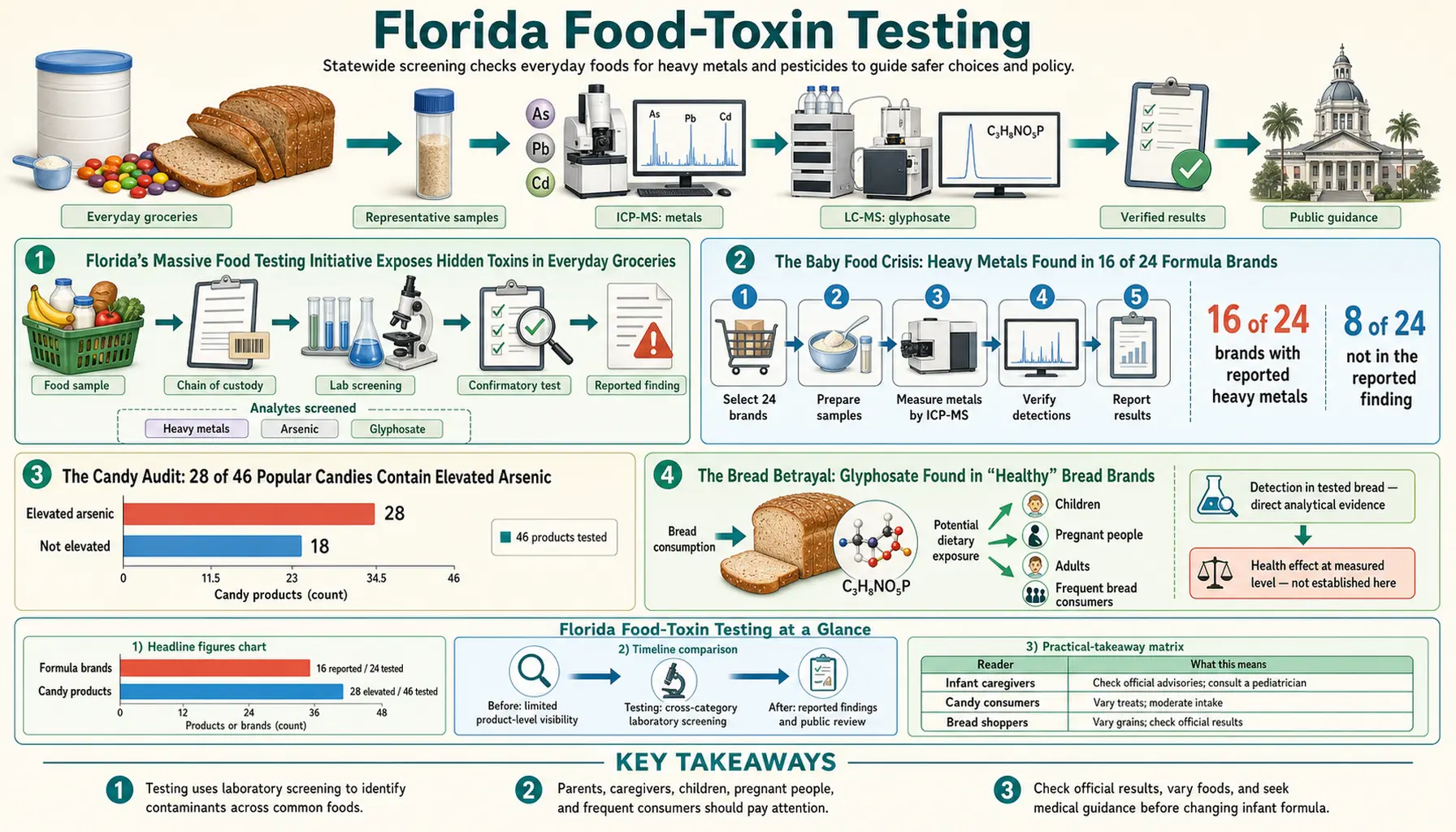
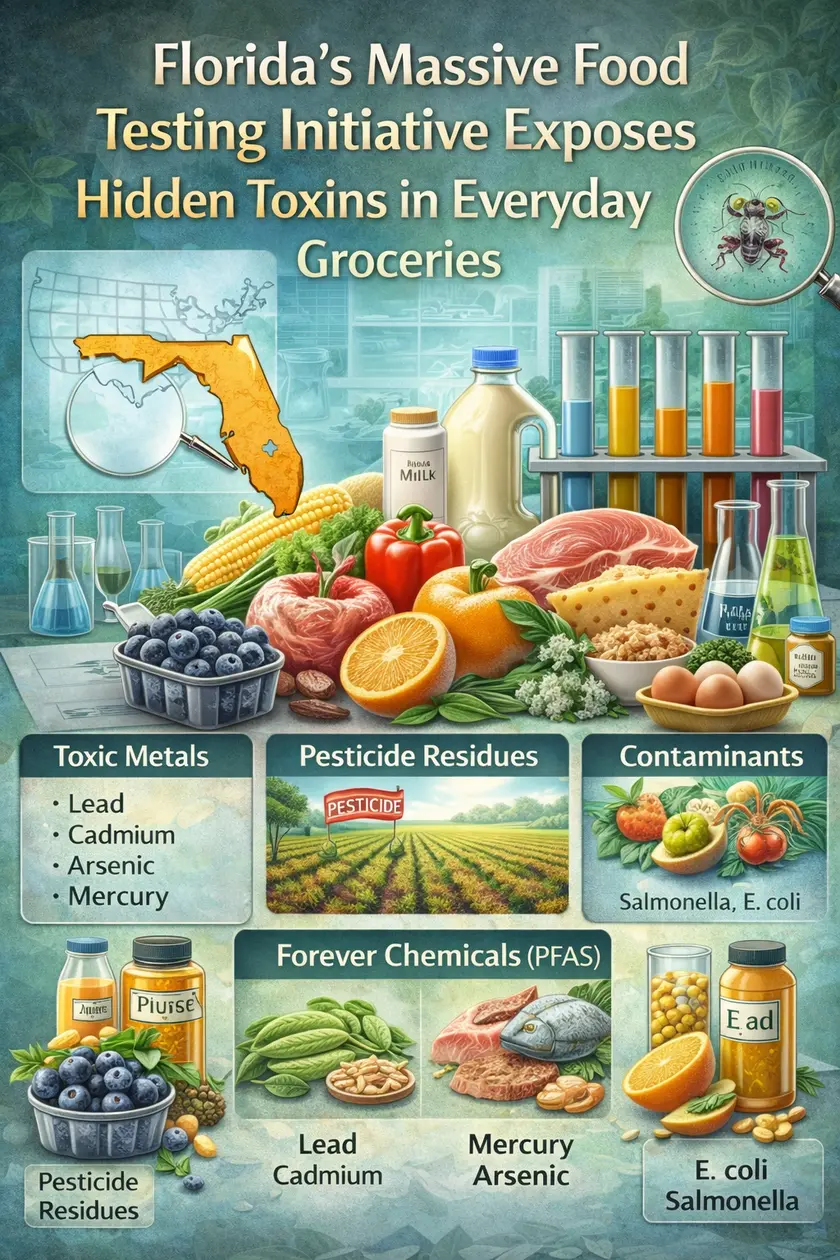
Table of Contents
- Florida’s Food-Testing Initiative: What Has Been Released
- Infant Formula: Elevated Heavy Metals in 16 of 24 Products
- Candy: Arsenic Detected in 28 of 46 Products
- Bread: Glyphosate Detected in Six of Eight Loaves
- Florida’s 2024 Ban on Lab-Grown Meat
- Reading the Evidence
- External Authoritative Resources
- Key Research Papers
- Connections
- Featured Videos
Florida’s Food-Testing Initiative: What Has Been Released
Under the Healthy Florida First initiative, led by Florida’s First Lady Casey DeSantis, the Florida Department of Health buys everyday products from stores and online sellers, has them analyzed at accredited laboratories, reviews the results, and posts them at exposingfoodtoxins.com. Up to this article’s date the state had released results for three product groups: infant formula (January 9, 2026), candy (January 26, 2026) and bread (February 5, 2026). The releases reported heavy metals above the state’s health-based screening benchmarks in infant formula — mercury, arsenic, cadmium and lead — arsenic in candy, and the herbicide glyphosate in bread.
State officials describe the program as a push for transparency and for testing before problems reach consumers. In a January 17, 2026 statement about a television interview on the formula results, Casey DeSantis said: “Ultimately, we would like products to be tested before they hit the market, which unfortunately, for various reasons, is not happening.” She added: “We are asking other states to join forces to utilize their assets to test products.” The statement did not name the states.
According to the state’s FAQ, products are tested for heavy metals (aluminum, arsenic, cadmium, lead and mercury), pesticides and herbicides (glyphosate, dicamba and 2,4-D), inorganic anions including fluoride, microplastics, volatile compounds and radioactive materials in water, though “not every product is tested for all contaminants.” The Department of Health says it judges health risk against EPA drinking-water standards, European Food Safety Authority (EFSA) health-based levels, Agency for Toxic Substances and Disease Registry (ATSDR) risk-assessment tools and EPA default exposure factors for different age groups, assessing both cancer and non-cancer risks where applicable. Results for baby food, cereals, snacks and beverages had not been published.
Infant Formula: Elevated Heavy Metals in 16 of 24 Products
The first results covered 24 infant formula products from seven brands, bought online and in stores across Florida and tested for arsenic, cadmium, lead, mercury and pesticides. Announcing them on January 9, 2026, Governor Ron DeSantis said the Department of Health “found elevated levels of heavy metals like mercury in 16, pointing to systemic problems in sourcing or manufacturing.” Later state releases describe the formula findings as “elevated levels of certain heavy metals compared to health-based screening benchmarks, including mercury, arsenic, cadmium, and lead.” The state’s scorecard marks each product and metal where testing “exceeded the maximum daily limit set by the U.S. Environmental Protection Agency and U.S. Food and Drug Administration”; it does not list the measured levels or the limits themselves. The scorecard also notes that many of the listed formulas are available through WIC, the federal nutrition program for women, infants and children.
Earlier investigations reported metals in baby foods. A February 4, 2021 staff report of the Subcommittee on Economic and Consumer Policy of the U.S. House Committee on Oversight and Reform, based on internal documents and test results from four of the seven large baby-food manufacturers it contacted, concluded that commercial baby foods “are tainted with significant levels of toxic heavy metals, including arsenic, lead, cadmium, and mercury.” In an October 2019 report on tests of 168 baby foods, Healthy Babies Bright Futures (HBBF) found toxic heavy metals in 95 percent of the foods and all four metals it assessed — arsenic, lead, cadmium and mercury — in one in four, and wrote that “organic standards do not address these contaminants.” The Clean Label Project reported from a study of over 530 baby and toddler food products that arsenic was detected in 65% of them and lead in 36%, and that “certified organic products contained 2 times more arsenic than the conventional products tested.”
The FDA says it prioritizes foods commonly eaten by babies and young children “because their smaller body sizes and metabolism make them more vulnerable to the harmful effects of these contaminants.” For lead, the World Health Organization states that young children “may absorb up to 4–5 times as much lead as adults from an ingested dose,” and that lead can permanently affect children’s brain development, resulting in reduced IQ and behavioral changes. The Florida Department of Health lists the potential effects of heavy metals as “neurological, cardiovascular, renal, immune, reproductive, developmental effects, and cancer,” adding that “children and pregnant women are particularly vulnerable.”
The FDA’s Closer to Zero plan, released on April 8, 2021, aims to reduce dietary exposure to arsenic, lead, cadmium and mercury “to as low as possible, while maintaining access to nutritious foods.” The plan’s page, last updated January 6, 2025, records final guidance on lead in processed foods for babies and young children (issued January 2025), lists draft guidance on arsenic and cadmium in those foods for 2025, and lists mercury as still under evaluation.
Candy: Arsenic Detected in 28 of 46 Products
In results released on January 26, 2026, the Florida Department of Health reported testing 46 candy products for heavy metals and detecting arsenic in 28 of them, “prompting further evaluation of potential exposure risks, particularly for children.” The state’s results page states that arsenic exposure beyond limits considered safe “can increase the risk of cancers, including lung, skin, kidney, and bladder.” The World Health Organization states that long-term exposure to arsenic from drinking water and food “can cause cancer and skin lesions” and has also been associated with cardiovascular disease and diabetes. For each candy with detectable arsenic, the state converted the result into an approximate “safe” amount per year for a child and for an adult, stating the piece or bar weight it assumed. Examples from the state’s table, with the arsenic level in parts per billion (ppb):
- A chocolate bar with peanuts, caramel and nougat (350 ppb): about 2⅖ pieces a year for a child and 6 for an adult, counting a piece as 9 grams
- A chocolate-covered wafer bar (230 ppb): about 2⅖ pieces for a child and 6 for an adult, counting a piece as 17 grams
- A strawberry licorice-type twist (500 ppb): 4 pieces for a child and 9⅗ for an adult, counting a piece as 11 grams
- Two flavors of a hard candy (540 and 320 ppb): 6 pieces for a child and 15 for an adult, counting a piece as 8 grams
- A cookies-and-cream candy bar (280 ppb): about 1⅕ bars for a child and 3 for an adult, counting a bar as 43 grams
- Gummy bears (370 ppb): 16 pieces for a child and 40 for an adult, counting a piece as 3 grams; the same maker’s organic gummy bears were listed as “risk not identified”
- Two flavors of a tiny tart candy (380 and 450 ppb): 96 pieces for a child and 240 for an adult, counting a piece as 0.5 gram
The table gives a separate figure for each product. It does not say how the yearly amounts combine when several products, other foods or drinking water are consumed, and it reports arsenic in parts per billion without stating whether the figure is total or inorganic arsenic. The remaining candies, including several chocolate candies, were listed as “risk not identified”; among the candies the state marked as “marketed as a healthier option,” some had arsenic values and others were listed as “risk not identified.” The full results for all 46 products are posted at exposingfoodtoxins.com.
For comparison, in January 2025 the EPA’s Integrated Risk Information System (IRIS) updated its oral reference dose for inorganic arsenic to 6 × 10⁻⁵ mg per kg of body weight per day, based on type 2 diabetes and ischemic heart disease, and it classifies inorganic arsenic as carcinogenic to humans. The FDA’s arsenic guidance covers inorganic arsenic in rice cereals for infants (August 2020) and apple juice (June 2023), and sets a 10 ppb limit for bottled water; it sets no arsenic level for candy.
Other research has measured lead and cadmium in chocolate. In a 2014–2022 analysis of 72 dark chocolate and cocoa products sold in the USA, 43% exceeded California’s Proposition 65 maximum allowable dose level for lead and 35% for cadmium, none exceeded it for arsenic, and 70 of the 72 were below the FDA’s interim reference level for lead; products labeled organic were significantly more likely to have higher cadmium and lead levels. A nationwide survey in Ecuador found that cadmium in cacao beans rose with the cadmium content of the soil and with falling soil pH. In Nigerian cocoa, the beans themselves contained very little lead, and the authors of an isotope study concluded that most lead contamination of cocoa products occurs during shipping and processing of the beans and the manufacture of cocoa and chocolate products.
Bread: Glyphosate Detected in Six of Eight Loaves
In results released on February 5, 2026, the Department of Health reported testing eight bread products from five national brands and detecting glyphosate — which the state describes as “a widely used herbicide commonly applied in agricultural production to control weeds” — in six of them. The six results ranged from 10.38 to 191.04 parts per billion (ppb); two white loaves were below the method detection limit, which the state reports as non-detect. The two lowest results, 11.85 and 10.38 ppb, came from two loaves made with organic flour, both from one brand; the other four loaves with detectable residue measured from 132.34 to 191.04 ppb. The state’s bread page lists the measured levels but does not name a benchmark or say whether any loaf exceeded a federal limit. Its glyphosate results count glyphosate and its breakdown product AMPA together, using FAO-recognized calculation methods.
First Lady Casey DeSantis said the results “show troubling levels of glyphosate.” State Surgeon General Dr. Joseph Ladapo said that “bread is a staple food for many Florida families,” that the testing “found high levels of glyphosate in some popular bread brands,” and that “chronic exposure to glyphosate is linked to harmful gut microbiome changes, liver inflammation, and adverse neurologic effects.” A 2020 critical review of the gut-microbiome research concluded that glyphosate residues on food could cause dysbiosis, a disturbance of the gut microbiome, but that the research “suffers from numerous methodological weaknesses, and these limitations make it impossible to draw any definitive conclusions regarding glyphosate’s influence on health through alterations in the gut microbiome.”
The World Health Organization’s International Agency for Research on Cancer (IARC) classified glyphosate as “probably carcinogenic to humans” (Group 2A) in March 2015. The 2020 review states that glyphosate “is applied to wheat crops before harvest to encourage ripening resulting in higher glyphosate residues in commercial wheat products within North America.” In field trials in Lithuania, glyphosate applied shortly before harvest left glyphosate and AMPA in the harvested wheat and barley grain, at levels below the EU maximum residue levels, while glyphosate applied before the crop emerged left none. In June 2020 a manufacturer of a glyphosate weed killer announced agreements to pay $10.1 billion to $10.9 billion to resolve current and potential future U.S. lawsuits over claims that the weed killer causes non-Hodgkin lymphoma; the company said the agreements “contain no admission of liability or wrongdoing.”
Florida’s 2024 Ban on Lab-Grown Meat
On May 1, 2024, Governor DeSantis signed SB 1084, a Department of Agriculture and Consumer Services bill sponsored by State Senator Jay Collins. Among other provisions, it makes it unlawful to manufacture for sale, sell, hold or offer for sale, or distribute cultivated (lab-grown) meat in Florida, which the law defines as “any meat or food product produced from cultured animal cells.” A person who knowingly violates the ban commits a second-degree misdemeanor, punishable under Florida law by up to 60 days in jail and a $500 fine. Florida’s Commissioner of Agriculture, Wilton Simpson, called it “first-in-the-nation legislation banning lab-grown meat.”
The law followed federal clearance of cultivated chicken. The FDA completed its first two pre-market safety consultations for food made from cultured chicken cells in November 2022 and March 2023, and in 2023 the USDA approved cultivated chicken from two companies for sale to U.S. consumers; a 2023 study of public comments to the USDA described the commercialization of cell-cultured meat as a reality in the United States as of June 2023. In the signing announcement, Governor DeSantis said: “Today, Florida is fighting back against the global elite’s plan to force the world to eat meat grown in a petri dish or bugs to achieve their authoritarian goals,” and “Our administration will continue to focus on investing in our local farmers and ranchers, and we will save our beef.” Commissioner Simpson said: “We must protect our incredible farmers and the integrity of American agriculture.”
The ban covers only products made from cultured animal cells; plant-based meat substitutes, which are not made from animal cells, fall outside the law’s definition.
Reading the Evidence
The agencies and testing groups cited above describe how exposure to heavy metals and pesticides from food arises and what published results can show.
Baby Food and Formula
- HBBF’s 2017 tests of 105 infant cereals found average arsenic levels in infant rice cereals six times higher than in other infant cereals. The FDA issued guidance setting an action level for inorganic arsenic in rice cereals for infants in August 2020.
- The FDA’s consumer page on arsenic says rice “tends to absorb arsenic more readily than other crops,” notes that the American Academy of Pediatrics advises feeding infants and toddlers a variety of grains as part of a well-balanced diet, and lists oat, barley and multigrain as other iron-fortified infant cereals.
- The same FDA page states that eating a variety of age-appropriate healthy foods “may reduce exposure to and potential harmful effects from contaminants that foods can absorb from the environment.”
- HBBF’s 2019 report states that parents “can’t shop their way out of these exposures by choosing organic foods or by switching from store-bought brands to homemade purees.”
- Decisions about an infant’s formula belong with a pediatrician or other clinician.
Candy
- The state’s candy table gives approximate yearly amounts only for products with detectable arsenic, one product at a time; the full list of tested products and results is posted at exposingfoodtoxins.com.
Bread and Grains
- USDA organic rules do not require zero residue: a product may not be sold, labeled or represented as organic when residue testing detects a prohibited substance above 5 percent of the EPA’s tolerance for that residue.
Across Foods
- The Florida Department of Health states that heavy metals “can accumulate in the body over time and may cause adverse health effects even at low concentrations,” and the World Health Organization states that lead is stored in the teeth and bones, “where it can accumulate over time.”
- The 72-product chocolate analysis notes that eating more than one serving a day, combined with heavy metals from other sources, “may add up to exposure that would exceed” California’s Proposition 65 levels.
- The state’s site invites suggestions for the initiative’s next focus, and Dr. Ladapo described the state’s approach as “transparency, continued testing, and a clear focus on reducing exposure.”
External Authoritative Resources
- Exposing Food Toxins — Florida’s Healthy Florida First initiative, full lab testing results
- Healthy Babies Bright Futures — Independent baby food testing and rankings
- Clean Label Project — Product testing and transparency reports for baby food and consumer goods
- FDA Closer to Zero Action Plan — Federal plan to reduce heavy metals in baby foods
- Congressional Subcommittee Baby Food Report (2021) — U.S. House investigation into heavy metals in baby food
- IARC Monographs — WHO — Glyphosate classification as “probably carcinogenic to humans” (Group 2A)
- Environmental Working Group — Glyphosate Testing — Independent testing of glyphosate in food products
- Florida SB 1084 — Full text of the lab-grown meat ban legislation
Key Research Papers
Peer-reviewed papers behind the background figures above, in story order; each entry was checked against PubMed and Crossref. The Florida test results themselves come from the state’s releases and results pages, not from a peer-reviewed paper.
- Hands JM, Anderson ML, Cooperman T, Balsky JE, Frame LA (2024). A multi-year heavy metal analysis of 72 dark chocolate and cocoa products in the USA. Frontiers in Nutrition 11:1366231. — PubMed PMID: 39144282
- Argüello D, Chavez E, Lauryssen F, Vanderschueren R, Smolders E, Montalvo D (2019). Soil properties and agronomic factors affecting cadmium concentrations in cacao beans: A nationwide survey in Ecuador. Science of the Total Environment 649:120-127. — PubMed PMID: 30173024
- Rankin CW, Nriagu JO, Aggarwal JK, Arowolo TA, Adebayo K, Flegal AR (2005). Lead contamination in cocoa and cocoa products: isotopic evidence of global contamination. Environmental Health Perspectives 113(10):1344-1348. — PubMed PMID: 16203244
- Barnett JA, Gibson DL (2020). Separating the Empirical Wheat From the Pseudoscientific Chaff: A Critical Review of the Literature Surrounding Glyphosate, Dysbiosis and Wheat-Sensitivity. Frontiers in Microbiology 11:556729. — PubMed PMID: 33101230
- Guyton KZ, Loomis D, Grosse Y, El Ghissassi F, Benbrahim-Tallaa L, Guha N, et al. (2015). Carcinogenicity of tetrachlorvinphos, parathion, malathion, diazinon, and glyphosate. The Lancet Oncology 16(5):490-491. — PubMed PMID: 25801782
- Kadžienė G, Pranaitienė S, Auškalnienė O, Veršulienė A, Supronienė S, Žvirdauskienė R, et al. (2023). Oilseed Rape, Wheat, and Barley Grain Contamination as Affected by Different Glyphosate Usage. Plants (Basel) 12(6):1335. — PubMed PMID: 36987023
- Failla M, Hopfer H, Wee J (2023). Evaluation of public submissions to the USDA for labeling of cell-cultured meat in the United States. Frontiers in Nutrition 10:1197111. — PubMed PMID: 37743911
- DaVault JB, Sinha MS (2025). Meat, The Future: The Role Of Regulators In The Lab-Grown Revolution. American Journal of Law & Medicine 51(1):69-99. — PubMed PMID: 40337901