 — February 9, 2026
· Shingles Vaccine Linked to Lower Dementia Risk in More Than 300,000 Adults
— February 9, 2026
· Shingles Vaccine Linked to Lower Dementia Risk in More Than 300,000 Adults
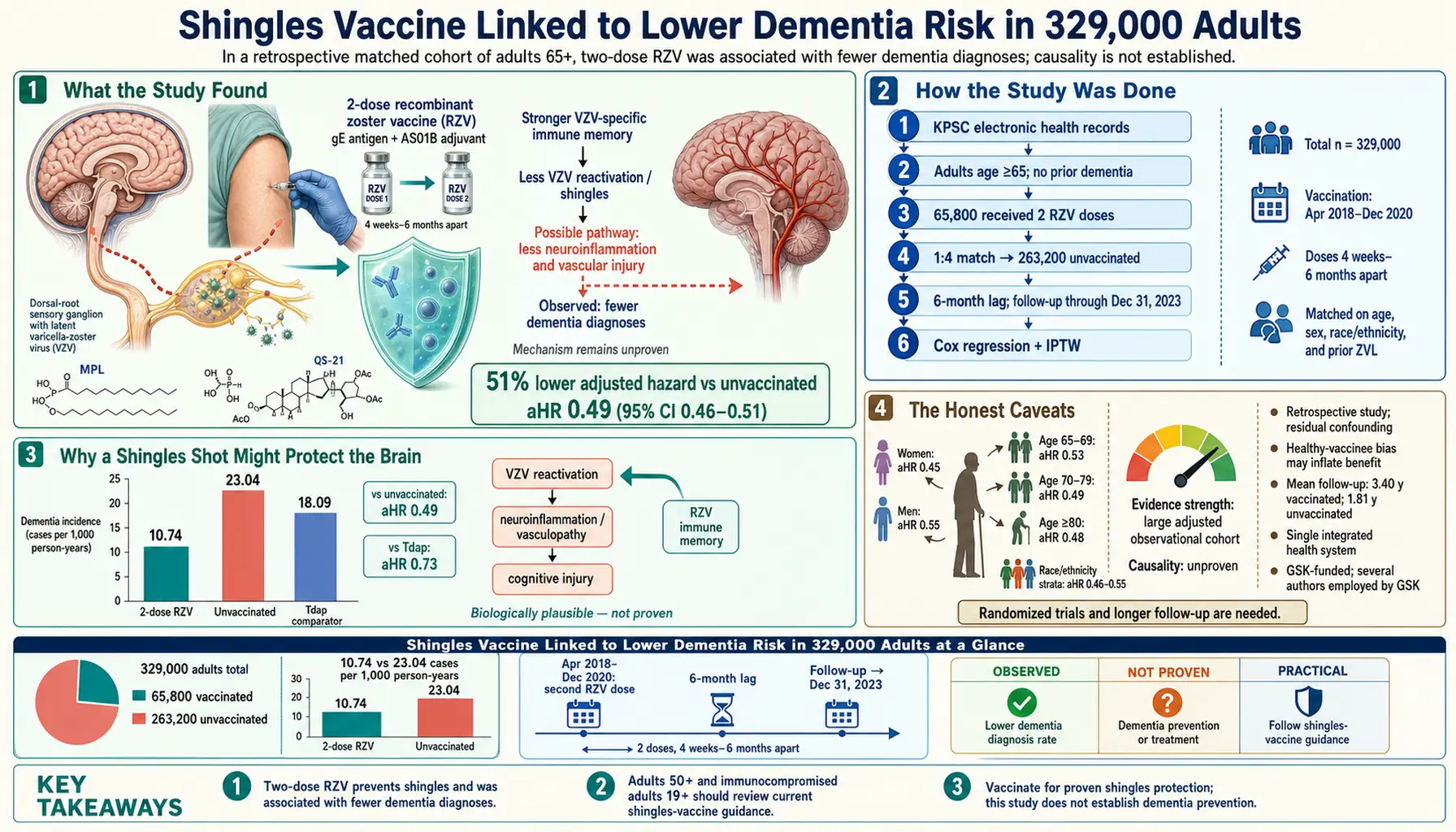
On February 9, 2026, researchers at Kaiser Permanente Southern California published a large study in Nature Communications reporting that adults who received two doses of the recombinant zoster vaccine went on to be diagnosed with dementia far less often than comparable adults who did not. It joins a growing body of evidence linking a routine shingles vaccine to lower dementia rates. The finding is an association, not proof that the vaccine prevents dementia; the sections below set out how the study tested that question and what it leaves open.
Table of Contents
- 1. What the Study Found
- 2. How the Study Was Done
- 3. Why a Shingles Shot Might Protect the Brain
- 4. The Honest Caveats
- 5. Key Points
- Sources
- Key Research Papers
- Connections
- Featured Videos
1. What the Study Found
The study's main estimate: among adults aged 65 and older, two doses of the recombinant zoster vaccine were associated with a 51% lower risk of a new dementia diagnosis over the follow-up period (adjusted hazard ratio 0.49, 95% confidence interval 0.46–0.51). The hazard ratios were similar across age, racial, and ethnic groups, and the reduction was stronger in women (about 55% lower risk; hazard ratio 0.45) than in men (about 45%; hazard ratio 0.55) — a sex difference that has also appeared in the Welsh natural experiment on the older live vaccine and in a 2024 comparison of the recombinant and live vaccines, and that has no established explanation.
An observational estimate this large is open to healthy-vaccinee bias: people who choose to get vaccinated tend to be healthier and more engaged with medical care to begin with. In the same paper, the comparison against recipients of a different vaccine (Tdap, described below) produced a smaller estimate — 27% rather than 51% — and the Welsh natural experiment on the older live vaccine estimated about 20%. The authors conclude that the association with the recombinant vaccine remains statistically significant after accounting for healthy-vaccinee bias.
2. How the Study Was Done
This was a retrospective matched-cohort study built from Kaiser Permanente Southern California's electronic health records. The team, led by Emily Rayens, identified 65,800 members aged 65 and older who completed the two-dose recombinant series (doses 4 weeks to 6 months apart) between April 2018 and December 2020 and matched each of them to four unvaccinated members of the same age, sex, race and ethnicity, and history of the live vaccine — 263,200 comparators, or about 329,000 cohort entries in all (25,987 people appear in both groups, having been matched as unvaccinated and later completed the series themselves) — then followed everyone for new dementia diagnoses through 31 December 2023.
Much of the paper is devoted to testing its own result. The central worry in any study like this is healthy-vaccinee bias: the people who show up for an optional vaccine are, on average, more health-conscious, better connected to primary care, and less frail than those who skip it — and all of those traits independently lower dementia risk. To test whether that bias explained everything, the researchers compared recombinant-vaccine recipients against people who received a different routine vaccine (Tdap) rather than against the unvaccinated. If the whole effect were just "vaccinated people are healthier," the two vaccinated groups would be expected to look similar. They did not: recombinant-vaccine recipients still had a 27% lower dementia risk than Tdap recipients (hazard ratio 0.73, 95% confidence interval 0.67–0.79). A separate "negative-control outcome" analysis — testing whether the vaccine was linked to a composite of six unrelated, acutely painful conditions it has no plausible reason to affect, such as appendicitis and wrist fracture — gave a hazard ratio close to 1 (0.94, 95% confidence interval 0.89–1.00), which the authors read as indicating that residual confounding is likely minimal.
3. Why a Shingles Shot Might Protect the Brain
There are two leading biological explanations, and they are not mutually exclusive. The first is virus-specific: shingles is caused by reactivation of the varicella-zoster virus, the same virus that causes chickenpox and then hides in nerve cells for life. The Kaiser authors write that the mechanism linking reactivation to dementia "has not been clearly demonstrated"; the possibilities they list are neuroinflammation, damage to blood vessels (vasculopathy), and reactivation of other dormant viruses in the brain such as herpes simplex virus 1 — processes studied in connection with the amyloid and neuroinflammatory changes of Alzheimer's disease and with vascular dementia. On this view, by preventing reactivation the vaccine may remove a recurring inflammatory hit to the aging brain.
The second explanation is non-specific: the recombinant vaccine pairs a single viral protein (glycoprotein E) with an adjuvant system (AS01B), and the authors of the Welsh study note that vaccines may have important off-target immunological effects beyond protection against their target virus. The protective signal for dementia has appeared with more than one type of shingles vaccine — the older live vaccine in Wales and the recombinant vaccine here — and a 2024 study found the recombinant vaccine associated with a lower dementia risk than the live vaccine and than influenza and Tdap vaccines; its authors called for studies of the mechanisms behind that protection. Which mechanism dominates — or whether the truth is some mix — is not yet settled.
4. The Honest Caveats
Several limits apply to what these studies can show.
- It is observational, not a randomized trial. No one was assigned by coin flip to get the vaccine. Matching and the Tdap comparison reduce bias but cannot eliminate it the way randomization would.
- The natural-experiment estimate is smaller. A 2025 study in Nature used a feature of the Welsh rollout of the older live shingles vaccine: eligibility was set by an exact date-of-birth cutoff (people born on or after 2 September 1933 were eligible; those born before were not), so people born a week on either side of the line are unlikely to differ systematically. Its authors describe this natural experiment as less vulnerable to confounding and bias than the existing associational evidence. It found a 3.5-percentage-point lower probability of a new dementia diagnosis over seven years — a one-fifth (20.0%) relative reduction (95% confidence interval 6.5–33.4%), not a halving. The new Kaiser study concerns the newer recombinant vaccine and reports a larger association; the Welsh estimate comes from the design less exposed to healthy-vaccinee bias.
- Association is not proof. These studies show that vaccinated people develop dementia less often. They do not prove the shot is the reason, and they cannot tell an individual how much their own risk would change.
- Follow-up is still relatively short for a disease that develops over decades — a mean of 3.4 years for the vaccinated group, counted from six months after the second dose — and diagnosis timing in health records is imperfect.
- Funding. The study was funded by the recombinant vaccine's manufacturer, and four of its 13 authors list that company as their affiliation.
5. Key Points
U.S. guidance already covers the two-dose recombinant shingles vaccine: the Advisory Committee on Immunization Practices recommended it in 2017 for immunocompetent adults aged 50 or older, and in 2021 for adults aged 19 or older who are or will be immunodeficient or immunosuppressed because of disease or therapy. Those recommendations are for preventing shingles, not dementia: shingles itself is common, painful, and can lead to months of postherpetic neuralgia and other complications. The recommendations rest on that evidence alone.
What this new study adds is a large association between the same two-dose series and fewer dementia diagnoses, one that persisted through the authors' checks for healthy-vaccinee bias. The research does not show the vaccine to be a proven dementia treatment, and a population-level estimate such as 51% does not translate into a personal risk reduction of that size. The dementia association remains unproven without randomized evidence; the authors of the 2024 comparison study wrote that such findings could facilitate the design of a large-scale randomized trial. Decisions about vaccines belong with a clinician.
Sources
- Rayens E, et al. Recombinant zoster vaccine is associated with a reduced risk of dementia. Nature Communications. February 9, 2026. Kaiser Permanente Southern California. DOI: 10.1038/s41467-026-69289-0 · Full text: nature.com/articles/s41467-026-69289-0 · PMC12949228
- Eyting M, Xie M, Michalik F, Heß S, Chung S, Geldsetzer P. A natural experiment on the effect of herpes zoster vaccination on dementia. Nature. 2025;641(8062):438–446. The Welsh date-of-birth-cutoff study; its authors describe the design as less vulnerable to confounding and bias than the existing associational evidence. DOI: 10.1038/s41586-025-08800-x
- CIDRAP (University of Minnesota) news coverage of the shingles-vaccine-and-dementia literature. cidrap.umn.edu
Key Research Papers
Primary papers behind the figures in this article. Each entry was checked against PubMed, and the two dementia studies also against Crossref and the full text, before it was written down.
- Rayens E, Sy LS, Qian L, Ackerson BK, Tubert J, Luo Y, et al. (2026). Recombinant zoster vaccine is associated with a reduced risk of dementia. Nature Communications 17(1):2056. — PubMed PMID: 41663414
- Eyting M, Xie M, Michalik F, Heß S, Chung S, Geldsetzer P (2025). A natural experiment on the effect of herpes zoster vaccination on dementia. Nature 641(8062):438-446. — PubMed PMID: 40175543
- Taquet M, Dercon Q, Todd JA, Harrison PJ (2024). The recombinant shingles vaccine is associated with lower risk of dementia. Nature Medicine 30(10):2777-2781. — PubMed PMID: 39053634
- Lal H, Cunningham AL, Godeaux O, Chlibek R, Diez-Domingo J, Hwang SJ, et al. (2015). Efficacy of an adjuvanted herpes zoster subunit vaccine in older adults. New England Journal of Medicine 372(22):2087-2096. — PubMed PMID: 25916341
- Dooling KL, Guo A, Patel M, Lee GM, Moore K, Belongia EA, Harpaz R (2018). Recommendations of the Advisory Committee on Immunization Practices for Use of Herpes Zoster Vaccines. MMWR Morbidity and Mortality Weekly Report 67(3):103-108. — PubMed PMID: 29370152
- Anderson TC, Masters NB, Guo A, Shepersky L, Leidner AJ, Lee GM, et al. (2022). Use of Recombinant Zoster Vaccine in Immunocompromised Adults Aged ≥19 Years: Recommendations of the Advisory Committee on Immunization Practices — United States, 2022. MMWR Morbidity and Mortality Weekly Report 71(3):80-84. — PubMed PMID: 35051134
PubMed Topic Searches
Connections
- Shingles (Herpes Zoster)
- Herpes Simplex
- Infectious Disease
- Alzheimer's Disease
- Vascular Dementia
- Lewy Body Dementia
- Frontotemporal Dementia
- Neurology
- May 28, 2026 — Active Forms & Reversible Biology
- News Archive