 — February 4, 2026
· Wildfire Smoke and Stroke
— February 4, 2026
· Wildfire Smoke and Stroke
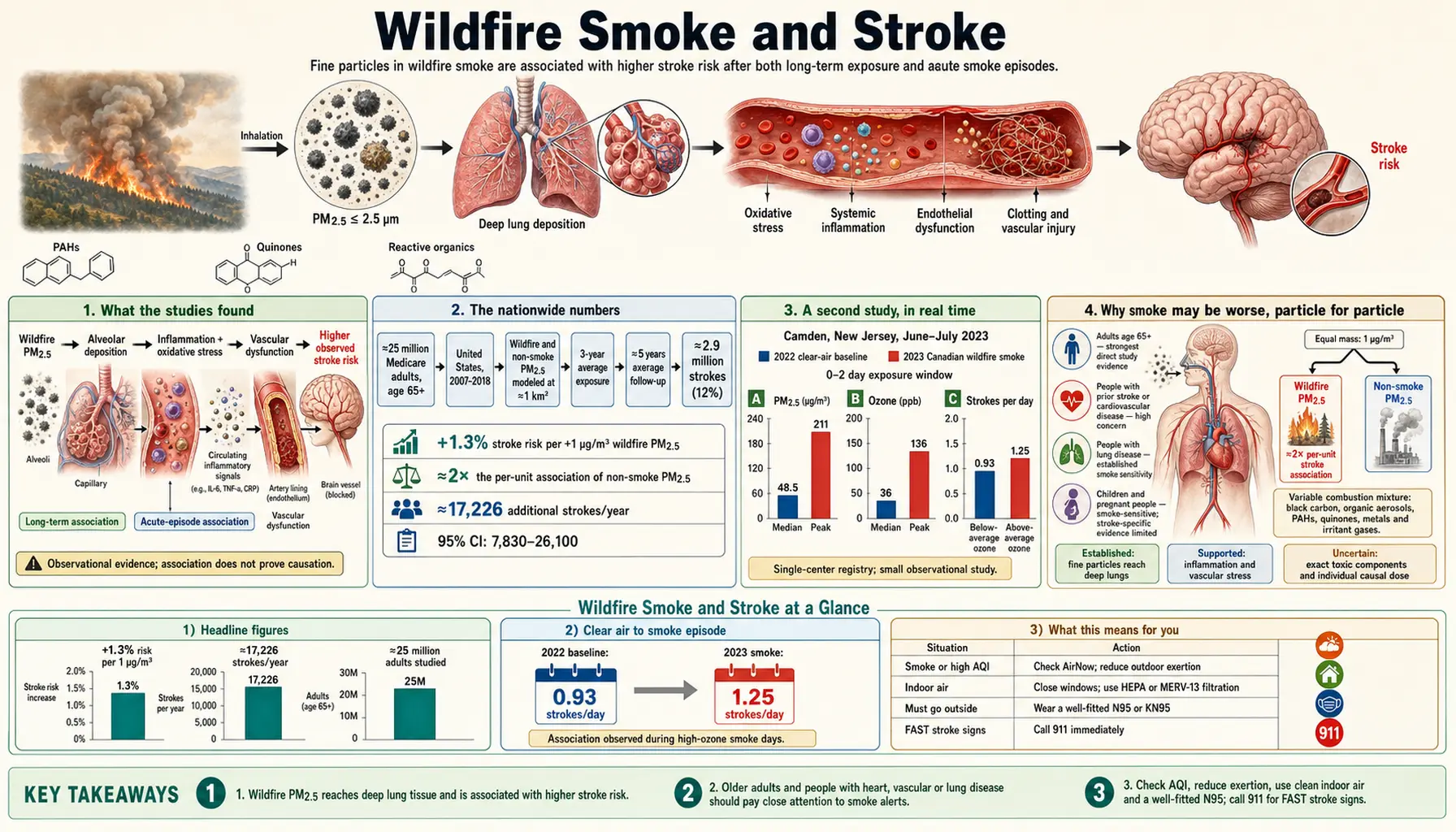
Two studies released in early 2026 report that the fine-particle pollution in wildfire smoke is associated with a higher risk of stroke, both over years of exposure and within days of a smoke episode. The larger of the two, a nationwide analysis of roughly 25 million older Americans, was published online in the European Heart Journal on January 27, 2026 and widely reported in the days that followed. The second, a single-hospital study of strokes during the 2023 Canadian wildfire smoke that reached the U.S. East Coast, was released in March 2026 as an abstract for the American Academy of Neurology’s 78th Annual Meeting (Chicago, April 18–22, 2026) and published in full in the Journal of Stroke and Cerebrovascular Diseases in April 2026. Neither proves causation on its own; both point in the same direction.
Correction: an earlier version of this article said the Camden study was presented at the International Stroke Conference in February 2026. It was released as an American Academy of Neurology abstract in March 2026, after this article’s date; its details below are from that release and the April 2026 paper.
Table of Contents
What the studies found
Fine particulate matter — the soot-sized particles measuring 2.5 micrometers or smaller, abbreviated PM2.5 — is small enough to slip past the nose and throat, lodge deep in the lungs, and drive inflammation that reaches the bloodstream. Wildfire smoke is an especially concentrated, chemically complex source of it. The new work asks a specific question: does the PM2.5 in smoke carry the same stroke risk as ordinary urban PM2.5, or a different one? In the nationwide study, the association per microgram was stronger for smoke PM2.5 than for non-smoke PM2.5, which the authors describe as suggesting potentially greater toxicity of smoke-derived particles.
The nationwide numbers
The European Heart Journal study, led by researchers at Emory University’s Rollins School of Public Health with Yang Liu as senior author, followed about 25 million Medicare beneficiaries aged 65 and older from 2007 to 2018. Using satellite and ground data resolved to roughly one-square-kilometer grids, the team used machine learning to separate the PM2.5 that came specifically from wildfire smoke from PM2.5 out of tailpipes, power plants, and other everyday sources. Over a median follow-up of five years, roughly 2.9 million people (about 12%) had a stroke.
The headline result: each 1 µg/m³ increase in the three-year average of wildfire-smoke PM2.5 was associated with a 1.3% higher risk of stroke (hazard ratio 1.013; 95% CI 1.006–1.020), compared with a 0.7% increase for the same increase in non-smoke PM2.5 (hazard ratio 1.007; 95% CI 1.006–1.008). Associations were stronger for longer exposure windows. The authors note that the effect is small at the individual level but that exposure is widespread: they estimate that a long-term increase of 1 µg/m³ in wildfire-smoke PM2.5 could correspond to approximately 17,226 additional strokes a year among U.S. older adults (95% CI 7,830–26,100), a population attributable fraction of 1.30%. The concentration–response relationship they observed was linear, with no threshold.
A second study, in real time
The conference study zoomed in on a single, vivid event. In June and July 2023, smoke from Canadian wildfires drove some of the worst air-quality readings in the modern history of the U.S. Northeast. Researchers at Cooper Medical School of Rowan University in Camden, New Jersey used a hospital stroke registry to compare strokes in June–July 2022 with the same months of 2023, linking cases to EPA air-quality monitor readings from Camden.
During the 2023 smoke episodes, monitors in Camden recorded ozone peaking at 136 parts per billion against a median of 36, and PM2.5 reaching 211 µg/m³ against a median of 48.5. On days when ozone ran above average, strokes rose to about 1.25 per day, versus 0.93 on below-average days. The investigators also reported that higher PM2.5 was associated with longer hospital stays and higher stroke-severity scores. The full paper, published in April 2026 and covering 1,184 patients from 2022 to 2023, reported that presentation on high-PM2.5 days was associated with greater stroke severity (initial NIH Stroke Scale 10.0 vs 8.25) and more hemorrhagic and large-artery atherosclerotic strokes, while overall ischemic stroke incidence did not differ between high and low PM2.5 days and ozone was not associated with stroke outcomes. It is a single-center study, on a much shorter time scale than the nationwide cohort.
Why smoke may be worse, particle for particle
The American Heart Association’s 2010 scientific statement on particulate matter and cardiovascular disease concluded that PM2.5 exposure over hours to weeks can trigger cardiovascular events, that longer-term exposure raises cardiovascular mortality further, and that “many credible pathological mechanisms” lend biological plausibility; its writing group judged the evidence consistent with a causal relationship. The mechanisms commonly described for inhaled fine particles include systemic inflammation and oxidative stress, raised blood pressure, dysfunction of the lining of blood vessels (endothelial dysfunction), and a shift of the blood toward clotting. Whether smoke particles are more harmful than other PM2.5 is still being studied: a 2021 Southern California analysis noted that toxicological studies suggest wildfire particulate matter may be more toxic than equal doses of ambient PM2.5, and it found increases in respiratory hospitalizations of 1.3% up to 10% per 10 µg/m³ of wildfire-specific PM2.5, compared with 0.67% to 1.3% for non-wildfire PM2.5. The same Emory group has separately linked long-term wildfire-smoke exposure to higher rates of heart failure (hazard ratio 1.014 per 1 µg/m³ of two-year average smoke PM2.5, versus 1.005 for non-smoke PM2.5, in about 22 million Medicare enrollees), which fits the broader picture of smoke as a cardiovascular, not merely respiratory, hazard.
Study Limitations
Both studies are observational. They can show association, tight timing, and a dose-response gradient, but they cannot by themselves prove that smoke caused any individual stroke. Their main limits:
- The nationwide cohort was Medicare enrollees over 65, and about 88% White. The findings may not translate directly to younger people or to other populations, and exposure was estimated from where people lived, not personal monitors — a source of measurement error.
- The Camden study comes from one hospital; its first figures were released as a conference abstract, and the full paper followed in April 2026. Daily stroke counts are small (0.93 vs 1.25), and ozone and PM2.5 rise together in smoke, making it hard to pin the effect on one pollutant — the full paper found no association for ozone. Heat and other confounders travel with smoke, too.
- The “17,000 strokes a year” figure in news headlines is a modeled estimate: the paper’s estimate of 17,226 additional strokes a year applies to a hypothetical long-term increase of 1 µg/m³ in wildfire-smoke PM2.5 and assumes a baseline stroke rate, so it is not a count of strokes observed in the study.
The two studies use different designs and time scales — a long-term national cohort and a short-term single-hospital comparison — and both report associations between smoke-related PM2.5 and stroke, and the AHA scientific statement describes biological mechanisms for particulate matter and cardiovascular disease.
What Agencies Advise About Smoke Days
The research raises the greatest concern for older adults and for people who have had a stroke or have heart or vascular disease. The U.S. Environmental Protection Agency describes reducing smoke exposure as especially important for children, older adults, and people with heart or lung disease; the CDC lists children, people with asthma, COPD, diabetes or heart disease, and pregnant people as needing special consideration. EPA’s wildfire guidance includes keeping windows and doors closed when local officials advise staying indoors, using a portable air cleaner sized for the room that does not produce ozone, avoiding strenuous activity during smoky times, and keeping N95 respirator masks on hand; the CDC describes setting up a room closed off from outside air with a portable air cleaner or filter, and notes that a NIOSH Approved respirator filters smoke and that fit matters. Current air-quality readings and smoke maps are published on the federal AirNow.gov site. Stroke warning signs are commonly taught with the BE-FAST mnemonic (Balance, Eyes, Face drooping, Arm weakness, Speech difficulty, Time to call emergency services). Background on the pollutant itself is on the air pollution and PM2.5 page and in the broader environmental toxins library.
Sources
- Hao H, Xu K, Zhang D, et al. Long-term exposure to wildfire smoke particulate matter and incident stroke: a US nationwide study. European Heart Journal. Published online January 27, 2026. DOI: 10.1093/eurheartj/ehaf875
- Accompanying editorial: Wildfire smoke and stroke: emerging evidence on long-term cardiovascular risk. European Heart Journal. 2026. DOI: 10.1093/eurheartj/ehaf1003
- American College of Cardiology Journal Scan (February 2, 2026): Long-Term Exposure to Wildfire Smoke Particulate Matter Increases Stroke Risk
- Eos (AGU): Wildfire Smoke Linked to 17,000 Strokes Annually in the United States
- American Academy of Neurology news release via EurekAlert (March 3, 2026) on the AAN 2026 abstract from Camden, NJ: Air pollution from wildfires linked to higher rate of stroke
- Medscape coverage (March 9, 2026): Wildfire Smoke Tied to Higher Stroke Incidence, Greater Severity
- American Stroke Association, International Stroke Conference (cited in an earlier version of this article; the Camden study was not presented there): professional.heart.org — International Stroke Conference
- U.S. air-quality forecast for the public: AirNow.gov
- U.S. EPA: Wildfires and Indoor Air Quality
- CDC: Preparing for Wildfires
Key Research Papers
- Hao H, Xu K, Zhang D, Deng Y, Benmarhnia T, Pu Q, et al. (2026). Long-term exposure to wildfire smoke particulate matter and incident stroke: a US nationwide study. European Heart Journal 47(21):2673-2682. — PubMed PMID: 41587749
- Zhang S, Chen K (2026). Wildfire smoke and stroke: emerging evidence on long-term cardiovascular risk. European Heart Journal 47(21):2683-2685. — PubMed PMID: 41587744
- Garfinkel LP, Cerceo E, Jaffri Z, Qureshi H, Piotrowski K, Anand A, et al. (2026). Air pollution and stroke: a two-year analysis linking short-term particulate matter 2.5 exposure to stroke severity and etiology. Journal of Stroke and Cerebrovascular Diseases 35(6):108648. — PubMed PMID: 42055357
- Hao H, Xu K, Zhang D, Deng Y, Al-Kindi S, Pattisapu VK, et al. (2025). Long-term wildfire smoke exposure and increased risk of heart failure in older adults. Journal of the American College of Cardiology 85(25):2439-2451. — PubMed PMID: 40562508
- Aguilera R, Corringham T, Gershunov A, Benmarhnia T (2021). Wildfire smoke impacts respiratory health more than fine particles from other sources: observational evidence from Southern California. Nature Communications 12(1):1493. — PubMed PMID: 33674571
- Brook RD, Rajagopalan S, Pope CA 3rd, Brook JR, Bhatnagar A, Diez-Roux AV, et al. (2010). Particulate matter air pollution and cardiovascular disease: an update to the scientific statement from the American Heart Association. Circulation 121(21):2331-2378. — PubMed PMID: 20458016
PubMed Topic Searches
Connections
- Air Pollution PM2.5 — Fine Particulate Matter
- Secondhand Smoke
- Environmental Toxins
- Stroke
- Neurology
- Heart Failure
- Cardiology
- Pulmonology
- May 28, 2026 — Active Forms & Reversible Biology
- News Archive