Oyster Mushroom (Pleurotus ostreatus)
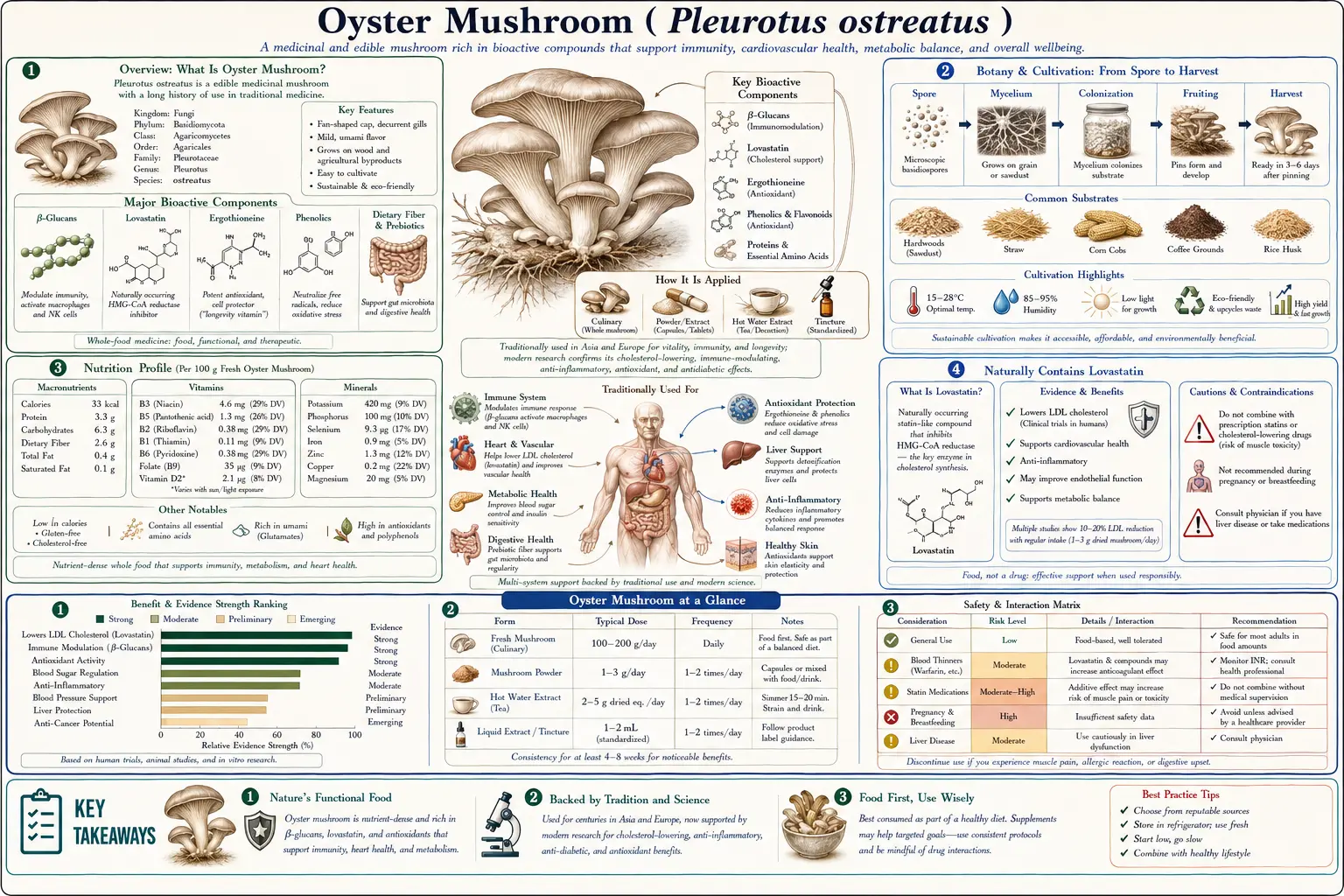
The oyster mushroom (Pleurotus ostreatus) sits at an unusual crossroads between the dinner plate and the medicine cabinet. It is a familiar, mild-tasting culinary mushroom that is also one of the easiest of all mushrooms to grow at home. At the same time, it naturally produces lovastatin, the same molecule that pharmaceutical companies developed into a cholesterol-lowering statin drug, along with immune-active beta-glucans. That combination of everyday food and genuine bioactivity makes it a true food-and-medicine bridge. This article explains what the science actually shows, where the evidence is strong, and where it is still thin and preliminary.
Table of Contents
- Overview
- Botany & Cultivation
- Nutrition Profile
- Naturally Contains Lovastatin
- Cholesterol & Lipids
- Beta-Glucans & Immune Support
- Antioxidant Effects
- Blood Sugar & Metabolic
- Blood Pressure & Cardiovascular
- Gut & Prebiotic Fiber
- Culinary Use & Selection
- Forms & Dosage
- Safety & Cautions
- Research Papers
- Connections
- Featured Videos
Overview
Oyster mushrooms are the fruiting bodies of Pleurotus ostreatus and several closely related species in the genus Pleurotus (including the golden, pink, and king oyster mushrooms). They are wood-decay fungi: in the wild they grow in shelf-like clusters on dead and dying hardwood trees, and on the farm they are cultivated on sawdust, straw, coffee grounds, and other agricultural by-products. Worldwide, Pleurotus species are among the most heavily cultivated edible mushrooms after the common button mushroom.
What distinguishes the oyster mushroom from most vegetables is its dual identity. As a food it is low in calories and fat, provides a respectable amount of plant protein, and delivers fiber, several B vitamins, and minerals such as potassium and copper. As a functional food it contains compounds with documented biological activity, chiefly the cholesterol-pathway inhibitor lovastatin and a soluble beta-glucan called pleuran. The remainder of this article walks through each of these in turn, keeping the food and the medicine claims clearly separated.
Botany & Cultivation
The cap of Pleurotus ostreatus is broad, smooth, and fan- or oyster-shaped, ranging from white and pale grey to tan or brown depending on strain and temperature. The gills run down a short, off-center stem (or there may be almost no stem at all), and the clusters often overlap like roof shingles on the side of a log. The flesh is firm when young and the spore print is white to pale lilac.
Oyster mushrooms are widely considered the most beginner-friendly mushroom to cultivate. They grow aggressively, tolerate a wide range of temperatures, and will colonize cheap, abundant substrates such as pasteurized straw, sawdust, cardboard, and spent coffee grounds. A small home kit can move from inoculation to harvest in a matter of weeks, which is part of why oyster mushrooms are so popular with hobby growers and small farms.
Their hunger for tough plant material also makes them useful in mycoremediation, the use of fungi to break down pollutants. Pleurotus species secrete powerful lignin-degrading enzymes and have been studied for their ability to digest petroleum hydrocarbons, certain pesticides, and other organic contaminants in soil and waste. This is an active research area rather than a settled cleanup technology, but it illustrates the metabolic versatility of the fungus.
Nutrition Profile
As a food, oyster mushrooms are mostly water, so a serving is low in calories. What remains is nutritionally useful and skews toward protein, fiber, and micronutrients rather than fat or sugar.
- Protein. For a vegetable, oyster mushrooms supply a relatively generous amount of protein with a fairly broad amino-acid profile, including several of the essential amino acids. They are not a complete substitute for animal protein, but they contribute meaningfully to a plant-forward diet.
- Fiber. A notable share of the dry weight is dietary fiber, including the cell-wall beta-glucans discussed below.
- B vitamins. Oyster mushrooms are a good source of several B vitamins, especially niacin (B3) and riboflavin (B2), along with folate and pantothenic acid.
- Minerals. They provide potassium, copper, and some iron, among other trace minerals.
- Ergothioneine. Like other mushrooms, oyster mushrooms are a dietary source of ergothioneine, a sulfur-containing antioxidant amino acid that the human body concentrates in tissues and does not make on its own.
- Low fat and low calorie. The fat content is very small, and almost none of it is saturated.
These figures vary with strain, substrate, maturity, and how the mushroom is cooked or dried, so this page describes the profile qualitatively rather than quoting exact percent-daily-value numbers that would be misleading to present as fixed.
Naturally Contains Lovastatin
One of the most remarkable facts about oyster mushrooms is that they are a genuine natural source of lovastatin (also called mevinolin). Lovastatin is a member of the statin class of drugs that lower blood cholesterol by inhibiting HMG-CoA reductase, the rate-limiting enzyme the body uses to manufacture cholesterol. The drug was originally derived from fungi, and several fungi, including Pleurotus ostreatus, make it as part of their own metabolism. Analytical studies that measured lovastatin directly in oyster mushroom fruiting bodies have confirmed its presence in both raw and processed mushrooms.
This is genuinely interesting, but it comes with an important caveat. The amount of lovastatin in whole mushrooms is variable and generally far below a prescription dose. The concentration depends on the strain, the growing substrate, the part of the mushroom, the harvest stage, and how the mushroom is dried or cooked. A normal culinary portion does not reliably deliver a pharmacologically standardized statin dose. For that reason, oyster mushrooms should be thought of as a healthy food that may modestly support a cholesterol-lowering diet, not as a substitute for prescribed statin medication. Anyone taking a statin or other cholesterol drug should continue it unless their own clinician advises otherwise.
Cholesterol & Lipids
Because oyster mushrooms contain both lovastatin and cholesterol-binding fiber, several human studies have tested whether adding them to the diet improves blood lipids. The results are encouraging but should be read with the size and quality of the studies in mind.
- A randomized crossover study in people with HIV on antiretroviral therapy (who frequently develop drug-related dyslipidemia) found that adding oyster mushrooms to the diet was associated with reductions in total cholesterol over the test period. This was a small, short trial, but it is a real human dataset.
- A dietary-supplementation study in a rural community in Mexico reported reductions in markers of hyperlipidemia and in visceral fat among participants who ate oyster mushrooms regularly.
- A clinical report in people with diabetes described lower blood cholesterol (alongside lower glucose) during a period of oyster-mushroom consumption.
Taken together, the human evidence points in a favorable direction for total cholesterol, but the trials are small, often short, and use varying amounts and forms of mushroom. Effect sizes have generally been modest. The honest summary is that oyster mushrooms appear to be a reasonable cholesterol-friendly food within an overall heart-healthy diet, while larger and longer randomized trials are still needed to pin down how much benefit to expect.
Beta-Glucans & Immune Support
The cell walls of oyster mushrooms are rich in beta-glucans, a family of soluble dietary fibers. The best-studied oyster-mushroom beta-glucan is pleuran, an insoluble-to-soluble (1→3),(1→6)-beta-glucan that has been used as the active ingredient in several supplements. Beta-glucans of this type are recognized by receptors on immune cells and are studied as immunomodulators, meaning they appear to help tune immune activity rather than simply rev it up.
The most concrete clinical evidence comes from a series of pediatric trials led by Jesenak and colleagues in children with recurrent respiratory tract infections. Randomized studies of pleuran reported immunomodulatory effects and fewer or milder respiratory infections during supplementation, and related work explored anti-allergic effects and benefits in children with asthma. A more recent randomized controlled trial of a chewable pleuran-based supplement again reported a reduction in respiratory tract infections in children.
These are meaningful findings, but they should be framed carefully. Pleuran is best described as immune support that may reduce the frequency of common infections in susceptible children. It is not a cure for infection, not a vaccine substitute, and not a treatment for any specific disease. Most of the strongest data are in children prone to recurrent infections, so the results do not automatically transfer to healthy adults or to other conditions.
Antioxidant Effects
Oyster mushrooms contain a mix of antioxidant compounds, including polyphenols, the flavone chrysin, and the sulfur antioxidant ergothioneine. Laboratory and animal studies consistently show measurable antioxidant and free-radical-scavenging activity from oyster mushroom extracts, and in some rodent models of high cholesterol, oyster mushroom extract (and its constituent chrysin) reduced markers of oxidative stress alongside improving lipids.
The practical takeaway is modest and honest: oyster mushrooms add antioxidant compounds to the diet, which is a reasonable part of why mushroom-rich eating patterns are associated with good health. But a measurable antioxidant effect in a test tube or a rat is not the same as a proven clinical benefit in people, and the antioxidant content alone should not be oversold.
Blood Sugar & Metabolic
Several lines of evidence suggest oyster mushrooms may have favorable effects on blood sugar and metabolism. The clinical report in people with diabetes mentioned above noted lower fasting glucose during oyster-mushroom consumption, and animal studies of Pleurotus glucan-rich polysaccharides have shown improvements in glucose tolerance and insulin resistance in high-fat-diet models.
Mechanistically, this fits with what is known about high-fiber, low-calorie foods: soluble fiber slows the absorption of sugars, supports satiety, and may improve insulin sensitivity over time. As with cholesterol, the human data are limited and the effects are best viewed as supportive of, rather than a replacement for, standard diabetes care. Oyster mushrooms are a sensible food choice for people managing blood sugar, but they are not a glucose-lowering medication.
Blood Pressure & Cardiovascular
Oyster mushrooms contribute to cardiovascular health through several indirect routes rather than one dramatic effect. They are low in sodium and a useful source of potassium, the mineral balance that supports healthy blood pressure. Their fiber and beta-glucans help with cholesterol, as discussed above, and their antioxidant compounds may help protect blood-vessel function. Some animal and laboratory studies report blood-pressure-favorable and vessel-protective effects from Pleurotus extracts.
Dedicated, high-quality human blood-pressure trials specifically on oyster mushrooms are sparse, so the cardiovascular case rests mostly on the combination of good nutrition (potassium, fiber, low fat), the lipid findings, and mechanistic plausibility. That is a reasonable basis for treating oyster mushrooms as a heart-friendly food, while being clear that they are not a proven antihypertensive on their own.
Gut & Prebiotic Fiber
A large fraction of an oyster mushroom is fiber, including beta-glucans and other cell-wall polysaccharides that humans do not fully digest. These fibers pass into the colon, where gut bacteria can ferment them, which is the definition of a prebiotic effect. Fermentation of mushroom fiber produces short-chain fatty acids that nourish the cells lining the colon and are linked to broader metabolic benefits.
Mushroom fiber has also been shown in laboratory work to influence the expression of cholesterol-related genes and to bind components in the gut, offering one more mechanism behind the lipid effects. For everyday eaters, the practical message is simple: oyster mushrooms add a gentle, fermentable fiber to the diet that supports a healthy gut microbiome, alongside their other benefits.
Culinary Use & Selection
Oyster mushrooms have a mild, slightly savory flavor and a tender, faintly seafood-like texture when cooked, which is reflected in their common name. They cook quickly and take well to high heat. They are excellent sauteed or pan-seared until the edges crisp, roasted, added to stir-fries and soups, or torn into strips and used as a meat-like topping. Because they hold a lot of water, giving them room in a hot, dry pan so the moisture can evaporate produces the best browning and texture.
When selecting them, look for clusters with firm, intact caps that are not slimy, discolored, or developing a strong sour smell. Pale, dry-but-not-shriveled caps are ideal. Store them loosely in the refrigerator (a paper bag works well) and use within a few days; mushrooms spoil faster when sealed in plastic with trapped moisture.
Forms & Dosage
There is no single official dose of oyster mushroom, and how you take it depends on whether your goal is food or supplementation.
- Fresh culinary mushrooms. This is the most common and most natural form. A regular serving as part of meals provides the nutrition, fiber, and naturally occurring bioactive compounds described above. Cooking is recommended (see Safety).
- Dried mushrooms and powders. Drying concentrates the mushroom and is convenient for soups, broths, and blends. Drying and processing can change the levels of heat-sensitive compounds, so concentrations vary by product.
- Standardized pleuran (beta-glucan) supplements. The pediatric respiratory studies used defined doses of purified pleuran rather than whole mushroom. If you are considering a beta-glucan supplement, follow the specific product's labeling and, ideally, your clinician's guidance, rather than assuming a culinary serving equals a studied dose.
- Extracts. Various hot-water and alcohol extracts are sold; their composition and strength differ widely and are not standardized across brands.
Because the lovastatin and beta-glucan content of whole mushrooms is not standardized, there is no reliable way to use ordinary cooking mushrooms as a measured medicine. Treat them as a healthful food first.
Safety & Cautions
Oyster mushrooms are widely eaten and considered safe as a food for most people. A few sensible cautions apply:
- Cook them thoroughly. Like most cultivated mushrooms, oyster mushrooms are best eaten cooked rather than raw. Cooking improves digestibility and breaks down compounds that can irritate some people's digestion.
- Allergy and "mushroom worker's lung." Some people are allergic to mushrooms. A specific occupational concern is hypersensitivity pneumonitis ("mushroom worker's lung") caused by repeatedly inhaling large quantities of mushroom spores, most relevant to growers and harvesters working in dense spore environments. Good ventilation and harvesting before heavy spore release reduce this risk; ordinary eaters are not affected.
- Interactions with cholesterol and diabetes medications. Because oyster mushrooms can have mild cholesterol- and glucose-lowering effects, there is a theoretical possibility of additive effects if you are already taking statins, other lipid drugs, or diabetes medications. This is usually not a problem with ordinary food amounts, but if you eat or supplement them heavily and are on these medications, mention it to your clinician and monitor as advised.
- Correct identification when foraging. If wild-harvesting, be confident in identification. Several look-alikes exist, and any foraged mushroom should be verified by an experienced identifier before eating.
Educational disclaimer: This page is for general education and is not medical advice. It does not diagnose, treat, or replace care from a qualified health professional. The studies summarized here are often small or preliminary, and a food being healthful is not the same as a proven treatment. Do not start, stop, or change any medication, including statins, based on this article. Talk with your own clinician about your situation, especially if you are pregnant, breastfeeding, immunocompromised, or managing a chronic condition.
Research Papers
Selected peer-reviewed literature. Links resolve to PubMed or DOI.
- Gaitan-Hernandez R, et al. Determination of Lovastatin, β-glucan, Total Polyphenols, and Antioxidant Activity in Raw and Processed Oyster Culinary-Medicinal Mushroom, Pleurotus ostreatus (Higher Basidiomycetes). Int J Med Mushrooms. 2015;17(2):117-28.
- Abrams DI, et al. Antihyperlipidemic effects of Pleurotus ostreatus (oyster mushrooms) in HIV-infected individuals taking antiretroviral therapy. BMC Complement Altern Med. 2011;11:60.
- Dietary Supplementation with Oyster Culinary-Medicinal Mushroom, Pleurotus ostreatus, Reduces Visceral Fat and Hyperlipidemia in Inhabitants of a Rural Community in Mexico. Int J Med Mushrooms. 2022;24(9):49-61.
- Khatun K, et al. Oyster mushroom reduced blood glucose and cholesterol in diabetic subjects. Mymensingh Med J. 2007;16(1):94-9.
- Jesenak M, et al. Immunomodulatory effect of pleuran (β-glucan from Pleurotus ostreatus) in children with recurrent respiratory tract infections. Int Immunopharmacol. 2013;15(2):395-9.
- Jesenak M, et al. Anti-allergic effect of Pleuran (β-glucan from Pleurotus ostreatus) in children with recurrent respiratory tract infections. Phytother Res. 2014;28(3):471-4.
- Beneficial effects of pleuran on asthma control and respiratory tract-infection frequency in children with perennial asthma. Sci Rep. 2025;15(1):7146.
- Antihypercholesterolemic and antioxidative effects of an extract of the oyster mushroom, Pleurotus ostreatus, and its major constituent, chrysin, in Triton WR-1339-induced hypercholesterolemic rats. J Physiol Biochem. 2013;69(2):313-23.
- Modulation of Cholesterol-Related Gene Expression by Dietary Fiber Fractions from Edible Mushrooms. J Agric Food Chem. 2015;63(33):7371-80.
- Reis FS, et al. Chemical composition and nutritional and medicinal value of fruit bodies and submerged cultured mycelia of culinary-medicinal higher Basidiomycetes mushrooms. Int J Med Mushrooms. 2014;16(3):273-91.
Connections
- Medicinal Mushrooms (overview)
- Reishi Mushroom
- Lion's Mane Mushroom
- Chaga Mushroom
- Turkey Tail Mushroom
- Ergothioneine
- Herbs
- Remedies
- Vitamins
- Minerals
- Food