Zinc — Benefits Deep Dive
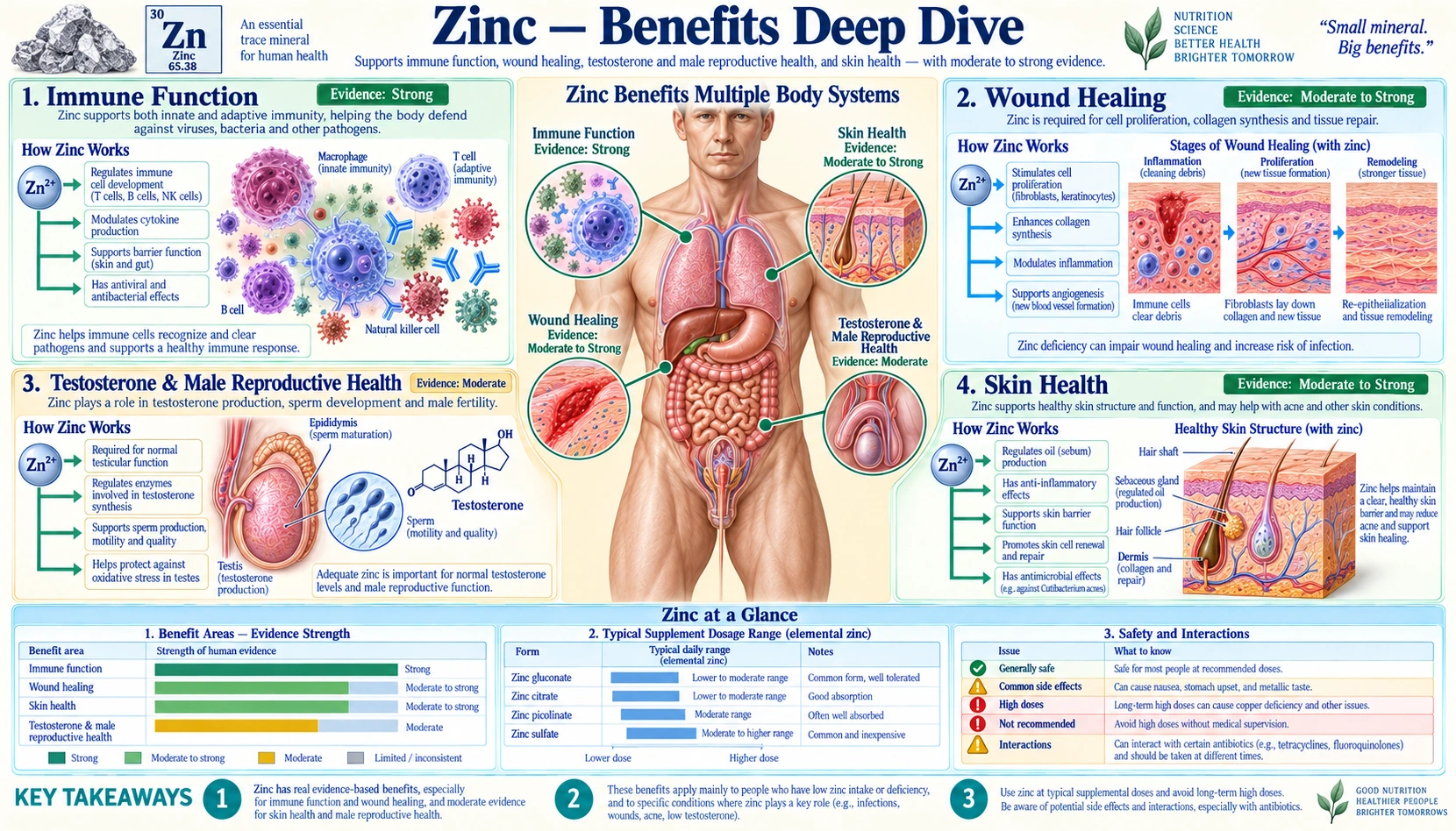
Zinc serves as a structural or catalytic cofactor in more than 300 enzymes and is required by more than 1,000 transcription factors (Prasad 2013). A 2006 genome analysis estimated that about 2,800 human proteins, roughly 10% of the proteome, may bind zinc; zinc fingers were the largest class, and most of these proteins are involved in regulating gene expression (Andreini 2006). Prasad's 2013 review lists growth retardation, cell-mediated immune dysfunction and cognitive impairment as the major clinical problems of zinc deficiency. The four deep-dive pages below cover the most-studied areas: immune defence against respiratory and diarrhoeal infection, wound repair, male reproductive hormones and fertility, and skin conditions from acrodermatitis enteropathica to acne. The strength of the evidence differs widely between them, and many of the clearer effects were seen in people who were zinc deficient. One safety finding recurs across all four: the NIH Office of Dietary Supplements states that zinc doses of 50 mg or more, if used for weeks, can interfere with copper absorption, and case reports describe zinc-induced copper deficiency with anemia, neutropenia and neurological disease (Willis 2005; Nations 2008).
Deep-Dive Articles
Immune Function
Zinc and thymulin activation, T-cell maturation, the Th1/Th2 balance, and NK-cell and neutrophil function. The current Cochrane review (2024) found that zinc used as treatment may shorten a cold (low-certainty evidence) but may make little or no difference to the risk of catching one, and WHO and UNICEF recommend zinc for acute childhood diarrhoea. A 2013 review estimates that nearly two billion people may be zinc deficient, and the WHO World Health Report 2002 attributed about 16% of lower respiratory infections worldwide to zinc deficiency.
Read the deep dive →Wound Healing
The skin holds about 5% of the body's zinc. Zinc's roles across the healing phases: inflammation, fibroblast and keratinocyte proliferation, collagen synthesis, and the zinc-dependent matrix metalloproteinases (such as MMP-1, MMP-2 and MMP-9) that remodel tissue. Acrodermatitis enteropathica as the model of severe zinc deficiency, topical zinc oxide in wound care, and a Cochrane review that found no evidence that oral zinc improves the healing of leg ulcers.
Read the deep dive →Testosterone & Male Reproductive Health
Prasad's reports from Iran (1961) and Egypt (1963) of young men with growth failure and hypogonadism, which led to the recognition of human zinc deficiency; a small 1996 study in which 20 weeks of dietary zinc restriction in four young men lowered serum testosterone from 39.9 to 10.6 nmol/L; exercise studies in wrestlers and sedentary men; zinc-magnesium-B6 combination trials; laboratory and rat findings on 5-alpha-reductase and aromatase; seminal zinc and the large FAZST trial, which found no live-birth benefit; and the zinc content of oysters, the highest per serving of any food in the NIH tables.
Read the deep dive →Skin Health
Oral zinc gluconate (30 mg of zinc a day) in inflammatory acne: better than placebo in a 1989 trial, and less effective than minocycline in a 2001 head-to-head trial (clinical success 31.2% versus 63.4%). Zinc and atopic dermatitis, where a 2019 meta-analysis found lower zinc levels in affected people but only two supplementation trials, with mixed results; topical zinc oxide in sunscreens and diaper-rash pastes; zinc pyrithione in antidandruff shampoos; and the zinc–vitamin A link first shown in rats, in which zinc was needed to mobilize vitamin A from the liver.
Read the deep dive →Table of Contents
- Deep-Dive Articles
- Why Zinc Produces Effects Across Many Systems
- High-Dose Zinc and Copper Deficiency
- Research Papers: Immune Function
- Research Papers: Wound Healing
- Research Papers: Testosterone & Male Reproduction
- Research Papers: Skin Health
- Research Papers: Cross-Cutting (Mechanism, Status, Safety)
- External Authoritative Resources
- Connections
- Featured Videos
Why Zinc Produces Effects Across Many Systems
Zinc has several different kinds of role in the body, which is one reason its deficiency shows up in many organ systems. Reviews usually group them into three: catalytic, structural and regulatory.
- Catalytic role in 300+ enzymes. More than 300 enzymes require zinc for their activity (Prasad 2013). Examples include carbonic anhydrase (respiration, acid-base balance), alcohol dehydrogenase (ethanol and retinol metabolism), alkaline phosphatase (bone, liver), carboxypeptidase (protein digestion), RNA polymerase (gene transcription), and the family of matrix metalloproteinases (extracellular matrix remodeling in wound healing and skin remodeling). The enzymes that copy DNA include zinc-binding domains, and zinc deprivation impairs DNA synthesis in cell studies.
- Structural role in zinc-finger proteins. The "zinc finger" is a small protein domain in which a zinc ion is held by cysteine and/or histidine residues, giving a stable fold that can bind DNA. A 2006 genome analysis estimated that about 2,800 human proteins, roughly 10% of the proteome, may bind zinc (with an uncertainty of about 400); zinc fingers were the most abundant class, Cys4 and Cys2His2 the most common types of zinc site, and most of these proteins are involved in regulating gene expression (Andreini 2006). Prasad's 2013 review counts more than 1,000 transcription factors that require zinc. The steroid hormone receptors, including the androgen receptor (testosterone signaling), estrogen receptor, progesterone receptor and glucocorticoid receptor, bind DNA through zinc-finger domains.
- Regulatory role in signaling. A subset of glutamatergic neurons stores zinc in synaptic vesicles and releases it during neurotransmission, where it modulates NMDA and GABA receptor activity. In immune cells, intracellular free zinc acts as a second messenger in signaling events (Prasad 2013). In a promyelocytic cell line, zinc raised A20 (TNFAIP3), itself a zinc-finger protein that dampens NF-κB activation, and so lowered the production of inflammatory cytokines such as TNF-α and IL-1β (Prasad 2008).
Because zinc has all three kinds of role, deficiency produces problems in many organ systems. Many of the trials summarized on the four deep-dive pages enrolled people who were zinc deficient or at high risk of deficiency, and results in those groups do not necessarily carry over to people whose zinc intake is already adequate.
High-Dose Zinc and Copper Deficiency
Long-term high zinc intake can cause copper deficiency. The NIH Office of Dietary Supplements states that zinc doses of 50 mg or more, if used for weeks, can interfere with copper absorption, and the adult Tolerable Upper Intake Level of 40 mg/day from food and supplements combined was set on the basis of zinc's effect on copper status. Zinc may induce intestinal metallothionein, which binds copper with high affinity and keeps it from passing into the blood; this is how zinc works as an anticopper treatment in Wilson's disease (Prasad 2013). In a 1988 case report, copper deficiency after 10 months of excessive oral zinc did not correct when the zinc was stopped and oral copper given for 2 months, and resolved only after intravenous copper; the authors concluded that excess zinc is eliminated slowly and blocks copper absorption until it is (Hoffman 1988).
Findings reported in zinc-induced copper deficiency include:
- Anemia — copper deficiency is a recognized cause of sideroblastic anemia (Willis 2005). In the 1988 case the anemia was hypochromic and microcytic, was first thought to be iron deficiency, and did not respond to oral or intravenous iron (Hoffman 1988).
- Neutropenia — moderate or severe neutropenia was present in all three patients of a 2005 report, and leukopenia and neutropenia in the 1988 case (Willis 2005; Hoffman 1988).
- Neurological disease — two of the three patients in the 2005 report had a progressive peripheral neuropathy; the other was a 21-year-old man taking zinc for acrodermatitis enteropathica (Willis 2005). A 2008 series described four patients with neurological abnormalities, low copper and high zinc who had used very large amounts of zinc-containing denture cream for years; two improved mildly with copper after they stopped the cream (Nations 2008).
- Immune function and HDL cholesterol — the NIH Office of Dietary Supplements lists reduced immune function and lower HDL cholesterol among the effects of zinc doses of 50 mg or more used for weeks.
Reference intakes and doses reported:
- The Recommended Dietary Allowance for adults is 11 mg/day for men and 8 mg/day for women. The Tolerable Upper Intake Level of 40 mg/day does not apply to people receiving zinc as medical treatment (NIH Office of Dietary Supplements).
- The AREDS eye-disease trial paired 80 mg of zinc with 2 mg of copper (AREDS Research Group 2001), which Prasad's review describes as added to prevent zinc-induced copper deficiency (Prasad 2013).
- Trials covered on the deep-dive pages used, for example, 30 mg of zinc a day (the acne trials and the FAZST fertility trial) and 45 mg a day (a 12-month trial in older adults; Prasad 2007).
- Zinc therapy for Wilson's disease is used precisely because it lowers copper absorption (Prasad 2013).
Decisions about long-term or high-dose zinc use belong with a clinician.
Research Papers: Immune Function
- Wessels I, Maywald M, Rink L (2017). Zinc as a gatekeeper of immune function. Nutrients 9(12):1286. — PubMed PMID: 29186856
- Prasad AS (2008). Zinc in human health: effect of zinc on immune cells. Mol Med 14(5-6):353-357. — PubMed PMID: 18385818
- Singh M, Das RR (2013). Zinc for the common cold. Cochrane Database Syst Rev (6):CD001364. — PubMed PMID: 23775705 — Withdrawn (withdrawn by Cochrane in April 2015 after errors were reported in the calculation and analysis of its data, and kept withdrawn in September 2016 after an editorial investigation; superseded by Nault et al. 2024, below; withdrawal notice: PubMed PMID: 25924708)
- Science M, Johnstone J, Roth DE, Guyatt G, Loeb M (2012). Zinc for the treatment of the common cold: a systematic review and meta-analysis. CMAJ 184(10):E551-E561. — PubMed PMID: 22566526
- Lassi ZS, Moin A, Bhutta ZA (2016). Zinc supplementation for the prevention of pneumonia in children 2–59 months. Cochrane Database Syst Rev (12):CD005978. — PubMed PMID: 27915460
- te Velthuis AJ, van den Worm SH, Sims AC, Baric RS, Snijder EJ, van Hemert MJ (2010). Zn(2+) inhibits coronavirus and arterivirus RNA polymerase activity in vitro and zinc ionophores block the replication of these viruses in cell culture. PLoS Pathog 6(11):e1001176. — PubMed PMID: 21079686
- Prasad AS, Beck FW, Bao B, et al. (2007). Zinc supplementation decreases incidence of infections in the elderly. Am J Clin Nutr 85(3):837-844. — PubMed PMID: 17344507
- Fraker PJ, King LE (2004). Reprogramming of the immune system during zinc deficiency. Annu Rev Nutr 24:277-298. — PubMed PMID: 15189122
- Hemila H, Petrus EJ, Fitzgerald JT, Prasad A (2016). Zinc acetate lozenges for treating the common cold: an individual patient data meta-analysis. Br J Clin Pharmacol 82(5):1393-1398. — PubMed PMID: 27378206
- Mocchegiani E, Romeo J, Malavolta M, et al. (2013). Zinc: dietary intake and impact of supplementation on immune function in elderly. Age 35(3):839-860. — PubMed PMID: 22222917
- Nault D, Machingo TA, Shipper AG, et al. (2024). Zinc for prevention and treatment of the common cold. Cochrane Database Syst Rev 5:CD014914. — PubMed PMID: 38719213
- Lazzerini M, Wanzira H (2016). Oral zinc for treating diarrhoea in children. Cochrane Database Syst Rev 12:CD005436. — PubMed PMID: 27996088
- Prasad AS (2013). Discovery of human zinc deficiency: its impact on human health and disease. Adv Nutr 4(2):176-190. — PubMed PMID: 23493534
Research Papers: Wound Healing
- Lin PH, Sermersheim M, Li H, Lee PHU, Steinberg SM, Ma J (2017). Zinc in wound healing modulation. Nutrients 10(1):16. — PubMed PMID: 29295546
- Lansdown ABG, Mirastschijski U, Stubbs N, Scanlon E, Agren MS (2007). Zinc in wound healing: theoretical, experimental, and clinical aspects. Wound Repair Regen 15(1):2-16. — PubMed PMID: 17244314
- Agren MS, Soderberg TA, Reuterving CO, Hallmans G, Tengrup I (1991). Effect of topical zinc oxide on bacterial growth and inflammation in full-thickness skin wounds in normal and diabetic rats. Eur J Surg 157(2):97-101. — PubMed PMID: 1676317
- Wilkinson EAJ (2014). Oral zinc for arterial and venous leg ulcers. Cochrane Database Syst Rev (9):CD001273. — PubMed PMID: 25202988
- Posthauer ME, Banks M, Dorner B, Schols JM (2015). The role of nutrition for pressure ulcer management: national pressure ulcer advisory panel, European pressure ulcer advisory panel, and pan pacific pressure injury alliance white paper. Adv Skin Wound Care 28(4):175-188. — PubMed PMID: 25775201
- Senapati A, Thompson RP (1985). Zinc deficiency and the prolonged accumulation of zinc in wounds. Br J Surg 72(7):583-584. — PubMed PMID: 4016546
- Gammoh NZ, Rink L (2017). Zinc in infection and inflammation. Nutrients 9(6):624. — PubMed PMID: 28629136
- Maverakis E et al. (2007). Acrodermatitis enteropathica and an overview of zinc metabolism. J Am Acad Dermatol 56(1):116-124. — PubMed PMID: 17190629
- Schwartz JR, Marsh RG, Draelos ZD (2005). Zinc and skin health: overview of physiology and pharmacology. Dermatol Surg 31(7 Pt 2):837-847. — PubMed PMID: 16029676
- Mohammed BM et al. (2016). Vitamin C promotes wound healing through novel pleiotropic mechanisms. Int Wound J 13(4):572-584. — PubMed PMID: 26290474
- Ogawa Y, Kinoshita M, Shimada S, Kawamura T (2018). Zinc in keratinocytes and Langerhans cells: relevance to the epidermal homeostasis. J Immunol Res 2018:5404093. — PubMed PMID: 30622978
Research Papers: Testosterone & Male Reproduction
- Prasad AS, Halsted JA, Nadimi M (1961). Syndrome of iron deficiency anemia, hepatosplenomegaly, hypogonadism, dwarfism and geophagia. Am J Med 31:532-546. — PubMed PMID: 14488490
- Prasad AS, Miale A Jr, Farid Z, Sandstead HH, Schulert AR (1963). Zinc metabolism in patients with the syndrome of iron deficiency anemia, hepatosplenomegaly, dwarfism, and hypogonadism. J Lab Clin Med 61:537-549. — PubMed PMID: 13985937
- Prasad AS, Mantzoros CS, Beck FW, Hess JW, Brewer GJ (1996). Zinc status and serum testosterone levels of healthy adults. Nutrition 12(5):344-348. — PubMed PMID: 8875519
- Cinar V, Polat Y, Baltaci AK, Mogulkoc R (2011). Effects of magnesium supplementation on testosterone levels of athletes and sedentary subjects at rest and after exhaustion. Biol Trace Elem Res 140(1):18-23. — PubMed PMID: 20352370 (A magnesium study, previously listed here under a zinc title; the zinc exercise study from the same group is Kilic 2006, next.)
- Kilic M, Baltaci AK, Gunay M, Gokbel H, Okudan N, Cicioglu I (2006). The effect of exhaustion exercise on thyroid hormones and testosterone levels of elite athletes receiving oral zinc. Neuro Endocrinol Lett 27(1-2):247-252. — PubMed PMID: 16648789
- Brilla LR, Conte V (2000). Effects of a novel zinc-magnesium formulation (ZMA) on hormones and strength. J Exerc Physiol Online 3(4):26-36. — PubMed (not indexed in PubMed; the link is a topic search)
- Wilborn CD, Kerksick CM, Campbell BI, et al. (2004). Effects of zinc magnesium aspartate (ZMA) supplementation on training adaptations and markers of anabolism and catabolism. J Int Soc Sports Nutr 1(2):12-20. — PubMed PMID: 18500945
- Schisterman EF, Sjaarda LA, Clemons T, et al. (2020). Effect of folic acid and zinc supplementation in men on semen quality and live birth among couples undergoing infertility treatment: a randomized clinical trial (FAZST). JAMA 323(1):35-48. — PubMed PMID: 31910279
- Fallah A, Mohammad-Hasani A, Colagar AH (2018). Zinc is an essential element for male fertility: a review of Zn roles in men's health, germination, sperm quality, and fertilization. J Reprod Infertil 19(2):69-81. — PubMed PMID: 30009140
- Costello LC, Franklin RB (2016). A comprehensive review of the role of zinc in normal prostate function and metabolism; and its implications in prostate cancer. Arch Biochem Biophys 611:100-112. — PubMed PMID: 27132038
Research Papers: Skin Health
- Dreno B, Amblard P, Agache P, Sirot S, Litoux P (1989). Low doses of zinc gluconate for inflammatory acne. Acta Derm Venereol 69(6):541-543. — PubMed PMID: 2575335
- Dreno B, Moyse D, Alirezai M, et al. (2001). Multicenter randomized controlled trial of zinc gluconate versus minocycline in inflammatory acne vulgaris. Dermatology 203(2):135-140. — PubMed PMID: 11586012
- Gupta M, Mahajan VK, Mehta KS, Chauhan PS (2014). Zinc therapy in dermatology: a review. Dermatol Res Pract 2014:709152. — PubMed PMID: 25120566
- Brocard A, Knol AC, Khammari A, Dreno B (2007). Hidradenitis suppurativa and zinc: a new therapeutic approach. Dermatology 214(4):325-327. — PubMed PMID: 17460404
- Maverakis E et al. (2007). Acrodermatitis enteropathica and an overview of zinc metabolism. J Am Acad Dermatol 56(1):116-124. — PubMed PMID: 17190629
- Michaëlsson G, Juhlin L, Vahlquist A (1977). Effects of oral zinc and vitamin A in acne. Arch Dermatol 113(1):31-36. — PubMed PMID: 137693 (This entry previously named a 1989 paper by Sanchez et al. that could not be found in PubMed; it is replaced by the 1977 trial it referred to.)
- Wang L, Cao L, Shi G, et al. (2018). The effect of zinc and vitamin A supplementation in children with atopic dermatitis: a meta-analysis. J Dermatolog Treat. — PubMed (No paper matching this citation could be found in PubMed or Crossref; the link is a topic search, and the entry is not relied on here. A verified review on the same question follows.)
- Gray NA, Dhana A, Stein DJ, Khumalo NP (2019). Zinc and atopic dermatitis: a systematic review and meta-analysis. J Eur Acad Dermatol Venereol 33(6):1042-1050. — PubMed PMID: 30801794
- Christensen MK et al. (2018). Zinc oxide nanoparticles in sunscreen: review of efficacy, safety, skin penetration. Skin Pharmacol Physiol. — PubMed (No paper matching this citation could be found in PubMed or Crossref; the link is a topic search, and the entry is not relied on here.)
- Schwartz JR, Marsh RG, Draelos ZD (2005). Zinc and skin health: physiology and pharmacology. Dermatol Surg 31(7 Pt 2):837-847. — PubMed PMID: 16029676
- Bae YS, Hill ND, Bibi Y, Dreiher J, Cohen AD (2010). Innovative uses for zinc in dermatology. Dermatol Clin 28(3):587-597. — PubMed PMID: 20510767
- Smith JC Jr, McDaniel EG, Fan FF, Halsted JA (1973). Zinc: a trace element essential in vitamin A metabolism. Science 181(4103):954-955. — PubMed PMID: 4730448 (rat study)
Research Papers: Cross-Cutting (Mechanism, Status, Safety)
- Maret W, Sandstead HH (2006). Zinc requirements and the risks and benefits of zinc supplementation. J Trace Elem Med Biol 20(1):3-18. — PubMed PMID: 16632171
- Andreini C, Banci L, Bertini I, Rosato A (2006). Counting the zinc-proteins encoded in the human genome. J Proteome Res 5(1):196-201. — PubMed PMID: 16396512
- Krebs NF, Hambidge KM (2007). Complementary feeding: clinically relevant factors affecting timing and composition. Am J Clin Nutr 85(2):639S-645S. (Zinc bioavailability and infant feeding.) — PubMed PMID: 17284770
- Hambidge M (2000). Human zinc deficiency. J Nutr 130(5S Suppl):1344S-1349S. — PubMed PMID: 10801941
- Hoffman HN 2nd, Phyliky RL, Fleming CR (1988). Zinc-induced copper deficiency. Gastroenterology 94(2):508-512. — PubMed PMID: 3335323
- Nations SP, Boyer PJ, Love LA, et al. (2008). Denture cream: an unusual source of excess zinc, leading to hypocupremia and neurologic disease. Neurology 71(9):639-643. — PubMed PMID: 18525032
- King JC, Cousins RJ (2014). Zinc. In: Modern Nutrition in Health and Disease, 11th ed. — PubMed (book chapter, not indexed in PubMed; the link is a topic search)
- Sandstrom B (2001). Micronutrient interactions: effects on absorption and bioavailability. Br J Nutr 85(Suppl 2):S181-S185. — PubMed PMID: 11509108
- Lonnerdal B (2000). Dietary factors influencing zinc absorption. J Nutr 130(5S Suppl):1378S-1383S. — PubMed PMID: 10801947
- Hambidge KM, Krebs NF (2007). Zinc deficiency: a special challenge. J Nutr 137(4):1101-1105. — PubMed PMID: 17374687
- Willis MS, Monaghan SA, Miller ML, et al. (2005). Zinc-induced copper deficiency: a report of three cases initially recognized on bone marrow examination. Am J Clin Pathol 123(1):125-131. — PubMed PMID: 15762288
- Age-Related Eye Disease Study Research Group (2001). A randomized, placebo-controlled, clinical trial of high-dose supplementation with vitamins C and E, beta carotene, and zinc for age-related macular degeneration and vision loss: AREDS report no. 8. Arch Ophthalmol 119(10):1417-1436. — PubMed PMID: 11594942
External Authoritative Resources
- Linus Pauling Institute — Zinc Micronutrient Information Center — a continuously updated scientific summary of zinc biology and clinical use
- NIH Office of Dietary Supplements — Zinc Fact Sheet (Health Professionals)
- WHO — Zinc supplementation in childhood diarrhea and pneumonia (global epidemiology and supplementation guidance)
- MedlinePlus — Zinc
- PubMed — All research on zinc and human health
Connections
- All Minerals
- Zinc (Main Page)
- Zinc for Immune Function
- Zinc for Wound Healing
- Zinc for Testosterone
- Zinc for Skin Health
- Copper (Critical Antagonist)
- Selenium
- Magnesium (ZMA Partner)
- Iron
- Vitamin A (RBP Partner)
- Vitamin C
- Vitamin D3
- Vitamin B6 (ZMA Partner)
- Acne
- Alopecia
- Pneumonia
- Infertility
- Testosterone Test
- Immune Boosting
- Cold & Flu Treatments
- Collagen
- Eggs
- Deficiency
- Toxicity
- History
- Sources