Iodine Excess (Too Much Iodine): Thyroiditis
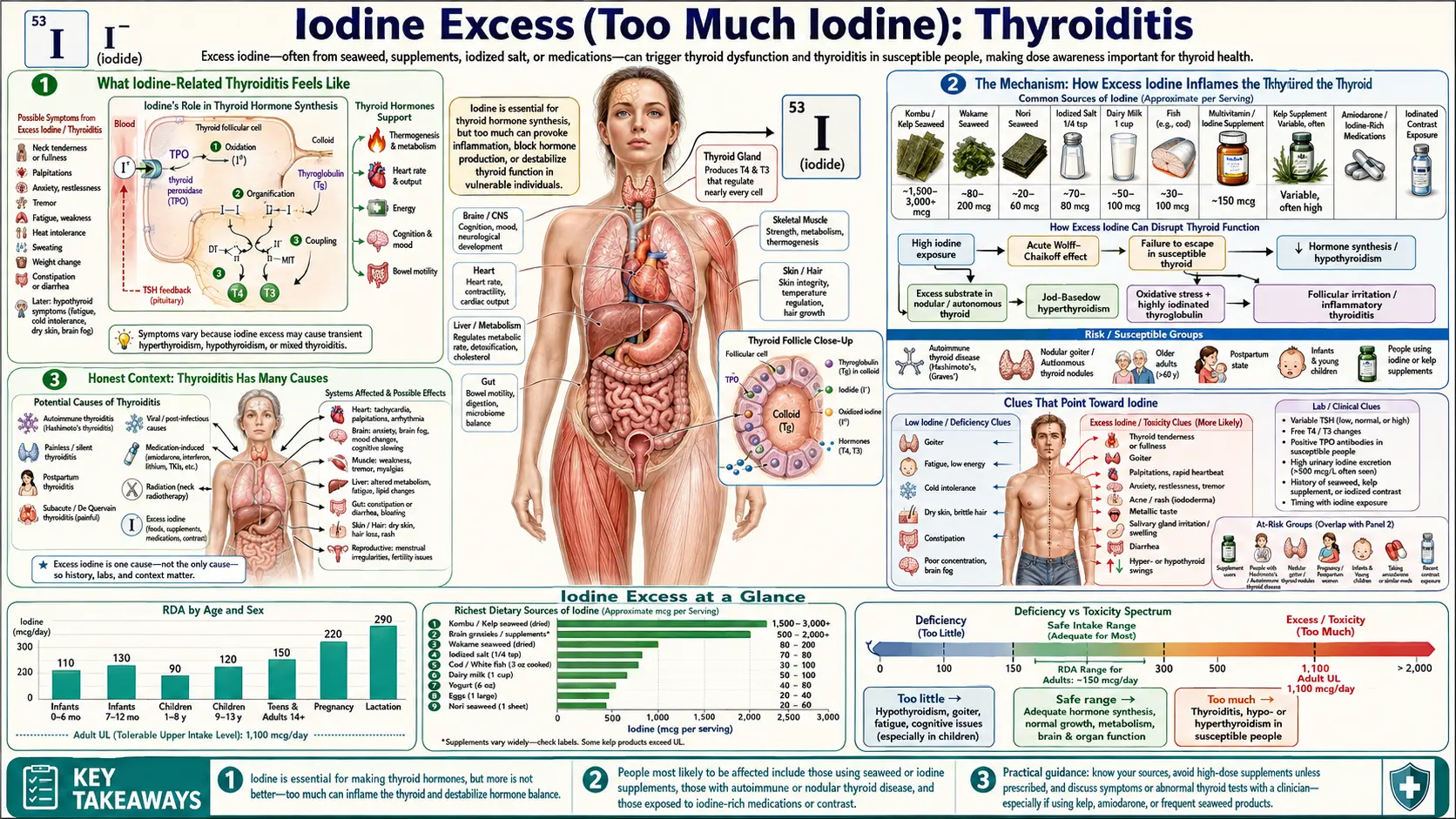
Iodine is essential for the thyroid — but in some people, taking in far more than the body needs can inflame the gland and tip the immune system into attacking it, a process doctors call thyroiditis. The most important version is autoimmune (Hashimoto-type) thyroiditis, where high iodine appears to act as a trigger or accelerator in those who are already genetically susceptible. Here is the honest framing this page keeps coming back to: most people can handle ordinary iodine, even generous dietary amounts, without any trouble at all, and inflammation of the thyroid has many causes that have nothing to do with iodine. Iodine excess is one contributing cause, most relevant after high-dose supplements, certain medications, or contrast dye — not a routine danger of eating iodized salt or seafood. This page explains how iodine-related thyroid inflammation feels, the biology behind it, why the symptom is non-specific, when iodine is the likely culprit, and which warning signs are urgent.
Table of Contents
- What Iodine-Related Thyroiditis Feels Like
- The Mechanism: How Excess Iodine Inflames the Thyroid
- Honest Context: Thyroiditis Has Many Causes
- Clues That Point Toward Iodine
- Where the Excess Iodine Comes From
- Getting Checked
- How Iodine-Related Thyroiditis Is Managed
- Warning Signs / Red Flags
- Key Research Papers
- Connections
- Featured Videos
What Iodine-Related Thyroiditis Feels Like
“Thyroiditis” simply means inflammation of the thyroid gland. When excess iodine is involved, that inflammation can show up in two very different ways — and what you feel depends largely on which one you have.
The more common, and the one this page focuses on, is a quiet, autoimmune (Hashimoto-type) inflammation. It usually develops slowly and silently. For months or years there may be nothing to feel at all — the only sign is rising thyroid antibodies on a blood test. As the inflammation gradually erodes the gland's ability to make hormone, the picture shifts toward an underactive thyroid (hypothyroidism), and that is when symptoms tend to appear:
- Fatigue and sluggishness — feeling tired, heavy, and slowed down even after a full night's sleep.
- Feeling cold — new sensitivity to cold rooms and cold hands and feet.
- Weight gain — modest, unexplained weight gain or difficulty losing weight.
- Dry skin, brittle hair, constipation — the classic “everything is running slow” cluster.
- Low mood and foggy thinking — depression, poor concentration, and slowed memory.
- A fullness or mild swelling at the front of the neck — sometimes a goiter develops as the gland enlarges (covered on the companion page, Goiter from Excess).
The second, far less common pattern is a painful, destructive thyroiditis, in which inflamed thyroid cells break open and spill their stored hormone into the blood all at once. This causes a temporary overactive phase — a racing heart, tremor, anxiety, heat intolerance, and weight loss — sometimes with tenderness over the gland. This destructive picture is the hallmark of type 2 amiodarone-induced thyroiditis, where the drug damages the gland directly: the 2018 European Thyroid Association guideline describes type 2 as a destructive thyroiditis in a normal thyroid gland, and type 1 as a form of iodine-induced hyperthyroidism in nodular goitres or latent Graves' disease. After the stored hormone is exhausted, the gland often swings temporarily underactive before recovering.
So the same word, “thyroiditis,” can mean a slow slide into too little hormone or a sudden surge of too much. What unites them is inflammation of the gland — and in the cases this page is about, an excess of iodine helping to set it off.
The Mechanism: How Excess Iodine Inflames the Thyroid
To see why too much of an essential nutrient can be harmful, it helps to picture what the thyroid does with iodine in the first place. The gland's job is to grab iodine from the blood, attach it to a large protein called thyroglobulin, and store the result until it is needed to make thyroid hormone. That attachment step — called organification — is a chemically violent reaction: the cell generates hydrogen peroxide and other reactive oxygen species (ROS, the same family of reactive molecules behind ordinary oxidative stress) to weld the iodine onto the protein. The thyroid is one of the few tissues that deliberately makes a strong oxidant as part of its daily work.
An analogy. Think of the thyroid as a welding shop. A little welding, done carefully, builds exactly what is needed. But run the torch too hot for too long and you scorch the surrounding workbench, throw off sparks, and eventually start a fire. Excess iodine is like turning the torch up: it forces the gland to do more high-temperature welding than it was built for, and the collateral damage — not the iodine itself — is what causes the trouble.
Three overlapping effects flow from that “overheated welding shop,” and together they explain iodine-driven thyroiditis:
- 1. Oxidative injury to thyroid cells. When iodine is abundant, organification ramps up and so does the production of hydrogen peroxide and reactive oxygen species. In excess, those reactive molecules injure the thyroid follicular cells themselves. Laboratory and animal studies show that high iodine can push these cells into programmed death (apoptosis) and an inflammatory form of cell rupture called pyroptosis, driven by reactive oxygen species acting on inflammatory signaling pathways such as NF-κB and the NLRP3 inflammasome. Dying, rupturing cells release their contents and draw immune cells into the gland.
- 2. More-immunogenic thyroglobulin. The more iodine that gets welded onto thyroglobulin, the more heavily iodinated the protein becomes — and a heavily iodinated thyroglobulin is a better target for the immune system. The extra iodine creates new molecular shapes (epitopes) and exposes normally hidden, “cryptic” fragments that the immune system has never learned to ignore. In effect, high iodine can make the body's own storage protein look foreign.
- 3. Recruiting and unmasking the immune attack. The combination of injured cells and altered self-protein increases the display of adhesion and signaling molecules on thyroid cells, helping immune cells home in on the gland and present those altered fragments. In someone genetically primed for thyroid autoimmunity, this can be the nudge that converts a quiet predisposition into active, antibody-producing Hashimoto-type thyroiditis — the autoimmune inflammation that gradually destroys hormone-making tissue.
This is why iodine is best thought of as a trigger or accelerator rather than a sole cause. The genetic susceptibility has to be there; excess iodine then tips a vulnerable gland over the edge. It also explains the most reassuring fact on this page: the effect is dose-related and largely confined to genuinely high intakes. Normal dietary iodine keeps the “welding shop” running at a safe temperature; it is the heavy supplemental or pharmacologic loads that overheat it.
Honest Context: Thyroiditis Has Many Causes
It would be a serious mistake to read the symptoms above — fatigue, cold intolerance, weight change, neck fullness — and conclude that iodine must be to blame. These are some of the most common and least specific symptoms in all of medicine, and thyroid inflammation itself has many causes that have nothing to do with iodine. Being candid about this matters, because chasing “iodine” can distract from the real cause or, worse, lead someone to restrict iodine harmfully.
The most important points of honesty:
- Hashimoto's thyroiditis is overwhelmingly the usual cause of autoimmune thyroid inflammation, and in most people it develops from genetic susceptibility, sex (it is far more common in women), age, family history, smoking, pregnancy, and other factors — not from dietary iodine. Iodine is one modifiable contributor among many, and only in some patients.
- Most iodine intake is harmless. Eating iodized salt, dairy, eggs, and seafood — even generously — does not cause thyroiditis in the great majority of people. The thyroid has built-in protective reflexes (described below) that let it tolerate day-to-day fluctuations.
- Painful, viral-type thyroiditis is unrelated to iodine. Subacute (de Quervain) thyroiditis — a painful gland after a viral illness — and postpartum thyroiditis are common forms of thyroid inflammation that have nothing to do with iodine excess.
- The same symptoms point in many directions. Fatigue, weight change, and feeling cold can stem from anemia, depression, sleep problems, low iron, vitamin deficiencies, perimenopause, medications, or simply being run-down — long before iodine is a likely suspect.
The honest bottom line: iodine-induced thyroiditis is real, but it is a relatively uncommon cause of thyroid inflammation and a still-uncommon cause of these everyday symptoms. It earns serious consideration mainly when the symptoms appear in the specific settings described next — not as a default explanation for feeling tired.
Clues That Point Toward Iodine
If thyroid inflammation is confirmed, a few patterns raise the likelihood that excess iodine is a contributor rather than a bystander. None is proof on its own, but together they tilt the suspicion:
- A clear high-iodine exposure shortly before the trouble began. Starting a high-dose iodine or kelp supplement, taking the iodine-rich drug amiodarone, receiving iodinated contrast dye for a computed tomography (CT) scan or angiogram, or using iodine-based antiseptics extensively — especially in the weeks to months beforehand — is the single strongest clue.
- Very high intake, not ordinary diet. Iodine-related thyroiditis tracks with genuinely large loads (milligram-range supplements, kelp, medications), not the microgram amounts in food. A history of “I started taking iodine for energy/thyroid support” is a common and revealing thread.
- A susceptible thyroid already. People who already carry thyroid antibodies, have a family history of Hashimoto's or Graves' disease, or were previously told they have “borderline” thyroid labs are the ones in whom an iodine load is most likely to tip the balance.
- A destructive, painful, or contrast/amiodarone-linked picture. A tender gland or a sudden overactive phase after a known iodine load points toward a destructive thyroiditis. In people taking amiodarone, the 2018 European Thyroid Association guideline separates type 1 amiodarone-induced thyrotoxicosis, a form of iodine-induced hyperthyroidism in nodular goitres or latent Graves' disease, from type 2, a destructive thyroiditis in a normal thyroid gland.
- It improves when the iodine source is removed. When stopping a supplement or finishing a contrast study is followed by gradual normalization, that response itself is suggestive.
Because high iodine can swing the gland either way, the resulting picture can resemble several conditions: a slide toward underactivity overlaps with Hashimoto's thyroiditis and hypothyroidism, while a destructive overactive phase can mimic Graves' disease and hyperthyroidism. The broader effects of iodine excess on hormone levels are covered on the sibling page Thyroid Dysfunction, and the gland-enlargement side on Goiter from Excess — this page stays on the inflammation itself.
Where the Excess Iodine Comes From
The thyroid has an elegant safety reflex called the Wolff–Chaikoff effect: when it is suddenly flooded with iodine, it briefly shuts down hormone production to protect itself, then “escapes” and resumes normal output within days. In most people this reflex absorbs an iodine surge smoothly. Trouble arises when the load is very large, very sustained, or lands on a thyroid that cannot adapt — which is why the causes below are dominated by concentrated, non-dietary sources:
- High-dose iodine and kelp supplements. This is the most common avoidable cause. Many over-the-counter “thyroid support,” iodine, and kelp products contain milligrams of iodine — tens to hundreds of times the daily requirement of about 150 micrograms. Taken for “energy” or in the mistaken belief that more iodine is always better, they can provoke exactly the inflammation people hope to avoid.
- Amiodarone. This widely used heart-rhythm drug is roughly one-third iodine by weight, and a single daily dose delivers an enormous iodine load. It causes both underactive and overactive thyroid problems, including a destructive type 2 amiodarone-induced thyroiditis in which the drug directly injures the gland. In a 2025 Korean national study of 27,023 people treated with amiodarone (mean follow-up 6.4 years), 1,326 (4.9%) developed an overactive thyroid and 3,121 (11.5%) an underactive one; existing Hashimoto's thyroiditis was linked to both (hazard ratio 2.00 for the overactive form and 2.26 for the underactive form).
- Iodinated contrast dye. The contrast used for computed tomography scans and angiograms is iodine-rich, and a study can transiently expose the thyroid to a very large iodine load — usually harmless, but occasionally enough to unmask thyroid dysfunction in a susceptible gland. In a US veterans study published in 2025 (122 people, median age 70, 98.4% men), 14 of 122 (11.5%) developed iodine-induced thyroid dysfunction during a median 18 months after contrast: 6 (4.9%) an overactive thyroid (1 of them overt) and 8 (6.6%) a mildly (subclinically) underactive one; at the last check, 10 of the 20 people with thyroid dysfunction (the 14 new cases and 6 present before the scan) still had mild over- or underactivity. A 2024 Swedish study of 422 randomly selected adults aged 50–65 having a contrast heart scan found no cases of overt over- or underactive thyroid 4–12 weeks later; mild (subclinical) changes or isolated abnormal free thyroxine levels developed in 3.5% of those with normal levels beforehand, without more thyroid-related symptoms, and raised thyroid peroxidase antibodies were a risk factor for mild underactivity.
- Topical and antiseptic iodine. Povidone-iodine antiseptics and certain iodine-containing medications (some expectorants, disinfectants, and traditional remedies) can add up, especially with heavy or prolonged use, or in newborns and people with damaged skin.
- Iodine-rich foods in extreme amounts. Routine seafood, dairy, and iodized salt are not the problem. The exception is very heavy, habitual intake of high-iodine foods — most notably large quantities of seaweed/kelp (kombu, dulse), which can contain enormous and variable iodine, and which has been linked to thyroid dysfunction in populations with very high seaweed consumption.
- Iodine-rich drinking water. A 2017 systematic review found that the excess iodine in the populations it studied came mainly from iodized salt or water. In the three adult studies it pooled, the odds ratio for overt hypothyroidism in excess-iodine versus adequate-iodine populations was 2.78, and for subclinical hypothyroidism 2.03; the authors noted the low quality and limited number of the studies.
Population studies reinforce the same theme from the other direction: when whole regions move from iodine deficiency to abundant or excessive intake — for example after universal salt iodization — the prevalence of thyroid autoantibodies and autoimmune (Hashimoto-type) thyroiditis tends to rise modestly. In a five-year Chinese cohort study (Teng and colleagues, 2006), the cumulative incidence of autoimmune thyroiditis was 0.2%, 1.0% and 1.3% in regions with mildly deficient, more than adequate and excessive iodine intake (median urinary iodine 84, 243 and 651 micrograms per litre). This is a public-health signal that excess, not just deficiency, has a cost. For an individual, though, the practical message is simpler: the risk lives in concentrated supplements, medications, and contrast — not in a normal diet.
Getting Checked
Sorting out whether the thyroid is inflamed — and whether iodine is involved — rests on a short, inexpensive set of tests interpreted alongside a careful history of recent iodine exposures.
Thyroid blood tests. The starting point is a thyroid panel: thyroid-stimulating hormone (TSH) (the pituitary's signal, which rises when the thyroid is underactive and falls when it is overactive) plus free T4 and often free T3. These show which way the gland is running. To detect the autoimmune inflammation specifically, doctors add thyroid antibodies — chiefly anti-thyroid peroxidase (anti-TPO) and anti-thyroglobulin antibodies. High antibody levels are the fingerprint of Hashimoto-type thyroiditis. A Comprehensive Metabolic Panel may be drawn at the same time to check general health and rule out other explanations for the symptoms.
Measuring iodine exposure. A spot or 24-hour urinary iodine level reflects recent intake and can confirm an unusually high iodine load, though it varies day to day and is interpreted cautiously. Just as useful is a plain-spoken review of the supplement bottle, the medication list (especially amiodarone), and any recent contrast scan — the history often makes the diagnosis before any iodine measurement does.
Imaging when needed. A thyroid ultrasound can show the gland's size and texture and detect the diffuse changes typical of chronic inflammation. In a destructive or overactive picture, a radioactive iodine uptake scan helps distinguish causes: a destructive thyroiditis (such as type 2 amiodarone thyroiditis, which the 2018 European Thyroid Association guideline classes as destructive thyroiditis rather than iodine-induced hyperthyroidism) typically shows low uptake, because the gland is leaking pre-formed hormone rather than busily making more — the opposite of Graves' disease. Note that a recent iodine load (supplement or contrast) can itself temporarily lower uptake, which affects how the scan is read.
How Iodine-Related Thyroiditis Is Managed
The central step in management is also the simplest: identifying and removing the excess iodine source wherever that can be done safely. The rest of management treats whatever direction the gland has swung and supports it while the inflammation settles.
- Removing the avoidable iodine. Discontinuing a high-dose iodine or kelp supplement is often the only intervention a mild case needs, and thyroid function may drift back toward normal over weeks to months once the gland is no longer overloaded. (This means avoidable sources only: the recommended iodine intake for adults who are not pregnant or breastfeeding is 150 micrograms a day, and for amiodarone the 2018 European Thyroid Association guideline treats continuing or stopping the drug as a joint specialist decision.)
- Treating an underactive thyroid. If the inflammation has left the gland unable to make enough hormone — the common Hashimoto-type endpoint — the standard treatment is levothyroxine, a once-daily replacement of the body's own thyroid hormone, dosed to bring thyroid-stimulating hormone back into range. This is covered in depth on the hypothyroidism and Hashimoto's thyroiditis pages.
- Managing a destructive, overactive phase. When inflamed cells dump stored hormone (as in type 2 amiodarone-induced thyroiditis), the surge is temporary, so treatment supports the patient through it rather than blocking hormone production. Beta-blockers ease the racing heart and tremor, and a destructive thyroiditis often responds to anti-inflammatory glucocorticoids (steroids) rather than the antithyroid drugs used for Graves'. For amiodarone, the 2018 European Thyroid Association guideline states that type 2 is treated with oral glucocorticoids and type 1 with thionamides (antithyroid drugs), sometimes combined for a few weeks with sodium perchlorate; mixed or uncertain forms are treated with thionamides, with oral glucocorticoids added from the start if the diagnosis is uncertain or after a few weeks if the response is poor. The guideline states that the decision to continue or stop amiodarone should be individualised to the person's heart risk and taken jointly by specialist cardiologists and endocrinologists.
- Watching and rechecking. Because many iodine-related thyroiditis pictures are self-limited or evolve over time, repeat thyroid testing — rather than aggressive intervention — is a frequent course, showing which way the gland is heading so that treatment can follow it.
Removing the excess is a different thing from cutting out all dietary iodine. Iodine is essential, and too little brings its own thyroid problems. The recommended intake for adults who are not pregnant or breastfeeding is 150 micrograms a day, and the US Institute of Medicine's tolerable upper level for adults is 1,100 micrograms a day — the approximate threshold below which notable adverse effects are unlikely in the healthy population (Leung and Braverman, 2014). Deliberate, sweeping iodine restriction is used in specific medical settings, for example briefly before certain treatments.
Warning Signs / Red Flags
Most iodine-related thyroid inflammation is not an emergency and is sorted out with unhurried testing. But a few situations are signs that hospitals treat as prompt or urgent:
- Signs of a severely overactive thyroid — a fast or irregular heartbeat, chest pain, marked tremor, severe anxiety or agitation, high fever, or confusion. A rapidly worsening overactive state can become a medical emergency (thyroid storm), which hospitals treat as urgent, especially in someone taking amiodarone.
- A painful, tender, or rapidly enlarging neck swelling, particularly with fever — a sign usually evaluated promptly to identify the type of thyroiditis and rule out other causes.
- Difficulty breathing or swallowing, or a sensation of pressure in the neck — a gland enlarging enough to press on the windpipe or esophagus is a sign usually evaluated promptly (see Goiter from Excess).
- Severe symptoms of an underactive thyroid — profound fatigue, very slow heart rate, intolerance of cold, or sluggish thinking that is worsening, which can rarely progress to a dangerous state (myxedema) that hospitals treat as urgent.
- Any new thyroid symptoms while taking amiodarone or after iodinated contrast — because the iodine load is so large. The authors of the 2025 Korean amiodarone study call regular thyroid function checks warranted for people treated with amiodarone, and the authors of the 2025 US contrast study support targeted monitoring after iodinated contrast.
Short of these warning signs, iodine-related thyroiditis is usually sorted out without urgency: the usual work-up is a thyroid panel with antibodies, a tally of every iodine source being taken, and a recheck after the excess is removed. For someone who is simply tired, cold, or has gained a little weight with no high-iodine exposure, iodine is an unlikely culprit, and a thyroid panel is part of the short, inexpensive set of tests described above.
Key Research Papers
- Leung AM, Braverman LE (2014). Consequences of excess iodine. Nature Reviews Endocrinology;10(3):136-142. — DOI: 10.1038/nrendo.2013.251. — doi:10.1038/nrendo.2013.251
- Teng W, Shan Z, Teng X, Guan H, et al. (2006). Effect of Iodine Intake on Thyroid Diseases in China. New England Journal of Medicine;354(26):2783-2793. — DOI: 10.1056/NEJMoa054022. — doi:10.1056/NEJMoa054022
- Luo Y, Kawashima A, Ishido Y, Yoshihara A, et al. (2014). Iodine Excess as an Environmental Risk Factor for Autoimmune Thyroid Disease. International Journal of Molecular Sciences;15(7):12895-12912. — DOI: 10.3390/ijms150712895. — doi:10.3390/ijms150712895
- Burek CL, Rose NR (2008). Autoimmune thyroiditis and ROS. Autoimmunity Reviews;7(7):530-537. — DOI: 10.1016/j.autrev.2008.04.006. — doi:10.1016/j.autrev.2008.04.006
- Carayanniotis G (2011). Molecular parameters linking thyroglobulin iodination with autoimmune thyroiditis. Hormones;10(1):27-35. — DOI: 10.14310/horm.2002.1290. — doi:10.14310/horm.2002.1290
- Liu J, Mao C, Dong L, Kang P, et al. (2019). Excessive Iodine Promotes Pyroptosis of Thyroid Follicular Epithelial Cells in Hashimoto's Thyroiditis Through the ROS-NF-κB-NLRP3 Pathway. Frontiers in Endocrinology;10:778. — DOI: 10.3389/fendo.2019.00778. — doi:10.3389/fendo.2019.00778
- Katagiri R, Yuan X, Kobayashi S, Sasaki S (2017). Effect of excess iodine intake on thyroid diseases in different populations: A systematic review and meta-analyses including observational studies. PLOS ONE;12(3):e0173722. — DOI: 10.1371/journal.pone.0173722. — doi:10.1371/journal.pone.0173722
- Teti C, Panciroli M, Nazzari E, Pesce G, et al. (2021). Iodoprophylaxis and thyroid autoimmunity: an update. Immunologic Research;69(2):129-138. — DOI: 10.1007/s12026-021-09192-6. — doi:10.1007/s12026-021-09192-6
- Leung AM, Avram AM, Brenner AV, Duntas LH, et al. (2015). Potential Risks of Excess Iodine Ingestion and Exposure: Statement by the American Thyroid Association Public Health Committee. Thyroid;25(2):145-146. — DOI: 10.1089/thy.2014.0331. — doi:10.1089/thy.2014.0331
- Bartalena L, Bogazzi F, Chiovato L, Hubalewska-Dydejczyk A, et al. (2018). 2018 European Thyroid Association (ETA) Guidelines for the Management of Amiodarone-Associated Thyroid Dysfunction. European Thyroid Journal;7(2):55-66. — DOI: 10.1159/000486957. — doi:10.1159/000486957
- Burch HB (2019). Drug Effects on the Thyroid. New England Journal of Medicine;381(8):749-761. — DOI: 10.1056/NEJMra1901214. — doi:10.1056/NEJMra1901214
- Sohn SY, Inoue K, Bashir MT, Currier JW, et al. (2025). Thyroid Dysfunction Risk After Iodinated Contrast Media Administration: A Prospective Longitudinal Cohort Analysis. Journal of Clinical Endocrinology and Metabolism;110(4):e1204-e1210. — DOI: 10.1210/clinem/dgae304. — doi:10.1210/clinem/dgae304
- Carlqvist J, Nyman U, Brandberg J, Nyström HF, Hellström M (2024). Effects of iodine contrast media on thyroid function – a prospective study. European Thyroid Journal;13(6):e240244. — DOI: 10.1530/ETJ-24-0244. — doi:10.1530/ETJ-24-0244
- Sohn SY, Kim YJ, Cho S, Cho SW (2025). Incidence and Risk Factors for Amiodarone-Induced Thyroid Dysfunction: A Nationwide Retrospective Cohort Study. American Journal of Cardiovascular Drugs;25(3):419-425. — DOI: 10.1007/s40256-024-00717-6. — doi:10.1007/s40256-024-00717-6