Selenium Test
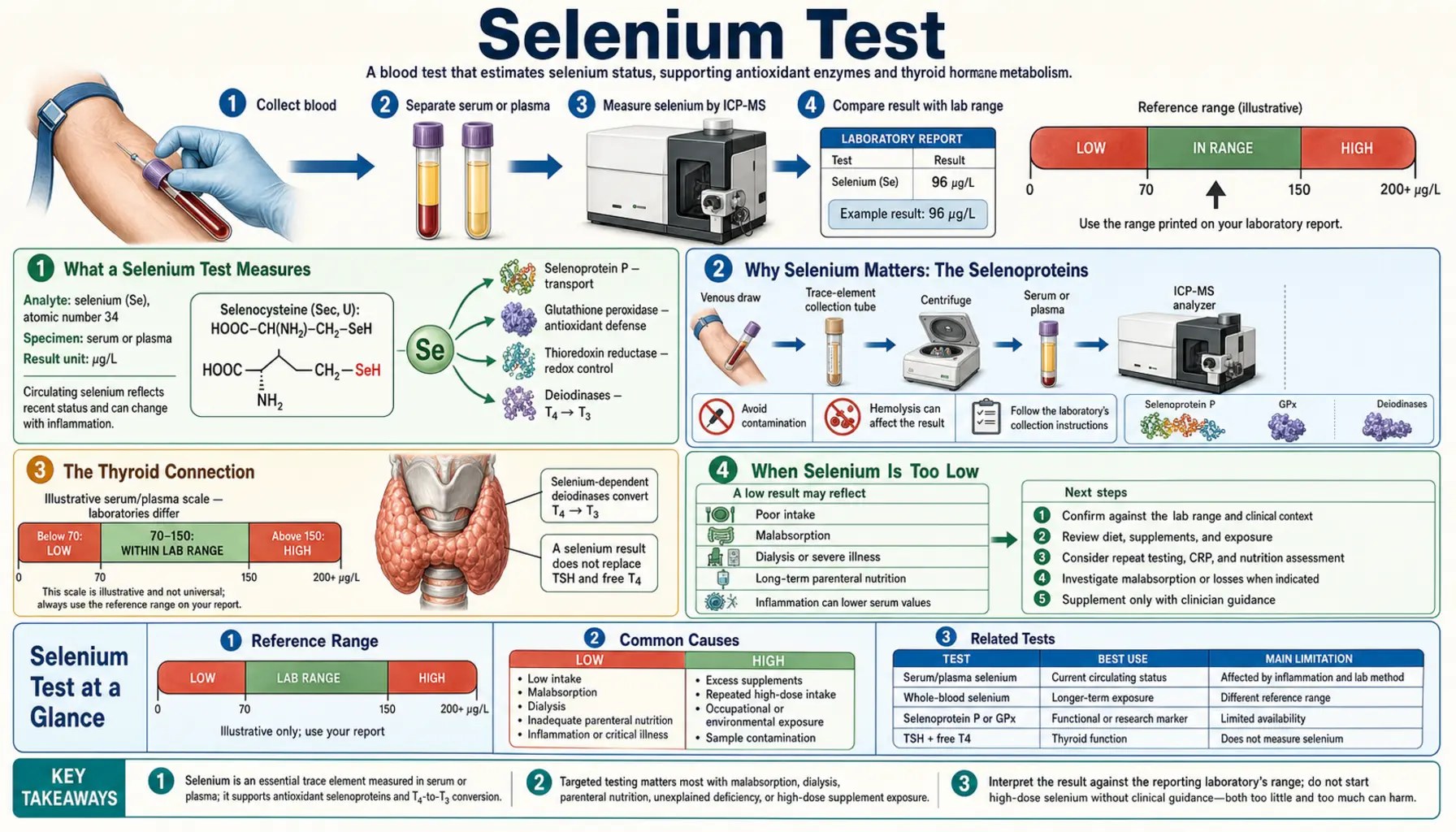
A selenium test measures how much of this trace mineral is in your body. Selenium is one of those nutrients where the story is not "more is better." Your body needs a small, steady amount to run its antioxidant defenses and to switch on your thyroid hormone — but the gap between "too little" and "too much" is unusually narrow. That makes testing genuinely useful: it can confirm a suspected deficiency in someone with a limited diet or a digestive disorder, and it can catch the opposite problem in someone taking high-dose supplements or eating a fistful of Brazil nuts every day. This page explains what the different selenium tests actually measure, what the numbers mean, why the safe window is so tight, and how to prepare.
Table of Contents
- What a Selenium Test Measures
- Why Selenium Matters: The Selenoproteins
- The Thyroid Connection
- When Selenium Is Too Low
- When Selenium Is Too High (Selenosis)
- The Narrow Window: A U-Shaped Risk
- Reference Ranges and What They Mean
- Who Gets Tested and How to Prepare
- Making Sense of Your Results
- Research Papers
- Connections
- Featured Videos
What a Selenium Test Measures
There is no single "selenium test." Instead, there is a small family of measurements, and which one your doctor orders depends on the question being asked. Some tests reflect what you ate this week; others reflect your intake over months. Some measure the raw amount of the mineral; others measure whether that selenium is actually doing its job. Understanding the difference is the key to reading your results correctly.
Serum or plasma selenium (recent intake)
This is the most common test and usually what people mean by "a selenium test." A technician draws blood from a vein, the cells are spun out, and the amount of selenium in the remaining liquid (serum or plasma) is measured, typically by a technique called mass spectrometry. This number rises and falls fairly quickly with your diet, so it mainly reflects your recent selenium intake — over roughly the past days to weeks. It is a good first-line snapshot, but because it responds to a single big meal or a recent supplement, it is not the whole picture.
Functional markers (is the selenium working?)
Because selenium's whole reason for mattering is that it builds special proteins, some tests skip the raw mineral and measure those proteins directly. These are called functional markers, and they answer a better question: not "how much selenium is present?" but "is there enough selenium to keep your selenoproteins topped up?"
- Glutathione peroxidase (GPx) — an antioxidant enzyme that depends on selenium. Its activity in blood rises as selenium status improves, then plateaus once the enzyme is fully saturated. Because it flattens out, GPx is a sensitive marker in people who are low but tells you little once selenium is adequate or high.
- Selenoprotein P (SEPP1) — the main selenium-transport protein made by the liver, and generally considered the best single functional marker of whole-body selenium status. Like GPx it plateaus at higher intakes, but it saturates at a slightly higher point, so it remains informative across a wider range.
When researchers want to define the intake that fully "fills up" the body's selenium machinery, they look for the point where selenoprotein P stops rising — the plateau — because beyond that, extra selenium is not building any more functional protein (see Research Papers). These functional tests are used more in research and specialist settings than in routine primary care, but they are the reason your doctor may say your plain selenium number is only part of the story.
Whole-blood, red-cell, and toenail selenium (longer-term)
To see selenium status over a longer horizon, other samples work better:
- Whole blood or red blood cells (RBC) — because red cells live about three to four months, the selenium locked inside them reflects your average intake over that longer window, smoothing out day-to-day swings.
- Toenail (or hair) selenium — nails grow slowly and lock in selenium as they form, so a nail clipping is a tissue "time capsule" of your intake over roughly the past several months to a year. Toenails are popular in large nutrition studies because they are easy to collect and mail, and they are hard to contaminate. Hair can also be used but is more easily skewed by selenium-containing shampoos.
In short: serum tells you about the last few weeks, red cells about the last few months, and nails about the last several months to a year. A doctor investigating a stubborn or long-standing problem may choose a longer-term sample; a doctor checking a recent change may choose serum.
Why Selenium Matters: The Selenoproteins
Selenium is unusual among minerals because it is built directly into the structure of about 25 human proteins, collectively called selenoproteins. In these proteins, selenium sits at the business end of the molecule in the form of a special amino acid, selenocysteine — often described as the twenty-first amino acid. Without selenium, the body simply cannot make these proteins, and their jobs go undone. That is why a mineral needed in such tiny amounts can have such wide-ranging effects.
Two families of selenoproteins explain most of what a selenium test is really about:
- Antioxidant defense (the glutathione peroxidases). These enzymes neutralize harmful byproducts of normal metabolism called peroxides, protecting cell membranes and DNA from oxidative damage. Think of them as part of the cell's cleanup crew, mopping up reactive molecules before they cause harm. This is the antioxidant role selenium is famous for.
- Thyroid hormone activation (the deiodinases). A separate group of selenoproteins acts as the switches that convert thyroid hormone from its storage form (T4) into its active form (T3). This is the direct biochemical link between selenium and the thyroid — and the reason the two are so often discussed and tested together (see The Thyroid Connection).
Other selenoproteins help with sperm formation, immune function, and recycling other antioxidants. But the antioxidant and thyroid roles are the two that most directly shape why someone gets a selenium test and how the result is interpreted.
The Thyroid Connection
The thyroid gland holds more selenium per gram than almost any other tissue in the body — a strong hint that selenium matters there. The connection runs through those deiodinase enzymes. Your thyroid mostly releases T4, a relatively inactive storage hormone. To do its work, T4 must be trimmed into the active hormone T3, and the enzymes that perform this conversion are selenoproteins. If selenium is in short supply, this activation step can falter even when the thyroid itself is producing hormone normally.
Selenium also protects the thyroid from itself. Making thyroid hormone generates hydrogen peroxide as a byproduct, and selenium-dependent antioxidant enzymes inside the gland neutralize that peroxide before it damages thyroid tissue. When selenium is low, that protective buffer weakens.
This is why selenium comes up in discussions of autoimmune thyroid conditions such as Hashimoto's thyroiditis. Some trials have reported that selenium supplementation can lower thyroid antibody levels in people with autoimmune thyroiditis, though the effect on symptoms and long-term outcomes is less certain and the evidence is mixed (see Research Papers). The practical takeaway is not that everyone with a thyroid problem should take selenium — it is that selenium status is one reasonable thing to check as part of a broader thyroid workup, which is why a thyroid panel and a selenium test sometimes travel together. Because both selenium and iodine are needed for healthy thyroid function, they are often considered side by side.
When Selenium Is Too Low
How much selenium you get depends heavily on where your food is grown. Selenium enters the food chain through soil, so people who eat food raised on selenium-poor soil — found in parts of China, parts of Europe, New Zealand, and elsewhere — tend to have lower intakes. This geography is written directly into the history of selenium deficiency.
- Keshan disease — a form of heart-muscle disease (cardiomyopathy) first described in a selenium-poor region of China, named after Keshan County. It struck children and women of childbearing age, causing an enlarged, weakened heart. Providing selenium dramatically reduced new cases, which is one of the clearest demonstrations that selenium is essential for humans. (A viral infection is thought to interact with the deficiency, but low selenium is the setting that allows it.)
- Kashin-Beck disease — a chronic joint and bone disorder, also seen in selenium-poor regions of Asia, that damages growing cartilage and can lead to joint deformity and stunted growth. Its causes are more complex and not solely due to selenium, but low selenium status is part of the picture.
Severe, disease-causing deficiency like this is uncommon in regions with selenium-adequate soil or varied diets that include foods trucked in from many places. But milder shortfalls can still occur, and testing is more likely to be considered in people who are at higher risk, such as those with:
- Digestive disorders that impair absorption (Crohn's disease, celiac disease, or short-bowel conditions after surgery).
- Long-term reliance on intravenous (tube or IV) feeding that was not adequately supplemented.
- Kidney disease requiring dialysis, which can lower selenium levels.
- Very restrictive diets, severe malnutrition, or living in a known low-selenium region.
Symptoms of low selenium are often vague — fatigue, muscle weakness, or weakened immunity — which is exactly why a blood test is more reliable than guessing from how you feel.
When Selenium Is Too High (Selenosis)
Here is what sets selenium apart from most nutrients: getting too much is a real and well-documented problem, not just a theoretical one. Selenium poisoning has a name — selenosis — and a recognizable set of signs. The classic features include:
- Hair loss and brittle, damaged nails — often the most visible early sign. Hair can become brittle and fall out, and nails may develop white streaks, ridges, or break easily.
- A garlic-like odor on the breath — caused by selenium-containing compounds being exhaled. A metallic taste in the mouth is also reported.
- Skin rashes and lesions.
- Nervous-system symptoms — numbness, tingling, or other signs of nerve irritation (neuropathy), and in severe cases tremor or problems with coordination.
- Digestive upset — nausea, vomiting, and diarrhea, especially with a large acute dose.
The most famous natural example again comes from China, where people in a small area ate crops grown on soil extraordinarily high in selenium and developed widespread hair and nail loss and nerve damage — a landmark study that mapped out what human selenosis looks like (see Research Papers). But you do not need unusual soil to overdo it today. Two everyday routes matter most:
- Supplements — especially high-dose products or, alarmingly, mislabeled or wrongly manufactured ones. In one documented outbreak, a liquid dietary supplement was manufactured with roughly 200 times the labeled amount of selenium and sickened more than 200 people, causing hair loss, nausea, joint pain, and nail damage (see Research Papers). It is a sharp reminder that "natural" supplements are not automatically safe.
- Brazil nuts — the single richest common food source of selenium, and a genuine overdose hazard precisely because they are a whole food. A single Brazil nut can contain anywhere from about 70 to 90 micrograms of selenium, sometimes much more, meaning just a few nuts can exceed a full day's requirement and a small handful eaten daily can push you toward the upper limit. They are a wonderful source in moderation — a couple a few times a week — but "healthy snack, eat freely" does not apply here.
The Narrow Window: A U-Shaped Risk
The single most important idea on this page is that selenium follows a U-shaped curve. Picture risk to your health on the vertical axis and selenium intake running left to right. On the far left (too little), risk is high — deficiency. As intake rises into the healthy middle, risk drops to the bottom of the U. But keep going, and the curve climbs again on the right side — toxicity. Both ends of the curve are bad, and the comfortable bottom of the U is narrower for selenium than for almost any other nutrient.
To put rough numbers on it: adults need on the order of 55 micrograms of selenium per day, while the tolerable upper limit for long-term intake is around 400 micrograms per day — and signs of chronic toxicity have been reported not far above that. That is a much tighter margin than, say, vitamin C, where the gap between "enough" and "too much" spans grams. With selenium you are working within a band of a few hundred micrograms, and casual supplementing on top of a normal diet can nudge you upward faster than people expect.
The U-shape is not just about the classic deficiency and toxicity syndromes. Large trials have added a subtler warning: selenium supplements are not automatically beneficial even in the middle of the range. A major prostate-cancer prevention trial (SELECT) found that selenium plus vitamin E did not prevent cancer, and other analyses raised the possibility of harm in people who already had adequate selenium. A separate long-term trial linked selenium supplementation to a higher risk of developing type 2 diabetes in already-replete participants (see Research Papers). The honest lesson from this research is consistent: correcting a genuine deficiency is worthwhile, but taking extra selenium when you are already in the healthy range is at best useless and at worst harmful. That is precisely why testing — rather than blanket supplementing — is the sensible approach.
Reference Ranges and What They Mean
Reference ranges vary between laboratories, between countries (because background selenium intake differs), and by the exact sample and method used. Your own lab's printed range always wins over any general figure. That said, here is a broad orientation for the most common test, serum or plasma selenium, to help you read a result:
- Many laboratories report a normal adult serum/plasma selenium range of roughly 70 to 150 micrograms per liter (µg/L). Some labs express the same thing in different units (micrograms per deciliter, or in nanomoles/millimoles per liter), so check which unit your report uses before comparing numbers.
- Values below about 70–80 µg/L are generally considered low and may prompt a look at diet, absorption, and symptoms. Levels needed to fully saturate the functional selenoproteins tend to sit a bit higher than the bare minimum that prevents deficiency disease.
- The intake that maximizes selenoprotein P (the "your tank is full" point in research studies) corresponds to plasma selenium in roughly the 120–125 µg/L range in the studies that defined it — a useful anchor for what "comfortably adequate" looks like, though not a formal clinical cutoff.
- Persistently elevated values — well above the top of the reference range, and especially alongside symptoms like hair or nail changes — point toward excess intake and should trigger a review of supplements and Brazil-nut habits.
For glutathione peroxidase activity and selenoprotein P, results are reported in enzyme-activity or concentration units specific to each assay, and there is no single universal number — interpretation leans entirely on the performing lab's reference range. The general principle holds across all of them: these functional markers rise with improving status and then plateau, so a "normal" functional result mainly confirms you are not deficient; it does not rule out excess. To catch the high end, the plain serum level (or a history of high supplement or Brazil-nut intake) is more telling.
Because of all this variation, a selenium result is best read as one input alongside your diet, your symptoms, your medications and supplements, and the reason you were tested — not as a pass/fail number in isolation.
Who Gets Tested and How to Prepare
Selenium is not part of routine annual bloodwork. It is usually ordered for a specific reason, such as: investigating possible deficiency in someone with a malabsorption disorder or on long-term IV nutrition; evaluating symptoms that could suggest selenosis (unexplained hair loss, nail changes, garlic breath, or neuropathy) in a supplement user; assessing status as part of a thyroid or fertility workup; or monitoring someone known to have abnormal levels.
Preparation is usually simple, but a few points make the result more reliable:
- The test is a standard blood draw (for serum, plasma, whole blood, or red cells) or, for longer-term status, a toenail clipping. No needle is involved in the nail version.
- Ask your doctor about supplements ahead of time. Because serum selenium reflects recent intake, a selenium supplement or a Brazil-nut binge in the days before the draw can raise the number and mask a true baseline. Your clinician may ask you to note or pause selenium-containing supplements — but do not stop any prescribed medication or supplement on your own; ask first.
- Fasting is generally not required for a selenium blood test unless it is being drawn together with other tests that do require fasting. Follow the specific instructions your lab gives you.
- Tell the lab and your doctor everything you take — multivitamins, "immune support" or "antioxidant" formulas, and thyroid or fertility products often contain selenium you may not have counted.
- For toenail samples, keep nails clean and free of polish or selenium-containing products, and follow the collection instructions exactly to avoid contaminating the sample.
Making Sense of Your Results
Once you have a number, a few habits of mind will keep you from over- or under-reacting:
- Read it against your own lab's range and units first. A value that looks "low" in one unit may be perfectly normal in another. Match the number to the range printed on your own report.
- Remember what each test reflects. A single serum value captures roughly the last few weeks. If it disagrees with how you have been eating for months, a red-cell or toenail measure may tell a truer long-term story.
- Low is a prompt to look, not to megadose. If your level is genuinely low, the fix is usually modest — dietary sources or a sensible, correctly dosed supplement — while also addressing any underlying absorption problem. The goal is to climb into the healthy middle of the U, not to overshoot it.
- High is a prompt to subtract. If your level is high, the answer is almost always to cut back the source: review every supplement label for selenium and reconsider daily Brazil nuts. Symptoms of selenosis usually improve once intake drops.
- Do not chase a "perfect" high number. The trial evidence is clear that pushing selenium above adequate does not buy extra protection and may cause harm. "Adequate" is the target, not "maximum."
- Interpret it in context. Selenium interacts with the thyroid, with other antioxidant nutrients like vitamin E, and with your overall health picture. Your clinician will weigh the number alongside your symptoms, diet, and reason for testing.
Used this way, a selenium test is a genuinely helpful tool — one of the clearest examples in nutrition of a nutrient where a lab number can steer you away from both too little and too much.
Research Papers
- Combs GF Jr. Biomarkers of selenium status. Nutrients. 2015;7(4):2209–2236. doi:10.3390/nu7042209 — A thorough review of the different ways selenium status is measured — plasma selenium, glutathione peroxidase, selenoprotein P, and tissue samples — and what each marker can and cannot tell you.
- Xia Y, Hill KE, Li P, et al. Optimization of selenoprotein P and other plasma selenium biomarkers for the assessment of the selenium nutritional requirement. The American Journal of Clinical Nutrition. 2010;92(3):525–531. doi:10.3945/ajcn.2010.29642 — A supplementation trial in selenium-deficient adults showing how selenoprotein P plateaus once selenium status is filled, defining the "tank is full" point used to set requirements.
- Rayman MP. Selenium and human health. The Lancet. 2012;379(9822):1256–1268. doi:10.1016/S0140-6736(11)61452-9 — A widely cited overview of selenium's roles, the U-shaped relationship between intake and health, and the difficulty of recommending supplements to already-replete populations.
- Fairweather-Tait SJ, Bao Y, Broadley MR, et al. Selenium in human health and disease. Antioxidants & Redox Signaling. 2011;14(7):1337–1383. doi:10.1089/ars.2010.3275 — A comprehensive review of selenoprotein function, selenium status assessment, and the balance between deficiency and toxicity.
- Rayman MP. Selenium intake, status, and health: a complex relationship. Hormones. 2020;19(1):9–14. doi:10.1007/s42000-019-00125-5 — A concise account of why the narrow gap between beneficial and harmful selenium intake makes population-wide supplementation unwise and testing valuable.
- Schomburg L. Selenium, selenoproteins and the thyroid gland: interactions in health and disease. Nature Reviews Endocrinology. 2011;8(3):160–171. doi:10.1038/nrendo.2011.174 — Explains the biochemistry linking selenium to thyroid hormone activation and thyroid protection, the basis of the selenium–thyroid connection.
- Ventura M, Melo M, Carrilho F. Selenium and thyroid disease: from pathophysiology to treatment. International Journal of Endocrinology. 2017;2017:1297658. doi:10.1155/2017/1297658 — Reviews the evidence, including its limits, on selenium status and supplementation in autoimmune thyroid disease.
- Yang G, Wang S, Zhou R, et al. Endemic selenium intoxication of humans in China. The American Journal of Clinical Nutrition. 1983;37(5):872–881. doi:10.1093/ajcn/37.5.872 — The landmark field study describing human selenosis — hair and nail loss and nerve damage — in a naturally high-selenium region.
- MacFarquhar JK, Broussard DL, Melstrom P, et al. Acute selenium toxicity associated with a dietary supplement. Archives of Internal Medicine. 2010;170(3):256–261. doi:10.1001/archinternmed.2009.495 — Documents an outbreak of selenium poisoning from a mislabeled liquid supplement containing about 200 times the stated dose, illustrating the real-world overdose hazard.
- Stranges S, Marshall JR, Natarajan R, et al. Effects of long-term selenium supplementation on the incidence of type 2 diabetes: a randomized trial. Annals of Internal Medicine. 2007;147(4):217–223. doi:10.7326/0003-4819-147-4-200708210-00175 — A randomized trial linking selenium supplementation to a higher risk of type 2 diabetes in already-replete adults — key evidence for the "too much" arm of the U-shaped curve.