Lactate (Lactic Acid)
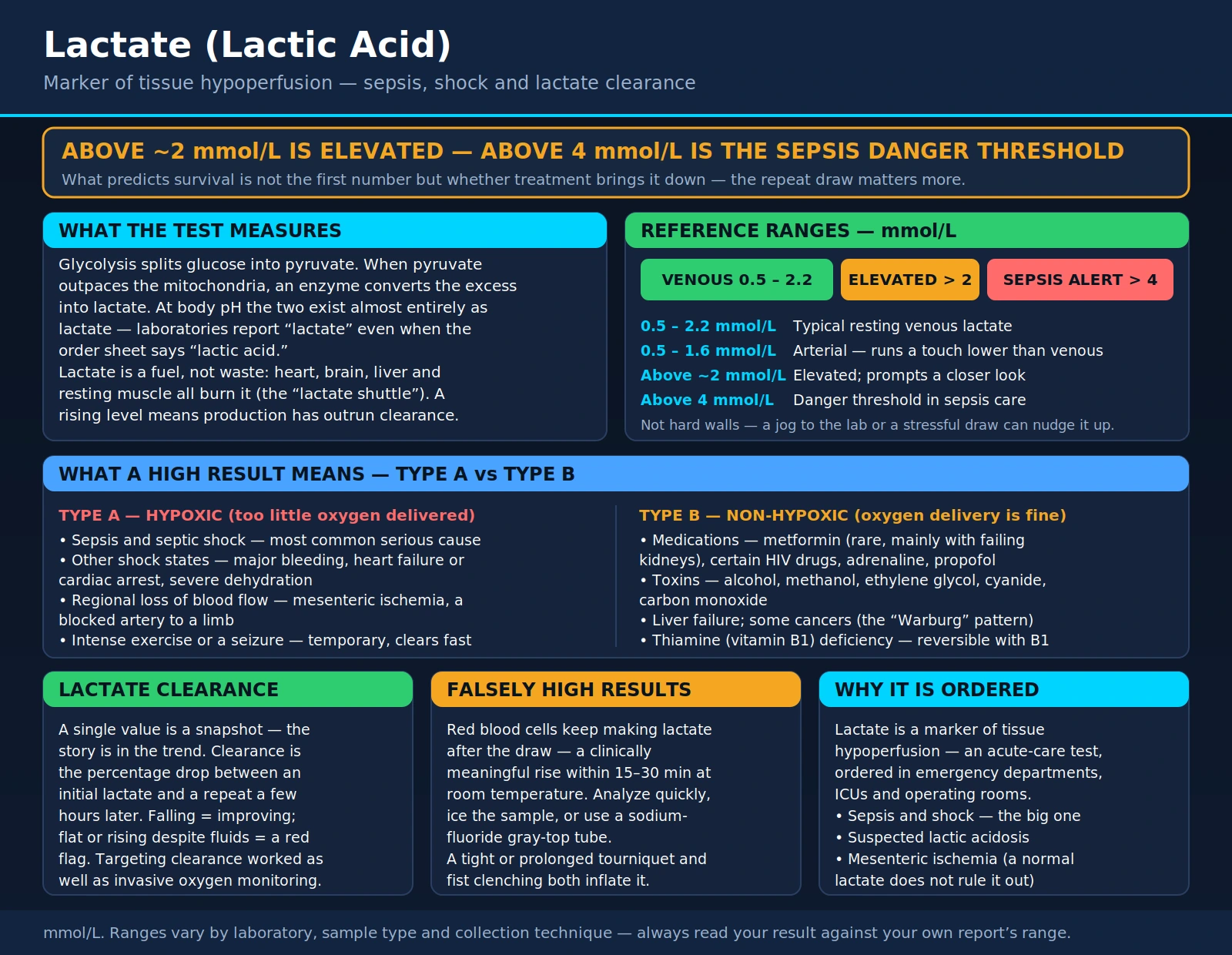
A lactate test measures how much lactate — the molecule most people still call "lactic acid" — is circulating in your blood. For decades lactate had a bad reputation as a useless waste product that made muscles ache. That picture is mostly wrong. Today scientists understand lactate as a normal, valuable fuel that your body makes and burns around the clock. So why does anyone test it? Because when tissues are starved of oxygen — as happens in sepsis, shock, and other emergencies — lactate climbs, and how high it goes (and whether it keeps rising or starts to fall) is one of the clearest chemical signals of how sick a person is and whether treatment is working. This page explains what lactate is, why the test is ordered, the surprisingly finicky rules for drawing and handling the sample, what a high number means, and why doctors almost always measure it more than once.
Table of Contents
- What Lactate Actually Is
- Why the Test Is Ordered
- How Lactate Is Measured
- Normal Ranges
- What a High Result Means: Type A vs Type B
- Lactate Clearance: Why One Number Is Never Enough
- Lactate and Exercise: The "Lactate Threshold"
- When to Talk to a Doctor
- Related Tests
- Research Papers
- Connections
- Featured Videos
What Lactate Actually Is
Every cell in your body breaks down glucose (blood sugar) for energy. The first stretch of that process, called glycolysis, splits glucose into a small molecule named pyruvate. When oxygen is plentiful, pyruvate marches into the cell's mitochondria to be fully burned for a large energy payoff. But glycolysis runs fast, and it can outpace the mitochondria. When pyruvate piles up faster than it can be used, an enzyme converts the excess into lactate. Chemically, lactate is the salt form of lactic acid; at the pH of the human body the two exist almost entirely as lactate, which is why laboratories report "lactate" even when the order sheet says "lactic acid."
This conversion is not a dead end — it is a clever recycling trick. Turning pyruvate into lactate regenerates a helper molecule (NAD+) that glycolysis needs to keep running, so cells can keep making quick energy even when oxygen or mitochondrial capacity is limited. The ratio of lactate to pyruvate inside cells is a rough readout of this balance, and it climbs when tissues are struggling to use oxygen.
Lactate is a fuel, not just "waste"
The old textbook story — lactate is a waste product that causes muscle burn and next-day soreness — has been overturned by modern physiology. Lactate is constantly produced by some tissues and just as constantly consumed by others: the heart, the brain, the liver, and resting muscle all happily burn lactate for energy. Researchers describe this traffic as the "lactate shuttle": lactate is shipped from cells that make a surplus to cells that can use it as fuel or rebuild it back into glucose. In this light, a rising blood lactate during a crisis is less a pile of garbage and more a smoke alarm — a sign that production has outrun the body's normal ability to clear and reuse it. (For the record, delayed muscle soreness after exercise is caused by tiny muscle-fiber damage and inflammation, not by lactate, which is cleared within an hour or so.)
Why the Test Is Ordered
Lactate is, above all, a marker of tissue hypoperfusion — a warning that some part of the body is not getting enough oxygen-rich blood to meet its needs. That single idea explains most of the reasons a clinician orders the test.
Sepsis and shock (the big one)
By far the most common reason to check lactate is a suspected or confirmed serious infection that is turning into sepsis, or any form of shock (from blood loss, heart failure, severe dehydration, or a massive allergic reaction). When blood pressure and oxygen delivery fall, oxygen-starved tissues switch toward the faster, oxygen-independent energy pathway and lactate rises. A markedly elevated lactate — and especially a lactate that keeps rising — flags a sicker patient and a higher risk of dying. Because of this, national and international guidelines fold lactate directly into the definition and early management of sepsis: it helps decide who needs aggressive fluids and intensive-care monitoring, and it becomes a target that treatment aims to bring down.
Other reasons
- Suspected lactic acidosis — when blood chemistry shows the body is too acidic and doctors need to know whether lactate is the cause.
- Mesenteric ischemia — a blocked blood supply to the intestines, a hard-to-diagnose surgical emergency in which lactate can be an important clue (though a normal lactate does not rule it out, especially early).
- Metabolic and mitochondrial evaluation — in some inherited metabolic disorders, in the workup of unexplained acidosis, or when a specific poisoning or drug reaction is suspected.
- Seizure and post-resuscitation care — lactate briefly spikes after a generalized seizure or a cardiac arrest and is used to gauge recovery.
In short, lactate is mostly an acute-care test. It is ordered in emergency departments, intensive-care units, and operating rooms far more often than in a routine annual physical.
How Lactate Is Measured
Lactate is measured on a blood sample, but this is one lab value where how the sample is drawn and handled matters as much as the number itself. Small handling mistakes can turn a normal result into an alarmingly high one.
Venous vs arterial
Blood can come from a vein (venous), an artery (arterial), or a fingertip/point-of-care device. Arterial samples are often taken when a blood-gas is being drawn anyway in critically ill patients. For most emergency screening, a venous lactate works well and correlates closely enough with arterial values to guide care; a normal venous lactate is especially reassuring. Many hospitals also use handheld or bedside analyzers that give a result in under a minute.
The critical sample-handling note
Here is the catch that trips people up: red blood cells keep making lactate after the blood leaves your body. Once blood sits in a tube, its cells continue glycolysis and lactate creeps upward — potentially by a clinically meaningful amount within 15–30 minutes at room temperature. To prevent a falsely high result, the sample must be either analyzed quickly (often within minutes on a point-of-care machine), placed on ice, or drawn into a special tube containing sodium fluoride — the gray-top tube — which poisons the enzyme that keeps making lactate. Two more avoidable errors:
- A prolonged or tight tourniquet. Squeezing off blood flow briefly starves the arm of oxygen and inflates the lactate reading. Ideally the tourniquet is released, or a "free-flowing" sample is drawn.
- Fist clenching or pumping during the draw is muscular exercise that raises local lactate. Patients are asked to keep the hand relaxed.
If a lactate result ever looks surprisingly high in someone who otherwise seems well, a repeat draw with careful technique is often the first, sensible step.
Normal Ranges
Reference ranges vary by laboratory, by the type of sample, and by how it was collected, so always read your result against the range printed on your own report. As a rough guide for a resting adult:
- Typical resting venous lactate: about 0.5 to 2.2 mmol/L (millimoles per liter).
- Arterial lactate tends to run a touch lower than venous, often quoted around 0.5 to 1.6 mmol/L.
- Above ~2 mmol/L is generally considered elevated and prompts a closer look at the clinical picture.
- Above 4 mmol/L is a recognized danger threshold in sepsis care and, in the right setting, triggers urgent, aggressive treatment.
These are not hard walls. A brief jog up a flight of stairs to the lab, a stressful blood draw, or a tight tourniquet can nudge a healthy person's lactate above the "normal" line without meaning anything is wrong. The number is always interpreted alongside how the person looks, their blood pressure, and the rest of their labs.
What a High Result Means: Type A vs Type B
Doctors sort a high lactate (hyperlactatemia, and when the blood turns acidic, lactic acidosis) into two classic buckets. The distinction is useful because it points toward very different causes and treatments.
Type A — the hypoxic type (too little oxygen)
This is lactate rising because tissues genuinely are not getting enough oxygen delivered to them. Causes include:
- Sepsis and septic shock — the most common serious cause.
- Other shock states — major bleeding, heart failure or cardiac arrest, severe dehydration.
- Regional loss of blood flow — such as mesenteric ischemia or a blocked artery to a limb.
- Intense exercise or a seizure — a normal, temporary surge from muscles working far beyond their oxygen supply. This kind clears quickly on its own.
Type B — the non-hypoxic type (oxygen delivery is fine)
Here lactate is high even though tissues are getting enough oxygen — the problem is in how cells are handling metabolism, or a drug or toxin is interfering. Causes include:
- Medications — most famously the diabetes drug metformin (a rare but serious side effect, mainly when the kidneys are failing), plus certain HIV drugs, high-dose adrenaline, propofol, and others.
- Toxins and poisonings — alcohol, and ingestions such as methanol, ethylene glycol (antifreeze), cyanide, and carbon monoxide.
- Liver failure — the liver normally clears a large share of the body's lactate, so severe liver disease lets it accumulate.
- Certain cancers — some fast-growing tumors favor glycolysis and pour out lactate (the "Warburg" pattern).
- Thiamine (vitamin B1) deficiency — thiamine is essential for feeding pyruvate into the mitochondria; without it, pyruvate is diverted to lactate. This is a genuinely reversible cause that a dose of thiamine can correct, so it is worth remembering in malnourished patients, heavy drinkers, and some critically ill people.
Many real patients have a mix of both types at once — a septic patient with liver disease, for example. The two-bucket model is a starting point for thinking, not a rigid diagnosis.
Lactate Clearance: Why One Number Is Never Enough
A single lactate value is a snapshot; the story is in the trend. In sepsis and shock, what predicts survival best is not just the starting number but whether treatment brings it down. Doctors call this lactate clearance — the percentage drop between an initial measurement and a repeat a few hours later.
This is why a lactate is so often ordered in pairs or series. A patient whose lactate falls substantially over the first hours of treatment is generally improving; one whose lactate stays high or climbs despite fluids and other care is a red flag that demands escalation. Landmark emergency-medicine trials showed that steering early sepsis treatment toward clearing lactate works about as well as steering it by more invasive oxygen-monitoring targets — a practical finding, since a repeat lactate is cheap, fast, and needs no special catheter. Later research reinforced that following the lactate trend improves outcomes, while also reminding clinicians that lactate is a guide, not a goal in itself: the aim is to fix the underlying problem (drain the infection, stop the bleeding, restore blood flow), and a falling lactate is the reward for doing so.
One honest caveat: because Type B causes exist, a slow-to-clear lactate does not always mean oxygen delivery is still inadequate. In someone on metformin or with liver failure, the lactate may lag for reasons that more fluid will not fix. Good care reads the number in context.
Lactate and Exercise: The "Lactate Threshold"
Outside the hospital, lactate has a second life in sports science. As you exercise harder, your muscles produce lactate faster. Up to a point your body clears it just as fast and blood lactate stays low; beyond a certain intensity — the lactate threshold — production outruns clearance and blood lactate begins to climb steeply. That threshold marks roughly the fastest pace or highest power you can sustain for a long time before fatigue sets in quickly.
Endurance athletes and coaches use lactate-threshold testing (usually a series of fingertip lactate readings taken at increasing workloads) to set training zones and track fitness: as an athlete gets fitter, the threshold shifts to higher intensities. It is worth knowing that the many published "threshold" definitions do not all agree, and the concept is a useful training tool rather than a precise physiological line in the sand. For everyday health, none of this requires testing — it is background for athletes who want to train by the numbers.
When to Talk to a Doctor
For most people, lactate is not a test you request or manage on your own — it is something the medical team draws when they are worried about a serious, acute illness, and they interpret it in real time. You generally will not be walking around with a lactate result to puzzle over the way you might with cholesterol.
The more useful thing to recognize is when the situations that call for a lactate test are happening. Seek emergency care right away for signs of sepsis or shock: a high fever or feeling ominously unwell with an infection, confusion or unusual sleepiness, fast breathing, a racing heart, clammy or mottled skin, very low urine output, or lightheadedness on standing. Sudden severe abdominal pain that seems out of proportion to the exam can signal the kind of intestinal ischemia that a lactate helps evaluate. If you take metformin and develop persistent vomiting, dehydration, or a kidney problem, mention the medication — those are the settings where lactate matters. In all of these cases the point is speed: the value of a lactate is largest when it is measured early and acted on quickly.
Related Tests
Lactate is rarely read alone. It is usually part of a broader picture built from tests such as:
- Basic and Comprehensive Metabolic Panels — electrolytes and the "anion gap," which flags a metabolic acidosis that lactate may explain.
- Arterial blood gas — measures blood pH and oxygen directly, and often reports lactate on the same sample.
- Complete Blood Count and procalcitonin — help gauge infection and its severity.
- Kidney and liver function tests — both organs clear lactate, and both are common culprits when it is elevated.
- Blood cultures — to find the organism when sepsis is suspected.
Research Papers
- Brooks GA. The Science and Translation of Lactate Shuttle Theory. Cell Metabolism. 2018;27(4):757–785. doi:10.1016/j.cmet.2018.03.008 — the foundational modern case that lactate is a shuttled fuel, not a waste product.
- Kraut JA, Madias NE. Lactic Acidosis. New England Journal of Medicine. 2014;371(24):2309–2319. doi:10.1056/NEJMra1309483 — a clear clinical review of Type A vs Type B lactic acidosis and its management.
- Andersen LW, Mackenhauer J, Roberts JC, et al. Etiology and Therapeutic Approach to Elevated Lactate Levels. Mayo Clinic Proceedings. 2013;88(10):1127–1140. doi:10.1016/j.mayocp.2013.06.012 — a practical, cause-by-cause guide to why lactate rises and what to do.
- Seheult J, Fitzpatrick G, Boran G. Lactic acidosis: an update. Clinical Chemistry and Laboratory Medicine. 2017;55(3):322–333. doi:10.1515/cclm-2016-0438 — a laboratory-medicine review covering measurement and the pre-analytical handling pitfalls.
- Evans L, Rhodes A, Alhazzani W, et al. Surviving Sepsis Campaign: International Guidelines for Management of Sepsis and Septic Shock 2021. Critical Care Medicine. 2021;49(11):e1063–e1143. doi:10.1097/CCM.0000000000005337 — the guidelines that embed lactate measurement and lactate-guided resuscitation in sepsis care.
- Rivers E, Nguyen B, Havstad S, et al. Early Goal-Directed Therapy in the Treatment of Severe Sepsis and Septic Shock. New England Journal of Medicine. 2001;345(19):1368–1377. doi:10.1056/NEJMoa010307 — the trial that put early, aggressive, lactate-and-perfusion-guided sepsis treatment on the map.
- Jones AE, Shapiro NI, Trzeciak S, et al. Lactate Clearance vs Central Venous Oxygen Saturation as Goals of Early Sepsis Therapy: A Randomized Clinical Trial. JAMA. 2010;303(8):739–746. doi:10.1001/jama.2010.158 — showed that targeting lactate clearance worked as well as invasive oxygen monitoring.
- Jansen TC, van Bommel J, Schoonderbeek FJ, et al. Early Lactate-Guided Therapy in Intensive Care Unit Patients: A Multicenter, Open-Label, Randomized Controlled Trial. American Journal of Respiratory and Critical Care Medicine. 2010;182(6):752–761. doi:10.1164/rccm.200912-1918OC — treating to lower lactate reduced ICU mortality.
- Hernández G, Ospina-Tascón GA, Damiani LP, et al. Effect of a Resuscitation Strategy Targeting Peripheral Perfusion Status vs Serum Lactate Levels on 28-Day Mortality Among Patients With Septic Shock (ANDROMEDA-SHOCK). JAMA. 2019;321(7):654–664. doi:10.1001/jama.2019.0071 — a reminder that lactate is a guide, and simple bedside perfusion checks can rival it.
- Casserly B, Phillips GS, Schorr C, et al. Lactate Measurements in Sepsis-Induced Tissue Hypoperfusion: Results From the Surviving Sepsis Campaign Database. Critical Care Medicine. 2015;43(3):567–573. doi:10.1097/CCM.0000000000000742 — higher initial lactate tracks with higher mortality across thousands of patients.
- Nichol AD, Egi M, Pettila V, et al. Relative hyperlactatemia and hospital mortality in critically ill patients: a retrospective multi-centre study. Critical Care. 2010;14(1):R25. doi:10.1186/cc8888 — even mildly elevated lactate, still within some "normal" ranges, carries prognostic weight.
- Faude O, Kindermann W, Meyer T. Lactate Threshold Concepts: How Valid Are They? Sports Medicine. 2009;39(6):469–490. doi:10.2165/00007256-200939060-00003 — a critical look at the many definitions of the exercise "lactate threshold."
Connections
- All Lab Tests
- Basic Metabolic Panel
- Comprehensive Metabolic Panel
- Procalcitonin Test
- Complete Blood Count
- Kidney Function Tests
- Liver Function Tests
- Lactate Dehydrogenase (LDH)
- Sepsis
- Bacteria
- Vitamin B1 (Thiamine)
- All Diseases