H. pylori Test
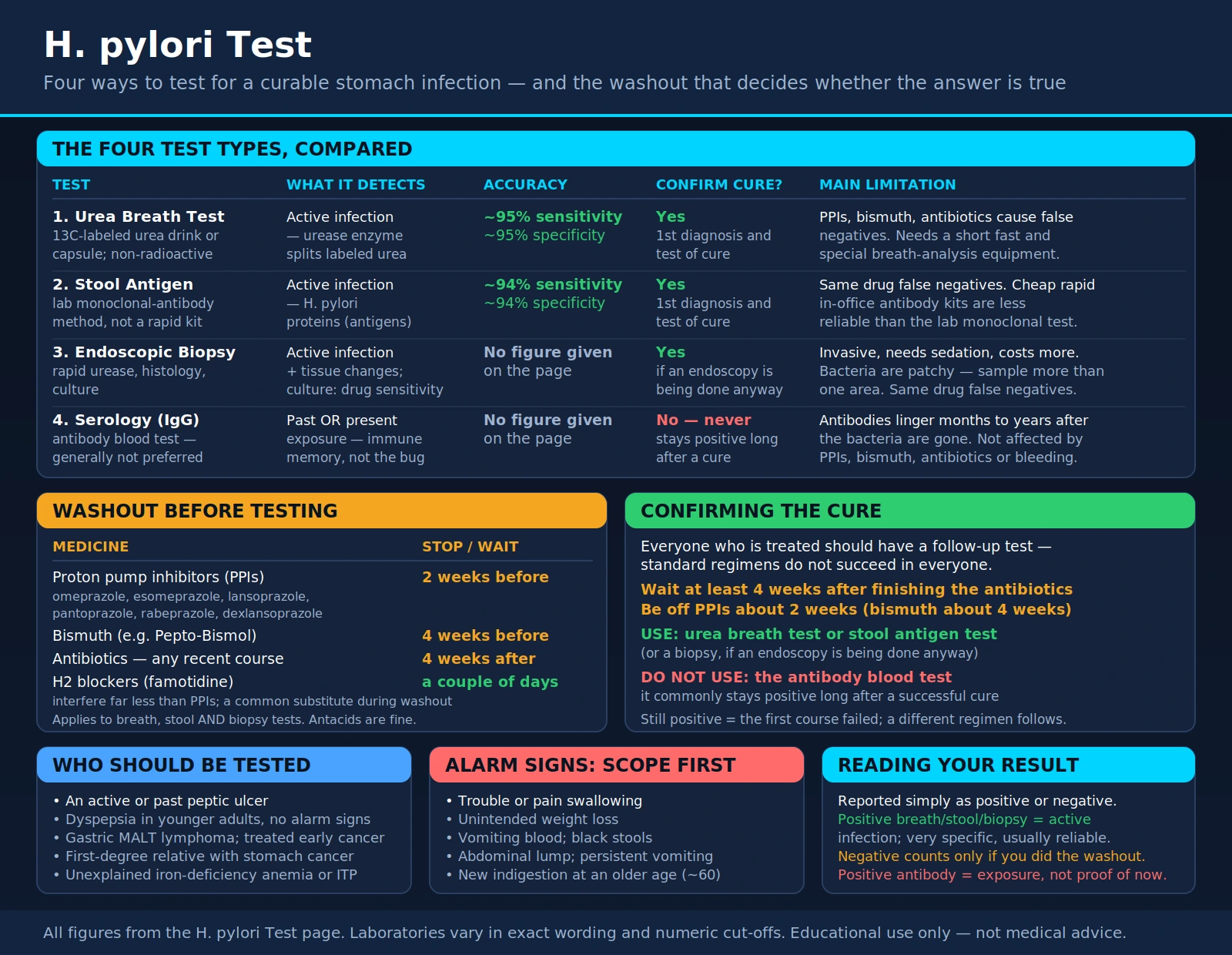
Helicobacter pylori (usually shortened to H. pylori) is a common stomach bacterium that quietly infects roughly half the people on Earth. Most never know they have it, but in some people it causes ulcers, long-term inflammation of the stomach lining, and — over decades — a meaningfully higher risk of stomach cancer. The good news is that H. pylori is curable with a course of antibiotics, and finding it is straightforward once you know which test to use. This page explains why testing matters, walks through the four kinds of tests honestly (their strengths and their weak spots), and covers the single most important thing patients get wrong: certain common medications can make a real infection look like no infection at all. Getting the preparation right is often the difference between a correct answer and a falsely reassuring one.
Table of Contents
- What H. pylori Is & Why Testing Matters
- Who Should Be Tested
- The Four Test Types, Compared Honestly
- Which Test Is Right for You
- Critical Prep: Medicines That Cause False Negatives
- The Test-and-Treat Strategy
- Confirming the Infection Is Gone
- Understanding Your Results
- Research Papers
- Connections
- Featured Videos
What H. pylori Is & Why Testing Matters
Helicobacter pylori is a spiral-shaped bacterium that has adapted to live in one of the most hostile places in the body: the acidic lining of the stomach. It survives there by producing an enzyme called urease, which breaks down urea in the stomach into ammonia. The ammonia neutralizes stomach acid in a tiny protective cloud around each bacterium — a trick that turns out to be the basis of several of the tests below. H. pylori is usually picked up in childhood, often from close family contact, and once established it tends to stay for life unless it is treated.
Most people who carry H. pylori feel completely fine and never develop a problem. But in a significant minority it drives real disease, which is why finding and treating it can matter so much:
- Peptic ulcers — H. pylori is the leading cause of ulcers in the stomach and the first part of the small intestine (duodenum), along with anti-inflammatory painkillers (NSAIDs). Curing the infection heals these ulcers and dramatically lowers the chance they come back.
- Chronic gastritis — the infection produces ongoing, low-grade inflammation of the stomach lining. Over years this can progress to thinning of the lining (atrophy) and cellular changes that raise cancer risk.
- Stomach cancer — the World Health Organization's cancer agency classifies H. pylori as a Group 1 (definite) carcinogen. It is the single biggest known risk factor for the most common type of stomach cancer, and it is also linked to a rare stomach lymphoma called MALT lymphoma that can sometimes be cured by eradicating the bacterium alone.
- Some cases of dyspepsia — in a subset of people with ongoing indigestion, upper-abdominal discomfort, bloating, or nausea with no ulcer found, treating H. pylori provides lasting relief. This benefit is real but modest — it helps a minority of people with these symptoms, not everyone.
The reason to test is simple: H. pylori is one of the few causes of these problems that can actually be cured. A short course of antibiotics can heal ulcers, calm inflammation, and lower long-term cancer risk. But you cannot treat what you have not found, and you should not treat blindly — so an accurate test is the starting point.
Who Should Be Tested
Testing is not recommended for everyone. Because so many healthy people carry H. pylori without harm, guidelines from the American College of Gastroenterology and the European Maastricht consensus groups suggest testing mainly when a positive result would change what you do. The widely accepted reasons to test include:
- An active or past peptic ulcer — anyone with a current ulcer, or a documented history of one that was never tested, should be checked and treated.
- Ongoing indigestion (dyspepsia) in younger adults without alarm symptoms — the "test-and-treat" approach described below.
- MALT lymphoma of the stomach, or a history of early stomach cancer that has been treated.
- A first-degree relative (parent, sibling, child) with stomach cancer, which raises personal risk.
- Long-term aspirin or NSAID use in some situations, and unexplained iron-deficiency anemia or a low-platelet condition called ITP, both of which have been linked to the infection.
Some symptoms are "alarm features" that mean you should not simply test and treat — you need prompt evaluation with a camera test (endoscopy) instead. These include difficulty or pain swallowing, unintended weight loss, vomiting blood or passing black stools, a lump in the abdomen, persistent vomiting, or new indigestion starting at an older age (commonly cited as around 60). These warning signs can point to something more serious than infection, and they change the plan entirely.
The Four Test Types, Compared Honestly
There are four broad ways to test for H. pylori. Two are non-invasive and excellent; one requires an endoscopy but gives extra information; and one — the antibody blood test — has a well-known flaw that limits its usefulness. Here is the honest picture of each.
1. Urea Breath Test (UBT)
This is one of the two best non-invasive tests. You swallow a drink or capsule containing urea labeled with a harmless carbon isotope (the non-radioactive carbon-13 version is standard and is safe even for children and during pregnancy). If H. pylori is present, its urease enzyme splits the urea and releases the labeled carbon as carbon dioxide, which you then breathe out. A machine measures the labeled CO₂ in your breath. No bacterium, no signal.
Strengths: very accurate — both sensitivity and specificity are around 95% in good studies — and it detects current, active infection, not just past exposure. It is quick, painless, and works well both for an initial diagnosis and for checking that treatment worked.
Limitations: it is strongly affected by the medications discussed below (acid-reducing drugs, bismuth, and antibiotics), which can make a real infection register as negative. It also requires a short fast beforehand and specialized breath-analysis equipment, so it is not offered at every clinic.
2. Stool Antigen Test
The other top non-invasive option. A small stool sample is tested in the lab for H. pylori proteins (antigens). The best version uses laboratory (monoclonal antibody) methods rather than a rapid office kit, and in that form it is highly accurate — sensitivity and specificity both around 94%.
Strengths: like the breath test, it identifies active infection and is excellent both for first diagnosis and for confirming a cure. It is often less expensive than the breath test, needs no special breathing equipment, and is easy to use in children.
Limitations: it shares the same critical weakness as the breath test — acid-reducing drugs, bismuth, and antibiotics can cause false negatives. Some people also simply prefer not to collect a stool sample. Cheap rapid in-office antibody-based stool kits are less reliable than the laboratory monoclonal test.
3. Endoscopic Biopsy (Rapid Urease, Histology, Culture)
When someone needs an upper endoscopy anyway — a thin flexible camera passed into the stomach, usually under sedation — the doctor can take tiny tissue samples (biopsies) and test them for H. pylori in three ways:
- Rapid urease test — the biopsy is placed in a gel containing urea and a color-changing indicator. If H. pylori's urease is present, the ammonia it produces shifts the color, often within minutes to hours. Fast, inexpensive, and available right in the endoscopy unit.
- Histology — a pathologist examines the tissue under a microscope. This not only spots the bacteria but also grades the inflammation and reveals whether the lining has developed worrying changes such as atrophy or "intestinal metaplasia." That extra information about the tissue is something no breath or stool test can provide.
- Culture — the lab grows the bacteria from the sample. It is technically demanding and slower, so it is not routine, but it has one unique advantage: it allows antibiotic-sensitivity testing, which is increasingly valuable when standard treatments have already failed and resistance is suspected.
Strengths: a biopsy-based approach confirms the infection and lets the doctor inspect the stomach directly for ulcers, cancer, and other disease — essential when alarm symptoms are present. Culture uniquely guides treatment when resistance is a problem.
Limitations: it is invasive, requires sedation, and costs more, so it is reserved for people who need an endoscopy for other reasons rather than as a first-line H. pylori test. Because the bacteria can be patchy, taking samples from more than one area of the stomach improves accuracy — and, like the tests above, recent acid-reducing drugs, bismuth, and antibiotics can suppress the bacteria and cause false negatives.
4. Serology (Antibody Blood Test) — Generally Not Preferred
A simple blood test can detect IgG antibodies your immune system has made against H. pylori. It sounds convenient, but it has a fundamental problem that patients need to understand.
The critical flaw: antibodies can linger in the blood for months to years after the bacteria are gone. A positive antibody test therefore cannot tell the difference between a current, active infection and one you had in the past and already cleared (whether on your own or from previous antibiotics). Because of this, serology must never be used to confirm that treatment worked — it will often stay positive long after a successful cure. For the same reason, in populations where the infection is uncommon, a positive result is more likely to be misleading.
The one situation where it can still help: unlike all the other tests, antibody levels are not lowered by acid-reducing drugs, recent bismuth or antibiotics, or active stomach bleeding. So in the uncommon case where someone cannot stop those medicines, or is bleeding, serology may occasionally provide a clue — but a positive result generally needs to be confirmed with an active-infection test before treatment. Overall, current guidelines recommend against routine use of the antibody test when a breath test, stool test, or biopsy is available.
Which Test Is Right for You
For most people who have not had an endoscopy and do not have alarm symptoms, the choice comes down to the urea breath test or the stool antigen test. Both are non-invasive, both are highly accurate, and both detect current infection — so the decision often depends on what your clinic offers, cost, and personal preference. The breath test avoids handling a stool sample; the stool test needs no special breathing equipment and is often cheaper.
An endoscopy with biopsy is the right first step when there are alarm features, when you are older and have brand-new indigestion, or when the doctor needs to look directly at the stomach lining to rule out an ulcer or cancer. It is also where culture can be obtained to guide treatment after previous therapy has failed.
Serology (the antibody blood test) is the fallback of last resort — useful mainly when the active-infection tests cannot be done, and never for confirming a cure. If a lab or ad offers a quick H. pylori "blood test," it is worth knowing its limits before relying on the result.
Critical Prep: Medicines That Cause False Negatives
This is the most important section on the page, because it is where accurate testing most often goes wrong. Three kinds of medication can suppress or kill H. pylori temporarily without fully eradicating it. When you test while they are still in your system, the bacteria hide, the test comes back falsely negative, and a real, treatable infection gets missed. This affects the breath test, the stool antigen test, and biopsy-based tests alike — every test that looks for the living bacterium or its activity.
- Proton pump inhibitors (PPIs) — drugs such as omeprazole, esomeprazole, lansoprazole, pantoprazole, rabeprazole, and dexlansoprazole (common names include Prilosec, Nexium, Prevacid, and Protonix). These powerful acid-reducers suppress the bacteria. Guidelines advise stopping them for about 2 weeks before a breath, stool, or biopsy test.
- Bismuth — the active ingredient in some stomach remedies (for example Pepto-Bismol) directly suppresses H. pylori. Stop it for about 4 weeks before testing.
- Antibiotics — any recent course, even for an unrelated infection, can knock the bacteria down. Wait about 4 weeks after finishing antibiotics before testing.
A few practical notes make this workable:
- Do not just stop a prescribed medicine on your own. Talk to your doctor first — especially if you take a PPI for a good reason. Often they can bridge the two weeks with a different, less-interfering acid medicine.
- H2 blockers (such as famotidine or the older ranitidine) interfere far less than PPIs. Many clinics still suggest pausing them for a couple of days before a breath test, but they are a common substitute during the PPI washout. Simple antacids (like calcium carbonate) are generally fine.
- The antibody blood test is the exception. Because it measures your immune memory rather than the live bacterium, it is not thrown off by PPIs, bismuth, or antibiotics — but that convenience comes at the cost of not being able to tell current infection from past, as explained above.
If there is one thing to remember from this whole page: a negative breath, stool, or biopsy test is only trustworthy if you were off these medicines for the right amount of time. Testing too soon can turn a genuine infection into a false "all clear."
The Test-and-Treat Strategy
For younger adults (commonly those under about 60) who have ongoing indigestion but no alarm symptoms, guidelines endorse a sensible shortcut called "test and treat." Rather than going straight to an endoscopy, the doctor uses a non-invasive test — a urea breath test or stool antigen test — and, if it is positive, prescribes a course of eradication therapy. If it is negative, attention shifts to other causes of the symptoms.
This approach is popular because it is accurate, non-invasive, and cost-effective: it spares many people an unnecessary camera test while still finding and curing the infections that matter. The important safeguards are the ones already mentioned — it is only appropriate when there are no alarm features and when the patient is not in the older age group where new indigestion warrants a closer look. It also depends entirely on using a good active-infection test with proper medication preparation; the antibody blood test is not suitable for this purpose.
Confirming the Infection Is Gone
Treating H. pylori is not quite the end of the story. Because standard antibiotic regimens do not succeed in everyone — partly due to rising antibiotic resistance — guidelines now recommend that everyone who is treated should have a follow-up test to confirm the bacteria are actually gone. Skipping this step can leave a persistent infection quietly continuing to damage the stomach.
Two rules make the confirmation test reliable:
- Use the right test. Confirmation should be done with a urea breath test or a stool antigen test (or, if an endoscopy is being done anyway, a biopsy). Do not use the antibody blood test — it commonly stays positive for a long time after a successful cure and cannot show whether the treatment worked.
- Wait long enough, and be off the interfering medicines. The follow-up test should be done at least 4 weeks after finishing the antibiotics, and you should be off PPIs for about 2 weeks beforehand (bismuth, too, for about 4 weeks). Testing too early — or while still taking a PPI — risks a false negative that wrongly declares success.
If the confirmation test is still positive, it means the first course did not work, and your doctor will typically choose a different antibiotic combination — sometimes guided by culture and sensitivity testing — for the second attempt.
Understanding Your Results
Results are usually reported simply as positive (infection present) or negative (no infection detected), though laboratories vary in the exact wording and numeric cutoffs.
- A positive breath, stool, or biopsy test means active infection, and — in the situations described above — treatment is generally recommended. These tests are very specific, so a positive is usually trustworthy.
- A negative breath, stool, or biopsy test is reassuring only if you prepared correctly. If you were taking a PPI, bismuth, or antibiotics within the relevant window, a negative result may be false, and the test may need to be repeated after a proper washout.
- A positive antibody (serology) test is the trickiest. It shows exposure at some point, but not necessarily a current infection, and it should not be acted on for eradication confirmation. In low-prevalence settings it is more likely to be a false alarm, and confirmation with an active-infection test is often wise before treating.
As always, results are best interpreted alongside your symptoms and history by the clinician who ordered the test. The numbers and labels are a tool, not a verdict.
Research Papers
- Chey WD, Leontiadis GI, Howden CW, Moss SF. ACG Clinical Guideline: Treatment of Helicobacter pylori Infection. American Journal of Gastroenterology. 2017;112(2):212–239. doi:10.1038/ajg.2016.563 — The U.S. guideline detailing who to test, which tests to use, the test-and-treat approach, and the recommendation to confirm eradication after treatment.
- Chey WD, Howden CW, Moss SF, et al. ACG Clinical Guideline: Treatment of Helicobacter pylori Infection. American Journal of Gastroenterology. 2024;119(9):1730–1753. doi:10.14309/ajg.0000000000002968 — The updated 2024 U.S. guideline, reflecting rising antibiotic resistance and reinforcing post-treatment eradication testing.
- Malfertheiner P, Megraud F, O'Morain CA, et al. Management of Helicobacter pylori infection—the Maastricht V/Florence Consensus Report. Gut. 2017;66(1):6–30. doi:10.1136/gutjnl-2016-312288 — The European consensus on diagnosis and treatment, including the effect of acid-suppressing drugs on test accuracy.
- Malfertheiner P, Megraud F, Rokkas T, et al. Management of Helicobacter pylori infection: the Maastricht VI/Florence consensus report. Gut. 2022;71(9):1724–1762. doi:10.1136/gutjnl-2022-327745 — The most recent European consensus updating test selection, preparation, and eradication confirmation.
- Fallone CA, Chiba N, van Zanten SV, et al. The Toronto Consensus for the Treatment of Helicobacter pylori Infection in Adults. Gastroenterology. 2016;151(1):51–69. doi:10.1053/j.gastro.2016.04.006 — The Canadian consensus on managing the infection, emphasizing confirmation of cure.
- Ferwana M, Abdulmajeed I, Alhajiahmed A, et al. Accuracy of urea breath test in Helicobacter pylori infection: Meta-analysis. World Journal of Gastroenterology. 2015;21(4):1305–1314. doi:10.3748/wjg.v21.i4.1305 — A meta-analysis quantifying the high sensitivity and specificity of the urea breath test.
- Gisbert JP, de la Morena F, Abraira V. Accuracy of monoclonal stool antigen test for the diagnosis of H. pylori infection: a systematic review and meta-analysis. American Journal of Gastroenterology. 2006;101(8):1921–1930. doi:10.1111/j.1572-0241.2006.00668.x — Establishes the strong accuracy of the laboratory (monoclonal) stool antigen test.
- Gisbert JP, Pajares JM. Review article: 13C-urea breath test in the diagnosis of Helicobacter pylori infection — a critical review. Alimentary Pharmacology & Therapeutics. 2004;20(10):1001–1017. doi:10.1111/j.1365-2036.2004.02203.x — A detailed review including how proton pump inhibitors and antibiotics cause false-negative breath tests.
- Best LMD, Takwoingi Y, Siddique S, et al. Non-invasive diagnostic tests for Helicobacter pylori infection. Cochrane Database of Systematic Reviews. 2018;(3):CD012080. doi:10.1002/14651858.CD012080.pub2 — A Cochrane review comparing the accuracy of breath, stool, and antibody tests.
- Wang YK, Kuo FC, Liu CJ, et al. Diagnosis of Helicobacter pylori infection: Current options and developments. World Journal of Gastroenterology. 2015;21(40):11221–11235. doi:10.3748/wjg.v21.i40.11221 — A broad overview of all four test categories, their strengths, and their limitations.
Connections
- All Lab Tests
- Peptic Ulcer Disease
- Gastritis
- GERD
- Functional Dyspepsia
- Stomach Cancer
- Gastroenterology