Folate Test
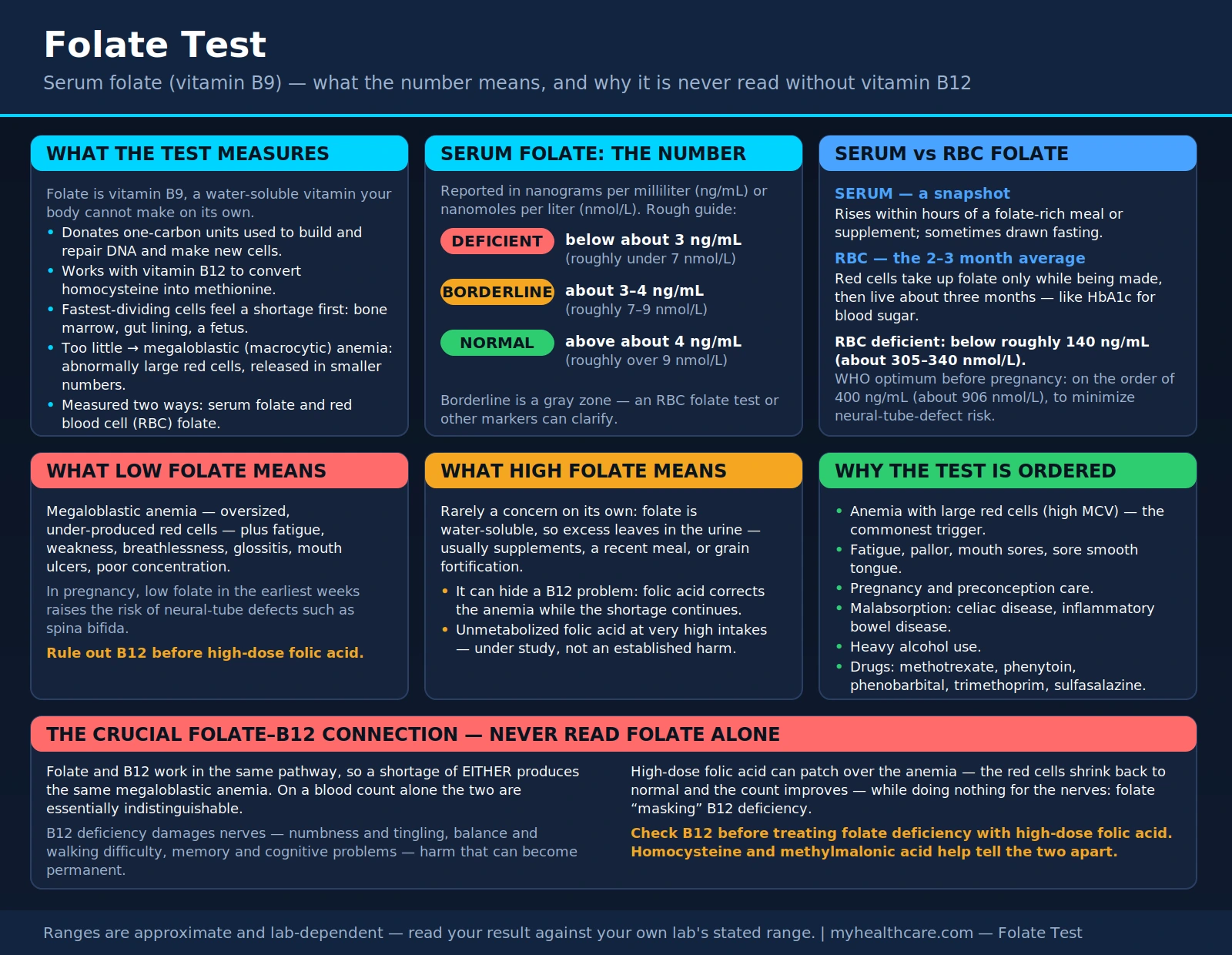
A folate test is a simple blood test that measures how much folate — vitamin B9 — you have available. Folate is one of the busiest vitamins in your body: it helps build DNA, divide cells, form healthy red blood cells, and, in early pregnancy, close the tube that becomes a baby's brain and spine. When folate runs low, red blood cells grow large and immature, causing a kind of anemia that shows up on routine bloodwork long before you might feel it. Doctors order a folate test to investigate that anemia, to check nutrition in pregnancy or in people who drink heavily or have gut problems, and to make sense of an abnormal blood count. This page explains what the test actually measures, the important difference between serum and red blood cell folate, how to read your numbers, and the single most important thing to understand about folate testing: why it must almost always be interpreted alongside vitamin B12.
Table of Contents
- What the Folate Test Measures
- Why the Test Is Ordered
- Serum Folate vs. RBC Folate
- Understanding Your Results
- What Low Folate Means
- What High Folate Means
- The Crucial Folate–B12 Connection
- Folic Acid, Folate, and 5-MTHF
- How to Prepare for the Test
- Research Papers
- Connections
- Featured Videos
What the Folate Test Measures
Folate is vitamin B9, a water-soluble vitamin your body cannot make on its own. You get it from leafy greens, legumes, citrus, liver, and — in many countries — fortified grain products. A folate blood test measures the amount of this vitamin circulating in your body so a doctor can tell whether you have enough for the jobs it does every day.
Those jobs are fundamental. Folate donates small chemical fragments (one-carbon units) that your cells use to build and repair DNA and to make new cells. Any tissue that divides quickly — bone marrow churning out blood cells, the lining of your gut, a developing fetus — depends on a steady folate supply. It also works hand-in-hand with vitamin B12 to convert the amino acid homocysteine into methionine, part of the body's "methylation" chemistry.
Because the fastest-dividing cells feel a shortage first, the classic sign of low folate is a change in the red blood cells. Without enough folate, developing red cells cannot finish copying their DNA on schedule, so they grow abnormally large and are released in smaller numbers. This produces megaloblastic (macrocytic) anemia — anemia with unusually big red cells — which is often the reason a folate test gets ordered in the first place.
There are two ways to measure folate, and they answer slightly different questions: serum folate and red blood cell (RBC) folate. The difference matters enough that it has its own section below.
Why the Test Is Ordered
A folate test is rarely a routine screen for healthy people. It is usually ordered for a specific reason:
- Working up anemia. When a complete blood count shows anemia with large red cells (a high MCV, or mean corpuscular volume), folate and vitamin B12 are the two vitamins checked to find the cause. This is the most common trigger for the test.
- Symptoms of deficiency. Persistent fatigue, weakness, shortness of breath, pale skin, mouth sores or a sore, smooth tongue, irritability, or trouble concentrating can prompt testing — especially when they appear together with an abnormal blood count.
- Pregnancy and preconception care. Folate is essential in the first weeks of pregnancy to close the neural tube, the structure that becomes the brain and spinal cord. A shortage in that window raises the risk of neural-tube defects such as spina bifida. Doctors may check or, more often, simply ensure adequate intake before and during early pregnancy.
- Malabsorption conditions. Folate is absorbed in the upper small intestine, so diseases that damage it — celiac disease, inflammatory bowel disease, and other malabsorption disorders — can cause deficiency even with a decent diet.
- Heavy alcohol use. Alcohol interferes with folate absorption, storage, and recycling, and heavy drinkers often eat poorly, making folate deficiency common in this group.
- Certain medications. Some drugs block folate metabolism. Methotrexate (used for cancer, rheumatoid arthritis, and psoriasis) is the classic example — it deliberately interferes with the folate pathway, which is why folic-acid supplementation is often prescribed alongside it. Other examples include the anti-seizure drugs phenytoin and phenobarbital, the antibiotic-combination trimethoprim, and sulfasalazine.
- Monitoring treatment. Once deficiency is found and treated, a repeat test can confirm that levels are recovering.
Serum Folate vs. RBC Folate
Understanding these two versions of the test explains a lot of the confusion patients run into.
Serum folate measures folate floating in the liquid part of your blood right now. It is quick, cheap, and widely available — but it is a snapshot. Serum folate rises within hours of a folate-rich meal or a supplement and can drop after a few days of poor intake. A single low serum result can therefore reflect a recent skipped meal rather than a true, long-standing shortage, and a normal result taken soon after eating can mask a developing problem. Because of this sensitivity to recent diet, serum folate is sometimes drawn fasting.
RBC folate measures the folate stored inside red blood cells. Because red cells take up folate only while they are being made in the bone marrow and then live for about three months, RBC folate reflects your average folate status over the previous two to three months — much like how the HbA1c test reflects average blood sugar. It is less swayed by yesterday's salad and is generally the better indicator of true tissue folate stores.
So why isn't RBC folate always used? It is more expensive, more technically finicky, and slower, and its results are affected by anything that changes red-cell turnover. In everyday practice, many laboratories and guidelines have concluded that a serum folate test is sufficient for most patients, reserving RBC folate for situations where the serum result is borderline or doesn't fit the clinical picture. Some experts argue RBC folate rarely adds enough to justify its cost. The right choice depends on the clinical question, and it is one your doctor and lab will make together.
Understanding Your Results
Reference ranges vary from lab to lab depending on the method and units used, and your report will always list the specific range that applies to your result. Always interpret your numbers against your own lab's range, not a number you read online. That said, the following approximate values give a sense of how results are generally read.
Serum folate is usually reported in nanograms per milliliter (ng/mL) or nanomoles per liter (nmol/L). As a rough guide:
- Deficient: below about 3 ng/mL (roughly under 7 nmol/L) suggests folate deficiency.
- Borderline / indeterminate: about 3–4 ng/mL (roughly 7–9 nmol/L) is a gray zone where an RBC folate test or a look at other markers can help clarify.
- Normal: above about 4 ng/mL (roughly over 9 nmol/L) is generally considered adequate.
RBC folate is reported as folate per volume of packed red cells. As a rough guide, values below roughly 140 ng/mL (about 305–340 nmol/L) suggest deficiency, while higher values indicate adequate stores. For women who could become pregnant, the World Health Organization suggests a higher optimal red-cell folate — on the order of 400 ng/mL (about 906 nmol/L) — specifically to minimize the risk of neural-tube defects, which is a higher bar than simply "not deficient."
The single most important rule about a folate result is this: a folate number should almost never be interpreted alone. It is read together with the complete blood count (is there anemia? are the red cells large?) and, critically, with the vitamin B12 level. The next two sections explain why.
What Low Folate Means
A low folate result means your body doesn't have enough vitamin B9 for its day-to-day work. Left uncorrected, this leads to megaloblastic anemia — those oversized, under-produced red cells — along with fatigue, weakness, breathlessness, a sore or smooth red tongue (glossitis), mouth ulcers, and sometimes low mood or difficulty concentrating. In pregnancy, low folate during the earliest weeks raises the risk of neural-tube defects in the developing baby.
Common causes of low folate include:
- Not enough in the diet — diets low in leafy greens, legumes, and fruit; "tea and toast" eating patterns in older adults; or overcooking, since folate is easily destroyed by prolonged heat.
- Poor absorption — celiac disease, inflammatory bowel disease, bariatric surgery, and other conditions affecting the small intestine.
- Increased need — pregnancy and breastfeeding, rapid growth, and conditions with high cell turnover such as chronic hemolytic anemias.
- Alcohol — which impairs folate absorption and handling and often accompanies a poor diet.
- Medications — methotrexate, certain anti-seizure drugs, trimethoprim, and sulfasalazine, as noted above.
Folate deficiency is usually straightforward to treat with dietary changes and folic-acid supplements once the cause is understood. But there is a vital caveat before anyone takes high-dose folate: a doctor should first make sure the anemia isn't actually being driven by vitamin B12 deficiency, because the two look nearly identical on a blood count — and treating the wrong one can cause real harm (see The Crucial Folate–B12 Connection).
What High Folate Means
A high folate result is far less worrying than a low one and is rarely a cause for concern on its own. Folate is water-soluble, so the body excretes excess in urine rather than storing it to toxic levels. High readings most often simply reflect recent supplement use, a folate-rich meal before the blood draw, or living in a country with widespread folic-acid fortification of grains.
There are, however, two reasons a high or normal-looking folate result still deserves a careful second look:
- It can hide a B12 problem. Taking folic acid can correct the anemia of vitamin B12 deficiency and normalize the blood count while the underlying B12 shortage — and the nerve damage it causes — continues unchecked. A reassuring blood count in someone taking folic acid does not rule out B12 deficiency.
- Unmetabolized folic acid. Very high intakes of synthetic folic acid (from heavy supplement use plus fortification) can leave unmetabolized folic acid circulating in the blood. Researchers continue to study whether this matters for health; at present it is an area of active investigation rather than an established harm, but it is one reason not to megadose folic acid without a reason.
In short, a high folate number by itself is usually benign, but it should never be taken as proof that "everything is fine" without checking vitamin B12.
The Crucial Folate–B12 Connection
This is the most important idea on the page, and it is the reason a folate test is almost always ordered together with a vitamin B12 test.
Folate and vitamin B12 work together in the same chemical pathway that lets cells divide and make DNA. Because they share that pathway, a shortage of either vitamin produces the same megaloblastic anemia — the same oversized red cells, the same fatigue and pallor. On a blood count alone, folate deficiency and B12 deficiency are essentially indistinguishable. That overlap creates a genuine danger.
Here is the problem. Vitamin B12 deficiency damages nerves. It causes numbness and tingling, balance and walking difficulties, memory and cognitive problems — harm that can become permanent if the deficiency continues. Now suppose someone with an undiagnosed B12 deficiency takes high-dose folic acid. The folic acid can patch over the anemia: the red cells shrink back to normal size and the blood count improves, so the most visible warning sign disappears. But folic acid does nothing for the nerves. The B12 deficiency keeps silently damaging the nervous system while the blood test that would have caught it now looks reassuringly normal. Doctors describe this as folate "masking" B12 deficiency — correcting the blood picture while the neurological damage progresses unseen.
This is not a theoretical worry; it is the central reason clinical guidelines insist on checking B12 before treating a folate deficiency with high-dose folic acid, and why the two vitamins are tested and interpreted as a pair. It is also why a "normal" folate or blood count in someone already taking folic acid should never be used to dismiss the possibility of B12 deficiency. There is even evidence that in people who are B12-deficient, a high folate level can be associated with worse markers of B12 function — the opposite of reassuring.
The practical takeaway for patients: if you have anemia or symptoms that might be a vitamin deficiency, ask that both folate and B12 be checked, and be honest with your doctor about any folic-acid or B-complex supplements you take, because they can change how your results should be read. Related markers like homocysteine and methylmalonic acid can help tell the two deficiencies apart when the picture is unclear.
Folic Acid, Folate, and 5-MTHF
The words on a supplement label can be confusing, so here is what they mean:
- Folate is the umbrella term for vitamin B9 in all its forms, including the natural forms found in food such as leafy greens, beans, and liver.
- Folic acid is the synthetic, highly stable form used in supplements and in food fortification. It is not biologically active as-is; your body has to convert it into the usable form. Folic acid is actually absorbed more completely than natural food folate, which is exactly why it was chosen for fortification programs.
- 5-MTHF (5-methyltetrahydrofolate, also sold as L-methylfolate or "methylfolate") is the active form that circulates in your blood — the final product your body converts other folates into. Supplements containing 5-MTHF skip the conversion step, which is why they are marketed to people with genetic variations (such as MTHFR variants) that may make that conversion less efficient.
Fortification is a public-health success worth understanding. After strong evidence that folic acid before and during early pregnancy prevents neural-tube defects, many countries — including the United States, beginning in 1998 — began adding folic acid to flour, bread, cereal, and other grain products. Population folate levels rose and neural-tube-defect rates fell substantially. This is also why folate deficiency has become less common in fortified countries than it once was, and why a doctor seeing a low folate result may look harder for an underlying cause such as malabsorption or alcohol use.
How to Prepare for the Test
A folate test is a simple blood draw from a vein in your arm, and preparation is minimal. Follow whatever instructions your ordering clinician or lab gives you, but a few general points help:
- Fasting: Some labs ask you to fast (nothing but water) for a number of hours before a serum folate test, because a recent folate-rich meal can temporarily raise the serum level and blur the result. Not every lab requires this; RBC folate is not affected by a recent meal. Ask your lab whether fasting is needed — and if your folate test is bundled with other tests (such as a metabolic panel), fasting may be required for those.
- Supplements: Tell your doctor about any folic acid, methylfolate, B-complex, or multivitamin you take, and ask whether to pause them before the test — they can raise your reading and change how the result should be interpreted. Do not stop a prescribed medication without medical advice.
- Timing with B12: Because folate and B12 are interpreted together, they are usually drawn from the same blood sample, so no extra visit is needed.
- Medications: Mention drugs that affect folate, such as methotrexate or anti-seizure medicines, so your results can be read in context.
The blood draw itself takes a minute or two, and side effects are limited to the usual brief soreness or a small bruise at the needle site. Results are typically available within a day or two.
Research Papers
- Sobczyńska-Malefora A, Harrington DJ. Laboratory assessment of folate (vitamin B9) status. Journal of Clinical Pathology. 2018;71(11):949–956. doi:10.1136/jclinpath-2018-205048 — A clear, current review of how folate is measured in the lab, the serum-versus-RBC question, and the pitfalls of interpretation.
- Farrell CJ, Kirsch SH, Herrmann M. Red cell or serum folate: what to do in clinical practice? Clinical Chemistry and Laboratory Medicine. 2013;51(3):555–569. doi:10.1515/cclm-2012-0639 — A practical appraisal concluding that serum folate is sufficient for most patients and RBC folate rarely adds enough to justify routine use.
- Galloway M, Rushworth L. Red cell or serum folate? Results from the National Pathology Alliance benchmarking review. Journal of Clinical Pathology. 2003;56(12):924–926. doi:10.1136/jcp.56.12.924 — A benchmarking study of laboratory practice supporting serum folate as the first-line test over the costlier RBC assay.
- Devalia V, Hamilton MS, Molloy AM; British Committee for Standards in Haematology. Guidelines for the diagnosis and treatment of cobalamin and folate disorders. British Journal of Haematology. 2014;166(4):496–513. doi:10.1111/bjh.12959 — Widely used clinical guidelines covering how folate and B12 are tested and why they must be interpreted together.
- Reynolds E. Vitamin B12, folic acid, and the nervous system. The Lancet Neurology. 2006;5(11):949–960. doi:10.1016/S1474-4422(06)70598-1 — A key review of how folic acid can mask B12 deficiency while neurological damage progresses.
- Selhub J, Morris MS, Jacques PF. In vitamin B12 deficiency, higher serum folate is associated with increased total homocysteine and methylmalonic acid concentrations. Proceedings of the National Academy of Sciences. 2007;104(50):19995–20000. doi:10.1073/pnas.0709487104 — Evidence that in B12-deficient people, high folate is linked with worse metabolic markers, underscoring the folate–B12 interaction.
- Bailey LB, Stover PJ, McNulty H, et al. Biomarkers of Nutrition for Development—Folate Review. The Journal of Nutrition. 2015;145(7):1636S–1680S. doi:10.3945/jn.114.206599 — A comprehensive expert review of folate biomarkers, including cutoffs and the red-cell folate threshold tied to neural-tube-defect risk.
- Green R. Indicators for assessing folate and vitamin B-12 status and for monitoring the efficacy of intervention strategies. The American Journal of Clinical Nutrition. 2011;94(2):666S–672S. doi:10.3945/ajcn.110.009613 — A concise guide to which tests best reflect folate and B12 status and how they complement one another.
- MRC Vitamin Study Research Group. Prevention of neural tube defects: results of the Medical Research Council Vitamin Study. The Lancet. 1991;338(8760):131–137. doi:10.1016/0140-6736(91)90133-A — The landmark trial establishing that folic acid before and during early pregnancy sharply reduces neural-tube defects, the basis for fortification.
- Crider KS, Bailey LB, Berry RJ. Folic acid food fortification—its history, effect, concerns, and future directions. Nutrients. 2011;3(3):370–384. doi:10.3390/nu3030370 — A review of how grain fortification with folic acid raised population folate levels and lowered deficiency and neural-tube-defect rates.
Connections
- All Lab Tests
- Vitamin B12 Test
- Homocysteine
- Vitamin B9 (Folate)
- MTHFR Gene Testing
- Complete Blood Count
- Iron Panel
- Ferritin Test