Beta-2 Microglobulin
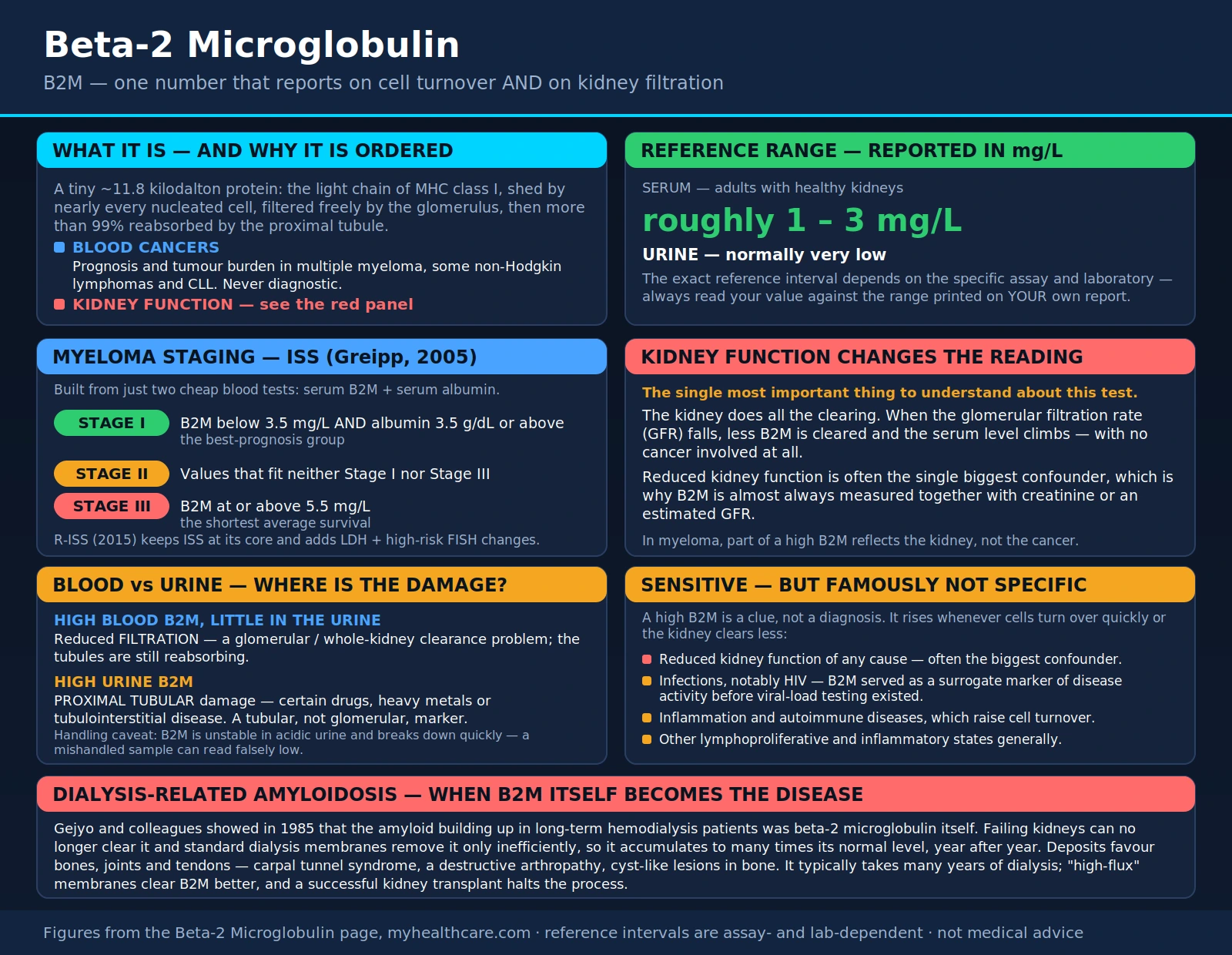
Beta-2 microglobulin (often written B2M or β2M) is a tiny protein that sits on the surface of nearly every cell in your body. As cells go about their normal business of living, dividing, and dying, small amounts of B2M are shed into the bloodstream, where it is filtered by your kidneys. Because of that dual biology, a single B2M measurement quietly reports on two very different things at once: how many cells are turning over (which matters in blood cancers) and how well your kidneys are working. This page explains what the test measures, the two main reasons a doctor orders it — blood cancers such as multiple myeloma and kidney disease — how blood and urine results are read differently, and why a high value is a clue rather than a diagnosis. Throughout, we try to be honest about what B2M can and cannot tell you: it is a sensitive marker but a famously non-specific one, so it almost never stands alone.
Table of Contents
- What Beta-2 Microglobulin Is
- Why the Test Is Ordered
- B2M in Multiple Myeloma and the Staging System
- B2M in Lymphoma and CLL
- B2M and Kidney Function
- Blood vs Urine B2M: Localizing the Problem
- Dialysis-Related Amyloidosis
- How to Interpret Your Result
- Related Tests
- When to Talk to a Doctor
- Research Papers
- Connections
- Featured Videos
What Beta-2 Microglobulin Is
Beta-2 microglobulin is a small protein — only about 11.8 kilodaltons, which is tiny as proteins go — that forms the light chain of the major histocompatibility complex (MHC) class I molecule. Almost every nucleated cell in the body carries MHC class I on its surface, where it acts like an identity badge that displays fragments of the cell's inner contents to the immune system. B2M is the constant, invariant partner that sits underneath and stabilizes that badge. Because it is present on essentially all cells, its production is a steady background hum tied to the ordinary turnover of tissue.
As cells age, get replaced, or are broken down, their surface MHC molecules are recycled and B2M is released into the blood and other body fluids as a free, soluble protein. From there its fate is dictated almost entirely by the kidneys. B2M is small enough to pass freely through the glomerulus — the kidney's filtering sieve — and under normal conditions the cells lining the proximal tubule reabsorb and break down more than 99% of what is filtered. Very little escapes into the final urine. This clean, well-understood handling is exactly what makes B2M useful: when its levels drift out of range, the cause usually lies in one of two places — the rate at which cells are making it, or the kidney's ability to filter and reclaim it.
Why the Test Is Ordered
Doctors reach for a B2M test in two broad situations, and it helps to keep them separate in your mind because the same number means different things in each.
- Blood cancers. B2M is a well-established prognostic and tumor-burden marker, most importantly in multiple myeloma, where it is one of the two ingredients of the International Staging System. It is also used in certain lymphomas and in chronic lymphocytic leukemia (CLL). Here, a higher B2M generally signals more disease and a tougher prognosis, and serial measurements help track whether treatment is working.
- Kidney function. Because the kidney does the clearing, serum B2M rises as filtration falls, so it behaves as a marker of kidney function. Meanwhile, urine B2M helps pinpoint where in the kidney the trouble is — a spillover of B2M into the urine points specifically to damage of the proximal tubule. B2M is also central to a complication seen in long-term dialysis patients called dialysis-related amyloidosis.
Sometimes the two reasons overlap in one patient — for example, someone with myeloma who also has kidney injury from the disease. That overlap is not a nuisance to be ignored; it is a big part of why B2M must always be read alongside a measure of kidney function.
B2M in Multiple Myeloma and the Staging System
Multiple myeloma is a cancer of plasma cells, the antibody-making cells that live in the bone marrow. In myeloma, B2M earns its keep not for making the diagnosis — that is done with other tests — but for staging the disease and estimating prognosis once myeloma is confirmed. The link is intuitive: more myeloma cells (and the reduced kidney function myeloma often causes) push B2M higher, so the number tracks the overall weight of disease in the body.
In 2005 an international group led by Greipp distilled thousands of patient records into the elegant, easy-to-use International Staging System (ISS), built from just two cheap, widely available blood tests: serum beta-2 microglobulin and serum albumin. In broad strokes:
- Stage I — B2M below 3.5 mg/L and albumin at or above 3.5 g/dL (the best-prognosis group).
- Stage II — values that fit neither Stage I nor Stage III.
- Stage III — B2M at or above 5.5 mg/L (the group with the shortest average survival).
The ISS replaced older, more cumbersome schemes and became a global standard largely because those two numbers are available almost anywhere. In 2015 the system was refined into the Revised ISS (R-ISS), which keeps ISS at its core but folds in two more prognostic pieces — serum lactate dehydrogenase (LDH) and high-risk chromosome changes found by FISH testing — to sort patients more precisely. B2M remains a load-bearing pillar of both versions.
Beyond staging, oncologists often watch B2M over time. A value that falls with treatment and stays low is reassuring; a rising trend can be an early hint that the disease is stirring again. It is worth repeating the key caveat: in a patient with myeloma who also has kidney impairment, part of a high B2M reflects the kidney rather than the cancer, which is one reason staging is interpreted by a specialist and not from the single number alone.
B2M in Lymphoma and CLL
The same logic — high cell turnover pushes B2M up — extends to other lymphoid cancers. In several non-Hodgkin lymphomas, an elevated pretreatment B2M has long been associated with more extensive disease and a less favorable outlook, and it appears in some prognostic indices. In chronic lymphocytic leukemia (CLL), serum B2M is one of the recognized prognostic markers folded into modern risk tools such as the CLL International Prognostic Index; the international CLL guidelines list it among the factors that help estimate how a patient's disease is likely to behave.
As in myeloma, B2M in these settings is a prognostic and monitoring aid, not a diagnostic test. It never confirms a lymphoma or leukemia by itself — that requires biopsy, flow cytometry, imaging, and other studies — but it adds a useful, inexpensive data point to the overall picture, and because kidney function also influences it, the same interpretive caution applies.
B2M and Kidney Function
Turn the biology around and B2M becomes a window on the kidneys. Since the glomerulus filters B2M freely and the proximal tubule normally reabsorbs nearly all of it, the amount of B2M circulating in blood depends heavily on how well the kidney is filtering. When the glomerular filtration rate (GFR) falls — as it does in chronic kidney disease — less B2M is cleared and the serum level climbs. In this respect B2M behaves much like other small-protein filtration markers and has been studied as a marker that reflects GFR across the spectrum of kidney diseases.
This kidney dependence is a double-edged sword. On one hand it makes B2M a sensitive early signal of falling filtration. On the other, it is precisely why a high serum B2M cannot be blamed on cancer until kidney function has been accounted for: reduced clearance alone will raise it. That interplay is the single most important thing to understand about the test, and it is the reason B2M is almost always measured together with creatinine or an estimated GFR.
Blood vs Urine B2M: Localizing the Problem
Measuring B2M in urine as well as blood turns the test into a small piece of detective work that can localize kidney damage. The reasoning follows directly from the plumbing:
- High blood B2M with little in the urine usually reflects reduced filtration (a glomerular or whole-kidney clearance problem) — the body is making or retaining more B2M than the kidney can clear, but the tubules are still dutifully reabsorbing what gets through.
- High urine B2M points instead to proximal tubular damage. When those tubular cells are injured — by certain drugs, heavy metals, or tubulointerstitial diseases — they lose their ability to reabsorb the filtered B2M, and it spills into the urine. Elevated urinary B2M is therefore a classic marker of tubular rather than glomerular injury.
This glomerular-versus-tubular distinction is genuinely useful, because the two kinds of kidney damage have different causes and different treatments. One practical caution: B2M is unstable in acidic urine and breaks down quickly, so urine samples must be handled carefully (often collected with the urine pH kept from turning acidic) or the result can read falsely low. Your lab and clinician will account for this.
Dialysis-Related Amyloidosis
In people with advanced kidney failure who depend on long-term hemodialysis, B2M causes a problem all its own. Failing kidneys can no longer clear B2M, and standard dialysis membranes remove it only inefficiently, so the protein accumulates in the blood to many times its normal level year after year. Over time it can misfold and deposit in tissues as amyloid — a condition called dialysis-related amyloidosis.
In 1985 Gejyo and colleagues made the key discovery that the amyloid protein building up in these patients was beta-2 microglobulin, which explained a puzzling cluster of symptoms seen after years on dialysis. The deposits favor bones, joints, and tendons, producing carpal tunnel syndrome, painful and stiff joints (a destructive arthropathy), and cyst-like lesions in bone. It typically takes many years of dialysis to develop. Modern care has reduced its frequency through more effective, "high-flux" dialysis membranes that clear B2M better, and ultimately a successful kidney transplant halts the process by restoring normal clearance. This history is a vivid reminder that B2M is not just a number on a lab report — at very high, sustained levels it is biologically active.
How to Interpret Your Result
B2M is reported as a concentration, usually in milligrams per liter (mg/L). Normal serum values in adults with healthy kidneys typically fall in a range of roughly 1 to 3 mg/L, though the exact reference interval depends on the specific assay and laboratory — always read your value against the range printed on your report. Normal urine B2M is very low. In the myeloma staging context, the ISS thresholds noted above (3.5 mg/L and 5.5 mg/L) are the numbers that matter, and they are interpreted together with serum albumin.
The golden rule is that a high B2M is sensitive but not specific. It goes up whenever cells are turning over quickly or the kidney is clearing less, which happens in a long list of conditions that have nothing to do with cancer, including:
- Reduced kidney function of any cause — often the single biggest confounder.
- Infections, notably viral infections such as HIV, where B2M was historically used as a surrogate marker of disease activity before viral-load testing existed.
- Inflammation and autoimmune diseases, which raise cell turnover.
- Other lymphoproliferative and inflammatory states generally.
Because of this, a single elevated B2M should never be read as "cancer" on its own. In someone with known myeloma, it is used for staging and tracking, not diagnosis, and always alongside kidney function so the two influences can be separated. In someone being evaluated for kidney disease, it is interpreted next to creatinine, GFR, and the urine findings. The most useful way to think about B2M is as one thread in a larger cloth — informative when woven together with the rest of the picture, misleading when pulled out on its own.
Related Tests
B2M rarely travels alone. Depending on why it was ordered, your clinician will pair it with different companions.
For a suspected or known blood cancer
- Serum and urine protein electrophoresis (SPEP/UPEP) and immunofixation — to find and identify the abnormal monoclonal (M) protein of myeloma.
- Serum free light chains (kappa and lambda, with their ratio) — a sensitive way to detect and monitor the abnormal protein.
- Immunoglobulin levels (IgG, IgA, IgM) — to quantify antibody classes and spot suppression of the normal ones.
- Serum albumin and LDH — albumin partners with B2M in the ISS; LDH is added in the Revised ISS.
For kidney evaluation
- Creatinine and estimated GFR (eGFR) — the everyday backbone of kidney-function testing.
- Cystatin C — another small, freely filtered protein used to estimate GFR, conceptually similar to B2M and often more reliable than creatinine in certain patients.
- Urinalysis and urine albumin — to characterize protein loss and distinguish glomerular from tubular patterns alongside urine B2M.
Seen together, these tests let a clinician tell apart the two stories B2M can tell — a proliferation story and a filtration story — which is something the B2M number can only hint at by itself.
When to Talk to a Doctor
B2M is a specialist's tool, not a screening test you would request on your own, so most people encounter it because a doctor is already investigating a specific concern. Reach out to your clinician if:
- You have been diagnosed with multiple myeloma, a lymphoma, or CLL and want to understand what your B2M value means for your stage, prognosis, or response to treatment.
- You have chronic kidney disease or are on dialysis and have questions about kidney markers or about joint and nerve symptoms that could relate to dialysis-related amyloidosis.
- You received a B2M result and are unsure how to read it — especially if your kidney function is also abnormal, since that alone can raise the number.
Any lab value is best interpreted by the clinician who knows your history and can see the rest of your results. Use your B2M number as a starting point for a conversation, not as a verdict. This page is educational and is not a substitute for personal medical advice.
Research Papers
- Greipp PR, San Miguel J, Durie BGM, et al. International Staging System for multiple myeloma. Journal of Clinical Oncology. 2005;23(15):3412–3420. doi:10.1200/JCO.2005.04.242 — the landmark study that built the ISS from serum B2M and albumin.
- Palumbo A, Avet-Loiseau H, Oliva S, et al. Revised International Staging System for multiple myeloma: a report from International Myeloma Working Group. Journal of Clinical Oncology. 2015;33(26):2863–2869. doi:10.1200/JCO.2015.61.2267 — the R-ISS, which keeps B2M-based ISS and adds LDH and cytogenetics.
- Rajkumar SV, Dimopoulos MA, Palumbo A, et al. International Myeloma Working Group updated criteria for the diagnosis of multiple myeloma. The Lancet Oncology. 2014;15(12):e538–e548. doi:10.1016/S1470-2045(14)70442-5 — the modern diagnostic framework within which B2M is used for staging, not diagnosis.
- Kyle RA, Rajkumar SV. Multiple myeloma. New England Journal of Medicine. 2004;351(18):1860–1873. doi:10.1056/NEJMra041875 — a widely cited clinical review of the disease B2M helps stage.
- Rajkumar SV. Multiple myeloma: 2020 update on diagnosis, risk-stratification and management. American Journal of Hematology. 2020;95(5):548–567. doi:10.1002/ajh.25791 — a practical update placing B2M staging in current practice.
- Bataille R, Durie BGM, Grenier J. Serum beta-2 microglobulin and survival duration in multiple myeloma: a simple reliable marker for staging. British Journal of Haematology. 1983;55(3):439–447. doi:10.1111/j.1365-2141.1983.tb02158.x — foundational work establishing B2M as a myeloma prognostic marker.
- Hallek M, Cheson BD, Catovsky D, et al. Guidelines for the diagnosis and treatment of chronic lymphocytic leukemia: a report from the International Workshop on Chronic Lymphocytic Leukemia. Blood. 2008;111(12):5446–5456. doi:10.1182/blood-2007-06-093906 — the iwCLL guidelines that list B2M among CLL prognostic factors.
- Argyropoulos CP, Chen SS, Ng YH, et al. Rediscovering beta-2 microglobulin as a biomarker across the spectrum of kidney diseases. Frontiers in Medicine. 2017;4:73. doi:10.3389/fmed.2017.00073 — a comprehensive review of B2M as a marker of kidney function and injury.
- Schardijn GHC, Statius van Eps LW. Beta-2 microglobulin: its significance in the evaluation of renal function. Kidney International. 1987;32(5):635–641. doi:10.1038/ki.1987.255 — classic paper on B2M and the glomerular-versus-tubular interpretation.
- Gejyo F, Yamada T, Odani S, et al. A new form of amyloid protein associated with chronic hemodialysis was identified as beta-2 microglobulin. Biochemical and Biophysical Research Communications. 1985;129(3):701–706. doi:10.1016/0006-291x(85)91948-5 — the discovery that dialysis amyloid is made of B2M.
- Yamamoto S, Gejyo F. Historical background and clinical treatment of dialysis-related amyloidosis. Biochimica et Biophysica Acta (Proteins and Proteomics). 2005;1753(1):4–10. doi:10.1016/j.bbapap.2005.09.006 — review of dialysis-related amyloidosis and how better dialysis reduces it.
- Morfeldt-Månson L, Julander I, von Stedingk LV, et al. Elevated serum beta-2 microglobulin: a prognostic marker for development of AIDS. Infection. 1988;16(2):109–110. doi:10.1007/bf01644315 — illustrates B2M's non-specificity, rising in HIV infection independent of cancer or kidney disease.
Connections
- All Lab Tests
- Immunoglobulins (IgG, IgA, IgM)
- Kidney Function Tests
- Cystatin C
- Microalbumin / ACR
- Urinalysis
- Albumin
- Lactate Dehydrogenase (LDH)
- Complete Blood Count
- Oncology