Thyroid Antibodies (Anti-TPO & Anti-Thyroglobulin) Test
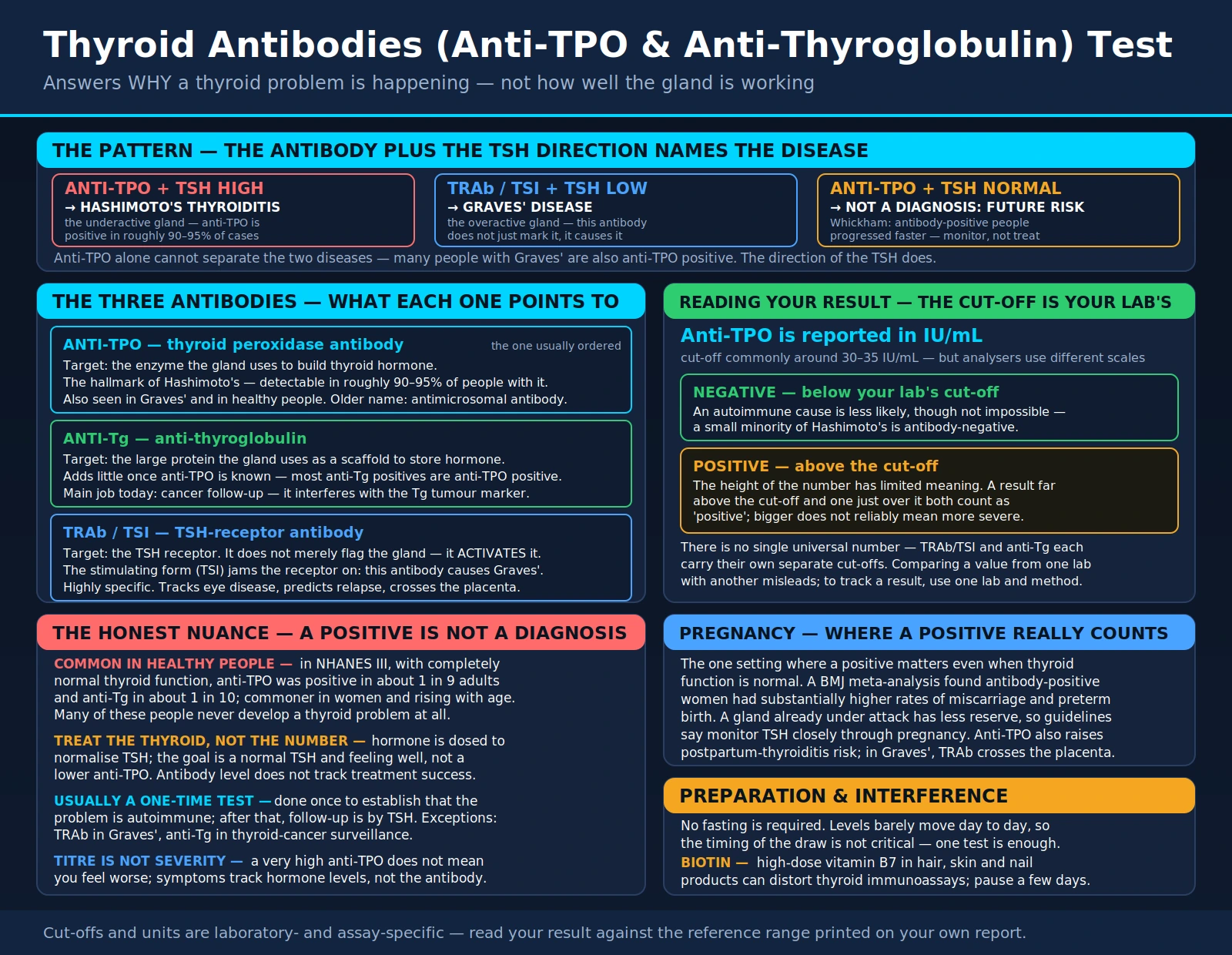
A thyroid antibody test is a blood test that looks for signs your immune system is targeting your own thyroid gland. It doesn't measure how well the thyroid is working — that's the job of TSH and thyroid hormone tests — instead it answers a different question: is the reason for a thyroid problem autoimmune? The most commonly ordered of these tests is anti-TPO (thyroid peroxidase antibody), the hallmark of Hashimoto's thyroiditis, the leading cause of an underactive thyroid. Two other antibodies round out the picture: anti-thyroglobulin and the TSH-receptor antibodies that drive Graves' disease. This page explains, in plain language, what each antibody points to, why a doctor orders these tests, how to read the result, and an important and often-misunderstood nuance: a positive antibody isn't a disease, the level isn't used to track treatment, and plenty of perfectly healthy people carry a low-positive result.
Table of Contents
- What Thyroid Antibodies Are
- The Three Antibodies & What Each Points To
- Anti-TPO: The Hallmark of Hashimoto's
- TRAb / TSI: The Marker of Graves'
- Why the Test Is Ordered
- Antibodies, Fertility & Pregnancy
- Reference Cutoffs & Reading Your Result
- The Honest Nuance: Positives & Tracking
- Preparation & What to Expect
- Research Papers
- Connections
- Featured Videos
What Thyroid Antibodies Are
Your immune system makes proteins called antibodies to recognize and attack things that don't belong — viruses, bacteria, toxins. Normally it leaves your own tissues alone. In an autoimmune condition, that self-tolerance breaks down and the immune system starts producing antibodies against your own cells. When those antibodies are aimed at the thyroid — the small, butterfly-shaped gland at the base of your neck that sets your metabolic pace — the result is autoimmune thyroid disease.
A thyroid antibody test measures the amount of these self-directed antibodies circulating in your blood. It's important to understand what this does and doesn't tell you:
- It tells you whether the immune system is involved — whether a thyroid problem is autoimmune in origin, or has some other cause (iodine deficiency, a nodule, medication, surgery).
- It does not tell you whether your thyroid is currently overactive, underactive, or normal. That's measured separately by TSH and thyroid hormones.
Because of this, antibody tests are usually ordered alongside a standard thyroid panel, not instead of one. The panel tells the doctor how the thyroid is functioning; the antibodies tell them why.
The Three Antibodies & What Each Points To
There are three thyroid antibodies you're likely to encounter on a lab report. Each targets a different part of the gland, and each points toward a somewhat different situation.
Anti-TPO (thyroid peroxidase antibody)
Thyroid peroxidase is an enzyme the gland uses to build thyroid hormone. Antibodies against it — abbreviated anti-TPO (older reports may call it "antimicrosomal antibody") — are the most common and most useful thyroid antibody. They are the signature of Hashimoto's thyroiditis and are found in the great majority of people with that condition. They also appear in a large share of Graves' disease and in some healthy people. If a doctor orders only one thyroid antibody, it is almost always this one.
Anti-thyroglobulin (anti-Tg)
Thyroglobulin is the large protein the thyroid uses as a scaffold to store hormone. Antibodies against it — anti-Tg — are also seen in Hashimoto's and other autoimmune thyroid disease, but they add relatively little once anti-TPO is known, because most anti-Tg-positive people are also anti-TPO-positive. Their main practical use today is a supporting role in Hashimoto's and, importantly, in the follow-up of thyroid cancer: anti-Tg antibodies can interfere with the thyroglobulin tumor-marker test used to watch for cancer recurrence, so labs measure them to make sure that marker can be trusted.
TSH-receptor antibodies (TRAb / TSI)
The third antibody is different in a crucial way: instead of simply flagging the gland for attack, it activates it. TSH-receptor antibodies (TRAb) bind to the receptor that normally responds to the pituitary's TSH signal. In Graves' disease, a stimulating version of this antibody — often reported as TSI (thyroid-stimulating immunoglobulin) — latches onto that receptor and jams it "on," forcing the thyroid to pump out too much hormone. This is the antibody that causes the overactive thyroid of Graves', which is why it's so specific to that diagnosis.
Anti-TPO: The Hallmark of Hashimoto's
Hashimoto's thyroiditis (also called chronic autoimmune thyroiditis) is the most common cause of an underactive thyroid in regions where people get enough iodine. In Hashimoto's, the immune system gradually damages the gland over years, so it slowly loses its ability to make enough hormone. The immune footprint of that process is anti-TPO antibodies, which are detectable in roughly 90–95% of people with the condition. That very high hit rate is what makes anti-TPO the go-to test for confirming that a hypothyroid problem is autoimmune.
What a positive anti-TPO adds, in practice:
- It explains the cause. If someone has an underactive thyroid and a strongly positive anti-TPO, the picture fits Hashimoto's, and there's usually no need for further imaging or biopsy to find out why.
- It flags future risk. In someone whose thyroid still works normally but who has positive anti-TPO, the antibodies signal a higher chance of developing hypothyroidism down the road. The classic Whickham community study found that people with positive antibodies progressed to an underactive thyroid at a meaningfully higher rate each year than antibody-negative people, especially when their TSH was already drifting upward.
- It clarifies "borderline" thyroid numbers. When TSH is only mildly elevated (subclinical hypothyroidism), a positive anti-TPO tilts the odds toward the condition worsening over time, which can influence whether and when to start treatment.
It's worth being clear about direction of causation: the antibodies are largely a marker of the autoimmune process rather than the main weapon doing the damage (much of the harm in Hashimoto's comes from immune cells attacking the gland directly). That's part of why lowering the antibody number is not itself a treatment goal — a point we return to below.
TRAb / TSI: The Marker of Graves'
Graves' disease is the mirror image of Hashimoto's: instead of an underactive gland, it produces an overactive one. The culprit is the stimulating TSH-receptor antibody, which tricks the thyroid into overproducing hormone. Because this antibody is the actual driver of the disease, testing for TRAb or TSI is highly specific for Graves' and is used to:
- Confirm the diagnosis when someone has an overactive thyroid. A positive TRAb in a person with hyperthyroidism strongly indicates Graves' rather than another cause (such as a toxic nodule or transient thyroiditis), often sparing the person a radioactive-iodine uptake scan.
- Assess Graves' eye disease. Higher antibody levels tend to track with more active thyroid eye disease (the bulging, irritated eyes some people with Graves' develop).
- Predict relapse and guide pregnancy. Unlike Hashimoto's antibodies, TRAb levels are clinically useful to follow in specific situations — they help predict whether Graves' will come back after a course of anti-thyroid medication, and, because they cross the placenta, a high level in a pregnant woman warns of possible thyroid overactivity in the baby.
Note the overlap: many people with Graves' also test positive for anti-TPO. So anti-TPO alone cannot distinguish an underactive Hashimoto's thyroid from an overactive Graves' one — that's exactly why the direction of the thyroid function tests (TSH high vs. low) and the TSH-receptor antibody matter for telling the two apart.
Why the Test Is Ordered
A clinician typically reaches for thyroid antibodies in a handful of clear situations:
- To find the cause of an abnormal thyroid. When TSH or thyroid hormone comes back out of range, antibodies answer whether it's autoimmune. A positive anti-TPO with a high TSH points to Hashimoto's; a positive TRAb with a low TSH points to Graves'.
- To evaluate a goiter or thyroid symptoms. An enlarged gland, unexplained fatigue, weight change, hair loss, feeling cold or overheated, a racing heart, or a swelling in the neck can prompt both a function panel and antibodies.
- To assess subclinical thyroid disease. When TSH is borderline but hormone levels are still normal, a positive anti-TPO raises the likelihood of progression and helps decide on monitoring versus treatment.
- For pregnancy and fertility. Antibodies are checked in some women who are pregnant, planning pregnancy, having fertility difficulty, or who have had recurrent miscarriage (see the next section).
- When another autoimmune condition is present. Autoimmune diseases travel together. People with type 1 diabetes, celiac disease, vitiligo, rheumatoid arthritis, or a positive ANA have a higher chance of autoimmune thyroid disease, so screening antibodies may be reasonable.
- In thyroid cancer follow-up. Anti-Tg is measured to check whether the thyroglobulin tumor marker can be interpreted reliably.
Antibodies, Fertility & Pregnancy
Pregnancy is one of the few settings where a thyroid antibody result carries real, practical weight even when thyroid function looks normal. Anti-TPO positivity in women who are pregnant or trying to conceive matters for several reasons:
- Higher risk of pregnancy complications. A large meta-analysis in the BMJ found that women positive for thyroid antibodies had substantially higher rates of miscarriage and preterm birth than antibody-negative women. The antibodies are a marker of risk, not necessarily the direct cause, but the association is consistent enough to be clinically useful.
- The thyroid can't keep up as easily. Pregnancy sharply increases the demand on the thyroid. A gland already under autoimmune attack has less reserve, so antibody-positive women are more likely to slip into hypothyroidism during pregnancy — which is why professional guidelines recommend monitoring their TSH closely through gestation.
- Postpartum thyroiditis. Anti-TPO-positive women are at markedly higher risk of a bout of thyroid inflammation in the months after delivery, which can cause a temporary swing into overactivity, underactivity, or both.
- Graves' and the baby. In a pregnant woman with Graves', TSH-receptor antibodies cross the placenta and can, at high levels, overstimulate the baby's thyroid — so TRAb is measured to gauge that risk.
Because of all this, thyroid antibodies are frequently part of the workup for recurrent miscarriage, unexplained infertility, and thyroid abnormalities discovered in early pregnancy. Major thyroid organizations have published detailed guidance on how to interpret and act on these results during pregnancy.
Reference Cutoffs & Reading Your Result
Thyroid antibodies are reported as a number with a lab-specific cutoff, and results are usually described simply as negative (below the cutoff) or positive (above it). A few practical points on reading them:
- The units and cutoffs vary by laboratory. There is no single universal number. Anti-TPO is often reported in IU/mL with a cutoff commonly in the range of roughly 30–35 IU/mL, but different analyzers use different scales — so always read your result against the reference range printed on your own report, not a number you found online.
- Negative means the antibody was not detected above the cutoff. This makes an autoimmune cause less likely (though not impossible — a small minority of Hashimoto's is antibody-negative).
- Positive means antibodies were detected above the cutoff. The height of the number has limited meaning: a result far above the cutoff and one just over it both count as "positive," and a bigger number does not reliably mean more severe disease.
- TSH-receptor antibodies (TRAb/TSI) have their own separate reference ranges and are interpreted in the context of Graves'. A positive TRAb in someone with an overactive thyroid is the key finding.
- Anti-Tg is reported with its own cutoff; in thyroid-cancer follow-up its main job is to flag whether the thyroglobulin tumor marker is trustworthy.
Because labs differ, comparing an antibody number drawn at one lab to one drawn at another can be misleading. If your result needs tracking over time, the same lab and method should be used.
The Honest Nuance: Positives & Tracking
This is the part most worth understanding, because it's easily misread and can cause needless worry.
1. A positive antibody is not a disease. Population studies make this vivid. In the U.S. NHANES III survey, a substantial share of people with completely normal thyroid function still tested positive for thyroid antibodies — anti-TPO in roughly 1 in 9 adults and anti-Tg in about 1 in 10, with positivity more common in women and rising with age. Many of these people never develop a thyroid problem. So a lone positive antibody, in someone whose TSH and thyroid hormones are normal and who feels well, often means only a higher-than-average future risk that warrants periodic monitoring — not a diagnosis and not automatic treatment.
2. You treat the thyroid, not the antibody number. This is a cornerstone of thyroid care that surprises many patients. Once autoimmune thyroid disease is confirmed, doctors manage the function of the gland — the TSH and hormone levels — not the antibody level. If Hashimoto's has made you hypothyroid, the treatment is thyroid hormone replacement dosed to normalize TSH; the goal is a normal TSH and feeling well, not a lower anti-TPO number. Antibody levels can drift down over years, but that fall doesn't track treatment success and isn't a target. This is why repeatedly re-checking anti-TPO to "see if it's improving" is generally not useful:
- The antibody test is typically done once to establish that a thyroid problem is autoimmune.
- After that, follow-up is done with TSH (and hormones as needed), not by re-measuring antibodies.
- The main exceptions are the situations noted earlier — TRAb in Graves' (to predict relapse or assess pregnancy risk) and anti-Tg in thyroid-cancer surveillance — where repeat measurement genuinely does inform care.
3. Antibodies don't gauge symptom severity. A very high anti-TPO does not mean you will feel worse than someone with a mildly positive one. How you feel is driven by your thyroid hormone levels, not by the antibody titer. Be cautious of programs that promise to "lower your antibodies" as a proxy for getting well — the evidence-based target is normal thyroid function.
Preparation & What to Expect
A thyroid antibody test is a routine blood draw, and it's undemanding on your part:
- No fasting is required for antibody testing itself. You can usually eat and drink normally. (If it's bundled with other blood work, follow whatever instructions your clinic gives for the panel as a whole.)
- Biotin caution. High-dose biotin (vitamin B7) supplements — often found in hair, skin, and nail products — can distort some thyroid immunoassays and give falsely off results. Many labs advise pausing biotin for a couple of days before testing; ask your provider what they recommend.
- Tell your provider about your thyroid medication and supplements. This helps them interpret the whole set of results correctly.
- The draw. A phlebotomist takes a small sample from a vein in your arm; it takes a minute or two. Mild soreness or a small bruise afterward is the extent of it.
- Timing. Antibody levels don't swing much day to day, so time of day is not critical — another reason a single measurement is usually enough.
Your result should be read together with your thyroid function tests and your symptoms by a clinician. On its own, an antibody number is only one piece of the story.
Research Papers
- Hollowell JG, Staehling NW, Flanders WD, Hannon WH, et al. Serum TSH, T4, and thyroid antibodies in the United States population (1988 to 1994): National Health and Nutrition Examination Survey (NHANES III). The Journal of Clinical Endocrinology & Metabolism. 2002;87(2):489–499. doi:10.1210/jcem.87.2.8182 — The large national survey showing that many people with normal thyroid function nonetheless carry positive anti-TPO or anti-Tg antibodies (more common in women and with age).
- Caturegli P, De Remigis A, Rose NR. Hashimoto thyroiditis: clinical and diagnostic criteria. Autoimmunity Reviews. 2014;13(4–5):391–397. doi:10.1016/j.autrev.2014.01.007 — A clear review of how Hashimoto's is defined and diagnosed, including the central role of anti-TPO antibodies.
- McLeod DSA, Cooper DS. The incidence and prevalence of thyroid autoimmunity. Endocrine. 2012;42(2):252–265. doi:10.1007/s12020-012-9703-2 — A synthesis of how common thyroid antibodies are across populations and who is most likely to be positive.
- Fröhlich E, Wahl R. Thyroid autoimmunity: role of anti-thyroid antibodies in thyroid and extra-thyroidal diseases. Frontiers in Immunology. 2017;8:521. doi:10.3389/fimmu.2017.00521 — A detailed overview of what anti-TPO, anti-Tg, and TSH-receptor antibodies each represent and where they are clinically useful.
- Barbesino G, Tomer Y. Clinical utility of TSH receptor antibodies. The Journal of Clinical Endocrinology & Metabolism. 2013;98(6):2247–2255. doi:10.1210/jc.2012-4309 — Reviews how TRAb/TSI testing confirms Graves' disease and helps predict relapse and manage pregnancy.
- Ross DS, Burch HB, Cooper DS, Greenlee MC, et al. 2016 American Thyroid Association guidelines for diagnosis and management of hyperthyroidism and other causes of thyrotoxicosis. Thyroid. 2016;26(10):1343–1421. doi:10.1089/thy.2016.0229 — The major clinical guideline covering how TSH-receptor antibodies are used in diagnosing and managing Graves' disease.
- Kahaly GJ, Bartalena L, Hegedüs L, Leenhardt L, et al. 2018 European Thyroid Association guideline for the management of Graves' hyperthyroidism. European Thyroid Journal. 2018;7(4):167–186. doi:10.1159/000490384 — European guidance placing TRAb measurement at the center of Graves' diagnosis and follow-up.
- Thangaratinam S, Tan A, Knox E, Kilby MD, et al. Association between thyroid autoantibodies and miscarriage and preterm birth: meta-analysis of evidence. BMJ. 2011;342:d2616. doi:10.1136/bmj.d2616 — Pooled evidence linking thyroid-antibody positivity to higher rates of miscarriage and preterm birth.
- Alexander EK, Pearce EN, Brent GA, Brown RS, et al. 2017 Guidelines of the American Thyroid Association for the diagnosis and management of thyroid disease during pregnancy and the postpartum. Thyroid. 2017;27(3):315–389. doi:10.1089/thy.2016.0457 — Comprehensive guidance on interpreting and acting on thyroid antibodies in pregnancy and the postpartum period.
- Garber JR, Cobin RH, Gharib H, Hennessey JV, et al. Clinical practice guidelines for hypothyroidism in adults: cosponsored by the American Association of Clinical Endocrinologists and the American Thyroid Association. Thyroid. 2012;22(12):1200–1235. doi:10.1089/thy.2012.0205 — The guideline underpinning why hypothyroidism is treated to a normal TSH rather than to an antibody target.
Connections
- All Lab Tests
- Thyroid Panel
- Hashimoto's Thyroiditis
- Graves' Disease
- Hypothyroidism
- Hyperthyroidism
- Subclinical Hypothyroidism
- Thyroid Disorders
- ANA Test