Anti-CCP (Rheumatoid Arthritis Antibody)
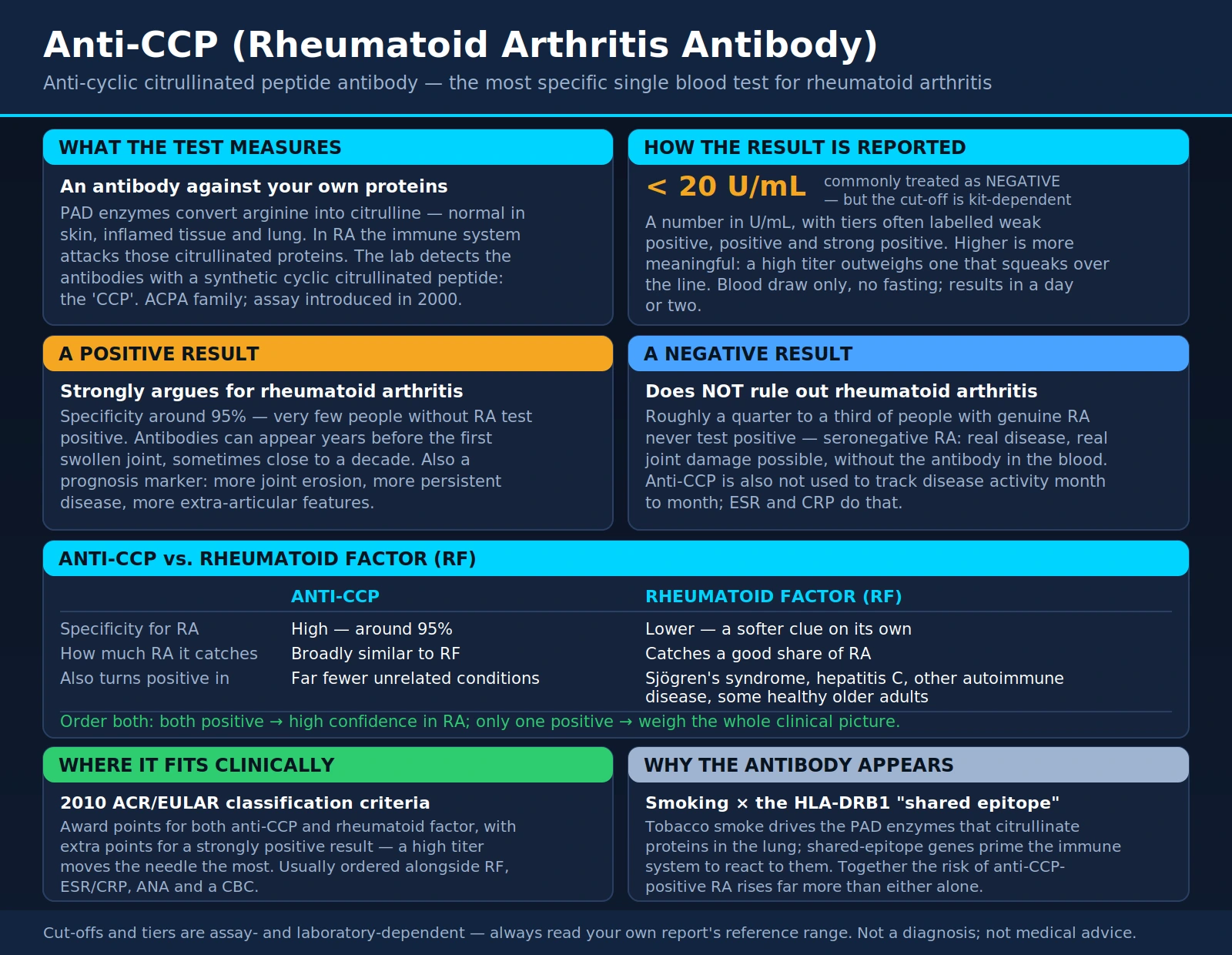
The anti-CCP test is a blood test that looks for one particular kind of autoantibody — an antibody your own immune system has made against your own tissue. Its full name is anti-cyclic citrullinated peptide antibody, and it belongs to a wider family that doctors call ACPA (anti-citrullinated protein antibodies). More than any other single blood test, a positive anti-CCP points toward rheumatoid arthritis (RA), an autoimmune disease that inflames and, over time, can erode the joints. What makes this test so useful is a rare combination of traits: it is highly specific (a positive result strongly suggests RA rather than something else), and it can turn positive years before the first swollen, painful joint ever appears. This page explains, in plain language, what the antibody is, why your doctor might order it, how it compares to the older rheumatoid factor test, how to make sense of your result, and why smoking and certain genes keep coming up in the story. As always, one lab value never diagnoses anything by itself — it is read alongside your symptoms, your exam, and other tests.
Table of Contents
- What Anti-CCP Is
- Why Your Doctor Orders an Anti-CCP Test
- Anti-CCP vs. Rheumatoid Factor
- What the Test Involves and How Results Are Reported
- How to Read Your Result
- What a Positive Result Predicts
- The Smoking and Genetics Connection
- Tests Often Ordered Alongside Anti-CCP
- When to Talk with a Doctor
- Research Papers
- Connections
- Featured Videos
What Anti-CCP Is
To understand the test, it helps to understand one small chemical change that happens inside proteins. Your body constantly modifies its own proteins in tiny ways as part of normal housekeeping. One of these modifications is called citrullination: an enzyme (peptidylarginine deiminase, or PAD) converts an amino acid called arginine into a slightly different one called citrulline. This is a normal, everyday process — it happens in skin, in inflamed tissue, and in the lungs.
In most people, the immune system shrugs at these citrullinated proteins and leaves them alone. In people who develop rheumatoid arthritis, something goes wrong: the immune system starts treating citrullinated proteins as enemies and manufactures antibodies against them. Those antibodies are the ACPAs, and the anti-CCP test is the practical, standardized way to measure them. Rather than trying to fish out antibodies against every possible citrullinated protein in the body, the lab uses a synthetic, ring-shaped stand-in antigen — a cyclic citrullinated peptide — that these antibodies bind to reliably. That synthetic peptide is where the name “CCP” comes from.
So in one sentence: anti-CCP is an antibody your immune system makes against your own citrullinated proteins, and its presence is a fingerprint of the autoimmune process behind rheumatoid arthritis. The first well-validated CCP assay was described in 2000, and it quickly became one of the most important tools in rheumatology because of how tightly it tracks with RA.
Why Your Doctor Orders an Anti-CCP Test
The flagship reason — by far — is the workup of rheumatoid arthritis. If you have joint pain, morning stiffness that lingers, or swelling in the small joints of the hands and feet without an obvious cause, anti-CCP is one of the first blood tests a doctor reaches for. It helps answer the central question: is this inflammatory autoimmune arthritis, or is it something else — wear-and-tear osteoarthritis, an injury, gout, or a passing viral achiness?
Two features make anti-CCP especially valuable in that moment:
- It is highly specific for RA. “Specific” means that when the test is positive, it is unlikely to be a false alarm. A positive anti-CCP points to rheumatoid arthritis more strongly than the older rheumatoid factor test does, because far fewer unrelated conditions push it up. In large pooled analyses, its specificity sits around 95–96% — meaning few people without RA test positive, though “few” is not “none”: roughly 1 in 20 people without RA in those studies still tested positive, so a positive result is a strong argument rather than a proof. In numbers a clinician uses, a positive anti-CCP multiplies the odds of RA by about 12×, against about 5× for a positive rheumatoid factor (Nishimura and colleagues, 2007); a negative result only cuts the odds to about a third, which is why it cannot rule the disease out.
- It can appear years before symptoms. When researchers went back and tested stored blood samples from people who later developed RA, they found anti-CCP antibodies already present — sometimes a few years, sometimes close to a decade — before the first swollen joint. That early-warning quality means the antibody isn’t just a bystander; it’s part of the disease process getting underway quietly.
Because of this, anti-CCP is used not only to confirm a suspected diagnosis but also to predict who is likely to progress to full rheumatoid arthritis — for example, in a person with early, undifferentiated joint inflammation that hasn’t yet declared itself as any specific disease. A positive result in that setting raises the odds that the arthritis will turn out to be RA, and often a more aggressive form of it.
Anti-CCP vs. Rheumatoid Factor
For decades, the classic RA blood test was rheumatoid factor (RF) — an antibody directed against part of your own other antibodies. RF is still useful, but it has a well-known weakness, and anti-CCP was developed largely to fix it. Here is the practical comparison:
- Rheumatoid factor is sensitive but not very specific. It catches a lot of RA (a good share of people with the disease are RF-positive), but it is also positive in many other situations — Sjögren’s syndrome, chronic infections like hepatitis C, some other autoimmune diseases, and even in a fraction of perfectly healthy older adults. So a positive RF, on its own, is a softer clue.
- Anti-CCP is more specific. It catches a broadly similar amount of RA as RF does, but it produces far fewer false positives in people who don’t have the disease. A positive anti-CCP therefore carries more diagnostic weight.
- Both are usually ordered together — but the added value is unproven. In practice a doctor orders the pair, and if both come back positive most rheumatologists are more confident. It is worth knowing that the largest systematic review of the question (Whiting and colleagues, Annals of Internal Medicine, 2010) looked specifically for evidence that combining anti-CCP with rheumatoid factor beats anti-CCP alone, and concluded the evidence was insufficient to say it does. So treat a matching pair as reassuring rather than as a second, independent confirmation, and treat a split result the way the review implies — by weighing the whole clinical picture rather than the RF.
This is not just a lab preference — it is built into how RA is formally classified. The 2010 ACR/EULAR classification criteria (a scoring system from the American College of Rheumatology and the European League Against Rheumatism) award points for both anti-CCP and rheumatoid factor, and give extra points for a strongly positive result. In other words, the two tests sit side by side in the official framework, and a high-titer anti-CCP moves the needle the most.
What the Test Involves and How Results Are Reported
Practically, this is one of the easiest tests to have done. It is a standard blood draw from a vein in your arm — no fasting, no special preparation, and no need to stop most medications. The sample goes to a lab, and results usually come back within a day or two.
Results are reported as a number in units per milliliter (U/mL), along with a cutoff and a word or two of interpretation. A few honest points about the numbers:
- The exact cutoff depends on the test kit. Different manufacturers calibrate their assays differently, so the “normal” threshold printed on your report is the one that matters — not a number you read somewhere else. Always read your own lab’s reference range.
- A common convention treats results below roughly 20 U/mL as negative, with higher tiers often labeled weak positive, positive, and strong positive. But this varies from lab to lab, which is exactly why the report spells out its own boundaries.
- Higher is more meaningful. A result far above the cutoff (a “high titer”) generally carries more diagnostic and prognostic weight than one that squeaks just over the line.
Because the result is a number rather than a simple yes/no, it’s worth asking your doctor both whether it was positive and how positive it was.
How to Read Your Result
Here is the balanced way to think about the two possible outcomes.
A positive result is a strong argument in favor of rheumatoid arthritis, especially when you already have joint symptoms that fit. It also does double duty as a prognosis marker: people who are anti-CCP positive tend to have a more active, more erosive form of the disease, which is one reason a positive result often nudges doctors to start effective treatment earlier and more assertively rather than adopting a wait-and-see approach.
A negative result does not rule out rheumatoid arthritis. This is the single most important thing to understand about the test. A large share of people with genuine RA never test positive for anti-CCP, and the honest number is bigger than most summaries give. Pooling every study design together, the meta-analysis by Nishimura and colleagues (Annals of Internal Medicine, 2007) put sensitivity at 67%, i.e. about a third of RA patients negative. But Whiting and colleagues (2010) showed that case-control designs and studies of long-established RA systematically overestimate sensitivity; restricted to the situation that actually matters — cohort studies of people with early RA of under two years — sensitivity was only 57% (95% CI 51–63%). In other words, in early disease roughly four in ten people who do have rheumatoid arthritis will have a negative anti-CCP. Doctors call this seronegative RA: real disease, real joint damage possible, but without the antibody showing up in the blood. If your joints are clearly inflamed and behaving like RA, a negative anti-CCP does not close the case; the diagnosis rests on the full picture — your history, the exam, imaging, and inflammatory markers — not on this one test.
It also helps to know what the test does not do. Anti-CCP is generally not used to track disease activity from month to month or to judge whether a medication is working; levels don’t swing quickly with treatment the way inflammatory markers can. For day-to-day monitoring, doctors lean on symptoms, joint exams, and markers like ESR and CRP.
What a Positive Result Predicts
Beyond helping to name the disease, anti-CCP helps forecast how it may behave. This prognostic role is one of the test’s quiet strengths, and it is why rheumatologists pay attention to it even after a diagnosis is settled. In studies, anti-CCP positivity — and especially high titers — has been linked to:
- More joint erosion. Anti-CCP-positive RA tends to be more aggressive on X-rays over time, with a greater tendency toward the bone and cartilage damage that causes lasting deformity.
- More persistent disease. Antibody-positive arthritis is less likely to be a self-limited, one-time flare and more likely to become established, chronic RA.
- Extra-articular features. Some complications that reach beyond the joints are more common in antibody-positive disease.
None of this is destiny — it describes tendencies across groups of people, not a guaranteed path for any one person. But taken together it gives doctors a reason to treat anti-CCP-positive RA seriously and early, aiming to control the inflammation before it can carve permanent damage into the joints.
The Smoking and Genetics Connection
One of the most fascinating threads in rheumatology is why some people start making these antibodies at all — and here the story points to a collision between the environment and our genes. The leading model connects three things: smoking, a set of immune genes, and citrullination.
The genetic piece involves certain versions of the HLA-DRB1 genes, collectively nicknamed the “shared epitope.” These genes shape how your immune system displays protein fragments to itself. People who carry shared-epitope alleles are, in effect, immunologically primed to notice citrullinated peptides and potentially react against them.
The environmental piece is smoking (and other forms of lung stress). Tobacco smoke ramps up citrullination in the lungs — it drives the very PAD enzymes that convert arginine to citrulline, generating a local supply of the modified proteins.
Put the two together and you get a gene–environment interaction: in a person who both smokes and carries the shared epitope, the immune system meets a steady stream of citrullinated proteins in a body that is genetically inclined to react to them. In that combination, the risk of developing anti-CCP-positive rheumatoid arthritis rises far more than either factor would predict on its own. It is one of the clearest, most cited examples of nature and lifestyle working together to trigger an autoimmune disease — and a genuinely practical reason that quitting smoking is part of caring for joint health.
Tests Often Ordered Alongside Anti-CCP
Anti-CCP rarely travels alone. Because diagnosing inflammatory arthritis is about assembling a picture, your doctor will usually pair it with several other tests:
- Rheumatoid factor (RF) — the classic companion antibody, ordered together with anti-CCP for the reasons above.
- ESR and CRP (inflammatory markers) — these don’t say what the disease is, but they measure how much inflammation is present and are used to gauge disease activity and treatment response over time.
- ANA (antinuclear antibody) — helpful for sorting out overlap with other autoimmune conditions such as lupus, which can also cause joint pain but is a different disease with a different treatment path.
- A complete blood count and basic chemistry — to check for anemia (common in chronic inflammation) and to establish a baseline before starting medications.
The point of the panel is triangulation: no single result is asked to carry the diagnosis. Anti-CCP contributes the most specific clue toward RA, RF adds sensitivity, and the inflammatory markers and other antibodies help place the whole thing in context.
When to Talk with a Doctor
If you have joint pain and swelling — particularly in the small joints of the hands, wrists, or feet — along with morning stiffness that lasts more than about half an hour, it is worth getting evaluated rather than waiting to see if it passes. Rheumatoid arthritis has what specialists call a “window of opportunity”: the early months of the disease are when treatment does the most good, because controlling inflammation before it damages the joints leads to markedly better long-term outcomes. Modern guidelines emphasize starting effective disease-modifying therapy promptly and steering treatment toward a target of low disease activity or remission.
That is really the whole reason a test like anti-CCP matters so much: catching the process early — sometimes even before the joints look badly affected — can change the course of the disease. If your anti-CCP comes back positive, ask to be seen by a rheumatologist, a specialist in these conditions. And if it comes back negative but your joints are still clearly inflamed, don’t let the negative result end the conversation — seronegative RA is real, and you still deserve a full evaluation. A single blood test is a clue, not a verdict; the diagnosis and the plan come from you and your doctor together.
Research Papers
- Schellekens GA, Visser H, de Jong BAW, et al. The diagnostic properties of rheumatoid arthritis antibodies recognizing a cyclic citrullinated peptide. Arthritis & Rheumatism. 2000;43(1):155–163. doi:10.1002/1529-0131(200001)43:1<155::aid-anr20>3.0.co;2-3<155::AID-ANR20>3.0.CO;2-3 — the landmark paper that introduced the CCP assay and showed how specific it is for rheumatoid arthritis.
- Nishimura K, Sugiyama D, Kogata Y, et al. Meta-analysis: diagnostic accuracy of anti-cyclic citrullinated peptide antibody and rheumatoid factor for rheumatoid arthritis. Annals of Internal Medicine. 2007;146(11):797–808. doi:10.7326/0003-4819-146-11-200706050-00008 — the head-to-head pooled comparison showing anti-CCP is more specific for RA than rheumatoid factor.
- Whiting PF, Smidt N, Sterne JAC, et al. Systematic review: accuracy of anti-citrullinated peptide antibodies for diagnosing rheumatoid arthritis. Annals of Internal Medicine. 2010;152(7):456–464. doi:10.7326/0003-4819-152-7-201004060-00010 — confirms high specificity with moderate sensitivity across many studies.
- Aletaha D, Neogi T, Silman AJ, et al. 2010 rheumatoid arthritis classification criteria: an American College of Rheumatology/European League Against Rheumatism collaborative initiative. Arthritis & Rheumatism. 2010;62(9):2569–2581. doi:10.1002/art.27584 — the official criteria that build both anti-CCP and rheumatoid factor into how RA is classified.
- Rantapää-Dahlqvist S, de Jong BAW, Berglin E, et al. Antibodies against cyclic citrullinated peptide and IgA rheumatoid factor predict the development of rheumatoid arthritis. Arthritis & Rheumatism. 2003;48(10):2741–2749. doi:10.1002/art.11223 — showed anti-CCP can be present years before RA symptoms begin.
- Nielen MMJ, van Schaardenburg D, Reesink HW, et al. Specific autoantibodies precede the symptoms of rheumatoid arthritis: a study of serial measurements in blood donors. Arthritis & Rheumatism. 2004;50(2):380–386. doi:10.1002/art.20018 — blood-donor samples confirming antibodies appear well before the first symptoms.
- van Gaalen FA, Linn-Rasker SP, van Venrooij WJ, et al. Autoantibodies to cyclic citrullinated peptides predict progression to rheumatoid arthritis in patients with undifferentiated arthritis: a prospective cohort study. Arthritis & Rheumatism. 2004;50(3):709–715. doi:10.1002/art.20044 — anti-CCP predicts which early, undefined arthritis will become RA.
- van der Helm-van Mil AHM, Verpoort KN, Breedveld FC, et al. Antibodies to citrullinated proteins and differences in clinical progression of rheumatoid arthritis. Arthritis Research & Therapy. 2005;7(5):R949–R958. doi:10.1186/ar1767 — links anti-CCP positivity to more erosive, damaging disease.
- Klareskog L, Stolt P, Lundberg K, et al. A new model for an etiology of rheumatoid arthritis: smoking may trigger HLA-DR (shared epitope)-restricted immune reactions to autoantigens modified by citrullination. Arthritis & Rheumatism. 2006;54(1):38–46. doi:10.1002/art.21575 — the classic gene–environment model connecting smoking, the shared epitope, and citrullination.
- Klareskog L, Rönnelid J, Lundberg K, et al. Immunity to citrullinated proteins in rheumatoid arthritis. Annual Review of Immunology. 2008;26:651–675. doi:10.1146/annurev.immunol.26.021607.090244 — a thorough review of how anti-citrullinated protein immunity drives RA.
- van Venrooij WJ, van Beers JJBC, Pruijn GJM. Anti-CCP antibodies: the past, the present and the future. Nature Reviews Rheumatology. 2011;7(7):391–398. doi:10.1038/nrrheum.2011.76 — an accessible overview of how the test was developed and how it is used in the clinic.
- Smolen JS, Landewé RBM, Bijlsma JWJ, et al. EULAR recommendations for the management of rheumatoid arthritis with synthetic and biological disease-modifying antirheumatic drugs: 2019 update. Annals of the Rheumatic Diseases. 2020;79(6):685–699. doi:10.1136/annrheumdis-2019-216655 — the guideline behind early, treat-to-target therapy and the “window of opportunity.”
Connections
- All Lab Tests
- Rheumatoid Arthritis
- Rheumatoid Factor Test
- ANA (Antinuclear Antibody) Test
- ANCA Test
- Inflammatory Markers
- ESR (Sedimentation Rate)
- hs-CRP
- Complement Test
- Rheumatology
- Arthritis — the broader family of joint disease this test helps sort through.