Ammonia (Blood Test)
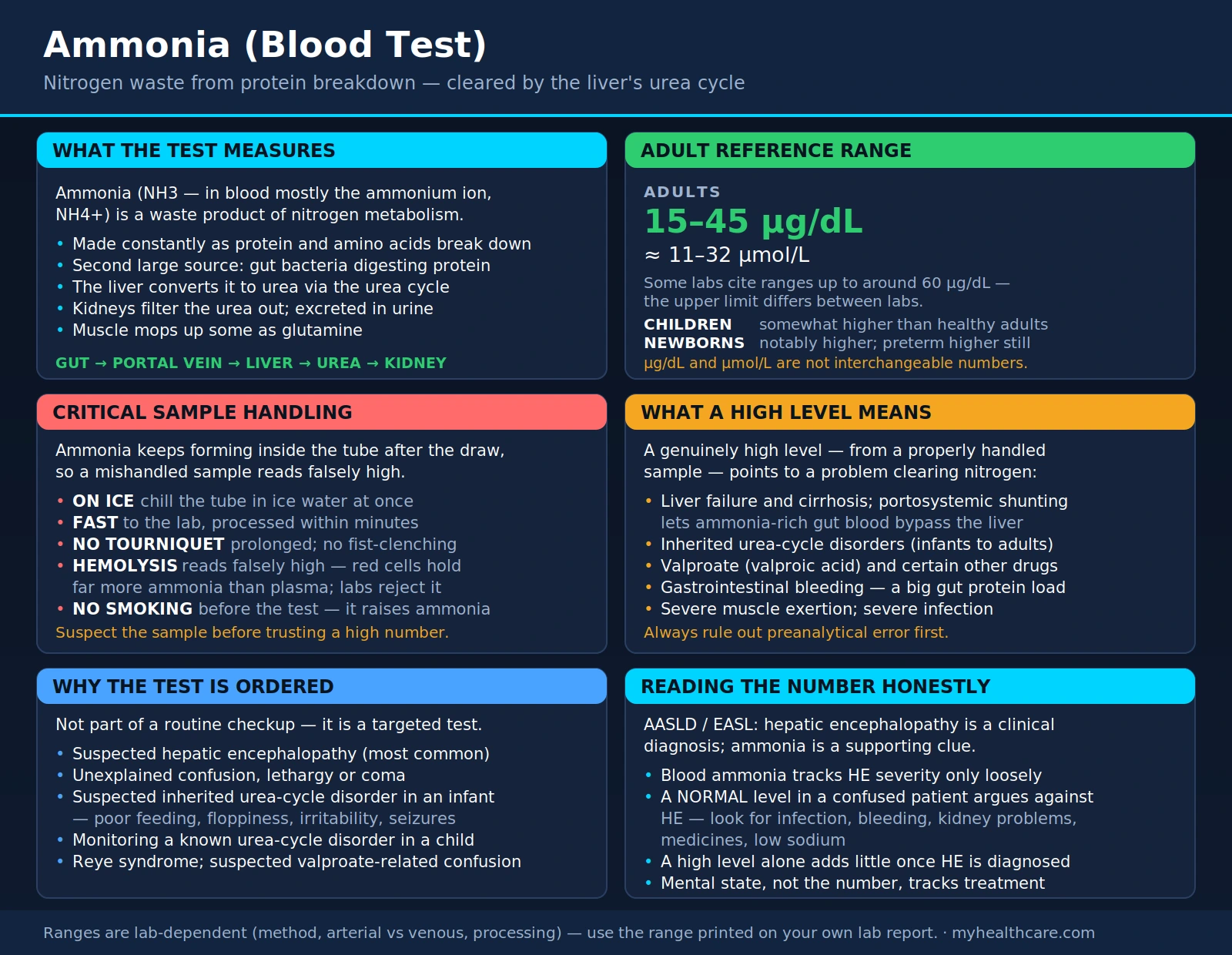
A blood ammonia test measures the amount of ammonia circulating in your blood. Ammonia is a small nitrogen-containing waste product that your body makes constantly as it breaks down protein, and normally your liver clears it away before it can build up. When the liver is badly damaged — or when a rare inherited problem stops the body from processing nitrogen — ammonia can rise and affect the brain, causing confusion, drowsiness, and in severe cases coma. This page explains in plain language what ammonia is, why a doctor might order the test, why the blood sample has to be handled so carefully (this is one of the trickiest tests in the lab to get right), what the results mean, and an honest look at how well the number actually tracks with how sick a person is. Ammonia is a useful clue, but it is only one piece of the picture, and it is easy to get a falsely high reading from a poorly drawn sample.
Table of Contents
- What Ammonia Is
- Why the Test Is Ordered
- How It's Measured and Critical Sample Handling
- Normal Ranges
- What High Ammonia Means
- Ammonia and Hepatic Encephalopathy: An Honest Look
- Treating Hepatic Encephalopathy
- Related Tests
- When to Talk to a Doctor
- Research Papers
- Connections
- Featured Videos
What Ammonia Is
Ammonia (chemical formula NH3, though in blood it mostly exists as the ammonium ion, NH4+) is a waste product of nitrogen metabolism. Every time your body breaks down protein and amino acids — from the food you eat and from the normal turnover of your own tissues — nitrogen is released, and some of it ends up as ammonia. A second large source is your gut: the bacteria living in your intestines produce ammonia as they digest proteins and other nitrogen-containing compounds, and that ammonia is absorbed into the bloodstream.
Ammonia is mildly toxic, especially to the brain, so the body does not let it accumulate. The liver is the cleanup crew. Blood leaving the intestines travels first to the liver through the portal vein, and liver cells convert the ammonia into urea through a series of chemical steps called the urea cycle. Urea is far less toxic and water-soluble, so the kidneys can filter it out and you excrete it in urine. A smaller amount of ammonia is also mopped up by muscle and other tissues, which combine it with the amino acid glutamate to make glutamine.
Because the liver sits directly in the path of blood coming from the gut and does most of the detoxification, ammonia levels are a rough window into two things: how well the liver is working, and whether the urea cycle is intact. When either system fails, ammonia has nowhere to go, and it starts to climb.
Why the Test Is Ordered
Doctors do not order an ammonia level as part of a routine checkup. It is a targeted test, used mainly in a few specific situations.
Suspected hepatic encephalopathy
This is by far the most common reason. Hepatic encephalopathy (HE) is a decline in brain function — ranging from mild confusion, poor concentration, and personality changes to disorientation, slurred speech, a characteristic flapping tremor of the hands (asterixis), and, at its worst, unresponsiveness and coma — that happens in people with serious liver disease, most often cirrhosis. When someone with known or suspected liver disease becomes confused, a doctor may check ammonia to help support the diagnosis. It is important to understand that HE is diagnosed clinically, at the bedside, and ammonia is a supporting clue rather than the deciding factor.
Unexplained changes in mental status
When a person becomes confused, lethargic, or comatose and the cause is not obvious, an elevated ammonia can point toward a metabolic cause that might otherwise be missed — occasionally revealing undiagnosed liver disease or a urea-cycle problem in an adult.
Suspected inherited urea-cycle disorders in infants and children
Babies born with a genetic defect in one of the urea-cycle enzymes cannot convert ammonia to urea normally. Such an infant may become poorly feeding, floppy, irritable, or lethargic in the first days of life, sometimes progressing rapidly to seizures and coma. A very high ammonia level is a red flag that prompts urgent evaluation. Ammonia is also monitored in children with a known urea-cycle disorder to guide treatment and catch dangerous spikes early.
Reye syndrome and certain drug effects
Historically, ammonia was measured when Reye syndrome — a rare, serious condition involving the liver and brain, once linked to aspirin use in children with viral illness — was suspected. It may also be checked when a medication known to raise ammonia (such as valproate, used for seizures and mood disorders) is thought to be causing confusion.
How It's Measured and Critical Sample Handling
The ammonia test is performed on a blood sample, usually venous blood drawn from a vein in the arm. What sets this test apart is that it is notoriously easy to get wrong — not because the laboratory instrument is unreliable, but because ammonia keeps forming inside the collection tube after the blood is drawn. If the sample is handled poorly, the reported number can be falsely high, which may lead to unnecessary worry or even the wrong treatment. Understanding this is genuinely important, because many "high ammonia" results are really just bad samples.
Here is why the handling is so fussy, and what good practice looks like:
- Ammonia rises quickly in the tube. Blood cells and enzymes keep generating ammonia after collection. The longer the blood sits, and the warmer it is, the higher the reading creeps. For this reason the sample should reach the lab and be processed as fast as possible, ideally within minutes.
- The sample goes on ice. Chilling the tube in ice water immediately after the draw slows down the ongoing ammonia production, buying time before the plasma can be separated and tested.
- Avoid a tight tourniquet and fist-clenching. A prolonged tourniquet and repeated pumping or clenching of the fist can raise ammonia locally in the arm and skew the result. A clean, prompt draw with minimal tourniquet time is preferred.
- Hemolysis falsely elevates it. If red blood cells break open (hemolysis) — from rough handling, a difficult draw, or shaking the tube — they spill their contents, and red cells contain far more ammonia than plasma does. A hemolyzed sample can read falsely high, and a good lab will often reject it.
- Smoking raises it. Recent cigarette smoking can increase blood ammonia, so patients are usually asked not to smoke before the test.
Because of all this, the practical rule is simple: a surprisingly high ammonia in a person who looks clinically well should make everyone suspect the sample before they trust the number. When in doubt, the test is repeated with careful collection. The care taken between the needle and the analyzer matters as much as the analyzer itself.
Normal Ranges
Reference ranges for blood ammonia vary quite a bit from one laboratory to another, because they depend on the exact method used, whether the sample is arterial or venous, and how the lab processes it. Always interpret your result against the reference range printed on your own lab report rather than a general figure. That said, as a rough orientation:
- Adults: roughly 15–45 micrograms per deciliter (µg/dL), which is about 11–32 micromoles per liter (µmol/L) — but some labs cite ranges up to around 60 µg/dL. The upper limit differs between labs.
- Children: generally somewhat higher than healthy adults, with the exact range depending on age and the laboratory.
- Newborns (neonates): notably higher than adults, and premature infants higher still. Because the normal newborn range is so different, results in babies are judged against age-specific values. In the context of a suspected inherited urea-cycle disorder, markedly elevated levels — well above the newborn baseline — are the concern.
Units matter: the same result can be reported in µg/dL or in µmol/L, and the two are not interchangeable numbers. Check which unit your report uses so you are comparing against the matching range.
What High Ammonia Means
A genuinely elevated blood ammonia — confirmed by a properly handled sample — points to a problem clearing nitrogen. The main causes include:
- Liver failure and cirrhosis. When liver cells are lost or scarred, the liver cannot convert ammonia to urea efficiently. In cirrhosis, blood may also bypass the liver through abnormal vessels (portosystemic shunting), so ammonia-rich gut blood reaches the general circulation without being detoxified. This is the setting for hepatic encephalopathy.
- Inherited urea-cycle disorders. Genetic deficiencies of urea-cycle enzymes prevent normal ammonia disposal. These can present dramatically in newborns or, in milder forms, surface later in childhood or even adulthood, sometimes triggered by illness, fasting, or a high-protein load.
- Certain drugs. Valproate (valproic acid) is a well-known example that can raise ammonia and occasionally cause a confusional state even when liver enzymes look normal.
- Gastrointestinal bleeding. Blood in the gut is a large protein load; intestinal bacteria break it down and generate extra ammonia. In a person with cirrhosis, a GI bleed can precipitate or worsen hepatic encephalopathy.
- Severe muscle exertion. Very intense exercise transiently increases ammonia production by muscle, which is one reason strenuous activity before a draw is discouraged.
Other contributors can include severe infection, some inborn organic-acid disorders, and states that shunt blood past the liver. Importantly, before attributing a high value to any of these, the possibility of a preanalytical error (a mishandled sample, as described above) always has to be ruled out.
Ammonia and Hepatic Encephalopathy: An Honest Look
It is tempting to treat the ammonia number as a "confusion meter" — higher ammonia, sicker brain. The reality is more nuanced, and being honest about this saves a lot of misplaced confidence.
Ammonia is central to the biology of hepatic encephalopathy: it crosses into the brain, where it disturbs the function of supporting cells (astrocytes), contributes to swelling, and interferes with normal signaling. So the connection is real. But in an individual patient, the blood ammonia level correlates only loosely with how severe the encephalopathy is. Two people can have the same ammonia value and very different degrees of confusion; a person can be clearly encephalopathic with a level that is only mildly elevated, and someone with a fairly high level may be surprisingly clear-headed. Studies looking at venous ammonia and the graded severity of HE have found the relationship to be inconsistent, which is part of why measuring the partial pressure of ammonia or arterial ammonia has been explored as a possibly better correlate — without those becoming routine everyday tests.
Major liver-society guidelines reflect this. The joint American Association for the Study of Liver Diseases (AASLD) and European Association for the Study of the Liver (EASL) guidance emphasizes that hepatic encephalopathy is a clinical diagnosis, and that a normal ammonia in a patient who appears encephalopathic should prompt a rethink of the diagnosis, while a high ammonia by itself does not add much for someone already diagnosed. In practice this means:
- Ammonia is used alongside clinical judgment, not as a strict severity gauge or a target to "treat to a number."
- A normal ammonia in a confused patient with liver disease is genuinely useful — it argues against HE and pushes doctors to look for another cause of the confusion (infection, bleeding, kidney problems, medications, low sodium, and so on).
- Serial ammonia levels are not the standard way to track whether HE treatment is working; the patient's mental state is. Improvement is judged by how the person looks and behaves, not by chasing the lab value down.
None of this means the test is useless. It means it should be read thoughtfully, in context, and with respect for how easily the number can mislead.
Treating Hepatic Encephalopathy
When high ammonia reflects hepatic encephalopathy, the goal of treatment is to lower the ammonia load reaching the brain and to correct whatever set off the episode. The cornerstones are well established.
Find and fix the trigger
Most episodes of HE in cirrhosis are set off by something identifiable: infection, gastrointestinal bleeding, dehydration or electrolyte problems (often from diuretics), constipation, or sedating medications. Treating the trigger is frequently the most important step.
Lactulose
The first-line medicine is usually lactulose, a non-absorbable sugar syrup. It works in the colon: it draws water in and speeds up bowel movements, physically clearing ammonia-producing material, and it acidifies the colon so that ammonia is trapped as ammonium and passed in the stool rather than absorbed. The dose is typically adjusted to produce two to three soft bowel movements a day. Too little does not help; too much causes diarrhea, dehydration, and electrolyte disturbance, which can paradoxically worsen HE, so the dose is titrated to effect.
Rifaximin
Rifaximin is a poorly absorbed antibiotic that acts in the gut to reduce the ammonia-producing bacteria. It is commonly added to lactulose, especially to help prevent recurrent episodes. Randomized trials support rifaximin for maintaining remission from overt HE, and the combination of rifaximin plus lactulose has been shown to be more effective than lactulose alone for treating overt episodes.
Other measures, used in specific situations, include correcting low potassium, avoiding unnecessary protein restriction (adequate protein is important for people with cirrhosis), and, for selected patients, managing the abnormal shunt vessels. Because HE reflects underlying liver disease, ongoing care of the liver — and, when appropriate, evaluation for liver transplantation — is part of the bigger picture.
Related Tests
Ammonia is almost never interpreted alone. It sits within a broader assessment of the liver and metabolism, and a doctor will usually look at several results together:
- Liver function tests — the panel of enzymes and proteins (such as ALT, AST, bilirubin, and albumin) that gauge liver injury and how well the liver is doing its jobs.
- Comprehensive metabolic panel — a broad blood chemistry panel that includes liver and kidney markers, electrolytes, and glucose, helping put ammonia in context and flag triggers like kidney problems or electrolyte imbalance.
- Albumin and clotting tests — markers of the liver's synthetic function, which help stage chronic liver disease.
- Hepatitis panel and GGT — help work out the cause of liver disease.
- In children with suspected metabolic disease, ammonia is paired with tests such as blood gas, glucose, lactate, and specialized amino-acid and organic-acid studies to pin down a urea-cycle or related disorder.
When to Talk to a Doctor
If you or someone you care for has liver disease and you notice new confusion, unusual sleepiness, disorientation, personality or mood changes, slurred speech, or a flapping tremor of the hands, treat it as a reason to seek medical care promptly — these can be signs of hepatic encephalopathy, and it is often reversible when the trigger is treated. A sudden, severe change in alertness is an emergency.
In a newborn or young child, poor feeding, unusual floppiness or irritability, vomiting, rapid breathing, lethargy, or seizures deserve urgent medical attention; a very high ammonia in this setting can signal an inherited urea-cycle disorder that needs immediate treatment.
Finally, if you are told your ammonia is high but you feel well, ask whether the sample was handled correctly and whether the test should be repeated with careful collection — a falsely elevated result from a mishandled sample is common. Use your own lab's reference range and units when reading any result, and go over what it means with the clinician who knows your history. This page is educational and is not a substitute for personal medical advice.
Research Papers
- Vilstrup H, Amodio P, Bajaj J, et al. Hepatic encephalopathy in chronic liver disease: 2014 Practice Guideline by the American Association for the Study of Liver Diseases and the European Association for the Study of the Liver. Hepatology. 2014;60(2):715–735. doi:10.1002/hep.27210 — the foundational joint guideline; states HE is a clinical diagnosis and that a normal ammonia should prompt reconsidering it.
- Montagnese S, Rautou PE, Romero-Gómez M, et al. EASL Clinical Practice Guidelines on the management of hepatic encephalopathy. Journal of Hepatology. 2022;77(3):807–824. doi:10.1016/j.jhep.2022.06.001 — current European guidance on diagnosing and treating HE, including the limited role of ammonia levels.
- Häussinger D, Dhiman RK, Felipo V, et al. Hepatic encephalopathy. Nature Reviews Disease Primers. 2022;8(1):43. doi:10.1038/s41572-022-00366-6 — comprehensive review of the biology, including how ammonia affects the brain's astrocytes.
- Ong JP, Aggarwal A, Krieger D, et al. Correlation between ammonia levels and the severity of hepatic encephalopathy. The American Journal of Medicine. 2003;114(3):188–193. doi:10.1016/s0002-9343(02)01477-8 — classic study examining how loosely venous ammonia tracks with clinical HE grade.
- Kramer L, Tribl B, Gendo A, et al. Partial pressure of ammonia versus ammonia in hepatic encephalopathy. Hepatology. 2000;31(1):30–34. doi:10.1002/hep.510310107 — argues that partial pressure of ammonia may correlate better with HE than total ammonia.
- Ge PS, Runyon BA. Serum ammonia level for the evaluation of hepatic encephalopathy. JAMA. 2014;312(6):643–644. doi:10.1001/jama.2014.2398 — concise clinical guidance cautioning against over-relying on the ammonia number.
- Ninan J, Feldman L. Ammonia levels and hepatic encephalopathy in patients with known chronic liver disease. Journal of Hospital Medicine. 2017;12(8):659–661. doi:10.12788/jhm.2794 — shows checking ammonia in already-diagnosed liver patients rarely changes management.
- Tapper EB, Jiang ZG, Patwardhan VR. Refining the ammonia hypothesis: a physiology-driven approach to the treatment of hepatic encephalopathy. Mayo Clinic Proceedings. 2015;90(5):646–658. doi:10.1016/j.mayocp.2015.03.003 — reviews how ammonia biology informs (and complicates) treatment decisions.
- Barsotti RJ. Measurement of ammonia in blood. The Journal of Pediatrics. 2001;138(1 Suppl):S11–S20. doi:10.1067/mpd.2001.111832 — details the preanalytical pitfalls (sample handling, timing, hemolysis) that cause falsely high results.
- Häberle J, Burlina A, Chakrapani A, et al. Suggested guidelines for the diagnosis and management of urea cycle disorders: first revision. Journal of Inherited Metabolic Disease. 2019;42(6):1192–1230. doi:10.1002/jimd.12100 — the reference guideline for the inherited disorders behind high ammonia in infants and children.
- Bass NM, Mullen KD, Sanyal A, et al. Rifaximin treatment in hepatic encephalopathy. New England Journal of Medicine. 2010;362(12):1071–1081. doi:10.1056/NEJMoa0907893 — landmark randomized trial supporting rifaximin to prevent recurrent overt HE.
- Sharma BC, Sharma P, Lunia MK, et al. A randomized, double-blind, controlled trial comparing rifaximin plus lactulose with lactulose alone in treatment of overt hepatic encephalopathy. American Journal of Gastroenterology. 2013;108(9):1458–1463. doi:10.1038/ajg.2013.219 — found the rifaximin-plus-lactulose combination more effective than lactulose alone.
Connections
- All Lab Tests
- Liver Function Tests
- Comprehensive Metabolic Panel
- Lactulose
- Nephrology & Hepatology
- Albumin
- GGT
- Hepatitis Panel
- Ceruloplasmin
- Kidney Function