Aldolase
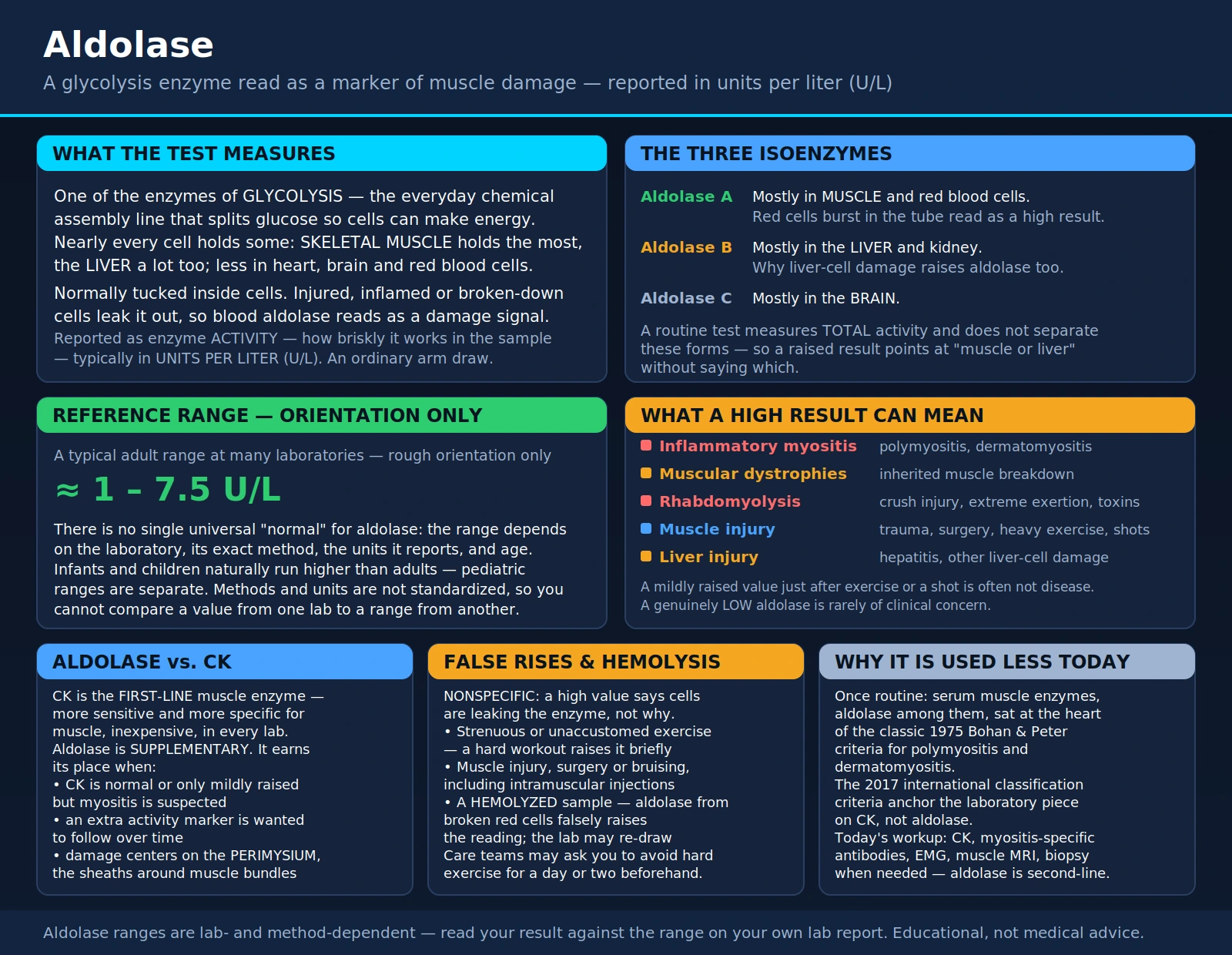
Aldolase is an enzyme — a tiny molecular tool your cells use to break down glucose (sugar) for energy. It lives inside nearly every cell in the body, but there is an especially large amount of it in muscle and in the liver. When muscle or liver cells are injured or inflamed, aldolase spills out of them and into the bloodstream, so a simple blood test can pick up that rise. For that reason, doctors mainly use the aldolase test as a marker of muscle damage or inflammation, most often alongside a more commonly used muscle enzyme called creatine kinase (CK). Its best-known role is in evaluating and following inflammatory muscle diseases such as polymyositis and dermatomyositis. This page explains, in plain language, what aldolase is, why a doctor might order it, what a high result can mean, how it compares with CK, and — honestly — why it is used less today than it once was. It is general health information, not a substitute for advice from your own clinician.
Table of Contents
- What Aldolase Is
- Why It's Ordered
- How It's Measured & What Raises It
- Normal Ranges
- What High Aldolase Means
- Aldolase vs. Creatine Kinase (CK)
- Why Aldolase Is Used Less Than It Once Was
- Related Tests
- When to Talk to a Doctor
- Research Papers
- Connections
- Featured Videos
What Aldolase Is
Aldolase is one of the enzymes that carry out glycolysis — the everyday chemical assembly line that splits glucose into smaller pieces so your cells can turn it into usable energy. Because every cell needs energy, aldolase is found almost everywhere in the body. But it is not spread out evenly: skeletal muscle (the muscles you move with) holds the most, and the liver holds a lot too. Smaller amounts sit in the heart, brain, and red blood cells.
Under normal conditions, aldolase stays tucked safely inside cells, and only a little bit is present in the blood. When cells that are rich in aldolase get damaged — torn, inflamed, starved of oxygen, or broken down — their contents leak out, and the amount of aldolase circulating in the blood goes up. A blood aldolase test simply measures how much of that enzyme has ended up in the bloodstream. In other words, it is less a test of "how your metabolism is doing" and more a window into whether certain cells, especially muscle cells, are being injured.
A note on the different forms
Aldolase comes in three closely related versions, called isoenzymes: aldolase A (mostly in muscle and red blood cells), aldolase B (mostly in the liver and kidney), and aldolase C (mostly in the brain). A routine blood test usually measures the total enzyme activity and does not separate these forms, which is part of why a raised result points you toward "muscle or liver" without telling you exactly which by itself.
Why It's Ordered
The main reason a doctor orders an aldolase test is to look for muscle damage or inflammation. It is rarely ordered on its own. In practice it is usually drawn together with creatine kinase (CK), the muscle enzyme that clinicians reach for first, so the two results can be read side by side.
Its most established role is in the inflammatory muscle diseases — particularly polymyositis and dermatomyositis, in which the immune system attacks the muscles. In these conditions aldolase is often elevated, and it can be useful in a few specific ways:
- It sometimes rises when CK happens to be normal, which can add a clue the CK alone would miss.
- It can move up and down with disease activity, so it may help a doctor gauge whether inflammation is improving with treatment or flaring again.
- In certain patterns of muscle inflammation it appears to reflect damage to the connective-tissue sheaths around muscle bundles, not just the muscle fibers themselves.
Beyond inflammatory myositis, aldolase can also be elevated in muscular dystrophies, in ordinary muscle injury, and in some kinds of liver disease. Because those causes overlap, the test is interpreted in the context of your symptoms and your other blood work — never in isolation.
How It's Measured & What Raises It
Measuring aldolase is straightforward: it takes an ordinary blood draw, usually from a vein in your arm. The laboratory reports the result as an amount of enzyme activity — how briskly the enzyme does its job in the sample — typically in units per liter (U/L).
There is usually no elaborate preparation, but one thing genuinely matters: like CK, aldolase goes up after the muscles have been worked or bumped. Because of that, your care team may ask you to avoid strenuous exercise for a day or two before the test, and to mention any recent injections or muscle injuries, so a harmless spike is not mistaken for disease.
Things that can raise aldolase without any muscle disease
- Strenuous or unaccustomed exercise — a hard workout can push levels up temporarily.
- Muscle injury, surgery, or bruising, including recent intramuscular injections (shots into a muscle).
- A hemolyzed blood sample — if red blood cells break during collection, the aldolase inside them leaks into the sample and falsely raises the reading, so the lab may ask for a re-draw.
All of this is a reminder that aldolase is nonspecific: a high number tells you cells are leaking the enzyme, but not, on its own, why.
Normal Ranges
There is no single universal "normal" number for aldolase. The reference range depends on the laboratory, the exact method it uses, the units it reports in, and the age of the person tested. The only number that truly matters for your result is the reference range printed on your own lab report, right next to your value.
As a rough orientation only:
- For many adult laboratories, a typical normal range falls somewhere around 1 to 7.5 units per liter (U/L), though different labs set their limits differently.
- Infants and children naturally run higher than adults, because growing muscle is more metabolically active; pediatric ranges are separate.
- Because methods and units are not standardized across labs, you generally cannot compare a value measured at one lab to a range from another. Always match your number to the range from the lab that ran it.
Rather than fixating on the exact figure, it is usually more meaningful to look at whether a result is clearly above the reporting lab's upper limit, and how it changes over time on repeat testing.
What High Aldolase Means
A high aldolase level signals that aldolase-rich cells — most often muscle, sometimes liver — are leaking the enzyme into the blood. Common reasons include:
- Inflammatory muscle disease (myositis). Polymyositis and dermatomyositis are the classic settings, where the immune system inflames the muscles.
- Muscular dystrophies. Inherited conditions in which muscle steadily breaks down can raise muscle enzymes, including aldolase.
- Rhabdomyolysis. A severe, sometimes dangerous breakdown of muscle (from crush injury, extreme exertion, certain medications, or toxins) that releases large amounts of muscle contents into the blood.
- Ordinary muscle injury or heavy exercise. Trauma, surgery, and intramuscular injections can all bump the level up.
- Liver injury. Because the liver is also rich in aldolase, hepatitis and other causes of liver-cell damage can raise it.
- Less specifically, some other conditions in which cells that contain aldolase are damaged.
A result that is only mildly above the range, especially soon after exercise or an injection, is often not a sign of disease at all. And a genuinely low aldolase level is rarely of any clinical concern. What matters is the whole picture: your symptoms, your CK and other enzymes, and how the numbers trend.
Aldolase vs. Creatine Kinase (CK)
If you take away one comparison from this page, make it this one. Creatine kinase (CK) is the first-line muscle enzyme. It is more sensitive and more specific for muscle than aldolase, it is inexpensive, and it is available in essentially every laboratory. For most questions about muscle damage, CK is the test a clinician orders and follows.
Aldolase is a supplementary test — a helper that occasionally adds value rather than a stand-alone answer. It tends to earn its place in a few situations:
- When the clinical picture strongly suggests myositis but the CK is normal or only mildly raised. In some people, especially certain dermatomyositis patterns, aldolase can be elevated while CK is not, and that mismatch can be an informative clue.
- When a doctor wants an additional marker of disease activity to follow over time in someone with an established inflammatory muscle disease, particularly if CK has already settled but the illness seems active.
- When the muscle involvement is centered on the connective-tissue sheaths around muscle (the perimysium) rather than the muscle fibers themselves — a pattern in which aldolase may rise even as CK stays near normal.
What they share
Both enzymes are nonspecific and both climb after exercise, injury, or shots. Neither one, high or low, diagnoses a specific disease by itself. They are pieces of evidence that a doctor weighs together with your history, exam, and other tests. When CK and aldolase disagree, that disagreement is itself a finding worth exploring — not a contradiction to explain away.
Why Aldolase Is Used Less Than It Once Was
Decades ago, aldolase was a routine part of the muscle-disease workup and appeared in the classic diagnostic criteria for polymyositis and dermatomyositis. Medicine has moved on. Today the muscle enzyme that anchors the workup is CK, supported by myositis-specific antibodies, electromyography (EMG), muscle MRI, and when needed a muscle biopsy. The widely used 2017 international classification criteria for inflammatory myopathies build their laboratory piece around CK, not aldolase.
There are honest reasons for the shift. Aldolase is not specific: it rises from muscle, from liver, and even from a poorly handled blood sample, and the standard test does not separate those sources. In most cases it does not tell a clinician anything that CK, plus modern antibody and imaging tests, would not tell them more clearly. So aldolase has become a selective, second-line test — genuinely useful in particular situations (such as the normal-CK myositis pattern described above), but no longer a test that most people need as part of a general checkup.
Related Tests
Because aldolase is one clue among many, it is almost always interpreted next to other tests. Depending on the question, these may include:
- Creatine kinase (CK) — the first-line muscle enzyme, usually drawn alongside aldolase.
- Lactate dehydrogenase (LDH) and the liver enzymes AST and ALT — these also rise with muscle damage as well as liver injury, and can help sort out where the leak is coming from.
- Liver function tests — useful to tell a muscle source from a liver source when several enzymes are up together.
- Myositis-specific antibody panel — blood antibodies (such as anti-Jo-1, anti-Mi-2, and anti-HMGCR) that help classify inflammatory muscle disease.
- Electromyography (EMG) — a nerve-and-muscle electrical study that shows whether muscles are behaving abnormally.
- Muscle MRI — imaging that can reveal inflammation and guide where to biopsy.
- Muscle biopsy — the closest look, examining a small sample of muscle under the microscope.
- ANA and inflammatory markers such as ESR and CRP — part of the broader autoimmune and inflammation workup.
When to Talk to a Doctor
You would not usually seek out an aldolase test on your own; it is a test a clinician chooses. But it is worth speaking with a doctor if you notice symptoms that make muscle disease a consideration, especially:
- Progressive muscle weakness, particularly in the muscles closest to the trunk — trouble climbing stairs, rising from a chair, or lifting your arms overhead.
- Persistent muscle aches or tenderness that do not fit a simple strain.
- Difficulty swallowing, or a new skin rash together with weakness (a pattern seen in dermatomyositis).
- Severe muscle pain with dark, tea-colored urine — this can signal rhabdomyolysis and deserves prompt, urgent medical attention.
If you already have a diagnosed inflammatory muscle disease, aldolase may be one of several markers your doctor tracks over time; a single value in isolation says very little. And please do not try to interpret one number alone — the same result can mean very different things depending on your symptoms, your other blood tests, and what happened in the days before the draw. Your clinician puts those pieces together.
Research Papers
- Dalakas MC. Inflammatory Muscle Diseases. New England Journal of Medicine. 2015;372(18):1734-1747. doi:10.1056/NEJMra1402225 — A broad, authoritative review of the inflammatory myopathies, including the role and limits of muscle enzymes in diagnosis.
- Dalakas MC, Hohlfeld R. Polymyositis and dermatomyositis. The Lancet. 2003;362(9388):971-982. doi:10.1016/S0140-6736(03)14368-1 — Classic overview of the two main autoimmune muscle diseases in which aldolase is most often measured.
- Bohan A, Peter JB. Polymyositis and Dermatomyositis (first of two parts). New England Journal of Medicine. 1975;292(7):344-347. doi:10.1056/NEJM197502132920706 — The historic criteria paper that once placed serum muscle enzymes, aldolase among them, at the center of diagnosis.
- Bohan A, Peter JB. Polymyositis and Dermatomyositis (second of two parts). New England Journal of Medicine. 1975;292(8):403-407. doi:10.1056/NEJM197502202920807 — The companion paper completing the classic diagnostic framework.
- Nozaki K, Pestronk A. High aldolase with normal creatine kinase in serum predicts a myopathy with perimysial pathology. Journal of Neurology, Neurosurgery & Psychiatry. 2009;80(8):904-908. doi:10.1136/jnnp.2008.161448 — Key evidence that aldolase can be raised while CK is normal, pointing to inflammation of the connective-tissue sheaths around muscle.
- Mathur T, Manadan AM, Thiagarajan S, Hota B, Block JA. The Utility of Serum Aldolase in Normal Creatine Kinase Dermatomyositis. Journal of Clinical Rheumatology. 2014;20(1):47-48. doi:10.1097/rhu.0000000000000062 — Examines exactly the niche where aldolase adds value: dermatomyositis with a normal CK.
- Volochayev R, Csako G, Wesley R, Rider LG, Miller FW. Laboratory Test Abnormalities are Common in Polymyositis and Dermatomyositis and Differ Among Clinical and Demographic Groups. The Open Rheumatology Journal. 2012;6:54-63. doi:10.2174/1874312901206010054 — Documents how often aldolase and other enzymes are abnormal across myositis subgroups.
- Lundberg IE, Tjärnlund A, Bottai M, Werth VP, Pilkington C, et al. 2017 European League Against Rheumatism/American College of Rheumatology classification criteria for adult and juvenile idiopathic inflammatory myopathies and their major subgroups. Annals of the Rheumatic Diseases. 2017;76(12):1955-1964. doi:10.1136/annrheumdis-2017-211468 — The current classification criteria, which anchor the enzyme component on CK rather than aldolase.
- Mammen AL. Statin-Associated Autoimmune Myopathy. New England Journal of Medicine. 2016;374(7):664-669. doi:10.1056/NEJMra1515161 — Reviews an immune-mediated muscle disease in which muscle enzymes are markedly elevated.
- Bosch X, Poch E, Grau JM. Rhabdomyolysis and Acute Kidney Injury. New England Journal of Medicine. 2009;361(1):62-72. doi:10.1056/NEJMra0801327 — Explains severe muscle breakdown, a setting in which muscle enzymes including aldolase pour into the blood.
- Brancaccio P, Maffulli N, Limongelli FM. Creatine kinase monitoring in sport medicine. British Medical Bulletin. 2007;81-82(1):209-230. doi:10.1093/bmb/ldm014 — Shows how exercise raises muscle enzymes, context for why exertion confounds these tests.
- Baird MF, Graham SM, Baker JS, Bickerstaff GF. Creatine-Kinase- and Exercise-Related Muscle Damage Implications for Muscle Performance and Recovery. Journal of Nutrition and Metabolism. 2012;2012:960363. doi:10.1155/2012/960363 — Details how muscle-damage markers rise and fall with physical activity.
Connections
- All Lab Tests
- Creatine Kinase (CK)
- Lactate Dehydrogenase (LDH)
- Liver Function Tests
- ANA Test
- Inflammatory Markers
- Rheumatoid Factor
- Rheumatology
- Neurology