Savory
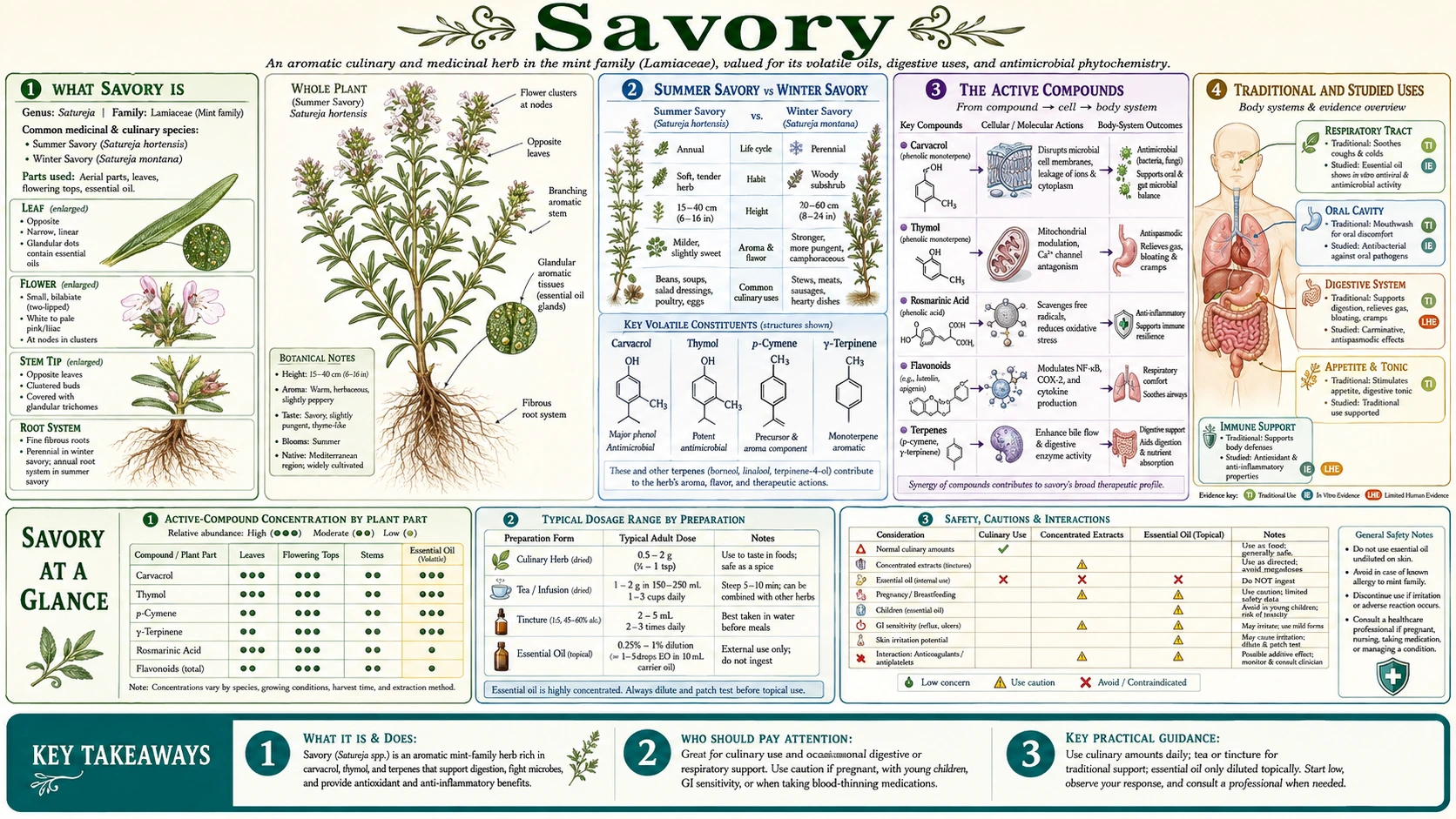
Savory (Satureja) is a peppery, aromatic herb from the mint family that has seasoned Mediterranean and European cooking for well over two thousand years. There are really two savories on the kitchen shelf: summer savory (Satureja hortensis), a soft, milder annual, and winter savory (Satureja montana), a tougher, more pungent perennial. Both taste a little like a cross between thyme and marjoram with a warm, spicy bite, which is why savory is a classic partner for beans, lentils, and roasted meats and a traditional member of the French seasoning blend herbes de Provence. Old herbals also gave savory a colorful reputation as a love herb, or aphrodisiac — a piece of folklore we will treat honestly rather than seriously. What is real and interesting is savory's essential oil, which is rich in carvacrol and thymol, the same potent antimicrobial phenols that make oregano and thyme so pungent. This page walks through what savory is, what it contains, how it has been used, what the science actually supports, and how to enjoy it safely.
Table of Contents
- What Savory Is
- Summer Savory vs Winter Savory
- The Active Compounds
- Traditional and Studied Uses
- What the Evidence Shows
- Savory in the Kitchen
- Forms and How It Is Used
- Safety and Cautions
- The Honest Bottom Line
- Research Papers
- Connections
- Featured Videos
What Savory Is
Savory is a culinary herb in the genus Satureja, part of the large mint family (Lamiaceae) that also gives us basil, oregano, thyme, marjoram, rosemary, sage, and mint. Like its relatives, it has small leaves packed with aromatic oil glands, and rubbing a sprig between your fingers releases a warm, peppery, slightly resinous scent. The flavor sits somewhere between thyme and marjoram but with more of a spicy kick — the English name "savory" captures exactly what it does on the plate.
The two species you are most likely to meet are summer savory and winter savory. Both are native to the warm, dry, rocky hillsides of the Mediterranean and southern Europe, and both have been cultivated since antiquity. The Romans used savory heavily as a seasoning before black pepper became widely available and affordable, and the herb spread across Europe with Roman cooking. In German-speaking countries summer savory is still called Bohnenkraut — literally "bean herb" — a name that tells you exactly what people have long cooked it with.
Savory is also one of the traditional herbs in herbes de Provence, the rustic Southern French blend that typically also includes thyme, rosemary, oregano, and marjoram. In France savory is called sarriette, and it is a natural companion to slow-cooked beans, grilled lamb, and vegetable stews.
One last piece of savory's story is pure folklore worth mentioning honestly. The genus name Satureja was popularly linked by old writers to the satyrs of Greek myth, and savory picked up a centuries-old reputation as an aphrodisiac. The seventeenth-century English herbalist Nicholas Culpeper even claimed the two savories had opposite effects on desire. There is no meaningful scientific evidence behind any of this — it is charming tradition, not pharmacology, and it is best enjoyed as a story rather than a health claim.
Summer Savory vs Winter Savory
Because recipes and herb labels use both names, it helps to know how the two savories differ.
Summer savory (Satureja hortensis)
Summer savory is an annual — a soft-stemmed plant grown fresh each year from seed. Its flavor is milder, sweeter, and more delicate, and its leaves are tender enough to chop into dishes near the end of cooking. This is the savory most cooks reach for, and the one usually dried and sold in jars. Because it is gentler, it is forgiving and easy to use generously.
Winter savory (Satureja montana)
Winter savory is a hardy perennial subshrub with woodier stems and small, stiff, evergreen-like leaves that survive cold weather. Its flavor is sharper, more pungent, and more resinous — closer to a peppery thyme or even a mild pine note. It stands up well to long braises and rich, fatty foods. Winter savory also tends to carry a higher, more assertive load of the pungent phenols in its oil, which is part of why it tastes stronger and why it appears often in laboratory studies of savory's antimicrobial activity.
In cooking the two are broadly interchangeable if you adjust the amount — use a lighter hand with winter savory. In the studies below, researchers are careful to state which species and even which regional harvest they used, because the exact oil chemistry shifts with species, growing conditions, and harvest time.
The Active Compounds
Savory's character and its studied biological activity both come mostly from its essential oil, the volatile aromatic fraction concentrated in the leaf oil glands. The headline compounds are two closely related monoterpene phenols:
- Carvacrol — the dominant pungent phenol in many savory oils and the single compound most responsible for savory's antimicrobial and antioxidant activity in the lab. It is the same phenol that makes oregano so potent.
- Thymol — carvacrol's chemical twin (an isomer), the signature phenol of thyme, present in savory alongside carvacrol in varying proportions.
These two phenols are why savory, oregano, and thyme share a family resemblance in both smell and studied effects — they are, chemically, close cousins built around the same reactive phenolic building blocks. Savory oils also contain the related monoterpenes p-cymene and γ-terpinene (biochemical relatives and precursors of carvacrol and thymol), along with smaller amounts of linalool, borneol, and other terpenes that round out the aroma.
Beyond the volatile oil, savory leaves contain water-soluble polyphenol antioxidants, most notably rosmarinic acid — a common and well-studied antioxidant compound across the mint family that contributes to the free-radical-scavenging activity measured in savory extracts. The exact ratio of all these compounds varies quite a bit between summer and winter savory and between growing regions, which is why two jars of "savory" can smell and behave somewhat differently.
Traditional and Studied Uses
Savory has a long folk-medicine record across the Mediterranean and the Middle East, most of it built around the same three ideas.
A digestive and carminative herb
The oldest and most consistent traditional use is for the digestive tract. Savory was taken as a tea or eaten with heavy foods to ease gas, bloating, indigestion, and cramping — a "carminative," in the old herbal vocabulary, meaning a herb that helps relieve trapped wind. This is not a coincidence with the kitchen tradition: cooking savory with beans and lentils was believed both to improve their flavor and to make them easier to digest, which is exactly why it earned the name "bean herb."
An antiseptic and antimicrobial
Because savory's oil is so pungent, it was traditionally used as an antiseptic — to help preserve food and to treat minor wounds, mouth complaints, and infections. Modern laboratory work has taken this tradition seriously, and it is where savory has the strongest scientific support (see the next section).
Cough and sore throat
Savory tea and preparations were also a traditional remedy for coughs, sore throats, and chest complaints, valued for a warming, drying quality. This overlaps with how thyme has been used, and reflects the shared thymol/carvacrol chemistry, though good human trials specifically on savory for respiratory symptoms are lacking.
What the Evidence Shows
Here is the honest picture, because savory is a good example of a herb with genuinely interesting laboratory science but limited human proof.
Strong laboratory evidence
Savory essential oils and extracts show real and repeatable activity in test tubes and on culture plates. Multiple independent studies of both summer savory (S. hortensis) and winter savory (S. montana) report meaningful antibacterial, antifungal, and antioxidant effects, and researchers consistently trace that activity back to the carvacrol and thymol content of the oil. The mechanism is reasonably well understood: the phenolic hydroxyl group on carvacrol disrupts the outer membrane of bacteria, leaking ions and collapsing the energy gradient the cell needs to survive. In one classic experiment, chemically altering that single hydroxyl group destroyed carvacrol's ability to kill a food-borne pathogen — direct evidence of how it works.
Some animal data
In rodent studies, savory extracts and oil have shown anti-inflammatory and pain-reducing effects, and reviews of the genus point to additional animal findings for antioxidant, antidiabetic, and blood-lipid-related activity. These are promising signals, but animal results do not automatically carry over to people, and doses used in the lab are often far higher and more concentrated than anything you would eat.
Limited human trials
The honest gap is that rigorous, well-controlled human clinical trials on savory are scarce. We do not have strong trial evidence that eating savory or drinking savory tea treats infections, lowers blood sugar, or cures a cough. That does not make savory worthless — far from it — but it does mean the sensible framing is: a safe, flavorful culinary herb with a long traditional record and impressive test-tube chemistry, not a proven medicine. The dramatic "kills bacteria" and "powerful antioxidant" headlines describe the concentrated oil under laboratory conditions, not a bowl of bean stew.
Savory in the Kitchen
Savory earns its place first and foremost as a seasoning, and this is where it delivers the most reliable value.
- Beans and lentils — the signature pairing. Add a sprig of savory to a pot of dried beans, lentils, split peas, or fava beans; it deepens the flavor and is the reason for the "bean herb" nickname.
- Meats and poultry — excellent with roast lamb, pork, sausages, game, chicken, and stuffings, where its peppery warmth cuts through richness.
- Herbes de Provence — savory is a backbone of this blend, so it works anywhere that mix does: grilled vegetables, tomato sauces, ratatouille, and slow braises.
- Eggs, cheese, and vegetables — a little chopped summer savory brightens omelets, soft cheeses, green beans, cabbage, and root vegetables.
A practical tip: add tender summer savory near the end of cooking to keep its aroma, but toss woodier winter savory in early so it has time to soften and mellow. Because savory is peppery, it can partly stand in for pepper, and it pairs naturally with its Lamiaceae cousins thyme, marjoram, and rosemary.
Forms and How It Is Used
Savory shows up in three main forms, and it matters which one you are dealing with because they are wildly different in strength.
Fresh and dried leaf
Fresh sprigs and dried leaves are the everyday culinary forms. Dried savory is more concentrated than fresh, so use roughly a third as much. Both are gentle, food-grade amounts of the herb.
Savory tea
A simple tea or infusion — a teaspoon or two of dried leaf steeped in hot water — is the traditional way to take savory for digestion. This is also a mild, food-level preparation and is the form most closely tied to the herb's old carminative reputation.
Concentrated essential oil
The essential oil is a different beast entirely. It is a highly concentrated extract of the volatile phenols — the carvacrol- and thymol-rich fraction — and it is what appears in the antimicrobial laboratory studies and in some natural cleaning and topical products. It is hundreds of times more concentrated than the herb on your plate. Because of that, savory essential oil is used only heavily diluted, applied topically or as a surface cleaner, and is not something to swallow by the dropperful. See the safety section before going anywhere near the neat oil.
Safety and Cautions
The good news is that savory's safety profile follows a clear and reassuring rule: the herb is very safe; the concentrated oil deserves respect.
As a food and tea: very safe
Used as a culinary herb or an ordinary tea, savory has a long, uneventful record of safe use and is treated as a safe food and flavoring. For most people there is nothing to worry about in normal kitchen amounts.
The concentrated essential oil: dilute, and do not drink it
Savory essential oil is a "hot" oil. Its high carvacrol and thymol content makes it a skin and mucous-membrane irritant that can cause burning, redness, and sensitization if applied undiluted. It should always be well diluted in a carrier oil for topical use, kept away from the eyes and inner nose, and never ingested undiluted. Concentrated phenolic oils like this can irritate the mouth, throat, and stomach and, in large internal doses, stress the liver — which is exactly why casual internal use of the neat oil is a bad idea.
Pregnancy and breastfeeding
Savory carries a traditional reputation as an emmenagogue (a herb thought to stimulate menstrual flow), so medicinal or large doses, and the essential oil, are best avoided during pregnancy. Normal culinary use of the herb in food is generally considered fine, but concentrated preparations should be set aside until after pregnancy and breastfeeding, and it is reasonable to check with a clinician.
Allergy
As with any plant, a rare allergy or contact sensitivity is possible, particularly in people already sensitive to other mint-family (Lamiaceae) herbs such as oregano, thyme, or mint. Stop use if a rash, itching, or mouth irritation appears.
The Honest Bottom Line
Savory is a flavorful, food-safe kitchen herb with genuinely interesting chemistry. Its warm, peppery taste has earned it a permanent place alongside beans, meats, and the herbes de Provence blend, and its essential oil carries a real, carvacrol- and thymol-driven antimicrobial and antioxidant profile that stands up well in the laboratory. The traditional use as a gentle digestive is plausible and low-risk, and worth trying as a simple tea.
Where honesty matters is the gap between the plate and the petri dish: the strong health claims belong to the concentrated oil in the lab, not to a bowl of stew, and rigorous human trials are still lacking. Enjoy savory generously as the excellent seasoning it is, keep the concentrated essential oil diluted and out of your glass, and treat the antique aphrodisiac stories as the charming folklore they are. As a safe, delicious herb with a modest, honest digestive reputation, savory earns its keep on flavor alone.
Research Papers
- Tepe B, Cilkiz M. A pharmacological and phytochemical overview on Satureja. Pharmaceutical Biology. 2016;54(3):375–412. doi:10.3109/13880209.2015.1043560 — broad review of the genus Satureja: its species, oil chemistry, and reported pharmacology.
- Momtaz S, Abdollahi M. An update on pharmacology of Satureja species; from antioxidant, antimicrobial, antidiabetes and anti-hyperlipidemic to reproductive stimulation. International Journal of Pharmacology. 2010;6(4):346–353. doi:10.3923/ijp.2010.346.353 — survey of the studied biological activities of savory species, including the reproductive folklore.
- Güllüce M, Sökmen M, Daferera D, et al. In vitro antibacterial, antifungal, and antioxidant activities of the essential oil and methanol extracts of Satureja hortensis L. Journal of Agricultural and Food Chemistry. 2003;51(14):3958–3965. doi:10.1021/jf0340308 — summer savory oil showed antibacterial, antifungal, and antioxidant activity in the lab.
- Serrano C, Matos O, Teixeira B, et al. Antioxidant and antimicrobial activity of Satureja montana L. extracts. Journal of the Science of Food and Agriculture. 2011;91(9):1554–1560. doi:10.1002/jsfa.4347 — winter savory extracts showed antioxidant and antimicrobial activity relevant to food use.
- Mihajilov-Krstev T, Radnović D, Kitić D, et al. Antimicrobial activity of Satureja hortensis L. essential oil against pathogenic microbial strains. Archives of Biological Sciences. 2010;62(1):159–166. doi:10.2298/abs1001159m — summer savory oil inhibited a range of pathogenic bacteria and fungi.
- Ćavar S, Maksimović M, Šolić ME, et al. Chemical composition and antioxidant and antimicrobial activity of two Satureja essential oils. Food Chemistry. 2008;111(3):648–653. doi:10.1016/j.foodchem.2008.04.033 — links savory oils' activity to their carvacrol and thymol content.
- Hajhashemi V, Ghannadi A, Pezeshkian SK. Antinociceptive and anti-inflammatory effects of Satureja hortensis L. extracts and essential oil. Journal of Ethnopharmacology. 2002;82(2–3):83–87. doi:10.1016/s0378-8741(02)00137-x — animal study showing pain-reducing and anti-inflammatory effects.
- Başer KHC. Biological and pharmacological activities of carvacrol and carvacrol bearing essential oils. Current Pharmaceutical Design. 2008;14(29):3106–3119. doi:10.2174/138161208786404227 — review of carvacrol, the key pungent phenol in savory, oregano, and thyme.
- Sharifi-Rad M, Varoni EM, Iriti M, et al. Carvacrol and human health: a comprehensive review. Phytotherapy Research. 2018;32(9):1675–1687. doi:10.1002/ptr.6103 — overview of carvacrol's antimicrobial, antioxidant, and anti-inflammatory activity and its limits.
- Suntres ZE, Coccimiglio J, Alipour M. The bioactivity and toxicological actions of carvacrol. Critical Reviews in Food Science and Nutrition. 2015;55(3):304–318. doi:10.1080/10408398.2011.653458 — reviews carvacrol's benefits alongside its irritant and dose-related toxic effects.
- Ultee A, Bennik MHJ, Moezelaar R. The phenolic hydroxyl group of carvacrol is essential for action against the food-borne pathogen Bacillus cereus. Applied and Environmental Microbiology. 2002;68(4):1561–1568. doi:10.1128/AEM.68.4.1561-1568.2002 — classic mechanism study showing how carvacrol disrupts bacterial membranes.
- Petersen M, Simmonds MSJ. Rosmarinic acid. Phytochemistry. 2003;62(2):121–125. doi:10.1016/S0031-9422(02)00513-7 — review of rosmarinic acid, the mint-family polyphenol antioxidant found in savory.
Connections
- All Herbs
- Oregano — the closest cousin, sharing savory's carvacrol/thymol chemistry.
- Thyme — the thymol-rich Lamiaceae herb and herbes de Provence partner.
- Marjoram — sweet mint-family herb often blended with savory.
- Rosemary — another herbes de Provence herb rich in rosmarinic acid.
- Sage — a warming culinary Lamiaceae herb with its own phenolic oils.
- Fennel — a classic carminative herb for gas and bloating, like savory.
- Lavender — the fragrant Provençal companion in the herbes de Provence tradition.