Tribulus — Benefits Deep Dive
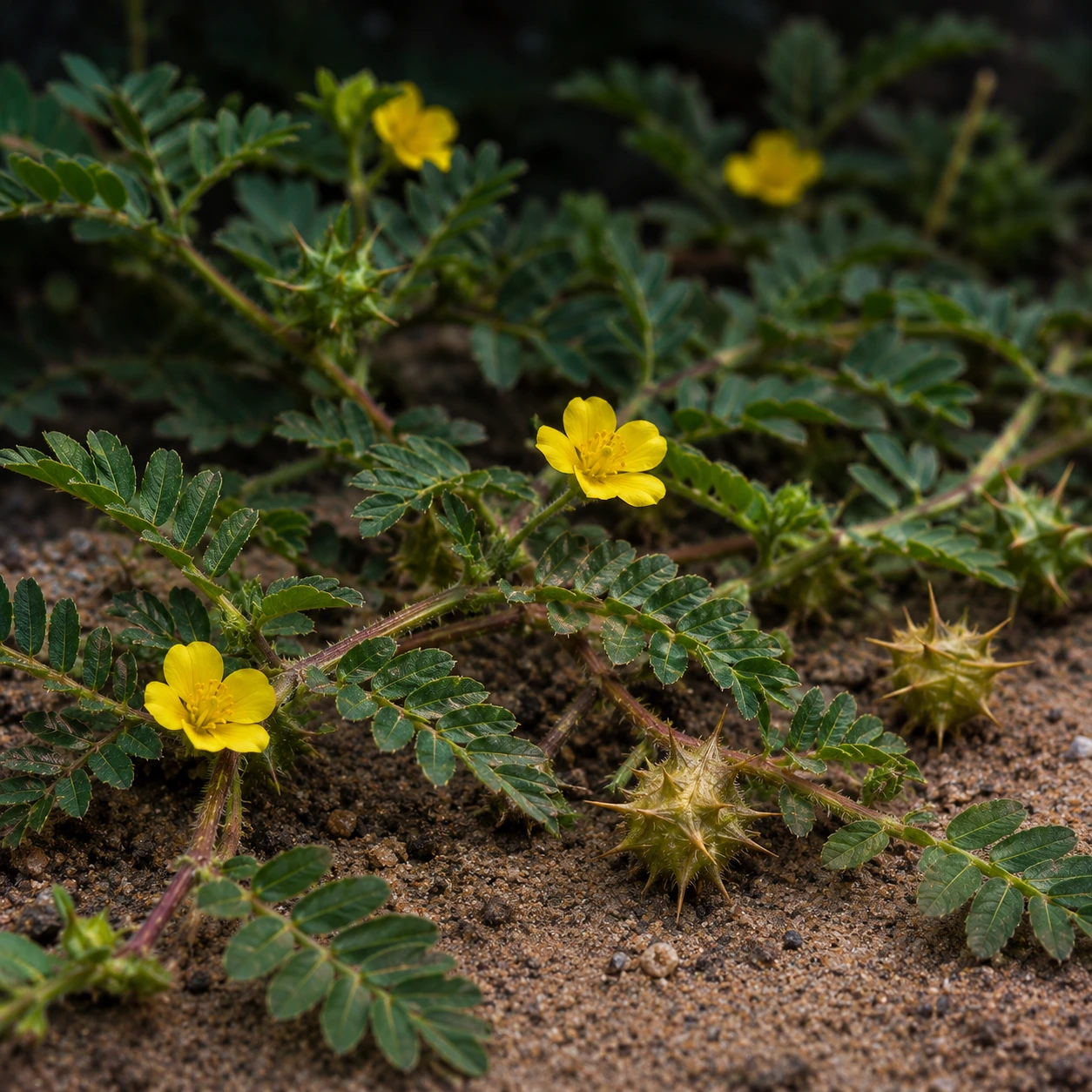
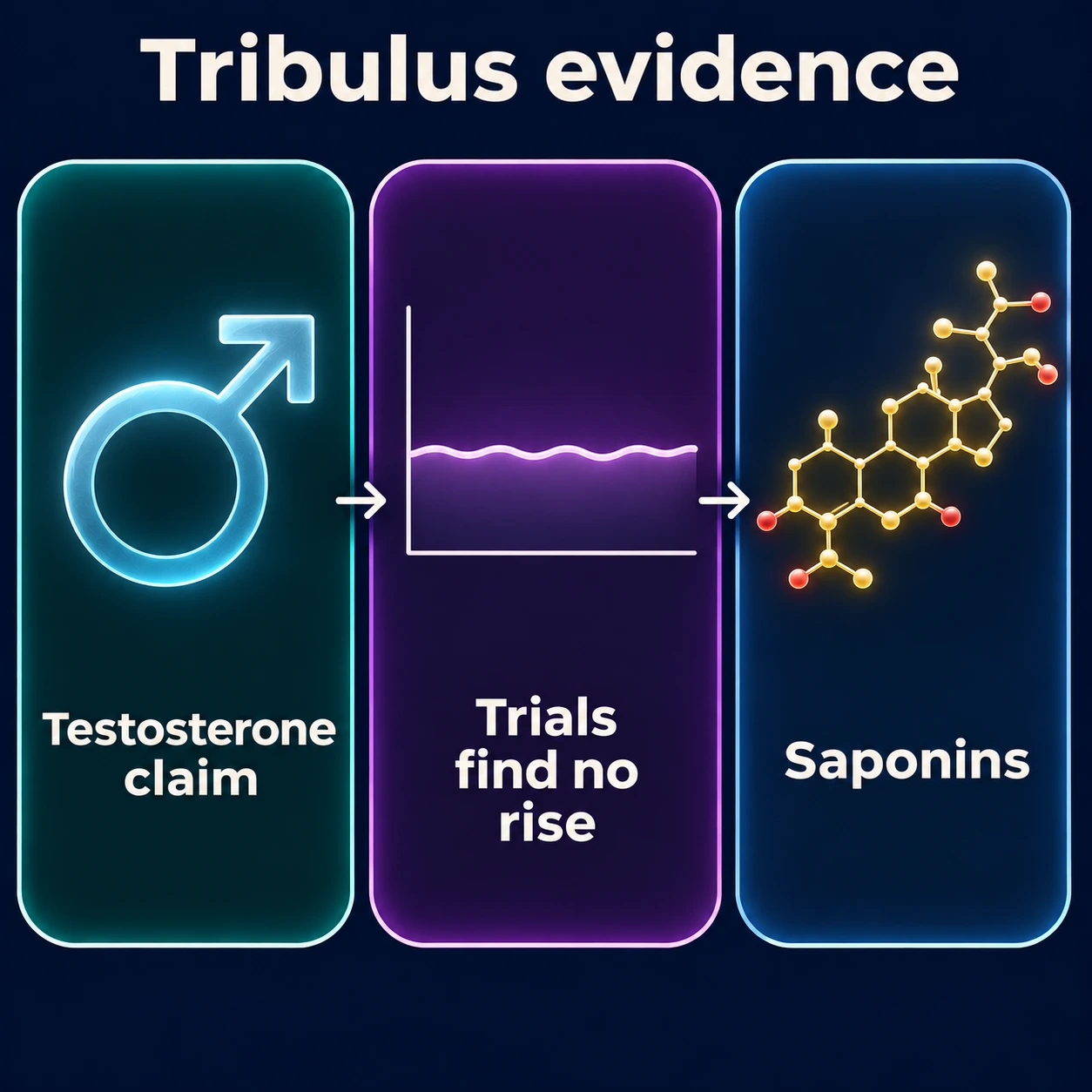
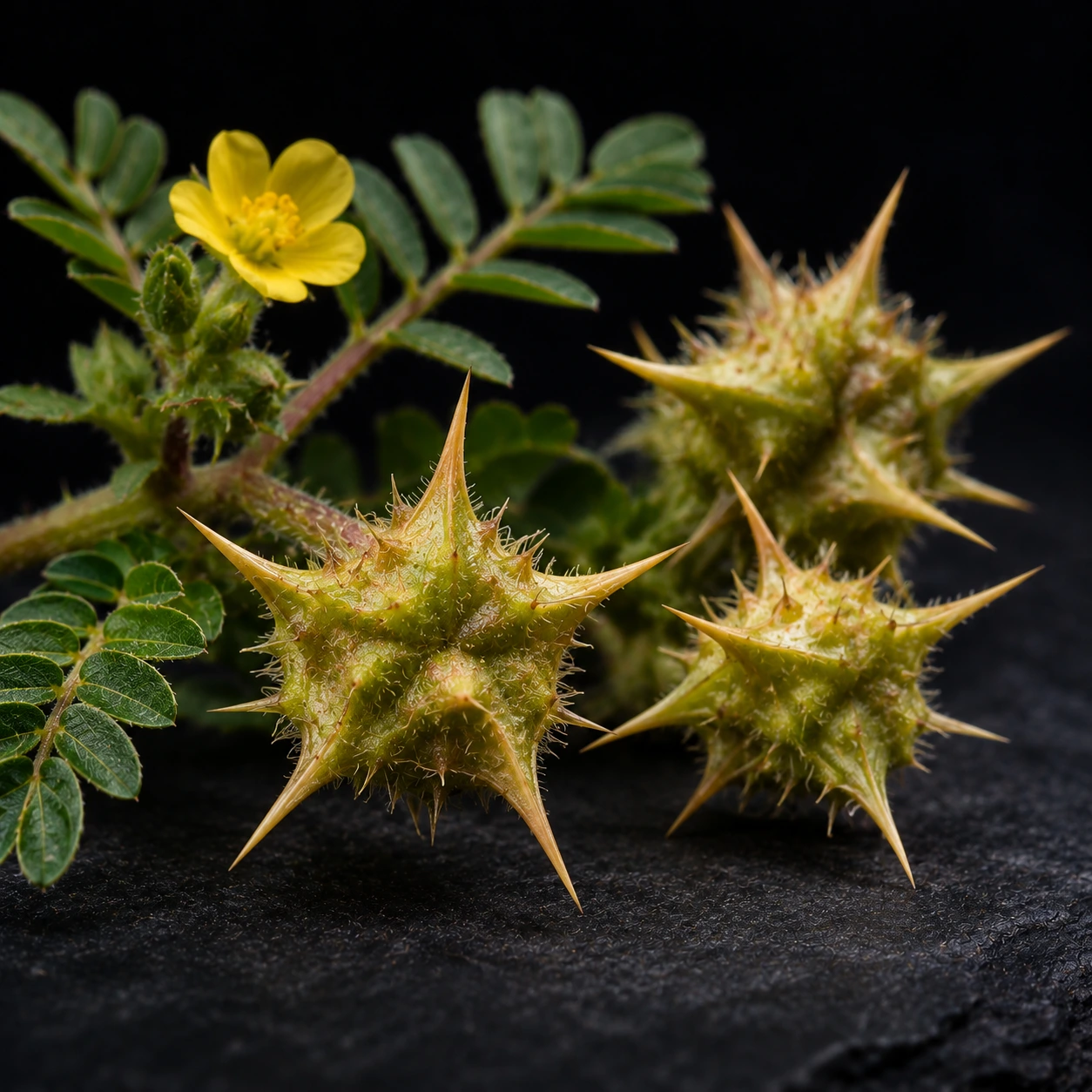
Tribulus terrestris is one of the best-selling and least-supported supplements in the entire men's-health aisle. That sentence is the reason these four pages exist. Almost every bottle on the shelf is sold on a single promise — that the herb raises your own testosterone — and that promise has been tested, repeatedly, in exactly the people who buy it, and it has failed. Not "the results were mixed." Failed. Healthy young men, resistance-trained men, and elite athletes have all been given standardized tribulus in placebo-controlled trials. In the healthy young men, testosterone, androstenedione and luteinizing hormone (a pituitary hormone) did not move; in the elite rugby league players, the urinary testosterone/epitestosterone ratio did not change; and the resistance-trained men gained no body-composition or performance advantage.
So why four pages instead of one dismissive paragraph? Because "it does not work" is not the whole story, and a page that stopped there would be almost as misleading as the label. Tribulus has a second claim — sexual desire — and that claim has the least-bad evidence of anything attached to this plant: several randomized, placebo-controlled trials, strongest in women with low desire and split between individual trials in men with erectile difficulty, report modest improvements in desire scores. In men, those improvements appear without testosterone rising; one small trial in women did record a rise in free and bioavailable testosterone. Reconciling those two facts — the hormone claim fails, the desire claim partly holds — is the single most useful thing anyone can tell you about tribulus, and it is what the marketing gets exactly backwards.
There is a third thread that matters more than either: what is actually in the bottle. Tribulus potency is sold on a saponin percentage and a protodioscin figure, and those numbers vary by plant part, growing region, season and extraction method to a degree that makes one trial's extract a poor proxy for another's. Layered on top of that is a documented adulteration problem — one anti-doping study reported a tribulus supplement contaminated by a banned steroid, and a 2004 international survey found anabolic androgenic steroids not declared on the label in 94 of 634 (14.8%) non-hormonal supplements. Add scattered but real case reports of liver and kidney injury, plus a documented risk of gynecomastia, and "harmless even if useless" stops being an accurate summary.
These four deep dives take those threads one at a time. Each one labels its claims by evidence tier — randomized clinical trial, preliminary (animal or in-vitro), traditional use only, or NOT SUPPORTED — so you can see at a glance which sentences are carrying real weight. Nothing claimed for tribulus has been quietly dropped from these pages; where a claimed use has documented harm attached, the harm is stated next to the claim rather than in a footnote.
Deep-Dive Articles
Tribulus and Testosterone: The Claim Examined
The flagship claim, taken apart. Where the "natural test booster" story came from, what the placebo-controlled trials in healthy and trained men actually measured, why animal results did not carry over to humans, and how studies in infertile men got quietly relabelled as evidence for everyone. Verdict: NOT SUPPORTED in healthy men.
Read the deep dive →Tribulus for Libido and Sexual Function
The one claim with real randomized evidence behind it — and it is modest, heterogeneous, and split between men and women. Why desire can improve while testosterone stays flat, what the female-desire trials found, why two male erectile-dysfunction trials reached opposite conclusions, and how much of the effect could be expectancy.
Read the deep dive →Tribulus for Athletic Performance
Strength, lean mass and recovery claims all borrow their credibility from the testosterone claim, so they fall with it. Includes the part athletes actually need: an anti-doping study has reported a tribulus supplement contaminated by a banned steroid, which is a doping-test and competitive-career risk unrelated to whether the herb works.
Read the deep dive →Tribulus: Saponins, Product Quality and Safety
What protodioscin is, why a "40% saponins" label tells you almost nothing, how much the chemistry shifts between fruit and leaf and between Bulgarian, Indian and Chinese material — and the safety file: hepatotoxicity and nephrotoxicity case reports, gynecomastia, priapism, drug interactions, and ruminant tribulosis in grazing livestock.
Read the deep dive →Table of Contents
Evidence at a Glance
Every claim commonly printed on a tribulus label, with the strongest available evidence tier attached. Nothing here is omitted for being inconvenient in either direction.
- Raises testosterone in healthy men — NOT SUPPORTED. Placebo-controlled trials found no androgen gain: no significant change in testosterone, androstenedione or luteinizing hormone in healthy young men, and no change in the urinary testosterone/epitestosterone ratio in elite rugby league players.
- Builds muscle, adds strength, improves body composition — NOT SUPPORTED. Randomized trials in trained men and preseason athletes found no advantage over placebo on lean mass, strength or performance measures.
- Improves sexual desire in women with low desire — randomized clinical trial evidence, modest and limited. Small double-blind placebo-controlled trials report improved desire and other sexual-function domains; sample sizes are small and follow-up short.
- Improves erectile function and desire in men with sexual dysfunction — randomized clinical trial evidence; individual trials conflict, pooled trials favour tribulus. The largest trial reported benefit; another randomized double-blind trial found no difference from placebo. A 2025 systematic review and meta-analysis of randomized trials included 8 studies in men with erectile dysfunction: tribulus outperformed placebo on the International Index of Erectile Function questionnaire (abridged IIEF-5 mean difference 3.23; full IIEF-15 mean difference 14.44), total testosterone did not differ between the groups, and adverse events were no more frequent than with placebo.
- Improves semen parameters in men with infertility — preliminary, and separate from the healthy-male claim. Small studies in men with fertility problems have reported changes in semen parameters and, in some, hormone measures. This is a different population and does not license the general claim.
- Aphrodisiac effects via protodioscin and nitric oxide — preliminary (animal and in-vitro). Rat, rabbit and primate work underpins the mechanism story; the human trials that tested the downstream prediction of higher androgens did not confirm it.
- Lowers blood glucose — preliminary, mostly animal and small human data. Relevant mainly as a possible additive effect with diabetes medication.
- Diuretic; helps urinary complaints and kidney stones — traditional use only (Ayurvedic gokshura). No rigorous human evidence that it dissolves or prevents stones.
- Lowers blood pressure, improves lipids — preliminary, animal-dominant with limited human confirmation.
- Documented harms: case reports of acute kidney injury and of liver injury associated with tribulus products; reported gynecomastia in men; at least one published priapism case; one anti-doping report of a tribulus supplement contaminated by a banned steroid; hepatogenous photosensitisation ("tribulosis") in livestock grazing the whole plant.
How to Read the Evidence Tiers
The four labels used across these pages are not decoration. They mean specific things, and the distance between them is large.
- Randomized clinical trial. Humans, randomly assigned, ideally blinded and placebo-controlled, with the outcome measured rather than asked about casually. This is the only tier that can support a sentence like "it works." Even here, one small trial is a hint and not a conclusion.
- Preliminary. Animal studies, isolated tissue, cell culture, or uncontrolled human observations. This tier is where mechanisms are proposed and hypotheses are born. It is emphatically not where dosing advice comes from. Tribulus is a case study in what happens when this tier is marketed as if it were the tier above.
- Traditional use only. A documented history of human use for a purpose, without controlled evidence that it achieves that purpose. Traditional use is real information — it tells you the plant was tolerated in some form for a long time and points research somewhere — but it is not efficacy data.
- NOT SUPPORTED. This is stronger than "unproven." It means the claim has been tested properly and the test came back negative. The testosterone claim sits here. When a claim reaches this tier, further marketing of it is not optimism; it is a factual error.
What These Pages Add to the Main Article
The main Tribulus article covers the plant itself — botany, the Ayurvedic gokshura and Chinese bai ji li traditions, its compounds, dosing, and a summary verdict. These four pages deliberately do not repeat that. They go one level deeper on the four questions readers actually arrive with:
- "Will this raise my testosterone?" — answered in full, including what each trial measured, how long for, in whom, and why the animal data pointed the other way.
- "Will it help my libido?" — answered separately, because the honest answer is different from the answer to the first question, and lumping the two together is exactly the error the supplement industry commits.
- "Will it help my lifting?" — answered, plus the doping-contamination problem, which is the part with real consequences for anyone who gets tested.
- "Which bottle should I buy, and is it safe?" — answered with the chemistry of why bottles differ so much, and with the full documented harm list rather than a reassuring "generally well tolerated."
Five Things Worth Knowing Before You Buy
- The reason most people buy tribulus is the reason the evidence supports least. If the goal is higher testosterone or more muscle, the controlled trials say no. That is the cleanest finding on this page.
- Desire and testosterone are not the same outcome. In men, sexual desire can improve while measured androgens sit still; one small trial in 40 women did record a rise in free and bioavailable testosterone. This is well established in sexual medicine generally, and it is the only coherent way to hold the tribulus literature together.
- "Standardized to 40% saponins" is not a potency guarantee. Total saponins is a broad, method-dependent number that lumps together compounds with different activity; the specific molecule most often credited, protodioscin, can differ several-fold between products with identical front labels.
- For people who are drug-tested, the risk lies in the whole product category. The risk is not the plant. It is what has been found added to plant-branded products — and a positive test does not care that you did not know.
- "Natural" is not a safety argument here. There are published case reports of serious kidney injury and of liver injury linked to tribulus use, and gynecomastia has been reported in men taking it — an outcome precisely opposite to what the label promises.
Key Research Papers
Each named paper below is given with its authors, title, journal and year, and closes with its PubMed PMID link, where you can confirm for yourself that the paper says what this page claims it says. Topic searches are labelled as such.
Theme 1 — The testosterone question in healthy and trained men
- Neychev VK, Mitev VI. The aphrodisiac herb Tribulus terrestris does not influence the androgen production in young men. Journal of Ethnopharmacology, 2005;101(1-3):319-23. The single most quoted negative result: healthy young men, controlled design, no change in testosterone, androstenedione or luteinizing hormone. PubMed PMID: 15994038
- Rogerson S, Riches CJ, Jennings C, Weatherby RP, Meir RA, Marshall-Gradisnik SM. The effect of five weeks of Tribulus terrestris supplementation on muscle strength and body composition during preseason training in elite rugby league players. Journal of Strength and Conditioning Research, 2007;21(2):348-53. Five weeks, elite athletes in real training, no between-group difference in strength, fat-free mass or the urinary testosterone/epitestosterone ratio. PubMed PMID: 17530942
- Neychev V, Mitev V. Pro-sexual and androgen enhancing effects of Tribulus terrestris L.: Fact or Fiction. Journal of Ethnopharmacology, 2016;179:345-55. A review by the same group as the 2005 trial, weighing the whole literature and concluding a genuine androgen-boosting effect in healthy men is not established. PubMed PMID: 26727646
- Topic search — all randomized human work on tribulus and testosterone, so you can see the full set rather than a curated slice: PubMed search
Theme 2 — Sexual desire and sexual function
- Vale FBC, Zanolla Dias de Souza K, Rezende CR, Geber S. Efficacy of Tribulus terrestris for the treatment of premenopausal women with hypoactive sexual desire disorder: a randomized, double-blinded, placebo-controlled trial. Gynecological Endocrinology, 2018;34(5):442-445. The cleanest positive signal in the literature, in women rather than men; the 40 women who took tribulus also had increased free and bioavailable testosterone. PubMed PMID: 29172782
- Akhtari E, Raisi F, Keshavarz M, Hosseini H, Sohrabvand F, Bioos S, Kamalinejad M, Ghobadi A. Tribulus terrestris for treatment of sexual dysfunction in women: randomized double-blind placebo-controlled study. DARU Journal of Pharmaceutical Sciences, 2014;22(1):40. Reported improvement across desire, arousal, lubrication and satisfaction domains. PubMed PMID: 24773615
- Kamenov Z, Fileva S, Kalinov K, Jannini EA. Evaluation of the efficacy and safety of Tribulus terrestris in male sexual dysfunction — a prospective, randomized, double-blind, placebo-controlled clinical trial. Maturitas, 2017;99:20-26. The largest male trial, reporting improved self-rated erectile function and desire. PubMed PMID: 28364864
- Santos CA Jr, Reis LO, Destro-Saade R, Luiza-Reis A, Fregonesi A. Tribulus terrestris versus placebo in the treatment of erectile dysfunction: a prospective, randomized, double-blind study. Actas Urológicas Españolas, 2014;38(4):244-8. The counterweight: no better than placebo for erectile dysfunction or serum total testosterone. PubMed PMID: 24630840
- Suharyani S, Amanda B, Angellee J, William W, Hariyanto TI, I'tishom R. Tribulus terrestris for management of patients with erectile dysfunction: a systematic review and meta-analysis of randomized trials. International Journal of Impotence Research, 2026;38(1):11-18 (published online 2025). Eight studies; tribulus outperformed placebo on IIEF-5 and IIEF-15, with no difference in total testosterone or in adverse events. PubMed PMID: 40360723
Theme 3 — Athletic performance and supplement contamination
- Antonio J, Uelmen J, Rodriguez R, Earnest C. The effects of Tribulus terrestris on body composition and exercise performance in resistance-trained males. International Journal of Sport Nutrition and Exercise Metabolism, 2000;10(2):208-15. Trained men, no meaningful effect on body composition or performance. PubMed PMID: 10861339
- Pokrywka A, Obmiński Z, Malczewska-Lenczowska J, Fijałek Z, Turek-Lepa E, Grucza R. Insights into supplements with Tribulus terrestris used by athletes. Journal of Human Kinetics, 2014;41:99-105. Reviews athlete use and raises the contamination and doping-test problem explicitly: one anti-doping study reported an incident with a tribulus supplement contaminated by a banned steroid. PubMed PMID: 25114736
- Geyer H, Parr MK, Mareck U, Reinhart U, Schrader Y, Schänzer W. Analysis of non-hormonal nutritional supplements for anabolic-androgenic steroids — results of an international study. International Journal of Sports Medicine, 2004;25(2):124-9. The landmark survey: 94 of 634 (14.8%) ordinary non-hormonal supplements contained anabolic androgenic steroids not declared on the label. PubMed PMID: 14986195
- Topic search — doping positives and supplement adulteration in general: PubMed search
Theme 4 — Saponin chemistry, standardization and product variability
- Ganzera M, Bedir E, Khan IA. Determination of steroidal saponins in Tribulus terrestris by reversed-phase high-performance liquid chromatography and evaporative light scattering detection. Journal of Pharmaceutical Sciences, 2001;90(11):1752-8. The analytical work behind the claim that saponin content swings widely between samples. PubMed PMID: 11745732
- Dinchev D, Janda B, Evstatieva L, Oleszek W, Aslani MR, Kostova I. Distribution of steroidal saponins in Tribulus terrestris from different geographical regions. Phytochemistry, 2008;69(1):176-86. Directly addresses the Bulgarian-versus-elsewhere sourcing question with chemistry rather than marketing. PubMed PMID: 17719068
- Chhatre S, Nesari T, Somani G, Kanchan D, Sathaye S. Phytopharmacological overview of Tribulus terrestris. Pharmacognosy Reviews, 2014;8(15):45-51. A broad survey of constituents and reported activities. PubMed PMID: 24600195
- Topic search — protodioscin content and standardization: PubMed search
Theme 5 — Safety, case reports and the veterinary context
- Talasaz AH, Abbasi MR, Abkhiz S, Dashti-Khavidaki S. Tribulus terrestris-induced severe nephrotoxicity in a young healthy male. Nephrology Dialysis Transplantation, 2010;25(11):3792-3. An Iranian man who used tribulus "herbal water" to prevent kidney stones presented with seizure and very high serum aminotransferases (liver enzymes) and creatinine after 2 days; the authors report liver, kidney and nerve toxicity (hepatotoxicity, nephrotoxicity and neurotoxicity), and stopping the remedy improved his symptoms and normalised his liver enzymes — the case most often cited when "natural means harmless" comes up. PubMed PMID: 20667992
- Topic search — gynecomastia reported with tribulus-containing products, an outcome opposite to the label promise: PubMed search
- Topic search — hepatotoxicity and liver injury associated with tribulus preparations: PubMed search
- Topic search — ruminant tribulosis, the hepatogenous photosensitisation syndrome in sheep grazing the whole plant. This is a veterinary phenomenon at grazing-scale intakes and is not the same as a measured human extract, but it is the clearest demonstration that the plant is biologically active: PubMed search
External Resources
- U.S. National Center for Complementary and Integrative Health (NCCIH) — Herbs at a Glance: the US National Center for Complementary and Integrative Health's plain-language summaries of individual botanicals, including how it words uncertainty.
- LiverTox (NIH/NIDDK): the reference database for drug- and supplement-induced liver injury, including herbal and dietary supplement entries. The place to check before assuming a botanical has no hepatic signal.
- U.S. National Institutes of Health (NIH) Office of Dietary Supplements — fact sheets: includes the U.S. National Institutes of Health Office of Dietary Supplements (ODS) sheet on dietary supplements for exercise and athletic performance, which covers the "test booster" category directly.
- United States Anti-Doping Agency (USADA) Supplement 411: the US Anti-Doping Agency's risk-education resource for athletes, including its high-risk list and its guidance on third-party certification.
- World Anti-Doping Agency (WADA) Prohibited List: the authoritative list of banned substances — relevant here because the risk from tribulus products is contamination with substances on this list, not the herb itself.
- U.S. Food and Drug Administration (FDA) — Dietary Supplements: how the category is regulated in the United States, which explains why label accuracy is not guaranteed before sale.
- PubMed — all Tribulus terrestris literature: the unfiltered corpus, if you would rather read it yourself than take anyone's summary.
Connections
- All Herbs
- Tribulus terrestris (main article)
- Tribulus and Testosterone: The Claim Examined
- Tribulus for Libido and Sexual Function
- Tribulus for Athletic Performance
- Tribulus: Saponins, Product Quality and Safety
- Testosterone Test
- SHBG Test
- Male Hypogonadism
- Gynecomastia
- Erectile Dysfunction
- Low Testosterone and TRT
- Male Infertility
- Ashwagandha — Benefits
- Maca — Benefits
- Epimedium (Horny Goat Weed) — Benefits
- Tongkat Ali — Benefits
- Fenugreek — Benefits
- Ginseng — Benefits
- Zinc
- Arginine
Safety and disclaimer. Nothing on this page or the four articles it links to is medical advice, and none of it is a substitute for a conversation with a clinician who knows your history. Tribulus is not benign. The research raises concerns for pregnancy, for people trying to conceive, for breastfeeding and for hormone-sensitive conditions, and its possible glucose- and blood-pressure-lowering and diuretic effects could add to diabetes medication, blood-pressure medication, diuretics or lithium. For people subject to drug testing in sport or at work, an anti-doping study has reported a tribulus supplement contaminated by a banned steroid. Dark urine, reduced urine output, yellowing of the eyes or skin and right-upper-abdominal pain are signs of kidney or liver injury that hospitals treat as urgent; unusual breast swelling or tenderness is the sign of the gynecomastia reported with tribulus.