Lavender: History and Traditional Use
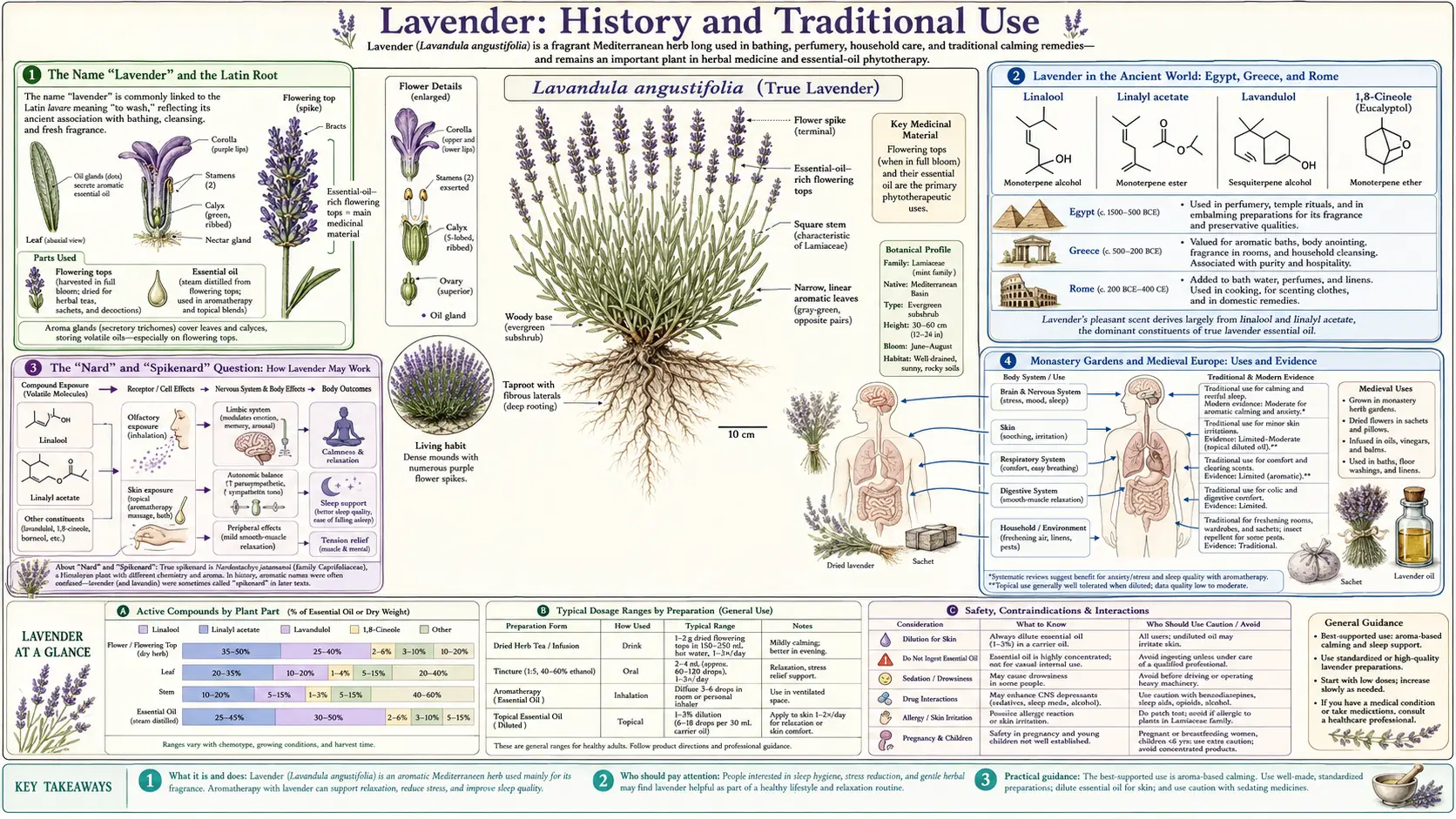
Few plants have travelled so far through human history as lavender. For more than two thousand years it has scented bathwater, dressed wounds, sweetened linen, calmed the nervous and the grieving, and perfumed the work of monks, washerwomen, and modern perfumers alike. Its very name is a small history lesson — it descends from the Latin lavare, “to wash.” This article follows lavender from the ancient Mediterranean through the monastery garden and the Tudor still-room to the lavender fields of Provence and the laboratory accident that gave the world the word aromatherapy. Where the record is solid we say so; where a beloved story is really folklore, we say that too.
Table of Contents
- The Name “Lavender” and the Latin Root
- Lavender in the Ancient World: Egypt, Greece, and Rome
- The “Nard” and “Spikenard” Question
- Monastery Gardens and Medieval Europe
- Tudor England and the Folk Tradition
- Provence, Grasse, and the Perfume Trade
- Gattefossé and the Birth of “Aromatherapy”
- From Tradition to Modern Research
- Research Papers and References
- Connections
- Featured Videos
The Name “Lavender” and the Latin Root
The name lavender is itself a record of how the plant was used. The English word entered the language in the medieval period by way of Old French (lavandre) and Medieval Latin (lavandula), and it is generally traced to the Latin verb lavare, “to wash.” The connection is straightforward: lavender was the plant of the wash-house, the bath, and the freshly laundered sheet. The same Latin root lavare also gives us the everyday English words laundry and lavatory, so the herb sits inside a small family of “washing” words that reach back to Rome.
This etymology is the one accepted by most botanical and linguistic references, but it is worth flagging an honest minor dispute. A few writers argue that the name derives instead from the Latin livere, “to be livid or bluish,” pointing to the colour of the flower spikes rather than to washing. Both ideas are old, and because the medieval spelling shifts around (lavandula, livendula), the question cannot be settled with certainty. The “to wash” derivation is by far the more widely cited and fits the plant’s documented role in bathing and laundry, which is why it is repeated here — with the caveat that the bluish-colour theory has its defenders.
The botanical name carries its own history. The genus Lavandula belongs to the mint family, Lamiaceae, and the species of greatest medicinal importance, Lavandula angustifolia, was long known by the older names Lavandula officinalis and Lavandula vera (“true” lavender). The epithet angustifolia simply means “narrow-leaved,” distinguishing it from the broader-leaved spike lavender, Lavandula latifolia. These naming details matter for history because the ancient and early-modern sources do not always make clear which lavender they mean — a recurring difficulty we will meet again below.
Lavender in the Ancient World: Egypt, Greece, and Rome
Lavender’s documented history begins in the ancient Mediterranean, and the threads of bathing, scenting, and healing are tangled together from the very start. In ancient Egypt, aromatic plants and resins were central to perfumery, cosmetics, and the elaborate preparation of the dead, and lavender is widely reported among the fragrant materials of the period. Caution is warranted on the specifics: the chemistry of which exact botanical species the embalmers used is still debated by Egyptologists, and confident claims that lavender was found in a particular pharaoh’s tomb are better treated as popular tradition than as settled archaeology. What is fair to say is that lavender belongs to the broad family of scented plants the Egyptians prized, and that its association with cleansing and preservation is very old.
In ancient Greece, lavender enters the written record. The philosopher and botanist Theophrastus (c. 371–287 BCE), often called the father of botany, discussed fragrant plants in his short treatise Concerning Odours (On Odours), one of the only works of ancient perfumery to survive. Several centuries later the Greek physician Dioscorides (c. 40–90 CE), army doctor and author of the foundational pharmacology text De Materia Medica, described a lavender — usually identified with Lavandula stoechas, the tufted “French” lavender — and recorded medicinal uses for chest complaints and as a general remedy. These classical authors are named here as historical primary sources rather than as modern citations, but it is from them that the Western written tradition of lavender flows.
Ancient Rome made lavender a fixture of daily life. The encyclopedist Pliny the Elder (23–79 CE), in his Natural History, distinguished different lavenders (the wild stoechas from the more prized true lavender) and noted their uses. By long tradition Roman bathers scented their water, oils, and linens with lavender, and the plant’s tie to the bath is the most likely reason its name and the verb lavare became permanently linked. It is also commonly recounted that Roman soldiers carried lavender on campaign to clean and dress wounds; this is a plausible and frequently repeated tradition consistent with the era’s use of aromatic antiseptics, though it should be read as well-attested custom rather than laboratory-proven practice. From Rome, lavender’s reputation as a plant of cleanliness, scent, and gentle healing passed northward into medieval Europe.
The “Nard” and “Spikenard” Question
No history of lavender is complete without addressing a persistent confusion: the claim that the “spikenard” of the Bible and classical writers was lavender. This is a question where accuracy matters, because the two plants are frequently muddled in popular herb-lore. The short answer is that spikenard and lavender are not the same plant, and the better-supported botanical view is that biblical spikenard refers to a different species entirely.
True spikenard is generally identified as Nardostachys jatamansi, an aromatic plant of the valerian family (Caprifoliaceae/Valerianaceae) native to the high Himalayas of Nepal, India, and China. Its fragrant rhizome yielded the costly perfumed oil — nard — named in the Song of Solomon and in the Gospel accounts of a woman anointing Jesus with “spikenard” (for example, Mark 14 and John 12). Because it had to be carried thousands of miles overland, true nard was famously expensive, which fits the biblical description of an extravagantly valuable ointment far better than a common Mediterranean shrub would.
So where does the lavender confusion come from? The usual explanation is linguistic. The ancient Greeks are said to have called lavender nardus, reportedly after a place-name (often given as the Syrian town of Naarda) associated with the aromatics trade, and that shared word nard later blurred the line between the two very different plants in some readers’ minds. This is a reasonable account of how the mix-up arose, but the place-name detail itself is the soft part of the story and should be treated as a traditional explanation rather than firmly documented fact. The reliable takeaway is the botanical one: lavender (genus Lavandula) and spikenard (Nardostachys jatamansi) are distinct plants in different families, and presenting biblical spikenard as “lavender” is a long-standing misidentification rather than a historical fact about lavender.
Monastery Gardens and Medieval Europe
After the decline of Rome, much of Europe’s herbal knowledge was preserved behind monastery walls. Lavender was cultivated in the physic gardens of monasteries and convents, where monks and nuns grew medicinal plants and copied the classical herbals that kept the old remedies alive. The plant’s reputation as a calming, cleansing, headache-easing herb travelled through these communities and into the medical writing of the age. The twelfth-century German abbess and polymath Hildegard of Bingen is widely cited as having written about lavender in her works on natural medicine, an attribution often repeated in herbal histories; readers should know that scholars debate exactly which plant her Latin terms denote, so it is mentioned here as a commonly noted but not airtight detail.
One concrete English record is frequently quoted: Merton Priory in Surrey appears in documents around 1301 in connection with the sale of lavender (sometimes recorded under the old word “spikings”). It is genuinely interesting evidence that lavender was being grown and sold in medieval England. The purpose of that sale, however, is reported inconsistently — some accounts tie the priory’s fundraising to King Edward I, others to a papal subsidy — so the safest statement is the documented fact itself: lavender was a cultivated, saleable commodity in England by around 1300.
The most charming linguistic fossil from this period concerns the laundry. Medieval and Renaissance women who took in washing were known as “lavenders” (from the same lavare root), and the practice they are remembered for — spreading wet linen over lavender bushes to dry so the cloth took up the scent, and tucking dried lavender among stored clothes — ties the plant directly to its name once more. Strewn on floors, packed into sachets against moths, and steeped for washing water, lavender in medieval Europe was as much a household staple as a medicine.
Tudor England and the Folk Tradition
Lavender flourished in Tudor and Elizabethan England, moving out of the cloister and into great-house gardens, cottage plots, and the domestic still-room. When Henry VIII dissolved the monasteries in the 1530s, the herb-growing knowledge once concentrated in religious houses dispersed into private and household hands, and lavender went with it. In the still-room of a well-run house, lavender was distilled into “lavender water,” strewn on floors, sewn into sachets, candied as a sweetmeat, and steeped as a tea for headaches and “the megrims” — the period word for migraine and related nervous complaints.
The great English herbalists of the era set lavender’s uses down in print. John Gerard, in his celebrated Herball of 1597, and later Nicholas Culpeper, in The English Physician (1652), both described lavender for disorders of the head and nerves — for headache, faintness, “the falling sickness” (epilepsy), cramps, and conditions of the brain — reflecting a settled folk consensus that lavender was, above all, a remedy for the mind and the senses. These herbals are named here as historical texts; the indications they record (calming, headache relief, nervous complaints) map remarkably closely onto the areas where modern clinical research on lavender has since concentrated.
Lavender also gathered a layer of folklore and sentiment. In Elizabethan times it was associated with love and devotion, and the idea that Queen Elizabeth I favoured lavender — valuing lavender conserve or drinking lavender tea for her headaches — is often repeated in popular histories. It is a pleasing and plausible story that fits the era’s well-documented use of lavender for “the megrims,” but the specific royal anecdote is traditional lore rather than firmly sourced fact, and is offered here in that spirit. What is solidly true is that by the seventeenth century lavender was woven into English domestic life as medicine, scent, flavouring, and symbol alike.
Provence, Grasse, and the Perfume Trade
The image most people now hold of lavender — endless purple rows combed across a sun-baked hillside — belongs to Provence, in southern France, which became the heart of the world’s lavender industry. Wild lavender had long grown on the dry limestone uplands of the region, and for generations it was gathered by hand from the hills. As the French perfume industry centred on the town of Grasse grew from the sixteenth and seventeenth centuries onward, demand for fragrant raw materials rose, and lavender shifted from a wild-harvested plant to a systematically cultivated crop. High-altitude true lavender (Lavandula angustifolia) and, later and far more abundantly, the hardy high-yielding hybrid lavandin (Lavandula × intermedia) came to blanket the Provençal landscape and to supply perfumers, soap-makers, and distillers across Europe.
Grasse is also the setting for one of lavender’s most repeated legends. The story goes that the town’s glove-makers, who scented their leather goods with lavender and other aromatic oils, were spared during outbreaks of plague, supposedly because the fragrant oils protected them. It is a memorable tale, and versions of it attach lavender to plague-time protection more generally (lavender was indeed among the herbs people carried and burned in hope of warding off disease). But this glovers-and-plague account is best understood as folklore: the details vary from telling to telling, the supposed protective mechanism is not established, and the same anecdote is sometimes told of cholera rather than plague. It survives because it captures something real — lavender’s long association with cleanliness and warding off “bad air” — not because it is documented epidemiology.
Whatever the truth of the legend, the economic reality is firm: by the nineteenth and twentieth centuries Provence had become the global symbol and a leading commercial source of lavender, its distilleries turning flower spikes into the essential oil that would carry the plant into the modern age of perfumery and, soon after, of aromatherapy.
Gattefossé and the Birth of “Aromatherapy”
Lavender sits at the origin of the modern word aromatherapy, and the story behind it is genuinely documented — though, as with so much of this plant’s history, the popular version has been polished into legend. The central figure is René-Maurice Gattefossé (1881–1950), a French chemist and perfume researcher from Lyon who worked in his family’s essential-oils business. He coined the term aromathérapie and made it the title of his 1937 book, which is generally credited as the first appearance of the word in print.
The famous anecdote is that, around 1910, Gattefossé badly burned his hand (or hands) in a laboratory explosion and treated the injury with lavender essence, healing remarkably and without serious scarring — an experience that supposedly launched his lifelong study of the medicinal properties of essential oils. The core of this is real: Gattefossé himself wrote about the incident. Here it is important to be careful, because the most dramatic retelling — that he instinctively plunged his burning hand into a conveniently open vat of lavender oil — is an embellishment. The aromatherapy author and researcher Robert Tisserand, who translated Gattefossé’s book, has pointed out that this “plunged into a vat” version is essentially fiction. In Gattefossé’s own account, he extinguished the flames by rolling on the ground, his burns later developed a serious infection (he described a rapidly spreading gas gangrene), and treatment with lavender essence then arrested the infection and aided healing — a deliberate application, not a lucky reflex.
Set in its proper context, the episode is still a milestone: a working chemist, impressed by what lavender did for his own injured skin, went on to argue to the medical world that essential oils had real therapeutic value and to give that field its enduring name. The takeaway for readers is twofold. First, the foundation of the word aromatherapy in Gattefossé’s work and his lavender-burn experience is well documented. Second, the cinematic “hand-in-the-vat” flourish is a later embroidery and should not be repeated as fact. Lavender’s reputation for soothing and helping to heal damaged skin is genuinely old and genuinely interesting — it does not need the myth.
From Tradition to Modern Research
What is striking about lavender’s long history is how neatly the old uses anticipate the modern science. For more than two millennia — from the Greek and Roman physicians, through the monastery garden and the Tudor still-room, to the herbalists Gerard and Culpeper — lavender was reached for above all to calm the mind, ease the head, settle the nerves, and soothe and clean the skin. Those are very nearly the exact areas in which contemporary clinical and laboratory research on lavender has concentrated: anxiety and stress, sleep, headache and migraine, and wound and skin healing.
Modern work has begun to supply the chemistry behind the tradition. Reviews of Lavandula angustifolia identify the essential oil’s principal calming constituents — the monoterpenes linalool and linalyl acetate — and report effects on the nervous system that plausibly underlie the herb’s historical reputation for relaxation and sleep, while other constituents account for its antimicrobial and anti-inflammatory actions on the skin. The traditional claim, in other words, is no longer merely traditional: it increasingly has a measurable, chemical address. The detailed clinical evidence is taken up in the companion articles on Anxiety and Stress, Sleep Quality, Headache and Migraine, and Skin Healing and Burns, and the full pharmacology is covered on the main Lavender page.
The thread that runs from a Roman bath, through a sachet of dried flowers in a Tudor linen chest, to a randomized clinical trial of lavender oil for anxiety is unbroken. Tradition raised the questions; research is now testing the answers. That continuity — a fragrant, abundant plant used in much the same way across continents and centuries, and only now being explained — is what makes lavender’s history worth knowing, and a reminder to keep folklore and evidence clearly labelled as we go.
Research Papers and References
The list below combines key peer-reviewed reviews of Lavandula angustifolia with curated PubMed topic-search links into the ethnobotanical and historical literature. Historical primary texts (Theophrastus’ Concerning Odours, Dioscorides’ De Materia Medica, Pliny’s Natural History, and the herbals of Gerard and Culpeper) are named in the article as historical sources rather than as modern citations. Author names and titles are given as plain text; only stable DOI, PMID, or institutional links are hyperlinked, and each opens in a new tab.
- Koulivand PH, Khaleghi Ghadiri M, Gorji A. Lavender and the nervous system. Evidence-Based Complementary and Alternative Medicine. 2013;2013:681304. — doi:10.1155/2013/681304 Search PubMed
- Cavanagh HMA, Wilkinson JM. Biological activities of lavender essential oil. Phytotherapy Research. 2002;16(4):301-308. — doi:10.1002/ptr.1103 · PMID 12112282
- Basch E, Foppa I, Liebowitz R, Nelson J, Smith M, Sollars D, Ulbricht C. Lavender (Lavandula angustifolia Miller). Journal of Herbal Pharmacotherapy. 2004;4(2):63-78. — Search PubMed
- Lavender ethnobotany, history, and traditional use PubMed: Lavandula angustifolia ethnobotany and traditional use
- Lavender essential oil — phytochemistry and pharmacology of linalool and linalyl acetate PubMed: lavender linalool and linalyl acetate pharmacology