⚠ Evidence warning: Clinical trials or other evidence do not support the claims that mullein's mucilage and saponins soothe the airways, loosen mucus and ease coughs, bronchitis and chronic lung conditions. This page keeps it as a report of what people, websites or other media say.
Mullein — Benefits Deep Dive
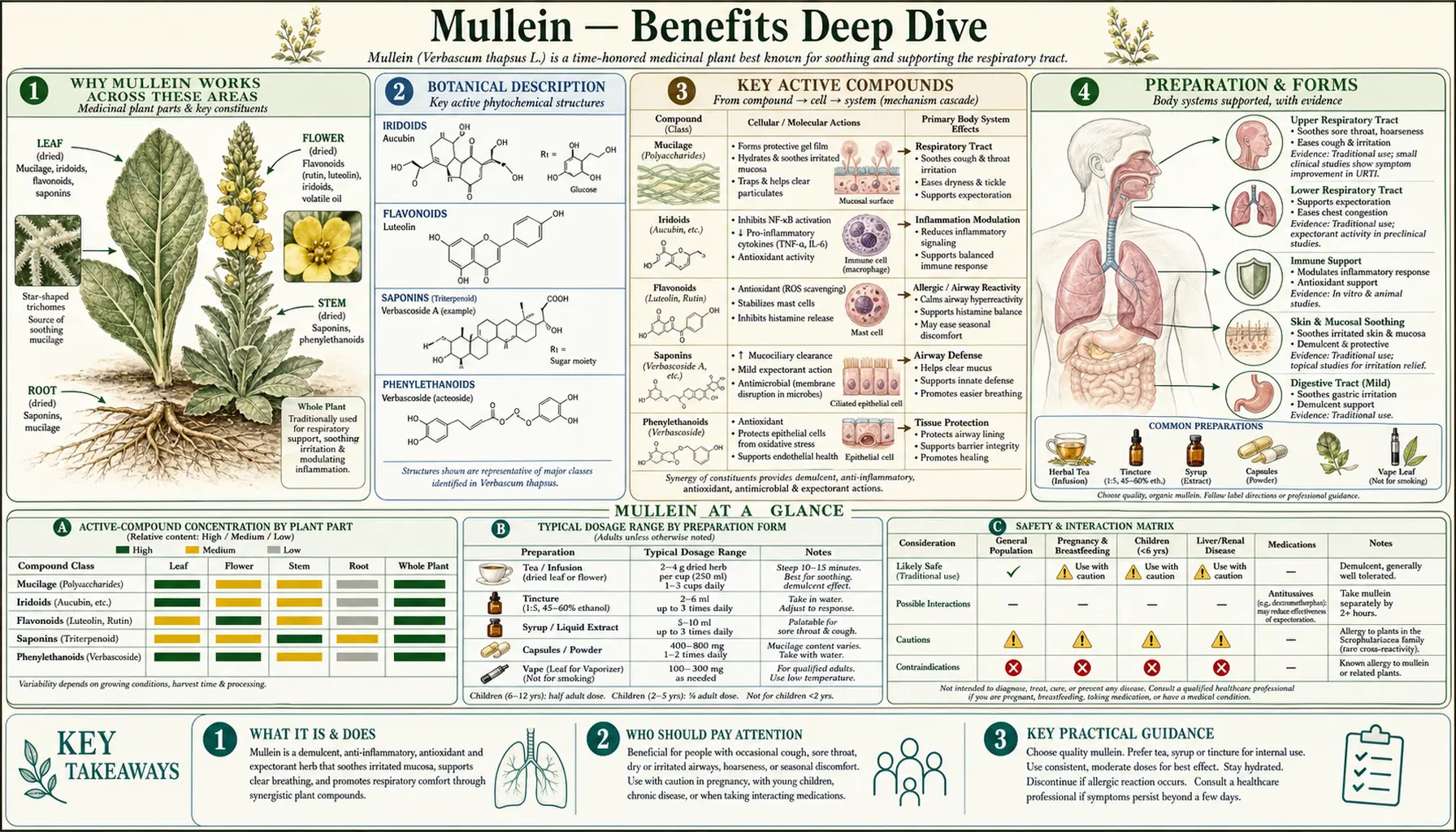
Mullein (Verbascum thapsus) is one of the classic respiratory herbs of Western and Eclectic herbal medicine, and nearly all of its documented benefits trace back to the same small set of constituents — soothing mucilage, expectorant saponins, and the anti-inflammatory, antimicrobial phenylethanoid glycoside verbascoside. Together they give the herb a demulcent (coating and soothing), expectorant (mucus-clearing), anti-inflammatory, and mildly antimicrobial profile. The six deep-dive pages below explore each major application in turn: lung and airway support, coughs and bronchitis, the laboratory antiviral and antibacterial findings, the traditional ear-oil use and two pediatric trials of a mullein-containing herbal ear-drop blend, and topical use for skin, wounds, and inflammation.
Deep-Dive Articles
Respiratory & Lung Health
How mullein's mucilage soothes inflamed airway tissue and its saponins act as an expectorant — the herb's signature use for lung support, dry irritated airways, and chronic respiratory conditions.
Read the deep dive →Cough, Bronchitis & Congestion
Mullein as a demulcent and expectorant for dry, hacking, and spasmodic coughs, acute and chronic bronchitis, and thinning and clearing stubborn chest congestion.
Read the deep dive →Antiviral Properties
Laboratory evidence that mullein extracts inhibit several enveloped viruses, the role of verbascoside and related compounds, and how the traditional respiratory use intersects with antiviral activity.
Read the deep dive →Antibacterial & Antimicrobial Action
Mullein's activity against respiratory and ear-infection bacteria, the antimicrobial constituents involved, and how this underpins its traditional use in ear-drop formulas.
Read the deep dive →Ear Health & Ear Infections
Mullein flower oil for earache, the naturopathic ear-drop trials in children with acute otitis media, and the critical safety rule about perforated eardrums.
Read the deep dive →Skin, Wounds & Inflammation
Topical mullein for wounds, hemorrhoids, and inflamed skin — the anti-inflammatory verbascoside, soothing mucilage, and traditional poultice preparations.
Read the deep dive →Table of Contents
- Deep-Dive Articles
- Why Mullein Works Across These Areas
- Research Papers: Respiratory, Cough & Expectorant
- Research Papers: Antiviral & Antibacterial
- Research Papers: Ear Health & Otitis Media
- Research Papers: Skin, Anti-Inflammatory & Constituents
- External Authoritative Resources
- Connections
- Featured Videos
Why Mullein Works Across These Areas
Unlike herbs whose effects come from a single dominant molecule, mullein's broad traditional repertoire rests on a complementary blend of constituents that act together. Understanding the four main components explains why one plant is used for the lungs, the throat, the ears, and the skin.
- Mucilage (soothing polysaccharides) — mullein leaves are rich in mucilage, which forms a soft, protective film over irritated mucous membranes. This demulcent action is the basis of its use for raw, dry, irritated airways and a scratchy throat, and of its topical use as a softening layer over inflamed skin.
- Saponins (expectorant action) — saponins help loosen and mobilise mucus so it can be cleared more easily, the expectorant action that makes mullein useful for productive coughs, bronchitis, and chest congestion alongside its soothing effect on dry coughs.
- Verbascoside / acteoside (anti-inflammatory & antimicrobial) — this phenylethanoid glycoside is the most-studied mullein compound, with documented anti-inflammatory, antioxidant, and antimicrobial activity. It is the common thread linking the herb's anti-inflammatory skin use, its antibacterial activity, and the phenolic compounds credited with the laboratory antiviral findings.
- Aucubin, flavonoids & other phenolics — iridoid glycosides such as aucubin and a range of flavonoids round out the antioxidant and anti-inflammatory capacity and contribute to the overall profile.
A practical theme runs through all six benefit pages: most of mullein's strongest evidence is traditional and preclinical (long historical use plus laboratory and small clinical studies) rather than large randomized trials. The clinical signal comes mainly from two trials in children with ear pain from acute middle-ear infection (acute otitis media), and both tested a multi-herb ear drop — garlic, mullein, calendula and St John’s wort in olive oil, with lavender and vitamin E added in the second — against anaesthetic ear drops, with no placebo group. In the 2001 trial of 103 children the herbal drops were as effective as the anaesthetic drops; in the 2003 trial of 171 children ear pain improved in every group over 3 days, and the authors judged the pain mostly (80%) self-limited, explained simply by the time elapsed. Neither trial isolates mullein. A 2021 double-blind randomized trial in Iran gave 93 first-time mothers a Verbascum thapsus cream or a placebo cream on their episiotomy wound (the cut made during childbirth) twice a day for 10 days; healing scores were better with mullein on day 10 (p = 0.01), though not significantly on days 1 and 3. It is the only placebo-controlled human trial of mullein found for this page, and it concerns skin healing, not the lungs. The full chemistry behind these constituents is detailed on the main hub's Active Compounds & Pharmacology page, and preparation and safety on Forms, Dosage & Safety.
Research Papers: Respiratory, Cough & Expectorant
- Mullein mucilage and expectorant / demulcent action in respiratory use PubMed: mullein respiratory expectorant
- Turker AU, Gurel E. "Common mullein (Verbascum thapsus L.): recent advances in research." Phytotherapy Research. 2005;19(9):733–739. — doi:10.1002/ptr.1653
- Gupta A, Atkinson AN, Pandey AK, Bishayee A. "Health-promoting and disease-mitigating potential of Verbascum thapsus L. (common mullein): A review." Phytotherapy Research. 2022;36(4):1507–1522. — doi:10.1002/ptr.7393
Research Papers: Antiviral & Antibacterial
- McCutcheon AR, Roberts TE, Gibbons E, Ellis SM, Babiuk LA, Hancock RE, Towers GH. "Antiviral screening of British Columbian medicinal plants." J Ethnopharmacol. 1995;49(2):101–110. — PubMed PMID: 8847882
- Escobar FM, Sabini MC, Zanon SM, Tonn CE, Sabini LI. "Antiviral effect and mode of action of methanolic extract of Verbascum thapsus L. on pseudorabies virus (strain RC/79)." Nat Prod Res. 2012;26(17):1621–1625. — PubMed PMID: 21999656
- Mullein (Verbascum thapsus) antibacterial activity PubMed: Verbascum thapsus antibacterial
Research Papers: Ear Health & Otitis Media
- Sarrell EM, Mandelberg A, Cohen HA. "Efficacy of naturopathic extracts in the management of ear pain associated with acute otitis media." Arch Pediatr Adolesc Med. 2001;155(7):796–799. — PubMed PMID: 11434846
- Sarrell EM, Cohen HA, Kahan E. "Naturopathic treatment for ear pain in children." Pediatrics. 2003;111(5 Pt 1):e574–e579. — PubMed PMID: 12728112
- Naturopathic herbal ear drops for acute otitis media in children PubMed: herbal ear drops otitis media
Research Papers: Skin, Anti-Inflammatory & Constituents
- Taleb S, Saeedi M. "The effect of the Verbascum Thapsus on episiotomy wound healing in nulliparous women: a randomized controlled trial." BMC Complement Med Ther. 2021;21(1):166. — PubMed PMID: 34103042
- Verbascoside (acteoside): anti-inflammatory and antioxidant pharmacology PubMed: verbascoside pharmacology
- Aucubin and iridoid glycosides of Verbascum species PubMed: aucubin Verbascum iridoids
- Mullein phytochemistry and bioactive constituents PubMed: mullein phytochemistry
External Authoritative Resources
Connections
- All Herbs
- Mullein (Main Page)
- Mullein for Respiratory & Lung Health
- Mullein for Cough, Bronchitis & Congestion
- Mullein Antiviral Properties
- Mullein Antibacterial & Antimicrobial Action
- Mullein for Ear Health & Ear Infections
- Mullein for Skin, Wounds & Inflammation
- Active Compounds & Pharmacology
- Forms, Dosage & Safety
- Eucalyptus
- Thyme
- Peppermint
- Elderberry
- Licorice
- Echinacea
- Asthma
- Chronic Obstructive Pulmonary Disease
- Pneumonia
- History