Boneset for Fever and Influenza, and Where the Name Comes From
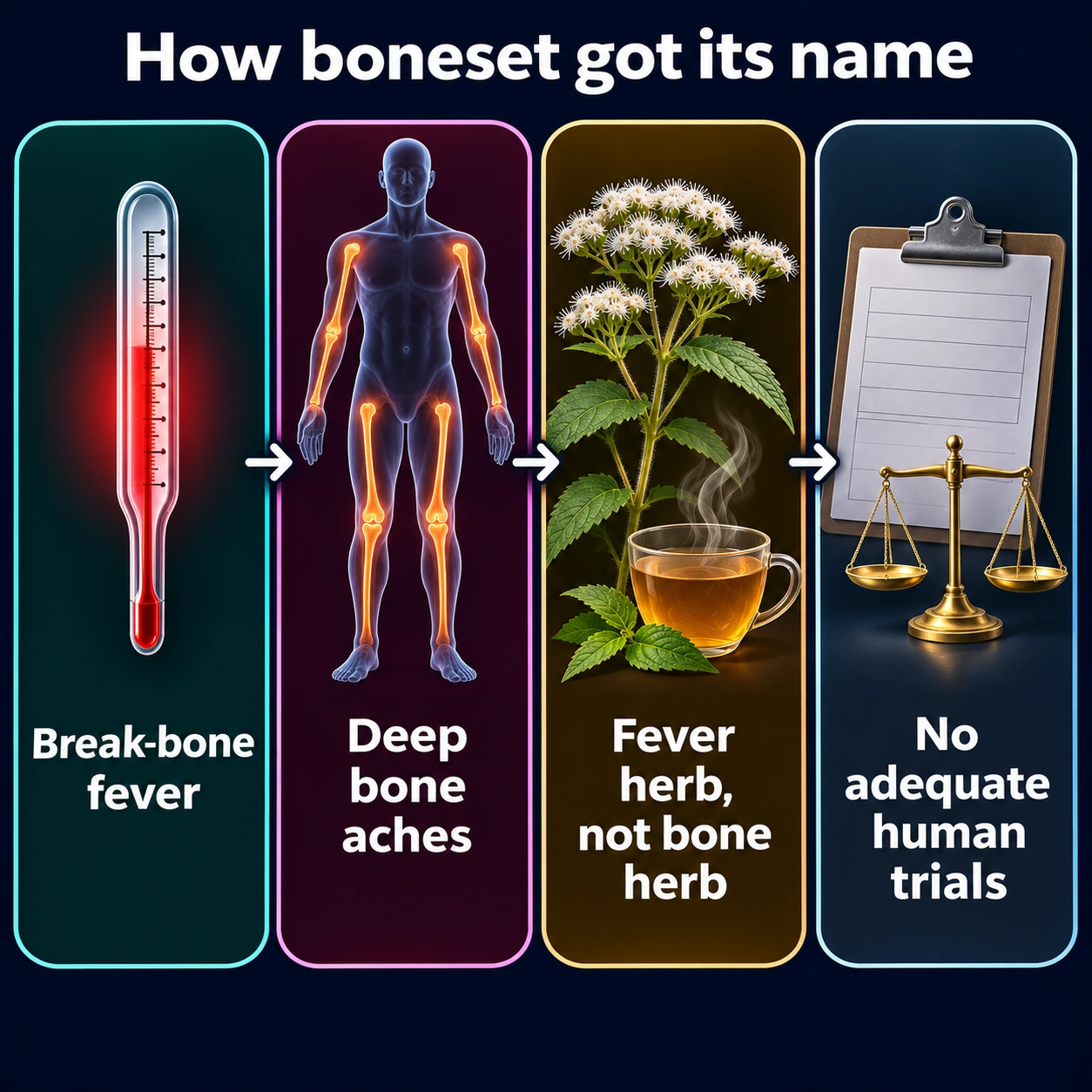

Almost everything a reader thinks they know about boneset from its name is wrong, and the error runs in a specific direction: the name sounds like a claim about bones, and boneset has nothing to do with bones. It was a fever herb — specifically a herb for the kind of fever that makes your bones feel as though they are breaking. Getting that straight is not pedantry. A name that implies a mechanical, structural, orthopaedic use invites a reader to try the plant for a broken wrist, a stress fracture, or osteoporosis, none of which it was ever used for and none of which it plausibly touches. And because boneset carries pyrrolizidine alkaloids, a mistaken long-term use for a chronic bone complaint is exactly the pattern of exposure that matters most.
This page does three things. It explains what the name actually refers to, and why the wrong reading is so durable. It sets out honestly what the fever-and-influenza claim rests on — a deep documentary tradition, some laboratory findings, and no adequate controlled human trial. And because a reader arriving here probably has a fever right now, it closes with the practical part: which fevers are ordinary, which are emergencies, and why suppressing a fever is not automatically the goal.
Table of Contents
- What “Boneset” Actually Means
- Break-Bone Fever: What Was Being Described
- Why the Bonesetter Reading Will Not Die
- The Plant’s Other Names All Say “Fever”
- The Sweating Theory of Fever
- Boneset and the Influenza Epidemics
- The Evidence for the Fever Claim
- The Homeopathic Confusion
- If It Really Is Dengue, This Matters
- Fever Is Usually Not the Thing to Suppress
- Warning Signs That Need Medical Care
- Key Research Papers
- Connections
- Featured Videos
What “Boneset” Actually Means
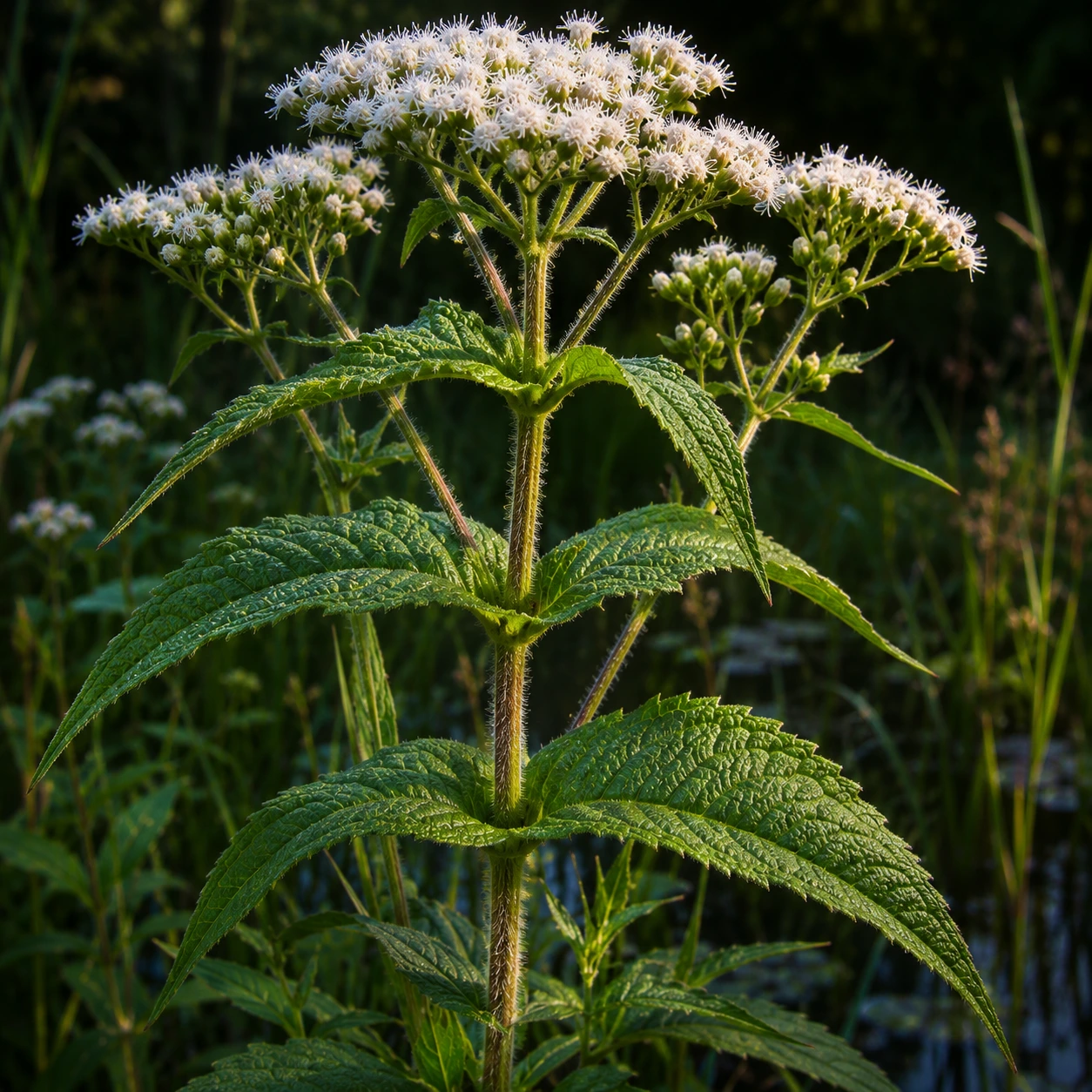
Eupatorium perfoliatum is a tall composite of North American wet ground, and its English name is a compression of a phrase, not a description of an action. It is the herb for break-bone fever — the herb for that illness — and over two centuries the phrase wore down to a single word whose surviving half, “bone,” points at the wrong noun.
Compare how other plant names work and the pattern is obvious. Feverfew means the herb that puts fever to flight; nobody reads it as a herb made of fever. Woundwort is for wounds. Liverwort was for the liver. Boneset follows the same grammar — herb-plus-target — but the target it names is a symptom, the deep skeletal ache of a severe febrile illness, and English happens to encode that symptom with the word for the body part rather than the word for the feeling. The name is a symptom name that reads like an anatomy name.
The plain reading — “sets bones” would require the plant to do something no herb does. Fracture healing is a mechanical and cellular process that depends on reduction, immobilisation, blood supply and time. There is no traditional record of boneset being used as a fracture remedy, no plausible mechanism by which a bitter sesquiterpene-lactone-bearing composite would accelerate callus formation, and no research literature attempting it. The absence is total, and per the standing rule on this site, absence of evidence is itself a finding worth stating plainly rather than leaving as a gap for the reader to fill in optimistically.
Break-Bone Fever: What Was Being Described
“Break-bone fever” was an ordinary English phrase in eighteenth- and nineteenth-century North America, and it described a recognisable clinical picture: abrupt high fever, ferocious headache, pain behind the eyes, and above all a boring, deep, unlocalised ache in the long bones and the back that patients described as feeling like fracture. The classic account belongs to Benjamin Rush, writing on the epidemic fever of Philadelphia in 1780, who recorded that patients themselves called it break-bone fever because of the character of the pain. That phrasing entered common speech and stuck.
What illness was it? Historically, at least two and probably more:
- Dengue. The classic dengue syndrome is precisely this — sudden fever, retro-orbital headache, and severe myalgia and bone pain. Dengue was present in the port cities of the American South and the Caribbean, and “break-bone fever” and “dandy fever” are both recognised historical names for it. The modern review literature on dengue's history treats the Philadelphia 1780 epidemic as an early described outbreak.
- Severe influenza. The bone-deep ache of bad influenza is the same subjective experience, and influenza was vastly more common across the whole continent than dengue ever was. Most of the boneset actually drunk in nineteenth-century North America was almost certainly drunk for influenza and for febrile respiratory illness, not for dengue.
- Other febrile illnesses with prominent myalgia — the intermittent fevers grouped under “ague,” typhoid and typhus, relapsing fevers. Pre-bacteriological nosology grouped illnesses by symptom picture, so a single folk name covered several modern diagnoses.
This matters for how you read the historical record. When an old dispensatory says boneset is “the remedy for break-bone fever,” it is not naming a disease in the modern sense. It is naming a presentation. The plant was reached for when a person was hot, aching, shivering and miserable, whatever the cause — which is also why the tradition cannot be converted into a claim about any one virus.
Why the Bonesetter Reading Will Not Die
The wrong reading survives because it is genuinely plausible. “Bonesetter” was a real occupation with a real history — the lay practitioner who reduced dislocations and splinted fractures, a trade that in parts of Britain and Ireland persisted into the twentieth century and fed directly into the origins of osteopathy. A herb named after that trade would make perfect sense. It simply is not what happened.
Two further things reinforce the error. First, some modern supplement copy repeats it, and once a claim appears in product marketing it circulates without a source. Second, the herb genuinely does have a plausible relationship to bone pain — not to bones. Its constituents include sesquiterpene lactones and flavonoids with demonstrable anti-inflammatory activity in cell models, and an anti-inflammatory action is a coherent story for making an aching febrile illness feel more bearable. So the plant sits one small step away from the claim its name suggests, which is the ideal distance for a misreading to survive.
There is a general principle here, and boneset is one of its cleanest examples: a common name can imply a use, or a safety profile, that the plant does not have. Motherwort is the mirror case — “mother” there meant the uterus, and the reassuring maternal ring of the name conceals exactly the reason the herb is contraindicated in pregnancy. Boneset's name conceals nothing dangerous by itself, but it points a reader toward chronic musculoskeletal self-treatment, and chronic use is the one pattern boneset's alkaloid content most argues against. The etymology is not trivia; it is a safety issue wearing a costume.
The Plant’s Other Names All Say “Fever”
If the name “boneset” is ambiguous, the plant's other historical names are not. Read together they amount to an unambiguous job description:
- Feverwort — the fever herb, stated outright.
- Agueweed — “ague” being the old word for a chills-and-fever illness, especially the intermittent fevers.
- Sweating-plant and sweat plant — naming the intended effect, not the disease.
- Indian sage — recording that the use came to colonists from Native American practice, and comparing the plant's bitterness and application to sage.
- Thoroughwort and crosswort — the only names that describe the plant itself rather than its use, both pointing at the fused, stem-piercing leaf pairs that give perfoliatum its epithet.
Not one of these names refers to bones, fractures, joints or skeletal repair. When most of a plant’s other historical names say “fever” or “sweat,” and the rest describe its leaves or where its use came from, the sole name that appears to say “bones” is the one that needs explaining — not the one that should govern the reading.
The Sweating Theory of Fever
Boneset was almost always given as a hot infusion, drunk warm and freely, with the explicit intention of producing a sweat. In the humoral and eclectic frameworks that governed nineteenth-century domestic medicine, sweating was not a side effect; it was the treatment. A fever was understood as something to be brought out and resolved through the skin, and a diaphoretic herb was the tool for doing it. The same logic sits behind elderflower, yarrow, ginger and peppermint teas across European and North American practice, which is why those herbs so often appear in the same recipes and the same combinations as boneset.
Two honest observations about this. First, much of the perceived effect is attributable to the vehicle rather than the herb: hot fluid taken in quantity by a febrile, dehydrated person genuinely does induce cutaneous vasodilation and sweating, genuinely does rehydrate, and genuinely does feel good. Any hot tea does this. That is not an argument that boneset is inert, but it does mean that the historical testimony — “we gave boneset tea and the patient sweated and felt better” cannot distinguish the plant from the hot water it was carried in.
Second, the underlying theory has not survived. Modern thermal physiology does not regard sweating as the mechanism by which an infection resolves. Sweating during defervescence is a consequence of the hypothalamic set point falling, not a cause of it. So the traditional rationale for boneset is not simply unproven — the framework it was reasoned within has been replaced. The tradition remains a real historical fact about how people used the plant; it is not evidence about what the plant does.
The traditional hot infusion also carries the plant’s alkaloids: a 2018 survey of 49 boneset samples found liver-toxic dehydropyrrolizidine alkaloids in every one (0.0002–0.07% by weight, mostly lycopsamine and intermedine and their related forms), and found high concentrations of them in hot-water infusions and decoctions, the traditional form described here, as well as in alcoholic tinctures.
Boneset and the Influenza Epidemics
Boneset's reputation was built during epidemics. It appears in nineteenth-century American medical writing on epidemic influenza, in the Eclectic materia medica, in household receipt books, and in the United States Pharmacopoeia of the period. It was cheap, it grew in ditches across half a continent, it could be dried and hung in a kitchen, and it was reached for at the first shiver — the profile of a genuine folk staple rather than a fashionable botanical.
The 1918–19 influenza pandemic is where the herb's modern reputation is most often anchored, and it is worth being careful here. Boneset was in use, and it was recommended. What does not exist is any controlled comparison from that period, any mortality data broken out by treatment, or any record that would let anyone claim boneset altered the course of the pandemic. In an event that killed tens of millions with no effective therapy of any kind, testimonials accumulate on both sides of every remedy that was tried. A claim that boneset “worked in 1918” is not a weak piece of evidence; it is not a piece of evidence.
What the epidemic record does establish, and establishes well, is use: boneset was one of the most widely employed domestic febrile remedies in North America for roughly two centuries. That is a historical claim, it is well documented, and it is the claim this site makes. It is a different claim from efficacy, and the two are constantly conflated in writing about this plant.
The Evidence for the Fever Claim
Here is the honest ranking, worst news first, because the popular narrative runs the other way.
- There is no adequate controlled human trial of boneset herb for fever, influenza, or any other indication. Not a negative trial — an absent one. Nobody has randomised people with influenza to boneset infusion versus placebo and measured symptom duration, fever curves, or viral shedding. This is the single most important fact on the page, and it is not a hedge: it is a stated result. The 2011 review of the plant does note older clinical data on ethanolic boneset extracts for the common cold: those data do not meet modern good clinical practice (GCP) standards, but the review reads them as indicating “positive tendencies”.
- What does exist is preclinical. A hydroalcoholic (water-and-alcohol) E. perfoliatum extract has been reported to interfere with influenza A virus attachment to cells in culture: in that 2016 study it blocked a pandemic H1N1 isolate and the laboratory strain PR8 at half-maximal concentrations (IC50) of 7 and 14 µg/mL, also acted on an oseltamivir-resistant isolate, and worked by stopping the virus from attaching to cells, while extracts made with dichloromethane or methanol were inactive — all of it in cell culture. Extracts and isolated constituents have shown anti-inflammatory activity in cell models including inhibition of inducible nitric oxide synthase. The claimed immune stimulation was not confirmed: in the 2011 cell study, extracts and isolated polysaccharides showed no stimulating effect on lymphocytes, phagocytosis or macrophage nitric oxide, and the 2011 review states that the postulated immunostimulating properties of the plant have not been confirmed by in-vitro data. These are real findings by identifiable groups, and they are the reason the plant remains scientifically interesting. They are also cell-culture findings, and the gap between a concentration in a dish and a concentration achievable in a human being drinking a bitter tea is the gap that the missing trials would have measured.
- The pharmacokinetics are unknown. Nobody has published human absorption, distribution or plasma-concentration data for boneset's characteristic constituents from an infusion. Without that, the in-vitro results cannot be scaled to a cup of tea even in principle. This is a stated finding, not an oversight in this page.
- Dose-finding does not exist. Traditional dosing was empirical and its upper bound was defined by emesis — the point at which the tea makes you vomit. That is a tolerability ceiling, not a therapeutic window established against an outcome.
Set beside comparators, the shape of the problem is clear. For febrile respiratory illness there are herbal interventions with human trial data of varying quality — elderberry preparations, Pelargonium sidoides root extract, Andrographis paniculata, echinacea preparations, and honey for cough in children. Those trials are often small and frequently criticised, but they exist, they can be argued about, and they can be updated. Boneset has no modern trial to argue about. That comparison pre-empts the reasonable objection that traditional herbs are simply never trialled: some of boneset's own shelf-mates have been.
The Homeopathic Confusion
A large share of what turns up when you search for human research on Eupatorium perfoliatum is about the homeopathic preparation, not the herb. Homeopathic Eupatorium perfoliatum is a long-standing remedy for febrile illness with bone-aching pain — the indication follows the traditional symptom picture almost exactly — and it appears in homeopathic influenza combinations and in clinical reports from that tradition. One controlled clinical study from the early 1980s, published in German in Arzneimittel-Forschung, tested homeopathic Eupatorium perfoliatum D2 against acetylsalicylic acid in common cold. It randomly assigned 53 outpatients with a common cold to aspirin (acetylsalicylic acid) or Eupatorium perfoliatum D2; symptoms, body temperature and laboratory findings did not differ significantly between the two groups, which the authors took as evidence that both were equally effective. With no placebo group, the trial cannot show that either one worked.
This is borrowed evidence and must be labelled as such at each use, not once per page. A D2 dilution is a hundredfold dilution of a mother tincture; higher potencies contain vanishingly little or nothing of the plant. Whatever such a study shows or fails to show, it is not a result about drinking a boneset infusion. Two distinct substitutions are happening at once: the preparation is different by orders of magnitude in concentration, and the therapeutic framework is different in kind. If the homeopathic result is positive, it cannot be credited to the herb's pharmacology; if it is negative, it does not condemn the herb either.
The same care applies to a second, subtler substitution. Much modern Eupatorium literature concerns other species entirely — E. cannabinum (hemp agrimony, a European plant), E. odoratum and its relatives, and the plants now moved out of the genus into Eutrochium and Ageratina. Chemistry within this group varies, and the taxonomic reshuffling means older papers use names that no longer point where a modern reader expects. A citation that says “Eupatorium” is not automatically a citation about boneset, and on this site it will be flagged when it is not.
If It Really Is Dengue, This Matters
Because the plant's name descends from a dengue-era phrase, it is worth being explicit: no herbal tea has been shown to treat dengue, and dengue carries one particular hazard that is easy to get wrong. In dengue, platelet counts fall and bleeding risk rises, which is why guidance for suspected dengue avoids aspirin and non-steroidal anti-inflammatory drugs for fever and pain. Sudden high fever with severe bone and muscle pain after travel to a dengue-endemic area is the classic picture of dengue — and the warning signs of severe dengue (persistent vomiting, abdominal pain, bleeding gums or nose, lethargy, restlessness) are medical emergencies.
Boneset has no place in that picture, and no evidence supporting one. The historical link between the plant and the phrase is an etymological fact, not a therapeutic recommendation, and it would be a serious error to read this page as suggesting the two are connected in practice.
Fever Is Usually Not the Thing to Suppress
A reader looking for a fever herb usually wants the fever gone. It is worth questioning the goal, because the physiology does not support treating fever itself as the enemy.
Fever is a regulated response, not a malfunction. The hypothalamic set point is deliberately raised, and the elevated temperature has measurable effects on immune function — lymphocyte trafficking, innate signalling, and the replication of some temperature-sensitive pathogens. The review literature on fever and thermal regulation of immunity in Nature Reviews Immunology makes the case that the febrile range is immunologically active rather than incidental. Meanwhile, trials of routine antipyresis in serious infection have not shown the benefit one might expect: the large randomised trial of acetaminophen for fever in critically ill patients with suspected infection reported in the New England Journal of Medicine found no improvement in the primary outcome: among 700 intensive-care patients with fever and known or suspected infection, those given acetaminophen had 23 days alive and out of intensive care by day 28 against 22 on placebo (P=0.07, not a significant difference), and by day 90, 55 of 345 patients (15.9%) on acetaminophen and 57 of 344 (16.6%) on placebo had died. Paediatric guidance from the American Academy of Pediatrics on fever and antipyretic use in children is explicit that the goal is comfort, not a normal number on a thermometer.
The same clinical report lists what matters instead: the child’s general well-being, their activity, signs of serious illness, and enough fluid. A febrile adult who is drinking, passing urine, thinking clearly and able to rest is usually having an ordinary illness, and the temperature itself is not the problem to solve. That is also, incidentally, most of what a hot cup of any tea provides — which puts the traditional boneset infusion in a fair light without granting it a pharmacology it has not earned.
Warning Signs That Need Medical Care
This is not medical advice and it cannot replace an assessment by a clinician who can see you. It is a list of the patterns that are recognised as needing urgent attention rather than watchful waiting.
- Any fever in an infant under three months. This is the single clearest rule in the whole of febrile illness: a young infant with a fever needs to be seen, promptly, regardless of how well they seem.
- A stiff neck, severe headache with light intolerance, or a new rash that does not fade under pressure. These raise the question of meningitis or meningococcal disease and are emergencies.
- Confusion, unusual drowsiness, difficulty waking, or a change in behaviour. Altered mental state with fever is never a wait-and-see finding.
- Breathing difficulty — breathlessness at rest, rapid or laboured breathing, chest pain, or blue-tinged lips.
- Signs of dehydration or shock — not passing urine, dizziness on standing, cold mottled skin, a racing pulse.
- Persistent vomiting, so that fluids cannot be kept down.
- Any bleeding — gums, nose, unexplained bruising, blood in vomit or stool — particularly after travel to a dengue-endemic area.
- A seizure with fever, or a first seizure of any kind.
- Fever lasting more than about three to five days without improvement, or a fever that settles and then returns.
- Fever in someone immunosuppressed — on chemotherapy, on immunosuppressant drugs, after splenectomy, or with a known immune deficiency. The usual thresholds do not apply, and clinicians treat fever in these patients as urgent much sooner.
- Fever in pregnancy, which warrants a call rather than self-management — and note that boneset is contraindicated in pregnancy on alkaloid grounds regardless.
- Yellowing of the eyes or skin, dark urine, pale stools, or right-upper-abdominal pain. These point at the liver, and they are also the pattern that matters most if someone has been taking a pyrrolizidine-alkaloid-containing herb.
The last item is the reason the safety article in this set is not optional reading. Boneset's fever tradition is deep and its fever evidence is absent; its alkaloid content, by contrast, belongs to a class whose human hepatotoxicity is established. That asymmetry — established harm mechanism, absent benefit evidence — is the honest summary of the plant, and it is set out in full in Boneset Safety: Pyrrolizidine Alkaloids and Liver Risk.
Key Research Papers
- Hensel A, Maas M, Sendker J, and colleagues. “Eupatorium perfoliatum L.: phytochemistry, traditional use and current applications.” Journal of Ethnopharmacology, 2011;138(3):641-51. The single most useful modern review of the plant, and the reference that most clearly states how thin the clinical evidence is. — PubMed PMID: 22004891
- Derksen A, Kühn J, Hafezi W, and colleagues. “Antiviral activity of hydroalcoholic extract from Eupatorium perfoliatum L. against the attachment of influenza A virus.” Journal of Ethnopharmacology, 2016;188:144-52. Cell-culture work reporting interference with viral attachment. Preclinical; no human outcome. — PubMed PMID: 27178637
- Maas M, Deters AM, Hensel A. “Anti-inflammatory activity of Eupatorium perfoliatum L. extracts, eupafolin, and dimeric guaianolide via iNOS inhibitory activity and modulation of inflammation-related cytokines and chemokines.” Journal of Ethnopharmacology, 2011;137(1):371-81. The mechanistic basis for the “makes an aching fever more bearable” story — in cells. — PubMed PMID: 21669270
- Gassinger CA, Wünstel G, Netter P. “A controlled clinical trial for testing the efficacy of the homeopathic drug Eupatorium perfoliatum D2 in the treatment of common cold.” Arzneimittel-Forschung, 1981;31(4):732-6 (in German). Borrowed evidence: this tests a homeopathic dilution, not the herb, and cannot be credited to boneset’s pharmacology in either direction. — PubMed PMID: 7195723
- Gubler DJ. “Dengue and dengue hemorrhagic fever.” Clinical Microbiology Reviews, 1998;11(3):480-96. The standard review, useful here for the historical naming of dengue and the early described American outbreaks. — PubMed PMID: 9665979
- Evans SS, Repasky EA, Fisher DT. “Fever and the thermal regulation of immunity: the immune system feels the heat.” Nature Reviews Immunology, 2015;15(6):335-49. Why the febrile range is immunologically active rather than incidental. — PubMed PMID: 25976513
- Kluger MJ. “Fever: role of pyrogens and cryogens.” Physiological Reviews, 1991;71(1):93-127. The classic synthesis of fever as a regulated, evolutionarily conserved response. — PubMed PMID: 1986393
- Young P, Saxena M, Bellomo R, and colleagues; HEAT Investigators. “Acetaminophen for fever in critically ill patients with suspected infection.” New England Journal of Medicine, 2015;373(23):2215-24. A large randomised test of routine antipyresis that did not find the expected benefit. — PubMed PMID: 26436473
- Sullivan JE, Farrar HC; Section on Clinical Pharmacology and Therapeutics; Committee on Drugs (American Academy of Pediatrics). “Fever and antipyretic use in children.” Pediatrics, 2011;127(3):580-7. The clinical report that reframes the goal as comfort rather than temperature. — PubMed PMID: 21357332
- Colegate SM, Upton R, Gardner DR, Panter KE, Betz JM. “Potentially toxic pyrrolizidine alkaloids in Eupatorium perfoliatum and three related species. Implications for herbal use as boneset.” Phytochemical Analysis, 2018;29(6):613-626. Detection of dehydropyrrolizidine alkaloids in E. perfoliatum and relatives — the basis for the safety article in this set. — PubMed PMID: 29968391
PubMed Topic Searches
- Historical nomenclature of dengue. The literature on early American febrile epidemics and the origins of “break-bone” and “dandy” fever as popular names. — Search PubMed on this topic
- Herbal interventions for febrile respiratory illness that do have human trials — the comparator literature named above, for readers who want a treatment with data rather than a treatment with a history. — Search PubMed on this topic
Connections
- All Herbs
- Boneset — main article
- Boneset Benefits — hub
- Boneset in Eclectic and Folk Medicine
- Boneset: Immune and Preclinical Research
- Boneset Safety: Pyrrolizidine Alkaloids
- Dengue Fever
- Influenza
- Fever — symptom guide
- Joint Pain
- Interactive: Fever and Thermoregulation
- Elderberry for Cold and Flu
- Echinacea for Cold and Flu
- Yarrow Benefits
- Meadowsweet for Joint Pain and Fever
- Chrysanthemum for Fever and Sore Throat
- Andrographis
- Feverfew
- Covered in depth on its own page: Influenza
A note on what this page is
This is educational background on a traditional herb, not medical advice and not a treatment recommendation. Boneset is documented here because it has a real and substantial place in North American herbal history, and the honest account of it includes both the tradition and the absence of clinical evidence. It contains pyrrolizidine alkaloids: a 2018 survey found liver-toxic dehydropyrrolizidine alkaloids in all 49 boneset samples tested, with high concentrations in hot-water infusions, decoctions and alcoholic tinctures, and this class of alkaloid is associated with liver disease in humans. For that reason boneset is treated as unsuitable in pregnancy, while breastfeeding, for infants and children, and for anyone with liver disease. Yellowing of the eyes or skin, dark urine, pale stools and right-upper-abdominal pain are the signs of liver injury listed above.