Constipation: Short-Term Use
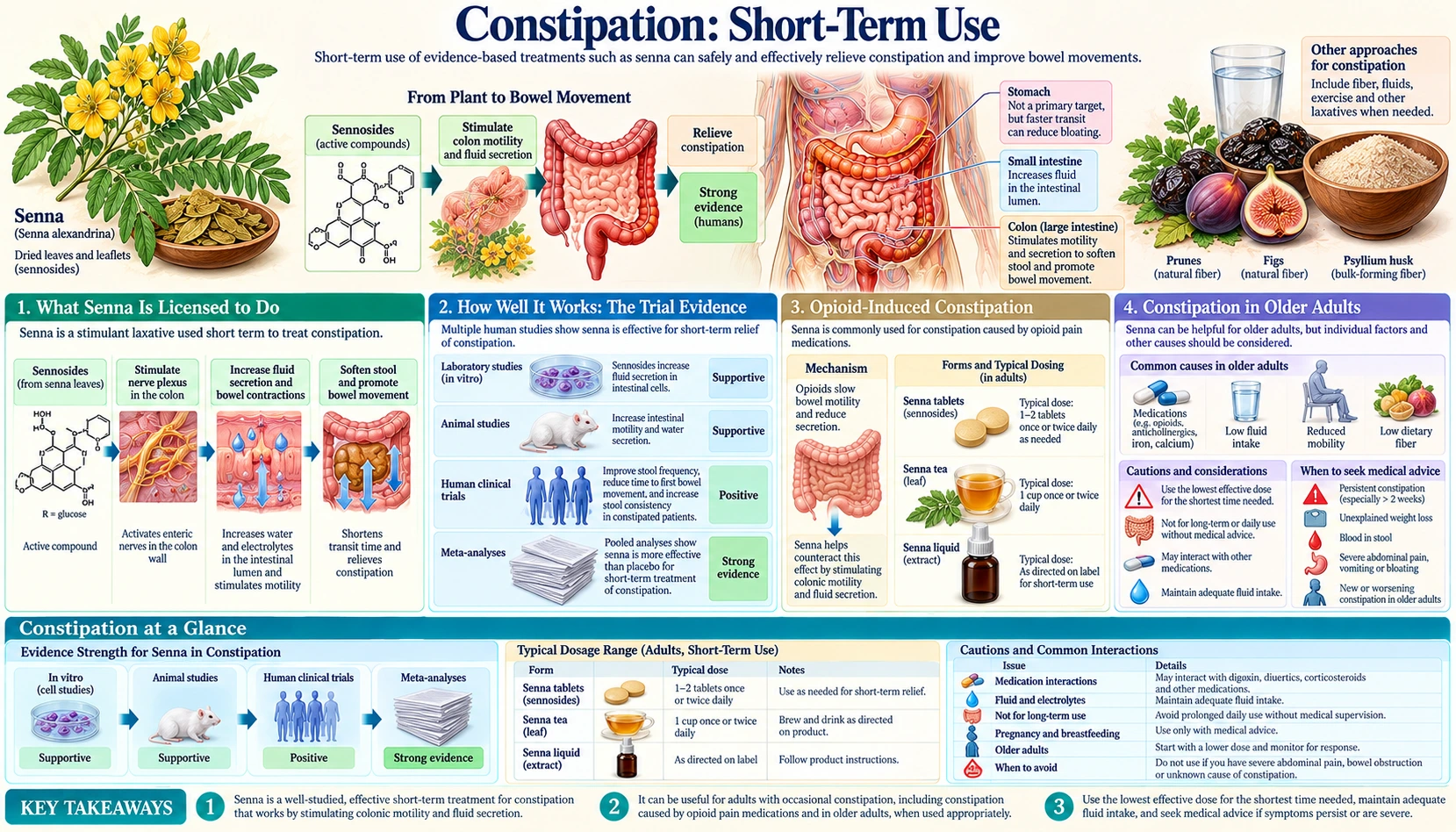
If you have been constipated for four days, you are uncomfortable, and you want to know whether the box of senna in the pharmacy is going to help — placebo-controlled trials say it usually does, and this page sets out what the labels and the trials say about using it. Senna is a licensed over-the-counter laxative in the United States, the United Kingdom, the European Union and most other regulated markets. It has been through placebo-controlled trials. It works in roughly 6 to 12 hours. It costs a few pounds or dollars for a month’s box, and the same molecule is in the cheap generic as in the brand name.
Almost everything that goes wrong with senna is a matter of how long and in what context, not whether. Used for a few days for a genuine bout of constipation, it is one of the more predictable, better-characterised drugs you can buy without a prescription. This article covers the licensed use, the dose, the timing, the forms, the groups the labels list as contraindicated, and the reasons another tablet often does not help.
Table of Contents
- What Senna Is Licensed to Do
- How Well It Works: The Trial Evidence
- Opioid-Induced Constipation
- Constipation in Older Adults
- Dose: How Much, and How to Start
- Timing: Why Labels Specify Bedtime
- Forms: Tablets, Tea, Pods, Syrup
- Why More Senna Often Does Not Help
- Children and Pregnancy
- Who the Labels and Research Raise Concerns For
- Red Flags: When Constipation Needs a Diagnosis
- Non-Drug Measures Studied Alongside Senna
- Key Research Papers
- Connections
- Featured Videos
What Senna Is Licensed to Do
Senna leaf and senna pod both hold formal regulatory status as medicines rather than supplements in most markets. In the United States, senna appears in the U.S. Food and Drug Administration’s over-the-counter monograph for laxative drug products, which is why a box of senna tablets sold as a drug carries a Drug Facts panel and not a Supplement Facts panel. The European Medicines Agency’s Committee on Herbal Medicinal Products has published monographs for both plant parts. The World Health Organization lists senna among essential medicines.
The wording of the indication is narrow and consistent across all of them: short-term treatment of occasional constipation. Not chronic constipation management. Not daily bowel maintenance. Not weight control, cleansing, or bloating. Occasional constipation, short-term.
The corresponding duration statement is equally consistent: one week. A US Drug Facts label for 8.6 mg sennoside tablets reads “Do not use laxative products for longer than 1 week unless directed by a doctor”, and the European Union herbal monograph on senna leaf states “Not to be used for more than 1 week”, adding that taking it up to two to three times during that week is usually sufficient. The two-week figure on the US label refers to something else: a sudden change in bowel habits that continues over 2 weeks is listed as a reason to ask a doctor before use. This is not risk-averse boilerplate — it is a substantive part of the authorisation, based on the electrolyte losses that accumulate with repeated stimulant-laxative use and on the fact that constipation lasting more than a couple of weeks usually has a cause worth finding.
How Well It Works: The Trial Evidence
Two kinds of evidence support senna, and they point the same way.
The placebo-controlled trial
The most useful single study is a Japanese randomised, placebo-controlled trial published in the American Journal of Gastroenterology in 2021 by Morishita and colleagues, which compared senna against magnesium oxide and against placebo in adults with chronic constipation. This is exactly the design that matters: constipation improves substantially on placebo in almost every trial ever run, so a comparison against nothing is uninformative. The trial enrolled 90 adults (93% women) and treated them for 28 days. Overall symptom improvement was reported by 69.2% of the senna group, 68.3% of the magnesium oxide group and 11.7% of the placebo group; both active treatments also beat placebo on spontaneous bowel movements and quality-of-life scores, and the rate of severe treatment-related side effects was 0%. The trial did not show senna to be dramatically superior to a well-chosen osmotic agent — it showed that both beat placebo, which is the honest summary.
The pooled analyses
Ford and Suares’s 2011 meta-analysis in Gut pooled randomised trials of laxatives and prescription drugs for chronic idiopathic constipation and found stimulant laxatives among the treatment classes with a demonstrable benefit over placebo. Ramkumar and Rao’s earlier systematic review in the American Journal of Gastroenterology graded the evidence for the traditional laxatives and found good evidence (Grade A) only for polyethylene glycol and tegaserod and moderate evidence (Grade B) for psyllium and lactulose; for senna — as for milk of magnesia, bisacodyl and stool softeners — it found a paucity of quality data. Neither review is glowing — both note that many of the underlying trials are old, small, and would not pass modern reporting standards. But the direction of effect is not in dispute.
The 2023 US guideline
In 2023 the American Gastroenterological Association and the American College of Gastroenterology published a joint guideline on drug treatment of chronic idiopathic constipation in adults. Its panel made 10 recommendations: strong recommendations for polyethylene glycol, sodium picosulfate, linaclotide, plecanatide and prucalopride, and conditional recommendations for fiber, lactulose, senna, magnesium oxide and lubiprostone.
Put plainly: senna is not the most rigorously trialled laxative on the market (that is probably polyethylene glycol), but it is well past the threshold of “does something.”
Opioid-Induced Constipation
Opioid painkillers — morphine, oxycodone, codeine, tramadol, fentanyl — bind receptors in the gut wall and slow intestinal movement to a crawl. Constipation follows in the majority of people who take them, does not fade with time the way nausea does, and is one of the commonest reasons patients stop taking pain relief they actually need.
Because opioids paralyse motility, a drug that directly stimulates motility is a mechanistically sensible answer. Senna is standard practice here: in hospice and oncology, a laxative is typically started at the same time as the opioid rather than waiting for constipation to appear.
What the trials show:
- Agra and colleagues (1998) randomised terminal cancer patients on opioids to senna or lactulose and found senna at least as effective, at appreciably lower cost.
- Marciniak and colleagues (2014) ran a double-blind active-comparator trial of lubiprostone versus senna in post-operative orthopaedic patients on opioids — a useful modern comparison against a prescription drug.
- The Cochrane review by Candy and colleagues (2015) assessed laxatives in palliative care and reached a deliberately unexciting conclusion: the trials are few and small, and no laxative was clearly superior to another. That is a genuinely negative finding for anyone claiming senna is proven best in this setting. It is not a finding that senna does not work — it is a finding that the evidence cannot rank the options.
- Kistemaker and colleagues (2024) systematically reviewed drug prevention and treatment of opioid-induced constipation in people with cancer, covering 20 studies (randomised trials and cohort studies). Two of its randomised treatment trials compared laxatives with each other, and in one of them polyethylene glycol was significantly more effective than sennosides. The authors concluded that more studies comparing standard laxatives with each other are needed.
Practical note: a stool softener such as docusate is often combined with senna in opioid constipation. The softener adds little on its own in trials, but the combination is widely used and can make the resulting bowel movement less uncomfortable.
Constipation in Older Adults
Constipation is far more common with age — reduced mobility, lower fluid and fibre intake, and a long medication list all contribute. Senna has a reasonable evidence base in this group specifically.
Passmore and colleagues, writing in the BMJ in 1993, ran a double-blind crossover trial in 77 long-stay elderly patients comparing lactulose with a senna-plus-fibre combination: mean daily bowel movements were 0.8 with the senna-fibre combination and 0.6 with lactulose. Kinnunen and colleagues reported a similar comparison in Pharmacology the same year. These are old trials in institutional settings, and neither is large — but they are on-point, and they are the reason senna-fibre products remain common in nursing homes.
Two cautions matter more in older adults than in anyone else. First, polypharmacy: diuretics, digoxin, corticosteroids and some antidepressants are all more common with age, and all interact with senna’s potassium losses. Second, faecal impaction — a hard plug of stool that a stimulant laxative pushes against rather than through. Impaction can present as overflow diarrhoea, which is easily mistaken for the laxative working too well. Anyone with a long history of constipation who suddenly starts leaking loose stool needs an examination, not a larger dose.
Dose: How Much, and How to Start
Every serious senna product states its strength in milligrams of sennosides, usually calculated as sennoside B. That number is the dose. Tablet weight, extract ratio and “mg of leaf” are all much less informative.
| Situation | Adult dose on the label | Comment |
|---|---|---|
| Starting dose, US label | 2 tablets of 8.6 mg sennosides once a day, preferably at bedtime | US Drug Facts label, adults and children 12 years and older. |
| Single dose, EU monograph | 10–30 mg hydroxyanthracene derivatives (calculated as sennoside B), once daily at night | The monograph states that the correct individual dose is the smallest required to produce a comfortable soft-formed motion. |
| No bowel movement after use | — | The US label lists failure to have a bowel movement after use of a laxative as a reason to stop use and ask a doctor, as it may indicate a serious condition. |
| Maximum | US label: 4 tablets of 8.6 mg twice a day. EU monograph: up to 30 mg per single dose, once daily at night | The two labels differ; products also differ in strength. |
| Duration | No more than 1 week | Both the US label and the EU monograph; the US label adds “unless directed by a doctor”. |
Both labels start at the low end. The dose–response curve for senna is unhelpfully steep at the top: a dose that is slightly too high does not produce a slightly better bowel movement, it produces griping cramps and watery diarrhoea. Most people who describe senna as “horrible” took too much on the first night.
Senna moves fluid into the colon, so a person who is already dehydrated has both less margin and a worse result.
Timing: Why Labels Specify Bedtime
Senna is a prodrug. The sennosides you swallow pass through the stomach and small intestine essentially unchanged and are only converted to the active compound, rhein anthrone, when colonic bacteria strip off their sugar groups. That journey and that conversion take time, which is why the onset is reliably 6 to 12 hours — not 30 minutes.
The practical consequence is simple: a bedtime dose gives a result in the morning, which is why the US label says “take preferably at bedtime” and the EU monograph “once daily at night”. A dose taken at 9 a.m. for relief now brings the result in the late afternoon or evening instead, possibly on a train.
When the problem is stool sitting in the rectum rather than higher up, a glycerin suppository works in minutes and is a different tool for a different job. The full mechanism, including why the delay is unavoidable, is covered in How Sennosides Work.
Forms: Tablets, Tea, Pods, Syrup
- Standardised tablets. The most predictable form, and what nearly every trial used. The label states the sennoside content.
- Senna tea and tea bags. Popular, cheap, and the hardest form to dose. The amount of sennoside extracted depends on how much leaf is in the bag, water temperature, and — critically — how long it steeps. A bag left in a mug for fifteen minutes while you forget about it can deliver several times the dose of the same bag steeped for three. Unpredictable cramping and diarrhoea from senna tea is a routine story. Steeping time is the main variable a tea drinker controls.
- Senna pods. Traditionally regarded as gentler than the leaf and preferred in several European preparations. Modern standardised products blur the distinction because both are dosed to sennoside content.
- Syrups and liquids. Common in paediatric and geriatric use, where swallowing tablets is difficult. These come with a measuring device; kitchen spoons vary in size.
- Senna with docusate. A very common combination product. The docusate is a stool softener; the senna does the work.
- “Detox” and slimming teas containing senna. A different product category with a different intent, covered in Senna in Weight-Loss and Detox Teas. These frequently do not disclose the sennoside dose at all.
Why More Senna Often Does Not Help
The instinct when a laxative fails is to take more of it. With senna this instinct is wrong often enough to be worth naming, because there are several reasons it might not work, and only one of them is “dose too small.”
- Not enough time. Six to twelve hours means twelve, sometimes. A full night is the timescale on the label, not four hours.
- Faecal impaction. If there is a hard, immovable plug, stimulating the colon above it causes pain, not evacuation. Impaction is found by examination and is often treated with a suppository or enema first.
- Low potassium. After a period of laxative use, low potassium may itself be slowing the colon. More senna deepens the deficiency and worsens the problem. This loop is the single most under-recognised reason for “my laxative stopped working.”
- Disrupted gut bacteria. Senna needs colonic bacteria to activate it. After a course of broad-spectrum antibiotics the conversion can be reduced.
- The problem is not slow transit. Pelvic-floor dyssynergia — where the muscles that should relax during defecation contract instead — does not respond to laxatives of any kind. It responds to biofeedback physiotherapy. People with this pattern can take escalating laxatives for years with no benefit.
- Obstruction. Rare, serious, and the reason for the hard rule below about undiagnosed abdominal pain.
The US label lists failure to have a bowel movement after use of a laxative as a reason to stop use and ask a doctor, because it may indicate a serious condition. Climbing the dose for weeks does not address any of the other causes listed above.
Children and Pregnancy
Children
Senna is genuinely used in paediatric constipation. The 2016 Cochrane review by Gordon and colleagues on osmotic and stimulant laxatives in childhood constipation found the overall evidence base weak, with polyethylene glycol the best-supported option. Small trials in specific surgical populations, such as children with repaired anorectal malformations, have compared senna directly with polyethylene glycol.
There is one paediatric-specific harm worth knowing about: senna-containing laxatives have caused blistering and skin breakdown in young children who swallowed them by accident. Spiller and colleagues (2003) evaluated 88 such accidental ingestions in children under 5 years old from six poison centres: 33% developed severe nappy rash and 11% blisters and skin peeling, at a mean of 15.6 hours (rash) and 14.5 hours (blisters) after ingestion, more often in children wearing nappies. Prolonged skin contact with senna-laden stool in a wet nappy produces a chemical burn-like injury. A severe, blistering nappy rash in a young child who has taken senna matches the injury this series describes; blistered, peeling skin is a burn-like injury that doctors treat.
The labels differ on children. The European Union herbal monograph on senna leaf lists children under 12 years of age as a contraindication. A US Drug Facts label for 8.6 mg sennoside tablets gives doses for children aged 6 to under 12 (1 tablet once a day, maximum 2 tablets twice a day) and 2 to under 6 (1/2 tablet once a day, maximum 1 tablet twice a day), and says “ask a doctor” for children under 2.
Pregnancy and breastfeeding
Constipation in pregnancy is extremely common — progesterone slows the gut and iron supplements make it worse. The standard approach is fibre, fluids and, if needed, a bulk-forming or osmotic laxative first. Senna is used in pregnancy when those are insufficient, on clinical advice, and it is poorly absorbed, which limits systemic exposure. The labels differ here too: the European Union herbal monograph on senna leaf lists pregnancy as a contraindication “because experimental data concerning a genotoxic risk of several anthranoids, e.g. emodin and aloe-emodin”, while the US Drug Facts label reads “If pregnant or breast-feeding, ask a health professional before use.” A Hungarian population-based case-control study by Acs and colleagues examined senna use in pregnancy and did not find an association with congenital abnormalities in the offspring; the same group published a companion analysis of constipation treatment more broadly with a similar result. These are observational studies with the usual limitations, not a licence for casual use.
In breastfeeding, only small amounts of active metabolite reach milk. The European Union herbal monograph lists lactation as a contraindication because active metabolites such as rhein were excreted in breast milk in small amounts; outside that monograph, senna is generally considered compatible at normal doses, though loose stools in the infant are occasionally reported.
Who the Labels and Research Raise Concerns For
These are not soft cautions. Each has a specific mechanism behind it.
- Known or suspected bowel obstruction, or ileus. Stimulating peristalsis against a blockage risks perforation. This is the most serious contraindication on the list.
- Undiagnosed abdominal pain, especially with nausea, vomiting or fever. Appendicitis is the classic scenario — a stimulant laxative in an inflamed appendix is dangerous. The EU herbal monograph lists abdominal pain of unknown origin as a contraindication.
- Inflammatory bowel disease — Crohn’s disease and ulcerative colitis — and other active bowel inflammation. Stimulant laxatives can aggravate an already inflamed bowel.
- Severe dehydration or existing electrolyte disturbance. Senna makes both worse.
- Taking digoxin. Digoxin toxicity rises sharply when potassium falls, and potassium loss is senna’s signature adverse effect. The EU herbal monograph states that people taking cardiac glycosides (the drug family digoxin belongs to) have to consult a doctor before taking senna.
- Taking diuretics or corticosteroids. Both lower potassium independently; senna adds to the loss.
- History of laxative misuse or an eating disorder. Not a moral judgement — a pharmacological one. Senna is the most-misused laxative class and re-exposure is a real relapse risk.
- Significant kidney or heart disease. Less margin for fluid and electrolyte shifts.
- Pregnancy, breastfeeding and children under 12. All three are contraindications in the European Union herbal monograph on senna leaf (see Children and Pregnancy above).
Other drug interactions described: warfarin (diarrhoea can alter vitamin K absorption and international normalized ratio (INR) control), and any oral medication with a narrow therapeutic window, since faster transit can reduce how much is absorbed.
Red Flags: When Constipation Needs a Diagnosis
Constipation is a symptom. Most of the time it is a boring one. Sometimes it is the first sign of something that a laxative will delay the diagnosis of. These signs are ones that doctors investigate before any laxative is used:
- Blood in the stool, or black tarry stool.
- Unintentional weight loss.
- A persistent change in bowel habit in anyone over 50, or new symptoms with a family history of bowel cancer.
- Iron-deficiency anaemia.
- Severe or worsening abdominal pain, or abdominal swelling with vomiting.
- Complete inability to pass stool or wind — a possible obstruction, which hospitals treat as urgent.
- Constipation that started with a new medication — that drug may be the cause.
- Constipation alongside new fatigue, cold intolerance and weight gain, which can point to an underactive thyroid.
Non-Drug Measures Studied Alongside Senna
Senna is a rescue, not a routine. The measures that keep bowels moving without a drug are unglamorous and genuinely effective:
- Fibre, increased gradually, with fluid. Adding fibre quickly without extra water can make constipation and bloating worse. A build-up over two to three weeks is the usual description.
- Fluid. Hard stool is dry stool. Mild dehydration is a common and trivially fixable cause.
- Movement. Even walking helps colonic motility; immobility is a major driver of constipation in hospital and care settings.
- The gastrocolic reflex. The colon is most active in the 30 minutes after a meal, especially breakfast. Unhurried, unpressured toilet time then makes use of it, and repeatedly deferring the urge blunts the signal.
- Position. A footstool that raises the knees above the hips straightens the anorectal angle and makes defecation mechanically easier.
- Prunes. The food with the best trial evidence for constipation, thanks to fibre plus sorbitol. Kiwifruit has supportive data too.
- Medications. Opioids, iron, some antidepressants, calcium-channel blockers and anticholinergics are all common culprits.
In 2025 the British Dietetic Association published guidelines on diet for chronic constipation in adults, built from four systematic reviews that included 75 randomised trials. Its statements covered dietary supplements (fibre supplements, probiotics, synbiotics, magnesium oxide, senna and kiwifruit supplements), foods (kiwifruit, prunes and rye bread) and drinks (high mineral-containing water). It made no recommendations for whole-diet approaches because of a lack of evidence.
Our Natural Constipation Relief page covers these in detail, and Prunes looks at the trial data on the fruit specifically.
Key Research Papers
Each identifier below was verified against NCBI E-utilities — author, title, journal and year had to match before it was written.
Efficacy and comparative trials
- Morishita D, Tomita T, Mori S, et al. Senna versus magnesium oxide for the treatment of chronic constipation: a randomized, placebo-controlled trial. The American Journal of Gastroenterology. 2021;116(1):152–161 — PubMed PMID: 32969946 — Human trial; senna separated from placebo, and magnesium oxide also worked.
- Ford AC, Suares NC. Effect of laxatives and pharmacological therapies in chronic idiopathic constipation: systematic review and meta-analysis. Gut. 2011;60(2):209–218 — PubMed PMID: 21205879 — Pooled human trials.
- Ramkumar D, Rao SSC. Efficacy and safety of traditional medical therapies for chronic constipation: systematic review. The American Journal of Gastroenterology. 2005;100(4):936–971. — PubMed PMID: 15784043
- Passmore AP, Wilson-Davies K, Stoker C, Scott ME. Chronic constipation in long stay elderly patients: a comparison of lactulose and a senna-fibre combination. BMJ. 1993;307(6907):769–771 — PubMed PMID: 8219947 — Human trial in institutionalised older adults.
- Kinnunen O, Winblad I, Koistinen P, Salokannel J. Safety and efficacy of a bulk laxative containing senna versus lactulose in the treatment of chronic constipation in geriatric patients. Pharmacology. 1993;47(Suppl 1):253–255. — PubMed PMID: 8234438
- Chang L, Chey WD, Imdad A, et al. American Gastroenterological Association-American College of Gastroenterology clinical practice guideline: pharmacological management of chronic idiopathic constipation. Gastroenterology. 2023;164(7):1086–1106 — PubMed PMID: 37211380 — Guideline; conditional recommendation for senna.
Opioid-induced constipation
- Agra Y, Sacristán A, González M, Ferrari M, Portugués A, Calvo MJ. Efficacy of senna versus lactulose in terminal cancer patients treated with opioids. Journal of Pain and Symptom Management. 1998;15(1):1–7 — PubMed PMID: 9436336 — Human randomised trial.
- Candy B, Jones L, Larkin PJ, Vickerstaff V, Tookman A, Stone P. Laxatives for the management of constipation in people receiving palliative care. Cochrane Database of Systematic Reviews. 2015;(5):CD003448 — PubMed PMID: 25967924 — Negative for superiority — too few, too small trials to rank laxatives against one another.
- Marciniak CM, Toledo S, Lee J, et al. Lubiprostone vs senna in postoperative orthopedic surgery patients with opioid-induced constipation: a double-blind, active-comparator trial. World Journal of Gastroenterology. 2014;20(43):16323–16333 — PubMed PMID: 25473191 — Human trial.
- Kistemaker KRJ, Sijani F, Brinkman DJ, et al. Pharmacological prevention and treatment of opioid-induced constipation in cancer patients: a systematic review and meta-analysis. Cancer Treatment Reviews. 2024;125:102704 — PubMed PMID: 38452708 — Systematic review of human studies.
Children, pregnancy and safety in special groups
- Gordon M, MacDonald JK, Parker CE, Akobeng AK, Thomas AG. Osmotic and stimulant laxatives for the management of childhood constipation. Cochrane Database of Systematic Reviews. 2016;(8):CD009118 — PubMed PMID: 27531591 — Found the paediatric evidence base weak overall.
- Santos-Jasso KA, Arredondo-García JL, Maza-Vallejos J, Lezama-Del Valle P. Effectiveness of senna vs polyethylene glycol as laxative therapy in children with constipation related to anorectal malformation. Journal of Pediatric Surgery. 2017;52(1):84–88 — PubMed PMID: 27836356 — Human trial in a specific surgical population.
- Spiller HA, Winter ML, Weber JA, Krenzelok EP, Anderson DL, Ryan ML. Skin breakdown and blisters from senna-containing laxatives in young children. The Annals of Pharmacotherapy. 2003;37(5):636–639 — PubMed PMID: 12708936 — Case series — the paediatric harm most parents have never heard of.
- Acs N, Bánhidy F, Puhó EH, Czeizel AE. Senna treatment in pregnant women and congenital abnormalities in their offspring: a population-based case-control study. Reproductive Toxicology. 2009;28(1):100–104 — PubMed PMID: 19491001 — Observational; no association found.
- Acs N, Bánhidy F, Puhó EH, Czeizel AE. No association between severe constipation with related drug treatment in pregnant women and congenital abnormalities in their offspring. Congenital Anomalies (Kyoto). 2010;50(1):15–20. — PubMed PMID: 20201964
Context: constipation management overall
- Bharucha AE, Lacy BE. Mechanisms, evaluation, and management of chronic constipation. Gastroenterology. 2020;158(5):1232–1249 — PubMed PMID: 31945360 — Where senna sits in a stepwise approach.
- Wald A. Constipation: advances in diagnosis and treatment. JAMA. 2016;315(2):185–191. — PubMed PMID: 26757467
- Cirillo C, Capasso R. Constipation and botanical medicines: an overview. Phytotherapy Research. 2015;29(10):1488–1493. — PubMed PMID: 26171992
- Dimidi E, van der Schoot A, Barrett K, et al. British Dietetic Association guidelines for the dietary management of chronic constipation in adults. Journal of Human Nutrition and Dietetics. 2025;38(5):e70133 — PubMed PMID: 41081513 — Dietary guideline built from 75 randomised trials.
PubMed Topic Searches
- PubMed: Senna and constipation, randomised trials
- PubMed: Sennosides dose–response
- PubMed: Opioid-induced constipation, first-line laxatives
- PubMed: Senna in older adults
- PubMed: Faecal impaction and overflow diarrhoea
- PubMed: Dyssynergic defecation and biofeedback
- PubMed: Senna in bowel preparation
- PubMed: Constipation alarm features
Connections
- All Herbs
- Senna Benefits — hub
- How Sennosides Work — why the delay, why the cramps
- Dependence, Melanosis Coli and Long-Term Risk
- Senna in Weight-Loss and Detox Teas
- Senna — main topic page
- Cassia alata (Ringworm Bush) — a different Senna species, used topically
- Constipation — causes and red flags
- Natural Constipation Relief
- Prunes
- Marshmallow Root
- Slippery Elm
- Potassium
- Gastroenterology