⚠ Evidence warning: Clinical trials or other evidence do not support the claim that prunes are the best-studied natural laxative. This page keeps it as a report of what people, websites or other media say.
Natural Constipation Relief: Best Foods and Remedies for Regular Bowel Movements
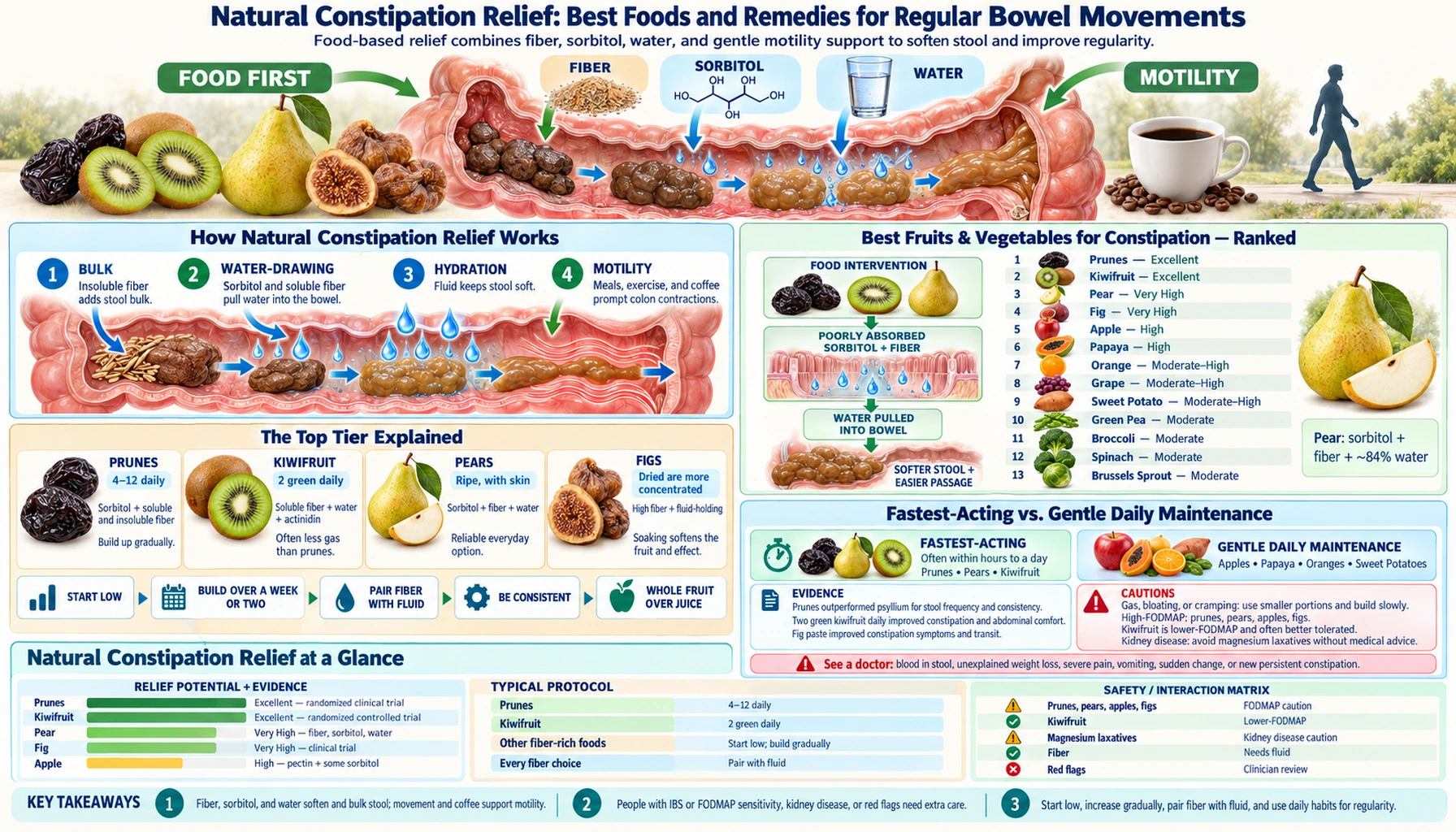
For most people, ordinary constipation responds remarkably well to food. The most effective natural remedies all work through the same handful of levers — fiber to add bulk, sorbitol and other poorly absorbed sugars to pull water into the bowel, plenty of water to keep stool soft, and compounds that gently stimulate the gut. This guide ranks the best fruits and vegetables for constipation relief and regular bowel movements, explains why each works, and covers the other proven natural approaches — fiber supplements, magnesium, fluids, exercise, coffee, and probiotics. The standouts — prunes and kiwifruit — are backed by real clinical trials, not just tradition.
Table of Contents
- How Natural Constipation Relief Works
- Best Fruits & Vegetables for Constipation — Ranked
- The Top Tier Explained
- Fastest-Acting vs. Gentle Daily Maintenance
- If Pears Already Work for You
- Beyond Fruit: Other Natural Remedies
- How People Use Them
- Cautions & Warning Signs
- Key Research Papers
- Connections
- Featured Videos
How Natural Constipation Relief Works
Almost every natural remedy for constipation works through one or more of four mechanisms. Understanding them tells you why some foods work faster than others — and why combining them works best.
- Bulk (insoluble fiber). Fiber that resists digestion adds bulk to stool and helps it move through the colon, much like a broom. More bulk means a larger, softer, easier-to-pass stool and a stronger urge to go.
- Water-drawing (sorbitol and soluble fiber). Sorbitol, a natural sugar alcohol the body absorbs poorly, acts as an osmotic laxative: it pulls water into the bowel, softening stool. Soluble fiber holds water in the same way. This is the single biggest reason prunes, pears, and apples “get things moving.”
- Hydration. Stool is mostly water. Without enough fluid, even a high-fiber diet can backfire and harden stool. Fiber and water are partners, not alternatives.
- Motility stimulation. Some foods and habits actively prompt the colon to contract — coffee, exercise, and the gastrocolic reflex triggered by eating — moving stool toward the exit.
The best foods, like prunes and kiwifruit, hit several of these at once. For the underlying condition, its causes, and red flags, see the main Constipation page.
Best Fruits & Vegetables for Constipation — Ranked
This ranking blends fiber content, sorbitol, water content, and clinical evidence. Fruits dominate the top because they combine sorbitol and soluble fiber with high water content; the vegetables lower down help mainly through fiber. Where we have a detailed page on a food, its name links to it.
| Rank | Fruit / Vegetable | Relief Potential | Main drivers |
|---|---|---|---|
| 1 | Prunes (dried plums) | Excellent | Sorbitol + fiber; beat psyllium in a head-to-head trial |
| 2 | Kiwifruit | Excellent | Soluble fiber + water + the enzyme actinidin; 2/day proven in trials |
| 3 | Pear (with skin) | Very High | Sorbitol + fiber + ~84% water |
| 4 | Fig (especially dried) | Very High | High fiber + fluid-holding; traditional, trial-supported laxative |
| 5 | Apple (with skin) | High | Pectin (soluble fiber) + some sorbitol |
| 6 | Papaya | High | Fiber + water + the enzyme papain |
| 7 | Orange | Moderate–High | Fiber (eat the pith) + fluid + naringenin |
| 8 | Grape (with skin) | Moderate–High | Fiber + fluid + skin polyphenols; gentle |
| 9 | Sweet Potato (with skin) | Moderate–High | Fiber + resistant starch |
| 10 | Green Pea | Moderate | Fiber + plant protein |
| 11 | Broccoli | Moderate | Fiber; sulforaphane may support motility |
| 12 | Spinach | Moderate | Fiber + magnesium |
| 13 | Brussels Sprout | Moderate | Fiber + fluid |
Read as a whole, the table puts the strongest effects at the top of the list (prunes, kiwifruit, pears, figs). The foods lower down build a fiber-rich pattern that helps keep bowel movements regular day to day and prevents constipation in the first place. Variety helps — different fibers feed different parts of the system.
The Top Tier Explained
1. Prunes — usually the strongest
Prunes are the best-studied natural laxative there is. Prunes are one of the most studied fruits for constipation. In a randomized clinical trial, people with constipation who ate prunes had more complete spontaneous bowel movements and better stool consistency than those taking psyllium, the standard fiber supplement. They combine a large dose of sorbitol (concentrated by drying) with soluble and insoluble fiber and gut-stimulating polyphenols. A typical effective amount is about 4–12 prunes a day, built up gradually. Full detail: Prunes for Digestion, Bowel Movements, and Constipation Relief.
2. Kiwifruit — the gentle powerhouse
Kiwifruit has unusually good evidence and tends to cause less gas than prunes. In an international multicenter trial, eating two green kiwifruit a day significantly improved constipation and abdominal comfort; earlier studies found the same in Chinese patients and in older adults. Kiwi works through soluble fiber, high water content, and actinidin — a natural enzyme that appears to speed stomach emptying and gut transit. Two kiwifruit a day is the amount used in the international trial.
3. Pears — reliable and easy
Pears are one of the most consistently effective everyday fruits, working through the same sorbitol + fiber + water combination as prunes, in a fresh, mild form. They are usually eaten ripe, with the skin on. Full detail: Pears for Digestion, Bowel Movements, and Constipation Relief.
4. Figs — especially dried
Figs are high in fiber and have a long traditional use for constipation. In a 2016 randomized, placebo-controlled trial of 80 Korean adults with functional constipation, 8 weeks of fig paste significantly shortened colon transit time and improved stool type and abdominal discomfort compared with placebo. Dried figs are more concentrated than fresh; soaking them softens both the fruit and the effect.
Fastest-Acting vs. Gentle Daily Maintenance
Different foods suit different goals. Some act within hours; others are better as a daily habit that quietly keeps you regular.
- Fastest-acting (often within hours to a day): Prunes, Pears, Kiwifruit. These carry the most sorbitol and water alongside fiber, so they work quickly.
- Gentle daily maintenance: Apples, Papaya, Oranges, Sweet Potatoes. These are lower in sorbitol but build a steady, fiber-rich pattern that prevents constipation over time.
A pattern people commonly describe is a fast-acting fruit when they are backed up, and the gentler foods (plus enough water) to stay regular day to day.
If Pears Already Work for You
If pears reliably get things moving for you, the fruits most likely to have a similar or stronger effect are, in order:
- Prunes — usually the strongest; the natural step up from pears.
- Kiwifruit — comparable effect, often with less gas; the trials used two kiwis per day.
- Pears — what already works; they can stay in rotation alongside the others.
- Dried figs — high fiber, easy to add to breakfast.
- Apples with skin — gentler, good for maintenance.
- Papaya — mild and soothing, with its own enzyme.
Among fresh fruits, kiwifruit and pears are probably the two most consistently effective natural options — so for someone looking to replace pears, two kiwifruit a day is the swap with the most trial evidence behind it.
Beyond Fruit: Other Natural Remedies
Fruit is the easiest place to start, but several other natural approaches are well supported — and they combine well with a fruit-rich diet.
- Fiber supplements — psyllium and ground flaxseed. If diet alone is not enough, chia seeds, ground flaxseed, and psyllium husk add soluble fiber. Psyllium is a gel-forming fiber shown to outperform some stool softeners for chronic constipation, and ground flaxseed improved constipation in a randomized trial. Psyllium labels direct mixing each dose with at least 8 ounces (a full glass) of water and warn that taken without enough fluid it can swell and block the throat or esophagus and cause choking.
- Magnesium. Magnesium (as citrate or oxide) is an osmotic laxative — it draws water into the bowel. In a randomized trial, magnesium oxide relieved chronic constipation about as well as the herb senna. It is a common, gentle option. The Institute of Medicine (1997) reports that high blood magnesium (hypermagnesemia) occurs in people with impaired kidney function, most often when they also take non-food magnesium such as antacids or laxatives; its upper limit for magnesium from supplements and medicines is 350 mg a day for teenagers and adults. Magnesium citrate labels add that laxatives may affect how other drugs work and direct taking it 2 or more hours before or after other drugs.
- Water and fluids. Adequate fluid is the partner of fiber. Increasing fiber without increasing water can worsen constipation; fluid taken steadily through the day keeps pace with the fiber.
- Physical activity. Exercise — even a daily walk — stimulates the natural muscular contractions of the colon and is consistently linked to better regularity.
- Coffee. Coffee (caffeinated especially) stimulates colonic contractions in many people within minutes — a real, if individual, effect. See Coffee.
- Probiotics and fermented foods. Probiotics and fermented foods can modestly improve stool frequency and transit time; a meta-analysis found certain strains help functional constipation. They are often paired with the prebiotic fiber in fruit and beans.
- Routine and toilet posture. Two free habits are commonly described: responding promptly to the urge rather than delaying it, and using a footstool to raise the knees above the hips, which straightens the rectal angle and makes passing stool easier.
How People Use Them
- Starting low and building up. Fiber- and sorbitol-rich foods are usually added gradually over a week or two. Jumping straight to a large amount commonly causes gas and bloating that settles as the gut adapts.
- Fiber paired with fluid. Fiber and sorbitol pull water into the bowel and work best with good hydration.
- Consistency. These foods work best as a daily habit, not a one-time rescue. Regular intake produces regular bowel movements.
- Combining mechanisms. A fruit for sorbitol, a vegetable or supplement for fiber, water for hydration, and a morning walk or coffee for motility — together they are more effective than any one alone.
- Whole fruit and juice. Juice (prune or pear) delivers concentrated sorbitol and can work fast, but loses the fiber of whole fruit, so it is usually kept as an occasional tool rather than the everyday choice.
Cautions & Warning Signs
- Gas, bloating, and cramping. The sorbitol and fiber that relieve constipation can cause these in larger amounts. Smaller portions, built up slowly, usually solve it.
- Irritable bowel syndrome (IBS) and FODMAP sensitivity. Many of these fruits (prunes, pears, apples, figs) are high in FODMAPs and can trigger symptoms in people with irritable bowel syndrome. Kiwifruit is lower-FODMAP and often better tolerated.
- Large amounts of sorbitol. Very large amounts of sorbitol (for example, a lot of prune juice) can cause diarrhea and cramping.
- Kidney disease and magnesium. The Institute of Medicine (1997) reports that high blood magnesium occurs mainly in people with impaired kidney function who take non-food magnesium such as antacids or laxatives, and that deaths from very large doses of magnesium sulfate or magnesium oxide have been reported, especially in people with poor kidney function. Magnesium citrate laxative labels list kidney disease and a magnesium-restricted diet among the conditions to ask a doctor about before use.
- Stimulant laxatives long-term. Food-based remedies are meant to be a sustainable first line. Over-the-counter stimulant laxative labels (senna) state that laxative products are not for use longer than 1 week unless directed by a doctor.
- Warning signs. Constipation that is new and persistent, that comes with blood in the stool, unexplained weight loss, severe pain, vomiting, or a sudden change in bowel habits, or that does not improve with these measures can signal a problem that needs medical evaluation. Over-the-counter laxative labels state that rectal bleeding, or no bowel movement after using a laxative, “could be signs of a serious condition,” and list a change in bowel habits lasting 2 weeks and laxative use for longer than 1 week as reasons to ask a doctor before use.
Key Research Papers
Fruits & Foods
- Attaluri A, et al. Randomised clinical trial: dried plums (prunes) vs. psyllium for constipation. Alimentary Pharmacology & Therapeutics. 2011. — Prunes outperformed psyllium for stool frequency and consistency. — doi:10.1111/j.1365-2036.2011.04594.x
- Lever E, et al. Systematic review: the effect of prunes on gastrointestinal function. Alimentary Pharmacology & Therapeutics. 2014. — Found four trials, one in constipation (prunes beat psyllium for stool frequency and consistency); says the evidence for other outcomes is weak and the benefit needs confirming by further rigorous research. — doi:10.1111/apt.12913
- Gearry R, et al. Consumption of 2 green kiwifruits daily improves constipation and abdominal comfort — results of an international multicenter randomized controlled trial. American Journal of Gastroenterology. 2023. — Two green kiwifruit daily relieved constipation across multiple countries. — doi:10.14309/ajg.0000000000002124
- Chan AOO, et al. Increasing dietary fiber intake in terms of kiwifruit improves constipation in Chinese patients. World Journal of Gastroenterology. 2007. — Kiwifruit improved bowel function in constipated adults. — doi:10.3748/wjg.v13.i35.4771
- Rush EC, et al. Kiwifruit promotes laxation in the elderly. Asia Pacific Journal of Clinical Nutrition. 2002. — Kiwifruit improved laxation in older adults. — doi:10.1046/j.1440-6047.2002.00287.x
- Baek HI, et al. Randomized, double-blind, placebo-controlled trial of Ficus carica paste for the management of functional constipation. Asia Pacific Journal of Clinical Nutrition. 2016. — Fig paste shortened colon transit time and improved stool type and abdominal discomfort versus placebo in 80 adults. — PubMed PMID: 27440682
- Reiland H, Slavin J. Systematic Review of Pears and Health. Nutrition Today. 2015. — Review of pears’ fiber, sorbitol, and digestive benefits. — doi:10.1097/NT.0000000000000112
Fiber, Sorbitol & Mechanisms
- Yang J, et al. Effect of dietary fiber on constipation: a meta analysis. World Journal of Gastroenterology. 2012. — More dietary fiber increases stool frequency. — doi:10.3748/wjg.v18.i48.7378
- Christodoulides S, et al. Systematic review with meta-analysis: effect of fibre supplementation on chronic idiopathic constipation in adults. Alimentary Pharmacology & Therapeutics. 2016. — Fibre supplementation (especially soluble) improves constipation. — doi:10.1111/apt.13662
- McRorie JW, et al. Psyllium is superior to docusate sodium for treatment of chronic constipation. Alimentary Pharmacology & Therapeutics. 1998. — The gel-forming fiber psyllium beat a common stool softener. — doi:10.1046/j.1365-2036.1998.00336.x
- Soltanian N, et al. A randomized trial of the effects of flaxseed to manage constipation, weight, glycemia, and lipids. Nutrition & Metabolism. 2018. — Ground flaxseed improved constipation in a controlled trial. — doi:10.1186/s12986-018-0273-z
- Lederle FA, et al. Cost-effective treatment of constipation in the elderly: a randomized double-blind comparison of sorbitol and lactulose. The American Journal of Medicine. 1990. — Sorbitol relieved constipation as well as the laxative lactulose. — doi:10.1016/0002-9343(90)90177-f
- Anderson JW, et al. Health benefits of dietary fiber. Nutrition Reviews. 2009. — Overview of fiber’s role in bowel and metabolic health. — doi:10.1111/j.1753-4887.2009.00189.x
Other Natural Remedies
- Morishita D, et al. Senna versus magnesium oxide for the treatment of chronic constipation: a randomized, placebo-controlled trial. American Journal of Gastroenterology. 2021. — Magnesium oxide and senna both relieved chronic constipation. — doi:10.14309/ajg.0000000000000942
- Dimidi E, et al. The effect of probiotics on functional constipation in adults: a systematic review and meta-analysis of randomized controlled trials. The American Journal of Clinical Nutrition. 2014. — Certain probiotics improved stool frequency and transit time. — doi:10.3945/ajcn.114.089151
- Fedewa A, Rao SSC. Dietary fructose intolerance, fructan intolerance and FODMAPs. Current Gastroenterology Reports. 2014. — Why sorbitol- and fructose-rich foods affect sensitive guts (the FODMAP caveat). — doi:10.1007/s11894-013-0370-0
- Müller-Lissner SA, et al. Myths and misconceptions about chronic constipation. The American Journal of Gastroenterology. 2005. — Separates evidence from folklore in constipation care. — doi:10.1111/j.1572-0241.2005.40885.x