⚠ Evidence warning: Clinical trials or other evidence do not support the claims that cat's whiskers (java tea) flushes out, dissolves or prevents kidney stones or cleanses the kidneys. This page keeps it as a report of what people, websites or other media say.
Cat’s Whiskers as a Diuretic and for Kidney Stones
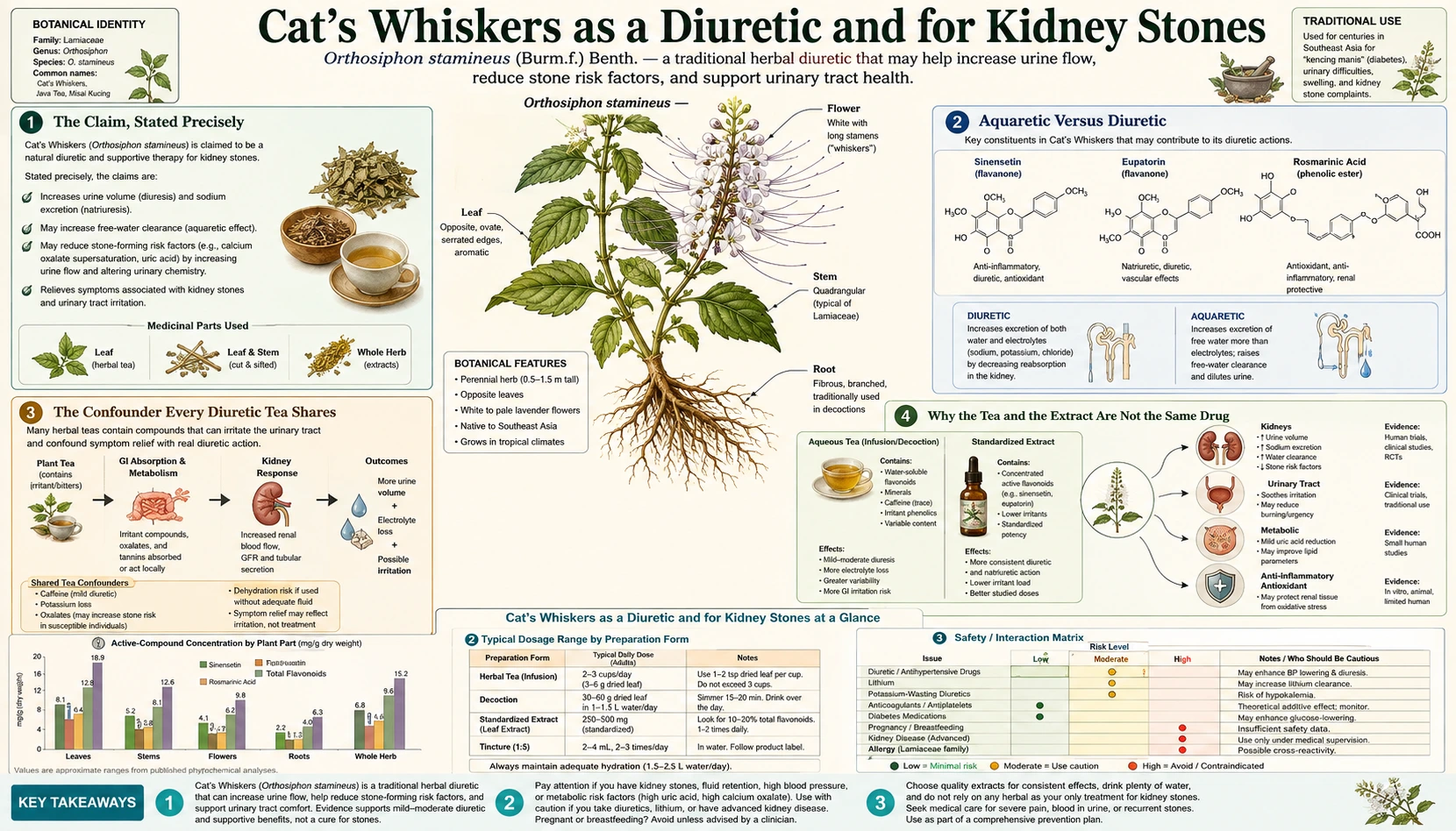
Cat’s whiskers — Orthosiphon stamineus in most of the research literature, Orthosiphon aristatus under the currently accepted name, misai kucing in Malaysia, kumis kucing in Indonesia and java tea on European pharmacy shelves — is sold almost entirely on one promise: that it makes you pass more urine, and that passing more urine flushes grit and stones out of the kidney. It is one of the most-consumed medicinal teas in Southeast Asia, and it holds a formal European traditional-use registration for exactly this purpose.
This page takes that claim apart carefully, because it is the claim most likely to be acted on by someone in pain. Three arguments do most of the work, and none of them is a hedge. First, the water in the cup produces diuresis regardless of the plant, so nobody’s personal experience of “it made me go more” can distinguish herb from vehicle. Second, the compounds the industry measures are the ones least likely to end up in a cup of tea, which means the tea and the standardised capsule are not the same intervention. Third, the one human stone trial that exists is small enough that its headline finding of “no significant difference” could not have detected a difference if one had been there. What follows spells all three out, prints the arithmetic so you can check it, and names precisely what a trial would have to measure to settle the question.
Table of Contents
- The Claim, Stated Precisely
- Aquaretic Versus Diuretic
- The Confounder Every Diuretic Tea Shares
- Why the Tea and the Extract Are Not the Same Drug
- What the Animal Diuresis Data Show
- Scaling the Rat Dose to a Cup of Tea
- What a Real Diuresis Trial Would Measure
- Kidney Stones: The One Human Trial, Read Closely
- The Arithmetic of “No Significant Difference”
- Stone Type Changes the Answer Completely
- How Stone Prevention Is Actually Measured
- What Actually Prevents Stone Recurrence
- Red Flags: When a Stone Is an Emergency
- Evidence Ledger for This Page
- Key Research Papers
- Connections
- Featured Videos
The Claim, Stated Precisely
The European Union herbal monograph on Orthosiphon aristatus leaf licenses the herb “to increase the amount of urine to achieve flushing of the urinary tract as an adjuvant in minor urinary tract complaints.” Read the grammar of that sentence rather than its atmosphere. The licensed effect is an increase in urine volume. The licensed purpose is flushing. The licensed role is adjuvant, meaning alongside something else. The licensed setting is minor complaints.
What the registration does not say is that flushing changes any outcome. That is not an oversight; it is the nature of the instrument. A traditional-use registration in Europe requires documented medicinal use for at least thirty years, fifteen of them within the EU, plus pharmacological plausibility and acceptable safety. It requires no efficacy trial whatsoever. The parallel “well-established use” column, the one that does demand clinical data, is empty for this herb. So the correct reading of the European licence is: this has been drunk for a long time, it is plausible, it appears safe, and nobody has demonstrated that it works. All four statements are compatible, and quoting the licence as proof of efficacy mistakes a legal category for a scientific verdict. The main cat’s whiskers page reproduces the monograph’s wording and dose table in full.
One consequence deserves stating up front, because it shapes everything below. The monograph instructs the user to maintain adequate fluid intake during treatment. That instruction is medically sensible — you cannot increase urine output while dehydrated — but it also means the licensed intervention is a herb bundled with a water load. The two cannot be separated in ordinary use, and they have never been separated in the evidence.
Aquaretic Versus Diuretic
Herbal writing describes java tea as an aquaretic rather than a diuretic, and the distinction is real enough to be worth learning — not least because it is also the distinction that makes the herb weak.
A loop diuretic such as furosemide blocks a specific sodium transporter in the kidney tubule; water follows the sodium it leaves behind, and urine volume rises steeply, at the cost of potassium and magnesium wasting and volume depletion. Thiazides do something comparable further downstream. Both work whether or not you drink extra water, which is exactly why they can dehydrate someone.
An aquaretic, in the loose sense herbal writers use, increases water excretion with comparatively little electrolyte loss. In pharmacology proper the word is reserved for vasopressin V2-receptor antagonists such as tolvaptan, which block the antidiuretic hormone signal in the collecting duct and produce genuine free-water clearance. No published work establishes that cat’s whiskers acts on the vasopressin pathway. The word is being borrowed for its respectability rather than earned by a mechanism. What is actually proposed for this leaf is much vaguer: a potassium load, a possible flavone effect on renal blood flow, and mild osmotic and irritant effects.
Two honest implications follow. The first is favourable to the herb: a mild agent that shifts water without dumping potassium is safer than furosemide, and that fits its long everyday use as a beverage. The second is not: an effect small enough to be safe in that way is also small enough to be indistinguishable from the effect of drinking the tea, and nobody has separated them.
The Confounder Every Diuretic Tea Shares
This is the argument that ends most discussions about herbal diuretics, and it applies identically to cleavers, dandelion leaf, horsetail, nettle and java tea.
Print the arithmetic and it becomes obvious. Assumptions: the monograph’s cup is 150 mL of boiling water on 2–3 g of leaf; the daily dose is 6–12 g of leaf; an adequately hydrated adult suppresses antidiuretic hormone within roughly twenty minutes of a water load and excretes most of the excess over the following one to two hours. On those assumptions the licensed regimen — several 150 mL cups a day — delivers guaranteed extra diuresis every day before the plant contributes anything at all — and that is before the monograph’s separate instruction to keep fluid intake adequate, which pushes total intake higher still.
Now consider what the user perceives. Somebody with vague urinary discomfort starts drinking several extra cups of hot fluid a day, on advice to drink plenty besides, and notices they are urinating more. That observation is guaranteed. It would occur with plain hot water, with rooibos, with weak barley tea. It carries no information about Orthosiphon whatsoever. Personal experience is not merely a weak form of evidence here; it is structurally incapable of answering the question, in the way that tasting a finished stew cannot tell you which pan the salt came from.
This is why an equal-volume control is not a bureaucratic nicety in a diuretic trial — it is the entire experiment. Without it, the measurement is of the mug.
To be fair about what this argument does and does not show: It does not show the plant is inert. It shows that the observation everyone relies on is uninformative — so the reputation of every diuretic tea rests on a measurement that cannot separate herb from vehicle. Sorting that out needs a trial, not more testimonials.
Why the Tea and the Extract Are Not the Same Drug
Here is the part that almost nobody selling this herb mentions, and it is a chemistry point rather than a clinical one.
The marker compounds for cat’s whiskers are sinensetin and eupatorin, together with 3′-hydroxy-5,6,7,4′-tetramethoxyflavone. These are polymethoxylated flavones: flavone skeletons in which free hydroxyl groups have been replaced by methoxy groups. That substitution has a well-understood consequence. Every hydroxyl removed is a hydrogen-bond donor removed, so methylation raises lipophilicity and lowers water solubility substantially. It is the same reason methylating a drug candidate is a standard trick for pushing it across membranes and a standard headache for formulating it in water.
So the compounds the European Pharmacopoeia measures — it sets a minimum sinensetin content for the crude drug — are among the constituents least likely to transfer efficiently into a 150 mL hot-water infusion. Meanwhile the great majority of the pharmacology attributed to this plant, including the vasodilation work discussed on the metabolic and blood-pressure page, was done with ethanolic or hydroalcoholic extracts, which do extract them.
That is a textbook case of solvent substitution: species, plant part and even the word “extract” match between the study and the traditional preparation, so the mismatch is easy to miss, yet hot water and 50% ethanol pull out different fractions of the same leaf. Two practical conclusions follow.
- A flavone result does not transfer to the tea. If sinensetin and eupatorin are the actives, then the traditional infusion — the preparation carrying all the tradition and the entire registration — is the wrong vehicle for delivering them.
- Conversely, if the tea works, the flavones are probably not why. The water-soluble candidates are potassium salts, rosmarinic acid and related caffeic-acid depsides, inositol and simple sugars. Rosmarinic acid is not remotely specific to this plant; rosemary, lemon balm, perilla and most culinary mints carry it, several in greater quantity. Attributing a rosmarinic-acid effect specifically to java tea is compound substitution, and it matters commercially, because the one good single-herb human trial this plant has used a deliberately rosmarinic-acid-rich extract rather than a sinensetin-standardised one.
We cannot quantify how much of each constituent survives into a cup, and we know of no published assay reporting transfer efficiency per gram of commercial leaf into a domestic infusion. A confident milligram-per-cup figure for sinensetin would be an invention, and any source supplying one without stating its extraction protocol is unreliable on that point. What the chemistry does establish is the direction, and the direction is unfavourable to the tea.
One further wrinkle, from the pharmacokinetic literature: work on pig gut microbiota metabolising Orthosiphon aristatus and Filipendula ulmaria extracts found substantial bacterial transformation of the constituents before absorption. The molecules circulating in blood after a cup of java tea are therefore not necessarily the molecules on the certificate of analysis — which weakens the inference from any test-tube result performed on the parent compounds. See Popowski and colleagues, Planta Medica, 2022 — PubMed PMID: 34624904.
What the Animal Diuresis Data Show
Evidence tier: animal, and mixed.
The European assessment report accompanying the monograph reviews several rat diuresis experiments, and it is worth reporting them exactly, because herbal marketing usually reports only the favourable half. Attribution matters here: these figures reach us through the regulator’s review of the primary papers, and we have not independently verified the primary metadata, so they are the assessment report’s summary rather than as first-hand citations.
- Olah and colleagues, 2003. Male rats given 700 mg/kg of a 50% ethanolic leaf extract by mouth produced urine volume about 1.3-fold above control; in the same experiment furosemide (30 mg/kg) produced about 2.5-fold. A 70% ethanolic extract at the same dose produced no increase in urine volume. Sodium excretion rose in all treated animals — in the 50% ethanol group, above the furosemide comparator — potassium excretion rose less than with furosemide, and uric acid elimination improved. No statistical analysis was performed.
- Casadebaig-Lafon and colleagues, 1989. Both an aqueous and a 70% hydro-alcoholic leaf extract, given by mouth to male rats at far lower doses (18 and 180 mg/kg, and 13.5 and 135 mg/kg), produced statistically significant increases in urine volume over water-treated controls in all treated groups, not related to dose. No positive control was used.
- Beaux and colleagues, 1999. A hydro-alcoholic extract given by injection into the abdomen (intraperitoneal, 50 mg/kg) significantly increased urine volume from 2 to 24 hours, with hydrochlorothiazide as the positive control. The assessor questions its relevance because the route is not the one used by people.
- Englert and Harnischfeger, 1992, and Kavimani and colleagues, 1997. Aqueous extracts given by mouth (the 1997 study used Orthosiphon thymiflorus whole plant) at 125 to 1,000 mg/kg did not increase urine volume but raised the excretion of sodium and chloride ions; furosemide also failed to increase urine volume in these two studies, a result the assessor calls questionable.
The report summarises further rat studies too: a 2009 aqueous-extract study at 5 and 10 mg/kg by mouth reporting dose-dependent diuretic activity, less potent than furosemide or hydrochlorothiazide, and a 2008 methanol-extract study in which a single dose did not raise urine output but seven days of repeated dosing did.
Three things should be said about this set of results, and only the third is usually said.
First, in the 2003 experiment the positive control behaved correctly, which validates that assay and ranks the herb below the drug. This is the opposite of the common failure mode in which an extract appears to “beat” a reference drug in a rodent model largely because the reference drug performs badly in rodents. Furosemide worked there, roughly twice as well as the extract. (In the 1992 and 1997 studies, by contrast, furosemide itself did not raise urine volume.)
Second, the 70% ethanol result is a negative finding and belongs in the ledger as one. In the 2003 experiment, two extracts of the same leaf, differing only in extraction solvent, gave 1.3-fold and nothing — although in the 1989 study a 70% hydro-alcoholic extract at much lower doses did raise urine volume significantly. That is not a robust pharmacological signal; it is a signal that depends on manufacturing. It also reinforces the previous section: “Orthosiphon extract” is not one substance, and a label omitting the solvent omits the variable that decided the outcome in the animal data.
Third, a 1.3-fold increase in a rat is a small effect. Rodent diuresis assays are sensitive and are designed to detect exactly this. Detecting a modest effect in a sensitive assay at a high dose is consistent both with a genuinely mild agent and with a marginal one.
For orientation on the wider field, a review of herbal diuretics in the ethnopharmacology literature surveyed the plants claimed to act this way and found the number of studies limited throughout (Wright and colleagues, Journal of Ethnopharmacology, 2007 — PubMed PMID: 17804183). The high-water mark for a traditional diuretic herb in humans remains a small unblinded single-day pilot of dandelion leaf extract in 17 people (Clare and colleagues, 2009 — PubMed PMID: 19678785). Java tea has nothing equivalent.
Scaling the Rat Dose to a Cup of Tea
Rodent doses are frequently quoted at readers as though they were human doses. They are not, and the conversion is standard, so let us do it with the assumptions printed.
Step one — interspecies scaling. Doses are converted between species by body-surface area, using the ratio of the two species’ scaling constants. For rat to human that ratio is conventionally 6 to 37, so the human-equivalent dose is the rat dose multiplied by 6/37, or divided by about 6.2. Applying that to 700 mg/kg gives roughly 113 mg/kg, and for a 70 kg adult, about 7.9 g of extract per day.
Step two — extract back to leaf, and here the arithmetic breaks down honestly. To express 7.9 g of extract as grams of dried leaf you need the drug-to-extract ratio of the extract used in that experiment, and we cannot verify it. The monograph lists drug-to-extract ratios for licensed European preparations ranging from about 5:1 to 12:1. If the rat extract sat anywhere in that range, 7.9 g of extract corresponds to roughly 40 to 95 g of dried leaf per day. The European daily dose of the herb as tea is 6–12 g.
So the rat dose that produced a 1.3-fold urine increase corresponds to something in the region of three to sixteen times the top of the human traditional daily dose. That range is wide because of an input we refuse to guess at, not because of the scaling, and an honest range beats a confident wrong number. The direction, however, holds under every value in the range: the 2003 animal experiment was run far above what anyone drinks, and even there the effect was modest. The 1989 study, by contrast, reported significant increases at oral doses of 13.5 to 180 mg/kg.
A second calibration, for perspective on what a genuinely established plant diuretic looks like. The only plant-derived diuretic mechanism firmly demonstrated in humans is caffeine, and it needs roughly 250–300 mg — two to three strong coffees, in someone not habituated — to produce a measurable acute effect. Java tea contains no caffeine at all. The one proven mechanism in this space is absent from the plant.
What a Real Diuresis Trial Would Measure
A common defence of traditional herbs is that they cannot be trialled properly. For diuresis that is simply false, and saying so precisely is more useful than any hedge. Renal handling of water and salt is among the most thoroughly measurable things in clinical medicine. A competent trial of cat’s whiskers as a diuretic would report:
- 24-hour urine volume, collected properly, against a control arm receiving an equal volume of fluid — not “usual intake,” which is what makes existing observations worthless.
- 24-hour urinary sodium, potassium, chloride and creatinine, with creatinine confirming the collection was complete.
- Fractional excretion of sodium and free water clearance, which separate a solute diuresis from a water diuresis — the exact distinction the word “aquaretic” claims.
- Urine osmolality, plus plasma osmolality, sodium and potassium, to show whether anything was actually depleted.
- Body weight daily — the cheapest and bluntest measure of fluid balance.
- Plasma renin activity and aldosterone, since a real volume effect provokes counter-regulation and a trivial one does not.
Every item on that list is routine, cheap and validated. A crossover design in twenty healthy volunteers with fixed fluid intake would settle whether the leaf adds anything to the water in the cup, and it would take weeks. It has not been done. That is a statement about research priorities, not about the difficulty of the experiment.
There is a fair counter-argument about blinding: an infusion has colour, smell and a grassy bitterness, so plain hot water is a poor placebo. But that is solvable, not impossible — a matched caffeine-free infusion of similar colour and bitterness is a standard beverage-trial control, and encapsulated extract against placebo capsules with protocol-fixed fluid intake removes the difficulty entirely. “Awkward to blind” is not “untestable.”
Kidney Stones: The One Human Trial, Read Closely
Evidence tier: one small randomised comparison, no placebo arm.
Kidney stones are the traditional indication that has actually been studied in people, and there is exactly one study worth the name. It is reported in A long-term study on the efficacy of a herbal plant, Orthosiphon grandiflorus, and sodium potassium citrate in renal calculi treatment, published in the Southeast Asian Journal of Tropical Medicine and Public Health in 2001 — see PubMed PMID: 11944733.
What was done: 48 rural Thai stone-formers, identified by ultrasound, were randomly assigned to two groups and followed for up to 18 months. Half drank two cups a day of Orthosiphon grandiflorus tea, each teabag containing 2.5 g of dried herb. The other half took 5–10 g of sodium potassium citrate daily in divided doses — a real, conventional stone-prevention drug. Every 5 to 7 weeks participants were interviewed, given a further supply, had a kidney ultrasound and gave a spot urine sample; stone size was tracked from the ultrasound images.
What was found: the rate of stone size reduction per year was 28.6 ± 16.0% in the herb group and 33.8 ± 23.6% in the citrate group, a difference reported as not statistically significant. About 90% of initial symptoms improved in both groups. Stones shrank least in people whose urine carried more calcium and uric acid. Fatigue and loss of appetite were observed in 26.3% of the citrate group.
Note the species: O. grandiflorus. Most authorities treat this as the same plant as O. aristatus, but the synonymy is not universally accepted. This is also one reason the literature on this herb is so hard to search — papers are scattered across aristatus, stamineus, grandiflorus, spicatus and Clerodendranthus spicatus, so a search under one name silently misses most of the field. Wherever this leg of the site cites a study, it names the binomial that study used, for exactly that reason.
Four structural problems limit what the trial can support, and the fourth is the one nobody raises.
- There was no placebo or no-treatment arm. Both groups were followed, encouraged and, implicitly, drinking more. Small stones pass and shrink spontaneously; stones of about 4 mm or less pass without intervention in the large majority of cases. Without a control arm there is no way to know how much of that 28% annual shrinkage would have happened anyway.
- Both arms received an intervention that increases fluid intake. Two cups of tea a day is a fluid intervention; citrate powder taken in divided doses is dissolved in fluid. Increased fluid intake is the one measure with solid randomised evidence in stone prevention, so the trial may have compared two delivery vehicles for water.
- Ultrasound is the weak link in the measurement. Ultrasound is less accurate than computed tomography for sizing stones, is prone to inter-observer variation, and tends to overestimate stone diameter. A 28% reduction in a 5 mm stone is about 1.4 mm — a quantity comfortably inside the error of the method used to detect it.
- The symptom data argue against taking the imaging data at face value. The improvements reported in both arms included back pain, headache and joint pain. Headache and joint pain are not symptoms of kidney stones. Near-universal improvement across unrelated complaints in both arms of an unblinded study is the classic signature of expectation, attention and regression to the mean — and if those forces were visibly operating on the symptom outcomes, they were also operating on the unblinded ultrasound measurements.
What the trial does support is modest and genuinely useful: in a small Thai cohort, drinking java tea twice a day was not obviously worse than a standard citrate regimen and was better tolerated. That is a reasonable basis for a traditional-use registration. It does not show that the tea can stand in for urological care.
Alongside it sits a laboratory study, An in vitro study of Orthosiphon stamineus (Misai Kucing) standardized water extract as a chemolytic agent in urolithiasis, in the Journal of Pharmacy and Bioallied Sciences (Ambursa and colleagues, 2021) — PubMed PMID: 35399798. Stone samples from patients who had stones removed — 15 per concentration — were incubated with the water extract at 4, 2 and 1 mg/mL. At 4 mg/mL the extract reduced calcium oxalate stone weight by 70%, against 41% for potassium citrate solution, and the effect depended strongly on acidity: calcium oxalate stone weight fell about 70% at pH 5, 48% at pH 7 and under 10% at pH 8. This is a beaker result on isolated stone material at concentrations a kidney never sees, with no blood supply, no urine flow, no protein matrix and no body around it. It generates a hypothesis. It is not evidence about a person.
The Arithmetic of “No Significant Difference”
The stone trial is routinely summarised as showing java tea “as effective as” citrate. That summary inverts what a non-significant result in a very small study means, and the arithmetic showing why is short enough to print.
Assumptions: two arms of 24; a two-sided significance threshold of 0.05; 80% power; a standard deviation of about 20 percentage points, taken from the reported 16.0 and 23.6; and the usual sum of critical values, 1.96 plus 0.84, equal to 2.80.
The smallest difference such a trial can reliably detect is that sum multiplied by the standard deviation and by the square root of two divided by the number per arm: 2.80 × 20 × the square root of 2/24. The square-root term is about 0.289, so the detectable difference is approximately 16 percentage points.
The difference actually observed was 5.2 percentage points, in favour of citrate. In other words, this trial could only have flagged a gap roughly three times larger than the one it saw. Its non-significant result is therefore not a finding of equivalence — it is the expected outcome whether the two treatments are identical, or whether the drug is meaningfully better and the study simply could not see it. Establishing equivalence requires a pre-specified non-inferiority margin and a sample size built around it, and this trial had neither.
This is not a criticism of the investigators, who reported their numbers plainly and described their work as a long-term observation in a rural cohort. It is a criticism of how the result is quoted. A trial with 24 people per arm comparing two treatments will produce “no significant difference” almost regardless of what the treatments do, and that phrase does not mean “just as good.”
Stone Type Changes the Answer Completely
“Kidney stones” is not one disease, and a tea marketed for stones in general is marketed against at least five different problems with different chemistry and different management. For anyone treating stones at home, this is the most useful section on the page.
- Calcium oxalate — the large majority of stones. Management centres on urine volume, dietary sodium reduction, normal (not low) dietary calcium, moderating oxalate load, and where indicated a thiazide or potassium citrate. Crucially, calcium oxalate stones are not dissolved in the body. No fluid, drug or tea has been shown to dissolve them in a person; the beaker study above, in which calcium oxalate stone material lost weight in concentrated extract at acidic pH, is a laboratory result at concentrations a kidney never sees. The realistic goals are preventing new stones and preventing growth.
- Calcium phosphate — associated with higher urine pH and with conditions such as renal tubular acidosis. Alkalinising the urine, which a potassium-rich tea would tend to do, is the wrong direction for this stone type. This is the clearest demonstration that a generic “stone tea” is incoherent: the same intervention that might help one stone type can favour another.
- Uric acid — the one common stone type that genuinely can be dissolved, by raising urine pH with alkali and lowering urate production. If cat’s whiskers has any plausible chemolytic role at all, this is where it is: the leaf carries a large potassium load, potassium salts of organic acids alkalinise urine, and the animal data reviewed by the regulator reported improved uric acid excretion. That is a specific, testable and completely untested hypothesis, and it is a far better claim than the vague one being sold. See Gout and Uric Acid testing.
- Struvite — infection stones, driven by urease-producing bacteria. They grow as long as the infection persists, can fill an entire renal collecting system, and require complete surgical clearance plus treatment of the infection. Treating a struvite stone with a flushing tea is actively dangerous, because the stone is a reservoir of live bacteria and the failure mode is sepsis, not discomfort.
- Cystine — rare, genetic, requiring very high urine volumes, alkalinisation and specific thiol drugs under specialist care.
Two corollaries. First, stone analysis is the decisive step. A passed stone sent for composition analysis, plus a 24-hour urine study, converts “kidney stones” into a specific problem with a specific answer — and it is the single highest-yield step a recurrent stone-former can take. Second, “stone-dissolving” as a general claim is category confusion, because dissolution is only meaningful for a minority of stone types. A product that does not distinguish them is not describing a mechanism. Compare chanca piedra, the South American “stone breaker,” sold on the same undifferentiated promise with a similarly thin file.
How Stone Prevention Is Actually Measured
As with diuresis, the tools exist and were never pointed at this plant. Here is what a real stone-prevention trial of cat’s whiskers would report.
Intermediate endpoints, from a 24-hour urine collection:
- Urine volume — the master variable, and the one a tea most plausibly moves.
- Urinary calcium, oxalate, citrate, uric acid, sodium, magnesium and phosphate.
- Urine pH, which decides whether uric acid stays dissolved and whether calcium phosphate precipitates.
- Relative supersaturation for calcium oxalate, calcium phosphate and uric acid — computed from the above, and the standard surrogate for stone risk.
Hard endpoints, over two to three years:
- New stone formation on imaging, ideally low-dose computed tomography (CT) rather than ultrasound.
- Growth of existing stones, measured the same way each time by a reader blinded to allocation.
- Symptomatic stone events — renal colic, emergency attendance.
- Need for intervention — shock-wave lithotripsy, ureteroscopy, surgery.
None of these has been applied to cat’s whiskers in an adequately controlled trial. Note precisely what that means, because two verdicts are routinely confused. The claim is absent, not refuted: no adequate trial has tested it, which is a different state from having been tested and failed. The contrast with uva ursi is instructive — bearberry leaf was trialled against placebo for urinary infection and the trial came back negative. Java tea has no such verdict against it. It also has none in its favour.
What Actually Prevents Stone Recurrence
Since the honest answer about the tea is “unknown,” the useful thing this page can do is name what is known. All of the following rests on real human evidence, and none of it is exotic.
- A high urine volume. This is the best-supported measure in stone prevention. In a 5-year randomised prospective study published in the Journal of Urology in 1996, 199 people with a first calcium stone were assigned either to a high water intake with no change of diet or to no treatment; stones recurred in 12 of 99 in the water group and 27 of 100 in the untreated group (p = 0.008) — PubMed PMID: 8583588. The figure of more than about 2.5 litres of urine a day is the American Urological Association guideline’s target, not that trial’s. For someone who enjoys java tea, the fluid it supplies counts towards that target — a genuine and legitimate benefit, of the fluid, delivered pleasantly.
- Sodium intake. High sodium intake drives urinary calcium excretion.
- Normal dietary calcium. Restricting calcium raises oxalate absorption and increases stone risk — one of the most durable counter-intuitive findings in the field.
- Moderate oxalate intake is the usual approach for calcium oxalate formers, rather than eliminating it.
- Potassium citrate or a thiazide where indicated, chosen from the stone type and the 24-hour urine, not from the mere fact of having stones. Professional guidance is summarised in the American Urological Association’s medical-management guideline — 2014 version, PubMed PMID: 24857648.
- Stone analysis and a metabolic workup are the usual next step after a second stone, or after a first in a young person or anyone with a family history.
In November 2026 the American Urological Association replaced its 2014 guideline with a two-part guideline in the Journal of Urology (Part I, PubMed PMID: 42529981; Part II, PubMed PMID: 42529979). It is built on a systematic review that drew on 30 publications, and its statements cover who is at high risk of stone recurrence, metabolic evaluation of high-risk and interested patients, treatment with diet and with drugs, and follow-up.
The site’s condition pages cover this properly: Kidney Stones and, for the inherited oxalate disorders behind some early aggressive stone disease, Primary Hyperoxaluria.
Red Flags: When a Stone Is an Emergency
This list is the most important thing on the page, and it is deliberately consistent with the red-flag approach on the uva ursi urinary-infection page, because the underlying logic is identical: delay is not a neutral choice. If any of the following applies, a tea is not the intervention and the timescale is hours, not weeks.
- Fever or chills with flank pain. An obstructed kidney that is also infected is a urological emergency requiring drainage; it does not wait for antibiotics to work, let alone for tea.
- Pain severe enough that you cannot keep fluids down, or persistent vomiting. Someone vomiting cannot self-treat with a drink, by definition.
- A single functioning kidney, a transplanted kidney, or obstruction on both sides. Obstruction of a solitary kidney is loss of all kidney function, not half.
- Passing little or no urine.
- Known chronic kidney disease or a rising creatinine. See Kidney Disease and Acute Kidney Injury.
- Pregnancy. Stones in pregnancy are managed by specialists, and this herb is not recommended in pregnancy for lack of data.
- Visible blood in the urine that is new or unexplained — it needs assessment even when a stone is the likely cause, because it has other causes too. See Urinalysis.
- Pain that has not settled within a few days, or a stone that has not passed. A stone sitting quietly and obstructing can damage a kidney without much pain at all.
- Known struvite or infection stones. These need clearance, not flushing.
The European monograph itself names fever, painful urination, spasms and blood in the urine as symptoms that, if they occur during use, call for consulting a doctor or qualified health care practitioner, and it gives symptoms persisting longer than two weeks during use as the point for the same consultation. That is the regulator agreeing with the paragraph above. The monograph also lists as contraindications hypersensitivity to the active substance and conditions where a reduced fluid intake is recommended (e.g. severe cardiac or renal disease), and it states that use in children and adolescents under 18 is not recommended because adequate data are lacking.
Evidence Ledger for This Page
Every claim above, sorted by what kind of evidence stands behind it, with negative and absent kept apart.
- Established, and not about the plant. A water load increases urine output. The licensed regimen is 6–12 g of leaf a day as tea at 2–3 g per 150 mL cup, plus an instruction to keep fluid intake adequate, so increased urination during use is guaranteed and uninformative.
- Regulatory position, correctly read. The European traditional-use registration attests documented long use, plausibility and apparent safety. It attests no efficacy, and its well-established-use column is empty.
- Animal, positive but weak. A 50% ethanolic extract at 700 mg/kg raised rat urine volume about 1.3-fold, against 2.5-fold for furosemide, with increased sodium and uric acid excretion.
- Animal, mixed. A 70% ethanolic extract at 700 mg/kg produced no increase in urine volume in the 2003 study, and aqueous extracts at 125–1,000 mg/kg raised sodium and chloride excretion but not urine volume in the 1992 and 1997 studies (where furosemide also failed to raise it). A 1989 study found statistically significant increases in urine volume with both an aqueous and a 70% hydro-alcoholic extract at 13.5–180 mg/kg, and a 1999 study found a significant increase after an intraperitoneal dose of 50 mg/kg.
- One small randomised comparison, uninformative about efficacy. Java tea versus potassium citrate in 48 Thai stone-formers found similar rates of stone shrinkage, in a study with no placebo arm and the power to detect only a difference roughly three times larger than the one observed.
- Laboratory only. A standardised water extract reduced the weight of stone material in vitro (calcium oxalate about 70% at 4 mg/mL, strongly dependent on pH).
- Chemistry, adverse to the tea. The marker flavones are polymethoxylated and therefore poorly water-soluble, so the traditional infusion is a poor delivery vehicle for the constituents the pharmacology used.
- Absent, not refuted. Any effect of the herb on 24-hour urine volume against an equal-volume control; on urinary supersaturation; on stone formation, growth, colic or need for intervention; or on any stone type specifically.
- Traditional use only. “Kidney cleansing,” gravel, difficult urination, and stone dissolution as a general claim.
- Refused. A milligram-per-cup figure for sinensetin or rosmarinic acid; a single-number leaf equivalent for the rat dose; and any claim that this herb dissolves calcium oxalate stones in the body.
Key Research Papers
Each citation ends with its PubMed identifier; topic searches are listed separately at the end. Where a figure reaches us through a regulatory review rather than the primary paper, that is said explicitly.
- Premgamone A, Sriboonlue P, Disatapornjaroen W, et al. A long-term study on the efficacy of a herbal plant, Orthosiphon grandiflorus, and sodium potassium citrate in renal calculi treatment. Southeast Asian Journal of Tropical Medicine and Public Health. 2001;32(3):654–660. The only human stone trial; 48 participants, no placebo arm. — PubMed PMID: 11944733
- Ambursa MB, Rahman MNG, Sulaiman SA, et al. An in vitro study of Orthosiphon stamineus (Misai Kucing) standardized water extract as a chemolytic agent in urolithiasis. Journal of Pharmacy and Bioallied Sciences. 2021;13(4):373–379. Stone dissolution in a beaker. — PubMed PMID: 35399798
- Popowski D, Zentek J, Piwowarski JP, Granica S. Gut microbiota of pigs metabolizes extracts of Filipendula ulmaria and Orthosiphon aristatus — herbal remedies used in urinary tract disorders. Planta Medica. 2022;88(3-04):254–261. Why the circulating compounds are not the label compounds. — PubMed PMID: 34624904
- Ouyang J, Lin D, Chen X, et al. Analysis of the chemical constituents and their metabolites in Orthosiphon stamineus Benth. via UHPLC-Q exactive orbitrap-HRMS and AFADESI-MSI techniques. PLoS One. 2024;19(6):e0304852. Modern constituent mapping by high-resolution mass spectrometry and imaging. — PubMed PMID: 38917120
- Wright CI, Van-Buren L, Kroner CI, Koning MM. Herbal medicines as diuretics: a review of the scientific evidence. Journal of Ethnopharmacology. 2007;114(1):1–31. The state of the whole field, which is thin. — PubMed PMID: 17804183
- Clare BA, Conroy RS, Spelman K. The diuretic effect in human subjects of an extract of Taraxacum officinale folium over a single day. Journal of Alternative and Complementary Medicine. 2009;15(8):929–934. A small, single-day, unblinded pilot — and the best human measurement any traditional diuretic herb has. — PubMed PMID: 19678785
- Borghi L, Meschi T, Amato F, et al. Urinary volume, water and recurrences in idiopathic calcium nephrolithiasis: a 5-year randomized prospective study. Journal of Urology. 1996;155(3):839–843. The randomised evidence for high water intake. — PubMed PMID: 8583588
- Pearle MS, Goldfarb DS, Assimos DG, et al. Medical management of kidney stones: AUA guideline. Journal of Urology. 2014;192(2):316–324. Where citrate and thiazides genuinely belong, and on what basis; replaced in 2026. — PubMed PMID: 24857648
- Pearle MS, Matlaga BR, Antonelli JA, et al. Medical Management of Kidney Stones: AUA Guideline (2026) Part I: Evaluation of Patients With Kidney Stones and Dietary Management of Patients With Calcium Stones. Journal of Urology. 2026;216(5):613–622. — PubMed PMID: 42529981
- Pearle MS, Matlaga BR, Antonelli JA, et al. Medical Management of Kidney Stones: AUA Guideline (2026) Part II: Treatment and Follow-up of Kidney Stones. Journal of Urology. 2026;216(5):623–631. — PubMed PMID: 42529979
- European Medicines Agency, Committee on Herbal Medicinal Products. European Union herbal monograph on Orthosiphon aristatus (Blume) Miq. var. aristatus, folium. Final – Revision 1. EMA/HMPC/486551/2020, 22 September 2021. Indication, dose, contraindications and warnings quoted on this page. — EMA monograph (PDF)
- European Medicines Agency, Committee on Herbal Medicinal Products. Assessment report on Orthosiphon aristatus (Blume) Miq. var. aristatus, folium. EMA/HMPC/486549/2020, 22 September 2021. Source of the rat diuresis summaries in the animal section.
- Topic search — Orthosiphon and urolithiasis. Everything published on this herb and stones, under any of its names.
- Topic search — Orthosiphon and diuresis. The primary diuresis literature the regulator reviewed.
- Topic search — sinensetin and polymethoxylated flavone solubility. The chemistry behind the tea-versus-extract argument.
- Topic search — spontaneous passage rates of ureteric stones by size. Why a single-arm shrinkage figure means little without a control.
Connections
- All Herbs
- Cat’s Whiskers / Java Tea — the main page, with the full European monograph wording, dose table and constituent list.
- Urinary Tract Complaints — why flushing is not an antimicrobial claim.
- Kidney Cautions and Interactions — the potassium arithmetic, and who should not drink this.
- Metabolic and Blood Pressure Research — where the flavone pharmacology actually points.
- Kidney Stones — stone types, workup and what prevents recurrence.
- Kidney Stones (Nephrology) — the metabolic and 24-hour-urine side of stone disease.
- Primary Hyperoxaluria — the inherited oxalate disorders behind some early, aggressive stone disease.
- Chanca Piedra for Kidney Stones — the same undifferentiated “stone breaker” claim in another hemisphere.
- Cleavers as a Diuretic — where the water-in-the-cup arithmetic on this site was first set out.
- Dandelion as a Diuretic — the one traditional diuretic with a human measurement, however small.
- Horsetail as a Diuretic — another traditional aquaretic, capped for a different reason.
- Uva Ursi: What the Trials Found — the contrast case, where the trial was run and came back negative.
- Gout — uric acid, and the one stone type that genuinely dissolves.
- Kidney Function Tests — blood urea nitrogen (BUN), creatinine, estimated glomerular filtration rate (eGFR) and cystatin C, the numbers “kidney support” never reports.
- Urinalysis — blood, crystals, pH and what a dipstick can and cannot settle.
- Covered in depth on its own page: Calcium