Uva Ursi for Urinary Tract Infection: What the Trials Show
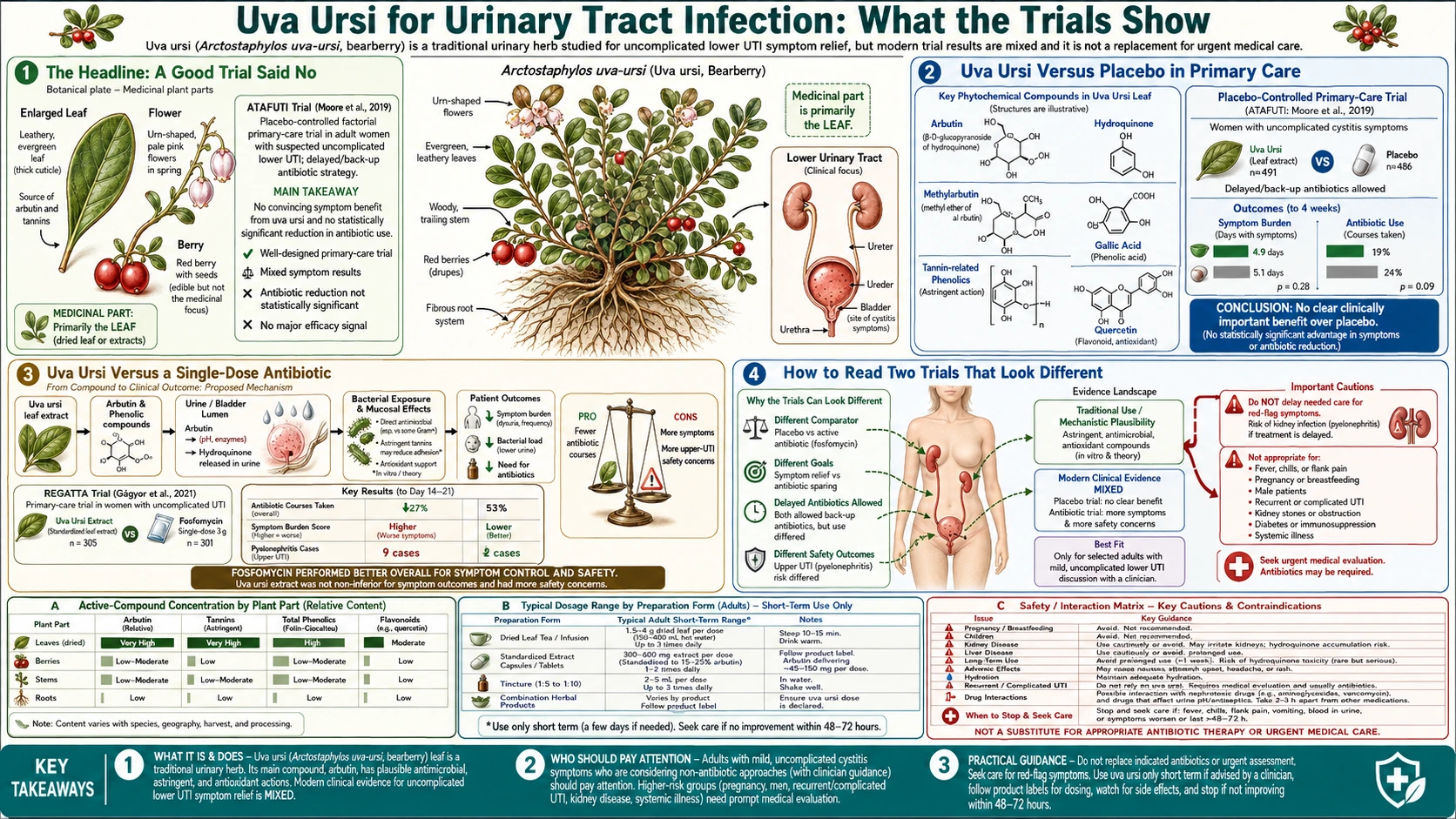
Most herbs on this site have never been tested properly, so the honest verdict is usually “traditional use, unproven.” Uva ursi is different, and that is the whole point of this page. Bearberry leaf (Arctostaphylos uva-ursi) has actually been through modern randomized controlled trials in exactly the population that reaches for it — women with an ordinary, uncomplicated bladder infection. Those trials came back with an answer, the answer was no, and that answer is almost completely absent from the way the herb is sold.
This page does something unusual for a “Benefits” page: it leads with the negative result, states it plainly, and only then explains the context. For anyone with burning and urgency right now who is hoping a herbal tea will fix it, the warning-signs section lists the signs that an infection may be spreading. The trials also show that waiting on a urinary infection is not a neutral choice.
Table of Contents
- The Headline: A Good Trial Said No
- Uva Ursi Versus Placebo in Primary Care
- Uva Ursi Versus a Single-Dose Antibiotic
- How to Read Two Trials That Look Different
- The Older Prevention Trial, and Why It Is Not Enough
- The Wider Pattern: Non-Antibiotic Strategies Keep Disappointing
- Why Delay Is Not Neutral
- How Uva Ursi Compares With Cranberry and D-Mannose
- Other Claimed Uses and Where They Stand
- Evidence Tiers at a Glance
- Warning Signs That the Infection May Be Spreading
- What This Means If You Are Deciding Right Now
- Key Research Papers
- Connections
- Featured Videos
The Headline: A Good Trial Said No
Evidence tier: randomized clinical trial.
A well-conducted randomized, placebo-controlled trial of uva ursi extract in women with uncomplicated urinary tract infection found that uva ursi did not ease the severity of frequency symptoms on days 2 to 4 compared with placebo, and did not significantly reduce how many women went on to use antibiotics (39.9% versus 47.4% on placebo, a difference that could be chance). Every woman in the trial also held a delayed (“back-up”) antibiotic prescription. That trial was run in ordinary general practice, in the exact clinical situation the herb is marketed for, with a placebo control and randomization — the design that is hardest to fool.
It is the result that is almost never mentioned on a supplement label. It was published as Uva-ursi extract and ibuprofen as alternative treatments for uncomplicated urinary tract infection in women (ATAFUTI): a factorial randomized trial in Clinical Microbiology and Infection (2019). Its record: PubMed PMID: 30685500.
Take a moment on why that matters more than it sounds. A negative placebo-controlled trial does not merely mean “we are still unsure.” It means the herb was given a fair chance to beat a sugar pill in real patients and did not do it. Uncomplicated cystitis is a condition where a substantial share of women get better on their own within a week regardless of what they take — which means an ineffective remedy will look like it works to almost everyone who tries it. Personal experience cannot tell these apart. A placebo arm can.
Uva Ursi Versus Placebo in Primary Care
Evidence tier: randomized clinical trial.
The placebo-controlled trial described above used a factorial design: women presenting to their general practitioner (GP) with symptoms of a simple lower urinary infection were allocated both to uva ursi extract or a matching placebo, and to advice on taking ibuprofen or not. That layout lets one study answer two questions at once, and it means the uva ursi comparison is genuinely against placebo rather than against “nothing at all,” which is a much weaker test.
What the investigators looked for:
- Symptom severity — a score of how bad frequency of urination and the related symptoms were on days 2 to 4.
- Subsequent antibiotic use — whether taking the herb let women avoid a prescription over the following days.
On the first, uva ursi did not deliver: symptom scores on the herb were no better than on placebo (difference −0.06 points, 95% confidence interval −0.33 to 0.21). On the second, 39.9% of women on uva ursi and 47.4% on placebo used antibiotics (odds ratio 0.59, 95% confidence interval 0.22 to 1.58), a difference the trial could not tell apart from chance. The claim “it reduces antibiotic use” is not supported by this trial. In the same trial, advice to take ibuprofen did cut antibiotic use (34.9% versus 51.0%; one woman fewer used antibiotics for every seven given the advice), and no upper urinary tract infections were recorded in any group.
There is one honest caveat in the herb's favour, and it belongs here rather than buried at the bottom: a trial can miss a real but small effect. What this trial rules out is a clinically obvious benefit — the kind that would justify choosing a herb over established treatment. It does not prove the extract is biologically inert. But “possibly a small effect we cannot detect” is a very different product from what is sold on the shelf.
Uva Ursi Versus a Single-Dose Antibiotic
Evidence tier: randomized clinical trial — and the more alarming of the two.
The second major trial asked a different and more practical question: if a woman with a simple bladder infection takes uva ursi instead of an antibiotic, what happens? This was the REGATTA trial, published as Herbal treatment with uva ursi extract versus fosfomycin in women with uncomplicated urinary tract infection in primary care: a randomized controlled trial in Clinical Microbiology and Infection (2021). Its protocol was published earlier in BMC Complementary and Alternative Medicine (2018). Their records: PubMed PMID: 34111592 (trial) and PubMed PMID: 29970072 (protocol).
The trial enrolled 398 women in 42 German family practices. They took either uva ursi 105 mg, 2 tablets 3 times a day for 5 days, or a single 3 g dose of the antibiotic fosfomycin, each with matching dummy pills, so that neither the women nor their doctors knew who got what.
The trade-off it found is worth stating carefully, because both halves are true:
- Antibiotic use fell. Antibiotic courses over 28 days were 63.6% lower in the uva ursi group than in the fosfomycin group. If the only goal were reducing antibiotic prescriptions, that reads as a win.
- They felt worse for longer. Overall symptom burden across the first week was higher in the uva ursi group — 136.5% of the burden in the women who got the single antibiotic dose, failing the trial’s pre-set limit of 125%. The herb did not substitute for treatment; it substituted for relief.
- More infections climbed to the kidneys. Eight women developed pyelonephritis — upper urinary tract (kidney) infection — in the uva ursi arm, compared with two on fosfomycin (p = 0.067), a difference that fell just short of statistical significance. The numbers were small in absolute terms, as they always are in a trial of this size, but they pointed the wrong way.
The investigators concluded that in women with uncomplicated urinary infection, starting with uva ursi “reduced antibiotic use but led to a higher symptom burden and more safety concerns than fosfomycin.” The trial team set out to test an antibiotic-sparing option and reported that the one they tested came with those costs.
How to Read Two Trials That Look Different
People sometimes point at these two trials and say the evidence is “mixed.” It is not really mixed — it is consistent once you notice that they asked different questions.
- Against placebo, uva ursi did not ease symptoms. So there is no demonstrated benefit.
- Against an antibiotic, uva ursi left women with more symptoms and more kidney infections (8 versus 2, short of statistical significance). So there is a demonstrated cost to using it as a replacement.
Put those together and the picture is coherent: no proven upside, and a real downside when it displaces treatment. The apparent “win” in the antibiotic trial — fewer prescriptions — is what you would also get by handing out nothing at all, because most simple cystitis resolves eventually. Fewer antibiotics is only a benefit if patients do not pay for it in symptom-days and complications. Here they did.
The Older Prevention Trial, and Why It Is Not Enough
Evidence tier: preliminary (small, old, combination product).
The one positive-looking human study is much older and much weaker. A small preliminary trial published in Current Therapeutic Research in 1993 tested a standardized bearberry preparation — a bearberry-and-dandelion combination product — for preventing recurrent cystitis over a year, and reported fewer recurrences than placebo. The paper is not indexed in PubMed; its record: doi:10.1016/s0011-393x(05)80204-8.
Four things keep this from carrying much weight:
- It was tiny, and small trials produce large, unreliable effect sizes in both directions.
- It was a combination product, so any effect cannot be assigned to bearberry.
- It tested prevention, not treatment — a different question from the one most people use the herb for.
- It has never been replicated in more than thirty years, despite the herb remaining widely sold. Unreplicated small positives are the single most common way a remedy acquires an undeserved reputation.
There is also a hard problem specific to this herb: prevention means continuous use, and continuous use is exactly what uva ursi's safety ceiling forbids. Even if the 1993 signal were real, the regulatory limit of about a week at a time makes year-round prophylaxis inadmissible. See Preparation, Dosing and Why Duration Is Capped.
The Wider Pattern: Non-Antibiotic Strategies Keep Disappointing
Evidence tier: multiple randomized clinical trials.
Uva ursi is not being singled out. Over the last fifteen years several serious research groups have tested whether uncomplicated cystitis can be managed without antibiotics, using anti-inflammatories rather than herbs, and the results form a pattern.
- Ibuprofen versus fosfomycin for uncomplicated urinary tract infection in women: randomised controlled trial, BMJ (2015) — the nonsteroidal anti-inflammatory drug (NSAID) arm avoided many antibiotic prescriptions but had a longer symptom course and more upper urinary tract infections. PubMed PMID: 26698878
- Symptomatic treatment of uncomplicated lower urinary tract infections in the ambulatory setting: randomised, double blind trial, BMJ (2017) — diclofenac was inferior to an antibiotic for symptom resolution (54% versus 80% symptom-free at day 3), and pyelonephritis occurred only in the nonsteroidal anti-inflammatory drug group (6 women, 5%, versus none). PubMed PMID: 29113968
- Ibuprofen versus pivmecillinam for uncomplicated urinary tract infection in women — a double-blind, randomized non-inferiority trial, PLoS Medicine (2018) — ibuprofen failed non-inferiority, and 7 of 181 women in the ibuprofen arm developed kidney infection (5 of them were admitted to hospital) while none did on the antibiotic. PubMed PMID: 29763434
- An earlier pilot of 79 women comparing ibuprofen with ciprofloxacin, published in BMC Medicine (2010), reported results that supported non-inferiority of ibuprofen (58.3% versus 51.5% symptom-free on day 4); 33% of the ibuprofen group versus 18% of the antibiotic group needed a later antibiotic course, a difference that was not statistically significant, and the authors called for larger trials. PubMed PMID: 20504298
Across these trials the counts of pyelonephritis in the non-antibiotic arms were small — 7 with ibuprofen in the Nordic trial, 6 with diclofenac in the Swiss trial and 8 with uva ursi in REGATTA — but higher than in the antibiotic arms, which had none, none and two. The placebo-controlled ATAFUTI trial, in which every woman held a back-up antibiotic prescription, recorded none in any group. Individually each count is small enough to shrug at. Repeated across independent trials in different countries, it stops being noise.
The relevance to uva ursi is direct. The whole marketing premise of the herb is “you can skip the antibiotic.” The best available evidence on skipping the antibiotic — whether you skip it with a herb or with ibuprofen — is that a minority of women pay for it with a kidney infection. That is not a neutral trade.
Why Delay Is Not Neutral
It helps to understand what is actually happening anatomically. A simple bladder infection is bacteria — usually Escherichia coli — multiplying in the bladder lining. Pyelonephritis is the same bacteria having travelled up the ureters into the kidney. That escalation converts an unpleasant few days into a serious illness: high fever, shaking chills, flank pain, vomiting, and a genuine risk of the infection reaching the bloodstream. It commonly needs intravenous antibiotics and sometimes hospital admission, and in a minority of people it leaves lasting kidney scarring.
So the arithmetic of “wait and see with a herb” is asymmetric. The upside of avoiding an antibiotic course is real but modest — fewer side effects, a little less pressure on resistance. The downside is low-probability but severe. When a trial reports “only a handful more cases of pyelonephritis,” each of those cases is a person who got badly ill in a way that immediate treatment would probably have prevented.
None of this means antibiotics are always the right answer or that antibiotic overuse is not a genuine problem — it is. The approaches studied for overuse are better diagnosis and shorter, better-targeted courses; the one herb tested in place of antibiotics has a negative placebo-controlled trial behind it. For background on the condition itself see Urinary Tract Infections and Pyelonephritis.
How Uva Ursi Compares With Cranberry and D-Mannose
Readers usually arrive here having also heard about cranberry or D-mannose, so they are placed side by side here, together with one non-antibiotic prevention medicine. None of them is a treatment for an infection already present.
- Cranberry — prevention only, modest, better evidence than uva ursi. Systematic reviews in the Cochrane Library have repeatedly examined cranberry products for preventing recurrent urinary infection, and the most recent updates find a reduction in recurrences in some groups. The 2023 Cochrane update (50 trials, 8,857 people) found that cranberry products reduced symptomatic, culture-confirmed infections overall (risk ratio 0.70), and in women with recurrent urinary tract infection (UTI) (0.74), children (0.46) and people prone to infection after a medical procedure (0.47), but showed little or no benefit in elderly care-home residents, pregnant women, or adults whose bladders do not empty fully because of nerve or muscle problems. The effect is modest and the older reviews were more sceptical, but this is a stronger evidence base than uva ursi has, and cranberry has no hydroquinone problem. Crucially, it is prophylaxis, not therapy. PubMed PMID: 37947276. See also Cranberries.
- D-mannose — an early positive trial, then a negative placebo-controlled one. A randomized study in World Journal of Urology (2014) reported that D-mannose powder reduced recurrences in women with recurrent infection, and the mechanism (blocking bacterial adhesion to the bladder wall) is coherent. But a 2024 UK placebo-controlled trial gave 598 women with repeated bladder infections 2 g of D-mannose or a dummy powder daily for 6 months: 51.0% on D-mannose and 55.7% on placebo had another infection needing medical care, a difference that could be chance, and no other outcome differed significantly. PubMed PMID: 23633128; PubMed PMID: 38587819.
- Methenamine hippurate — a non-antibiotic prevention medicine. In the UK ALTAR trial, 240 women with recurrent infections took methenamine hippurate 1 g twice daily or daily low-dose antibiotics for 12 months. Infections treated with antibiotics fell in both groups, to 1.38 versus 0.89 episodes per person-year, a gap within the trial’s pre-set non-inferiority margin of one infection per person-year. During treatment, antibiotic-resistant E. coli on skin swabs was more common in the antibiotic group (72% versus 56%). PubMed PMID: 35535708.
- Uva ursi — negative placebo-controlled trial, plus a safety ceiling. Uniquely among the three, it also carries a hard duration limit because its proposed active metabolite is hydroquinone.
An underrated point: the interventions with the best evidence in recurrent urinary tract infection are the boring ones — adequate fluid intake, addressing constipation, reviewing contraception and post-menopausal vaginal oestrogen with a clinician, and in selected cases a planned prophylactic strategy. In a 2018 randomized trial, 140 premenopausal women with recurrent cystitis (an average of 3.3 episodes the year before) who drank less than 1.5 litres a day either added 1.5 litres of water daily or did not; over 12 months the extra-water group averaged 1.7 bladder infections against 3.2 in the control group, and used antibiotics 1.9 versus 3.6 times. PubMed PMID: 30285042.
Other Claimed Uses and Where They Stand
Bearberry leaf is also promoted for several things beyond acute cystitis. Here is where each actually sits.
- “Urinary antiseptic” and general bladder irritation — traditional use only. The astringent, drying character of the tannin-rich leaf is what earned the reputation, and it is the oldest claim in the file. No modern trial supports it as a treatment.
- Diuretic / “water retention” — traditional use only. Any diuretic effect is unremarkable and shared by drinking more fluid, which carries no hydroquinone.
- Antibacterial activity in the laboratory — preliminary (in vitro). Bearberry extracts and hydroquinone inhibit urinary pathogens in a dish, and there is interesting laboratory work on extracts reducing bacterial adhesion and interacting with resistance mechanisms. Petri-dish activity is a starting hypothesis, not evidence of benefit in a person. PubMed search: uva-ursi antibacterial in vitro
- Kidney stones / “gravel” — traditional use only. This is a nineteenth-century indication with no supporting trials, and reduced kidney function is a contraindication. See Kidney Stones.
- Skin lightening — a different product and exposure route. Arbutin appears in topical cosmetics precisely because it releases hydroquinone, a skin-lightening agent. That is a separate exposure route with its own regulatory history, and it tells you nothing about swallowing the leaf — except that it confirms what the active moiety is.
- Interstitial cystitis / bladder pain syndrome — not supported, and potentially harmful. This is a non-infectious condition with an irritated bladder lining; adding an astringent, tannin-heavy, hydroquinone-yielding herb has no rationale. See Interstitial Cystitis.
Evidence Tiers at a Glance
Every claim on this page carries a label. Collected in one place:
- Randomized clinical trial — negative. Uva ursi did not ease symptoms of uncomplicated urinary tract infection versus placebo, and did not significantly reduce antibiotic use.
- Randomized clinical trial — unfavourable. Used instead of a single-dose antibiotic, uva ursi produced a higher symptom burden and more pyelonephritis (8 versus 2, short of statistical significance).
- Randomized clinical trials — consistent warning. Non-antibiotic management of uncomplicated cystitis, herbal or nonsteroidal anti-inflammatory drug, repeatedly produces more upper urinary tract infections.
- Preliminary. One small, old, unreplicated combination-product trial suggested fewer recurrences with a bearberry/dandelion preparation.
- Preliminary (in vitro). Bearberry constituents inhibit urinary bacteria in the laboratory, and bacteria can liberate hydroquinone from arbutin locally.
- Traditional use only. Urinary antiseptic, astringent, diuretic, “gravel,” and the requirement for alkaline urine.
- Not supported. Uva ursi as a substitute for antibiotic treatment of a diagnosed urinary infection; uva ursi as long-term prophylaxis; uva ursi for interstitial cystitis.
Warning Signs That the Infection May Be Spreading
This is the most important list on the page. These are the signs that clinics and hospitals treat as reasons for medical assessment the same day, because they point to kidney involvement, a complicated infection, or a person at higher risk.
- Fever, chills, or feeling systemically unwell. A simple bladder infection does not usually cause fever. Fever suggests the kidney is involved.
- Flank or back pain — pain in the side or the small of the back, often on one side, sometimes with tenderness when tapped.
- Nausea or vomiting. Both point upward from the bladder, and vomiting also means you cannot reliably keep anything down.
- Blood in the urine. Visible blood needs evaluation even when an infection is the likely cause, because it has other causes too.
- Pregnancy. Urinary infection in pregnancy is treated promptly because of risks to both mother and baby — and uva ursi is contraindicated in pregnancy regardless.
- Male sex. Urinary infection in men is not classed as uncomplicated; it warrants assessment for prostate or structural involvement.
- Children. Urinary infection in children is assessed by a clinician, and uva ursi is not recommended for children at all.
- Recurrent infections — several episodes in a year. This pattern is usually investigated and managed with a prevention plan rather than repeated self-treatment.
- No improvement within 48 hours, or any worsening at any point.
- Diabetes, immune suppression, kidney disease, a urinary catheter, a known structural abnormality, or a recent urological procedure. All move the episode out of the “simple” category.
- Confusion or new unsteadiness in an older adult, which can be the presenting sign of infection rather than the classic burning.
Whether symptoms are an infection at all is settled by a urine dipstick and culture, and culture also shows which antibiotic will work; a 2010 systematic review found that diagnosis by symptoms alone is wrong in about a third of cases. See Urinalysis.
What This Means If You Are Deciding Right Now
Stripped to essentials:
- Uva ursi is not a treatment for a urinary tract infection. The placebo-controlled trial found it did not ease symptoms. Nothing published since has overturned that.
- Using it in place of treatment has measurable costs — more days of symptoms and more kidney infections in the trial that tested exactly that strategy.
- The warning signs above mark a spreading or complicated infection. They are the signs that hospitals treat as urgent, and the part of this page most likely to matter.
- For simple symptoms with no warning signs, the approaches tested in trials are pain relief, fluids, a urine culture and a delayed (back-up) antibiotic prescription; in ATAFUTI, advice to take ibuprofen alongside a back-up prescription cut antibiotic use (34.9% versus 51.0%) with no kidney infections recorded, while anti-inflammatory painkillers given instead of an antibiotic led to more kidney infections in the German, Swiss and Nordic trials.
- For people who use uva ursi, the regulatory limit is a short course of about a week at a time. The dosing and duration page and the safety page set out the limit and the people the research raises concerns for.
- For prevention of recurrence, cranberry has better evidence than uva ursi (the 2023 Cochrane update) and no hydroquinone ceiling, and in a 2018 trial extra water cut repeat bladder infections from 3.2 to 1.7 a year in women who drank little.
Uva ursi's real distinction is that it was tested. Most herbs never are, and their reputations survive on that. Bearberry got its trial and the trial did not go its way — a finding that has rarely reached the way the herb is sold.
Key Research Papers
Each citation below ends in its PubMed or DOI record. Titles, journals and years are stated so you can confirm you have the right paper.
- Uva-ursi extract and ibuprofen as alternative treatments for uncomplicated urinary tract infection in women (ATAFUTI): a factorial randomized trial. Clinical Microbiology and Infection, 2019. The placebo-controlled trial at the centre of this page. PubMed PMID: 30685500
- Herbal treatment with uva ursi extract versus fosfomycin in women with uncomplicated urinary tract infection in primary care: a randomized controlled trial. Clinical Microbiology and Infection, 2021 (REGATTA). Higher symptom burden and more pyelonephritis in the herbal arm. PubMed PMID: 34111592
- Reducing antibiotic use for uncomplicated urinary tract infection in general practice by treatment with uva-ursi (REGATTA) — a double-blind, randomized, controlled comparative effectiveness trial. BMC Complementary and Alternative Medicine, 2018. The pre-specified design. PubMed PMID: 29970072
- Ibuprofen versus fosfomycin for uncomplicated urinary tract infection in women: randomised controlled trial. BMJ, 2015. Fewer antibiotics, longer symptoms, more upper tract infection. PubMed PMID: 26698878
- Symptomatic treatment of uncomplicated lower urinary tract infections in the ambulatory setting: randomised, double blind trial. BMJ, 2017. Diclofenac inferior to antibiotic; pyelonephritis only in the nonsteroidal anti-inflammatory drug (NSAID) arm. PubMed PMID: 29113968
- Ibuprofen versus pivmecillinam for uncomplicated urinary tract infection in women — a double-blind, randomized non-inferiority trial. PLoS Medicine, 2018. Non-inferiority not met; 7 cases of pyelonephritis, all with ibuprofen. PubMed PMID: 29763434
- Prophylactic effect of UVA-E in women with recurrent cystitis: a preliminary report. Current Therapeutic Research, 1993;53:441-443 (Larsson B, Jonasson A, Fianu S). The small, old, unreplicated positive; not indexed in PubMed. doi:10.1016/s0011-393x(05)80204-8
- Botanical medicines for the urinary tract. World Journal of Urology, 2002. Review placing bearberry among traditional urinary herbs and noting the short-course caveat. PubMed PMID: 12522584
- Natural approaches to prevention and treatment of infections of the lower urinary tract. Alternative Medicine Review, 2008. Sympathetic review that still describes the bearberry evidence as limited and inconsistent. PubMed PMID: 18950249
- Cranberries for preventing urinary tract infections. Cochrane Database of Systematic Reviews, updated 2023. The comparator with the better prevention evidence. PubMed PMID: 37947276
- D-mannose powder for prophylaxis of recurrent urinary tract infections in women: a randomized clinical trial. World Journal of Urology, 2014. PubMed PMID: 23633128
- d-Mannose for Prevention of Recurrent Urinary Tract Infection Among Women: A Randomized Clinical Trial. JAMA Internal Medicine, 2024 (Hayward G, et al.). 598 women; no reduction in further infections. PubMed PMID: 38587819
- Methenamine hippurate compared with antibiotic prophylaxis to prevent recurrent urinary tract infections in women: the ALTAR non-inferiority RCT. Health Technology Assessment, 2022 (Harding C, et al.). 240 women; non-inferior to daily low-dose antibiotics. PubMed PMID: 35535708
- Effect of Increased Daily Water Intake in Premenopausal Women With Recurrent Urinary Tract Infections: A Randomized Clinical Trial. JAMA Internal Medicine, 2018 (Hooton TM, et al.). 1.7 versus 3.2 episodes over 12 months. PubMed PMID: 30285042
- Symptomatic treatment (ibuprofen) or antibiotics (ciprofloxacin) for uncomplicated urinary tract infection? — results of a randomized controlled pilot trial. BMC Medicine, 2010 (Bleidorn J, et al.). 79 women; results supported non-inferiority of ibuprofen. PubMed PMID: 20504298
- Uncomplicated urinary tract infection. New England Journal of Medicine, 2012. Standard clinical framing of what “uncomplicated” means and when it stops applying. PubMed PMID: 22417256
- The diagnosis of urinary tract infection: a systematic review. Deutsches Ärzteblatt International, 2010. Diagnosis by clinical criteria alone has an error rate of about 33%. PubMed PMID: 20539810
External Resources
- PubMed — the primary literature index used for every citation above.
- NCCIH (US National Center for Complementary and Integrative Health) — plain-language herb summaries.
- Cochrane Library — systematic reviews, including the cranberry prevention reviews.
- European Medicines Agency — publishes the herbal monograph and assessment report that set the duration limit.
- NHS — patient-facing guidance on urinary tract infection and when to seek urgent care.
Connections
- All Herbs
- Uva Ursi (main page)
- Uva Ursi Benefits Hub
- Arbutin and Hydroquinone Mechanism
- Preparation, Dosing and Duration Limits
- Hydroquinone Risk and Who Should Avoid
- Urinary Tract Infections
- Pyelonephritis
- Interstitial Cystitis
- Kidney Stones
- Urology
- Escherichia coli
- Klebsiella pneumoniae
- Proteus mirabilis
- Urinalysis
- Kidney Function Tests
- Cranberries
- Goldenseal
- Berberine
- Dandelion
- Horsetail
- Marshmallow Root
Safety note. This page is general health education, and it is not a diagnosis. A urinary tract infection can escalate to a kidney or bloodstream infection, and the trial evidence summarised here found more kidney infections when treatment was replaced by uva ursi. Fever, flank or back pain, nausea or vomiting, blood in the urine, symptoms in pregnancy, in a man, or in a child, recurrent infections, or no clear improvement within 48 hours are the signs that clinics treat as reasons for prompt medical care. Uva ursi is not recommended in pregnancy or breastfeeding, in children, or with kidney or liver disease, and its regulatory limit is the short course described on the dosing page. Herbal products can also interact with prescription medicines.