Cassia vs Ceylon Cinnamon — Coumarin Safety
KEY FINDINGS
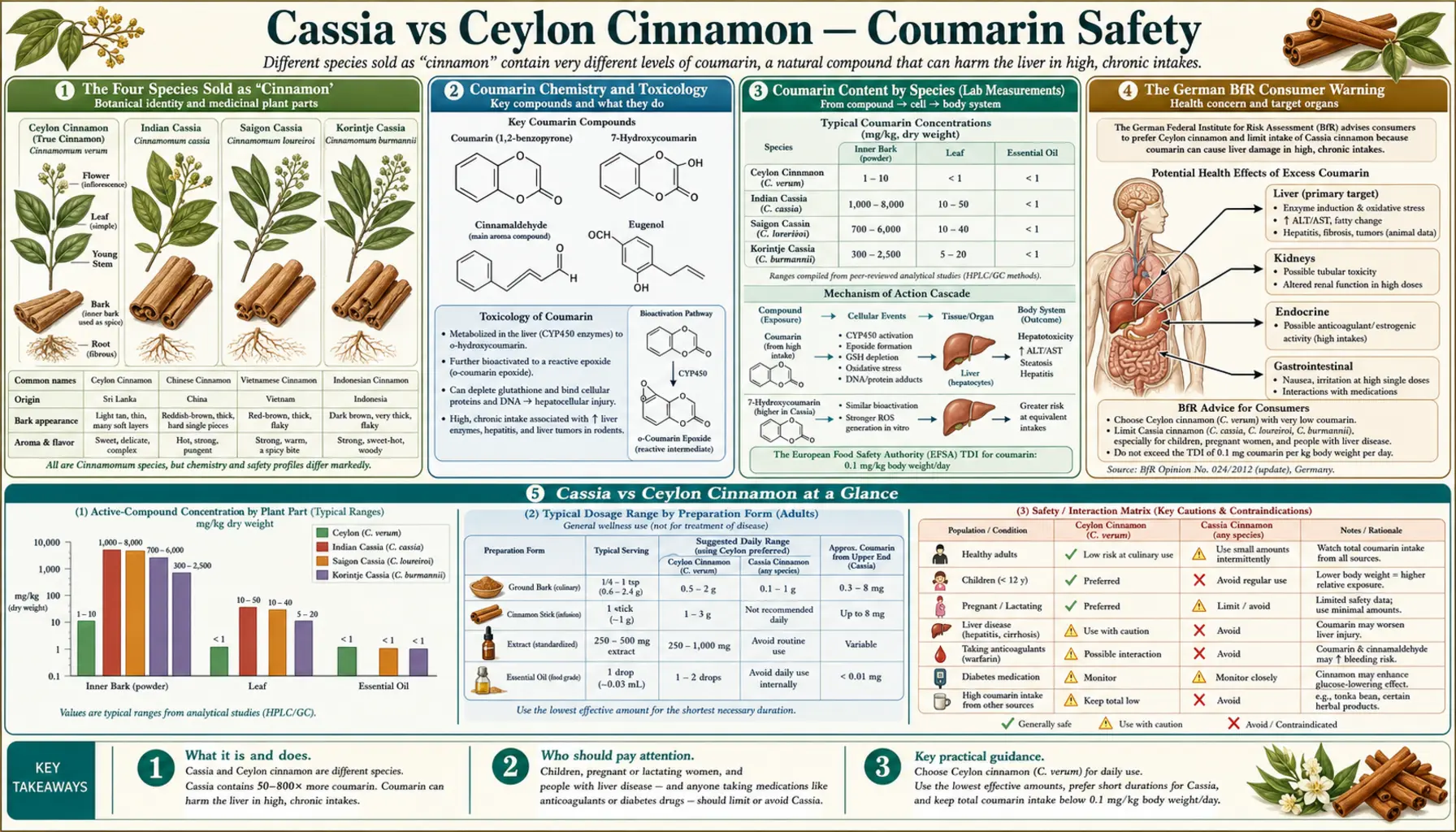
Several species are sold as "cinnamon". The cassia species (Cinnamomum cassia, C. burmannii and C. loureiroi) contain substantial amounts of coumarin, a compound that damages the liver at high intakes, while Ceylon cinnamon (Cinnamomum verum) contains only traces. The European Food Safety Authority (EFSA) set a tolerable daily intake (TDI) for coumarin of 0.1 mg per kg of body weight. Assuming an average of 3000 mg of coumarin per kg of cassia, the German Federal Institute for Risk Assessment (BfR) calculated in 2012 that a 60 kg adult reaches that TDI with 2 g of cassia cinnamon a day, and a 15 kg child with 0.5 g. Occasional use as a spice is not where the BfR places the concern; daily intake of large amounts, including cinnamon capsules, is.
The species sold as "cinnamon" differ greatly in coumarin, a fragrant plant compound that is toxic to the liver at high doses and is regulated in European Union foods. Analyses of cassia bark and powder from German, Czech and US retail markets found coumarin in the thousands of milligrams per kilogram, while Ceylon cinnamon held traces or none. The German Federal Institute for Risk Assessment (BfR) issued opinions on coumarin in cinnamon in 2006 and updated them in 2012; it concluded that the tolerable daily intake can be exceeded by people who eat a great deal of cassia cinnamon, and stated that it "still recommends that Cassia cinnamon is consumed in moderation". This page sets out what the measurements, the risk assessments, the EU limits and the liver case reports say.
Table of Contents
- The Four Species Sold as "Cinnamon"
- Coumarin Chemistry and Toxicology
- Coumarin Content by Species (Lab Measurements)
- The German BfR Opinions (2006 and 2012)
- EU Maximum Levels (Regulation 1334/2008)
- Tolerable Daily Intake (TDI)
- What the BfR Reported for Daily Intakes
- Liver-Injury Case Reports and the Sensitive Subgroup
- How Ceylon and Cassia Are Told Apart
- Labelling and Mislabelling Findings
- What the Sources Report by Use Case
- Key Research Papers
- Connections
- Featured Videos
The Four Species Sold as "Cinnamon"
The English word "cinnamon" covers several species of the genus Cinnamomum (family Lauraceae). Analytical studies treat four as the main ones in trade (Wang 2013; Avula 2015):
- Cinnamomum verum (synonym C. zeylanicum) — Ceylon cinnamon, "true" cinnamon. Associated with Sri Lanka (formerly Ceylon). The BfR describes it as more expensive than the cassia types, with a more flowery aroma, and as containing no coumarin or at most traces (BfR 2006).
- Cinnamomum cassia (synonym C. aromaticum) — Chinese cassia. The BfR describes cassia as spicier and tarter than Ceylon cinnamon (BfR 2006). Its bark contains substantial coumarin (Wang 2013).
- Cinnamomum burmannii — Indonesian cassia (also called Padang or korintje cassia). A US analysis found substantial coumarin in its bark, and the chemical profiles of the locally bought cinnamon, cinnamon-flavored foods and cinnamon supplements it tested pointed to this species (Wang 2013).
- Cinnamomum loureiroi — Vietnamese or "Saigon" cassia. In the same US analysis, C. loureiroi and C. burmannii were the two cassia species with especially high coumarin (Wang 2013).
In the United States, the cassia species are sold under the plain name "cinnamon" alongside true cinnamon (Wang 2013). In a Czech survey, none of 60 retail ground-cinnamon samples was labelled with its botanical source (Blahová 2012), and in an Italian survey of 34 cinnamon samples, about 51% were cassia, 10% were probably a cassia–Ceylon blend and only 39% were Ceylon cinnamon (Lungarini 2008).
Coumarin Chemistry and Toxicology
Coumarin (1,2-benzopyrone) is a fragrant compound found in cassia cinnamon and in tonka beans, among other plants. It is chemically distinct from the anticoagulants warfarin and dicoumarol, which are 4-hydroxycoumarin derivatives, although the shared name is often confused.
The toxicology, as the reviews summarize it:
- Liver toxicity. Coumarin is hepatotoxic in experimental animals and in a proportion of the human population (Woehrlin 2010). In rats and mice the target organs for toxicity are mainly the liver and lung; other species, including the Syrian hamster, appear resistant (Lake 1999).
- Species differences in metabolism. In most people the main pathway is 7-hydroxylation, which appears to be a detoxification route. In rats and mice the main route is 3,4-epoxidation, which forms toxic metabolites (Lake 1999). Coumarin is cleared rapidly by 7-hydroxylation in humans, but this detoxification may vary between individuals because of genetic polymorphisms in the CYP2A6 enzyme (Yamada 2022).
- Tumours in rodents. Tumours in rats and mice appeared only at high doses that also caused liver and lung toxicity, and most mutagenicity tests suggest coumarin is not genotoxic (Lake 1999). EFSA discounted a genotoxic mechanism in 2004, which allowed it to set a TDI for the first time (Abraham 2010).
- Use as a medicine. In a randomized crossover trial in 140 women with arm lymphedema after breast cancer treatment, 200 mg of coumarin twice daily for six months did no better than placebo, and it produced serologic evidence of liver toxicity in 6% of the women (Loprinzi 1999).
Coumarin in cinnamon is absorbed nearly as well as isolated coumarin. In a four-way crossover study in 24 healthy volunteers given 12 mg of coumarin in different forms, the relative extent of absorption was 62.8% for isolated coumarin in a capsule, 56.0% for cinnamon in capsules, 66.1% for cinnamon tea and 54.7% for cinnamon in rice pudding; the authors concluded that the coumarin TDI can be used for cinnamon-containing meals (Abraham 2011).
Coumarin Content by Species (Lab Measurements)
Published measurements of coumarin in cinnamon (mg of coumarin per kg of cinnamon):
- Ceylon (C. verum): only traces or below the measurement limit; under 15 mg/kg in one stick sample examined by a German state laboratory (BfR 2006). A Sri Lankan plantation sample of C. verum was coumarin-free (Blahová 2012), and authenticated C. verum bark contained only traces (Wang 2013).
- Cassia in cinnamon capsules (German control laboratory): between approximately 2100 and approximately 4400 mg/kg of cinnamon powder (BfR 2006).
- Czech retail ground cinnamon: 60 samples from twelve brands, all apparently cassia, with mean levels from 2,650 to 7,017 mg/kg (Blahová 2012).
- German retail cassia sticks: from below the limit of detection to about 10,000 mg/kg in sticks from two packages; among five Indonesian cassia trees, one tree showed high variation and two had no detectable coumarin (Woehrlin 2010).
- Cassia generally: "up to 1 %" coumarin (Abraham 2011). For its 2012 calculations the BfR assumed an average of 3000 mg/kg in cassia (BfR 2012).
Every figure in the diagram is stated, with its source, in the list above and in the BfR section below.
The studies did not report coumarin per teaspoon, and the content varies too much within cassia, even within one tree, for a single per-spoon figure to describe it (Woehrlin 2010).
The German BfR Opinions (2006 and 2012)
The German Federal Institute for Risk Assessment (Bundesinstitut für Risikobewertung, BfR) has issued several opinions on coumarin in cinnamon:
- Health Assessment No. 043/2006, 16 June 2006, on the high coumarin levels in cinnamon and cinnamon-containing biscuits. In it the BfR classified coumarin as a toxicologically problematic ingredient of cassia cinnamon (as summarized in BfR 2006, No. 044/2006).
- Health Assessment No. 044/2006, 18 August 2006, "High daily intakes of cinnamon: Health risk cannot be ruled out", on cinnamon capsules sold to lower blood sugar in type 2 diabetes. The BfR noted that no reliable data exist on the effects of daily long-term intake of cinnamon in the gram range, that the blood-sugar claim rested on one study of 60 patients (Khan 2003), and that capsules of cassia powder were likely to lead to the coumarin TDI being exceeded.
- Opinion No. 036/2012, 27 September 2012, "New insights into coumarin contained in cinnamon", which replaced the June 2006 opinion after the BfR's own human absorption study (Abraham 2011) and the new EU limits.
What the 2012 opinion states:
- The assessment of coumarin's danger potential had not changed, and the TDI of 0.1 mg per kg of body weight continues to apply.
- Coumarin is well absorbed from the plant matrix of cinnamon, so a TDI derived from isolated coumarin also applies to cinnamon-containing foods.
- Even where foods reach the maximum EU limit values, exceeding the TDI is possible only if large quantities of cinnamon-containing foods are eaten daily. A 15 kg child would reach the TDI by eating 30 g of cinnamon stars (about 6 small cinnamon stars) or 100 g of gingerbread a day.
- No limit values exist for cinnamon sticks and powder sold as a household spice. Assuming an average of 3000 mg of coumarin per kg of cassia, a 60 kg adult reaches the TDI with 2 g of cassia a day and a 15 kg child with 0.5 g; other sources such as coumarin-containing cosmetics add to the total.
- The BfR "still recommends that Cassia cinnamon is consumed in moderation" and states that people who frequently use large quantities of cinnamon as a condiment "should therefore opt for the low-coumarin Ceylon cinnamon" (an agency recommendation, quoted).
EU Maximum Levels (Regulation 1334/2008)
The EU sets maximum levels for coumarin in Regulation (EC) No 1334/2008 on flavourings, Annex III Part B, which covers substances naturally present in flavourings and food ingredients with flavouring properties. The limits apply to the compound food as consumed, not to cinnamon itself:
- Traditional and/or seasonal bakery ware containing a reference to cinnamon in the labelling: 50 mg/kg
- Breakfast cereals including muesli: 20 mg/kg
- Fine bakery ware, other than the traditional or seasonal cinnamon bakery ware above: 15 mg/kg
- Desserts: 5 mg/kg
According to the BfR, these limits have applied since January 2011 (BfR 2012). They replaced an older limit of 2 mg/kg under the earlier European Flavourings Directive, which an Italian survey found cinnamon-containing foods often exceeded (Lungarini 2008).
In the United States, food containing added coumarin, or coumarin as a constituent of tonka beans or tonka extract, is deemed adulterated under a 1954 order (19 FR 1239), now 21 CFR 189.130. Coumarin naturally present in other food ingredients such as cassia cinnamon is not regulated (Wang 2013).
Tolerable Daily Intake (TDI)
The TDI is the amount that can be eaten every day over a lifetime without a risk to health (BfR 2006). How the figure of 0.1 mg per kg of body weight per day came about:
- EFSA, 2004. Once a genotoxic mechanism for coumarin's tumours had been discounted, EFSA derived a TDI of 0.1 mg/kg body weight from animal liver-toxicity data (Abraham 2010); the underlying study was a chronic study in dogs (Yamada 2022).
- Human data, 2010. BfR scientists analysed liver-toxicity data from patients treated with coumarin as a medicine. These showed a subgroup of people more susceptible to the liver effect than the animal species studied; derived from the human data, the TDI was again 0.1 mg/kg body weight, confirming EFSA's value (Abraham 2010).
- EFSA, 2008. EFSA's panel issued a further opinion on coumarin in flavourings and other food ingredients with flavouring properties (EFSA 2008).
- BfR, 2012. The TDI of 0.1 mg per kg of body weight "continues to apply" (BfR 2012).
Intake from food is estimated at 1–3 mg of coumarin a day on average, with about ten times that in worst-case scenarios — levels close to or above the TDI (Yamada 2022). In a German telephone survey of more than 1000 people about the Christmas season, heavy consumers of cassia cinnamon could reach a daily coumarin intake corresponding to the TDI (Abraham 2010).
What the BfR Reported for Daily Intakes
The BfR's 2006 assessment of cinnamon capsules worked through the products then on the German market (BfR 2006):
- Capsules at about 1 g of cinnamon a day. For the six cinnamon-powder products tested by a state laboratory, the recommended daily dose used between 31 and 64% of the TDI for a 70 kg adult, with correspondingly higher shares at the customary 60 kg. Added to coumarin from other sources, this could in isolated cases lead to the TDI being exceeded.
- Products recommending 1.5 g to about 3 g a day (one distributor gave 2 to 4 g). With coumarin in the medium to upper range of the measured values, these daily doses would lead to full use or even exceeding of the TDI.
- 6 g a day, the highest dose in the Khan 2003 trial, "would definitely lead to the TDI being exceeded".
- Aqueous cassia extracts. Extract products measured 274 to 425 mg/kg of capsule content, and their recommended daily doses used 3 to 7% of the TDI for a 70 kg adult.
- A capsule labelled as Ceylon cinnamon measured 2300 mg/kg, which the BfR wrote "clearly points to the use of cassia cinnamon".
The Khan 2003 trial behind these doses gave 60 people with type 2 diabetes 1, 3 or 6 g of cinnamon or placebo for 40 days and reported 18–29% lower fasting glucose. Since 2025 it has carried an expression of concern from the journal (Diabetes Care, notice PMID 40834253), which questions the plausibility of the reported data. The BfR noted in 2006 that the published data did not show any dose-related effect across the three doses.
For the household spice and for foods at the EU maximum levels, the BfR's 2012 figures are given in the section above: 2 g of cassia a day for a 60 kg adult and 0.5 g for a 15 kg child at an assumed 3000 mg/kg, and 30 g of cinnamon stars or 100 g of gingerbread a day for a 15 kg child (BfR 2012). EFSA and the BfR describe the TDI as a lifetime daily intake; neither source quoted here gives a per-teaspoon figure.
Liver-Injury Case Reports and the Sensitive Subgroup
The NIH LiverTox database describes cinnamon used as an herbal medicine as generally well tolerated but "implicated in isolated, rare reports of acute liver injury" (LiverTox, Cinnamon). Published cases include:
- A 73-year-old woman who had taken a statin for coronary artery disease for many months developed abdominal pain, vomiting and diarrhea about one week after starting cinnamon supplements; workup confirmed hepatitis with no other specific cause found. Cinnamon and the statin were stopped, and the statin was later resumed without further problems. The authors diagnosed cinnamon–statin combination-induced hepatitis and attributed cinnamon's liver toxicity to coumarin (Brancheau 2015, American Journal of Case Reports).
- A 34-year-old woman who had taken cinnamon over a long period for weight loss presented with abdominal pain, jaundice and dark urine; her liver tests returned to normal after cinnamon was stopped. The authors rated it a probable case of cinnamon-induced mixed hepatocellular–cholestatic liver injury (Yesukumar 2025).
The sensitive-subgroup idea. Clinical data from patients treated with coumarin as a medicine revealed a subgroup of people more susceptible to its liver toxicity than the animals tested; the cause of that susceptibility is unknown (Abraham 2010). A 2022 Japanese risk assessment found that coumarin is cleared rapidly by 7-hydroxylation in humans and that plasma levels at doses expected from food are considerably lower than those that injure the liver in rats, but noted that this detoxification may vary with CYP2A6 polymorphisms and that activation by CYP1A2 and CYP2E1 can change with enzyme induction; its authors concluded that the results support the existence of highly sensitive human subpopulations (Yamada 2022). In the 1999 lymphedema trial, 6% of women taking 400 mg of coumarin a day showed serologic evidence of liver toxicity (Loprinzi 1999).
The case reports describe individuals; they do not show how often liver injury occurs among people using cassia, and none of the sources here reports a rate.
How Ceylon and Cassia Are Told Apart
Appearance of the sticks. Ceylon quills are commonly described as many thin, papery layers rolled together, and cassia quills as a single thicker, harder layer of bark curled into a hollow tube. Ground powder cannot be told apart by eye.
Taste and aroma. The BfR describes cassia as spicier and tarter and Ceylon cinnamon as having a more flowery aroma (BfR 2006).
Chemistry. Ceylon cinnamon contains eugenol and benzyl benzoate, and no coumarin or at most traces, which separates it chemically from cassia (BfR 2006). Laboratories distinguish the species by coumarin and other marker compounds using liquid chromatography and mass spectrometry (Wang 2013; Avula 2015).
Labels. Species names that appear on labels include Cinnamomum verum or C. zeylanicum (Ceylon), C. cassia or C. aromaticum (Chinese cassia), C. burmannii (Indonesian cassia) and C. loureiroi (Vietnamese cassia). The surveys below show that labels often name no species, and sometimes name the wrong one.
Labelling and Mislabelling Findings
- Czech Republic: none of 60 ground-cinnamon samples from twelve brands carried its botanical source; their high coumarin showed they came from cassia, unlike a Sri Lankan C. verum sample, which was coumarin-free (Blahová 2012).
- Italy: of 34 cinnamon samples, about 51% were cassia, 10% were probably blends and 39% were Ceylon cinnamon (Lungarini 2008).
- United States: coumarin was found in all locally bought cinnamon, cinnamon-flavored foods and cinnamon supplements tested, and their profiles pointed to Indonesian cassia (Wang 2013).
- Germany: a capsule product declared as Ceylon cinnamon measured 2300 mg/kg of coumarin, which the BfR read as cassia (BfR 2006).
- Denmark: coumarin was measured in cinnamon-containing food products on the Danish market (Ballin 2014).
The BfR's 2006 opinion also reported that aqueous extracts of cassia gave far lower coumarin exposure than cassia powder (BfR 2006).
What the Sources Report by Use Case
- Occasional use as a spice: small amounts of cinnamon have been used as a spice for thousands of years without reports of side effects (BfR 2006). At the EU maximum levels, foods push intake over the TDI only when large quantities are eaten daily (BfR 2012).
- Frequent, heavy use of cassia as a spice: the TDI can be exceeded by consumers who eat a great deal of cassia; the BfR advises such consumers to opt for Ceylon cinnamon (BfR 2012, quoted above).
- Cinnamon capsules for blood sugar: the BfR found that cassia capsules can use up or exceed the TDI depending on the dose, and that the safety of long-term daily doses in the gram range has not been demonstrated (BfR 2006). Whether Ceylon cinnamon has the same effect on blood sugar as cassia was, the BfR wrote, not known.
- Children: a 15 kg child reaches the TDI at 0.5 g of cassia a day at an assumed 3000 mg/kg (BfR 2012); the BfR's 2006 opinion named frequent helpings of rice pudding with sugar and cinnamon as a source of high exposure in small children.
- Pregnancy: the BfR's 2006 opinion raised a separate concern about cinnamaldehyde, the main flavour compound: animal studies indicate that cinnamaldehyde taken during pregnancy could damage the unborn offspring, and the BfR called for warnings on capsule products and for clarification of this possible effect (BfR 2006).
- People taking other medicines that affect the liver: the authors of the cinnamon–statin case report concluded that the combination "should be discouraged" (Brancheau 2015). No trial has tested the interaction.
- People with existing liver disease: none of the sources quoted here studied this group.
Decisions about supplements belong with a clinician.
Key Research Papers
- Abraham K, Wöhrlin F, Lindtner O, Heinemeyer G, Lampen A (2010). Toxicology and risk assessment of coumarin: focus on human data. Molecular Nutrition & Food Research 54(2):228–239. — PubMed PMID: 20024932
- Lake BG (1999). Coumarin metabolism, toxicity and carcinogenicity: relevance for human risk assessment. Food and Chemical Toxicology 37(4):423–453. — PubMed PMID: 10418958
- European Food Safety Authority (EFSA) (2004). Opinion of the Scientific Panel on food additives, flavourings, processing aids and materials in contact with food (AFC) related to Coumarin. EFSA Journal 2(12):104. — doi:10.2903/j.efsa.2004.104
- Wang YH, Avula B, Nanayakkara NPD, Zhao J, Khan IA (2013). Cassia cinnamon as a source of coumarin in cinnamon-flavored food and food supplements in the United States. Journal of Agricultural and Food Chemistry 61(18):4470–4476. — Wang 2013 US cinnamon coumarin. — PubMed PMID: 23627682
- Blahová J, Svobodová Z (2012). Assessment of coumarin levels in ground cinnamon available in the Czech retail market. Scientific World Journal 2012:263851. — PubMed PMID: 22761548
- Woehrlin F, Fry H, Abraham K, Preiss-Weigert A (2010). Quantification of flavoring constituents in cinnamon: high variation of coumarin in cassia bark from the German retail market and in authentic samples from Indonesia. Journal of Agricultural and Food Chemistry 58(19):10568–10575. — PubMed PMID: 20853872
- Brancheau D, Patel B, Zughaib M (2015). Do cinnamon supplements cause acute hepatitis? American Journal of Case Reports 16:250–254. — PubMed PMID: 25923145
- Loprinzi CL, Kugler JW, Sloan JA et al. (1999). Lack of effect of coumarin in women with lymphedema after treatment for breast cancer. NEJM 340(5):346–350. (Serologic evidence of liver toxicity in 6% of women at 400 mg/day.) — Loprinzi coumarin lymphedema. — PubMed PMID: 9929524
- Hadi A, Campbell MS, Hassani B, Pourmasoumi M, Salehi-Sahlabadi A, Hosseini SA (2020). The effect of cinnamon supplementation on blood pressure in adults: A systematic review and meta-analysis of randomized controlled trials. Clinical Nutrition ESPEN 36:10–16. — PubMed PMID: 32220351
- Ballin NZ, Sorensen AT (2014). Coumarin content in cinnamon containing food products on the Danish market. Food Control 38:198–203. — doi:10.1016/j.foodcont.2013.10.014
- Hoofnagle JH. Cinnamon. In: LiverTox: Clinical and Research Information on Drug-Induced Liver Injury. Bethesda (MD): National Institute of Diabetes and Digestive and Kidney Diseases; 2012– (updated 2026 Jul 1). — PubMed PMID: 42551031
- Ranasinghe P, Pigera S, Premakumara GA, Galappaththy P, Constantine GR, Katulanda P (2013). Medicinal properties of 'true' cinnamon (Cinnamomum zeylanicum): a systematic review. BMC Complementary and Alternative Medicine 13:275. — Ranasinghe Ceylon cinnamon review. — PubMed PMID: 24148965
- Khan A, Safdar M, Ali Khan MM, Khattak KN, Anderson RA (2003). Cinnamon improves glucose and lipids of people with type 2 diabetes. Diabetes Care 26(12):3215–3218. — PubMed PMID: 14633804 — Expression of concern (Diabetes Care 2025: PubMed PMID: 40834253)
- Abraham K, Pfister M, Wöhrlin F, Lampen A (2011). Relative bioavailability of coumarin from cinnamon and cinnamon-containing foods compared to isolated coumarin: a four-way crossover study in human volunteers. Molecular Nutrition & Food Research 55(4):644–653. — PubMed PMID: 21462332
- Yamada T, Katsutani N, Maruyama T, Kawamura T, Yamazaki H, Murayama N, Tong W, Yamazoe Y, Hirose A (2022). Combined risk assessment of food-derived coumarin with in silico approaches. Food Safety (Tokyo) 10(3):73–82. — PubMed PMID: 36237397
- Lungarini S, Aureli F, Coni E (2008). Coumarin and cinnamaldehyde in cinnamon marketed in Italy: a natural chemical hazard? Food Additives & Contaminants Part A 25(11):1297–1305. — PubMed PMID: 19680836
- Avula B, Smillie TJ, Wang YH, Zweigenbaum J, Khan IA (2015). Authentication of true cinnamon (Cinnamon verum) utilising direct analysis in real time (DART)-QToF-MS. Food Additives & Contaminants Part A 32(1):1–8. — PubMed PMID: 25421162
- Yesukumar SJ, Bakir L, Mohamed IA, Danjuma M (2025). Probable cinnamon-induced mixed hepatocellular-cholestatic liver injury in a young woman: a case report. Cureus 17(9):e93328. — PubMed PMID: 41158894
- European Food Safety Authority (EFSA) (2008). Coumarin in flavourings and other food ingredients with flavouring properties — Scientific Opinion of the Panel on Food Additives, Flavourings, Processing Aids and Materials in Contact with Food (AFC). EFSA Journal 6(10):793. — doi:10.2903/j.efsa.2008.793
- German Federal Institute for Risk Assessment (BfR) (2006). High daily intakes of cinnamon: Health risk cannot be ruled out. BfR Health Assessment No. 044/2006, 18 August 2006. — BfR PDF
- German Federal Institute for Risk Assessment (BfR) (2012). New insights into coumarin contained in cinnamon. BfR Opinion No. 036/2012, 27 September 2012. — BfR PDF
- Regulation (EC) No 1334/2008 of the European Parliament and of the Council of 16 December 2008 on flavourings and certain food ingredients with flavouring properties for use in and on foods, Annex III Part B. Official Journal of the European Union L 354. — EUR-Lex
- US Code of Federal Regulations, 21 CFR 189.130 Coumarin (substances prohibited from use in human food). — 21 CFR 189.130
PubMed Topic Searches
Connections
- All Herbs
- Cinnamon Overview
- Cinnamon Benefits Hub
- Cinnamon for Blood Sugar
- Cinnamon for Cardiovascular Health
- Cinnamon Antimicrobial & Antifungal
- Hepatology (Liver Disease)
- Toxins Overview
- Inflammatory Markers
- Fenugreek
- Turmeric
- Clove
- Oregano
- Type 2 Diabetes
- Metabolic Syndrome
- Blood Sugar Control
- History