Comfrey
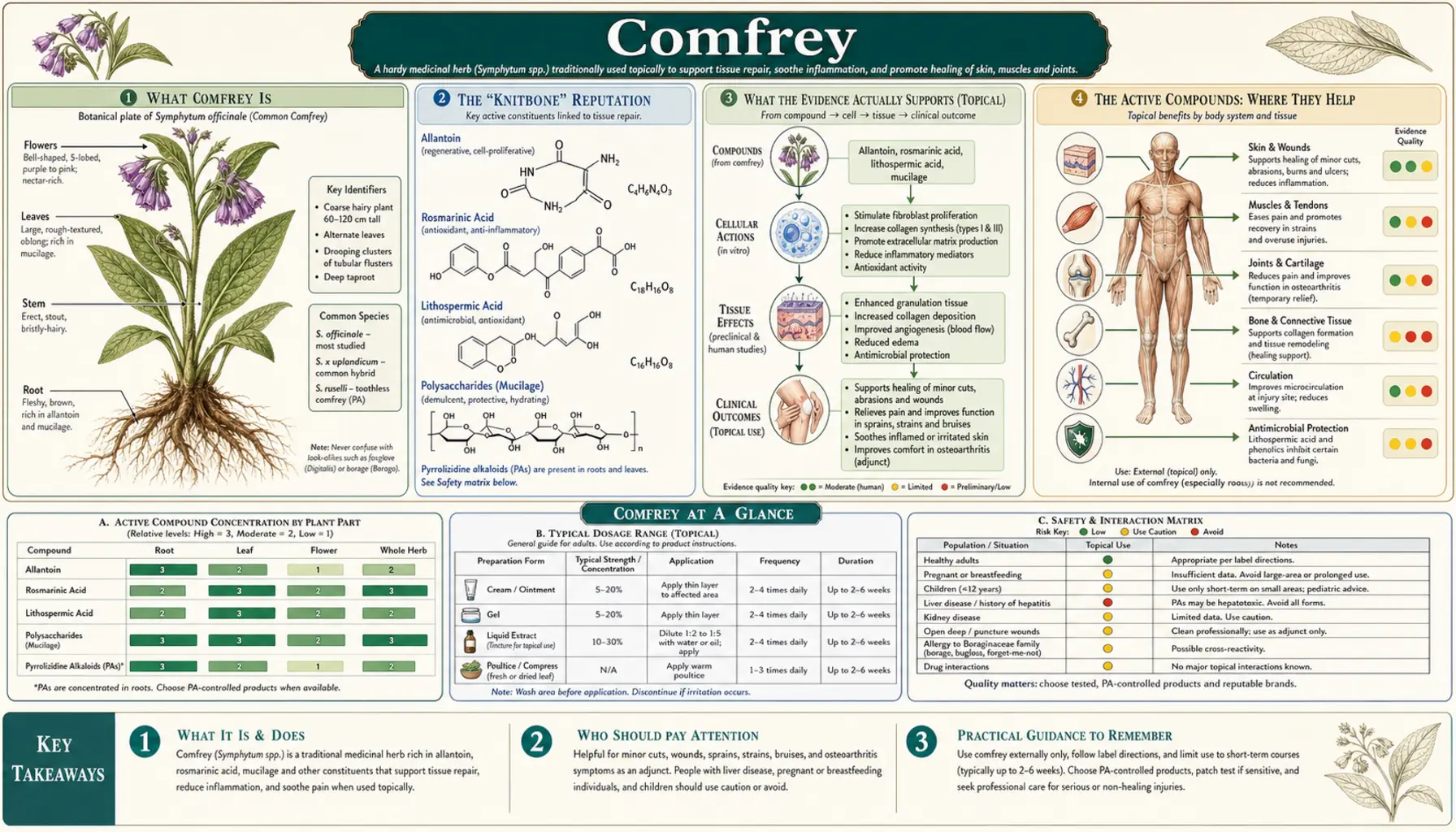
Comfrey (Symphytum officinale) is one of the oldest and most useful herbs in the European folk-medicine chest — and also one of the most genuinely dangerous if it is used the wrong way. For centuries it was the go-to remedy for bruises, sprains, and aching muscles and joints, earning the affectionate country names “knitbone” and “boneset” for its reputation of helping the body mend. The remarkable thing about comfrey is that, unlike many folk remedies, this one has a real kernel of modern evidence behind it: well-designed clinical trials show that comfrey creams and ointments, applied to the skin, can reduce pain and improve movement in ankle sprains, bruises, back pain, and osteoarthritis of the knee. But there is a hard line that must never be crossed. Comfrey contains pyrrolizidine alkaloids — natural compounds that are toxic to the liver. Taken internally — as a tea, in capsules, or by eating the leaf or root — comfrey can cause severe and sometimes fatal liver damage, and oral comfrey products have been banned or withdrawn in the United States, the United Kingdom, Germany, and other countries. This page lays out what comfrey is, where its healing reputation came from, exactly what the topical evidence does and does not show, the critical safety facts, and the strict rules for using it on the skin only. The short version, kept front and center throughout: comfrey is a good herb to rub on — and a dangerous one to swallow.
Table of Contents
- What Comfrey Is
- The “Knitbone” Reputation
- What the Evidence Actually Supports (Topical)
- The Active Compounds
- The Critical Warning: Pyrrolizidine Alkaloids
- Using Comfrey Safely: Topical-Only Rules
- Who Must Avoid Comfrey Entirely
- The Honest Bottom Line
- Research Papers
- Connections
- Featured Videos
What Comfrey Is
Comfrey is a large, leafy perennial in the borage family (Boraginaceae) — the same botanical clan as borage and forget-me-nots. Its botanical name is Symphytum officinale, and the garden hybrid known as Russian comfrey (Symphytum × uplandicum) is also widely grown and used. The name Symphytum comes from Greek roots meaning roughly “to make grow together” or “to unite” — a direct nod to the plant’s ancient reputation for helping the body knit itself back together.
If you have seen it, it is hard to miss: a robust plant, waist-high or taller, with big, coarse, hairy leaves and drooping clusters of small bell-shaped flowers in cream, pink, or purple. It grows readily — some would say too readily — in damp ground, ditches, and cottage gardens across Europe, and it has naturalized in North America and beyond. Gardeners still prize it as a compost activator and “green manure.”
The parts used medicinally are the leaves and, especially, the roots. Traditionally these were mashed into poultices, simmered into salves, or steeped as teas. Today the responsible forms are commercial creams, ointments, and gels made for use on the skin. As the safety sections below make clear, the difference between those preparations — and the difference between putting comfrey on the body versus taking it into the body — is the single most important thing to understand about this herb. The root, notably, contains far more of comfrey’s toxic alkaloids than the leaf.
The “Knitbone” Reputation
Comfrey’s folk names tell its story. “Knitbone” and “boneset” reflect a belief, going back to antiquity, that the herb could help broken bones fuse and sprained joints heal. Other old names — “bruisewort,” “slippery root,” “healing herb” — point to the same cluster of uses: bruises, swellings, sprains, and wounds.
The written record reaches back to the Greek and Roman physicians. Dioscorides and others recommended comfrey for wounds and broken bones, and it appears throughout the European herbal tradition that followed, from the medieval monastery garden to the 17th-century English herbalists. The classic method was a poultice: the fresh root or leaf, crushed to a pulp and bound over a bruise, sprain, or fracture. Traditional healers claimed a comfrey wrap could speed the mending of the injury underneath.
What did people actually observe? Comfrey preparations are genuinely soothing and anti-inflammatory on the skin, so a poultice could plausibly ease the pain and swelling of a sprain or a bad bruise — effects that later trials would partly confirm. The dramatic claim that comfrey literally “knits” a fractured bone faster, however, has never been demonstrated in people and should be treated as folklore rather than fact. And crucially, one central part of the old tradition — applying comfrey to open wounds and broken skin, or drinking it as a tonic “to heal from the inside” — is exactly the practice that modern toxicology has shown to be unsafe. The reputation was real and partly earned; the traditional methods need serious updating.
What the Evidence Actually Supports (Topical)
Here is where comfrey earns genuine respect. Over the past few decades, a series of randomized, double-blind, placebo-controlled trials — the gold standard of clinical testing — have studied standardized comfrey creams and ointments applied to the skin. The results have been consistently encouraging for short-term musculoskeletal pain. The honest caveats come after the good news, so let us take both in turn.
Sprains and bruises
Two double-blind trials tested comfrey root ointment on acute ankle sprains. In one, comfrey clearly outperformed a placebo ointment for pain, swelling, and mobility over about a week (Koll 2004). In another, a comfrey ointment was compared head-to-head with a diclofenac gel — a standard anti-inflammatory rub — and performed at least as well (Predel 2005). For the everyday injuries comfrey was always used for — a rolled ankle, a deep bruise — this is meaningful, real-world evidence.
Sore muscles and back pain
A comfrey herb cream tested against placebo in people with muscle pain (myalgia) reduced pain at rest and on movement and improved function (Kucera 2005). A separate double-blind, placebo-controlled trial found that a comfrey root ointment gave clear, rapid relief of acute back pain compared with placebo (Giannetti 2010). Again, the pattern is a modest but real reduction in pain and stiffness over days to a couple of weeks.
Osteoarthritis of the knee
Comfrey has also been tested for the wear-and-tear joint pain of knee osteoarthritis. A double-blind, placebo-controlled trial of a comfrey root extract ointment found significantly reduced pain and improved knee function versus placebo (Grube 2007), and later work with comfrey-containing creams pointed the same direction. For a common, nagging condition where people are often looking for something to rub on, this is a legitimately useful option.
The honest caveats
The evidence is genuine but not flawless, and it deserves a clear-eyed read:
- Many trials were funded by the makers of the comfrey products being tested. That does not make the results wrong, but industry sponsorship is a known source of optimistic bias, so the effect sizes are best read as an upper estimate.
- The studies are short-term — days to a few weeks — matching how comfrey should be used. They say nothing about long-term or repeated use.
- These results apply to specific, standardized commercial products, not to a home-made poultice of unknown strength and unknown alkaloid content.
- An independent scoping review that pulled the external-use studies together concluded that topical comfrey looks promising for pain and inflammation, while flagging exactly these methodological limits and calling for more rigorous, independent research (Frost 2013).
Put simply: the direction of the evidence is real and reasonably consistent — topical comfrey helps with the short-term pain of sprains, bruises, sore muscles, back pain, and knee osteoarthritis — but it is a modest, symptomatic benefit from a small body of mostly industry-sponsored trials, not a miracle cure.
The Active Compounds
Comfrey is chemically busy, and several of its constituents have plausible roles in the effects seen on the skin. The leading candidates:
- Allantoin. This is comfrey’s star ingredient and the most likely explanation for its “healing” reputation. Allantoin is a genuine cell-proliferation and tissue-soothing compound — it encourages skin cells to grow and turn over, softens and helps shed rough dead skin, and calms irritation. It is so well regarded that purified allantoin is added to countless mainstream skin creams, lotions, and after-sun products. Allantoin is water-soluble and non-toxic, and it is a large part of why comfrey feels soothing and looks like it “does something” for damaged skin.
- Rosmarinic acid. A natural polyphenol with real anti-inflammatory and antioxidant activity. It helps dampen the local inflammation and swelling that make a sprain or bruise hurt.
- Mucilage. Comfrey is rich in slippery, gel-like polysaccharides — the reason for the old name “slippery root.” Mucilage is emollient and soothing, forming a soft, protective, moisture-holding layer on the skin.
- Tannins and other constituents. Astringent tannins and additional plant compounds add to the mild anti-inflammatory, protective effect.
An honest note: comfrey’s benefit almost certainly comes from a combination of these constituents rather than any single “magic” molecule, and the precise mechanism has not been fully pinned down. Allantoin’s ability to help skin cells proliferate is the tidiest story for a “knitbone” herb, but it is a story about skin and soft-tissue soothing, not literal bone-knitting. And none of these useful compounds change the central danger described next — because the same plant also carries a very different class of chemicals.
The Critical Warning: Pyrrolizidine Alkaloids
This is the most important section on the page, so it is stated plainly: comfrey contains pyrrolizidine alkaloids (PAs), which are toxic to the liver, and comfrey must never be taken internally. No tea. No capsules. No tinctures. Do not eat the leaf or the root.
Pyrrolizidine alkaloids — compounds such as symphytine, echimidine, and lycopsamine — are natural chemicals the comfrey plant makes. On their own they are not the problem; the trouble starts when the liver processes them. The liver converts PAs into highly reactive substances that attack the tiny veins inside the liver, causing them to swell and clog. The result is a serious, sometimes irreversible condition called hepatic veno-occlusive disease (also called hepatic sinusoidal obstruction syndrome): blood backs up, the liver becomes damaged and scarred, and in severe cases the liver fails. This can be fatal.
This is not a theoretical worry. There are documented human cases of people developing liver veno-occlusive disease after consuming comfrey or other PA-containing products — including reports tied directly to comfrey teas and supplements (Ridker 1985; Weston 1987; Yeong 1990). Reviews of comfrey’s safety have repeatedly concluded that internal use is unjustifiably risky (Stickel 2000). On top of the liver-vein injury, PAs are genotoxic and carcinogenic in animal studies — meaning they can damage DNA and cause tumors — which adds a long-term cancer concern to the acute liver danger (Mei 2010).
Some practical facts that matter:
- The root is far more toxic than the leaf, and young leaves generally carry more PAs than old ones — but no part of the plant is safe to ingest.
- The damage can build up quietly. Liver injury from PAs can develop from repeated smaller doses over time, not only from one large dose, and early symptoms (abdominal pain, nausea, swelling) can be vague.
- Regulators have acted. Because of this toxicity, oral comfrey products have been banned or withdrawn from the market in the United States, the United Kingdom, Germany, and other countries. The U.S. Food and Drug Administration asked companies to remove oral comfrey supplements from sale, and the UK withdrew oral comfrey medicines years earlier. When a herb’s internal use is pulled by multiple governments, that is a signal worth taking seriously.
If you have been taking comfrey internally, stop, and tell a doctor — especially if you have abdominal pain, unusual tiredness, swelling of the belly, or yellowing of the skin or eyes.
Using Comfrey Safely: Topical-Only Rules
Comfrey can be a good herb on the skin, but even topical use has real rules, because pyrrolizidine alkaloids can be absorbed through the skin — especially where the skin is not intact. Follow these guidelines, which mirror the cautions set by European drug-safety regulators:
- Use a commercial, PA-reduced (low-alkaloid) product. Reputable manufacturers process comfrey to strip out most of the pyrrolizidine alkaloids and often certify the low PA content. A standardized, quality-controlled cream or ointment is far safer — and better studied — than a home-made poultice of unknown strength.
- Apply to intact skin only. This is the big one, and it overturns part of the old tradition: never put comfrey on broken skin, open wounds, cuts, grazes, or mucous membranes. Damaged skin lets the alkaloids into the body, which is precisely what you are trying to avoid.
- Keep it short-term and limited. Topical comfrey is meant for brief courses — typically no more than a few weeks at a time, and not repeatedly throughout the year. Do not slather it over large areas of the body day after day; follow the specific product’s label for the maximum amount and duration.
- Wash your hands after applying, and keep it away from the eyes and mouth.
- Do not use it in pregnancy or breastfeeding, or on infants and young children (see the next section).
Used this way — a reputable low-PA cream, on unbroken skin, for a sprain or a sore knee, for a limited time — comfrey is a reasonable and evidence-backed choice. Used the old way — raw root mashed onto an open wound, or steeped into a daily tea — it is exactly the kind of thing this page is warning against.
Who Must Avoid Comfrey Entirely
Some people should not use comfrey in any form, even on the skin, and no one should ever take it internally. Avoid comfrey completely if you are in any of these groups:
- Anyone considering taking it internally. There is no safe internal dose. This applies to everyone, always.
- Pregnant or breastfeeding. Pyrrolizidine alkaloids can cross the placenta and are known to be able to harm a developing baby’s liver; PAs can also pass into breast milk. Do not use comfrey — even topically — during pregnancy or while breastfeeding.
- Infants and young children. Their smaller bodies and developing livers make them far more vulnerable to PA toxicity. Comfrey is not for children.
- People with liver disease, or anyone taking medicines that stress the liver. A liver that is already compromised has less margin to handle any alkaloid exposure. If you have hepatitis, cirrhosis, fatty liver, or take hepatotoxic drugs, steer clear.
- Anyone with broken skin at the area to be treated — wounds, ulcers, eczema flares, or grazes — because damaged skin dramatically increases absorption.
If you take prescription medication, have a chronic condition, or are unsure whether comfrey is appropriate for you, check with a doctor or pharmacist first. This is a herb where the cautions genuinely matter.
The Honest Bottom Line
Comfrey is a rare case of a folk remedy that is both genuinely useful and genuinely dangerous, depending entirely on how it is used. As a topical herb, it has earned its keep: real clinical trials show that a standardized comfrey cream or ointment can ease the pain and improve the movement of ankle sprains, bruises, sore muscles, back pain, and osteoarthritis of the knee — a modest but honest benefit that most soothing herbs cannot claim. Its active compounds, above all allantoin, give a plausible reason why.
But comfrey’s pyrrolizidine alkaloids make it a herb to respect, not to trifle with. Swallowed, it can cause severe and sometimes fatal liver damage, which is why oral comfrey has been banned or pulled from the market across much of the world. The safe path is narrow and clear: use a reputable, low-alkaloid commercial product, on intact skin only, for short periods, and never take it internally — and avoid it entirely in pregnancy, breastfeeding, young children, and liver disease.
Remember the one-line rule that runs through this whole page: comfrey is a herb to rub on, not to swallow. Kept to the skin, in a quality product, for a sprain or a sore joint, it is a legitimately helpful old remedy. Taken into the body, it is a real hazard. Treat it accordingly, and when in doubt, ask a clinician.
Research Papers
- Grube B, Grünwald J, Krug L, Staiger C. Efficacy of a comfrey root (Symphyti offic. radix) extract ointment in the treatment of patients with painful osteoarthritis of the knee: results of a double-blind, randomised, bicenter, placebo-controlled trial. Phytomedicine. 2007;14(1):2–10. doi:10.1016/j.phymed.2006.11.006 — The key knee-osteoarthritis trial; topical comfrey root ointment significantly reduced pain and improved knee function versus placebo.
- Kucera M, Barna M, Horáček O, Kálal J, Kucera A, Hladikova M. Topical Symphytum herb concentrate cream against myalgia: a randomized controlled double-blind clinical study. Advances in Therapy. 2005;22(6):681–692. doi:10.1007/bf02849961 — A double-blind trial in which a comfrey cream reduced muscle pain at rest and on movement and improved function versus placebo.
- Koll R, Buhr M, Dieter R, et al. Efficacy and tolerance of a comfrey root extract (Extr. Rad. Symphyti) in the treatment of ankle distorsions: results of a multicenter, randomized, placebo-controlled, double-blind study. Phytomedicine. 2004;11(6):470–477. doi:10.1016/j.phymed.2004.02.001 — Comfrey root ointment clearly outperformed placebo for pain, swelling, and mobility in acute ankle sprains.
- Predel HG, Giannetti B, Koll R, Bulitta M, Staiger C. Efficacy of a comfrey root extract ointment in comparison to a diclofenac gel in the treatment of ankle distortions: results of an observer-blind, randomized, multicenter study. Phytomedicine. 2005;12(10):707–714. doi:10.1016/j.phymed.2005.06.001 — Head-to-head trial in which comfrey ointment performed at least as well as a standard diclofenac anti-inflammatory gel.
- Giannetti BM, Staiger C, Bulitta M, Predel HG. Efficacy and safety of comfrey root extract ointment in the treatment of acute upper or lower back pain: results of a double-blind, randomised, placebo controlled, multicentre trial. British Journal of Sports Medicine. 2010;44(9):637–641. doi:10.1136/bjsm.2009.058677 — Comfrey root ointment produced clear, rapid relief of acute back pain compared with placebo.
- Frost R, MacPherson H, O’Meara S. A critical scoping review of external uses of comfrey (Symphytum spp.) Complementary Therapies in Medicine. 2013;21(6):724–745. doi:10.1016/j.ctim.2013.09.009 — An independent review concluding topical comfrey is promising for pain and inflammation, while flagging industry funding and methodological limits.
- Staiger C. Comfrey root: from tradition to modern clinical trials. Wiener Medizinische Wochenschrift. 2013;163(3–4):58–64. doi:10.1007/s10354-012-0162-4 — Reviews how comfrey’s traditional external use has been tested and supported by controlled topical trials.
- Stickel F, Seitz HK. The efficacy and safety of comfrey. Public Health Nutrition. 2000;3(4A):501–508. doi:10.1017/S1368980000000586 — A balanced review weighing comfrey’s benefits against its pyrrolizidine-alkaloid hepatotoxicity and concluding internal use is not justified.
- Ridker PM, Ohkuma S, McDermott WV, Trey C, Huxtable RJ. Hepatic venocclusive disease associated with the consumption of pyrrolizidine-containing dietary supplements. Gastroenterology. 1985;88(4):1050–1054. doi:10.1016/S0016-5085(85)80027-5 — Documents human liver veno-occlusive disease from ingesting pyrrolizidine-alkaloid supplements, including comfrey.
- Weston CFM, Cooper BT, Davies JD, Levine DF. Veno-occlusive disease of the liver secondary to ingestion of comfrey. British Medical Journal (Clinical Research Ed.). 1987;295(6591):183. doi:10.1136/bmj.295.6591.183 — A classic case report of liver veno-occlusive disease directly attributed to eating comfrey.
- Yeong ML, Swinburn B, Kennedy M, Nicholson G. Hepatic veno-occlusive disease associated with comfrey ingestion. Journal of Gastroenterology and Hepatology. 1990;5(2):211–214. PubMed: Yeong comfrey veno-occlusive disease — Another documented human case of comfrey-induced hepatic veno-occlusive disease.
- Mei N, Guo L, Fu PP, Fuscoe JC, Luan Y, Chen T. Metabolism, genotoxicity, and carcinogenicity of comfrey. Journal of Toxicology and Environmental Health, Part B. 2010;13(7–8):509–526. PubMed: Mei comfrey genotoxicity carcinogenicity — Reviews how comfrey’s pyrrolizidine alkaloids are metabolized into reactive, DNA-damaging, tumor-causing compounds.
Connections
- All Herbs
- Arnica — the other classic topical-only bruise herb
- Ankle Sprain
- Osteoarthritis
- Low Back Pain
- Orthopedics
- Liver Disease
- Calendula
- Plantain (Herb)
- Marshmallow Root
- Yarrow
- Toxins