Comfrey: Wound Healing and Allantoin
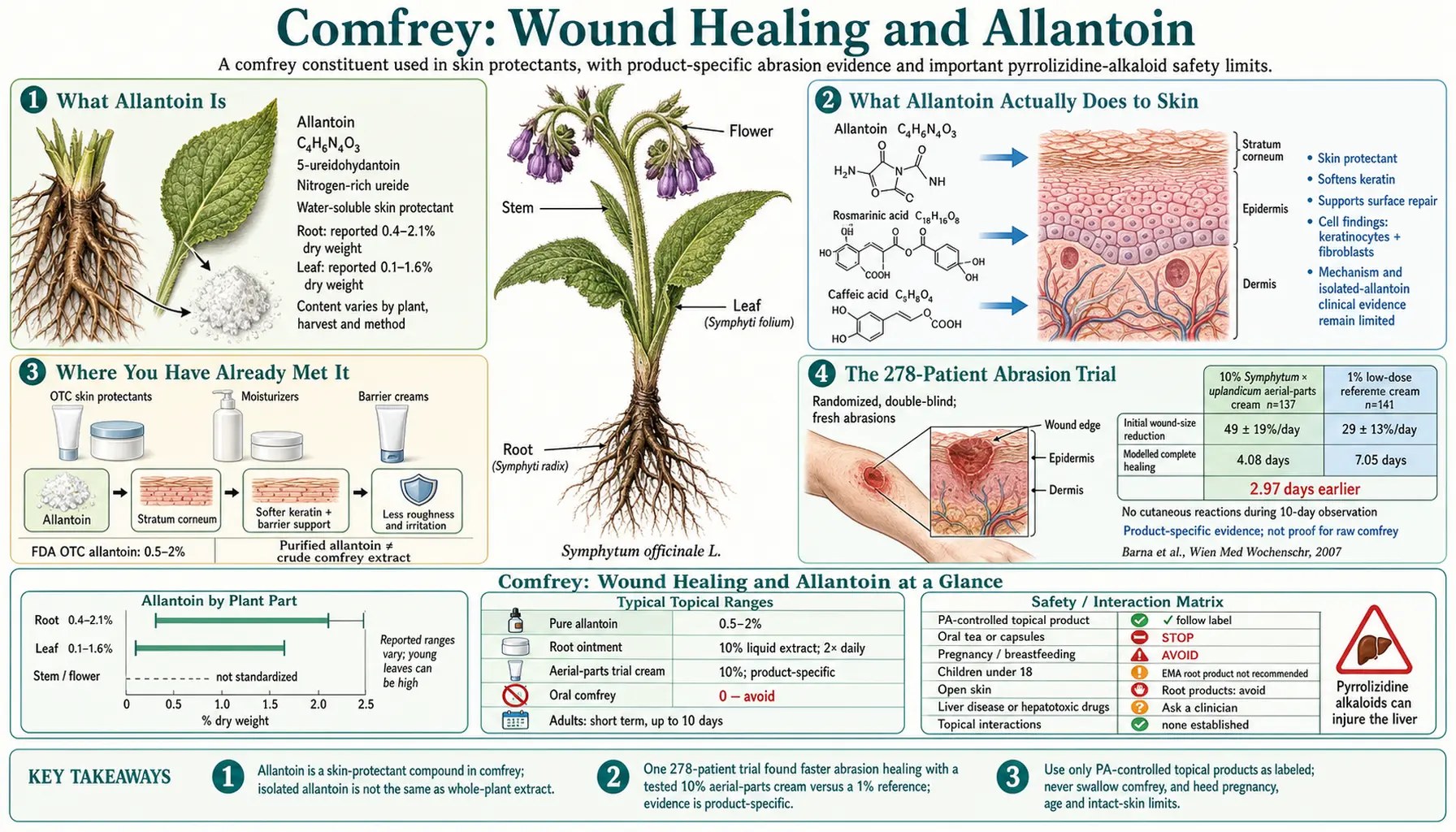
Most herbs credited with “healing wounds” do not contain any identified compound that heals wounds. Comfrey does. Its name is allantoin, and it is not a folk-medicine curiosity — it is a workaday ingredient in mainstream dermatology, sitting in nappy-rash creams, after-sun lotions, lip balms and prescription skin protectants. The old country reputation for “bruisewort” and “healing herb” is, unusually, traceable to a specific molecule that does a specific thing.
But this article carries a genuine tension, and it would be dishonest to smooth it over. Comfrey contains a compound that helps damaged skin regrow, and it also contains compounds that must not be allowed into the bloodstream — and broken skin is exactly where they get in. The plant that folk medicine mashed onto open wounds is the plant that modern safety guidance says to keep away from them. Resolving that tension is what this page is for.
⚠ The rule first, as on every page here: comfrey is never taken internally. Its pyrrolizidine alkaloids cause hepatic veno-occlusive disease — irreversible and sometimes fatal — with documented deaths, including from comfrey tea. Oral comfrey is banned or restricted in the United States, the United Kingdom, Germany, Canada and Australia. Because those alkaloids are absorbed through broken skin, ordinary comfrey preparations belong on intact skin only, for a short course (typically 10 days), never in pregnancy or breastfeeding, and not on children.
Table of Contents
- What Allantoin Is
- What Allantoin Actually Does to Skin
- Where You Have Already Met It
- The 278-Patient Abrasion Trial
- The Broken-Skin Paradox
- What the Cell and Animal Work Shows
- The Rest of the Wound-Relevant Chemistry
- Why This Is Not Bone Healing
- Getting the Benefit Without the Risk
- Practical Guidance
- Cautions and Contraindications
- Key Research Papers
- Connections
What Allantoin Is
Allantoin is a small, simple, water-soluble molecule — a diureide of glyoxylic acid, if you want the chemistry — and it is remarkably widespread in biology. It was first isolated from allantoic fluid, the fluid surrounding a developing embryo, which is where the name comes from.
In most mammals, allantoin is the end product of purine metabolism: the enzyme uricase converts uric acid into allantoin, which is far more soluble and easily excreted. Humans and the other great apes lost functional uricase during evolution, which is why we accumulate uric acid and get gout while dogs and mice do not. So humans have very little endogenous allantoin. Plants make it for their own nitrogen-handling reasons, and comfrey — especially the root — is one of the richest natural sources known.
Crucially, allantoin is not a pyrrolizidine alkaloid and carries none of comfrey’s toxicity. It is non-irritating, non-sensitising, and has an excellent safety record at the concentrations used in skin products. When people say comfrey is “proven to heal skin,” the honest version of that claim is: comfrey contains a lot of a compound that has independent evidence for helping skin.
What Allantoin Actually Does to Skin
Three distinct actions, all relevant to a healing wound:
- It promotes cell proliferation. This is the headline property. Allantoin encourages keratinocytes and fibroblasts — the cells that rebuild the skin surface and the connective tissue underneath — to divide and migrate. A wound closes by exactly those two processes, so a compound that accelerates them is doing something structurally useful rather than merely soothing.
- It is keratolytic and desquamating. Allantoin softens and helps shed hardened keratin. In practice this means it loosens crusts, softens rough or hyperkeratotic skin, and helps clear the dead surface layer that a new epithelium has to grow across. This is why it appears in products for cracked heels, calluses and scaly skin.
- It is a skin protectant and anti-irritant. It holds moisture at the surface, reduces the sting of an irritated area, and blunts the inflammatory response to detergents and other irritants in laboratory testing.
Put together, that is a coherent wound-healing profile: clear the dead surface, calm the irritation, and speed up the cells that rebuild. It is not dramatic pharmacology — allantoin is not an antibiotic, an anaesthetic or a growth factor — but it is real, and it is unusually well tolerated.
Where You Have Already Met It
Allantoin is one of those ingredients that quietly turns up everywhere once you start reading labels. In the United States it is recognised as an over-the-counter skin protectant active ingredient, typically at 0.5 to 2 %. You will find it in:
- Nappy-rash and barrier creams
- After-sun and post-procedure skin lotions
- Lip balms and hand creams for cracked skin
- Scar-management gels, usually alongside onion extract or silicone
- Anti-acne and exfoliating preparations, for its keratolytic action
- Shaving products and aftershave balms, as an anti-irritant
- Ophthalmic and oral-care products, where its non-irritancy matters
Almost all of it is synthetic. Allantoin is cheap to manufacture and chemically identical whether it comes from a reactor or a comfrey root, so there is no pharmacological advantage to the botanical source. That single fact resolves most of the practical dilemma on this page: if what you want is allantoin, you can buy allantoin, with no alkaloids attached.
The 278-Patient Abrasion Trial
There is one substantial human trial of a comfrey preparation on actual broken skin, and its details matter enormously.
Barna and colleagues (Wiener Medizinische Wochenschrift, 2007) ran a randomised, controlled, double-blind study in 278 patients with fresh abrasions — grazes. The product was Traumaplant, a cream containing 10 % of a concentrate from the aerial parts of Symphytum × uplandicum Nyman. The comparator was an otherwise identical cream containing only 1 % of the same concentrate. 137 patients received the strong version, 141 the weak one; 64 patients were aged 20 or under.
The results were unusually clear-cut:
- Initial wound-size reduction of 49 ± 19 % per day with the 10 % cream versus 29 ± 13 % per day with the 1 % reference (p<5×10⁻²¹).
- Time to complete healing, from linear regression: 4.08 days versus 7.05 days — nearly three days faster (p=7.4×10⁻⁴⁵).
- Physicians rated efficacy good to very good in 93.4 % of the strong-cream cases versus 61.7 % of the reference cases.
- Patients rated the strong cream 84.4 ± 10.1 out of 100, against 65.5 ± 24.8 for the reference.
- No adverse effects and no cutaneous reactions at all in any patient across the 10-day observation period.
Now the qualifications, which are as important as the numbers. The p-values are extraordinary — 10⁻⁴⁵ is not a number you normally see in clinical medicine — and they come from a linear-regression comparison rather than a simple between-group test, which inflates apparent precision. The comparator was not inert: it was a weaker version of the same cream, so this is a dose-response study and cannot tell you how much of either arm’s healing was simply what a graze does anyway. And the trial was conducted by investigators associated with the product.
But the single most important caveat is about the product itself. This trial was possible only because Traumaplant is made from a selected cultivar and process specified by the manufacturer as having pyrrolizidine alkaloid content below the limit of detection, and it uses the aerial parts rather than the alkaloid-rich root. That is why a regulator permitted a trial on broken skin at all. The result does not license putting ordinary comfrey on an open wound. It licenses putting that product on one.
The Broken-Skin Paradox
Here is the tension stated plainly, because it confuses a lot of people who read that comfrey heals wounds and then read that comfrey must not touch wounds.
| Claim | Status |
|---|---|
| Comfrey contains a compound (allantoin) that genuinely promotes skin repair | True |
| Traditional practice put comfrey poultices on open wounds and ulcers | True, and it is the part of the tradition that modern toxicology overturned |
| A specific alkaloid-free comfrey herb cream sped healing of fresh abrasions in a 278-patient trial | True |
| Therefore any comfrey cream is safe on broken skin | False, and potentially dangerous |
The reason is absorption. Intact skin is a genuinely good barrier: when researchers applied a crude alcoholic comfrey extract to the skin of rats at a large dose, urinary excretion of alkaloid N-oxides over two days amounted to only 0.1 to 0.4 % of the applied dose, while the same material given orally produced 20 to 50 times more urinary alkaloid. That is the whole safety case for topical comfrey in one measurement — the skin keeps most of it out.
Break the skin and you remove that barrier. A graze, a cut, a leg ulcer, a weeping patch of eczema, a burn, or a mucous membrane is a direct route into tissue and bloodstream. Nobody has measured how much alkaloid crosses a wound bed from a comfrey poultice, and nobody is going to run that trial — but the mechanism is obvious and the consequence, hepatic veno-occlusive disease, is severe enough that the precautionary answer is the correct one.
A survey of practitioners who use comfrey externally (Frost, O’Meara and MacPherson, 2014) found that some do apply it to broken skin, and the authors flagged this specifically as a safety concern. Traditional practice persists. It should not.
What the Cell and Animal Work Shows
Below the level of clinical trials, there is a reasonably consistent laboratory picture. All of the following is cell-culture or animal work and is labelled as such.
- Allantoin versus whole extract. Savić and colleagues (2015) compared pure allantoin with an aqueous comfrey root extract standardized to the same allantoin content, testing both on epithelial (MDCK) and fibroblast (L929) cell lines by MTT assay, along with anti-irritant testing. The comparison is the useful part: it separates what allantoin does from what the rest of the root does.
- Fibroblast stimulation. Sowa and colleagues (2018) applied a comfrey root extract to human skin fibroblasts and found a stimulatory effect on cell metabolism and viability, with no disruption of cytoskeletal structure or cell shape. The same paper quantified allantoin plus five phenolic acids — rosmarinic, p-hydroxybenzoic, caffeic, chlorogenic and p-coumaric — by HPLC, and measured high antioxidant activity by DPPH, FRAP and total-phenolic-content assays.
- Allantoin alone, in animals. Araújo and colleagues (2010) characterised the wound-healing profile induced by allantoin as an isolated compound, independent of any plant matrix.
- Comfrey creams on rat wounds. Mârza and colleagues (2024) tested creams based on Symphytum officinale extract on experimental skin wounds in rats — useful supporting evidence, and a reminder that most comfrey wound data is preclinical.
- Anti-inflammatory mechanism. Seigner and colleagues (2019) showed a comfrey root extract blocks NF-κB signalling at two steps in human endothelial cells, suppressing COX-2, E-selectin, VCAM-1 and ICAM-1. Inflammation control is part of orderly wound healing, not just pain relief.
What none of this shows is that comfrey outperforms ordinary wound care. There is no trial of comfrey against simple cleaning and a dressing, none against an antiseptic, and none in chronic wounds such as venous leg ulcers or diabetic foot ulcers — which are the wounds where a genuinely better treatment would matter most, and which are also precisely the wounds where prolonged alkaloid exposure through a large open surface would be most concerning.
The Rest of the Wound-Relevant Chemistry
- Mucilage. Comfrey’s slippery polysaccharides — the source of the old name “slippery root” — form a soft, moisture-retaining film. Moist wound healing is a genuine principle of modern wound care, so an occlusive, hydrating layer is not a trivial contribution. Interestingly, the anti-inflammatory activity in cell studies was stronger in the mucilage-depleted fraction, so the soothing feel and the anti-inflammatory action come from different parts of the plant.
- Rosmarinic acid and related phenolics. Antioxidant and anti-inflammatory. A wound bed is an oxidatively stressful environment, and excess inflammation slows healing.
- Tannins. Astringent; they precipitate surface proteins, which tightens tissue and reduces weeping. This is the classic reason astringent herbs feel effective on grazes.
- ⚠ Pyrrolizidine alkaloids. Present in every part of the plant unless deliberately removed, and much more concentrated in the root than the leaf. They contribute nothing to healing and everything to the risk.
Why This Is Not Bone Healing
The folk name knitbone, and the genus name Symphytum — from Greek roots meaning roughly “to grow together” — both encode a claim that comfrey helps fractures fuse. Allantoin’s cell-proliferation activity is often cited as the mechanism.
It does not follow. Allantoin promotes proliferation of skin and connective-tissue cells at the surface where it is applied. A fracture line sits centimetres below skin, muscle and periosteum, and bone repair is driven by osteoblasts and a well-characterised cascade of growth factors that a topical cream does not reach. There is no human trial of comfrey for fracture healing.
The most likely explanation for the tradition is simpler and rather sympathetic: a comfrey poultice bound over an injured limb reduced the pain and swelling of the surrounding soft tissue, the limb was immobilised by the binding, and the bone healed on its own schedule — as bones do. The observers were not wrong that the patient felt better. They were wrong about why.
Getting the Benefit Without the Risk
If the thing you actually want is faster, more comfortable skin healing, there are cleaner ways to get it.
- Buy purified allantoin. It is inexpensive, chemically identical to the plant-derived molecule, and free of alkaloids. Many barrier and repair creams list it at 0.5–2 %. This is the single most rational option, and it is faintly absurd how rarely it gets suggested.
- For broken skin, use a herb that is safe on broken skin. Calendula is the traditional and better-supported choice for grazes and minor wounds, without a hepatotoxic fraction.
- Do not neglect ordinary wound care. Clean the wound with running water, remove grit, cover it, keep it moist rather than letting it dry to a hard scab, and change the dressing. This outperforms every herbal option in the evidence base, and it is free.
- Keep comfrey for what it was actually tested on. Sprains, muscle pain, back pain and knee osteoarthritis — all on intact skin.
Practical Guidance
| Situation | What to do |
|---|---|
| Bruise or sore muscle, skin unbroken | A comfrey ointment or cream is reasonable. Follow the label; keep the course short. |
| Graze, cut, or any broken skin | Do not use a general comfrey product. Clean, cover, and consider calendula or a plain allantoin-containing barrier cream. |
| Chronic wound — leg ulcer, pressure sore, diabetic foot | Comfrey is not appropriate. These need clinical assessment; a large, long-standing open surface is the worst possible route for alkaloid exposure. |
| Burn | No. Cool with running water, cover, and seek care for anything beyond a small superficial burn. |
| Child with a graze | No comfrey. Soap, water and a plaster. |
| Scar management | Silicone gel or sheeting has the better evidence. Allantoin-containing scar gels exist and are harmless; comfrey adds nothing but risk. |
Label-reading for wound-adjacent products. If a product names allantoin as an active ingredient with a percentage, you know what you are getting. If it names “comfrey extract” without a plant part, a species, an extract ratio or an alkaloid statement, you do not — and for anything going near compromised skin, that uncertainty is the problem.
Cautions and Contraindications
⚠ Never take comfrey internally — no tea, capsules, tincture, powder, or eating the leaves. See Never Take It Internally.
- Intact skin only, for any general comfrey product. This is the central caution of this article. Broken skin removes the barrier that makes topical comfrey acceptable in the first place.
- The 278-patient abrasion result belongs to one specific alkaloid-free product. Do not generalise it. If a manufacturer does not state that its comfrey preparation is alkaloid-free and intended for use on damaged skin, assume it is not.
- Short courses only — about 10 days of self-treatment under the European monograph for comfrey root preparations, with German rules capping external use at roughly four to six weeks per year.
- Not in pregnancy or breastfeeding. Alkaloids cross the placenta and enter milk; the fetal and infant liver is the target organ.
- Not on children. Note that the abrasion trial did include patients aged 20 and under — but again, with an alkaloid-free product. General comfrey creams carry age restrictions for good reason: children have far more skin surface per kilogram of body weight, so the same application delivers proportionally more.
- Avoid with liver disease or alongside hepatotoxic medication.
- Do not apply to large body areas, and do not occlude with a dressing or wrap unless the product says to — occlusion increases absorption.
- Contact dermatitis is uncommon but reported for Boraginaceae preparations. Stop at the first sign of redness, itching or blistering.
- Signs a wound needs a clinician, not a cream: spreading redness, increasing pain after day two, pus, fever, a wound that will not close after two weeks, a wound with embedded debris, an animal or human bite, or any wound in someone with diabetes or poor circulation.
Key Research Papers
Every identifier below was verified live against NCBI E-utilities — title, first author, journal and year all had to match before a PMID was written. Study type is labelled for each.
- Barna M, Kucera A, Hladícova M, Kucera M. Wound healing effects of a Symphytum herb extract cream (Symphytum × uplandicum Nyman): results of a randomized, controlled double-blind study. Wiener Medizinische Wochenschrift. 2007;157(21–22):569–574. — Human trial. 278 patients with fresh abrasions; complete healing in 4.08 versus 7.05 days; no cutaneous reactions over 10 days. Used an alkaloid-free herb preparation. German-language article.
- Savić VLj, Nikolić VD, Arsić IA, et al. Comparative study of the biological activity of allantoin and aqueous extract of the comfrey root. Phytotherapy Research. 2015;29(8):1117–1122. — Cell culture. Pure allantoin versus allantoin-standardized root extract on MDCK and L929 cells, plus anti-irritant testing.
- Sowa I, Paduch R, Strzemski M, et al. Proliferative and antioxidant activity of Symphytum officinale root extract. Natural Product Research. 2018;32(5):605–609. — Cell culture. Stimulated human skin fibroblasts without cytoskeletal disruption; quantified allantoin and five phenolic acids.
- Araújo LU, Grabe-Guimarães A, Mosqueira VCF, Carneiro CM, Silva-Barcellos NM. Profile of wound healing process induced by allantoin. Acta Cirúrgica Brasileira. 2010;25(5):460–466. — Animal study. Allantoin as an isolated compound, without the plant matrix.
- Mârza SM, Däescu AM, Purdoiu RC, et al. Healing of skin wounds in rats using creams based on Symphytum officinale extract. International Journal of Molecular Sciences. 2024;25(6). — Animal study.
- Seigner J, Junker-Samek M, Plaza A, et al. A Symphytum officinale root extract exerts anti-inflammatory properties by affecting two distinct steps of NF-κB signaling. Frontiers in Pharmacology. 2019;10:289. — Cell culture. The mucilage-depleted fraction was the more active one.
- Brauchli J, Lüthy J, Zweifel U, Schlatter C. Pyrrolizidine alkaloids from Symphytum officinale L. and their percutaneous absorption in rats. Experientia. 1982;38(9):1085–1087. — Animal study. The measurement that underpins the intact-skin rule: 0.1–0.4 % urinary excretion after dermal dosing versus 20–50 times more after oral dosing.
- Frost R, O’Meara S, MacPherson H. The external use of comfrey: a practitioner survey. Complementary Therapies in Clinical Practice. 2014;20(4):347–355. — Survey. Documents that some practitioners still apply comfrey to broken skin, which the authors flag as a safety concern.
- Frost R, MacPherson H, O’Meara S. A critical scoping review of external uses of comfrey (Symphytum spp.). Complementary Therapies in Medicine. 2013;21(6):724–745. — Independent review of the whole external-use literature, wound healing included.
- Salehi B, Sharopov F, Boyunegmez Tumer T, et al. Symphytum species: a comprehensive review on chemical composition, food applications and phytopharmacology. Molecules. 2019;24(12). — Review. Useful for the constituent profile across Symphytum species.
- Luca SV, Zengin G, Sinan KI, et al. Phytochemical profiling and bioactivity assessment of underutilized Symphytum species in comparison with Symphytum officinale. Journal of the Science of Food and Agriculture. 2024;104(7):3971–3981. — Analytical chemistry. Species differ substantially in what they contain.
- Kim NC, Oberlies NH, Brine DR, et al. Isolation of symlandine from the roots of common comfrey (Symphytum officinale) using countercurrent chromatography. Journal of Natural Products. 2001;64(2):251–253. — Analytical chemistry. A reminder of what else the root contains alongside the allantoin.
Live PubMed Searches
- Allantoin and wound healing
- Allantoin and keratinocyte proliferation
- Symphytum officinale and wounds
- Comfrey cream for abrasions
- Moist wound healing
- Calendula and wound healing
- Allantoin as a skin protectant
- Comfrey percutaneous absorption
Connections
- All Herbs
- Comfrey Benefits — hub
- Comfrey — main topic page
- Topical Use for Sprains and Bruises
- Osteoarthritis and Back Pain
- ⚠ Never Take It Internally
- Calendula — the herb to use on broken skin
- Marshmallow Root — mucilage without the alkaloids
- Butterbur — the same alkaloid problem, a different herb
- Orthopedics — injury and soft-tissue repair