Chasteberry (Vitex)
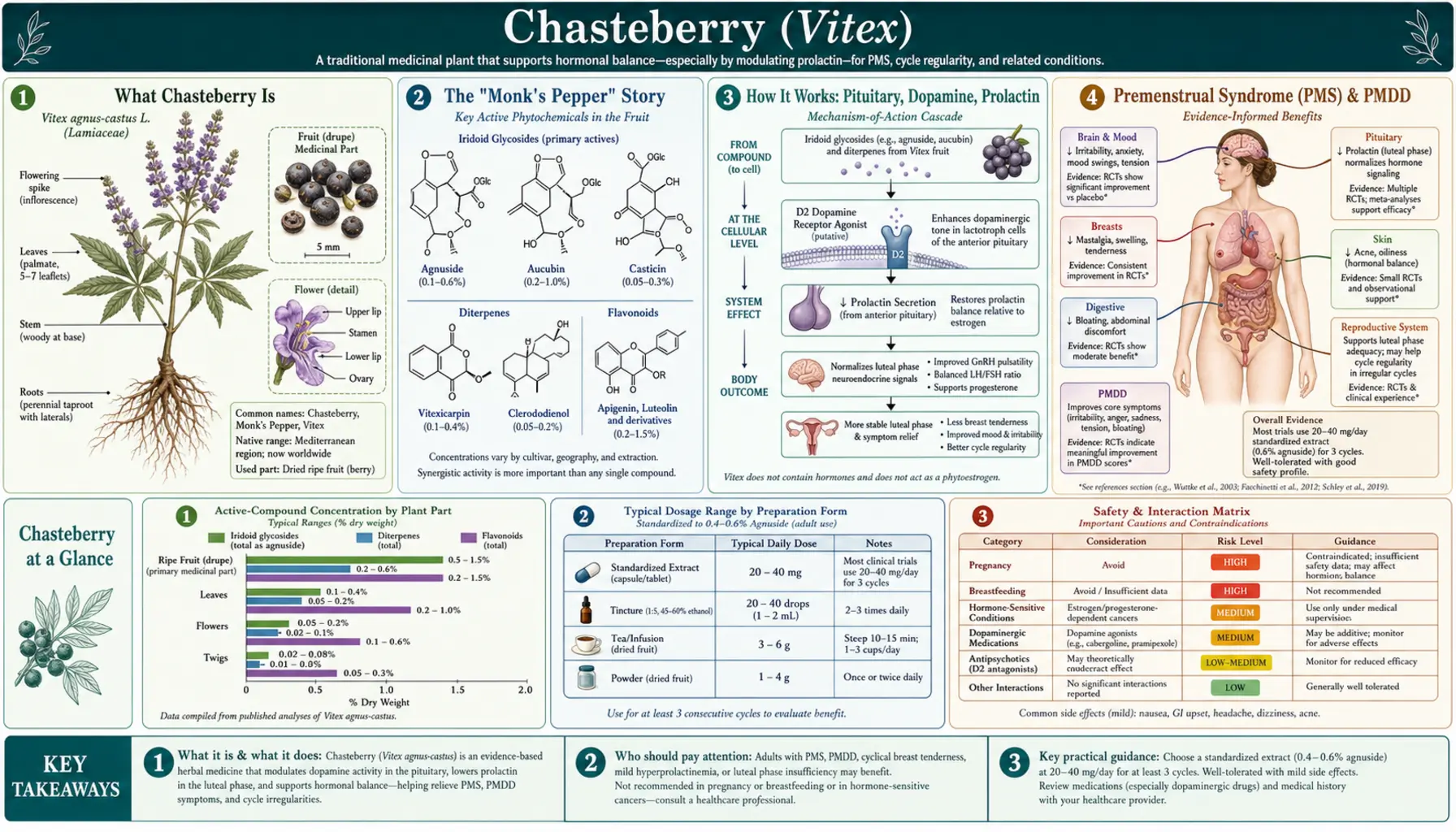
Chasteberry is the small, dark, peppercorn-sized fruit of a Mediterranean shrub called Vitex agnus-castus — also known as chaste tree, vitex, or "monk's pepper." Among the many herbs sold for "women's health," chasteberry is one of the few with a plausible, well-studied mechanism and several real clinical trials behind its headline use. It does not act like an estrogen or a hormone itself. Instead, it works higher up the chain — nudging the pituitary gland in the brain through a dopamine-like effect, which gently lowers the hormone prolactin. That single action is the thread that ties together its best-supported uses: relief of premenstrual syndrome (PMS), easing of cyclical breast pain, and some help with luteal-phase and menstrual-cycle irregularities. This page lays out what chasteberry genuinely does, what the trials actually show (including how modest some effects are), where the popular claims run ahead of the evidence, and the safety issues — especially drug interactions and pregnancy — that matter most.
Table of Contents
- What Chasteberry Is
- The "Monk's Pepper" Story
- How It Works: Pituitary, Dopamine, Prolactin
- Premenstrual Syndrome (PMS) & PMDD
- Cyclical Breast Pain (Mastalgia)
- Cycle Irregularity & the Luteal Phase
- Fertility & Menopause: An Honest Look
- Forms & Dosing
- Safety, Side Effects & Interactions
- Research Papers
- Conditions It Is Used For
- Connections
- Featured Videos
What Chasteberry Is
Chasteberry comes from Vitex agnus-castus, a hardy deciduous shrub or small tree native to the Mediterranean basin and Central Asia. It produces slender spikes of lilac flowers followed by clusters of small, hard, reddish-black berries about the size of a peppercorn. Those dried berries — with their faintly peppery, spicy taste — are the part used medicinally. When you see a product labeled "vitex," "chaste tree," or "chasteberry," it is almost always an extract of this fruit.
The berries contain a mix of active compounds rather than a single "drug." The ones researchers pay most attention to are:
- Diterpenes (such as rotundifuran and the clerodadienols) — thought to be the compounds responsible for the dopamine-like activity that gives chasteberry its main effect.
- Flavonoids (such as casticin and vitexin) — antioxidant plant pigments that may contribute to secondary effects seen in the laboratory.
- Iridoid glycosides (such as agnuside and aucubin) — often used as marker compounds to standardize the strength of an extract.
- Small amounts of an essential oil that give the berry its aroma.
Because the effect comes from this blend, chasteberry is sold as a whole-fruit extract rather than as an isolated molecule — and the specific standardized extracts used in the good clinical trials (see Forms & Dosing) are what the evidence actually applies to.
The "Monk's Pepper" Story
Chasteberry has one of the more memorable names in the herbal world, and the story behind it explains a common misconception. The plant's Latin name, agnus-castus, roughly translates to "chaste lamb," and its old English names — chaste tree and monk's pepper — come from a centuries-old belief that the berries dampened sexual desire. Medieval European monks were said to grind the peppery berries as a seasoning and take them to help uphold their vows of celibacy, and the plant was associated with chastity as far back as classical antiquity, when Greek and Roman writers such as Dioscorides described it.
Here is the honest footnote to that colorful history: there is no good modern evidence that chasteberry reduces libido in the way the folklore claims. The "anti-desire" reputation is tradition and anecdote, not established pharmacology. What the plant does reliably do — act on the pituitary to lower prolactin — is a genuinely different and more interesting story, and it is the reason chasteberry survived from monastery gardens into modern gynecology rather than fading into folklore. Its traditional use for menstrual complaints, "female weakness," and problems with milk flow after childbirth turned out to point, however roughly, at a real hormonal target.
How It Works: Pituitary, Dopamine, Prolactin
This is the part worth understanding, because it explains why chasteberry helps with some things and not others. Unlike many "hormone-balancing" herbs, chasteberry is not a phytoestrogen in the usual sense — it does not mainly work by mimicking estrogen. Its central action happens in the brain, at the pituitary gland, the small master gland that directs much of the body's hormone system.
The key player is a brain chemical called dopamine. In the body's hormonal wiring, dopamine acts as the natural "off switch" for a hormone called prolactin — dopamine tells the pituitary to release less prolactin. Laboratory studies have shown that chasteberry's diterpene compounds bind to dopamine D2 receptors on pituitary cells, imitating dopamine's signal. The practical result is that chasteberry can modestly lower prolactin, especially when prolactin is running slightly high (see Research Papers).
Why does that matter for the menstrual cycle? Prolactin's best-known job is stimulating breast milk production, but even outside of breastfeeding, mildly elevated prolactin can throw off the delicate hormonal rhythm of the cycle. It can blunt the smooth rise and fall of the reproductive hormones, shorten or disrupt the second half of the cycle (the luteal phase, after ovulation), and contribute to tender breasts and premenstrual symptoms. By gently lowering prolactin, chasteberry may help this rhythm run more normally. This single mechanism — lower prolactin, steadier luteal phase — is the honest, evidence-based core of what chasteberry does.
Two important qualifiers keep this in perspective. First, the effect is gentle: chasteberry nudges prolactin, it does not slam it down the way a prescription drug does, and it is not a treatment for the large prolactin elevations caused by a pituitary tumor (a prolactinoma), which needs real medical care. Second, chasteberry contains many compounds, and laboratory work has reported additional, weaker interactions — including activity at opioid receptors and a selective, mild effect at one type of estrogen receptor (estrogen receptor beta). These may fine-tune the herb's effects, but the dopamine–prolactin route is by far the best-supported explanation for its clinical benefits.
Premenstrual Syndrome (PMS) & PMDD
Relief of premenstrual syndrome is chasteberry's flagship use and its strongest area of evidence. PMS covers the cluster of physical and emotional symptoms — irritability, mood swings, breast tenderness, bloating, headache, anger, low mood — that show up in the days before a period and fade once bleeding starts. Several randomized, placebo-controlled trials have tested standardized chasteberry extracts for exactly this pattern.
The landmark study is a 2001 trial published in the BMJ. Women with PMS took either a standardized chasteberry extract (20 mg once daily) or a placebo for three menstrual cycles. Roughly half of the chasteberry group (about 52%) reported meaningful improvement — a 50% or greater reduction in symptoms — compared with about a quarter (24%) on placebo. Individual symptoms that improved included irritability, mood changes, anger, headache, and breast fullness. A later dose-finding trial by the same lead researcher found that the 20 mg daily dose was the sweet spot: a lower 8 mg dose worked little better than placebo, and a higher 30 mg dose was no better than 20 mg. A large multicenter placebo-controlled trial in China, using a different standardized extract, likewise found significantly greater symptom reduction with chasteberry than placebo.
When researchers pool these trials in systematic reviews and meta-analyses, the overall verdict is consistent but carefully hedged: chasteberry appears more effective than placebo for PMS, yet the authors repeatedly flag two honest limitations. First, the quality of the trials is uneven — several carry a meaningful risk of bias, and a number were funded by the companies that make the extracts. Second, results vary between studies. In plain terms: the direction of the evidence genuinely favors chasteberry for PMS, the effect is real and clinically useful for many women, but it is moderate, not miraculous, and the research base is not as airtight as the marketing implies.
A key expectation to set: chasteberry is slow. Because it works by gradually nudging the pituitary, benefit typically builds over about three menstrual cycles (roughly three months) rather than within days. It is a cycle-regulating herb, not a fast-acting painkiller.
What about premenstrual dysphoric disorder (PMDD) — the severe, mood-dominated form of PMS that is treated as a psychiatric condition? Here the evidence is much thinner. Only a few trials have looked specifically at PMDD, results are mixed, and for genuinely disabling PMDD the best-supported treatments remain SSRIs and other approaches supervised by a clinician. Chasteberry is reasonable to discuss for milder premenstrual mood symptoms, but it should not be treated as a proven stand-in for real PMDD care. If premenstrual symptoms are severe enough to disrupt work, relationships, or safety, that is a conversation for a doctor, not a supplement bottle.
Cyclical Breast Pain (Mastalgia)
Cyclical mastalgia — breast pain and tenderness that swells in the days before a period and settles afterward — is one of chasteberry's most mechanistically sensible uses, because breast tissue is directly sensitive to prolactin. If chasteberry lowers prolactin, easing premenstrual breast pain is exactly the kind of effect you would predict.
The evidence backs this up on a modest scale. A placebo-controlled, double-blind trial of a chasteberry solution found a significantly greater reduction in cyclical breast pain over several cycles compared with placebo. Reviews of chasteberry's use across women's reproductive complaints consistently list cyclical mastalgia, alongside PMS, as one of the conditions with the more convincing supporting data. As with PMS, the benefit is real but moderate, and it builds over a few cycles rather than overnight.
One important caveat: new, one-sided, persistent, or lumpy breast changes are not something to self-treat with an herb. Cyclical, both-sided tenderness that tracks the menstrual cycle is usually benign, but any breast pain that is constant, focal, or accompanied by a lump, skin change, or nipple discharge should be evaluated by a clinician before reaching for chasteberry.
Cycle Irregularity & the Luteal Phase
Beyond PMS and breast pain, chasteberry has a long traditional reputation for helping "regulate" the menstrual cycle, and its prolactin-lowering action gives that reputation a plausible basis. The most studied version of this idea is the luteal-phase defect linked to mildly elevated prolactin (sometimes called latent hyperprolactinemia).
Here is the logic, in plain terms. The luteal phase is the roughly two-week stretch after ovulation when the ovary's corpus luteum produces progesterone to prepare the uterus. If prolactin runs slightly high, it can interfere with this phase, making it too short or the progesterone output too low — which can show up as irregular cycles, spotting, or trouble in the second half of the cycle. Because chasteberry gently lowers prolactin, older and smaller studies explored whether it could help normalize a shortened luteal phase and support more regular cycles, with some encouraging results.
The honest status of this use is promising but not settled. Systematic reviews that looked across chasteberry's studied conditions describe the evidence for luteal-phase and general cycle-regulation effects as weaker and more equivocal than the PMS and mastalgia data — the relevant trials tend to be older, smaller, and less rigorous. It is fair to say chasteberry may help some women with prolactin-related cycle irregularity, particularly milder cases, while being clear that this is not proven the way its PMS use is. Persistent irregular cycles always deserve a medical work-up first, because the cause — thyroid problems, PCOS, significant hyperprolactinemia, and others — changes what the right treatment is.
Fertility & Menopause: An Honest Look
Two of the biggest marketing claims for chasteberry — that it boosts fertility and that it eases menopause — are also the two where the evidence is weakest, so they deserve a plain, honest accounting.
Fertility. The fertility claim is an extension of the luteal-phase story: if mildly high prolactin is disrupting the second half of the cycle and making conception harder, then lowering prolactin might, in theory, help. A handful of small and mostly older studies have looked at chasteberry (sometimes as one ingredient in a multi-herb fertility blend) in women with luteal-phase problems or subtle prolactin elevation, with some positive signals. But the evidence is limited, inconsistent, and often confounded by being tested inside combination products, so it is impossible to credit chasteberry alone. The bottom line: chasteberry is not an established fertility treatment. It may be reasonable for a specific, prolactin-related cause of luteal-phase trouble, but anyone struggling to conceive is far better served by a proper fertility evaluation (see Female Infertility) than by assuming an herb will fix an unknown problem.
Menopause. This is where the biology itself argues for caution. Chasteberry's whole mechanism — regulating prolactin and the luteal phase of an ovulating cycle — is a premenopausal target. After menopause there is no cycle to regulate, and the classic menopausal complaints (hot flashes, night sweats) are driven by falling estrogen, not by prolactin. Unsurprisingly, there is little good evidence that chasteberry alone relieves menopausal symptoms. It sometimes appears in combination products with herbs like black cohosh, which has its own (also debated) menopause evidence, but that does not make a case for chasteberry itself. For menopausal symptom relief, chasteberry is not the herb the evidence points to. It is best understood as a tool for the reproductive years, aimed at prolactin-related, cycle-linked complaints.
Forms & Dosing
One of the most important and least-advertised facts about chasteberry is that the good evidence applies to specific standardized extracts, not to "chasteberry" in the abstract. Two extracts dominate the quality trials:
- Ze 440 — the standardized extract used in the influential PMS trials, typically dosed at 20 mg once daily.
- BNO 1095 (sold in products such as Agnucaston / Agnolyt) — the standardized extract used in the large Chinese PMS trial and other studies.
Chasteberry is also sold as dried whole berries, powdered fruit in capsules, liquid tinctures, and teas. Typical label doses for standardized fruit extracts fall in the range of about 20–40 mg per day, while whole dried-fruit or crude-powder products are dosed higher (often a few hundred milligrams) to deliver a comparable amount of active compounds. Because products vary so much in strength and standardization, two bottles labeled "chasteberry" are not necessarily equivalent — matching a product to one of the studied extracts, where possible, is the most evidence-aligned choice.
A few practical points on how it is used:
- Take it in the morning. Chasteberry is traditionally and in most trials taken as a single morning dose, timed to the body's natural early-day hormonal rhythm.
- Give it about three cycles. As noted above, chasteberry works gradually; judging whether it helps usually takes roughly three months of consistent daily use, not a few days.
- It is taken daily, not just premenstrually. Unlike a symptom pill, chasteberry is generally taken every day throughout the cycle, because it works by steadily influencing the pituitary over time.
Safety, Side Effects & Interactions
For most healthy, non-pregnant adults, chasteberry is generally well tolerated. A systematic review of adverse events found that side effects reported in trials were mostly mild, reversible, and no more common than with placebo, with no serious adverse events attributable to the herb. The side effects that do occur tend to be minor:
- Digestive upset — nausea or stomach discomfort.
- Headache.
- Skin reactions — acne-like breakouts, rash, or itching.
- Menstrual changes — spotting or shifts in cycle timing, especially early on.
- Occasionally, dizziness or fatigue.
The more important safety issues are interactions and specific situations to avoid, which follow directly from chasteberry's mechanism:
- Dopamine-affecting medications. Because chasteberry acts like dopamine at the pituitary, it can theoretically work against dopamine-blocking drugs — most notably antipsychotics (such as haloperidol or risperidone) and the anti-nausea drug metoclopramide — potentially blunting their intended effect. Conversely, it could theoretically add to dopamine-agonist drugs such as bromocriptine, cabergoline, or Parkinson's medications like ropinirole. Anyone on these medications should not take chasteberry without medical advice.
- Hormonal contraceptives and hormone therapy. There is a theoretical concern that chasteberry's hormonal effects could interfere with the pill or other hormone treatments. The evidence for a real-world interaction is limited, but it is worth discussing with a provider — and chasteberry should not be relied upon to influence a cycle that is being controlled by hormonal birth control.
- Hormone-sensitive conditions. Because chasteberry can influence the hormonal system, caution is advised for anyone with a hormone-sensitive condition. If you have a history of a hormone-related cancer or another hormone-sensitive disorder, clear chasteberry with your specialist first.
- Assisted reproduction (IVF). Given its hormonal activity and prolactin effect, chasteberry should be avoided during fertility treatment cycles unless a fertility specialist specifically approves it.
Pregnancy and breastfeeding: avoid. Chasteberry is not recommended during pregnancy because of its hormonal activity and a lack of safety data. It should also be avoided while breastfeeding — and here the mechanism makes the reason clear: prolactin is the hormone that drives milk production, so a herb that lowers prolactin could reduce milk supply. (Some traditional lore pointed the opposite way, using it to encourage milk flow, but the modern, mechanism-based guidance is to steer clear while nursing.)
As with any supplement, quality and honesty about expectations matter. Chasteberry is a legitimate, reasonably evidence-based option for premenstrual symptoms and cyclical breast pain in the reproductive years — not a cure-all, not a fertility guarantee, and not a menopause remedy. Used thoughtfully, with realistic timelines and an eye on the interactions above, it is one of the better-studied herbs in the women's-health aisle.
Research Papers
- Schellenberg R. Treatment for the premenstrual syndrome with agnus castus fruit extract: prospective, randomised, placebo controlled study. BMJ. 2001;322(7279):134–137. doi:10.1136/bmj.322.7279.134 — The landmark placebo-controlled trial: about 52% of women on chasteberry (Ze 440, 20 mg/day) improved meaningfully over three cycles versus about 24% on placebo.
- He Z, Chen R, Zhou Y, et al. Treatment for premenstrual syndrome with Vitex agnus castus: a prospective, randomized, multi-center placebo controlled study in China. Maturitas. 2009;63(1):99–103. doi:10.1016/j.maturitas.2009.01.006 — A large multicenter placebo-controlled trial (BNO 1095 extract) confirming greater PMS symptom reduction with chasteberry than placebo.
- Schellenberg R, Zimmermann C, Drewe J, Hoexter G, Zahner C. Dose-dependent efficacy of the Vitex agnus castus extract Ze 440 in patients suffering from premenstrual syndrome. Phytomedicine. 2012;19(14):1325–1331. doi:10.1016/j.phymed.2012.08.006 — A dose-finding study showing 20 mg/day is the effective dose — 8 mg was near-placebo and 30 mg no better than 20 mg.
- Momoeda M, Sasaki H, Tagashira E, Ogishima M, Takano Y, Ochiai K. Efficacy and safety of Vitex agnus-castus extract for treatment of premenstrual syndrome in Japanese patients: a prospective, open-label study. Advances in Therapy. 2014;31(3):362–373. doi:10.1007/s12325-014-0106-z — An open-label study reporting PMS improvement in Japanese women; useful but limited by the lack of a placebo comparison.
- Verkaik S, Kamperman AM, van Westrhenen R, Schulte PFJ. The treatment of premenstrual syndrome with preparations of Vitex agnus castus: a systematic review and meta-analysis. American Journal of Obstetrics and Gynecology. 2017;217(2):150–166. doi:10.1016/j.ajog.2017.02.028 — A pooled analysis finding chasteberry more effective than placebo for PMS while cautioning about risk of bias and industry funding in many trials.
- Csupor D, Lantos T, Hegyi P, et al. Vitex agnus-castus in premenstrual syndrome: a meta-analysis of double-blind randomised controlled trials. Complementary Therapies in Medicine. 2019;47:102190. doi:10.1016/j.ctim.2019.08.024 — A meta-analysis of double-blind RCTs reporting a significant reduction in PMS symptoms, tempered by heterogeneity between studies.
- Cerqueira RO, Frey BN, Leclerc E, Brietzke E. Vitex agnus castus for premenstrual syndrome and premenstrual dysphoric disorder: a systematic review. Archives of Women's Mental Health. 2017;20(6):713–719. doi:10.1007/s00737-017-0791-0 — A review supporting chasteberry for PMS while noting that evidence specifically for PMDD remains limited.
- van Die MD, Burger HG, Teede HJ, Bone KM. Vitex agnus-castus extracts for female reproductive disorders: a systematic review of clinical trials. Planta Medica. 2013;79(7):562–575. doi:10.1055/s-0032-1327831 — A broad review finding the strongest evidence for PMS and cyclical mastalgia, and weaker or equivocal evidence for other reproductive uses.
- Halaska M, Beles P, Gorkow C, Sieder C. Treatment of cyclical mastalgia with a solution containing a Vitex agnus castus extract: results of a placebo-controlled double-blind study. The Breast. 1999;8(4):175–181. doi:10.1054/brst.1999.0039 — A double-blind trial showing significantly greater reduction in cyclical breast pain with chasteberry than placebo.
- Wuttke W, Jarry H, Christoffel V, Spengler B, Seidlová-Wuttke D. Chaste tree (Vitex agnus-castus) — pharmacology and clinical indications. Phytomedicine. 2003;10(4):348–357. doi:10.1078/094471103322004866 — A key pharmacology review describing the dopaminergic, prolactin-lowering mechanism at the pituitary.
- Meier B, Berger D, Hoberg E, Sticher O, Schaffner W. Pharmacological activities of Vitex agnus-castus extracts in vitro. Phytomedicine. 2000;7(5):373–381. doi:10.1016/S0944-7113(00)80058-6 — Laboratory work demonstrating that chasteberry extracts bind dopamine D2 receptors, the basis of the prolactin-lowering effect.
- Daniele C, Thompson Coon J, Pittler MH, Ernst E. Vitex agnus castus: a systematic review of adverse events. Drug Safety. 2005;28(4):319–332. doi:10.2165/00002018-200528040-00004 — A safety review concluding that reported adverse events are mild, reversible, and comparable to placebo, with no serious events attributable to the herb.
Conditions Chasteberry (Vitex) Is Used For
Each condition below links to its page. The coloured half of every capsule shows how much human evidence supports this herb for that specific use — traditional use is history, not proof, and is marked as such.
Connections
- All Herbs
- PMS and PMDD
- Dysmenorrhea
- PCOS
- Prolactinoma
- Female Infertility
- Menopause
- Black Cohosh
- Maca
- Dong Quai (Angelica sinensis) — the Chinese blood tonic — a different species from European angelica
- White Peony Root (Bai Shao) — source of Total Glucosides of Paeony, an approved rheumatoid-arthritis drug in China