Chasteberry Benefits
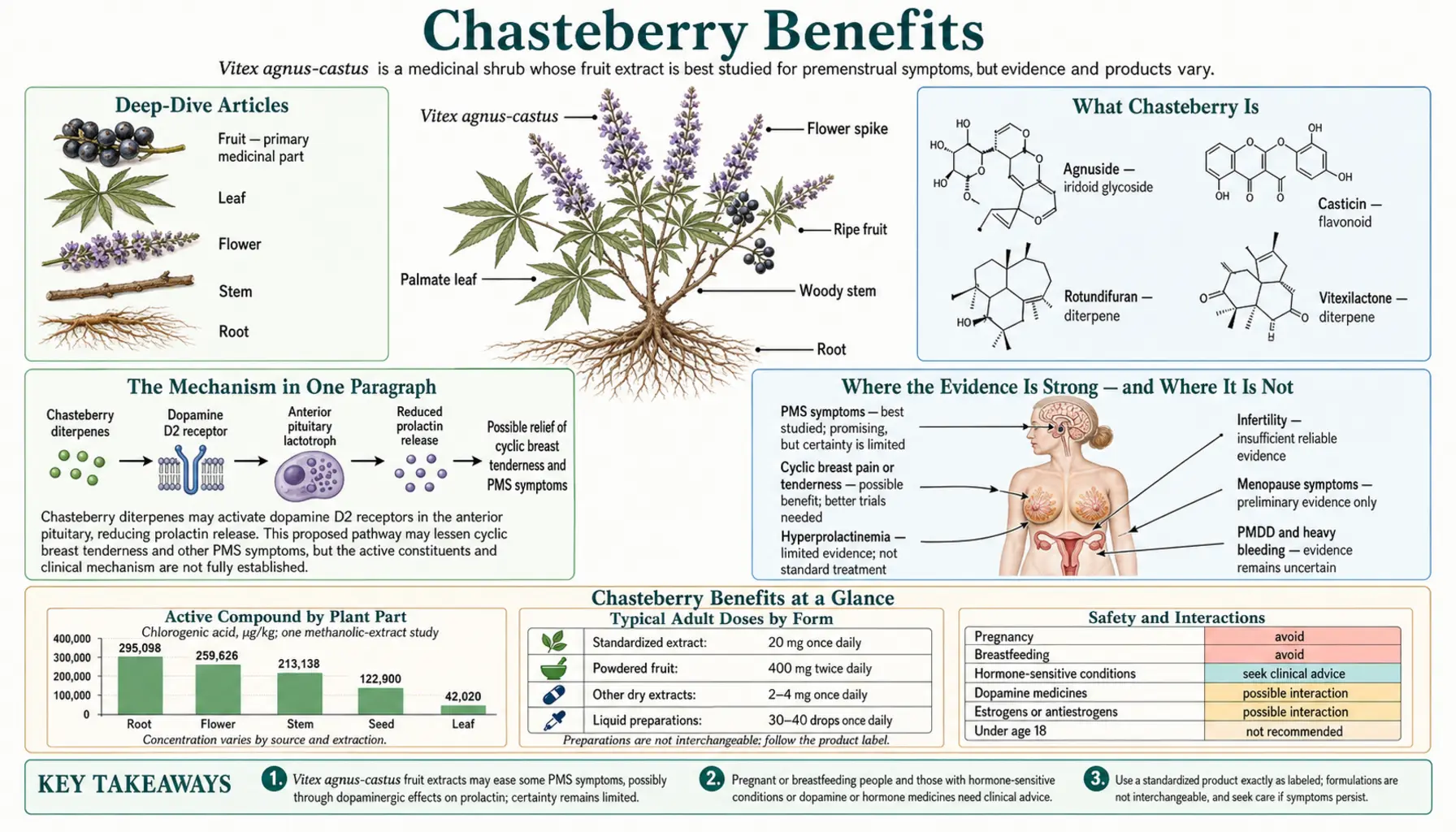
Chasteberry is the dried fruit of Vitex agnus-castus L., a Mediterranean shrub with lilac flower spikes and hard, peppercorn-sized berries. Botanists once filed it under Verbenaceae; modern molecular classification places it in the mint family, Lamiaceae. Its folk names all point the same direction — chaste tree, agnus castus ("chaste lamb"), and monk's pepper, from the medieval belief that monastery gardeners ground the peppery berries as a seasoning to help keep their vows. That story is worth telling because it is memorable, and worth correcting because it is not what the herb does: there is no credible modern evidence that chasteberry suppresses libido.
What it does do is more interesting, and unusually well characterised for a herbal medicine. Extracts of the fruit bind the dopamine D2 receptor on pituitary cells and imitate dopamine's natural braking signal on prolactin. That single, testable mechanism explains the shape of the evidence: chasteberry helps most where prolactin and the second half of the cycle are involved — premenstrual symptoms and cyclical breast pain — and does progressively less as you move away from that target, toward fertility, PCOS and menopause.
These four articles go past the summary on the main Chasteberry page and into the trials themselves: who was enrolled, which extract at which dose, for how long, and what the number actually was. Two expectations to carry in from the start. First, the good evidence attaches to two named extracts — Ze 440 and BNO 1095 — not to "chasteberry" as a generic ingredient. Second, it is slow: essentially every positive trial ran for three menstrual cycles, and that is the honest trial period before you decide whether it works for you.
Table of Contents
- Deep-Dive Articles
- What Chasteberry Is
- The Mechanism in One Paragraph
- Where the Evidence Is Strong — and Where It Is Not
- The Three-Cycle Rule
- Why a Raised Prolactin Is Not a Diagnosis
- Cautions That Actually Matter
- Key Research Papers
- External Resources
- Connections
Deep-Dive Articles
Start with PMS and cyclical breast pain — that is where the trials are real and everything else is context.
PMS and Cyclical Breast Pain
The strongest evidence on this page: the 170-woman BMJ trial of Ze 440, the 217-woman Chinese BNO 1095 trial, the dose-ranging study that settled on 20 mg, and the meta-analysis that pooled 718 women for cyclical mastalgia — alongside the reviewers who call the trial base biased and heterogeneous.
Cycle Regulation and Fertility
The 1993 Milewicz trial on luteal phase defect and latent hyperprolactinaemia — the single best study behind the "cycle-regulating" claim, and a small one. Why the fertility evidence is confounded by combination products, and why chasteberry is not the herb for PCOS or menopause.
Prolactin and Hormonal Mechanism
Dopamine as prolactin's brake, the D2 receptor binding assays, the diterpene rotundifuran and its relatives, the iridoids agnuside and aucubin, casticin and apigenin at oestrogen receptor beta — and why the mechanism predicts what chasteberry can and cannot treat.
Forms, Dosing and Interactions
Ze 440 versus BNO 1095 versus the unlabelled capsule, what to look for on a label, the real side-effect profile from a systematic adverse-event review, and the interactions that follow from a dopaminergic herb — antipsychotics, metoclopramide, bromocriptine, contraception, IVF and pregnancy.
What Chasteberry Is
Vitex agnus-castus is a deciduous shrub or small tree native to the Mediterranean basin and Central Asia, hardy enough to be planted as an ornamental far outside its range. The medicinal part is the ripe dried fruit — small, hard, dark reddish-brown berries with a faint peppery bite. Every product on the market, from tinctures to 20 mg tablets, starts there.
The fruit is a mixture, not a single drug, and four constituent groups matter:
- Iridoid glycosides — agnuside and aucubin. These are the compounds most often printed on a certificate of analysis, because they are easy to measure by HPLC and stable enough to serve as quality markers. They are markers, not the active principle: no one has shown that agnuside content predicts clinical effect.
- Labdane diterpenes — rotundifuran, vitexilactone, and 6β,7β-diacetoxy-13-hydroxy-labda-8,14-diene. These are the compounds that carry the dopaminergic activity. Analytical work found rotundifuran at roughly 0.04–0.30 percent of the dried fruit and 1.04–2.23 percent of the extract, a spread of about sevenfold between commercial samples — a concrete reason two "chasteberry" products need not behave alike.
- Flavonoids — casticin, vitexin, penduletin and apigenin. Casticin is a second common standardisation marker. Apigenin turned out to be the compound responsible for chasteberry's weak, oestrogen-receptor-beta-selective activity.
- Essential oil — largely 1,8-cineole, sabinene and pinenes. It gives the berry its aroma and its peppery taste; it is not the reason anyone takes it.
The Mechanism in One Paragraph
Prolactin is made by lactotroph cells in the anterior pituitary. Unlike most pituitary hormones, prolactin's default is on: the hypothalamus holds it down by dripping dopamine onto D2 receptors on those cells. Remove the dopamine and prolactin rises — which is exactly why dopamine-blocking drugs such as antipsychotics and metoclopramide raise prolactin as a side effect. Chasteberry extract contains a compound that binds the D2 receptor and mimics that braking signal. This was demonstrated directly in 1994 in a rat pituitary cell system, where the extract inhibited prolactin release without touching LH or FSH, and it was traced in 2000 to the lipophilic diterpene fraction. Because prolactin excess shortens and weakens the luteal phase and makes breast tissue tender, a herb that gently lowers prolactin lands on PMS, cyclical mastalgia and luteal-phase problems — and on nothing much else. Chasteberry is not an oestrogen and not a progesterone; that is the single most common misunderstanding about it.
Where the Evidence Is Strong — and Where It Is Not
| Use | Best available evidence | Honest verdict |
|---|---|---|
| Premenstrual syndrome | Multiple double-blind placebo-controlled trials of Ze 440 and BNO 1095; three meta-analyses | The flagship use. Real, replicated, moderate in size — and every reviewer flags risk of bias and industry funding |
| Cyclical breast pain (mastalgia) | Placebo-controlled trials plus a 2020 meta-analysis pooling 718 women | The best mechanistic fit. Moderate effect size; typical studied dose 20–40 mg/day for 3 months |
| Luteal phase defect with latent hyperprolactinaemia | One randomised placebo-controlled trial (52 enrolled, 37 analysed, 1993) | Positive and mechanistically coherent, but a single small old study is a thin foundation |
| PMDD | Two small comparator trials; one found chasteberry comparable to fluoxetine, one found fluoxetine better | Thin and mixed. Disabling PMDD needs proper psychiatric care, not a supplement |
| Fertility / trying to conceive | Small trials, mostly of multi-ingredient products in which chasteberry was one of several actives | Not an established fertility treatment. The combination design makes chasteberry's own contribution unknowable |
| PCOS | No adequate trials of chasteberry alone | Not supported. PCOS is an androgen and insulin problem, not a prolactin problem |
| Menopausal hot flushes | Little direct evidence for chasteberry alone | The mechanism runs out here. There is no cycle left to regulate |
| Reducing libido ("monk's pepper") | Folklore only | Not supported by any modern pharmacology |
The Three-Cycle Rule
Almost every trial worth citing ran for three menstrual cycles — the BMJ study, the Chinese BNO 1095 studies, the dose-ranging study, the Japanese study, the mastalgia trials, the luteal-phase trial. That is not an arbitrary convention. Chasteberry works by shifting a hormonal set-point, and a set-point moves over cycles, not over days.
Two practical consequences. If you stop after three weeks because "nothing happened," you have not actually tested it. And if the marketing on a bottle promises relief in the first cycle, it is promising something the trial literature does not show. The Japanese open-label study is instructive on the shape of the response: the symptom score fell significantly after the first cycle and kept falling through cycles two and three, with the responder rate climbing over time. Some benefit early, most of it later.
The corresponding rule for stopping: if three full cycles at a studied dose have produced nothing you would notice, chasteberry is probably not your answer, and continuing is spending money on hope.
Why a Raised Prolactin Is Not a Diagnosis
This deserves its own section, because it is the place where self-treating with chasteberry can do genuine harm — not through toxicity, but through delay.
If a blood test comes back with a high prolactin, that is a finding that requires an explanation, not a condition to be treated. The differential includes a prolactinoma (a benign pituitary tumour, the most common functioning pituitary adenoma), hypothyroidism (a high TSH drives prolactin up, and the fix is thyroid hormone), medications — antipsychotics, metoclopramide and domperidone, some antidepressants, opioids, verapamil — chronic kidney disease, chest-wall injury, pregnancy, and the laboratory artefact macroprolactin, in which an inert antibody-bound prolactin inflates the assay in someone who is entirely well.
Taking a herb that nudges prolactin down does nothing about a pituitary adenoma, an untreated thyroid, or a drug that needs reviewing — but it can blur the picture and postpone the work-up. Endocrine society guidance for hyperprolactinaemia is explicit that the diagnostic sequence comes first: confirm the elevation, exclude pregnancy, review medications, check thyroid and renal function, screen for macroprolactin, and image the pituitary when the level is persistently and substantially raised. Chasteberry has a place in the mild, cyclical, symptom-driven end of this spectrum. It has no place as a response to a number on a lab report you have not explained.
Cautions That Actually Matter
The safety profile in trials is genuinely reassuring — a systematic review of adverse events found them mild and reversible, most often nausea, headache, gastrointestinal upset, menstrual changes, acne, itching and rash, with no reported drug interactions in the published record. But "no reported interactions" is a statement about what has been studied, not a clean bill of health. The interactions that matter follow from the pharmacology:
- Dopamine antagonists — antipsychotics (haloperidol, risperidone, amisulpride and others), metoclopramide, domperidone. A dopaminergic herb pulls against a dopamine-blocking drug. The same adverse-event review that found no documented interactions still names this as the theoretical one to respect.
- Dopamine agonists — bromocriptine, cabergoline, and Parkinson's drugs such as ropinirole and pramipexole. Here the concern is additive effect rather than opposition. Chasteberry has been compared head-to-head with bromocriptine for hyperprolactinaemia with mastalgia; taking both together without supervision is not something the literature supports.
- Prolactin-lowering therapy generally — if a clinician is titrating a drug against your prolactin level, adding an unmeasured second agent that moves the same number is a bad idea.
- Hormonal contraception — genuinely unclear. One trial deliberately included women on oral contraceptives and reported no difference in response, which is mildly reassuring, but nobody has run a proper interaction study. Do not expect chasteberry to "regulate" a cycle that a contraceptive is already controlling.
- IVF and assisted reproduction — avoid unless your fertility specialist has approved it. Stimulated cycles are pharmacologically choreographed, and an unquantified dopaminergic agent is an uncontrolled variable.
- Pregnancy — avoid. A systematic review of chasteberry in pregnancy and lactation found the evidence base to be theoretical and expert opinion only, with in-vitro suggestions of hormonal and uterine activity and no adequate human safety data. Its authors note that because chasteberry is used by women of childbearing age, some will take it while unknowingly pregnant — a reason to stop it as soon as conception is a possibility.
- Breastfeeding — avoid. Prolactin drives milk production, so a prolactin-lowering herb is the wrong direction. Traditional lore pointed both ways; the mechanism does not.
And the clinical rule that overrides all of the above: new, one-sided, focal or persistent breast pain, a lump, skin change or nipple discharge is not cyclical mastalgia and is not a job for a herb. Get it examined.
Key Research Papers
Every PMID below was checked live against NCBI E-utilities — first author, title, journal and year all had to match before the number was printed. Where a paper could not be confirmed that way, the entry carries a PubMed topic search instead of an identifier that might point at the wrong article.
Premenstrual syndrome — the randomised trials
- Schellenberg R. Treatment for the premenstrual syndrome with agnus castus fruit extract: prospective, randomised, placebo controlled study. BMJ. 2001;322(7279):134–137. The landmark study: 178 screened, 170 evaluated, Ze 440 one tablet daily over three cycles; responder rates 52 percent active versus 24 percent placebo.
- He Z, Chen R, Zhou Y, et al. Treatment for premenstrual syndrome with Vitex agnus castus: a prospective, randomized, multi-center placebo controlled study in China. Maturitas. 2009;63(1):99–103. 217 women randomised to BNO 1095 or placebo for three cycles; note the honest detail in the abstract — a 50 percent placebo effect.
- Schellenberg R, Zimmermann C, Drewe J, Hoexter G, Zahner C. Dose-dependent efficacy of the Vitex agnus castus extract Ze 440 in patients suffering from premenstrual syndrome. Phytomedicine. 2012;19(14):1325–1331. 162 women, four arms — placebo, 8 mg, 20 mg, 30 mg. Only 20 mg beat both placebo and 8 mg, and 30 mg added nothing.
- Ma L, Lin S, Chen R, Wang X. Treatment of moderate to severe premenstrual syndrome with Vitex agnus castus (BNO 1095) in Chinese women. Gynecological Endocrinology. 2010;26(8):612–616. A smaller companion trial (67 women) in which negative affect and water retention improved most.
Systematic reviews and meta-analyses — including the criticism
- Verkaik S, Kamperman AM, van Westrhenen R, Schulte PFJ. The treatment of premenstrual syndrome with preparations of Vitex agnus castus: a systematic review and meta-analysis. American Journal of Obstetrics and Gynecology. 2017;217(2):150–166. A large pooled effect (Hedges g −1.21) that the authors themselves call explorative and probably inflated — heterogeneity 91 percent, high risk of bias, evidence of publication bias.
- Csupor D, Lantos T, Hegyi P, et al. Vitex agnus-castus in premenstrual syndrome: a meta-analysis of double-blind randomised controlled trials. Complementary Therapies in Medicine. 2019;47:102190. Applied CONSORT herbal-reporting standards and found only three of 21 trials adequate; those three (520 women) gave a relative risk of remission of 2.57.
- van Die MD, Burger HG, Teede HJ, Bone KM. Vitex agnus-castus extracts for female reproductive disorders: a systematic review of clinical trials. Planta Medica. 2013;79(7):562–575. Twelve randomised trials across PMS, PMDD and latent hyperprolactinaemia — the clearest map of what has actually been tested.
- Cerqueira RO, Frey BN, Leclerc E, Brietzke E. Vitex agnus castus for premenstrual syndrome and premenstrual dysphoric disorder: a systematic review. Archives of Women's Mental Health. 2017;20(6):713–719.
Cyclical breast pain
- Ooi SL, Watts S, McClean R, Pak SC. Vitex agnus-castus for the treatment of cyclic mastalgia: a systematic review and meta-analysis. Journal of Women's Health. 2020;29(2):262–278. 25 studies reviewed; a conservative meta-analysis of six (718 women) gave a moderate effect size, SMD 0.67 (95 percent CI 0.5–0.85). Typical dose 20–40 mg/day for three months.
- Halaska M, Beles P, Gorkow C, Sieder C. Treatment of cyclical mastalgia with a solution containing a Vitex agnus castus extract: results of a placebo-controlled double-blind study. The Breast. 1999;8(4):175–181. Significant at cycles one and two — and only "borderline" (p = 0.064) at cycle three, a nuance usually lost in secondary citations.
- Mirghafourvand M, Mohammad-Alizadeh-Charandabi S, Ahmadpour P, Javadzadeh Y. Effects of Vitex agnus and flaxseed on cyclic mastalgia: a randomized controlled trial. Complementary Therapies in Medicine. 2016;24:90–95. 159 women in three arms; chasteberry and flaxseed both beat placebo, and neither beat the other.
Mechanism — dopamine, prolactin and the diterpenes
- Jarry H, Leonhardt S, Gorkow C, Wuttke W. In vitro prolactin but not LH and FSH release is inhibited by compounds in extracts of Agnus castus: direct evidence for a dopaminergic principle by the dopamine receptor assay. Experimental and Clinical Endocrinology. 1994;102(6):448–454. The founding demonstration of D2 binding — rat pituitary cells, prolactin suppressed, gonadotropins untouched.
- Meier B, Berger D, Hoberg E, Sticher O, Schaffner W. Pharmacological activities of Vitex agnus-castus extracts in vitro. Phytomedicine. 2000;7(5):373–381. Localised the D2 activity to the lipophilic diterpene fraction (rotundifuran and relatives) and found additional binding at mu and kappa opioid receptors.
- Hoberg E, Meier B, Sticher O. Quantitative high performance liquid chromatographic analysis of diterpenoids in agni-casti fructus. Planta Medica. 2000;66(4):352–355. Where the rotundifuran percentages quoted above come from.
- Wuttke W, Jarry H, Christoffel V, Spengler B, Seidlová-Wuttke D. Chaste tree (Vitex agnus-castus) — pharmacology and clinical indications. Phytomedicine. 2003;10(4):348–357.
Cycle, fertility and safety
- Milewicz A, Gejdel E, Sworen H, et al. [Vitex agnus castus extract in the treatment of luteal phase defects due to latent hyperprolactinemia. Results of a randomized placebo-controlled double-blind study]. Arzneimittel-Forschung. 1993;43(7):752–756. German-language; 52 women enrolled, 37 analysed, 20 mg daily for three months. Shortened luteal phases normalised and luteal progesterone rose in the active group only.
- Daniele C, Thompson Coon J, Pittler MH, Ernst E. Vitex agnus castus: a systematic review of adverse events. Drug Safety. 2005;28(4):319–332. Adverse events mild and reversible; no drug interactions reported; avoid in pregnancy and lactation; theoretical interference with dopaminergic antagonists.
- Dugoua JJ, Seely D, Perri D, Koren G, Mills E. Safety and efficacy of chastetree (Vitex agnus-castus) during pregnancy and lactation. Canadian Journal of Clinical Pharmacology. 2008;15(1):e74–e79.
- Melmed S, Casanueva FF, Hoffman AR, et al. Diagnosis and treatment of hyperprolactinemia: an Endocrine Society clinical practice guideline. The Journal of Clinical Endocrinology and Metabolism. 2011;96(2):273–288. The reason a raised prolactin gets a work-up rather than a supplement.
Live PubMed Searches
- Vitex agnus-castus
- Chasteberry and PMS
- Chasteberry and mastalgia
- Chasteberry and prolactin
- Rotundifuran and dopamine
- Agnuside
- Latent hyperprolactinaemia and luteal phase defect
- Macroprolactin assay interference
External Resources
- NCCIH — Chasteberry
- LactMed — Chasteberry record (Drugs and Lactation Database)
- PubChem — agnuside compound record
- European Medicines Agency — Agni casti fructus herbal monograph
- World Flora Online — Vitex agnus-castus L. taxonomy
- ClinicalTrials.gov — registered chasteberry trials
Connections
- All Herbs
- Chasteberry (Vitex) — the main topic page
- PMS and Cyclical Breast Pain
- Cycle Regulation and Fertility
- Prolactin and Hormonal Mechanism
- Forms, Dosing and Interactions
- Black Cohosh — the menopause herb chasteberry is often confused with
- Dong Quai — another herb sold for menstrual complaints
- White Peony Root (Bai Shao) — the East Asian counterpart in gynaecological formulas
- Reproductive Medicine — the conditions chasteberry is used for