⚠ Evidence warning: Clinical trials or other evidence do not support the claim that brewing time and temperature change catechins far more than scenting does. This page keeps it as a report of what people, websites or other media say.
Jasmine Tea vs Green Tea: Which Benefits Belong to Which
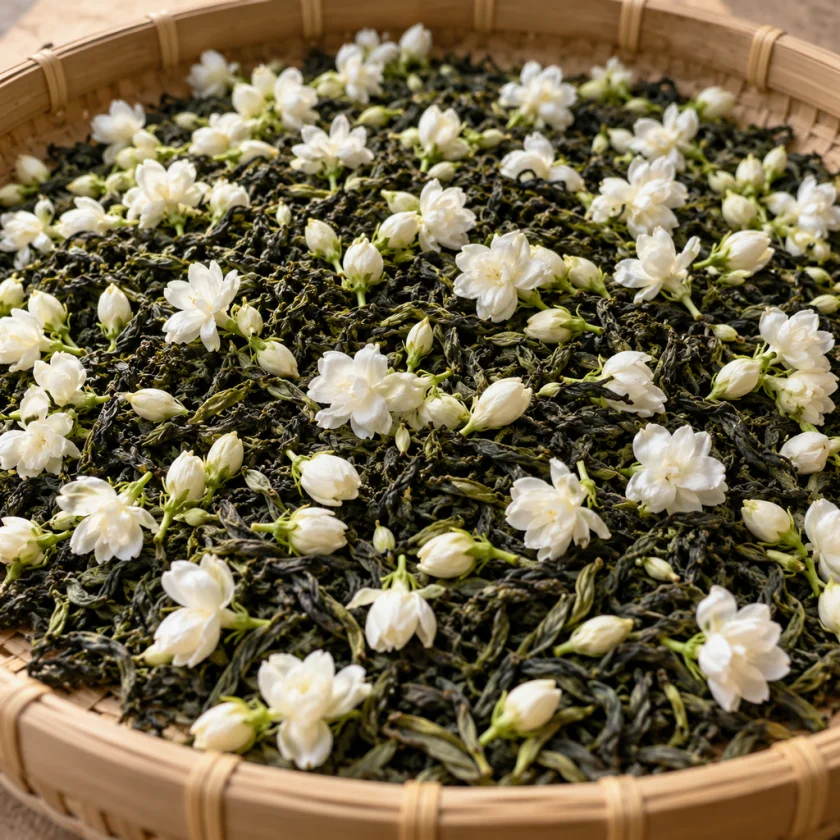
Here is the sentence that reorganises everything you have read about this drink. Jasmine tea is green tea. It is leaf of Camellia sinensis, processed as green tea, then scented with the blossom of Jasminum sambac and packed — usually with the flowers removed and discarded. Two plants are involved, only one of them is in the packet, and the packet is named after the one that isn't.
That single manufacturing fact explains why nearly every “jasmine tea benefit” you can find is, on inspection, a green tea result. Catechins and epigallocatechin gallate (EGCG): green tea. Caffeine and L-theanine: green tea. The cardiovascular cohort studies, the fat-oxidation trials, the oral-health work, the cancer epidemiology: green tea, every one. None of that research was generated by studying jasmine flowers, and none of it transfers to jasmine. This page walks the claims one at a time and puts each on the correct side of the line, then tells you what a pure jasmine-blossom infusion — no tea leaf at all — actually gives you.
Table of Contents
- How Jasmine Tea Is Actually Made
- The Claim Audit: Which Side of the Line
- What the Flower Genuinely Adds
- Pure Jasmine Blossom Tea: No Leaf, No Evidence
- Caffeine, L-Theanine and the Alert-Calm Question
- What Scenting Costs the Tea
- Grades and Pearls of Jasmine Tea
- Brewing Without Wasting Either Plant
- Why This Distinction Is Worth Making
- Cautions
- Key Research Papers
- Connections
- Featured Videos
How Jasmine Tea Is Actually Made
The process is worth knowing in detail, because once you have seen it you cannot unsee the attribution error.
- A base tea is made first and dried hard. Almost always a green tea — commonly a Fujian or Guangxi green, sometimes a white tea, occasionally a light oolong. It is dried thoroughly, which matters: bone-dry tea leaf is intensely hygroscopic and grabs volatile aromatics out of the air. The same property that makes tea go stale beside spices in a cupboard is the property the whole industry exploits here.
- Jasmine buds are picked in the afternoon, still closed. J. sambac opens at night. Pickers take the buds while shut and hold them until evening, because the flower's volatile output peaks as it opens in the dark.
- Flowers and dry tea are layered together overnight. Alternating beds, or mixed and piled. The pile is turned through the night to manage the heat the respiring flowers generate — overheat it and you get a cooked, hay-like off-note instead of a clean floral.
- In the morning the spent flowers are sieved out and thrown away. This is the step that decides the whole argument. The flowers do not stay in the tea. Any blossoms in a finished commercial tea have been added back afterwards for appearance, in token quantity.
- The tea, now damp from the flowers' moisture, is gently re-dried.
- The cycle repeats with entirely fresh flowers — typically three to seven rounds for good tea, nine or more for top grades. Each round costs another re-drying, and each re-drying costs a little of the base tea's own freshness and character.
So the finished product is a green tea carrying jasmine's volatile fingerprint at trace concentration. The flower's non-volatile chemistry — its secoiridoid glycosides, its flavonoids — goes into the compost with the sieved petals. Nothing in that fraction reaches your cup in any meaningful amount.
Two variants deserve mention. Some low-grade product is simply green tea dust plus dried flowers plus, in the cheapest cases, added jasmine flavouring — scenting by shortcut. And a genuine minority tradition uses the same layering method on white tea (jasmine silver needle) or on a light oolong, which changes the base's chemistry but nothing about the attribution point.
The Claim Audit: Which Side of the Line
Below, the claims most often attached to jasmine tea, each assigned to the plant that earned it and labelled with its real evidence tier.
- “Rich in antioxidants.” Green tea. The antioxidant capacity of the brew is overwhelmingly catechins from the leaf — EGCG, EGC, ECG and EC. Evidence tier: extensive human and mechanistic work, on Camellia sinensis. See epigallocatechin gallate and Catechins. Jasmine blossom does contain flavonoids, but they are removed with the flowers.
- “Supports heart health / lowers cardiovascular risk.” Green tea. Built on large East Asian cohort studies and blood-pressure and lipid trials of green tea and green tea extract. Tier: observational cohorts plus randomised trials of surrogate endpoints. Nothing to do with jasmine.
- “Helps with weight loss / boosts metabolism.” Green tea, and even there the honest reading is modest. The catechin-plus-caffeine fat-oxidation effect is real in short trials and small in real-world terms. See Green Tea — Metabolism and Fat Oxidation. Jasmine contributes nothing here.
- “Good for oral health / reduces plaque bacteria.” Green tea catechins and fluoride content. Tier: mostly in vitro plus small clinical work. Jasmine's own in-vitro antimicrobial activity exists but was measured with concentrated extracts and oils, not with a brewed cup — see the antimicrobial page.
- “Calm alertness / focus without jitter.” Green tea, specifically the caffeine plus L-theanine combination. Tier: several small randomised human trials of the combination. This is the claim most often credited to jasmine's aroma, and it belongs to a leaf amino acid.
- “Associated with lower cancer risk.” Green tea, and observational only, with inconsistent results across sites and populations. No jasmine involvement whatsoever.
- “Reduces stress and helps you relax.” Mixed, and this is the interesting one. Part is green tea's L-theanine. Part is genuinely jasmine's: small human experiments on jasmine tea aroma and jasmine oil report short-term autonomic and mood shifts. In the one study of the tea's own aroma (Kuroda and colleagues, 2005), 24 healthy volunteers breathed jasmine tea odour for 5 minutes at the faintest strength each could detect; their heart rate fell, the high-frequency part of heart-rate variability (a marker of the calming side of the nervous system) rose, and mood questionnaires showed “calm and vigorous mood states”. Lavender odour at a similar strength did the same, and (R)-(−)-linalool alone, at the concentration found in the tea, copied the effect. Tier: preliminary human, small, unblindable, minutes long, and inconsistent in direction. Covered in full on the aroma page.
- “Aids digestion / settles the stomach.” Traditional use only, on both sides. Chinese use of 茉莉花 as a light aromatic to relieve chest oppression and settle the stomach is real practice with no controlled testing. Tea itself has no established digestive indication.
- “Contains jasmine's calming compounds you can drink.” False as stated. The volatiles are present at trace level and their studied route is inhalation, not ingestion. If jasmine aroma does anything for you in a cup, it is doing it through your nose while you hold the cup — which is not a trivial mechanism, but it is a different one.
- “Jasmine rice gives you the same benefits.” False. Thai hom mali contains no jasmine. Its aroma is 2-acetyl-1-pyrroline, produced by the rice plant itself and shared with pandan and basmati.
What the Flower Genuinely Adds
Having taken a great deal away, it is worth being precise about what jasmine does contribute, because it is not nothing.
A volatile profile, at trace concentration. Analytical work on scented tea tracks the transfer of the flower's aromatics into the leaf matrix across scenting rounds. The compounds involved are the same ones that make the living flower smell as it does:
- Benzyl acetate — usually one of the largest single components. Sweet, fruity, unmistakably “jasmine” to most noses, and the note cheap synthetic jasmine leans on entirely, which is why cheap jasmine perfume smells thin.
- Linalool — the monoterpene alcohol shared with lavender, coriander seed and bergamot. This is the molecule most often invoked when jasmine aroma is credited with calming effects, and it has been studied vastly more than jasmine has.
- Indole — present at low percentage but perceptually decisive. Animalic and frankly unpleasant in isolation; floral and alive at trace dilution. Indole is why real jasmine smells like a living thing rather than like soap.
- Methyl anthranilate — grape-like with a faint medicinal edge.
- cis-Jasmone and methyl jasmonate — the jasmonates, genuine plant signalling hormones named after this flower. Methyl jasmonate has a large cancer-cell-line literature; that work concerns an isolated molecule at experimental concentrations and says precisely nothing about drinking scented tea.
- Benzyl alcohol, benzyl benzoate, (Z)-3-hexenyl benzoate, eugenol, α-farnesene, linalool oxides — the supporting cast supplying green, balsamic and spicy edges.
And an experience, which is a legitimate thing to buy. Aroma is most of flavour perception, and a scent that arrives before the first sip changes how a drink is experienced. If jasmine tea makes you slow down and take five quiet minutes, that is a real effect of the tea on your day. It is simply not a pharmacological effect of jasmine on your body, and the two get conflated constantly.
Pure Jasmine Blossom Tea: No Leaf, No Evidence
A growing number of products are dried J. sambac blossoms and nothing else, sold as caffeine-free jasmine flower tea. This is a different drink and it needs saying clearly: it carries essentially no evidence base at all.
What you get:
- No caffeine, which for some readers is the entire point — a fragrant evening cup with no stimulant.
- No catechins, no epigallocatechin gallate, no L-theanine. Those are leaf compounds. A flower-only infusion has none of them, so none of green tea's evidence applies even loosely.
- Some jasmine flavonoids and secoiridoid glycosides, in amounts nobody has quantified in a brewed cup, with no human data on what they do. As a member of the olive family (Oleaceae), J. sambac contains secoiridoids in the general class that olive leaf and oleuropein belong to, but the specific compounds and quantities in this species' blossom are poorly characterised and no standardised extract exists.
- The aroma, which is the honest reason to drink it.
Two practical notes on buying flower-only product. First, some dried jasmine blossom is sulphite-treated to keep it white, as with many dried floral and fruit products; the concern is for sulphite-sensitive people with asthma, unsulphured stock is sold, and very bright uniform whiteness in a dried flower is a common sign of treatment. Second, this is exactly the product category where the look-alike problem bites — loose “jasmine flowers” from an unlabelled bulk bin, with no botanical (Latin) name on the packet, cannot be checked against the poisonous look-alikes.
Caffeine, L-Theanine and the Alert-Calm Question
Because jasmine tea is green tea, its stimulant profile is green tea's. A cup brewed from leaf typically supplies somewhere in the region of 20–45 mg of caffeine, varying widely with leaf grade, quantity, water temperature and steep time — a strongly brewed large mug of a leafy green can exceed that range and a light quick infusion of a low-grade tea can fall below it. Any single number quoted for “a cup of jasmine tea” hides that range; the variable is the brewing, not the flowers.
The interesting pharmacology here is not jasmine's. Green tea supplies caffeine alongside L-theanine, an amino acid nearly unique to tea, and several small randomised human trials of the combination report a profile people describe as alert but not jittery — attention benefits with less of caffeine's edge. Tier: small randomised trials, mostly on cognitive tasks, mostly with isolated compounds at doses above a single cup. See Green Tea — L-Theanine and Calm Focus and L-Theanine — Calm Focus and Anxiety.
This matters for jasmine's reputation in a specific way. When someone says jasmine tea calms them, the most parsimonious explanations are, in order: the L-theanine and caffeine in the leaf; the aroma; the ritual; and last, some unmeasured ingested jasmine compound. Popular writing reverses that order.
What this means for evening drinking: a flower-only infusion and a scented decaffeinated tea both carry jasmine's scent without the caffeine. A standard scented green tea in the evening carries the base tea's full caffeine, whatever the flowers suggest. See Sleep Hygiene.
What Scenting Costs the Tea
A fair question, and one where it is easy to overclaim in either direction.
What is well established: each scenting round requires the tea to be re-dried, because the flowers give up moisture. Repeated gentle heating is not free — tea people generally hold that heavily scented teas lose some of the base leaf's own freshness, brightness and varietal character, which is one reason the finest single-origin greens are not scented. The practice historically also served to lift undistinguished leaf, and a good deal of jasmine tea on the market is scenting applied to a base that could not stand alone.
What the newest laboratory work shows about catechins: until recently there was no body of work measuring catechin change across scenting rounds. Two 2026 analytical studies now track it, and both found that catechins fall. Zhang and colleagues analysed Jinhua jasmine tea at six processing stages: catechins, flavonols and flavones generally decreased, while soluble sugars, amino acids and phenolic acids increased, and instrument measures of sweetness, richness and savoury (umami) taste were generally higher after scenting. Yang and colleagues compared tea before and after scenting: amino acids and soluble sugars increased, “astringent substances such as tea polyphenols and catechins decreased”, tasters’ aroma and taste scores rose, and floral compounds such as cis-3-hexenyl benzoate and methyl anthranilate passed from the flowers into the tea. That fits the common description of jasmine tea as sweeter and less astringent than its base. Neither abstract gives a percentage loss, and how much the change matters for health has not been measured, so a precise percentage quoted anywhere needs its source. The other lever on catechins in the cup is brewing time and temperature, which control how much of the leaf's catechins are extracted. Readers wanting to preserve catechins have a much larger lever available: brewing time and temperature, which changes extraction far more than scenting changes content.
Grades and Pearls of Jasmine Tea
Jasmine tea grading is quoted in scenting rounds. A tea sold as “seven-times scented” went through the layering cycle seven times with fresh flowers each time. More rounds means a deeper, more integrated floral character and a higher price, and past a point it means the base leaf disappears behind the flower.
- Loose mo li hua cha — the standard form, quality spanning the entire range from tea dust to excellent.
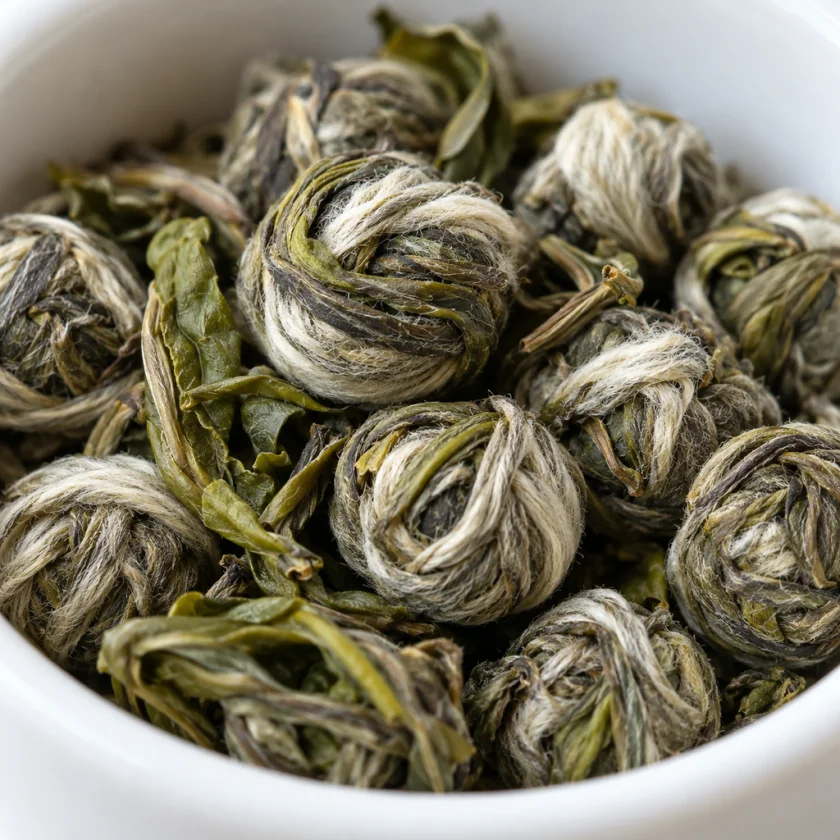
- Jasmine dragon pearls — buds and young leaves hand-rolled into small spheres, then scented. The rolling is real craft and the leaf is usually good; the pearls unfurl over multiple infusions.
- Jasmine silver needle — white tea base, scented. Lighter, sweeter, lower in caffeine than a green base.
- “Blooming” tied flowers — hand-tied bundles that open in the glass. Mostly theatre; the leaf is rarely the point.
- Flavoured product — if an ingredient list says “natural flavouring” or “jasmine flavour”, the tea was not scented with flowers at all. Not harmful, not the same thing.
Markers that tea specialists point to: an origin (Hengzhou in Guangxi is now the dominant world source of jasmine blossom for scenting, having overtaken the historic centre at Fuzhou in Fujian), a stated number of scenting rounds, a harvest year, and few or no visible flowers — because in properly scented tea the flowers were removed. Abundant petals are decoration, and in cheap product they substitute for scenting.
Brewing Without Wasting Either Plant
Both plants in this cup are damaged by heat, in different ways. Green tea turns bitter and astringent as catechins over-extract; jasmine's volatiles simply leave.
- Water at roughly 75–85 °C, not boiling, is the usual range for green tea; tea makers get there by letting boiled water rest three to five minutes or by adding a splash of cold water. Boiling water scorches the leaf and drives off the aromatics.
- About 2–3 g of leaf per 250 ml is the common proportion, adjusted to taste. Pearls take a little less by volume because they are dense.
- One to three minutes for the first infusion is typical. Green tea's bitterness is a time-and-temperature product; the floral top notes are also the first thing to be lost, so a short first steep serves both.
- A lid on the cup or pot while steeping is the one step specific to a scented tea: it keeps the volatiles over the liquid instead of sending them across the room. It makes an obvious difference.
- Re-infusing. Good jasmine tea gives two or three infusions. The floral character fades faster than the leaf's, so infusions two and three are increasingly the base tea talking — which is a decent test of the tea's quality.
- Iced tea is usually brewed stronger and cooled fast, or cold-brewed overnight in the refrigerator. Cold brewing extracts less caffeine and less bitterness and holds the floral notes well.
- Storage airtight, away from light and anything fragrant. The hygroscopic quality that let the tea take up jasmine will just as happily let it take up a spice shelf — and let the jasmine go.
Why This Distinction Is Worth Making
A reasonable objection: if jasmine tea really does carry green tea's benefits, who cares which plant gets the credit? The answer is that misattribution changes behaviour, in four predictable ways.
- Wrong substitution. A reader who believes the benefits live in the flower switches to caffeine-free jasmine blossom tea and expects the same effects. They get a pleasant floral infusion with no catechins.
- Wrong dose form. If jasmine is the active plant, jasmine essential oil looks like a concentrated version of it. It is not — it is a solvent-extracted perfumery material that is not made to be swallowed, and jasmine absolute in particular retains extraction solvent traces.
- Wrong plant entirely. This is the serious one. “Jasmine is a calming herb you can brew” is a sentence that has led people to brew Gelsemium sempervirens — “yellow jasmine”, “Carolina jasmine” — which is a genuinely poisonous plant, and to plant and handle Cestrum nocturnum as a medicinal. See the species page.
- Lost signal. Burying jasmine under green tea's research means the small, genuinely jasmine-specific literature — the odour and autonomic work — never gets read carefully. That literature is modest but real, and it deserves better than being drowned in borrowed citations.
This is not a jasmine-specific failure. It is the same pattern that lets tulsi (Ocimum tenuiflorum) and sweet basil (Ocimum basilicum) trade trials, and that lets any plant sharing a cup or a shelf with a well-studied one inherit its file. The fix is always the same: name the species, then check which species was actually studied.
Cautions
- Caffeine. Scented green tea's caffeine is the base tea's. Standard guidance applies — up to roughly 400 mg a day for most healthy adults, about 200 mg a day in pregnancy. Not a jasmine issue.
- Iron absorption. Tea polyphenols reduce non-heme iron absorption when drunk with a meal. Tea drunk between meals, rather than with them, has less effect on iron absorption from the meal. Again a Camellia effect, not jasmine's.
- Green tea extract and the liver. High-dose concentrated green tea extract supplements have been associated with liver injury in case reports and regulatory reviews. Brewed tea, scented or not, is not implicated. It is not a jasmine caution.
- Sulphites in dried blossom. Relevant to flower-only product and to sulphite-sensitive people with asthma. Unsulphured stock is sold.
- Species verification for loose flowers. True jasmine is only Jasminum species. Loose flowers with no botanical (Latin) name on the packet cannot be checked against poisonous look-alikes.
- Jasmine absolute and essential oil are not drinks. They are external and aromatic materials, and adding them to tea to “boost” the jasmine puts a solvent-extracted perfumery material in the cup.
Key Research Papers
Most citations here are PubMed topic searches — a mistyped record number silently resolves to a different paper, usually in the same journal issue, and that failure mode is very hard to spot. Papers whose PubMed record has been checked carry their PubMed number (PMID). Where a paper is named, the metadata is stated only as far as we are confident of it; otherwise the finding is described and the search does the work. Note carefully which entries below are jasmine research and which are green tea research.
- Jasmine tea scenting chemistry. Analytical work tracking the transfer of floral volatiles into the tea matrix across successive scenting rounds — the direct evidence that what the tea gains is aroma. Analytical chemistry. Find on PubMed
- Zhang Y, Li M, Liu S, Wang J, Fu D, Zhu M, Liu Z, Wang K (2026). Integrated non-targeted metabolomics, volatile profiling and targeted quantification characterize chemical changes in Jinhua jasmine tea during the scenting process. Food Chemistry: X 40:104668. — PubMed PMID: 42964392
- Yang Y, Dong Y, Song Z, Zou J, Huang X, Mao D, He C, Lin L (2026). Aroma characteristics and volatile compound transfer in jasmine tea during scenting. Foods 15(8):1403. — PubMed PMID: 42073291
- Aroma profiling of scented tea. GC-MS and headspace comparisons of scented versus unscented base tea, which is how the trace-level nature of the floral fraction was established. Find on PubMed
- Jasminum sambac flower volatiles. Benzyl acetate, linalool, indole, methyl anthranilate and the jasmonates, and how output shifts across the flower's night-opening cycle. Find on PubMed
- Jasminum sambac phytochemistry reviews. The non-volatile fraction — secoiridoid glycosides and flavonoids — which is the part discarded with the sieved flowers. Find on PubMed
- Kuroda K, Inoue N, Ito Y, Kubota K, Sugimoto A, Kakuda T, Fushiki T (2005). Sedative effects of the jasmine tea odor and (R)-(−)-linalool, one of its major odor components, on autonomic nerve activity and mood states. European Journal of Applied Physiology 95(2-3):107-114. — PubMed PMID: 15976995 (The one paper that studied the tea's aroma specifically rather than a concentrated absolute. Preliminary human.)
- Green tea catechins and cardiometabolic outcomes. This is green tea research, not jasmine's — the source of most borrowed “jasmine tea” claims. Tier: cohort studies plus randomised trials of surrogate endpoints. Find on PubMed
- Caffeine plus L-theanine and cognition. Green tea research. Small randomised trials of the combination on attention and subjective calm. Find on PubMed
- Tea polyphenols and non-heme iron absorption. Green tea research, and the most practically relevant tea interaction for most readers. Find on PubMed
- Green tea extract hepatotoxicity. Green tea research, concerning concentrated extracts rather than brewed tea. Find on PubMed
- Catechin extraction versus brewing temperature and time. Why your kettle matters more than your scenting rounds. Find on PubMed
- 2-Acetyl-1-pyrroline in fragrant rice. The compound behind “jasmine rice”, which contains no jasmine. Find on PubMed
- Sulphite sensitivity and sulphited dried plant material. Relevant to bleached-white dried blossom. Find on PubMed
Connections
- All Herbs
- Jasmine — Benefits Deep Dive — the hub for this section.
- Arabian Jasmine (Jasminum sambac) — botany, culture and traditional use of the flower itself.
- Green Tea — the plant that owns most of the claims audited on this page.
- Green Tea — Benefits Deep Dive — where the catechin evidence is actually laid out.
- Green Tea — Epigallocatechin Gallate and Antioxidants
- Green Tea — Metabolism and Fat Oxidation
- Green Tea — Brewing Time and Temperature — the lever that actually changes what is in your cup.
- Epigallocatechin Gallate · Catechins — the catechin pages.
- L-Theanine · L-Theanine and Calm Focus — the real source of tea's alert-calm.
- Jasmine Aroma for Stress and Sleep — the part of the calming claim that genuinely is jasmine's.
- Jasmine: Species, Safety and Look-Alikes — read before buying loose flowers.
- Chrysanthemum — the other great Asian flower tea, and a closer comparison than green tea is.
- Hibiscus · Butterfly Pea — caffeine-free floral infusions, each with its own honest evidence tier.
Safety and disclaimer. Educational content, not medical advice. Jasmine-scented green tea is a food with an excellent safety record; its only routinely relevant components are the base tea's caffeine and polyphenols. Jasmine absolute and jasmine essential oil are made for external and aromatic use, not for drinks. Nothing on this page establishes jasmine as a treatment for any condition, and green tea's evidence is not jasmine's. For pregnancy, iron deficiency and prescription medicines, the facts that matter are the base tea's: its caffeine (the usual guidance is about 200 mg a day in pregnancy) and its polyphenols, which reduce iron absorption from a meal they are drunk with.