⚠ Evidence warning: Clinical trials or other evidence do not support the claims that a 2:1 L-theanine to caffeine ratio is the best mix, that the mix reduces jitter, that L-theanine raises alpha waves with the eyes open, and that human trials tested single doses up to 2,000 mg. This page keeps it as a report of what people, websites or other media say.
Green Tea L-Theanine and Calm Focus
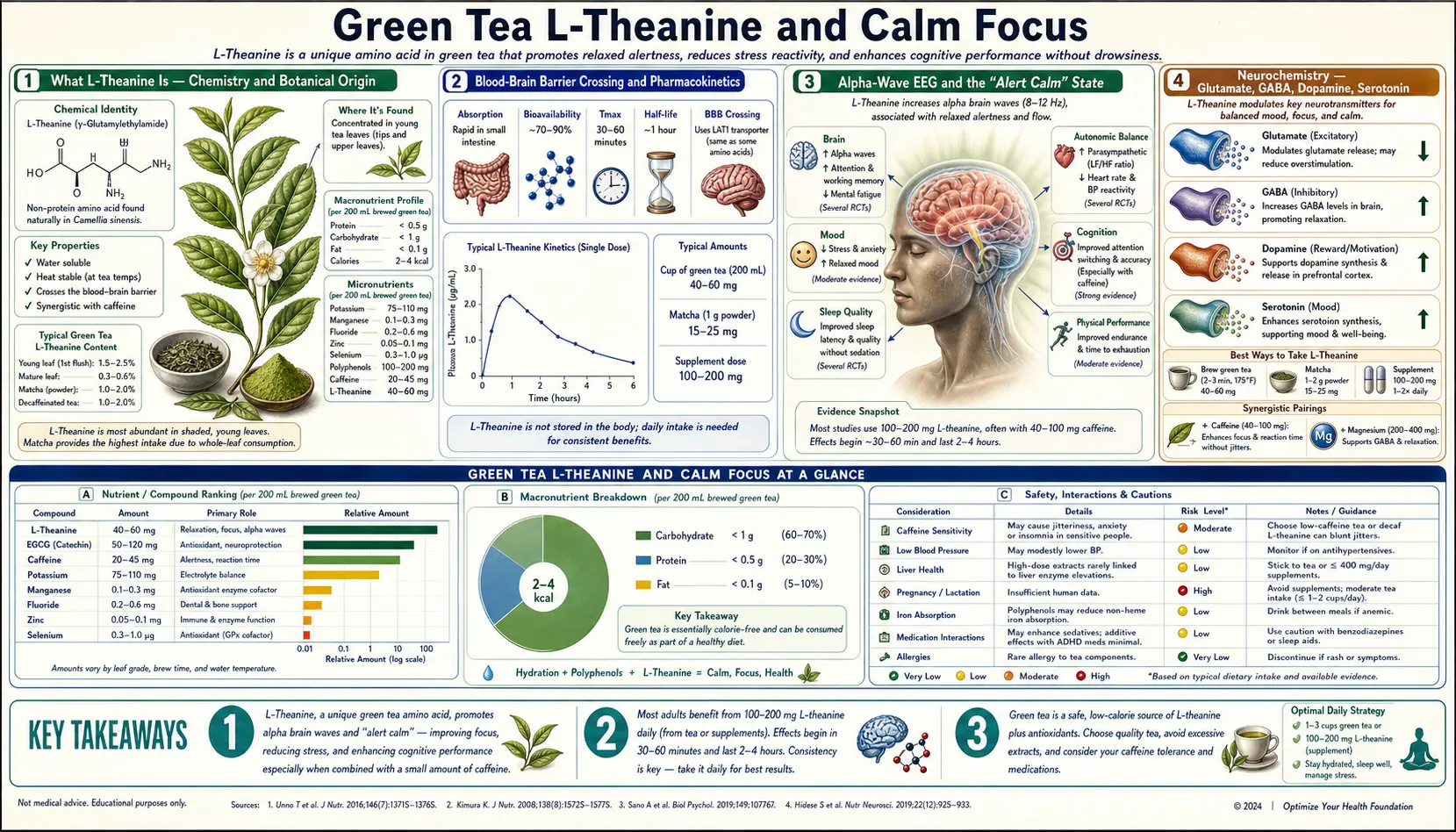
L-theanine (gamma-glutamylethylamide) is a non-protein amino acid that occurs almost exclusively in Camellia sinensis and a small number of edible mushrooms (Xerocomus badius notably). It is the single compound most responsible for the experiential difference between a cup of green tea and an equivalent caffeine dose from coffee or cola. L-theanine crosses the blood-brain barrier within 30-40 minutes, increases alpha-wave electroencephalogram (EEG) activity, modestly elevates gamma-aminobutyric acid (GABA) and dopamine, partially antagonizes the excitatory glutamate AMPA and N-methyl-D-aspartate (NMDA) receptors, and produces the subjective state that Japanese tea culture calls "alert calm" — relaxed body, focused mind, no drowsiness. The synergy with caffeine is the central pharmacology: caffeine alone increases task vigilance with jitter and reduced calm; L-theanine alone increases relaxation with mild attentional drift; the combination at the 2:1 L-theanine:caffeine ratio often attributed to high-grade matcha and gyokuro is described as producing both attention and calm without either side effect. This page covers the chemistry, the neural mechanisms, the human cognitive trials, and the doses and forms that have been studied.
Table of Contents
- What L-Theanine Is — Chemistry and Botanical Origin
- Blood-Brain Barrier Crossing and Pharmacokinetics
- Alpha-Wave Electroencephalogram and the "Alert Calm" State
- Neurochemistry — Glutamate, Gamma-Aminobutyric Acid, Dopamine, Serotonin
- The Caffeine-Theanine Synergy (2:1 Ratio)
- Cognitive Performance Trials
- Anxiety, Stress Reactivity, and Cortisol
- Sleep Architecture and Onset Latency
- Cultivar and Shading — Why Matcha and Gyokuro Are L-Theanine-Rich
- Practical Dose and Form
- Key Research Papers
- Connections
- Featured Videos
What L-Theanine Is — Chemistry and Botanical Origin
L-theanine is structurally similar to glutamic acid and the neurotransmitter glutamate — the resemblance is the central explanation for its central nervous system activity. Specifically, L-theanine is the ethylamide of L-glutamic acid: gamma-glutamylethylamide. It carries the alpha-amino group, the alpha-carboxylic acid, and the gamma-carbon chain of glutamate, with the gamma-carboxylic acid converted to an ethylamide (CONHCH2CH3) instead of a free acid.
L-theanine is biosynthesized in the roots of Camellia sinensis from ethylamine and L-glutamate by the enzyme L-theanine synthetase. From the roots, L-theanine is transported up the plant to the young leaves and stems, where it accumulates — eventually comprising 1-2% of the dry weight of green tea leaves. In sunlight, L-theanine is gradually converted to catechins in the leaf, which is why shading the plants for the final weeks before harvest (the technique used to produce gyokuro and matcha) results in elevated L-theanine and reduced bitter catechins relative to standard sencha.
L-theanine's ethylamide group is the molecular feature that distinguishes it from glutamate and gives it its distinct receptor pharmacology. Glutamate is the dominant excitatory neurotransmitter in the mammalian central nervous system (CNS); L-theanine is its structural analog but with much weaker affinity for ionotropic glutamate receptors and a different pattern of agonist-versus-antagonist behavior depending on which receptor subtype is involved.
Blood-Brain Barrier Crossing and Pharmacokinetics
L-theanine's amino acid character allows it to cross the blood-brain barrier via the large neutral amino acid transporter (LAT1, SLC7A5), the same transporter that ferries phenylalanine, tyrosine, tryptophan, leucine, and methionine across the blood-brain barrier. This transporter is normally saturated by the abundant dietary aromatic and branched-chain amino acids, but L-theanine effectively competes for transport because of its structural similarity to glutamate.
Pharmacokinetics in humans after oral L-theanine:
- Time to peak plasma — approximately 30-60 minutes after oral ingestion (0.8 hour after 100 mg from capsules or tea in a 2012 kinetics study of 12 participants)
- Time to peak brain concentration — approximately 60-90 minutes is the figure quoted (slight lag behind plasma due to blood-brain barrier transport kinetics). It is not a human measurement: the human kinetics study measured plasma, red blood cells and urine, and the evidence for brain uptake comes from rats
- Plasma half-life — approximately 60-80 minutes
- Brain residence — longer than plasma half-life, suggesting active uptake into neurons
- Elimination — primarily renal as unchanged L-theanine and as ethylamine + glutamate after hydrolysis
The kinetic profile means that the subjective effect of L-theanine from a cup of tea begins to be noticeable about 30-40 minutes after drinking, peaks at 60-90 minutes, and tapers over the following 2-3 hours. This matches the experience that the "alert calm" state from green tea takes some time to develop — it is not the immediate hit of a caffeine bolus but a slower, gentler onset.
Alpha-Wave Electroencephalogram and the "Alert Calm" State
The most reproducible objective neural effect of L-theanine in humans is an increase in occipital alpha-wave electroencephalogram activity. Alpha waves (8-13 Hz) are the dominant electroencephalogram rhythm during relaxed wakeful states with closed eyes — meditation, daydreaming, alert relaxation. Increased alpha activity is generally interpreted as a marker of internally-directed attention, mental calm, and a reduction in the sensory-vigilance posture associated with sympathetic arousal.
The Nobre et al. trial (Asia Pacific Journal of Clinical Nutrition, 2008) is the canonical demonstration: 35 young healthy participants received either 50 mg L-theanine (16 people; a realistic dietary level, with the paper putting a cup of black tea at about 20 mg) or placebo (19 people), and underwent electroencephalogram recording over the next 105 minutes while resting with their eyes closed. The L-theanine arm showed:
- A significantly greater increase in alpha activity across the recording period (measured at 45, 60, 75, 90 and 105 minutes post-dose)
- Replication in a second study of participants engaged in passive activity; accounts also describe an eyes-open effect as the more striking finding (alpha is normally suppressed by visual input), which the paper's abstract does not report
- No reduction in vigilance — the increased alpha was a state of relaxed attentiveness rather than drowsiness
In those accounts, an eyes-open alpha increase is the key finding because it suggests L-theanine produces a state of active relaxation — the kind of mental posture that supports sustained focused work without the hyperarousal cost of high caffeine intake. This maps onto the subjective experience reported by tea drinkers and onto the Japanese aesthetic tradition that places green tea at the center of contemplative practices like the tea ceremony and Zen meditation. During an active attention task, Kelly and colleagues (2008) found lower overall alpha power with L-theanine plus caffeine.
Neurochemistry — Glutamate, Gamma-Aminobutyric Acid, Dopamine, Serotonin
L-theanine's neurochemical signature includes modest effects on multiple neurotransmitter systems, with the glutamate system being the entry point:
- Glutamate receptors — L-theanine is a weak partial antagonist at AMPA and N-methyl-D-aspartate receptors and a weak agonist at metabotropic glutamate receptors (mGluR). The net effect is dampening of glutamatergic excitatory transmission, which translates to reduced central neuronal hyperactivity in stress-related circuits.
- Gamma-aminobutyric acid — L-theanine modestly increases brain gamma-aminobutyric acid concentrations in rodents, consistent with the relaxation effect. The mechanism is uncertain but may involve increased glutamate decarboxylase (GAD) activity, which is the enzyme that synthesizes gamma-aminobutyric acid from glutamate.
- Dopamine — L-theanine increases dopamine release in the striatum in rodents, which may contribute to the mood-elevating component of the subjective effect and possibly to the attention-supporting component.
- Serotonin — L-theanine modulates brain serotonin in rodent models, though the human translation is less clear.
- Glycine — L-theanine appears to potentiate glycinergic inhibitory transmission in the brainstem, contributing to calming and sleep-supportive effects at higher doses.
The neurochemical pattern is reminiscent of a mild benzodiazepine without the gamma-aminobutyric acid-A receptor binding, dependency risk, cognitive impairment, or motor side effects. L-theanine's signature is "relaxation without sedation" — a property that is hard to achieve with any other widely available compound. Most calming agents (alcohol, benzodiazepines, antihistamines, opioids) impose some attentional or motor cost. L-theanine appears to preserve and even slightly enhance attention.
For more on glutamate / gamma-aminobutyric acid balance in anxiety and stress, see our Anxiety page and L-Theanine amino acid page.
The Caffeine-Theanine Synergy (2:1 Ratio)
The pharmacology of L-theanine becomes clinically interesting when combined with caffeine. Caffeine alone produces:
- Increased alertness, faster reaction times, improved vigilance on sustained-attention tasks
- Increased sympathetic outflow, mild tachycardia, mild blood pressure elevation
- Subjective jitter, anxiety, mild gastroesophageal reflux disease (GERD), possible insomnia at higher doses
- Eventually tolerance with chronic high-dose use
L-theanine alone produces:
- Increased subjective calm and relaxation
- Increased alpha-wave electroencephalogram activity
- Modest improvement on attention tasks, smaller effect than caffeine, though trials differ: Kelly (2008) found no effect of 100 mg alone on attention, and Haskell (2008) found that 250 mg alone increased headache ratings and decreased correct serial seven subtractions
- No sympathetic stimulation; possibly modest blood pressure reduction
The combination at the 2:1 L-theanine:caffeine ratio often attributed to green tea is described as preserving the attention-enhancing benefit of caffeine while suppressing the jitter, anxiety, and sympathetic-arousal side effects. The Owen et al. trial (Nutritional Neuroscience, 2008) gave 27 people 50 mg caffeine with and without 100 mg L-theanine, testing word recognition, rapid visual information processing, flicker fusion, attention switching and mood. The Haskell et al. trial (Biological Psychology, 2008) tested 250 mg L-theanine with 150 mg caffeine. Together with accounts from people who use the combination, these are reported:
- Faster and more accurate attention switching at 60 minutes, and less susceptibility to distracting information in a memory task, compared with placebo (Owen)
- Reduced subjective rating of jitter and "wired" feeling, as users describe it; the Owen, Haskell and Kelly abstracts do not report this. Haskell reports lower "headache" and "tired" and higher "alert" ratings
- Modestly elevated mood (a 2025 review pooled a small difference from placebo with an uncertain direction: overall mood at the second hour, SMD 0.26, 95% CI -0.10 to 0.63)
- Reduced post-task cognitive fatigue (Haskell: smaller increases in self-reported "mental fatigue", also seen with caffeine alone)
A 2025 review of tea and theanine trials pooled small-to-moderate differences favoring theanine plus caffeine over placebo, including attention-switching accuracy (standardized mean difference, SMD, 0.33, 95% CI 0.13–0.54), and noted that confidence intervals often showed uncertainty about the size and direction of these differences.
The 2:1 ratio (200 mg L-theanine + 100 mg caffeine) is often described as the sweet spot for cognitive endpoints and as closely matched by the natural ratio in 1-2 cups of high-grade matcha or gyokuro. The trials above used 100 mg + 50 mg (Owen, Kelly) and 250 mg + 150 mg (Haskell), and none of these abstracts compares ratios. A 2026 review says the amounts and ratios of these compounds in Japanese green tea vary significantly by harvest season, cultivar and cultivation. This is also the ratio used in most commercial L-theanine-plus-caffeine supplements aimed at office workers and students.
The synergy is part of why coffee and green tea, at equivalent caffeine doses, produce subjectively different states. Coffee delivers caffeine alone (with chlorogenic acid and small amounts of other minor compounds). Green tea delivers caffeine with the modulating L-theanine. Habitual coffee drinkers often report that switching to green tea produces a calmer, more sustained alertness with less afternoon energy crash — this is plausibly the L-theanine synergy modifying their caffeine response.
Cognitive Performance Trials
The L-theanine cognitive literature has accumulated approximately 30 randomized human trials, mostly using doses of 100-400 mg L-theanine with or without caffeine. The convergent findings:
- Sustained attention tasks — L-theanine + caffeine combinations consistently outperform placebo and frequently outperform caffeine alone on Rapid Visual Information Processing (RVIP) and similar vigilance tasks. Effect sizes are modest (d = 0.2-0.4) but consistent.
- Working memory — effects on N-back and similar working memory tasks are smaller and less consistent than attention effects, but generally positive.
- Mood — L-theanine is reported to reduce self-reported tension and increase self-reported calm without sedation in healthy participants. A 2026 meta-analysis of 31 trials found the reduction in acute stress "was modest (SMD = 0.31) and largely influenced by studies with a high risk of bias", and anxiety effects were inconsistent and non-significant apart from one study in psychotic anxiety.
- Stress response — physiological stress markers (cortisol, immunoglobulin A, heart rate variability) show modest improvements during stressful tasks with L-theanine pretreatment.
- Schizophrenia adjunct — small pilot trials suggest L-theanine 250-400 mg as adjunct to standard antipsychotic therapy modestly reduces positive symptoms and anxiety in schizophrenia, with good tolerability. In a second trial, 80 inpatients on risperidone took 400 mg a day or placebo for 8 weeks (60 were analysed); negative, general and total symptom scores fell more with L-theanine (p=0.03, 0.01, 0.04), with side effects comparable.
- Attention-deficit/hyperactivity disorder (ADHD) — a few pediatric pilot trials of L-theanine 200-400 mg in attention-deficit/hyperactivity disorder have shown modest sleep-quality improvements but more limited effects on core attention deficits.
- Geriatric cognition — small trials in older adults with mild cognitive impairment have shown modest improvements in attention and executive function with L-theanine plus green tea catechins.
A 2026 meta-analysis of 31 randomized trials (1,168 people) found that a single 200 mg dose taken 30-60 minutes before testing improved choice reaction time (SMD 0.51, 95% CI 0.25–0.77). It found no significant effect on fatigue, and no serious adverse events were reported.
Not every test shows a benefit. A 2025 meta-analysis of 5 trials in 148 healthy adults found faster recognition visual reaction time (-15.20 ms, 95% CI -28.99 to -1.41) but no significant effect on simple reaction time or the Stroop test, and concluded that the benefit "could not be confirmed by all test methods". Its authors point to the small number of trials and the differences between test preparations.
The pattern reported is that L-theanine is a real, modest cognitive enhancer in the attention-and-calm domain. It is not a powerful nootropic on the order of prescription psychostimulants; it is described as a well-tolerated, low-risk additive that people pair with caffeine for sustained focused work.
Anxiety, Stress Reactivity, and Cortisol
L-theanine's stress-attenuating effect is reported in human laboratory stress paradigms, and a 2026 meta-analysis rated the acute effect as modest and largely influenced by studies with a high risk of bias. Several trials have used standardized stressors (mental arithmetic, public speaking simulations, cold pressor) and measured physiological and subjective responses with and without L-theanine pretreatment.
Representative findings:
- Salivary cortisol — reduced stress-induced cortisol elevation with 200 mg L-theanine pretreatment
- Salivary alpha-amylase — reduced sympathetic stress marker elevation
- Heart rate — modest attenuation of stress-induced heart rate elevation
- Blood pressure — small reduction in stress-induced blood pressure elevation
- Subjective stress rating — reduced State-Trait Anxiety Inventory score during stressful tasks
Two named trials: Kimura and colleagues (2007) studied 12 people during a mental arithmetic task and found lower heart rate and salivary immunoglobulin A responses with L-theanine than with placebo. Hidese and colleagues (2019) gave 30 adults 200 mg a day for 4 weeks in a crossover trial, and depression, trait anxiety and sleep-quality scores improved after L-theanine.
The clinical implication is that habitual green tea drinkers may benefit from a small, sustained reduction in stress-reactivity tone. This would fit the Ohsaki study (Kuriyama et al., JAMA 2006), in which green tea consumption among 40,530 Japanese adults was inversely associated with cardiovascular mortality; that study measured green tea and not L-theanine, so the link to stress attenuation is an inference. The stress-attenuation effect plausibly contributes to the cardiovascular benefit alongside the catechin antioxidant and endothelial effects.
Accounts of acute anxiety use describe L-theanine 200-400 mg taken 30-45 minutes before a known stressful event (public speaking, exam, difficult conversation) as low-risk. It is not reported to abort a panic attack or to substitute for definitive anxiety treatment; the effect reported is a modest blunting of the physiological and subjective stress response. A 2020 systematic review of 9 trials found that 200-400 mg a day may help reduce stress and anxiety in people under stressful conditions, and said longer and larger studies are needed.
Sleep Architecture and Onset Latency
Despite caffeine being a stimulant, the L-theanine in green tea modestly improves sleep quality in some studies — an apparent paradox resolved by separating the two compounds' effects on sleep architecture.
The Lyon et al. trial (Alternative Medicine Review, 2011) in 98 boys aged 8-12 with attention-deficit/hyperactivity disorder found that 200 mg L-theanine twice daily (morning and after school, well before bedtime) was associated with higher sleep percentage and sleep efficiency on actigraphy compared to placebo. Less activity during sleep was only a non-significant trend, and sleep latency was unchanged. The Rao et al. review (2015) concluded that 200 mg L-theanine before bed may support improved sleep quality, through reduced anxiety rather than sedation.
A 2025 meta-analysis (19 articles, 897 people) found small improvements in self-reported time to fall asleep (SMD 0.15), daytime dysfunction (SMD 0.33) and overall sleep quality (SMD 0.43), and noted a lack of studies on pure L-theanine.
The mechanism is presumably that L-theanine's relaxation and stress-attenuation effects, plus the modest gamma-aminobutyric acid and glycine modulation, support the parasympathetic shift needed for sleep onset. The effect is small in magnitude — nothing like prescription hypnotics — but is consistent and well-tolerated.
People use L-theanine as a low-risk adjunct for occasional sleep difficulty or as an alternative to over-the-counter antihistamine sleep aids (which have substantial morning hangover and anticholinergic burden). Doses of 200-400 mg taken 30-60 minutes before bedtime are described as well-tolerated, but the brewed-tea source delivers smaller doses (20-40 mg per cup) and the accompanying caffeine probably outweighs the L-theanine benefit for evening consumption.
Cultivar and Shading — Why Matcha and Gyokuro Are L-Theanine-Rich
L-theanine content in tea leaves varies substantially by cultivar, growing region, leaf age, and most importantly cultivation technique. The single largest determinant of L-theanine concentration in finished tea is whether the plants were grown in full sun or under shade in the final weeks before harvest.
Mechanism: in sunlit leaves, L-theanine is gradually converted to polyphenolic catechins as part of the leaf's normal photoprotective response. In shaded leaves (typically covered with black cloth or reed mats for 3-4 weeks before harvest), this conversion is suppressed and L-theanine accumulates. Shading also increases chlorophyll content (giving the leaves their deep green color) and reduces bitter catechin content.
The classical Japanese shaded tea categories:
- Gyokuro — "jade dew," shaded for approximately 3 weeks before harvest. Among the highest L-theanine content of any tea, with characteristic umami sweetness and minimal bitterness. L-Theanine content typically 30-50 mg per 2-gram serving.
- Matcha — shaded leaves stone-ground to a fine powder, with the entire leaf consumed in suspension. L-Theanine content typically 30-60 mg per 2-gram serving, with the highest concentration in ceremonial-grade matcha grown for the tea ceremony.
- Kabusecha — shaded for approximately 1 week, intermediate between gyokuro and sencha in L-theanine content
- Sencha — the standard Japanese green tea, grown in full sun. L-Theanine content typically 10-25 mg per cup, lower than shaded teas but still meaningful.
Chinese green teas (longjing, gunpowder, biluochun) are typically grown in full sun and have L-theanine content comparable to Japanese sencha. They tend toward different flavor profiles — nutty, vegetal, sometimes smoky — rather than the deep umami of Japanese shaded teas.
For maximizing the L-theanine benefit per cup, the shaded Japanese teas (matcha and gyokuro) deliver substantially more L-theanine per serving than sencha or Chinese greens. Matcha has the additional advantage that the whole leaf is consumed in suspension, capturing L-theanine and catechins that would otherwise remain in spent tea leaves.
For more on matcha specifically, see our Matcha page.
Practical Dose and Form
The L-theanine doses reported across different goals:
- Background daily intake from tea — 3-5 cups per day of high-grade Japanese sencha or 1-2 servings of matcha delivers 60-200 mg total daily L-theanine. Tea drinkers treat this as enough for the cognitive and stress-attenuation benefits without supplementation; the Nobre et al. trial used 50 mg, and most other trials used larger single doses.
- Acute focus support (with caffeine) — a single cup of matcha (40-60 mg L-theanine + 30-60 mg caffeine, roughly 1:1 in these figures; a 2026 review says amounts and ratios vary significantly, and shading raised both theanine and caffeine in a 2022 study), which tea drinkers describe having 30-45 minutes before a focused work block
- Acute focus support (capsule, paired with coffee) — 100-200 mg L-theanine capsule with a single cup of coffee provides the 2:1 L-theanine:caffeine ratio often described as optimal; two trials tested 100 mg L-theanine with 50 mg caffeine
- Stress and anxiety adjunct — 200-400 mg L-theanine, reported both as a single dose before a stressor and as twice-daily standing use; trials include 200 mg a day for 4 weeks (Hidese)
- Sleep adjunct — 200-400 mg L-theanine, 30-60 minutes before bedtime, which users describe separating from caffeine intake by at least 6 hours; a 2026 review of 13 trials covered 50-900 mg a day
- Schizophrenia / anxiety disorder adjunct (in trials) — 400 mg a day in total, added to antipsychotic treatment (Ritsner 2011, Shamabadi 2023); both trials were in schizophrenia, and Ritsner's also measured anxiety
The supplement form is well-tolerated. A commercial pharmacopeial-grade synthetic L-theanine is used in most clinical trials and most commercial products; it is structurally identical to the natural plant L-theanine. There is no documented benefit to higher-purity preparations of natural plant-derived L-theanine over the synthetic.
Safety profile: a 2026 meta-analysis of 31 randomized trials reported no serious adverse events, and a 2026 review of sleep trials covered 50-900 mg a day. Some accounts say L-theanine has been given at doses up to 2,000 mg single-dose and 600 mg daily for extended periods without significant adverse events in human trials; no such human trial was found. A 2015 review gives a no-observed-adverse-effect level above 2,000 mg per kg of body weight per day, without naming a human trial. Under the Generally Recognized as Safe (GRAS) notice GRN 209 in the United States, the intended use is as an ingredient in several food categories at up to 250 mg per serving; the FDA closed the notice with no questions on February 5, 2007.
The principal caution is that L-theanine may enhance the effects of antihypertensive drugs (slight additive blood pressure reduction) and of sedating drugs (slight additive calming). Neither interaction is clinically dangerous in the documented range, but combining L-theanine with sedatives, benzodiazepines, or alcohol may produce more sedation than expected.
Key Research Papers
- Nobre AC, Rao A, Owen GN (2008). L-theanine, a natural constituent in tea, and its effect on mental state. Asia Pacific Journal of Clinical Nutrition. — PubMed PMID: 18296328
- Owen GN et al. (2008). The combined effects of L-theanine and caffeine on cognitive performance and mood. Nutritional Neuroscience. — PubMed PMID: 18681988
- Haskell CF et al. (2008). The effects of L-theanine, caffeine and their combination on cognition and mood. Biological Psychology. — PubMed PMID: 18006208
- Kelly SP et al. (2008). L-theanine and caffeine in combination affect human cognition as evidenced by oscillatory alpha-band activity and attention task performance. Journal of Nutrition. — PubMed PMID: 18641209
- Kimura K et al. (2007). L-Theanine reduces psychological and physiological stress responses. Biological Psychology. — PubMed PMID: 16930802
- Yokogoshi H et al. (1998). Effect of theanine, r-glutamylethylamide, on brain monoamines and striatal dopamine release in conscious rats. Neurochemical Research. — PubMed PMID: 9566605
- Lyon MR et al. (2011). The effects of L-theanine (Suntheanine®) on objective sleep quality in boys with attention deficit hyperactivity disorder (ADHD). Alternative Medicine Review. — PubMed PMID: 22214254
- Rao TP et al. (2015). In search of a safe natural sleep aid. Journal of the American College of Nutrition. — PubMed PMID: 25759004
- Ritsner MS et al. (2011). L-theanine relieves positive, activation, and anxiety symptoms in patients with schizophrenia and schizoaffective disorder: an 8-week, randomized, double-blind, placebo-controlled, 2-center study. Journal of Clinical Psychiatry. — PubMed PMID: 21208586
- Hidese S et al. (2019). Effects of L-theanine administration on stress-related symptoms and cognitive functions in healthy adults: a randomized controlled trial. Nutrients. — PubMed PMID: 31623400
- Juneja LR et al. (1999). L-theanine, a unique amino acid of green tea and its relaxation effect in humans. Trends in Food Science & Technology. — doi:10.1016/s0924-2244(99)00044-8
- Williams JL et al. (2020). The Effects of Green Tea Amino Acid L-Theanine Consumption on the Ability to Manage Stress and Anxiety Levels: a Systematic Review. Plant Foods for Human Nutrition. — PubMed PMID: 31758301
- Gerolymos C et al. (2026). Cognitive and affective effects of L-Theanine: a systematic review and meta-analysis of 31 randomized trials. Molecular Psychiatry. — PubMed PMID: 42410082
- Mátyus RO et al. (2025). Promising, but Not Completely Conclusive-The Effect of l-Theanine on Cognitive Performance Based on the Systematic Review and Meta-Analysis of Randomized Placebo-Controlled Clinical Trials. Journal of Clinical Medicine. — PubMed PMID: 41227106
- Payne ER et al. (2025). Effects of Tea (Camellia sinensis) or its Bioactive Compounds l-Theanine or l-Theanine plus Caffeine on Cognition, Sleep, and Mood in Healthy Participants: A Systematic Review and Meta-Analysis of Randomized Controlled Trials. Nutrition Reviews. — PubMed PMID: 40314930
- Bulman A et al. (2025). The effects of L-theanine consumption on sleep outcomes: A systematic review and meta-analysis. Sleep Medicine Reviews. — PubMed PMID: 40056718
- Cotter J et al. (2026). Examining the effect of L-theanine on sleep: a systematic review of dietary supplementation trials. Nutritional Neuroscience. — PubMed PMID: 41176609
- Shamabadi A et al. (2023). L-Theanine adjunct to risperidone in the treatment of chronic schizophrenia inpatients: a randomized, double-blind, placebo-controlled clinical trial. Psychopharmacology. — PubMed PMID: 37697164
- Scheid L et al. (2012). Kinetics of L-theanine uptake and metabolism in healthy participants are comparable after ingestion of L-theanine via capsules and green tea. Journal of Nutrition. — PubMed PMID: 23096008
- Kuriyama S et al. (2006). Green tea consumption and mortality due to cardiovascular disease, cancer, and all causes in Japan: the Ohsaki study. JAMA. — PubMed PMID: 16968850
- Unno K et al. (2026). Compositional Diversity and Functional Interactions of Bioactive Compounds in Japanese Green Tea: Focus on Matcha, Sencha, and Gyokuro. Molecules. — PubMed PMID: 42654013
- Chen X et al. (2022). Effect of Shading on the Morphological, Physiological, and Biochemical Characteristics as Well as the Transcriptome of Matcha Green Tea. International Journal of Molecular Sciences. — PubMed PMID: 36430647