L-Theanine for Calm Focus & Anxiety
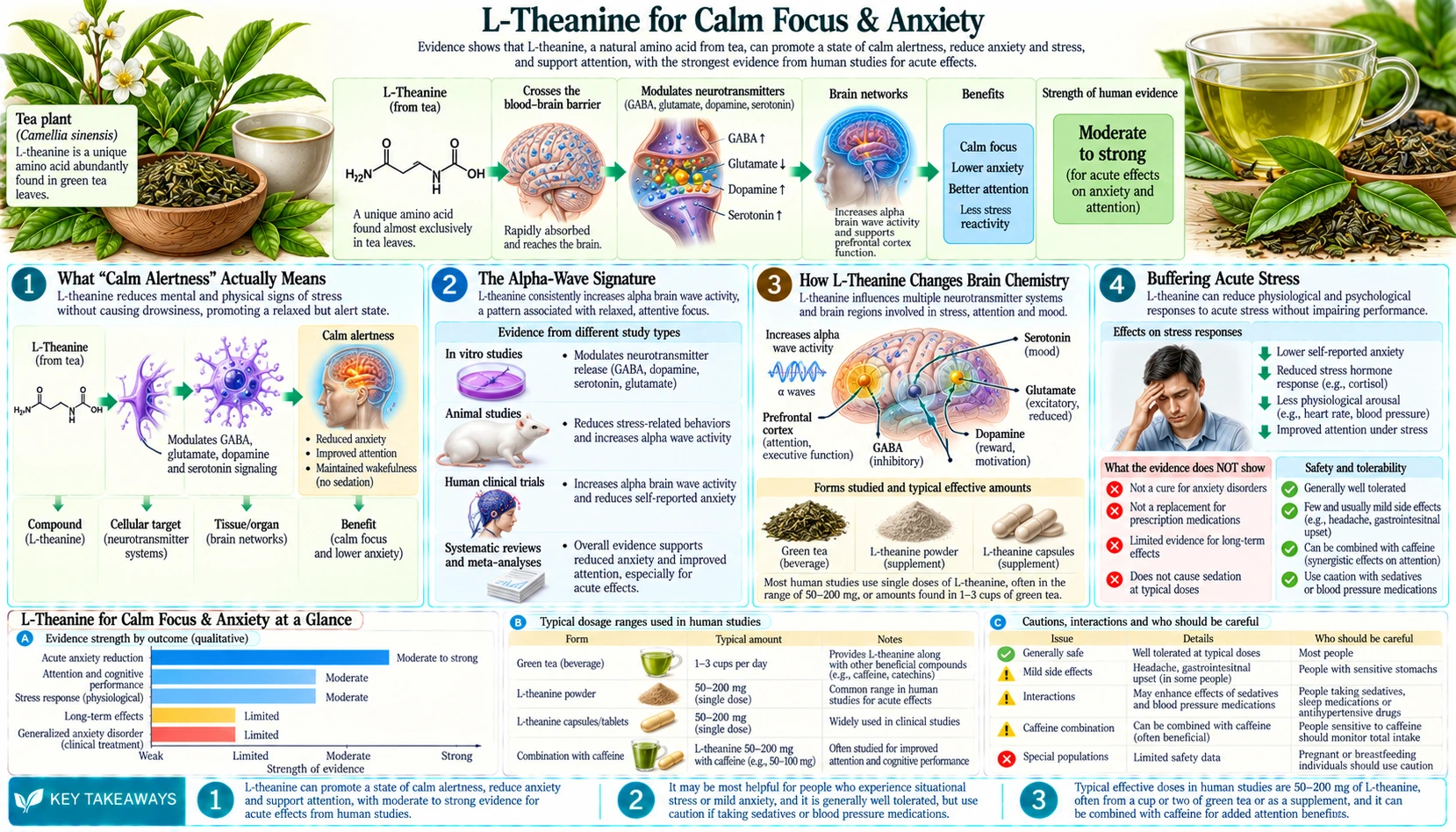
The phrase you will see everywhere is "calm alertness" — the idea that L-theanine relaxes you without making you sleepy. That is a real and reasonably well-documented state, visible on brain recordings as increased alpha-wave activity. But "calm" is not the same as "treats anxiety," and this is where honesty matters. Trials find a modest drop in acute stress when people face an actual stressor, yet a careful trial in people with diagnosed generalized anxiety disorder found it no better than placebo on the core anxiety measure. This page maps exactly where the effect is strong, where it is modest, and where it simply is not there.
Interactive Visualization Caffeine, Adenosine & Why Coffee Stops Working Caffeine doesn’t give you energy — it blocks the tiredness signal while adenosine keeps piling up behind the blockade. Move your coffee to 2 p.m. and watch your deep sleep vanish. Launch →
Table of Contents
- What "Calm Alertness" Actually Means
- The Alpha-Wave Signature
- How L-Theanine Changes Brain Chemistry
- Buffering Acute Stress
- Everyday Anxiety — An Honest Look
- Clinical Anxiety and Related Conditions
- What the Effect Sizes Really Tell Us
- Who Might Benefit — and Realistic Expectations
- Cautions
- Key Research Papers
- Connections
- Featured Videos
What "Calm Alertness" Actually Means
Most substances that calm you down also dull you: alcohol, antihistamines, benzodiazepines, and sedating herbs all trade alertness for relaxation. L-theanine is interesting precisely because it seems to separate those two things. In the research literature the target state is called "relaxed alertness" or "calm alertness" — you feel less keyed-up, but your reaction time and attention are not blunted, and in some studies they slightly improve.
This is not a strong tranquilizing effect. People taking L-theanine in blinded trials often cannot tell whether they received it or placebo, which tells you the subjective change is mild. What tips the scales in its favor is the combination of a measurable brain-activity change (alpha waves), a consistent physiological stress-buffering signal (lower heart rate and stress markers under a stressor), and an exceptionally clean safety record. In other words, it is a small, pleasant, low-risk effect — which for many everyday uses is exactly what people want.
The Alpha-Wave Signature
The single most reproducible finding about L-theanine is that it increases alpha-band activity in the electroencephalogram (EEG). Alpha waves (roughly 8–12 Hz) dominate when you are awake but relaxed, eyes closed, or in a calm, internally-focused, meditative state. They tend to decrease under stress, anxiety, and intense concentration on external tasks.
In controlled studies, a single dose of about 50 to 200 mg of L-theanine increases resting alpha power within 30 to 45 minutes. Nobre and colleagues, in a frequently cited 2008 study, tested one dose, 50 mg in 16 healthy young people against placebo in 19, found a greater rise in alpha activity over 45 to 105 minutes, and interpreted it as a shift toward relaxation without drowsiness (drowsiness would show up as a different, slower theta/delta pattern, which L-theanine does not reliably produce). A 2016 study of a multi-nutrient L-theanine drink (White and colleagues) saw greater resting alpha two hours after the dose, but only in people higher in trait anxiety.
It is worth being precise about what this does and does not prove. An increase in alpha power is a genuine, objective neurophysiological effect — it is not placebo. But alpha waves are a correlate of a relaxed-alert state, not a clinical outcome in themselves. A change on an electroencephalogram readout is meaningful evidence that something real is happening in the brain; it is not the same as demonstrating that your anxiety disorder improved. Keeping those two levels of evidence separate is the key to reading L-theanine honestly.
How L-Theanine Changes Brain Chemistry
L-theanine crosses the blood-brain barrier and, because it structurally resembles the neurotransmitter glutamate, it can interact with the brain's glutamate system — though weakly. The proposed mechanisms, drawn largely from animal studies, include:
- Raising gamma-aminobutyric acid (GABA) and glycine tone. L-theanine has been reported to increase brain levels of gamma-aminobutyric acid, the main inhibitory ("brake pedal") neurotransmitter, and to modulate glycine signaling — a plausible route to a calming effect.
- Modulating dopamine and serotonin. Rat studies by Yokogoshi and colleagues found theanine changes concentrations of dopamine and serotonin in several brain regions and alters striatal dopamine release, which may contribute to the mood and focus effects.
- Dampening over-excitation. By competing weakly at glutamate transporters and receptors, L-theanine may modestly blunt excitatory glutamate signaling — a mechanism that has driven interest in it as a potential neuroprotective agent, though that use remains preliminary.
The honest caveat: much of this mechanistic detail comes from rodents given doses that do not map cleanly onto a human cup of tea or a 200 mg capsule. The mechanisms are biologically plausible and point in a consistent "gentle calming" direction, but they should be read as the likely explanation for the human effects, not as fully settled human pharmacology.
Buffering Acute Stress
The strongest human evidence for a calming effect is in acute stress — the response to a specific, time-limited stressor rather than a chronic anxiety condition. In a well-known 2007 study, Kimura and colleagues had 12 participants perform a mentally demanding arithmetic task. Those given L-theanine beforehand showed a smaller rise in heart rate and lower salivary immunoglobulin A stress responses than those given placebo, suggesting a blunted sympathetic ("fight-or-flight") reaction to the stressor.
Unno and colleagues (2013) took a real-world approach: 20 pharmacy students facing the stress of practical training took L-theanine (200 mg twice a day) or placebo in a single-blind comparison. The L-theanine group showed lower morning salivary alpha-amylase (a marker of sympathetic stress activation) and lower subjective stress (p=0.020). Across both groups, students with higher alpha-amylase had higher trait anxiety (p=0.015). A 2016 crossover study of 34 healthy adults by White and colleagues found that an L-theanine-containing drink reduced the subjective stress response to a multitasking stressor at one hour and the salivary cortisol response at three hours. Its magnetoencephalography measure was resting alpha activity, and that change did not correlate with the stress or cortisol response.
The pattern across these studies is consistent and important: L-theanine's calming effect shows up best when there is a stressor to buffer. A relaxed person in a quiet room may notice little; a nervous person about to give a presentation may notice more.
Everyday Anxiety — An Honest Look
Here the story gets more complicated, and this is where a lot of marketing overreaches. Two anxiety trials, one in healthy volunteers and one in people with a diagnosis, were largely negative:
- Lu et al. (2004) compared, in 16 healthy volunteers, L-theanine against the benzodiazepine alprazolam and placebo for anticipatory anxiety induced in a laboratory. Neither L-theanine nor even alprazolam produced a clear anti-anxiety effect under those specific experimental conditions — L-theanine showed a small trend toward relaxation during the baseline phase but did not meaningfully reduce experimentally provoked anxiety. This is often mis-cited as "L-theanine works like alprazolam." It does not; if anything the study showed how hard it is to move the needle on provoked anxiety with either agent.
- Sarris et al. (2019) ran a proper double-blind, placebo-controlled trial of L-theanine (450–900 mg/day) as an add-on treatment for 46 people with diagnosed generalized anxiety disorder. On the primary outcome — core anxiety severity — L-theanine did not beat placebo (p = 0.73). It showed a possible signal for improved self-reported sleep, but not for the anxiety itself.
Not every result was negative. A placebo-controlled crossover trial in 30 healthy adults (Hidese 2019) gave 200 mg a day for four weeks; depression, trait anxiety and sleep scores fell (p = 0.019, 0.006 and 0.013). The tablets came from a maker of L-theanine, which funded the trial, and two authors worked there.
A 2020 systematic review by Williams and colleagues covered 9 articles on pure L-theanine and concluded that 200-400 mg/day may assist in reducing stress and anxiety in people exposed to stressful conditions, with longer and larger studies needed before it can be justified as a therapeutic agent. The evidence is reasonably supportive for smoothing out a stressful afternoon. The trials do not establish L-theanine as a treatment for an anxiety disorder.
Clinical Anxiety and Related Conditions
L-theanine has been studied as an adjunct (add-on) in a few psychiatric conditions, with modest and preliminary results:
- Schizophrenia and schizoaffective disorder. Ritsner and colleagues (2011) ran an 8-week randomized, placebo-controlled trial adding 400 mg/day of L-theanine to antipsychotic medication. Of 60 people enrolled, 40 finished. The L-theanine group showed reductions in anxiety and in "positive" and activation symptoms compared with placebo (effect sizes 0.09-0.39); negative symptoms, thinking tests and quality of life did not change. This is a genuine positive trial, but it is a single study in a specific population using L-theanine alongside standard medication — not evidence that it treats these conditions on its own.
- Major depressive disorder. An open-label study (Hidese 2017; 20 patients, 250 mg/day, 8 weeks) found that adding L-theanine was associated with improvements in depressive symptoms, anxiety, sleep, and cognition. Because it was open-label (everyone knew they were taking it, no placebo group), it cannot separate a true drug effect from expectation, so it is best read as hypothesis-generating.
The consistent thread is that L-theanine's most credible role in mental-health contexts is as a gentle, low-risk add-on that may ease anxiety and stress-related symptoms — not as a stand-alone treatment for any psychiatric diagnosis.
What the Effect Sizes Really Tell Us
Reading L-theanine research well means paying attention to how big the effects are, not just whether a p-value crossed 0.05. A few honest generalizations:
- The alpha-wave and acute-stress effects are small-to-moderate. A 2026 analysis of 31 randomized trials (1,168 people) found the drop in acute stress modest (standardised mean difference 0.31) and leaning on studies at high risk of bias. The same analysis found a single 200 mg dose improved reaction time (0.51), and no serious side effects were reported. These effects are not large enough to feel dramatic.
- Effects are context- and person-dependent. The benefit is bigger under an actual stressor; one study (White 2016) saw its alpha-wave change only in people higher in trait anxiety. Averaged across everyone in a quiet lab, the effect can look tiny.
- The chronic-anxiety evidence does not support strong claims. The Sarris trial in diagnosed generalized anxiety disorder was negative on anxiety, and the 2026 analysis found anxiety effects inconsistent and not significant, apart from one study in psychotic anxiety.
- Combination with caffeine is the most robust benefit. The clearest, most reproducible improvements in attention come from the L-theanine + caffeine pairing, covered on the Caffeine Synergy page.
Who Might Benefit — and Realistic Expectations
Based on the evidence at its true size, these are the uses with the most support or the most reports:
- Situational stress — a nerve-wracking meeting, exam, flight, or presentation. People commonly take 100–200 mg 30–60 minutes beforehand, the timing used for the single 200 mg dose in the 2026 analysis, which reported no serious side effects.
- People sensitive to caffeine's jitteriness — pairing L-theanine with coffee or an energy drink to keep the focus and lose the edge (see the Caffeine Synergy page).
- General "wind-down" support — as a gentle, non-sedating aid to a calmer evening, often alongside magnesium or a relaxation practice like meditation.
On sleep, a 2025 analysis of 18 trials found small improvements in how fast people felt they fell asleep (0.15), daytime tiredness (0.33) and overall sleep quality (0.43), all self-reported. Many of the products were not pure L-theanine, which limits the conclusion.
Realistic expectation: most people describe the effect as a subtle "taking the edge off," not a noticeable wave of calm. If you expect a benzodiazepine-like effect, you will be disappointed; if you expect a small, clean, background smoothing of stress, you are more likely to find it delivers.
Cautions
- Not a treatment for anxiety disorders. For anxiety that interferes with daily life, the evidence points to therapy (such as cognitive behavioral therapy, CBT) and, where appropriate, prescribed medication — not L-theanine as a substitute.
- Blood pressure. L-theanine can slightly lower blood pressure, especially under stress. This is usually harmless or mildly beneficial, and it could add to the effect of blood-pressure medication (see Sources & Dosing).
- Sedating or stimulant medications. L-theanine gently nudges gamma-aminobutyric acid and dopamine tone, so an added effect with psychiatric medication is possible. In trials it was added to stable antidepressant or antipsychotic treatment; the antipsychotic trial (Ritsner 2011) found side-effect measures were not affected.
- Pregnancy and breastfeeding. There is not enough safety data for supplemental doses; food amounts from tea are a different matter.
Key Research Papers
- Nobre AC, Rao A, Owen GN (2008). L-theanine, a natural constituent in tea, and its effect on mental state. Asia Pacific Journal of Clinical Nutrition — PubMed PMID: 18296328
- Kimura K, Ozeki M, Juneja LR, Ohira H (2007). L-Theanine reduces psychological and physiological stress responses. Biological Psychology — PubMed PMID: 16930802
- Unno K, Tanida N, Ishii N, et al. (2013). Anti-stress effect of theanine on students during pharmacy practice: positive correlation among salivary α-amylase activity, trait anxiety and subjective stress. Pharmacology, Biochemistry, and Behavior — PubMed PMID: 24051231
- White DJ, de Klerk S, Woods W, et al. (2016). Anti-stress, behavioural and magnetoencephalography effects of an L-theanine-based nutrient drink: a randomised, double-blind, placebo-controlled, crossover trial. Nutrients — PubMed PMID: 26797633
- Hidese S, Ogawa S, Ota M, et al. (2019). Effects of L-theanine administration on stress-related symptoms and cognitive functions in healthy adults: a randomized controlled trial. Nutrients — PubMed PMID: 31623400
- Lu K, Gray MA, Oliver C, et al. (2004). The acute effects of L-theanine in comparison with alprazolam on anticipatory anxiety in humans. Human Psychopharmacology — PubMed PMID: 15378679
- Sarris J, Byrne GJ, Cribb L, et al. (2019). L-theanine in the adjunctive treatment of generalized anxiety disorder: a double-blind, randomised, placebo-controlled trial. Journal of Psychiatric Research — PubMed PMID: 30580081
- Ritsner MS, Miodownik C, Ratner Y, et al. (2011). L-theanine relieves positive, activation, and anxiety symptoms in patients with schizophrenia and schizoaffective disorder: an 8-week, randomized, double-blind, placebo-controlled, 2-center study. Journal of Clinical Psychiatry — PubMed PMID: 21208586
- Williams JL, Everett JM, D'Cunha NM, et al. (2020). The effects of green tea amino acid L-theanine consumption on the ability to manage stress and anxiety levels: a systematic review. Plant Foods for Human Nutrition — PubMed PMID: 31758301
- Yokogoshi H, Kobayashi M, Mochizuki M, Terashima T (1998). Effect of theanine, γ-glutamylethylamide, on brain monoamines and striatal dopamine release in conscious rats. Neurochemical Research — PubMed PMID: 9566605
- Yamada T, Terashima T, Wada K, Ueda S, Ito M, Okubo T, Juneja LR, Yokogoshi H (2007). Theanine, r-glutamylethylamide, increases neurotransmission concentrations and neurotrophin mRNA levels in the brain during lactation. Life Sciences — PubMed PMID: 17904164
- Hidese S, Ota M, Wakabayashi C, Noda T, Ozawa H, Okubo T, Kunugi H (2017). Effects of chronic l-theanine administration in patients with major depressive disorder: an open-label study. Acta Neuropsychiatrica — PubMed PMID: 27396868
- Gerolymos C, Saddier E, Boyer L, Fond G (2026). Cognitive and affective effects of L-Theanine: a systematic review and meta-analysis of 31 randomized trials. Molecular Psychiatry — PubMed PMID: 42410082
- Bulman A, D'Cunha NM, Marx W, Turner M, McKune A, Naumovski N (2025). The effects of L-theanine consumption on sleep outcomes: a systematic review and meta-analysis. Sleep Medicine Reviews — PubMed PMID: 40056718
PubMed Topic Searches
External Authoritative Resources
Connections
- All Amino Acids
- Caffeine, Adenosine & Why Coffee Stops Working — interactive animation
- L-Theanine Overview
- L-Theanine Benefits Hub
- L-Theanine + Caffeine Synergy
- L-Theanine for Sleep Quality
- Gamma-Aminobutyric Acid
- Glutamic Acid (Glutamate)
- Glycine
- Tryptophan
- Anxiety
- Social Anxiety Disorder
- Depression
- Magnesium
- Meditation
- Ashwagandha
- Green Tea