Calendula — Benefits Deep Dive
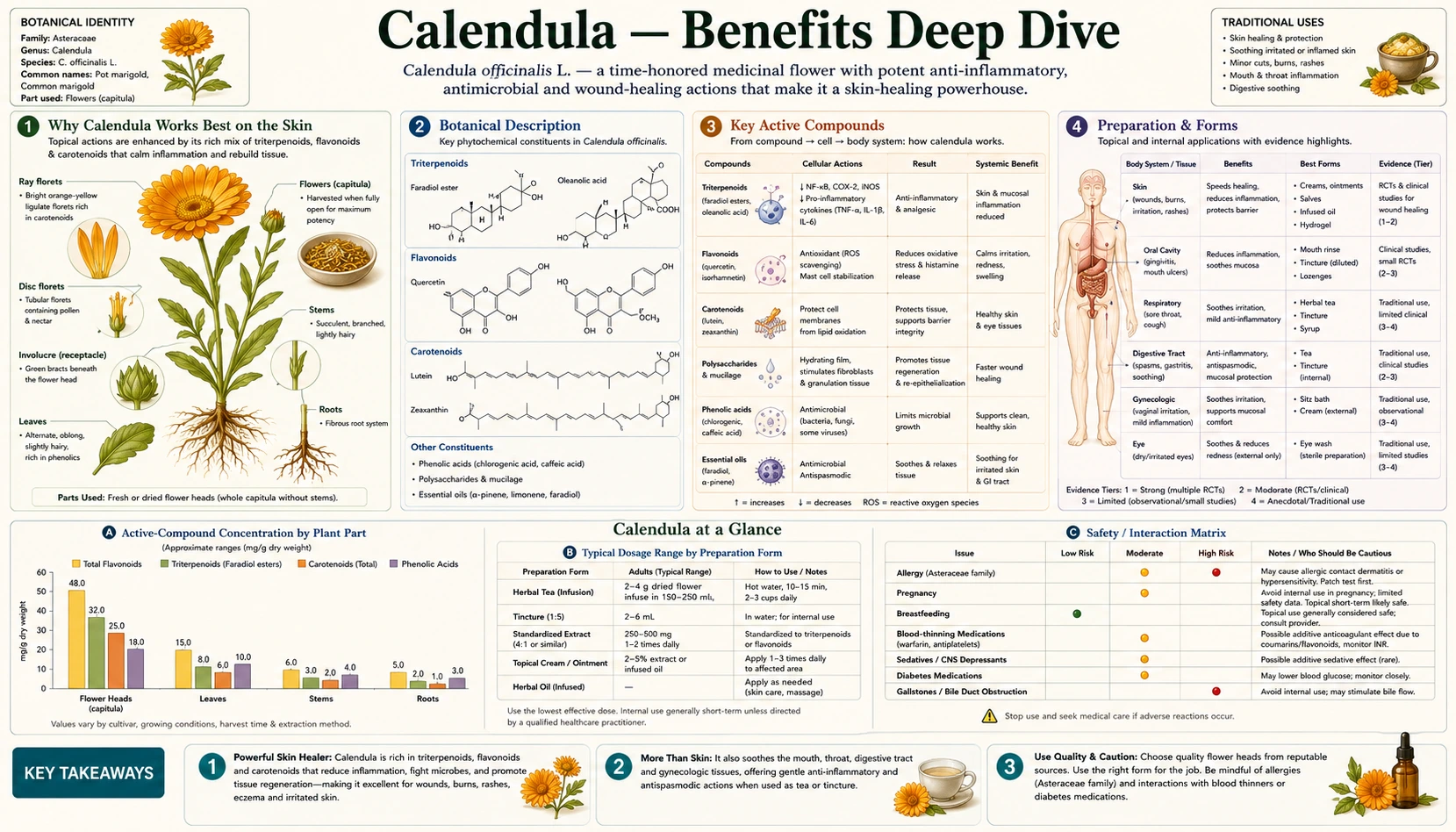
Calendula (Calendula officinalis, the bright orange "pot marigold") is one of the few traditional skin herbs with a genuine, if modest, clinical evidence base — and that evidence is almost entirely topical. Its value lies in soothing inflamed and irritated skin, supporting the early phase of minor wound healing, and easing the skin and mouth reactions that develop during cancer radiotherapy. The four deep-dive pages below separate what the science actually supports from what is only traditional use: the wound-and-skin evidence (including the well-known Pommier radiation-dermatitis trial), the anti-inflammatory and antimicrobial mechanisms behind the plant's triterpenoids and flavonoids, the mouthwash and throat-rinse research, and a practical guide to infused oils, creams, and tinctures — along with the one caution that matters most: an allergy risk for people sensitive to the daisy (Asteraceae) family. Throughout, the honest expectation is mild comfort, not a dramatic cure.
Deep-Dive Articles
Skin & Wound Healing
Calendula's home turf: minor wounds and scrapes, irritated skin and mild dermatitis, diaper rash, and the plant's best-documented use — preventing and easing radiation dermatitis during breast-cancer radiotherapy (the landmark Pommier phase III trial). Includes an honest look at why later meta-analyses are more cautious, plus the venous-leg-ulcer and diabetic-foot-ulcer studies.
Anti-Inflammatory & Antimicrobial
The mechanisms behind the soothing reputation: faradiol triterpenoid esters as the main anti-inflammatory and anti-oedema compounds, flavonoid antioxidants that blunt UVB oxidative stress, and the laboratory antifungal, antibacterial, and antiviral activity of flower extracts — with a careful line drawn between test-tube findings and proven clinical effects.
Oral & Throat
Calendula as a mouth rinse and gargle: the randomized evidence for reducing radiation-induced oral mucositis in head-and-neck cancer, the anti-plaque and anti-gingivitis mouthwash trials, and where a cooled calendula infusion fits as a gentle comfort measure for a sore, inflamed mouth or throat.
Sources & Preparations
How to choose and use calendula: distinguishing true Calendula officinalis from ornamental Tagetes marigolds, making an infused (macerated) petal oil, choosing creams, ointments, salves, and tinctures, extraction methods that concentrate the active triterpenoids — and the essential Asteraceae-allergy patch-test caution.
Table of Contents
- Deep-Dive Articles
- Why Calendula Works Best on the Skin
- Research Papers: Skin & Wound Healing
- Research Papers: Anti-Inflammatory & Antimicrobial
- Research Papers: Oral & Throat
- Research Papers: Constituents, Preparations & Safety
- Research Papers: Reviews & Cross-Cutting
- External Authoritative Resources
- Connections
- Featured Videos
Why Calendula Works Best on the Skin
Most of what calendula does well, it does on contact. The medicinal part is the flower — the petals and whole flower heads — and the compounds that give calendula its reputation are concentrated there in three main groups, each mapping to a distinct part of the clinical story:
- Triterpenoids (faradiol esters and related pentacyclic triterpenes) — widely regarded as the primary anti-inflammatory and anti-swelling (anti-oedema) constituents of calendula. Classic isolation studies showed that removing the triterpenoid fraction removes most of the topical anti-inflammatory activity, and that faradiol monoester is roughly as potent as the same weight of an equal-weight comparison in the standard croton-oil ear-oedema model. This is the mechanism behind the soothing of inflamed, irritated skin.
- Flavonoids and other polyphenol antioxidants — these mop up reactive oxygen species and are linked in laboratory work to reduced oxidative damage after UVB exposure and to the faster tissue repair seen in animal wound models. They contribute to both the wound-healing and the anti-inflammatory picture.
- Carotenoids and essential-oil components — the orange-yellow pigments (carotenoids) plus a small amount of volatile oil carry the plant's mild, largely laboratory-level antimicrobial activity against certain fungi and bacteria.
The reason the evidence is so consistently topical is partly practical: calendula is used where its compounds can act directly on inflamed epithelium — a graze, a radiation-reddened patch of skin, a sore mouth. Taken by mouth as a systemic remedy, it has little proven benefit, and concentrated internal use is exactly where the traditional pregnancy caution applies. The four deep-dive pages keep that boundary sharp: strong-ish evidence for radiation dermatitis and reasonable support for minor skin soothing and oral mucositis, set against much thinner evidence for most other claims. The realistic promise of calendula is a gentle, low-risk soother — useful, but never a substitute for proper care of serious wounds, burns, or infections.
Research Papers: Skin & Wound Healing
- Pommier P, Gomez F, Sunyach MP, et al. Phase III randomized trial of Calendula officinalis compared with trolamine for the prevention of acute dermatitis during irradiation for breast cancer. J Clin Oncol. 2004. — PubMed PMID 15084618
- Haruna F, Lipsett A, Marignol L. Topical management of acute radiation dermatitis in breast cancer patients: a systematic review and meta-analysis. Anticancer Res. 2017. — PubMed PMID 28982842
- Givol O, Kornhaber R, Visentin D, et al. A systematic review of Calendula officinalis extract for wound healing. Wound Repair Regen. 2019. — PubMed PMID 31145533
- Panahi Y, Sharif MR, Sharif A, et al. A randomized comparative trial on the therapeutic efficacy of topical aloe vera and Calendula officinalis on diaper dermatitis in children. ScientificWorldJournal. 2012. — PubMed PMID 22606064
- Preethi KC, Kuttan R. Wound healing activity of flower extract of Calendula officinalis. J Basic Clin Physiol Pharmacol. 2009. — PubMed PMID 19601397
- Duran V, Matic M, Jovanovć M, et al. Results of the clinical examination of an ointment with marigold (Calendula officinalis) extract in the treatment of venous leg ulcers. Int J Tissue React. 2005. — PubMed PMID 16372475
- Buzzi M, de Freitas F, de Barros Winter M. Clinical benefits of using Calendula officinalis hydroglycolic extract for the topical treatment of diabetic foot ulcers. Ostomy Wound Manage. 2016. — PubMed PMID 26978856
- Parente LM, Lino Junior RS, Tresvenzol LM, et al. Wound healing and anti-inflammatory effect in animal models of Calendula officinalis L. growing in Brazil. Evid Based Complement Alternat Med. 2012. — PubMed PMID 22315631
Research Papers: Anti-Inflammatory & Antimicrobial
- Della Loggia R, Tubaro A, Sosa S, et al. The role of triterpenoids in the topical anti-inflammatory activity of Calendula officinalis flowers. Planta Med. 1994. — PubMed PMID 7809203
- Zitterl-Eglseer K, Sosa S, Jurenitsch J, et al. Anti-oedematous activities of the main triterpendiol esters of marigold (Calendula officinalis L.) J Ethnopharmacol. 1997. — PubMed PMID 9254116
- Colombo E, Sangiovanni E, Fumagalli M, et al. A bio-guided fractionation to assess the inhibitory activity of Calendula officinalis L. on inflammatory markers. Evid Based Complement Alternat Med. 2015. — PubMed PMID 26491463
- Fonseca YM, Catini CD, Vicentini FT, et al. Protective effect of Calendula officinalis extract against UVB-induced oxidative stress in skin. J Ethnopharmacol. 2010. — PubMed PMID 20026397
- Efstratiou E, Hussain AI, Nigam PS, et al. Antimicrobial activity of Calendula officinalis petal extracts against fungi, as well as Gram-negative and Gram-positive clinical pathogens. Complement Ther Clin Pract. 2012. — PubMed PMID 22789794
- Kalvatchev Z, Walder R, Garzaro D. Anti-HIV activity of extracts from Calendula officinalis flowers. Biomed Pharmacother. 1997. — PubMed PMID 9207986
- Saffari E, Mohammad-Alizadeh-Charandabi S, Adibpour M, et al. Comparing the effects of Calendula officinalis and clotrimazole on vaginal candidiasis: a randomized controlled trial. Women Health. 2017. — PubMed PMID 27880086
- Pazhohideh Z, Mohammadi S, Bahrami N, et al. The effect of Calendula officinalis versus metronidazole on bacterial vaginosis in women: a double-blind randomized controlled trial. J Adv Pharm Technol Res. 2018. — PubMed PMID 29441319
Research Papers: Oral & Throat
- Babaee N, Moslemi D, Khalilpour M, et al. Antioxidant capacity of Calendula officinalis flowers extract and prevention of radiation-induced oropharyngeal mucositis in patients with head and neck cancers. Daru. 2013. — PubMed PMID 23497687
- Khairnar MS, Pawar B, Marawar PP, Mani A. Evaluation of Calendula officinalis as an anti-plaque and anti-gingivitis agent. J Indian Soc Periodontol. 2013. — PubMed PMID 24554883
- Lauten JD, Boyd L, Hanson MB, et al. A clinical study: Melaleuca, Manuka, Calendula and green tea mouth rinse. Phytother Res. 2005. — PubMed PMID 16317652
- Mahyari S, Mahyari B, Emami SA, et al. Evaluation of the efficacy of a polyherbal mouthwash containing Zingiber officinale, Rosmarinus officinalis and Calendula officinalis extracts in patients with gingivitis. Complement Ther Clin Pract. 2016. — PubMed PMID 26850813
- Tidke S, Chhabra GK, Madhu PP, et al. The effectiveness of herbal versus non-herbal mouthwash for periodontal health: a literature review. Cureus. 2022. — PubMed PMID 36120261
Research Papers: Constituents, Preparations & Safety
- Molina JAP, et al. Calendula: general aspects, applications, and formulations in the pharmaceutical industry. Int J Pharm Compd. 2025. — PubMed PMID 40961475
- Baumann D, Adler S, Grüner S, et al. Supercritical carbon dioxide extraction of marigold at high pressures: comparison of analytical and pilot-scale extraction. Phytochem Anal. 2004. — PubMed PMID 15311841
- Lohani A, Mishra AK, Verma A. Cosmeceutical potential of geranium and calendula essential oil: determination of antioxidant activity and in vitro sun protection factor. J Cosmet Dermatol. 2019. — PubMed PMID 30251317
- Paulsen E. Contact sensitization from Compositae-containing herbal remedies and cosmetics. Contact Dermatitis. 2002. — PubMed PMID 12492516
- Reider N, Komericki P, Hausen BM, et al. The seamy side of natural medicines: contact sensitization to arnica (Arnica montana L.) and marigold (Calendula officinalis L.) Contact Dermatitis. 2001. — PubMed PMID 11722485
Research Papers: Reviews & Cross-Cutting
- Cruceriu D, Balacescu O, Rakosy E. Calendula officinalis: potential roles in cancer treatment and palliative care. Integr Cancer Ther. 2018. — PubMed PMID 30289008
- Fonseca YM, Catini CD, Vicentini FT, et al. Efficacy of marigold extract-loaded formulations against UV-induced oxidative stress. J Pharm Sci. 2011. — PubMed PMID 21491442
- Lohani A, Verma A, Joshi H, et al. Topical delivery of geranium/calendula essential oil-entrapped ethanolic lipid vesicular cream. Biomed Res Int. 2021. — PubMed PMID 34552986
- PubMed — all indexed research on Calendula officinalis. — PubMed: Calendula officinalis
External Authoritative Resources
- Memorial Sloan Kettering Cancer Center — About Herbs: Calendula — a balanced, regularly updated professional summary of the evidence, uses, and interactions
- European Medicines Agency — Calendulae flos (marigold flower) herbal monograph — the EU regulatory assessment of traditional topical use
- MedlinePlus — Marigold (Calendula) — consumer-oriented overview from the U.S. National Library of Medicine
- Drugs.com — Calendula — a referenced professional monograph on dosing, cautions, and interactions
- PubMed — Calendula officinalis (topical use)
Connections
- All Herbs
- Calendula (Main Page)
- Calendula for Skin & Wound Healing
- Anti-Inflammatory & Antimicrobial
- Calendula for Oral & Throat
- Sources & Preparations
- Aloe Vera
- Chamomile
- Tea Tree
- Manuka Honey
- Gotu Kola
- Eczema
- Contact Dermatitis
- Breast Cancer
- Gum Disease
- Antibacterial Herbs