Boneset in Eclectic and Folk Medicine
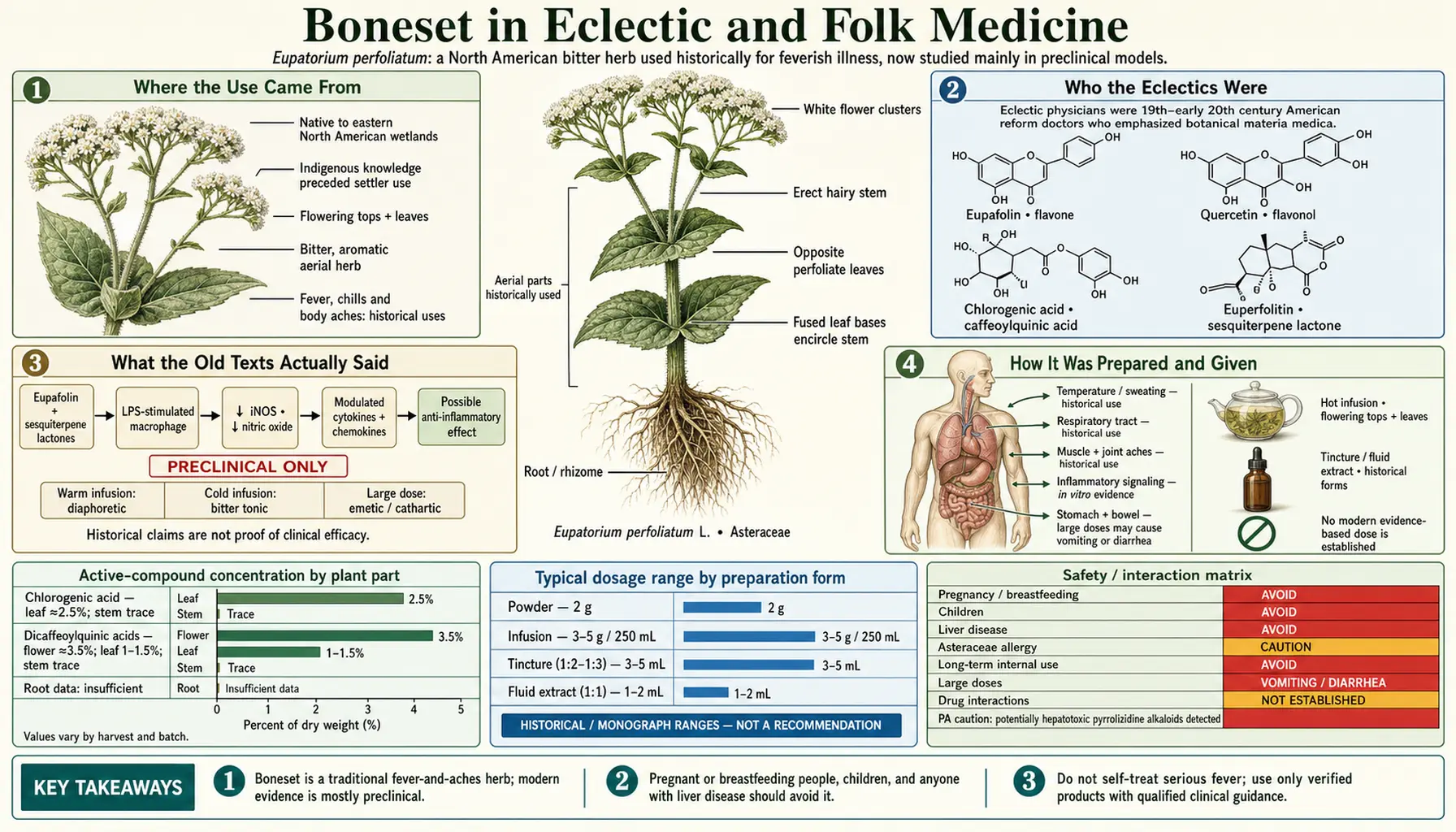
Boneset has one of the best-documented use histories of any North American medicinal plant. It was used by Native American nations, adopted wholesale by colonists, written up at length by nineteenth-century Eclectic physicians, listed in official pharmacopoeial and dispensatory literature, kept dried in farmhouse kitchens across half a continent, and reached for by the cupful in every influenza season for roughly two hundred years. That record is real, it is substantial, and it is worth setting out carefully.
It is also history, not evidence, and this page keeps the two apart deliberately. A tradition tells you what people did and what they believed about why it worked. It does not tell you whether it worked. Those are different questions with different kinds of answers, and the most common way a herb page overstates itself is by letting the weight of the historical record slide across into the efficacy column. Boneset's history is the strongest thing about it. That is a comment on the history, not on the plant.
Table of Contents
- Where the Use Came From
- Who the Eclectics Were
- What the Old Texts Actually Said
- How It Was Prepared and Given
- The Emetic Ceiling
- The Bitter Tonic Use — and a Contradiction
- What It Was Combined With
- Official Status and Its Decline
- The Homeopathic Branch
- How to Read a Historical Materia Medica
- The Identity Problem in Old Sources
- What Survives Today
- Key Research Papers
- Connections
Where the Use Came From
The colonial and Eclectic use of boneset was not invented in Philadelphia or Cincinnati. It was learned. Eupatorium perfoliatum is native to eastern and central North America and was in use among Native American nations across that range before European settlement, and the analytical ethnobotanical literature — most systematically the work of Daniel Moerman on the food and drug plants of native North America — records it among the febrifuge and diaphoretic plants of the region.
Two honest cautions about how that record should be read. First, it is a record assembled largely by outsiders, often decades or centuries after the fact, and the compression of many distinct nations' practices into a single line item ("used for fevers") flattens real differences in preparation, indication and context. Second, one of the plant's own common names — Indian sage — is itself a colonial artefact: it records that settlers understood the use to be of indigenous origin and compared the plant to a familiar European kitchen herb. That is a useful piece of provenance and a reminder that the naming was done from one side.
What the record supports is straightforward: the febrile-and-diaphoretic use of boneset is indigenous in origin, it was transmitted to settlers, and it then expanded into a much larger and better-documented literature of its own. Nothing in that chain of transmission constitutes a test of the plant.
Who the Eclectics Were
“Eclectic medicine” is a specific thing, and boneset's reputation is inseparable from it. The Eclectics were an organised American medical reform movement of roughly the 1830s to the 1930s. They trained in their own colleges, held their own licences, published their own journals and dispensatories, and defined themselves against what they called the heroic practice of the day — the bleeding, blistering and heavy mercury dosing of orthodox nineteenth-century medicine. Their alternative leaned heavily on botanical remedies, and their case for those remedies was often that they were gentler, which in the context of calomel and the lancet was frequently true.
Their literature matters here because it is unusually detailed. The Eclectic dispensatories describe indications, preparations, dose ranges, expected effects, and adverse effects, in a consistent format, across decades. When a modern herb book says something about boneset, the chain of citation very often runs back through the Eclectic texts — particularly the late-nineteenth-century American dispensatory literature associated with Harvey Wickes Felter and John Uri Lloyd — and then stops there, because that is where the observations were made.
So the Eclectics were careful clinical observers writing in a pre-statistical era. They had no control groups, no blinding, no randomisation, no placebo concept, and no way to distinguish a self-limiting illness resolving on its own from a remedy resolving it. That is not a criticism of them; it is a description of what their evidence can and cannot support. Their notes are excellent primary sources about practice and unreliable sources about effect.
What the Old Texts Actually Said
Read across the nineteenth-century American botanical literature and boneset's entry is remarkably consistent. Four claims recur:
- Diaphoretic and febrifuge in hot infusion. The core use. A warm infusion given freely at the onset of a febrile, achy illness, with the intention of producing free perspiration.
- Tonic and bitter in cold infusion or small dose. The same plant, cooled and taken sparingly, treated as a stomachic bitter for poor appetite and sluggish digestion — and as a general convalescent tonic after fever.
- Emetic and cathartic in large dose. Stated openly and repeatedly. A strong or copious dose produces vomiting and loosens the bowels, and this was sometimes the intended effect rather than an accident.
- Relief of the aching. Specifically the deep muscular and skeletal soreness of febrile illness — the property the name descends from.
Beyond those four, the older sources scatter more speculative indications: intermittent fever, rheumatic complaints, jaundice and hepatic sluggishness, catarrh, and a general reputation as a “cleansing” herb. These marginal claims are much weaker even as historical claims — they appear inconsistently, they overlap with the era's general enthusiasm for depurative and evacuant therapy, and one of them (jaundice) is grimly ironic in a plant containing hepatotoxic alkaloids.
Notably absent from any of it: fractures, bone healing, and osteoporosis. The historical texts are entirely clear that this is a fever plant, which is why the modern misreading of its name is a modern problem rather than an inherited one. That etymology is unpacked in Boneset for Fever and Influenza, and Where the Name Comes From.
How It Was Prepared and Given
The part used was the dried above-ground herb — leaves and flowering tops, gathered as the plant came into bloom in late summer and dried. Three preparations dominate the record.
- Hot infusion. The standard febrile preparation: dried herb steeped in just-boiled water, strained, and drunk warm. Quantity mattered more than concentration — the aim was volume of hot liquid, taken repeatedly, to bring on a sweat, with the patient kept warm and in bed.
- Cold infusion. The same herb steeped without heat, or the hot infusion allowed to cool, taken in small amounts as a bitter. The distinction between the hot and the cold preparation is doing real work in the old texts: it is presented as changing the indication, not merely the temperature.
- Tincture and fluid extract. Alcoholic preparations dosed by drops, favoured by practitioners for consistency and shelf life. This is also the form in which the plant's constituents are most concentrated, which has a safety implication the historical sources could not have known.
This page does not give doses, and that is deliberate. The historical figures are recorded in apothecaries' measures against a herb of unknown and variable potency, harvested at unknown stages, dried by unknown methods, and — as discussed below — not always reliably identified. Converting a nineteenth-century drachm-based direction into a modern gram figure would produce a number that looks authoritative and is not. A confident dose for boneset would be a guess dressed up, and saying so is more useful than supplying one.
The Emetic Ceiling
One feature of boneset's traditional use deserves separating out, because it is the closest thing the plant has to a dose-response relationship and it is not a flattering one: the upper bound of boneset dosing was defined by vomiting.
The old sources are unanimous that a large or strong dose is emetic and cathartic. That is a genuine pharmacological effect — intensely bitter sesquiterpene lactones acting on the gut are a plausible mechanism, and the property is shared with other bitter composites. But consider what it means as a therapeutic window. The therapeutic dose was never established against a measured outcome; it was established as “less than the amount that makes you sick.” That is a tolerability ceiling standing in for an efficacy floor, and there is nothing in the record telling you how far below the ceiling the useful range begins, or whether there is one.
Two practical consequences follow. First, brewing the tea stronger is not a way to get more benefit; it is a way to approach the emetic threshold, which is the one effect the plant reliably produces. Second, the traditional guidance to use small amounts for short periods was not caution born of a safety analysis — the alkaloid issue was unknown until the twentieth century — it was caution born of the herb being unpleasant. The practice happened to align with what the modern safety picture also requires, but for an entirely different reason. That coincidence is worth noticing rather than mistaking for ancestral wisdom about the liver.
The Bitter Tonic Use — and a Contradiction
The claim that boneset in small cold doses “stimulates appetite and digestion” is one of the most repeated in the traditional literature, and it sits inside a broader contradiction that runs through the entire class of bitter herbs.
Traditional herbalism holds that bitters increase appetite by stimulating digestive secretion. Modern human work on bitter taste receptors points the other way: studies delivering bitter agonists to human volunteers have generally found reduced appetite, reduced calorie intake, altered gut hormone release and slowed gastric emptying — effects that would make a person eat less, not more. This is not a boneset-specific finding; it is a general tension in the bitters literature, and this site has recorded the same contradiction on yarrow and horehound.
Candidate reconciliations, none of them established:
- Dose and route differ. A trace of bitterness on the tongue before a meal is not the same intervention as an intragastric infusion of a concentrated bitter agonist, and the receptor studies mostly do the latter.
- Population differs. The traditional indication is a convalescent or anorexic patient recovering from fever. Studies in healthy volunteers may not model that state at all.
- “Appetite” is not one thing. Subjective interest in food, gastric accommodation, secretion and rate of emptying can move in different directions, and older observers had access only to the first.
- The traditional claim may simply be wrong — a plausible-sounding inference from the sensation of bitterness rather than an observation.
The tension is unresolved. The honest position is that boneset's bitter-tonic use rests on tradition, that the closest relevant human physiology points the opposite way, and that nobody has tested boneset itself in this role.
What It Was Combined With
Boneset rarely appears alone in the traditional record. The febrile formulas of nineteenth-century North American practice combined it with other diaphoretics and warming aromatics — elderflower, yarrow, peppermint, ginger, catnip, pleurisy root — and often with something to make it drinkable, because the plant is punishingly bitter.
This is a small point with a large consequence for reading the literature. Where a historical account reports success with a boneset compound, the result cannot be attributed to boneset. Multi-herb formulas are the classic vehicle for borrowed evidence: the credit accrues to whichever component the writer happens to be interested in. And in this case the co-ingredients are not inert bystanders — elderflower and yarrow carry their own diaphoretic reputations, ginger has genuine thermogenic and antiemetic effects, and peppermint changes the whole subjective experience of the drink. If the compound helped, at least four things were happening, plus hot water, plus bed rest.
This site therefore treats formula testimony as evidence about the formula and not about any component of it, and flags it wherever it appears. The same rule is applied on other herb pages to Triphala-for-haritaki, Trikatu-for-long-pepper, and proprietary combination products cited as though they were single-herb data.
Official Status and Its Decline
Boneset was not a fringe remedy. It held a place in the official American drug literature of the nineteenth century — appearing in the United States Pharmacopoeia of the period and, after being dropped from it, continuing in the National Formulary and the dispensatory literature that stood alongside them. Practically, that meant a pharmacist could be expected to stock it and a physician to know what to do with it.
Then it went. The reasons are structural rather than specific to the plant:
- Bacteriology replaced symptom-based nosology. Once fevers were sorted by organism rather than by presentation, a remedy indexed to “hot and aching” had no diagnostic slot to occupy.
- Aspirin arrived. A cheap, standardised, orally active antipyretic and analgesic did the job boneset was reached for, more predictably and without the vomiting.
- The Eclectic schools closed. Following the reorganisation of American medical education in the early twentieth century, the institutions that carried boneset's clinical tradition ceased to exist, and the transmission chain broke.
- Efficacy standards changed. Twentieth-century drug regulation began asking for trial evidence. Boneset had testimony.
Note what is not on that list: boneset was not withdrawn because it was found not to work, and it was not withdrawn on safety grounds. It was displaced. That distinction cuts both ways and should be stated in both directions — its removal from official status is not a verdict against it, and its long presence there is not a verdict for it.
The Homeopathic Branch
A second, separate tradition also carries the name. Eupatorium perfoliatum is a long-standing homeopathic remedy, and its homeopathic indication tracks the herbal one almost exactly: febrile illness with severe aching in the bones, restlessness, and thirst. It appears in homeopathic influenza remedies and combinations, and it has generated a small clinical literature of its own within that framework.
For the purposes of this site the two traditions must be kept strictly apart, because the preparations differ by orders of magnitude in concentration. A homeopathic potency is a serial dilution of a mother tincture; the material dose is small at low potencies and effectively absent at higher ones. Any clinical report on homeopathic Eupatorium perfoliatum is therefore borrowed evidence when cited for the herb — it is a different intervention within a different explanatory framework, and it can neither support nor refute a claim about drinking an infusion.
It is worth knowing that the homeopathic branch exists mainly because of what it does to searching. A reader looking for human studies on boneset will find the homeopathic literature first, and it is easy to mistake it for evidence about the plant. It is not.
How to Read a Historical Materia Medica
Traditional sources are worth reading, and they are worth reading correctly. A few rules make the difference.
- A dispensatory entry is a summary of practice, not a finding. It records what practitioners did and what they expected. Its confident tone reflects the genre, not the strength of the underlying observation.
- Entries copy each other. Nineteenth-century materia medica compilation was heavily citational, and a claim repeated in six books may descend from one observation in a seventh. Repetition is not replication.
- Self-limiting illness flatters every remedy. Influenza and febrile colds resolve. Any treatment given at onset will be followed by recovery in the great majority of cases, and pre-statistical observation cannot separate the two.
- A traditional-use registration is not an efficacy finding. Where a modern regulator grants a herbal product traditional-use status, the standard is documented long-standing use plus plausible pharmacology and acceptable safety — explicitly not clinical proof. Similarly, a monograph from a national expert commission is a judgement resting on tradition plus plausibility. Quoting either as though it certified efficacy misrepresents the instrument.
- Absence of a safety warning in an old text means nothing. Pyrrolizidine alkaloid hepatotoxicity was not characterised until the twentieth century. The nineteenth-century sources are silent on it because they could not have known, not because they looked and found nothing.
The Identity Problem in Old Sources
One further complication sits underneath the entire historical record: the genus has been taken apart. Plants once catalogued as Eupatorium have since been distributed into several genera, including Eutrochium (the Joe-Pye weeds), Ageratina (which contains the genuinely toxic white snakeroot, A. altissima, long known as Eupatorium rugosum), and others. A pre-twentieth-century source writing about “Eupatorium” may not be writing about the plant a modern reader would fetch under that name.
This has two consequences. Historically, it means some traditional claims may have been made about relatives rather than about E. perfoliatum, and there is often no way to tell which. Practically — and more importantly — it means identity is a live safety issue for boneset today, not a resolved historical curiosity. White snakeroot grows in the same region, flowers white at the same season, and is seriously poisonous; the reliable distinguishing feature is boneset's fused, stem-piercing leaf pairs against white snakeroot's ordinary stalked leaves. Joe-Pye weeds are harmless but are a different herb with a different traditional use, so recipes do not transfer.
The standard reassurance offered for PA-containing herbs — that historical harm was really caused by a substituted species — has a sting in its tail, and the sting applies here. If you cannot verify which plant is in your jar, the argument does not exculpate the jar; it makes it worse. An identity defence only works for material whose identity is known. That logic is developed in Boneset Safety: Pyrrolizidine Alkaloids and Liver Risk.
What Survives Today
Boneset persists in three places, and they are worth distinguishing.
- Western herbalism. It remains in the working materia medica of practitioners in the diaphoretic-for-acute-fever role, usually with explicit short-course guidance and pregnancy contraindication. It is a minor herb in commercial terms — nothing like echinacea or elderberry — and is more often encountered as loose dried herb or a tincture than as a mass-market capsule.
- Homeopathy. Where it is a well-established remedy with a stable indication and a much larger retail presence than the herb.
- Native plant horticulture and ecology. Genuinely and increasingly — boneset is an excellent late-season nectar plant for pollinators in wet meadow and rain-garden plantings, and this is now arguably the most common reason a North American reader encounters the name at all. It is a use with no safety issue and no evidentiary burden.
The through-line of this whole page: boneset's tradition is genuine, deep and well recorded, and it explains why the plant is remembered. It does not tell you whether the tea does anything. For the laboratory side of that question see Boneset: Immune and Preclinical Research, and for the reason none of this should be a long-term habit, see the safety article.
Key Research Papers
Cited as PubMed topic searches so the links keep working and so a reader sees a question's literature rather than one paper's framing. Where a historical primary source is named, its bibliographic details are as attributed in the modern review literature and have not been independently verified here.
- Hensel A, Maas M, Sendker J, and colleagues. “Eupatorium perfoliatum L.: phytochemistry, traditional use and current applications.” Journal of Ethnopharmacology, 2011. The best modern synthesis of the traditional record alongside the chemistry, and the source most worth reading in full. Find on PubMed.
- Moerman DE. Analyses of the food and drug plants of native North America. Journal of Ethnopharmacology, 1990s. The quantitative framework behind most statements about which plants were used by which nations for what. Find on PubMed.
- Nineteenth-century clinical accounts of Eupatorium perfoliatum in epidemic influenza. Reports of this kind exist in the mid-nineteenth-century American medical journal literature and are cited in the modern reviews; the primary metadata is not verified here and the accounts are uncontrolled case series by modern standards. Search PubMed on this topic.
- Herz W and colleagues. Sesquiterpene lactones of Eupatorium perfoliatum. Journal of Organic Chemistry, 1977. The foundational chemistry that put names to the plant's bitter principles — the compounds most plausibly behind both the bitterness and the emesis. Find on PubMed.
- Vollmar A, Schäfer W, Wagner H. Immunologically active polysaccharides of Eupatorium cannabinum and Eupatorium perfoliatum. Phytochemistry, 1986. Note the two-species design: results reported for the pair should not be read as results for boneset alone. Find on PubMed.
- Habtemariam S, Macpherson AM. Cytotoxicity and antibacterial activity of an ethanol extract from leaves of the herbal drug boneset (Eupatorium perfoliatum). Phytotherapy Research, 2000. An in-vitro screen; the cytotoxicity finding is as relevant as the antibacterial one. Find on PubMed.
- Maas M, Petereit F, Hensel A. Caffeic acid derivatives from Eupatorium perfoliatum. Molecules, 2009. Characterisation of the phenolic fraction — the constituents most likely to be present in an aqueous infusion. Find on PubMed.
- Human bitter taste receptor studies and appetite. The literature in which bitter agonists delivered to volunteers reduce rather than increase appetite and calorie intake, and alter gut hormone release — the direct challenge to the traditional bitter-tonic rationale. Search PubMed on this topic.
- Gassinger CA, Wünstel G, Netter P. Controlled clinical trial of homoeopathic Eupatorium perfoliatum D2 in common cold. Arzneimittel-Forschung, 1981 (in German). Borrowed evidence: a homeopathic dilution, not the herb. Find on PubMed.
- Dehydropyrrolizidine alkaloids in boneset and related species. Analytical work by Betz, Colegate, Upton and colleagues — the reason the traditional short-course pattern happens to be the right one. Search PubMed on this topic.
- Taxonomic revision of Eupatorium and the segregate genera. Why an old source's “Eupatorium” may be Eutrochium or Ageratina, and why that is an identification issue rather than a filing issue. Search PubMed on this topic.
- White snakeroot, tremetol and milk sickness. The look-alike hazard, and the reason correct identification of a white-flowered wetland composite is not optional. Search PubMed on this topic.
Connections
- All Herbs
- Boneset — main article
- Boneset Benefits — hub
- Boneset for Fever, and the Name
- Boneset: Immune and Preclinical Research
- Boneset Safety: Pyrrolizidine Alkaloids
- Coltsfoot Benefits — a parallel case
- Comfrey Benefits
- Yarrow: Bitters and Digestion
- Elderberry
- Echinacea
- Ginger
- Peppermint
- Sage
- Feverfew
- Influenza
- Fever — symptom guide
- Loss of Appetite
A note on what this page is
This is a history page. Nothing on it should be read as a recommendation to use boneset, and nothing on it is medical advice. The traditional record is presented because it is real and well documented, and because understanding it is the only way to see clearly where it stops. Boneset contains pyrrolizidine alkaloids and should be avoided in pregnancy, while breastfeeding, in infants and children, and by anyone with liver disease. Talk to a qualified healthcare professional about anything you intend to take.