Betel Nut (Areca Nut) — What the Evidence Shows
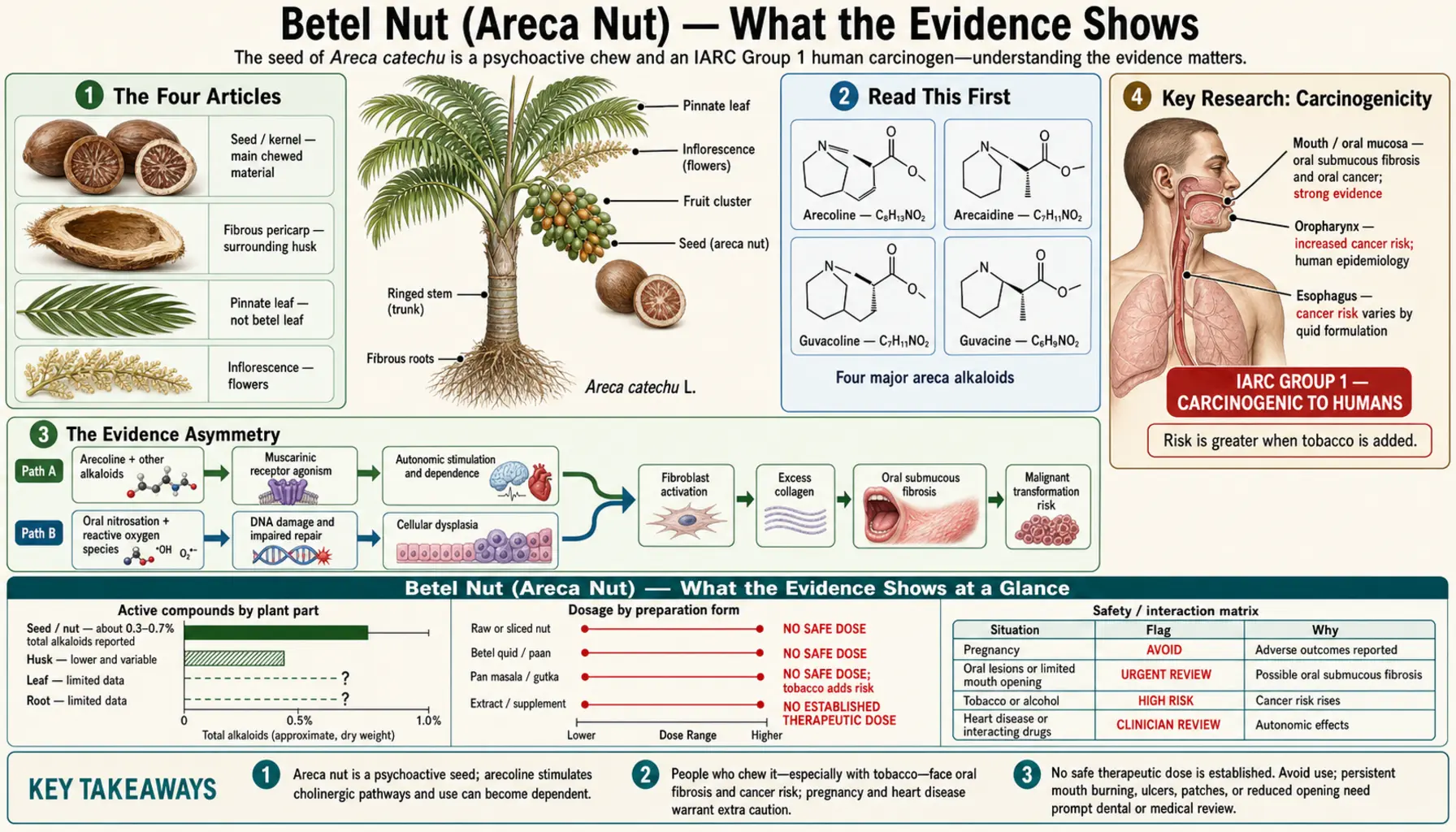
Areca nut — the seed of the palm Areca catechu, almost always called betel nut in English — is classified by the International Agency for Research on Cancer as a Group 1 human carcinogen: carcinogenic to humans. That classification applies to areca nut on its own, to betel quid without added tobacco, and to betel quid with tobacco, each evaluated separately and each placed in the same category as tobacco smoking and asbestos. This section is therefore not a benefits deep dive, and it is not headed as one, because calling it that would misrepresent what the evidence says.
What it is instead: an honest account for the reader who chews, or whose family chews. Areca nut is used every day by several hundred million people — estimates in the literature run from roughly 300 to 600 million, and all of them are estimates — which makes it one of the most widely used psychoactive substances on earth. It carries deep ceremonial and social meaning at weddings, in temples, and as an offering to a guest across South Asia, Southeast Asia and the Pacific. The alertness people describe from chewing is real pharmacology, not suggestion. None of that changes the biology, and none of it is a reason to be written at as though normal cultural practice were ignorance.
So these four articles document what areca nut is claimed to do, state the established harm alongside every claim, and put the genuinely useful material — how to recognise trouble early, and how to stop — where it can be found. The evidence is deliberately asymmetric and the asymmetry is stated on every page: the harm sits in the strongest tier there is, established human epidemiology, while the benefit side consists of traditional use plus the pharmacology of a short-acting stimulant. Those are not comparable categories.
One piece of terminology, because the confusion is pervasive and matters medically. Areca nut is not betel leaf. Betel leaf is Piper betle, a pepper vine used as the wrapper, and it is covered separately under betel leaf and its benefits leg. A betel quid or paan is the assembled preparation: areca nut, slaked lime, usually a betel leaf, and very often tobacco. Gutka, mawa and pan masala are commercial areca-based mixtures, the first two containing tobacco. Chewing plain areca nut with no leaf and no tobacco is not an exemption from anything here.
The Four Articles
Areca Nut and Oral Cancer: The Established Harm
The IARC Group 1 classification and where it comes from — Monographs Volume 85 and Volume 100E. The human epidemiology for oral cavity, pharynx and oesophagus; the risk that persists in people who have never used tobacco, which is what isolates areca's own contribution; the dose-response gradient in quids per day, years chewed and retention time; and the mechanisms, from arecoline and arecaidine genotoxicity through nitrosamines formed in the mouth during chewing to the reactive oxygen species driven by slaked lime. Also which beliefs about safer chewing hold up, and which do not.
Oral Submucous Fibrosis: The Condition Chewers Should Know
The condition to recognise early, because early detection is the one thing that changes outcomes. Burning on spicy food is the first sign and is almost always dismissed for years. Covers blanching, palpable fibrous bands, progressive trismus and how mouth opening is measured and tracked; why the scarring is progressive and largely irreversible; its recognised premalignant status and what is honestly known about the transformation rate; why it now appears in teenagers after only a few years of sachet products; and the weak state of the treatment evidence.
Arecoline: Why Areca Nut Is Habit-Forming
Why “just stop” fails as advice. Arecoline is a muscarinic agonist with additional nicotinic-receptor activity, and areca use produces tolerance, craving and a withdrawal syndrome of irritability, low mood and disturbed sleep — documented in chewers who use no tobacco at all. Also the harms that are not cancer and are rarely mentioned: metabolic syndrome and type 2 diabetes, cardiovascular disease and mortality, worsened asthma through direct bronchoconstriction, pregnancy associations including reduced birthweight, and medication interactions.
Areca Nut: Traditional Claims, and Help With Quitting
What areca nut is claimed to do, each claim labelled by evidence tier — the after-meal digestive use, the alertness and stamina effect (which is real), the obsolete anthelmintic action, and the ceremonial roles at weddings and religious occasions. Then the most practical material on the site about areca: what quitting achieves and how fast, a step-by-step quit plan, handling withdrawal, substitutes chewers actually use, how to decline a quid without insulting the person offering it, and what to ask a dentist to examine and measure.
Table of Contents
- The Four Articles
- Read This First
- The Evidence Asymmetry
- Key Research: Carcinogenicity
- Key Research: Submucous Fibrosis
- Key Research: Dependence and Pharmacology
- Key Research: Metabolic, Cardiac and Pregnancy
- Key Research: Cessation and Screening
- External Resources
- Connections
Read This First
Four things that decide most of what a reader needs from this section:
- There is no established safe amount, and no safer preparation. Omitting tobacco, using a betel leaf, choosing fresh nut over cured, or buying a branded “tobacco-free” sachet do not remove the classification. Areca nut alone is Group 1.
- Risk is graded, which means reduction is not futile. Fewer quids, shorter retention, and never holding a quid overnight all move a chewer down a real dose-response gradient. Stopping moves them furthest.
- Early detection is the intervention available today. A two-minute soft-tissue examination of the mouth, with mouth opening measured in millimetres and written down, is cheap, quick, and the thing most likely to change what happens. Burning on spicy food is the symptom worth an appointment on its own.
- Stopping is hard for pharmacological reasons. Dependence with tolerance, craving and withdrawal is documented, including in chewers who use no tobacco. Advice that treats chewing as a mere habit fails, and the failure is not the chewer's.
The Evidence Asymmetry
This site labels the evidence tier behind every claim. On this topic the tiers fall almost entirely on one side, and stating that openly is more useful than a balanced-sounding summary would be.
- Established human epidemiology — the strongest tier. Areca nut causes cancer of the oral cavity, pharynx and oesophagus. Consistent across independent populations, with dose-response, and present in never-tobacco-users. IARC Group 1, evaluated in 2004 and reaffirmed in 2012.
- Established clinical observation. Oral submucous fibrosis is caused by areca chewing, is progressive, is largely irreversible once established, and is a recognised oral potentially malignant disorder.
- Well supported. Dependence with tolerance, craving and withdrawal. Bronchoconstriction and worsening of asthma, which follows directly from muscarinic agonism.
- Consistent observational evidence. Metabolic syndrome and type 2 diabetes; cardiovascular disease and all-cause mortality; reduced birthweight and adverse pregnancy outcomes; periodontal disease and tooth loss.
- Established pharmacology, presented as fact rather than benefit. The stimulant and alertness effect of arecoline is real and measurable. So is the increase in salivation and gut motility behind the after-meal use. The historical veterinary anthelmintic action of arecoline salts is also real, and obsolete.
- Traditional use, no clinical evidence. Digestive and dyspepsia use, appetite suppression, nausea, mood, toothache.
- Documented cultural practice, not a health claim. The ceremonial, marital, religious and hospitality roles — historical and ethnographic fact, and the reason messaging that talks down to chewers does not work.
- Contradicted by the evidence. That chewing cleans the teeth. That tobacco-free areca is safe.
- Thin evidence base, stated as such. Areca-specific cessation research; the time course of withdrawal; every medical treatment for submucous fibrosis; and any pharmacotherapy for areca dependence, of which none is established.
Nothing on the claim side is supported by a clinical trial showing benefit in a defined condition. A real stimulant effect does not offset a Group 1 classification, and this section does not present it as though it might.
Key Research: Carcinogenicity
All citations across this section are given as PubMed topic searches rather than direct records, so they stay current. Titles, journals and years identify the specific paper.
- IARC Working Group. Betel-quid and Areca-nut Chewing and Some Areca-nut-derived Nitrosamines. IARC Monographs, Volume 85, 2004. The foundational evaluation, and the source of the three separate Group 1 classifications. Find on PubMed
- IARC Working Group. Personal Habits and Indoor Combustions. IARC Monographs, Volume 100E, 2012. The re-evaluation that reaffirmed all three. Find on PubMed
- Secretan B, Straif K, Baan R, et al. “A review of human carcinogens — Part E: tobacco, areca nut, alcohol, coal smoke, and salted fish.” The Lancet Oncology, 2009. Find on PubMed
- Guha N, Warnakulasuriya S, Vlaanderen J, Straif K. “Betel quid chewing and the risk of oral and oropharyngeal cancers: a meta-analysis with implications for cancer control.” International Journal of Cancer, 2014. Pooled risk, separating quid with and without tobacco. Find on PubMed
- Warnakulasuriya S, Trivedy C, Peters TJ. “Areca nut use: an independent risk factor for oral cancer.” BMJ, 2002. Find on PubMed
- Jeng JH, Chang MC, Hahn LJ. “Role of areca nut in betel quid-associated chemical carcinogenesis.” Oral Oncology, 2001. The mechanistic review. Find on PubMed
- Znaor A, Brennan P, Gajalakshmi V, et al. “Independent and combined effects of tobacco smoking, chewing and alcohol drinking on the risk of oral, pharyngeal and esophageal cancers in Indian men.” International Journal of Cancer, 2003. Find on PubMed
- Nair U, Bartsch H, Nair J. “Alert for an epidemic of oral cancer due to use of the betel quid substitutes gutkha and pan masala.” Mutagenesis, 2004. On the commercial sachet products. Find on PubMed
- Thomas SJ, MacLennan R. “Slaked lime and betel nut cancer in Papua New Guinea.” The Lancet, 1992. Find on PubMed
Key Research: Submucous Fibrosis
- Pindborg JJ, Sirsat SM. “Oral submucous fibrosis.” Oral Surgery, Oral Medicine, Oral Pathology, 1966. The reference clinical and histological description. Find on PubMed
- Murti PR, Bhonsle RB, Pindborg JJ, et al. “Malignant transformation rate in oral submucous fibrosis over a 17-year period.” Community Dentistry and Oral Epidemiology, 1985. The most-cited transformation figure. Find on PubMed
- Tilakaratne WM, Klinikowski MF, Saku T, Peters TJ, Warnakulasuriya S. “Oral submucous fibrosis: review on aetiology and pathogenesis.” Oral Oncology, 2006. Find on PubMed
- Rajendran R. “Oral submucous fibrosis: etiology, pathogenesis, and future research.” Bulletin of the World Health Organization, 1994. Find on PubMed
- Warnakulasuriya S, Johnson NW, van der Waal I. “Nomenclature and classification of potentially malignant disorders of the oral mucosa.” Journal of Oral Pathology & Medicine, 2007. Where the premalignant terminology comes from. Find on PubMed
- Trivedy C, Baldwin D, Warnakulasuriya S, Johnson N, Peters T. “Copper content in Areca catechu (betel nut) products and oral submucous fibrosis.” The Lancet, 1997. The copper and lysyl oxidase mechanism. Find on PubMed
- Kerr AR, Warnakulasuriya S, Mighell AJ, et al. “A systematic review of medical interventions for oral submucous fibrosis and future research opportunities.” Oral Diseases, 2011. Why the treatment evidence is called weak. Find on PubMed
- Hazarey VK, Erlewad DM, Mundhe KA, Ughade SN. “Oral submucous fibrosis: study of 1000 cases from central India.” Journal of Oral Pathology & Medicine, 2007. A large clinical series, useful for the shift to younger ages. Find on PubMed
Key Research: Dependence and Pharmacology
- Winstock A. “Areca nut — abuse liability, dependence and public health.” Addiction Biology, 2002. Find on PubMed
- Benegal V, Rajkumar RP, Muralidharan K. “Does areca nut use lead to dependence?” Drug and Alcohol Dependence, 2008. Find on PubMed
- Bhat SJ, Blank MD, Balster RL, Nichter M, Nichter M. “Areca nut dependence among chewers in a South Indian community who do not also use tobacco.” Addiction, 2010. Dependence without the tobacco confounder. Find on PubMed
- Papke RL, Horenstein NA, Stokes C. “Nicotinic activity of arecoline, the psychoactive element of ‘betel nuts’, suggests a basis for habitual use and anti-inflammatory activity.” PLoS One, 2015. Find on PubMed
- Chu NS. “Effects of betel chewing on the central and autonomic nervous systems.” Journal of Biomedical Science, 2001. Where the alertness effect is measured. Find on PubMed
- Chu NS. “Neurological aspects of areca and betel chewing.” Addiction Biology, 2002. Find on PubMed
- Trivedy CR, Craig G, Warnakulasuriya S. “The oral health consequences of chewing areca nut.” Addiction Biology, 2002. Staining, wear, periodontal disease and tooth loss. Find on PubMed
Key Research: Metabolic, Cardiac and Pregnancy
- Yen AM, Chiu YH, Chen LS, et al. “A population-based study of the association between betel-quid chewing and the metabolic syndrome in men.” American Journal of Clinical Nutrition, 2006. Find on PubMed
- Tung TH, Chiu YH, Chen LS, et al. “A population-based study of the association between areca nut chewing and type 2 diabetes mellitus in men.” Diabetologia, 2004. Find on PubMed
- Boucher BJ, Mannan N. “Metabolic effects of the consumption of Areca catechu.” Addiction Biology, 2002. Find on PubMed
- Lin WY, Chiu TY, Lee LT, et al. “Betel nut chewing is associated with increased risk of cardiovascular disease and all-cause mortality in Taiwanese men.” American Journal of Clinical Nutrition, 2008. Find on PubMed
- Taylor RF, Al-Jarad N, John LM, Conroy DM, Barnes NC. “Betel-nut chewing and asthma.” The Lancet, 1992. The airway effect, mechanistically direct. Find on PubMed
- Senn M, Baiwog F, Winmai J, Mueller I, Rogerson S, Senn N. “Betel nut chewing during pregnancy, Madang province, Papua New Guinea.” Drug and Alcohol Dependence, 2009. Find on PubMed
- Deahl M. “Betel nut-induced extrapyramidal syndrome: an unusual drug interaction.” Movement Disorders, 1989. Case-report level, on the antipsychotic interaction. Find on PubMed
Key Research: Cessation and Screening
- Sankaranarayanan R, Ramadas K, Thomas G, et al. “Effect of screening on oral cancer mortality in Kerala, India: a cluster-randomised controlled trial.” The Lancet, 2005. The strongest evidence that visual oral screening reduces mortality in high-risk users. Find on PubMed
- Gupta PC, Mehta FS, Pindborg JJ, et al. “Primary prevention trial of oral cancer in India: a 10-year follow-up study.” Journal of Oral Pathology & Medicine, 1992. Community education and examination, with measured reductions in use and in precancerous lesions. Find on PubMed
- Gupta PC, Warnakulasuriya S. “Global epidemiology of areca nut usage.” Addiction Biology, 2002. Prevalence and patterns, with the limits of the estimates stated. Find on PubMed
- Sharan RN, Mehrotra R, Choudhury Y, Asotra K. “Association of betel nut with carcinogenesis: revisit with a clinical perspective.” PLoS One, 2012. A clinically framed synthesis, useful for what to tell a patient. Find on PubMed
- Cessation intervention literature. Reviews of interventions for areca-nut and betel-quid cessation consistently report that trials are few, small and heterogeneous, and that no pharmacotherapy is established. This is the honest state of the field. Find on PubMed
- Lesion regression after cessation. Follow-up of chewers who stop has documented regression of some oral precancerous lesions — a concrete finding worth giving to someone quitting. Find on PubMed
External Resources
- IARC Monographs on the Identification of Carcinogenic Hazards to Humans — the primary source for the Group 1 classifications of areca nut and betel quid, with or without tobacco.
- World Health Organization, South-East Asia Region: tobacco and smokeless tobacco — regional context, since areca use overlaps heavily with smokeless tobacco.
- National Cancer Institute: head and neck cancers — symptoms, screening, staging and treatment for the cancers most associated with chewing.
- National Institute of Dental and Craniofacial Research — oral health information, including oral cancer and mouth lesions.
- World Health Organization: oral health — global oral disease burden and prevention policy, including areca and tobacco control.
- PubMed: all areca nut literature — the unfiltered search, if you would rather read the primary sources yourself.
Connections
- All Herbs
- Areca Nut and Oral Cancer — the IARC Group 1 evidence, dose-response and mechanisms.
- Oral Submucous Fibrosis — the premalignant condition to recognise early.
- Arecoline and Dependence — why chewing is habit-forming, plus the non-cancer harms.
- Traditional Claims and Quitting — the claims, labelled, and the practical quit material.
- Betel Nut (Areca catechu) — the main topic page: botany, names, compounds, forms and cautions.
- Betel Leaf (Piper betle) — the other plant, the wrapper, and a different risk profile entirely.
- Betel Leaf — Benefits — the leaf's evidence review, where the two-plant distinction is set out.
- Betel Leaf vs Betel Quid: Cancer Risk — the same question approached from the leaf's side.
- Oral Cancer — presentation, staging, treatment and prognosis.
- Head and Neck Cancer — the wider category including oropharyngeal sites.
- Esophageal Cancer — the third site with sufficient evidence.
- Oncology — the full cancer section.
- Dentistry — oral examination and the conditions found on it.
- Periodontitis — gum disease and tooth loss, both more common in chewers.
- Metabolic Syndrome — associated with chewing in population studies.
- Type 2 Diabetes — why a regular chewer should have glucose checked.
- Asthma — worsened by chewing through direct bronchoconstriction.
- Addiction — how dependence is defined and treated generally.
- Nitrates and Nitrites — the chemistry of the nitrosamines formed during chewing.
- Secondhand Smoke — relevant because chewing and smoking coexist and their risks multiply.
A real safety statement, not a disclaimer. Nothing in this section recommends areca nut, and nothing in it should be read as a reason to start or continue chewing. If you chew, the two actions that matter most are stopping and having your mouth examined — and the examination can be arranged this month whatever you decide about the chewing. Ask a dentist or doctor to look at your cheeks, gums, palate, tongue and the floor of your mouth, tell them how much areca you use and for how many years, and ask for your mouth opening to be measured in millimetres and written down. If food has begun to burn, if a patch or ulcer has not healed in three weeks, or if your mouth does not open as far as it used to, that is not something to raise at your next routine visit.