Baheda: Tannins, Gallic Acid and the Research
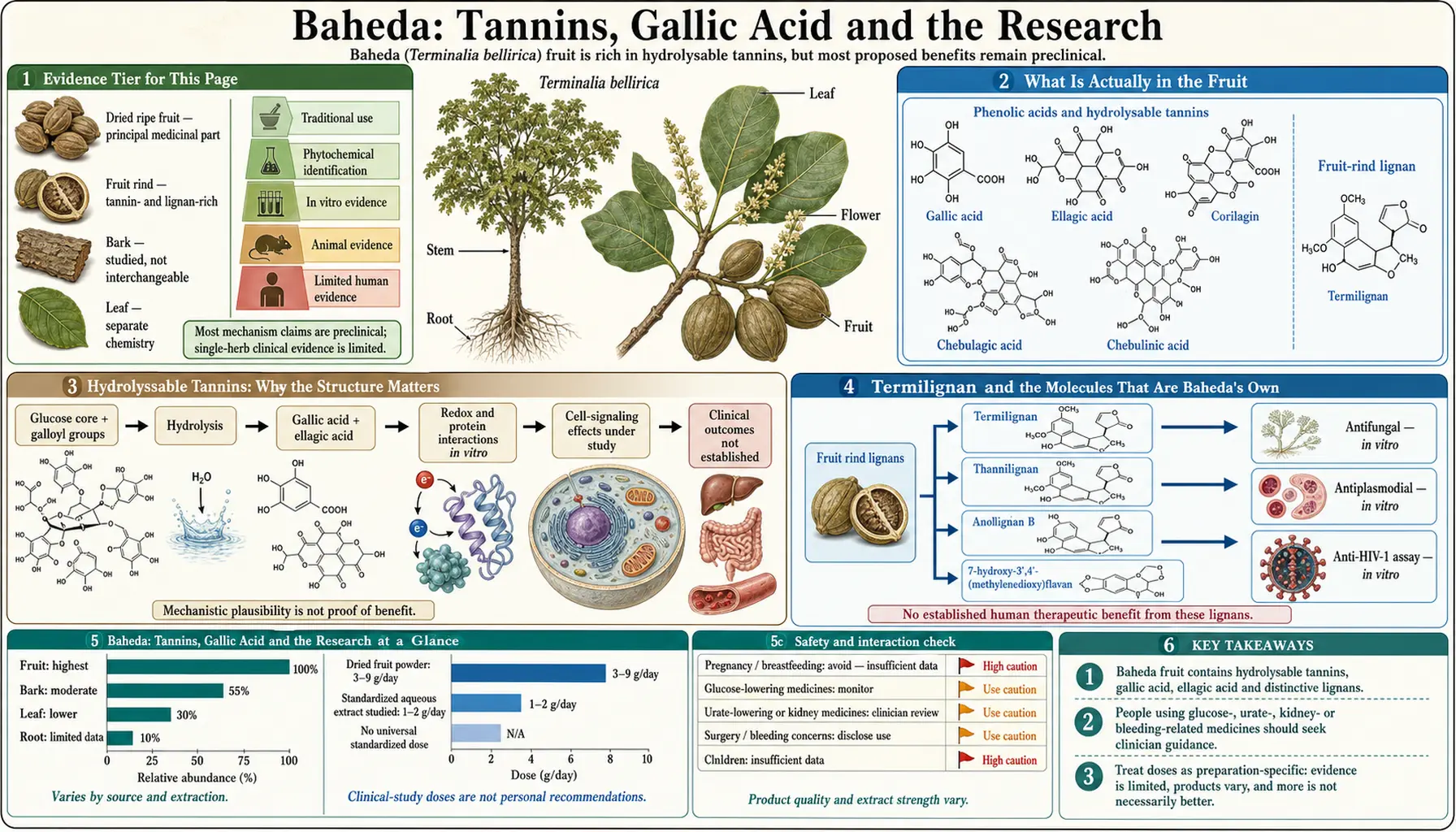
Baheda's laboratory literature is much larger than its clinical literature, and it is where nearly every claim you will read about the fruit originates — antioxidant, antimicrobial, hepatoprotective, glucose-lowering, anticancer. This page goes through it and does two things at each step: names the species, the plant part, the preparation and the subject that the study actually used, and says what the result can and cannot support.
Those four details are not pedantry in this genus. Terminalia is large, several of its species are medicinal, and T. arjuna (a cardiovascular bark) and T. catappa (a leaf) carry substantial literatures of their own that are routinely absorbed into writing about baheda. Add the two competing spellings, bellirica and bellerica, and it becomes easy to build a paragraph of impressive-sounding pharmacology in which not one study used this fruit.
Table of Contents
- Evidence Tier for This Page
- What Is Actually in the Fruit
- Hydrolysable Tannins: Why the Structure Matters
- Termilignan and the Molecules That Are Baheda's Own
- The Numbers This Page Refuses to Print
- The Antioxidant Scores, and Why They Mislead
- What Actually Reaches the Blood
- Antimicrobial Work, and the Arithmetic
- Liver Studies: Model, Species, Preparation
- Glucose-Lowering Animal Data
- Heart, Wounds and Cancer Cell Lines
- Why Two Batches Differ
- What Would Move Any of This Up a Tier
- Key Research Papers
- Connections
Evidence Tier for This Page
- Analytical chemistry — the compound identifications and the side-by-side comparisons with the other Triphala fruits. The most solid material in this topic, and it describes composition rather than effect.
- Preliminary (in vitro) — antioxidant assays, antimicrobial screens, enzyme-inhibition work, cancer cell lines. Informative about mechanism, silent about outcome.
- Preliminary (animal) — the liver, glucose, cardiac and wound-healing studies. One step closer, still not a clinical claim.
- Absent — there is no published human pharmacokinetic study of baheda. Nobody has measured what appears in blood after a dose. This single gap is what keeps every in-vitro potency figure on this page disconnected from any person.
- Caution — the same chemistry that produces the astringency and most of the laboratory activity is the chemistry that binds iron and interferes with drug absorption. See the safety article.
What Is Actually in the Fruit
The medicinal article is the dried fruit pulp — the pericarp, with the stone removed. Its chemistry is dominated by hydrolysable tannins: large molecules built on a sugar core studded with gallic acid units, or with the larger hexahydroxydiphenoyl units that release ellagic acid.
- Gallic acid — abundant, both free and bound into larger tannins. The single galloyl unit that drives the astringency, most of the antioxidant assay performance, and the iron interaction. Also the compound most often isolated and tested on its own in baheda studies, which is worth noticing: a result obtained with purified gallic acid is a result about gallic acid, and gallic acid is in tea, oak, sumac, witch hazel and a great many other plants.
- Ellagic acid — released when ellagitannins are hydrolysed. One of the most studied plant polyphenols, and again not specific to this fruit. See ellagic acid.
- Chebulagic acid and its relatives — shared with haritaki, and one reason the two Terminalia fruits behave similarly in laboratory assays. Shared chemistry is also what makes the congener swap described in the attribution article so easy to miss.
- Gallotannins and ellagitannins generally, including belleric acid derivatives.
- Termilignan, thannilignan and anolignan B — lignans reported from the fruit. These are the constituents most specific to this species and also the least studied.
- Bellericanin — a glycoside named for the species, frequently listed in reviews, with thin modern characterisation. Treat any claim built on it as preliminary in the strongest sense: the molecule is barely described.
- β-Sitosterol and a range of simple phenolics, plus the ordinary fruit constituents — sugars, fibre, minerals.
The best analytical reference for this fruit remains Pfundstein and colleagues in Phytochemistry in 2010, which characterised and quantified the polyphenols of T. bellerica, T. chebula and T. horrida fruits and measured their antioxidant capacities side by side under identical conditions. Internal comparisons of that kind are worth far more than three separate papers, because assay conditions vary enough between laboratories to swamp real differences between plants. Hegde and colleagues did the same job at metabolome scale in Scientific Reports in 2024 for the three Triphala fruits.
Hydrolysable Tannins: Why the Structure Matters
Tannins come in two structurally distinct families, and lumping them together is one of the commonest errors in health writing about polyphenols.
- Condensed tannins (proanthocyanidins) — chains of flavan-3-ol units. These are the tannins of cocoa, apples, grape seed and many berries.
- Hydrolysable tannins — a sugar core esterified with gallic acid or hexahydroxydiphenic acid units. These are the tannins of oak galls, sumac, pomegranate rind, and the Terminalia fruits. They are called hydrolysable because acid, alkali or enzymes cleave them back into their sugar and their phenolic acids.
Baheda is squarely in the second family, and that has one consequence which matters more than any other fact on this page. Brune, Rossander and Hallberg established in the European Journal of Clinical Nutrition in 1989 that inhibition of non-haem iron absorption in humans tracks the number of galloyl groups on the molecule, and that condensed tannins do not interfere much. It is specifically the galloyl-rich hydrolysable tannins that block iron. Human absorption study.
So the structural class that defines baheda chemically is the same structural class that defines its principal documented interaction in people. It is worth pausing on the asymmetry: the best-established human pharmacology of this fruit describes a harm, not a benefit. That is not a rhetorical flourish; it is what the literature contains.
A second consequence is size. Hydrolysable tannins are large molecules — well above the range that crosses the intestinal wall intact in any quantity. Whatever they do, they mostly do it on surfaces and in the gut lumen: precipitating protein on a mucous membrane, binding metal ions and drug molecules in a meal, inhibiting digestive enzymes at the brush border. The systemic story is a different and much weaker one, covered below.
Termilignan and the Molecules That Are Baheda's Own
Most of baheda's chemistry is shared with other tannin-rich plants. The lignans are the exception, and they are the reason a chemist would call this fruit distinctive rather than generic.
Termilignan, thannilignan and anolignan B were isolated from Terminalia bellerica fruit and reported to show antifungal, antimalarial and anti-HIV-1 activity in vitro, in the Journal of Natural Products in the 1990s. Species: T. bellerica. Part: fruit. Preparation: isolated pure compounds from a solvent extract. Subject: cell-free and cell-culture assays. Preliminary (in vitro).
How to read that, honestly and in both directions:
- It is genuinely interesting chemistry. Novel lignans with activity across three unrelated pathogen classes is the sort of finding that justifies further work, and it is the strongest reason to think baheda is not merely a generic tannin source.
- It is thirty years old and has gone almost nowhere. There is no development literature, no animal efficacy work of consequence, no pharmacokinetics. An in-vitro antiviral hit that is not followed up for three decades is usually a hit that did not survive follow-up, though absence of publication is weak evidence either way.
- Isolated pure compounds are not the fruit. The lignans are minor constituents of a preparation dominated by tannins. Nothing establishes that a meaningful quantity of any of them is present in a spoonful of powder, let alone absorbed.
- It licenses no clinical claim at all. Baheda is not an antiviral, an antifungal or an antimalarial. In particular, an in-vitro anti-HIV-1 result from the 1990s must never be read as bearing on HIV treatment, where effective drugs exist and interruption is dangerous.
The honest summary: these molecules are why baheda deserves more research attention than it gets, and they support no consumer claim whatsoever.
The Numbers This Page Refuses to Print
Several figures would make this page look more authoritative and would be guesses. They are named here instead, so that their absence is visible.
- Total tannin content of the dried fruit as a percentage by weight. Published figures vary with grade, geographic origin, season, maturity at collection, drying conditions, storage time and assay method — and the assay method alone can shift a “total tannin” number substantially, because different methods measure different things. Any single percentage quoted for baheda is a number lifted from one sample set. This page does not print one.
- Gallic acid content per gram. Same problem, plus the extra difficulty that free and bound gallic acid are different measurements and are frequently reported without saying which was meant.
- A daily dose in grams for any indication except hyperuricaemia. There is no dose-finding study. The traditional ranges given on the main page are tradition, and are labelled as such.
- A minimum inhibitory concentration for any organism. Reported values for Terminalia extracts span orders of magnitude depending on extraction solvent, extract concentration method, assay format and inoculum. Quoting one would imply a precision the field does not have.
- Metadata for papers this page cannot verify. Where the journal, year or author list is not certain, the finding is described and a topic search is given instead of an assertion. Several entries in the research list below are written that way deliberately.
Refusing these makes the page shorter and more useful. A reader who wants a tannin percentage for a specific product should ask the supplier for a certificate of analysis naming the assay method — which is a better answer than a number from a review.
The Antioxidant Scores, and Why They Mislead
Baheda performs spectacularly in laboratory antioxidant assays. Extracts routinely score at the top of comparison tables, and that fact is the single most quoted thing about the fruit.
The reason is boring chemistry, not biological virtue. Assays such as DPPH, ABTS, FRAP and ORAC measure how readily a substance donates an electron or hydrogen atom to a coloured radical in a cuvette. Galloyl groups do that superbly. A molecule carrying many of them will produce a very large number. So will purified gallic acid; so will oak-gall extract; so will strong tea.
Three reasons the number does not transfer to a person:
- Absorption. The molecules doing the scavenging in the tube are large hydrolysable tannins that are poorly absorbed intact. What circulates after an oral dose is mostly small metabolites produced by gut bacteria and by liver conjugation — different molecules with different chemistry.
- Concentration. Assay concentrations are typically far above anything achievable in plasma from an ordinary dose. This is the same gap that undermines in-vitro antimicrobial claims, worked through arithmetically below.
- Physiology. The body's antioxidant defences are enzymatic and regulated — superoxide dismutase, catalase, glutathione peroxidase, the Nrf2 response. A dietary electron donor does not simply add to them, and in some contexts polyphenols act as mild pro-oxidants, which is one proposed route by which they trigger protective adaptive responses. “More antioxidant capacity is better” is not established biology.
The useful reading of a high antioxidant score is as a proxy for tannin content. It tells you the fruit is polyphenol-dense. That is worth knowing — it predicts the astringency and it predicts the iron interaction. It is not a health claim.
What Actually Reaches the Blood
This section exists because it is the missing keystone of the entire preclinical literature, and its absence should be stated as a result.
There is no published human pharmacokinetic study of baheda. No measured plasma concentration–time curve for gallic acid, ellagic acid, chebulagic acid or any tannin after an oral dose of the fruit. No bioavailability figure. No elimination half-life. Nothing.
What is known from the wider polyphenol literature, and is likely to apply:
- Large hydrolysable tannins are poorly absorbed intact. Most are hydrolysed or metabolised by gut microbiota rather than crossing the intestinal wall.
- Free gallic acid is absorbed but is rapidly conjugated — methylated, glucuronidated, sulfated — so what circulates is chiefly conjugates rather than the parent compound, and the conjugates are less chemically reactive.
- Ellagitannins yield ellagic acid, which is poorly absorbed and is converted by gut bacteria to urolithins, with large between-person differences depending on the individual's microbiota. Two people taking the same dose can have quite different circulating metabolite profiles.
- Consequence: the luminal and contact effects — astringency in the throat, protein and metal binding in the gut, digestive-enzyme inhibition at the brush border — are the ones most likely to be real at achievable doses. Systemic claims require the compound to arrive, and the arrival has never been measured.
This is the same conclusion reached for haritaki: what survives digestion best is also what causes the iron problem, and the benefit that survives best is the contact one. The finding is not flattering to a capsule.
Antimicrobial Work, and the Arithmetic
Antimicrobial screens are the most abundant preclinical papers on baheda, and the least useful as written. Doing the arithmetic explains why better than any hedge.
A worked illustration, with the assumptions printed so they can be checked. These are round numbers chosen to be generous to the herb, not values taken from any particular paper:
- Suppose an extract inhibits a bacterium at 1 mg/mL in broth. For a crude plant extract that is a good result — many reported values are higher.
- Total body water in a 70 kg adult is roughly 42 litres.
- To reach 1 mg/mL throughout that volume requires 42 grams of extract — and an extract is concentrated from severalfold its weight of dried fruit, so the fruit equivalent is larger still. Traditional daily doses are in the region of a few grams of powder.
- That calculation assumes 100% absorption, no metabolism, no protein binding and instantaneous even distribution. In reality the tannins are poorly absorbed, gallic acid is rapidly conjugated, and plasma protein binding removes more from the free fraction. Each of those pushes the required dose up, most of them by a large factor.
- Broth is also not tissue. Serum protein, competing ligands, pH and the presence of iron all reduce the effective free concentration of a metal- and protein-binding polyphenol.
The gap is not a factor of two. It is several orders of magnitude. That is why an in-vitro inhibition result should never be read as “baheda kills bacteria in the body”. Where such chemistry could plausibly matter is at surfaces reached directly: the mouth, the throat, the gut lumen, or a topical application — which is precisely where the traditional uses sit, and is a genuine point of coherence between tradition and chemistry.
One further caution specific to this fruit. Tannins produce apparent activity in some assay formats through non-specific protein binding rather than any targeted antimicrobial mechanism. A tannin-rich extract inhibiting an enzyme in a tube is a result that requires controls to interpret, and those controls are not always present.
Liver Studies: Model, Species, Preparation
Hepatoprotection is one of baheda's frequently repeated claims. The underlying work is animal work, and the model matters.
Rodent studies have reported protective effects of T. bellerica extracts, and of purified gallic acid, against chemically induced liver damage — carbon tetrachloride being the classic inducer. Species: T. bellerica. Part: fruit. Preparation: solvent extracts, and in some studies isolated gallic acid rather than the fruit. Subject: rats. Preliminary (animal).
Four things to keep in view:
- Carbon tetrachloride hepatotoxicity is a free-radical-driven model, and it is unusually easy for any potent antioxidant to blunt. A positive result in that model is close to a restatement of the antioxidant assay rather than an independent finding, and it does not predict benefit in fatty liver disease, viral hepatitis, alcohol-related liver disease or drug-induced injury in people — which have different mechanisms.
- Where the active agent tested was purified gallic acid, the result is a gallic acid result. Gallic acid is widespread in the plant kingdom, and attributing it to baheda specifically is a compound substitution of exactly the kind this Benefits leg is written to flag.
- Work on Triphala preparations for fatty liver disease is formula work. A 2024 study reported preventive mechanisms of a Tibetan Triphala preparation against non-alcoholic fatty liver disease in an animal and mechanistic investigation. Preliminary; formula, not baheda alone.
- There is no human liver-outcome trial of baheda. None. And a tannin-rich herb is not a benign thing to take when the liver is already the organ in question — herbal and dietary supplements are a recognised cause of drug-induced liver injury as a category, which is a reason for caution rather than confidence.
Glucose-Lowering Animal Data
Coherent, entirely preclinical, and the source of one of the few genuinely actionable safety points on these pages.
- Enzyme inhibition in vitro. Das and colleagues reported in the Journal of Food Science and Technology in 2022 that low-glycaemic foods formulated with wheat, barley and all three Triphala herbs inhibited α-amylase, α-glucosidase and DPP-IV and lowered glucose in diabetic rats. Species: all three fruits together. Preparation: formulated food. Subject: high-fat, low-dose streptozotocin diabetic rats. Preliminary (animal); formula, not baheda alone.
- Gallic acid in diabetic rodents. Rodent work has reported insulin-secretagogue and lipid-lowering effects for gallic acid isolated from T. bellerica in streptozotocin-induced diabetic rats. Again: an isolated-compound result, in a chemically induced diabetes model. Preliminary (animal).
- Mechanistic plausibility is real. Brush-border carbohydrase inhibition by tannins does not require absorption — it happens in the lumen, where these molecules are — so of all the systemic-sounding claims, this is the one with the least awkward pharmacokinetics.
The safety consequence, which is the part that matters: this is not enough evidence to say baheda treats anything, but it is enough to assume it might add to a glucose-lowering drug until shown otherwise. Anyone on insulin, a sulfonylurea (gliclazide, glipizide, glimepiride) or a meglitinide should treat that as a real possibility, monitor more closely for the first few weeks, and be alert before driving. The safety article covers this and the parallel case for haritaki is worked through on that page.
Note also the human counterweight, since it is rarely quoted: the best-designed human trial of a Triphala-containing preparation for a metabolic endpoint — Donato and colleagues in Complementary Medicine Research in 2021, 90 people, three months, placebo-controlled — was negative on total and LDL cholesterol, BMI and waist circumference, with a hypersensitivity rash in a small proportion of the treated group. Randomized clinical trial, formula. When the laboratory story is strong and the one good human trial is negative, the honest summary is that the mechanism does not translate at the doses used.
Heart, Wounds and Cancer Cell Lines
- Cardiac. Chaudhary and colleagues investigated a protective effect of Terminalia bellirica against drug-induced cardiotoxicity in Wistar albino rats, published in the Journal of Ethnopharmacology in 2020. Species: T. bellirica. Subject: rats. Preliminary (animal). Note the specific trap here: Terminalia arjuna is the Terminalia with a cardiovascular reputation and a clinical literature, from bark rather than fruit. A cardiac claim for baheda that turns out to rest on arjuna work is a species, part and organ-system substitution at once, and it is the most consequential misattribution available in this genus.
- Wound healing. Singh and colleagues reported wound-healing activity for T. bellerica and gallic acid in experimentally induced diabetic animals, in the Journal of Complementary and Integrative Medicine. Species: T. bellerica, plus isolated gallic acid. Subject: diabetic rodents. Route: topical and oral in different arms of this literature, which matters because a topical result does not support an oral product. Preliminary (animal).
- Cancer cell lines. Pinmai and colleagues reported in the World Journal of Gastroenterology in 2008 that Phyllanthus emblica and Terminalia bellerica extracts had synergistic growth-inhibitory effects with doxorubicin and cisplatin against human hepatocellular carcinoma and lung cancer cell lines. Subject: cell culture only. Preliminary (in vitro). This paper is sometimes cited as a reason to take baheda alongside chemotherapy. It is not one, and there are positive reasons not to: tannin-rich extracts interfere with drug absorption, no interaction study with any cytotoxic regimen exists, and the consequence of under-dosing chemotherapy is severe. Anyone in cancer treatment should clear every supplement with their oncology team.
- Antioxidant, anti-inflammatory and enzyme-inhibition screens more broadly — numerous, repetitive, and adding little beyond confirming the fruit is polyphenol-dense.
Why Two Batches Differ
A practical section, and one that follows from botany rather than from commerce.
Baheda is almost entirely wild-collected. The supply comes from forest trees across India, Nepal, Sri Lanka, Bangladesh, Myanmar and Southeast Asia, gathered by hand, dried in variable conditions, sold on to village traders, aggregated at regional markets and graded afterwards. Umesh Kanna and colleagues published a genetic diversity and population-structure analysis of Indian T. bellerica in Plants in 2024 — work undertaken partly to inform conservation and cultivation, and incidentally a demonstration that the species varies substantially between populations.
Sources of batch-to-batch variation, roughly in order of likely impact:
- Maturity at collection. As with haritaki, immature and fully ripe fruit are traditionally held to differ in action, not merely in strength.
- Preparation. Raw versus roasted or grilled. The rodent antidiarrhoeal work suggests this may change the direction of effect, not just its size — the single most under-labelled variable on the shelf.
- Provenance and population genetics. Wild material from different forests is different material.
- Drying and storage. Polyphenols oxidise; ground powder degrades faster than whole fruit. Buy small quantities.
- Extraction, for extract products. Water, ethanol and methanol pull different fractions. The hyperuricaemia trials used a specific standardised aqueous extract, and a hydroalcoholic extract of the same fruit is not the same intervention.
- Part purity. Whether the stone was properly removed. This is a safety question, not a potency one — see the kernel warning on the main page.
The consequence is that “one gram of baheda” is not a defined exposure. That is the honest reason no dose figure on this site is presented as authoritative.
What Would Move Any of This Up a Tier
Naming the missing experiments is more useful than repeating that evidence is lacking, and none of these is exotic. Four would change the picture, in order of value per pound spent:
- A human pharmacokinetic study. Single oral dose of a defined preparation, serial plasma sampling, measurement of gallic acid and its conjugates, ellagic acid, urolithins and the major tannins. This one study would either connect or disconnect the whole in-vitro literature from human physiology, and it is the cheapest high-value experiment available.
- A human iron-absorption study with baheda specifically, of the type already done for tea and for isolated tannic acid. It would convert a well-reasoned prediction into a measurement, and it would be straightforward.
- A factorial dismantling of Triphala — formula versus each of the three fruits alone versus placebo, on a single outcome. The design is standard; nobody has run it. Independent replication of the hyperuricaemia trials belongs in the same programme.
- Characterisation of the seed kernel, so that a centuries-old toxicity report either becomes a documented hazard with a named compound or is retired. Follow-up on the lignans, unexplained since the 1990s, would be the obvious companion project.
Key Research Papers
Cited as PubMed topic searches with details in prose, so a link cannot silently point at the wrong record. Each entry names species, part, preparation and subject where these are known, and where metadata could not be verified the finding is described rather than attributed.
- Pfundstein and colleagues, Phytochemistry, 2010 — polyphenolic compounds in the fruits of Terminalia bellerica, Terminalia chebula and Terminalia horrida: characterisation, quantitation and antioxidant capacities. Three species measured side by side under identical conditions, which is what makes it the reference. Analytical chemistry. Find on PubMed
- Hegde and colleagues, Scientific Reports, 2024 — comprehensive metabolome profiling of Terminalia chebula, Terminalia bellerica and Phyllanthus emblica to explore Triphala's medicinal potential. The groundwork for assigning any formula effect to a fruit. Analytical chemistry. Find on PubMed
- Brune, Rossander and Hallberg, European Journal of Clinical Nutrition, 1989 — iron absorption and phenolic compounds, establishing that galloyl group number drives the inhibition and that condensed tannins behave differently. The mechanistic anchor for treating baheda's tannin class as consequential. Human absorption study. Find on PubMed
- Lignans from Terminalia bellerica — termilignan, thannilignan and anolignan B, isolated from the fruit and reported to show antifungal, antimalarial and anti-HIV-1 activity in vitro in the Journal of Natural Products in the 1990s. Isolated pure compounds, cell-free and cell-culture assays; author details not verified here, so the finding is described rather than attributed. Preliminary (in vitro). Topic search
- Pandey and colleagues, Journal of Ethnopharmacology, 2017 — grilling enhances the antidiarrhoeal activity of Terminalia bellerica fruits. Raw versus grilled whole fruit, rodent model. The reason preparation is treated as a variable throughout these pages. Preliminary (rodent). Find on PubMed
- Chaudhary and colleagues, Journal of Ethnopharmacology, 2020 — investigation of a protective effect of Terminalia bellirica against drug-induced cardiotoxicity in Wistar albino rats. Read alongside the warning that T. arjuna, not baheda, is the cardiovascular Terminalia. Preliminary (rodent). Find on PubMed
- Singh, Gupta and Sisodia, Journal of Complementary and Integrative Medicine — wound-healing activity of Terminalia bellerica and gallic acid in experimentally induced diabetic animals. Note that where gallic acid was the agent, the result belongs to gallic acid rather than to this fruit. Preliminary (rodent). Find on PubMed
- Pinmai and colleagues, World Journal of Gastroenterology, 2008 — synergistic growth-inhibitory effects of Phyllanthus emblica and Terminalia bellerica extracts with doxorubicin and cisplatin against human hepatocellular carcinoma and lung cancer cells. Cell culture only, and not a reason to combine anything with chemotherapy. Preliminary (in vitro). Find on PubMed
- Das and colleagues, Journal of Food Science and Technology, 2022 — low-glycaemic foods formulated with wheat, barley and the three Triphala herbs inhibited α-amylase, α-glucosidase and DPP-IV and lowered glucose in diabetic rats. All three fruits together, in a formulated food. Preliminary (rodent); formula, not baheda alone. Find on PubMed
- Gallic acid isolated from Terminalia bellerica in streptozotocin-induced diabetic rats — insulin-secretagogue and lipid-lowering effects reported in rodent work. An isolated-compound result in a chemically induced model; described rather than attributed because the metadata is not verified here. Preliminary (animal). Topic search
- Hepatoprotective studies of Terminalia bellerica extracts and of gallic acid against carbon tetrachloride-induced liver damage in rats. A free-radical-driven model that any potent antioxidant can blunt, and not a prediction about human liver disease. Described rather than attributed. Preliminary (animal). Topic search
- Donato and colleagues, Complementary Medicine Research, 2021 — guggul and Triphala for hypercholesterolaemia, placebo-controlled and double-blind, negative on the primary outcomes. The human counterweight to the metabolic laboratory story. Randomized clinical trial, formula. Find on PubMed
- Umesh Kanna and colleagues, Plants, 2024 — genetic diversity and population structure of Terminalia bellerica in India. The botanical basis for saying that wild-collected material varies. Botany and genetics. Find on PubMed
- Bioavailability and metabolism of hydrolysable tannins, ellagitannins and gallic acid in humans, including urolithin production by gut microbiota — why an in-vitro potency figure for this fruit cannot be carried across to a person. Human pharmacokinetics, other sources. Topic search
- Antimicrobial screening of Terminalia bellirica extracts — the accumulated in-vitro literature, worth reading with the arithmetic above in hand, and with attention to whether tannin protein-binding controls were included. Preliminary (in vitro). Topic search
Connections
- All Herbs
- Baheda (Terminalia bellirica) — the main topic page, including the compound list and the uric-acid trials.
- Baheda — Benefits Deep Dive — the hub for these four articles.
- Baheda, Triphala and the Attribution Problem — the species and formula substitutions this page labels study by study.
- Baheda for Respiratory and Other Traditional Uses — where the contact mechanism actually applies.
- Baheda Safety: Iron, Dose and Unknowns — the same tannin chemistry read as a hazard.
- Ellagic Acid — one of baheda's two headline phenolic acids, and not remotely specific to it.
- Antioxidants — why laboratory antioxidant scores are a poor guide to anything.
- Haritaki for Metabolic and Cholesterol Health — the same enzyme-inhibition story and the same negative human trial, on the congener.
- Haritaki — Benefits Deep Dive — the evidence map for the better-studied fruit.
- Amla — Vitamin C and Antioxidant Chemistry — the third Triphala fruit's quite different chemistry.
- Chanca Piedra — Lignans and Tannins — another herb where lignans and tannins are argued about together.
- Agrimony — Diarrhoea, Astringency and Tannins — the astringent mechanism worked through on a European herb.
- Iron — the mineral this chemistry binds.
Safety and disclaimer. This article is health information, not medical advice. Every pharmacological finding described here is from cells, animals or a multi-herb formula; none of it establishes that baheda treats any condition in people, and no dose is recommended. There is no published human pharmacokinetic study of this fruit, so laboratory potency figures cannot be carried across to a person. Do not take baheda alongside chemotherapy, and do not use it in place of prescribed treatment for diabetes, liver disease, heart disease or infection. Assume it may add to glucose-lowering drugs. Avoid it in pregnancy and breastfeeding, and in children. Use the fruit pulp, not the seed kernel, and separate it from iron-containing meals, mineral supplements and all medicines by at least two hours.