Black Walnut Sources & Safety — Hull, Nut, and Juglone Cautions
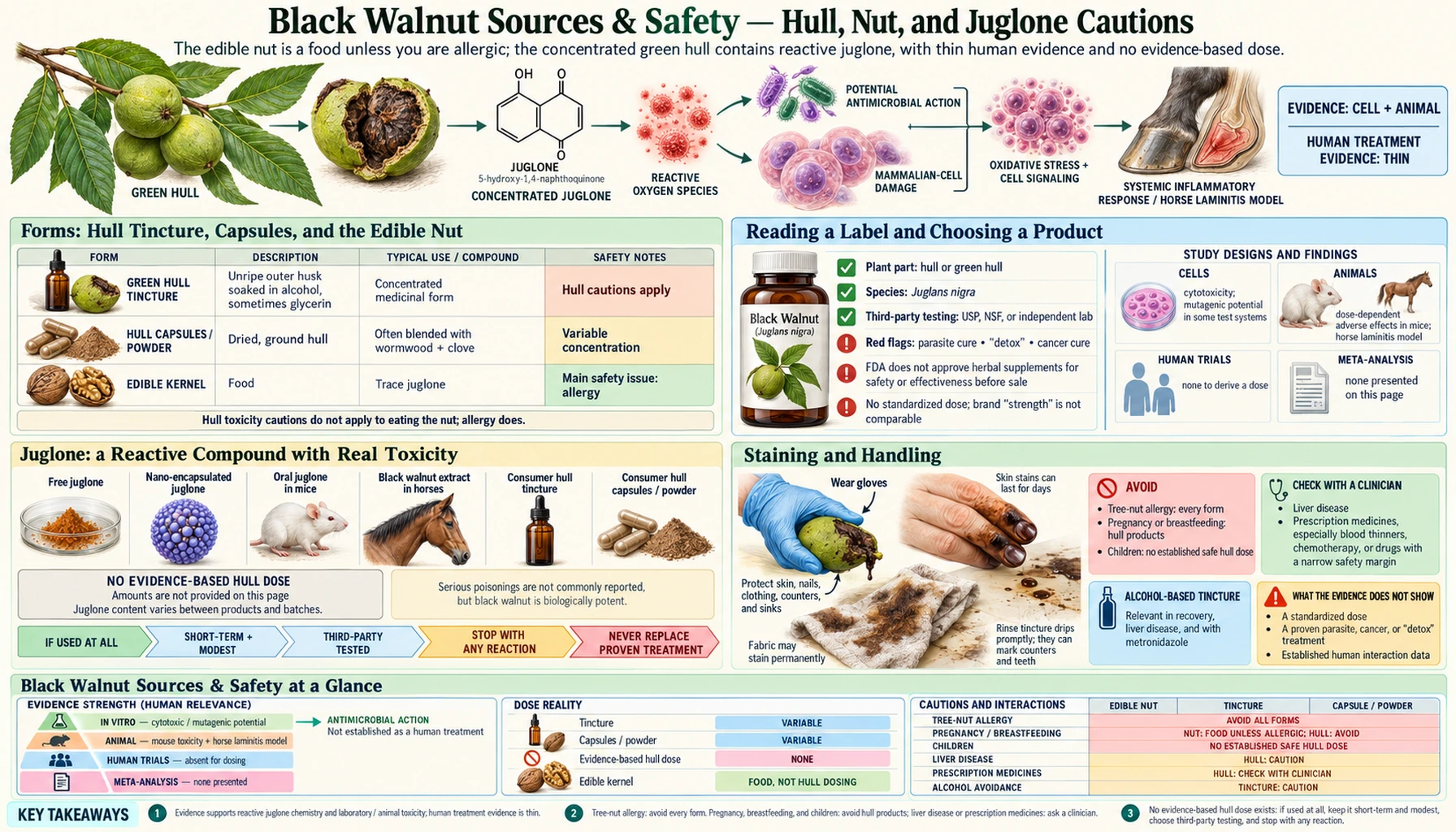
Black walnut (Juglans nigra) reaches people in two very different forms: the edible kernel, a food whose documented hazard is tree-nut allergy, and the green hull, sold as tinctures and capsules and concentrated in the reactive compound juglone. This page sets out what is known about each — how the products differ, what juglone does in cells and animals, what the best-known toxicity finding (laminitis in horses) actually involved, the allergy and cross-reactivity data, what is and is not known for pregnancy and children, and where the popular "parasite cleanse" claim stands. No human trial has established a dose of the hull, so much of the evidence concerns what has not been studied.
Table of Contents
- Forms: Hull Tincture, Capsules, and the Edible Nut
- Labels, Regulation, and Product Variation
- Juglone: What the Toxicity Data Show
- Staining and Skin Contact
- Tree-Nut Allergy and Cross-Reactivity
- Pregnancy, Breastfeeding, and Children
- Interactions and Who the Research Raises Concerns For
- Dosing Reality and Quality Concerns
- The Parasite-Cleanse Claim
- Where the Evidence Stands
- Key Research Papers
- Connections
- Featured Videos
Forms: Hull Tincture, Capsules, and the Edible Nut
Three kinds of product carry the "black walnut" name:
- Green hull tincture — the classic herbal preparation: the unripe outer husk extracted in alcohol, sometimes with glycerin. It is the most concentrated of the hull products and the main subject of this page.
- Hull capsules / powder — dried, ground hull in capsules, often blended with wormwood and clove in "cleanse" kits (see The Parasite-Cleanse Claim). The chemistry is that of the hull; the concentration varies.
- The edible kernel — the food, covered on the Nutrition page. USDA FoodData Central lists "Nuts, walnuts, black, dried" (FDC ID 170186) at 619 kcal, 24.06 g protein, 59.33 g fat and 6.8 g fiber per 100 g, with 2.677 g of the plant omega-3 alpha-linolenic acid, 201 mg magnesium and 3.896 mg manganese; its English walnut entry (FDC ID 170187) lists 15.23 g protein per 100 g. The kernel's documented hazard is allergy.
The toxicity findings below concern hull products, juglone itself and the tree's wood — not the kernel eaten as food. The diagram sets the three parts side by side.
Labels, Regulation, and Product Variation
In the United States, dietary supplements are regulated differently from drugs. Under the Dietary Supplement Health and Education Act of 1994, the FDA states, the firms that make and distribute supplements are responsible for evaluating the safety and labeling of their products before marketing (FDA — Dietary Supplements, linked below). What that means for black walnut products:
- Plant part. Hull products state the plant part ("hull" or "green hull") and the species, Juglans nigra; the kernel, the leaves and the wood are different materials with different chemistry.
- Third-party testing. Independent testing programs check whether a product contains what its label states and screen for some contaminants; they do not test whether a product works.
- Claims. No study supports claims that a hull product cures parasites, "detoxes" the body or treats cancer (see The Parasite-Cleanse Claim).
- Strength. There is no standardized dose or juglone content, so "strength" figures on different labels are not comparable.
Juglone: What the Toxicity Data Show
Juglone (5-hydroxy-1,4-naphthoquinone) is a chemically reactive quinone. Almost all of its toxicity data come from cells, plants and animals; no human toxicity study of juglone or of black walnut hull was found for this page.
- Pro- and antioxidant activity. As a quinone, juglone can redox-cycle and generate reactive oxygen species; a review describes this pro-oxidant action as one way it kills cancer cells in laboratory studies, alongside antioxidant activity and effects on cell signaling (Ahmad 2019). In a plant-seedling study it acted as an antioxidant at low concentrations and as a pro-oxidant at higher ones, the pro-oxidant effect depending on its binding of iron (Chobot 2009).
- Cells and mutagenicity. Free juglone reduced the viability of cultured mouse fibroblasts in a dose- and time-dependent way and was mutagenic in one bacterial test strain (Salmonella TA98 with metabolic activation) (Erisen 2020).
- Mice. In a 2022 oral toxicity study in mice, single doses of 50, 300 and 2000 mg/kg damaged liver and kidney tissue at every dose. Repeated daily doses of 15 and 50 mg/kg reduced food intake and body weight, altered liver and kidney function and caused dose-dependent deaths, and the authors put the no-observed-adverse-effect level below 5 mg/kg/day (Gohil 2022).
- Horses (an animal finding, from the wood). Horses bedded on black walnut shavings commonly developed laminitis, a painful inflammatory condition of the hoof, and investigators established that only the tree's heartwood induced it (Belknap 2010). In a 1991 study, all 12 horses dosed by stomach tube with an aqueous black walnut extract developed laminitis within 8 to 12 hours, 4 of them severely (Galey 1991); a 1989 report described 10 horses at one stable that developed laminitis 8 to 12 hours after exposure to shavings, all of which recovered (Uhlinger 1989). The extract is now a standard research model of laminitis (Belknap 2010). Juglone itself was not shown to be the cause: given by mouth to ponies in amounts up to 1 g, it only inconsistently caused mild signs of laminitis, and applied to the skin of horses' feet it caused local irritation but no laminitis (True and Lowe 1980).
- Dogs. In 93 dogs reported to an animal poison control center after eating black walnut wood, nuts or hulls, vomiting was the most common sign after nuts or hulls, while neurologic or musculoskeletal signs were more common after wood (Coleman and Merola 2016).
- Allelopathy. Juglone is the compound credited with the black walnut tree's allelopathy — its suppression of plants growing nearby (Soderquist 1973).
No published case series of black walnut hull poisoning in people was found for this page. That reflects an absence of study as much as an absence of harm: no trial has measured the safety of hull products in people at any dose or for any length of time.
Staining and Skin Contact
Fresh black walnut hulls stain skin, nails, clothing, countertops and sinks a deep brown that is slow to fade from skin and may be permanent on fabric; the same chemistry made walnut husks a traditional dye. Case reports describe contact pigmentation and acute irritant contact dermatitis in two young children who played with the juice of green walnut husks (of the English walnut, Juglans regia); the authors describe juglone, the active ingredient of the green husk, as a strong irritant (Neri 2006). In horses, juglone applied to the skin caused local irritation (True and Lowe 1980). Gloves are the usual protection when fresh hulls or concentrated tincture are handled, and tincture drips mark counters and teeth.
Tree-Nut Allergy and Cross-Reactivity
Walnut is one of the major tree-nut allergens. A 2018 review puts tree-nut allergy at about 1% of the U.S. population and notes that it is outgrown in fewer than 10% of cases (Smeekens 2018). Reactions can include anaphylaxis, a rapid, potentially life-threatening reaction. Among children seen for anaphylaxis at five Canadian emergency departments between 2011 and 2020, tree nuts caused 540 of 3096 cases (17%), and walnut accounted for 11.5% of the tree-nut cases, after cashew (32.8%) and hazelnut (20.0%) (Ducharme 2022).
- Black walnut and English walnut. IgE from people who had had life-threatening reactions to English walnut bound proteins from every walnut cultivar and species tested, and the major English walnut allergens cross-reacted with black walnut (J. nigra) extract. The authors conclude that people with severe English walnut allergy are likely to be clinically allergic to closely related Juglans species (Comstock 2004).
- Black walnut's own allergens. An 11S globulin purified from black walnut, Jug n 4, was recognized by IgE in 32% of sera from 25 people whose walnut allergy had been confirmed by double-blind, placebo-controlled food challenge (Zhang 2017).
- Other tree nuts. In a European study of 122 children with at least one nut or sesame allergy who underwent food challenges to the others, 60.7% had a coexistent peanut, tree-nut or sesame allergy, with strong correlations between walnut and pecan (Brough 2020); a review describes walnut and pecan as highly cross-reactive (Smeekens 2018).
- Hull products. No study measuring walnut allergen proteins in hull tinctures or capsules was found. Cleanse blends can also combine walnut with other plant ingredients.
- Guideline. The 2017 British Society for Allergy and Clinical Immunology guideline describes nut allergy as likely to be long-lived and names avoidance advice, patient-specific emergency medication and an emergency treatment plan as the core of management (Stiefel 2017).
- Signs of anaphylaxis can include hives, swelling of the lips, tongue or throat, wheezing or difficulty breathing, vomiting, and dizziness or collapse.
Pregnancy, Breastfeeding, and Children
Pregnancy and breastfeeding. No study of juglone or black walnut hull in pregnancy or breastfeeding was found for this page, so there are no safety data in either direction. Hull products are often combined with wormwood, whose essential oil contains thujone, a compound that can cause seizures at high doses (see the Wormwood page), and with clove. The European Medicines Agency's clove-oil monograph states that safety during pregnancy and lactation has not been established and, in the absence of sufficient data, does not recommend its clove-oil preparations then. The edible kernel is an ordinary food; the allergy data above apply to it.
Children. No dose of hull products has been established for children. For clove, the usual partner herb, the EMA monograph records life-threatening conditions after 5–10 mL of clove oil was taken by mouth by children under 2 years of age. Approved drug treatment of pinworm, a common childhood worm infection, is covered on the Pinworm page.
Interactions and Who the Research Raises Concerns For
- Alcohol-based tinctures contain alcohol, which matters for people in recovery, people with liver disease, and people taking medicines whose labeling warns against alcohol, such as metronidazole.
- Liver and kidney. Juglone damaged liver and kidney tissue in mice (Gohil 2022). No human data exist, which leaves people with liver or kidney disease without safety information.
- Medicines. No human interaction study of black walnut hull or juglone was found, including for blood thinners, chemotherapy and drugs with a narrow safety margin.
- Tree-nut allergy. The cross-reactivity data above apply to every form that contains walnut protein.
Decisions about supplements and medicines belong with a clinician or pharmacist.
Dosing Reality and Quality Concerns
There is no evidence-based dose of black walnut hull, because there is no human trial from which one could be derived. Traditional herbal texts and product labels give figures — a number of tincture drops or capsules — but these are conventions, not doses tested for safety or effect. Products are not standardized for juglone, so the amount of juglone in a labeled dose is not known.
The 2022 mouse study above is the nearest thing to a dose-response safety study; its authors present their benchmark doses as a basis for setting a human reference dose for juglone, which has not yet been done (Gohil 2022).
The Parasite-Cleanse Claim
Black walnut hull is best known today as one part of a three-herb "parasite cleanse". The combination was popularized by Hulda Regehr Clark in her books The Cure for All Cancers (1993) and The Cure for All Diseases (1995), in which she described a regimen of green black walnut hull tincture, wormwood and cloves and attributed cancer and many other illnesses to parasites. These are her claims. No controlled trial of the combination was found.
- Black walnut and juglone. PubMed searches for Juglans nigra or juglone together with parasites, worms or anthelmintic activity return laboratory and animal studies, many of them on the English walnut; no controlled human trial of black walnut hull or juglone against any human parasite was found. That laboratory and animal work is reviewed on the Antiparasitic — Traditional Use page.
- Wormwood. The plant in the cleanse is common wormwood (Artemisia absinthium), a different plant from sweet wormwood (Artemisia annua), the source of the antimalarial drug artemisinin. Its antiparasitic evidence is covered on the Wormwood: Parasites and Antimicrobial page.
- Clove. The EMA clove-oil monograph covers only traditional use for toothache and minor inflammation of the mouth or throat, based on long-standing use; it lists no antiparasitic use, and it records life-threatening poisoning in small children (see above).
Parasitic infections are diagnosed by testing and treated with approved antiparasitic drugs that have been studied in trials; the organisms and their treatments are covered in the Parasites section.
Where the Evidence Stands
- Diagnosed infections — parasitic, fungal or bacterial: approved drugs exist and have trial evidence; black walnut hull has none in people.
- Symptoms such as blood in the stool, unexplained weight loss, persistent fever, severe abdominal pain, or a spreading or non-healing skin infection have many causes, which are identified by medical examination and testing, not by a cleanse.
- Pregnancy, breastfeeding and childhood: no safety data for hull products.
- Tree-nut allergy: cross-reactivity extends across walnut species.
- Narrow-margin medicines and liver disease: no interaction or safety data.
Black walnut hull is an old folk remedy with reactive chemistry, laboratory and animal data, and no controlled human evidence for any use. Its best-known toxicity finding, laminitis in horses, comes from the tree's heartwood. The kernel is a nutritious food whose documented hazard is allergy.
Key Research Papers
- Gohil D et al. (2022). Acute and sub-acute oral toxicity assessment of 5-hydroxy-1,4-naphthoquinone (juglone) in mice. Drug and Chemical Toxicology — PubMed PMID: 35899689
- Ahmad T, Suzuki YJ (2019). Juglone in Oxidative Stress and Cell Signaling. Antioxidants — PubMed PMID: 30959841
- Chobot V, Hadacek F (2009). Milieu-dependent pro- and antioxidant activity of juglone may explain linear and nonlinear effects on seedling development. Journal of Chemical Ecology — PubMed PMID: 19263168
- Erisen S et al. (2020). Cytotoxic and mutagenic potential of juglone: a comparison of free and nano-encapsulated form. Arhiv za Higijenu Rada i Toksikologiju — PubMed PMID: 32597139
- Belknap JK (2010). Black walnut extract: an inflammatory model. Veterinary Clinics of North America: Equine Practice — PubMed PMID: 20381738
- Weber RW (2003). Black walnut. Annals of Allergy, Asthma & Immunology — PubMed PMID: 14533650
- Ducharme L et al. (2022). Tree nut-induced anaphylaxis in Canadian emergency departments: Rate, clinical characteristics, and management. Annals of Allergy, Asthma & Immunology — PubMed PMID: 35718284
- Stiefel G et al. (2017). BSACI guideline for the diagnosis and management of peanut and tree nut allergy. Clinical and Experimental Allergy — PubMed PMID: 28836701
- Soderquist CJ (1973). Juglone and allelopathy. Journal of Chemical Education — doi:10.1021/ed050p782
- Dos Santos Moreira C et al. (2021). Juglone: A Versatile Natural Platform for Obtaining New Bioactive Compounds. Current Topics in Medicinal Chemistry — PubMed PMID: 34348624
- Majdi C et al. (2023). An overview on the antibacterial properties of juglone, naphthazarin, plumbagin and lawsone derivatives and their metal complexes. Biomedicine & Pharmacotherapy — PubMed PMID: 37075666
- Galey FD et al. (1991). Black walnut (Juglans nigra) toxicosis: a model for equine laminitis. Journal of Comparative Pathology — PubMed PMID: 2061431
- True RG, Lowe JE (1980). Induced juglone toxicosis in ponies and horses. American Journal of Veterinary Research — PubMed PMID: 7436086
- Uhlinger C (1989). Black walnut toxicosis in ten horses. Journal of the American Veterinary Medical Association — PubMed PMID: 2768058
- Coleman AE, Merola V (2016). Clinical signs associated with ingestion of black walnut tree (Juglans nigra) wood, nuts, and hulls in dogs: 93 cases (2001-2012). Journal of the American Veterinary Medical Association — PubMed PMID: 26720086
- Neri I et al. (2006). Acute irritant contact dermatitis due to Juglans regia. Contact Dermatitis — PubMed PMID: 16842563
- Comstock SS et al. (2004). Extensive in vitro cross-reactivity to seed storage proteins is present among walnut (Juglans) cultivars and species. Clinical and Experimental Allergy — PubMed PMID: 15479274
- Zhang YZ et al. (2017). Purification and Characterization of a Black Walnut (Juglans nigra) Allergen, Jug n 4. Journal of Agricultural and Food Chemistry — PubMed PMID: 27936684
- Brough HA et al. (2020). Defining challenge-proven coexistent nut and sesame seed allergy: A prospective multicenter European study. Journal of Allergy and Clinical Immunology — PubMed PMID: 31866098
- Smeekens JM, Bagley K, Kulis M (2018). Tree nut allergies: Allergen homology, cross-reactivity, and implications for therapy. Clinical and Experimental Allergy — PubMed PMID: 29700869
PubMed Topic Searches
- PubMed: juglone toxicity
- PubMed: juglone cytotoxicity / mutagenicity
- PubMed: walnut / tree-nut allergy
- PubMed: black walnut extract laminitis (horse)
- PubMed: Juglans nigra safety
External Resources
- USDA FoodData Central — Nuts, walnuts, black, dried (FDC ID 170186) (kernel nutrient profile)
- USDA FoodData Central — Nuts, walnuts, english (FDC ID 170187)
- European Medicines Agency — Community herbal monograph on clove oil (EMA/HMPC/534924/2010) (pregnancy, children, overdose)
- FDA — Dietary Supplements (how supplements are regulated)
- FARE — Tree Nut Allergy