⚠ Evidence warning: Clinical trials or other evidence do not support the claim that tulsi matches SSRIs, buspirone and talking therapy for anxiety, normalizes cortisol in both directions in adrenal exhaustion, and gives acute calming through apigenin within an hour of a cup of tea. This page keeps it as a report of what people, websites or other media say.
Holy Basil for Stress Adaptation
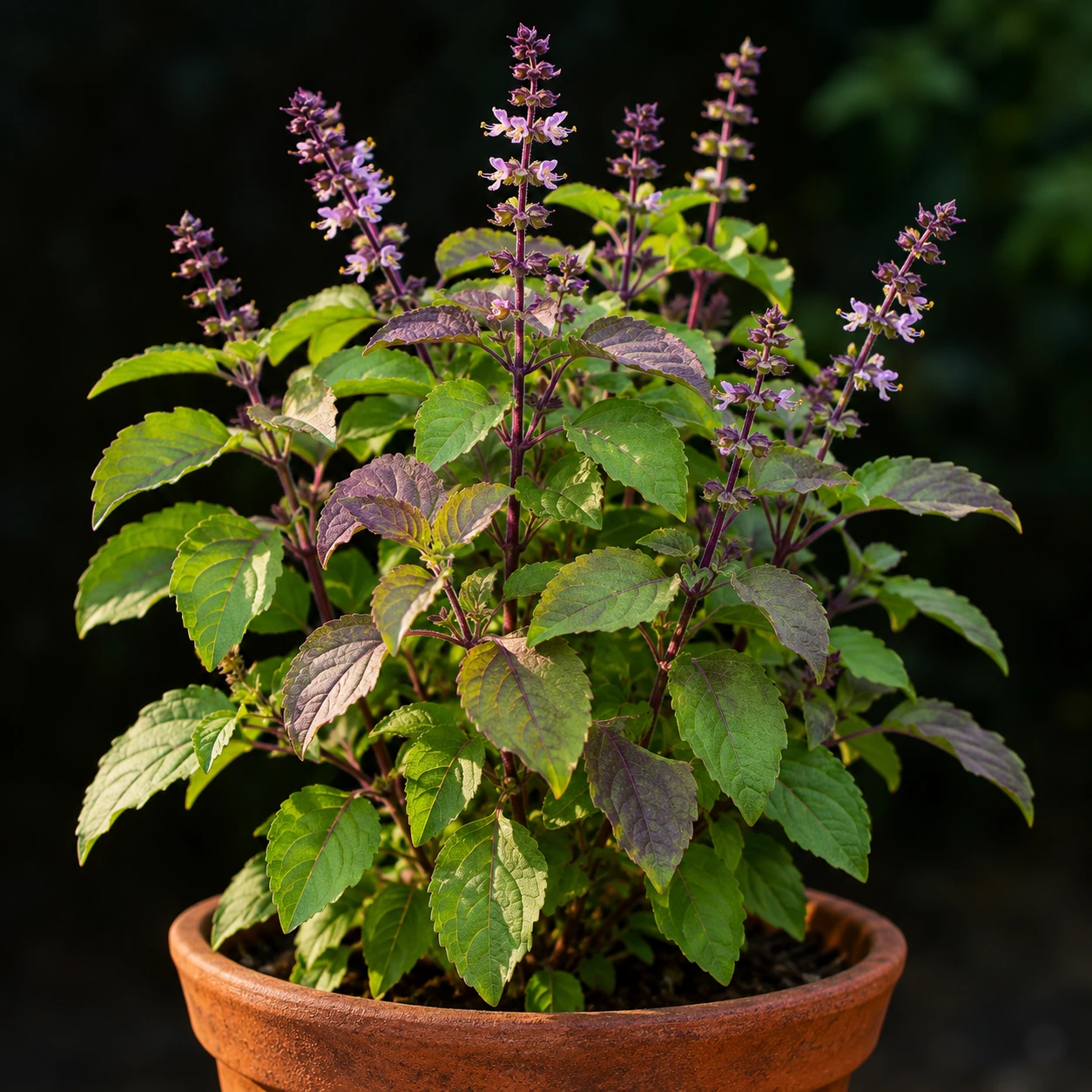
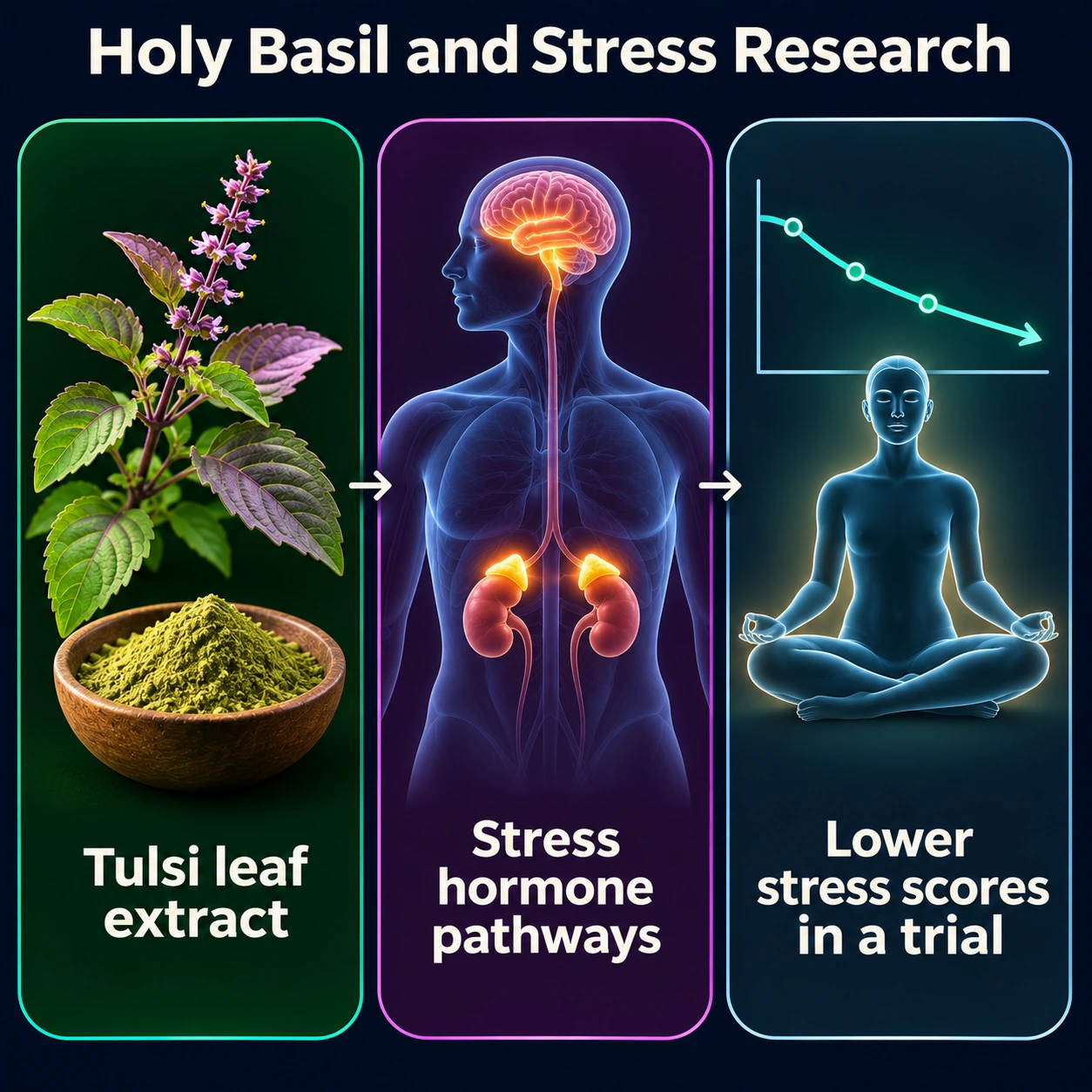
Of holy basil's four major clinical effects, the adaptogenic stress-modulating action is the one with the deepest Ayurvedic pedigree and the most direct modern validation. Tulsi (Ocimum sanctum) is the "queen of herbs" precisely because of this property — the 3,000-year-old Charaka Samhita prescribed daily fresh leaves for what we now recognize as chronic hypothalamic-pituitary-adrenal-axis dysregulation. Two twenty-first-century clinical trials tested tulsi extract for stress: Bhattacharyya et al. 2008 gave it to 35 people with generalized anxiety disorder, with no placebo group, and reported less anxiety, stress and depression after 60 days; Saxena et al. 2012 compared it with placebo in adults with general stress and reported lower self-rated stress-symptom scores after six weeks. The mechanism is multi-compound: ocimumosides A and B normalized stress-hormone changes in rats, ursolic acid suppresses the upstream NF-kB inflammatory cascade that drives chronic cortisol elevation, rosmarinic acid provides hippocampal antioxidant protection against cortisol-mediated neuronal damage, and apigenin produces acute gamma-aminobutyric acid-A receptor anxiolysis without sedation. This deep-dive walks through the trials, the mechanism, and the doses used in trials and tradition.
Table of Contents
- The "Queen of Herbs" Ayurvedic Position as Rasayana
- The Bhattacharyya 2008 Trial — Generalized Anxiety Disorder
- The Saxena 2012 Randomized Controlled Trial — General Stress Outcomes
- Additional Anxiety and Depression Trials
- Hypothalamic-Pituitary-Adrenal-Axis Mechanism (Ocimumosides A and B)
- Eugenol, Ursolic Acid, and Rosmarinic Acid Mechanisms
- Apigenin and the Gamma-Aminobutyric Acid-A Receptor (Acute Calming)
- Tulsi vs Benzodiazepines, Selective Serotonin Reuptake Inhibitors, and Other Pharmaceutical Approaches
- Doses Used in Trials and Tradition
- Cautions and Drug Interactions
- Key Research Papers
- Connections
- Featured Videos
The "Queen of Herbs" Ayurvedic Position as Rasayana
In Sanskrit, tulsi means "the incomparable one," and the plant's position in Hindu religious and medical tradition is genuinely without parallel among medicinal herbs anywhere in the world. Tulsi is grown in a dedicated raised platform (the tulsi vrindavan) in the courtyard of essentially every traditional Hindu household, watered daily by the household women, and worshipped at sunset with the lighting of an oil lamp. The plant itself is regarded as a living manifestation of the goddess Lakshmi. Marriage of a tulsi plant to a black stone representing Vishnu (the Tulsi Vivah ritual) is celebrated annually across India.
Within the Ayurvedic pharmacopoeia, tulsi is classified as a rasayana — one of the small group of botanical agents that promote longevity, support resilience against disease, and rejuvenate body, mind, and spirit. Other classical rasayanas include ashwagandha, amla (Indian gooseberry), bacopa, and shilajit. What distinguishes tulsi within this group is the breadth of its applications — the Charaka Samhita and the Rig Veda both list it for respiratory disease, digestive complaints, skin conditions, fevers, and general weakness, in addition to its central role as a stress and longevity tonic.
The modern Western adaptogen concept, formalized by Soviet pharmacologist Nikolai Lazarev in 1947 and refined by Israel Brekhman, describes a class of botanicals that increase resistance to physical, chemical, and emotional stressors while restoring homeostasis without disrupting normal function. The classical adaptogen criteria — nonspecific resistance, normalizing effect (down-regulating overactive systems and up-regulating underactive ones), and lack of disruption to normal physiology — map closely onto the Ayurvedic rasayana category. Tulsi satisfies all three classical adaptogen criteria more cleanly than perhaps any other studied herb, which is why it has become the prototypical example used in modern reviews of adaptogenic phytotherapy.
The Bhattacharyya 2008 Trial — Generalized Anxiety Disorder
The Bhattacharyya et al. 2008 study, published in the Nepal Medical College Journal, tested holy basil leaf extract in people with generalized anxiety disorder in a hospital setting in Kolkata. Hamilton's brief psychiatric rating scale and clinical investigations were used to select the patients. Thirty-five patients (21 men and 14 women, average age 38.4 years) took Ocimum sanctum leaf extract at a fixed 500 mg capsule twice daily after meals for 60 days, and were assessed with standard psychological rating questionnaires at the start (day 0), day 30 and day 60. All patients took the extract; there was no placebo group.
The study abstract reports:
- Generalized anxiety: significantly reduced (p<0.001)
- The stress and depression that went with the anxiety: also reduced
- "Willingness to adjustment" and attention: significantly improved (p<0.001)
The trial had no placebo or comparison group and was modest in size, which limits the strength of the inference. The Bhattacharyya trial established the scientific case for further investigation and remains the most-cited paper in the modern tulsi pharmacology literature.
The Saxena 2012 Randomized Controlled Trial — General Stress Outcomes
The Saxena et al. 2012 study, published in Evidence-Based Complementary and Alternative Medicine, addressed the methodological limitations of the Bhattacharyya trial with a true double-blind, placebo-controlled randomized trial design. The study used a standardized holy basil extract (whole-plant Ocimum tenuiflorum) at 1,200 mg of actives per day for six weeks, against an identical-looking placebo capsule. Of 158 adults with general stress who were enrolled (76 on the extract, 82 on placebo), 150 were analysed (71 on the extract, 79 on placebo).
The patients rated their own stress symptoms on a symptom rating scale at weeks 0, 2, 4 and 6. Results at 6 weeks showed:
- Total symptom score: fell significantly more in the extract group than in the placebo group (P ≤ 0.05). The authors express the overall improvement as "1.6 times or 39% more" than placebo — a difference between the two groups, not a 39% fall in symptoms
- Forgetfulness, sexual problems of recent origin, frequent feeling of exhaustion and frequent sleep problems of recent origin: each fell significantly more than with placebo (P ≤ 0.05)
- Sexual problems: the authors report the extract reduced this symptom score by 87.5% in comparison to the placebo group
- Safety: no adverse events were reported
The Saxena trial is the strongest single piece of evidence in the modern tulsi pharmacology literature. The combination of a true placebo-controlled design, a meaningful sample size (158 enrolled, 150 analysed), a 6-week duration sufficient to allow adaptogenic effects to develop, and significant differences from placebo on the total score and on four individual symptoms makes the case difficult to dismiss as placebo response or methodological artifact.
Additional Anxiety and Depression Trials
Beyond the two pivotal trials, the smaller modern literature on tulsi for stress-related disorders includes:
- Sampath et al. 2015 — placebo-controlled study of 300 mg a day of an ethanolic holy basil leaf extract for 30 days in healthy adult volunteers. Compared with placebo, the extract group improved more on reaction time and error rate in two attention-and-memory tests (the Sternberg and Stroop tests). Salivary cortisol, anxiety scores (State-Trait Anxiety Inventory) and P300 latency (a brain-wave timing measure) improved over time in the extract group alone, but of these only P300 latency differed significantly from placebo.
- Jamshidi and Cohen 2017 systematic review — identified 24 human studies of tulsi reporting effects on metabolic disorders, cardiovascular disease, immunity and neurocognition. All studies reported favourable clinical outcomes and none reported any significant adverse events; the authors wrote that the studies suggest tulsi is an effective treatment for lifestyle-related chronic diseases including diabetes, metabolic syndrome and psychological stress, and that further studies are required to explore mechanisms of action, clarify the dosage and dose form, and determine who is most likely to benefit. The review noted methodological limitations of much of the underlying literature (small sample sizes, short duration, variable extract standardization) while documenting consistency of direction of effect across trials.
- Lopresti et al. 2022 — randomized, double-blind, placebo-controlled trial in Australia: 100 adults aged 18 to 65 who were experiencing stress took 125 mg of a standardized holy basil extract twice daily, or placebo, for 8 weeks. Compared with placebo, the extract group improved more on the Perceived Stress Scale (p = 0.003) and the Athens Insomnia Scale (p = 0.025), and at week 8 their hair cortisol was lower (p = 0.025). In a laboratory stress test (the Maastricht Acute Stress Test), the extract group had smaller rises in salivary cortisol (p = 0.001), salivary amylase (p = 0.001), systolic (p = 0.010) and diastolic (p = 0.025) blood pressure, and stress ratings (p < 0.001). No major adverse effects were reported. The authors write that the sleep findings still need confirmation with gold-standard objective sleep measures.
- Cohen 2014 narrative review — comprehensive review of the human and animal evidence for tulsi as an adaptogen, published in the Journal of Ayurveda and Integrative Medicine. This is the standard reference for clinicians integrating tulsi into stress-management protocols.
Animal studies are extensive and consistent: rodent models of restraint stress, chronic mild stress, and learned helplessness all show that tulsi extract pre-treatment reduces corticosterone elevation, normalizes hippocampal neurogenesis, and prevents the depression-like behavior that develops in untreated stressed animals. The animal mechanistic work has been particularly important in identifying the molecular targets discussed below.
Hypothalamic-Pituitary-Adrenal-Axis Mechanism (Ocimumosides A and B)
The hypothalamic-pituitary-adrenal (HPA) axis is the body's primary stress-response system. Under perceived stress, the hypothalamus releases corticotropin-releasing hormone (CRH), which stimulates the anterior pituitary to release adrenocorticotropic hormone (ACTH), which in turn stimulates the adrenal cortex to produce cortisol. Cortisol provides negative feedback to both the hypothalamus and pituitary, normally damping the response and returning the system to baseline. In chronic stress, this negative-feedback mechanism fails — cortisol output remains elevated, glucocorticoid receptors downregulate, and the system loses its ability to return to baseline. This is the underlying physiology of the cluster of symptoms (sleep disturbance, weight gain, immune suppression, cognitive impairment, mood disturbance) that defines the chronic-stress syndrome in modern populations.
Holy basil contains two glycosides — ocimumoside A and ocimumoside B — that were isolated from the leaves in 2007 by Gupta and colleagues at the Central Drug Research Institute (Lucknow) and tested in rats. In rats under acute stress, ocimumoside A at 40 mg/kg normalized the stress-raised blood sugar, corticosterone (the rat stress hormone), creatine kinase and adrenal enlargement, and ocimumoside B normalized most of these measures. In a 2012 study of rats under chronic unpredictable stress, both compounds (40 mg/kg by mouth) brought corticosterone back to control levels and lessened the stress-induced changes in brain monoamines and antioxidant systems. The isolated compounds have not been tested in people in any study cited here, so whether they account for the herb's effects in humans is not known. The proposed actions of the ocimumosides on the hypothalamic-pituitary-adrenal cascade are:
- Hippocampal preservation — the hippocampus is particularly vulnerable to glucocorticoid toxicity (chronic cortisol elevation damages hippocampal neurons and impairs the negative-feedback signal). In the 2012 rat study, ocimumosides A and B lessened stress-induced changes in monoamines and antioxidant enzymes in the hippocampus, frontal cortex and striatum; effects on hippocampal volume, brain-derived neurotrophic factor (BDNF) expression and neurogenesis are proposed but were not reported in the ocimumoside studies cited here.
- Restoration of glucocorticoid receptor sensitivity — chronic stress downregulates glucocorticoid receptors, blunting the negative-feedback signal. Restoring receptor expression and the feedback loop is a proposed action of the ocimumosides; the rat studies cited here report corticosterone, not receptor measurements.
- Adrenal cortex tonification — in Ayurvedic rasayana tradition and adaptogen theory, tulsi is described as normalizing adrenal output in both directions: down-regulating excessive cortisol in stressed individuals, and supporting cortisol output in patients with adrenal exhaustion / hypocortisolism. This bidirectional normalization is the defining feature of adaptogenic action.
- Monoamine modulation — in rats under chronic stress, ocimumosides A and B lessened the stress-induced fall in noradrenaline (norepinephrine), dopamine and serotonin in the frontal cortex, striatum and hippocampus; whether this contributes to the mood effects reported in human trials is not known.
The ocimumosides are present at low concentration in the whole leaf and are difficult to standardize without extensive extraction work.
Human hormone studies are less clear-cut. A 2022 systematic review of 52 randomized controlled human trials of single plants and plant extracts (holy basil among them) on stress hormones — cortisol, cortisone, corticotrophin-releasing hormone and adrenocorticotropic hormone (ACTH) — found that, because study designs varied widely, the effect of most of these plants on hypothalamic-pituitary-adrenal-axis activity in humans is unclear. The most consistent finding was a morning cortisol-lowering effect from ashwagandha.
Eugenol, Ursolic Acid, and Rosmarinic Acid Mechanisms
The ocimumosides are the principal hypothalamic-pituitary-adrenal-axis mediators, but they do not act in isolation. The whole-plant adaptogenic effect requires three additional compound classes acting on parallel pathways:
Eugenol is the dominant phenylpropanoid in the essential oil fraction (especially abundant in Krishna Tulsi). Beyond its well-known cyclooxygenase-2 (COX-2) inhibition and bronchodilatory effects, eugenol provides indirect stress benefit by reducing the chronic low-grade inflammation that perpetuates hypothalamic-pituitary-adrenal-axis dysregulation. Chronic inflammatory cytokine elevation (interleukin-6 (IL-6), tumor necrosis factor-alpha) signals upward to the hypothalamus and drives sustained CRH output even in the absence of acute psychological stressors. By suppressing peripheral inflammation, eugenol reduces this inflammatory input to the hypothalamic-pituitary-adrenal axis.
Ursolic acid suppresses NF-kB-driven inflammatory cascades upstream of cytokine production, providing a second route to inflammation reduction. Ursolic acid also exerts direct effects on glucose metabolism (relevant to the blood sugar deep-dive) and on muscle preservation, which is particularly relevant in chronic-stress states where catabolic cortisol dominance drives muscle wasting.
Rosmarinic acid is a polyphenolic antioxidant that crosses the blood-brain barrier and provides hippocampal neuroprotection against oxidative damage. Under chronic cortisol elevation, hippocampal neurons sustain reactive-oxygen-species damage that contributes to cognitive impairment and the failure of negative feedback. Rosmarinic acid preserves hippocampal function, supporting both subjective memory improvement (one of the symptom dimensions improved in the Saxena trial) and restoration of hypothalamic-pituitary-adrenal-axis feedback regulation.
The integrated effect — ocimumosides directly normalizing hypothalamic-pituitary-adrenal axis output, ursolic acid and eugenol suppressing inflammatory drivers, and rosmarinic acid protecting the hippocampal feedback machinery — explains why whole-plant tulsi outperforms any single isolated compound. The compounds also explain the multi-week timeline of clinical response: receptor restoration, neurogenesis, and tissue regeneration are inherently slow processes, and the adaptogenic effect builds over 4 to 8 weeks of consistent dosing.
Apigenin and the Gamma-Aminobutyric Acid-A Receptor (Acute Calming)
While the hypothalamic-pituitary-adrenal-axis normalization develops over weeks, many users report an acute subjective calming effect within an hour of drinking a strong cup of tulsi tea. This acute effect is mechanistically distinct from the long-term adaptogenic action and traces to the flavonoid apigenin.
Apigenin binds to the benzodiazepine binding site on the gamma-aminobutyric acid-A receptor with modest affinity and acts as a partial agonist. The pharmacology resembles a very mild benzodiazepine without the sedation, motor impairment, or dependency potential of the diazepam class. The same flavonoid is the active anxiolytic compound in chamomile, parsley, and several other traditional calming herbs. Tulsi's apigenin content is modest but consistent, sufficient to produce a subjectively detectable acute calming effect when consumed as a full cup of strong tea.
This dual-timeline pharmacology — acute apigenin-mediated gamma-aminobutyric acid (GABA) modulation plus chronic ocimumoside-mediated hypothalamic-pituitary-adrenal normalization — is unusually elegant and explains why tulsi is well-suited to use both as an acute symptomatic remedy at moments of stress and as a daily long-term tonic. Users do not have to wait six weeks to feel anything; they feel mild acute calming on the first cup, then experience increasing baseline resilience as the longer-term hypothalamic-pituitary-adrenal adaptation builds.
Tulsi vs Benzodiazepines, Selective Serotonin Reuptake Inhibitors, and Other Pharmaceutical Approaches
Practitioners compare tulsi with several pharmaceutical and other approaches to mild-to-moderate generalized anxiety and chronic-stress symptoms:
- vs benzodiazepines (alprazolam, lorazepam, diazepam) — benzodiazepines produce rapid and powerful anxiolysis but carry significant downsides: sedation, motor and cognitive impairment, dependency with chronic use, withdrawal syndrome on discontinuation, and excess mortality risk in elderly populations. Tulsi's apigenin-mediated gamma-aminobutyric acid effect is much milder, with none of these liabilities. Tulsi has not been studied as a replacement for benzodiazepines in panic disorder or short-term crisis; the trials above tested it over 30 days to 8 weeks for ongoing stress and anxiety.
- vs selective serotonin reuptake inhibitor antidepressants (sertraline, escitalopram, fluoxetine) — selective serotonin reuptake inhibitors (SSRIs) are first-line for generalized anxiety disorder and produce moderate effect sizes in randomized trials. They have well-documented downsides: sexual dysfunction (often persistent even after discontinuation), emotional blunting, weight gain, sleep disturbance, and difficult discontinuation with withdrawal symptoms. Herbal practitioners describe tulsi's effect as comparable to that seen in typical selective serotonin reuptake inhibitor trials. In the Saxena placebo-controlled trial, sexual problems of recent origin improved more on the extract than on placebo.
- vs buspirone — buspirone is a serotonin 5-HT1A partial agonist marketed specifically for generalized anxiety. It has fewer side effects than benzodiazepines or selective serotonin reuptake inhibitors but modest effect sizes. Herbal practitioners describe tulsi's effect as at least comparable, at roughly an order of magnitude lower cost.
- vs ashwagandha — the two major Ayurvedic adaptogens have overlapping but distinguishable profiles. Ashwagandha is more sedating, more strongly anxiolytic in the short term, with documented effects on testosterone and sleep architecture. Tulsi is less sedating, with more pronounced cognitive enhancement and metabolic effects. Many practitioners combine the two, with tulsi taken during the day and ashwagandha in the evening.
- vs cognitive behavioral therapy (CBT) — cognitive behavioral therapy remains the gold-standard nonpharmacological intervention for anxiety with the largest effect sizes and most durable benefit. Practitioners describe tulsi as a complement to talking therapy rather than a replacement, holding that the physiological calming makes psychological work more effective but does not substitute for it.
For a complete review of natural approaches, see the Stress Management page and the Anxiety page.
Doses Used in Trials and Tradition
The trials described above used the extract doses below; traditional and herbal practice uses the leaf, tea and tincture amounts that follow.
- Capsule / standardized extract (doses used in trials) — 500 mg of leaf extract twice daily after meals for 60 days (Bhattacharyya 2008); 1,200 mg of actives a day of a standardized whole-plant extract for six weeks (Saxena 2012); 300 mg a day of an ethanolic leaf extract for 30 days (Sampath 2015); 125 mg of a standardized extract twice daily for 8 weeks (Lopresti 2022).
- Loose-leaf tulsi tea — 1 to 2 teaspoons of dried tulsi leaves (or 4 to 8 fresh leaves) steeped in 8 ounces of just-off-the-boil water for 5 to 10 minutes, covered to retain volatile oils, is the traditional preparation, taken as two to three cups a day, often one in the morning and one in the early evening. Tea is the most traditional form and the closest to how the herb has been used for millennia.
- Fresh leaf chewing — 5 to 8 fresh tulsi leaves chewed on an empty stomach in the morning, the traditional Ayurvedic practice. This is the most concentrated route for the volatile oil fraction but requires access to fresh plants.
- Tincture (1:5 in 40% alcohol) — in herbal practice, 30 to 60 drops (1 to 2 mL) two to three times daily in a small amount of water. Convenient for travel and dose-adjustment but provides somewhat less of the whole-plant compound profile than tea or fresh leaves.
- Combination with ashwagandha — for marked sleep disturbance accompanying the anxiety, some practitioners pair daytime tulsi with evening ashwagandha (300 to 600 mg of an ashwagandha root extract), taken with the evening meal. The two adaptogens have complementary profiles.
Traditional Ayurvedic practice includes periodic breaks (6 weeks on, 1 week off; a modern variant often used is 5 days on, 2 days off, weekly), held to preserve receptor sensitivity. Practitioners describe adaptogenic effects as building slowly and persisting for several days after stopping, so brief breaks do not lose ground. Users commonly report the first improvements in sleep and acute calming within 1 to 2 weeks, with progressive improvement in baseline resilience, cognitive clarity, and stress tolerance over 4 to 8 weeks.
Cautions and Drug Interactions
- Pregnancy — small culinary amounts of tulsi (as tea) are traditional and considered safe in pregnancy in Indian practice. There are no good safety data on high-dose supplements in pregnancy, and uterine-stimulating effects have been proposed in theory.
- Blood-thinning medications — tulsi has mild antiplatelet effects via eugenol and rosmarinic acid. Combined with warfarin, direct oral anticoagulants (apixaban, rivaroxaban) or antiplatelet drugs (clopidogrel, aspirin), therapeutic doses raise a concern for an added bleeding tendency.
- Hypoglycemic medications — tulsi's glycemic effect can produce additive hypoglycemia when combined with sulfonylureas, insulin, or other hypoglycemics. The Blood Sugar deep-dive has the details.
- Surgery — the antiplatelet and blood-sugar-lowering effects above raise a concern for bleeding and low blood sugar under anesthesia; stopping at least 2 weeks before scheduled surgery is the interval commonly given for herbs with these effects.
- Fertility — animal studies at very high doses (well above any human therapeutic dose) have shown reduced sperm count. The relevance for couples trying to conceive is unclear.
- Thyroid medications — mild anti-thyroid effects have been reported at high doses. For people on levothyroxine, this raises a concern that sustained high-dose tulsi could shift thyroid-stimulating hormone (TSH) levels.
The overall safety profile is excellent — tulsi has been consumed daily by hundreds of millions of people for millennia, with no associated mortality signal or significant adverse-event pattern in modern trials. The cautions above are about specific drug interactions and pregnancy, not about tulsi itself.
Key Research Papers
- Bhattacharyya D, Sur TK, Jana U, Debnath PK (2008). Controlled programmed trial of Ocimum sanctum leaf on generalized anxiety disorders. Nepal Medical College Journal, 10(3), 176-179. — PubMed PMID: 19253862
- Saxena RC, Singh R, Kumar P, et al. (2012). Efficacy of an extract of Ocimum tenuiflorum (OciBest) in the management of general stress: a double-blind, placebo-controlled study. Evidence-Based Complementary and Alternative Medicine, 2012:894509. — PubMed PMID: 21977056
- Sampath S, Mahapatra SC, Padhi MM, et al. (2015). Holy basil (Ocimum sanctum Linn.) leaf extract enhances specific cognitive parameters in healthy adult volunteers: a placebo controlled study. Indian Journal of Physiology and Pharmacology, 59(1), 69-77. — PubMed PMID: 26571987
- Lopresti AL, Smith SJ, Metse AP, Drummond PD (2022). A randomized, double-blind, placebo-controlled trial investigating the effects of an Ocimum tenuiflorum (Holy Basil) extract (Holixer™) on stress, mood, and sleep in adults experiencing stress. Frontiers in Nutrition, 9, 965130. — PubMed PMID: 36185698
- Cohen MM (2014). Tulsi — Ocimum sanctum: A herb for all reasons. Journal of Ayurveda and Integrative Medicine, 5(4), 251-259. — PubMed PMID: 25624701
- Jamshidi N, Cohen MM (2017). The clinical efficacy and safety of tulsi in humans: a systematic review of the literature. Evidence-Based Complementary and Alternative Medicine, 2017:9217567. — PubMed PMID: 28400848
- Lopresti AL, Smith SJ, Drummond PD (2022). Modulation of the hypothalamic-pituitary-adrenal (HPA) axis by plants and phytonutrients: a systematic review of human trials. Nutritional Neuroscience, 25(8), 1704-1730. — PubMed PMID: 33650944
- Maity TK, Mandal SC, Saha BP, Pal M (2000). Effect of Ocimum sanctum roots extract on swimming performance in mice. Phytotherapy Research, 14(2), 120-121. — PubMed PMID: 10685110
- Gupta P, Yadav DK, Siripurapu KB, et al. (2007). Constituents of Ocimum sanctum with antistress activity. Journal of Natural Products, 70(9), 1410-1416. — PubMed PMID: 17850106
- Ahmad A, Rasheed N, Gupta P, et al. (2012). Novel Ocimumoside A and B as anti-stress agents: modulation of brain monoamines and antioxidant systems in chronic unpredictable stress model in rats. Phytomedicine, 19(7), 639-647. — PubMed PMID: 22455995
- Bhargava KP, Singh N (1981). Anti-stress activity of Ocimum sanctum Linn. Indian Journal of Medical Research, 73, 443-451. — PubMed PMID: 7275241
- Tabassum I, Siddiqui ZN, Rizvi SJ (2010). Effects of Ocimum sanctum and Camellia sinensis on stress-induced anxiety and depression in male albino Rattus norvegicus. Indian Journal of Pharmacology, 42(5), 283-288. — PubMed PMID: 21206619
- Salim S, Chugh G, Asghar M (2012). Inflammation in anxiety. Advances in Protein Chemistry and Structural Biology, 88, 1-25. (Mechanistic context for tulsi's anti-inflammatory-mediated anxiolytic effect.) — PubMed PMID: 22814704