Resistant Starches — Benefits Deep Dive
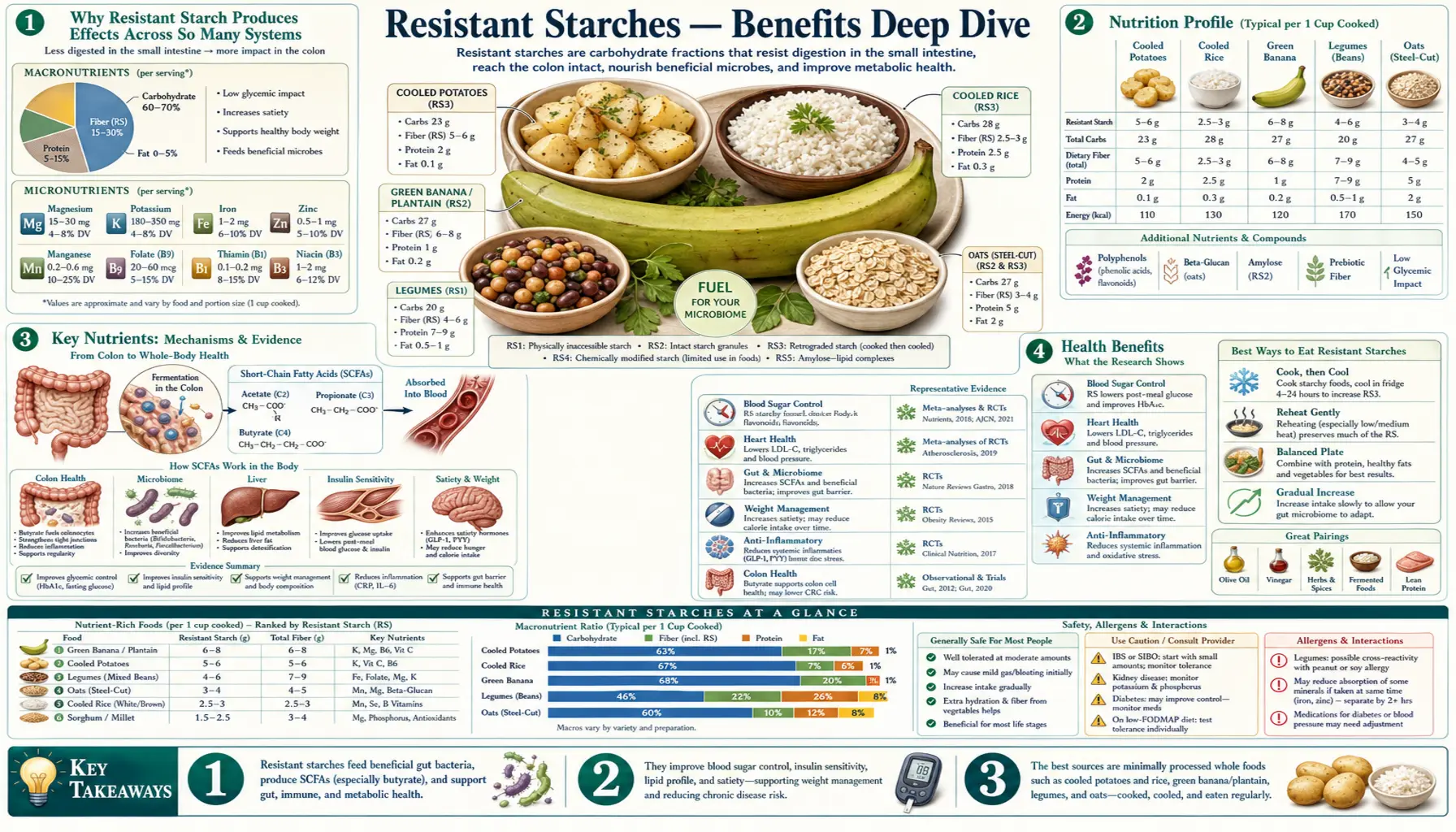
Resistant starch is not a single molecule but a structural class of carbohydrate — any fraction of dietary starch that escapes amylase digestion in the small intestine and arrives intact in the colon, where it behaves functionally like a soluble, fermentable fiber. Four subtypes (RS1 through RS4, with an emerging RS5) reach the colon through different routes: physical inaccessibility inside intact cell walls, crystalline granule structure that enzymes cannot penetrate, retrogradation after cooking and cooling, chemical modification, and amylose-lipid complexing. Once in the colon, saccharolytic bacteria ferment it into the three short-chain fatty acids — acetate, propionate, and butyrate — in roughly a 60:20:20 ratio. Through those three molecules and the microbial-community shifts that produce them, a single inexpensive dietary intervention reaches the liver, the pancreas, adipose tissue, the immune system, the gut barrier, and the brain. Average Western intake is 3–5 grams per day; the range tested in human trials is 15–40 grams per day; ancestral and traditional diets likely supplied 30–50 grams. The four benefit pages below explore the four conditions where the human evidence is strongest — non-alcoholic fatty liver disease, gut microbiome reshaping, visceral adipose tissue reduction, and the practical food sources that let any reader reach a therapeutic intake from whole foods alone.
Deep-Dive Articles
Fatty Liver Disease
The 2023 Cell Metabolism Ni et al. Randomized controlled trial (RCT) showing a 9.08% absolute reduction in MRI-PDFF liver fat (5.89% after adjusting for weight loss) from 40 g/day of high-amylose maize RS for four months, the gut-microbiome changes the trial linked to the effect (lower blood branched-chain amino acids and fewer Bacteroides stercoris bacteria), the gut-liver axis and metabolic endotoxemia, the Robertson and Cani groups' mechanistic work, and the four-week ramp described in practice for non-alcoholic fatty liver disease (NAFLD) / metabolic dysfunction-associated steatotic liver disease (MASLD) patients. The honest framing on dose — meaningful effects require 30–40 g/day, not the 5 g/day a typical Western diet supplies.
Read the deep dive →Gut Microbiome
How RS selectively feeds Ruminococcus bromii, Bifidobacterium adolescentis, Faecalibacterium prausnitzii, and Eubacterium rectale; why RS is one of the most butyrogenic substrates in the diet; the cross-feeding networks that translate primary fermenters' products into butyrate; tight-junction restoration; and the human trial evidence that microbiome composition can shift measurably in as little as a week of RS supplementation.
Read the deep dive →Visceral Fat
Why visceral adipose tissue (VAT) is metabolically dangerous in a way subcutaneous fat is not, the glucagon-like peptide-1 (GLP-1) and PYY satiety arm, the short-chain fatty acid-AMPK fat-oxidation arm, the insulin-sensitivity arm, and the human clinical trials showing modest but consistent VAT reductions from 15–40 g/day of RS independent of calorie restriction. Includes the DXA/MRI measurement context and why waist circumference alone underestimates the problem.
Read the deep dive →High Resistant Starch Foods
A practical food-source catalog: raw potato starch (~8 g per tablespoon), green banana flour (~20 g per 30 g flour), cooked-and-cooled potatoes/rice/pasta (the RS3 retrogradation gain), lentils and navy beans (~2–4 g per half-cup), high-amylose maize resistant starch, and how cooking-and-cooling cycles can roughly double the RS in everyday meals. Includes a worked example for hitting 30 g/day without supplements.
Read the deep dive →Table of Contents
- Deep-Dive Articles
- Why Resistant Starch Produces Effects Across So Many Systems
- Resistant Starch and Cancer Prevention in Lynch Syndrome
- Research Papers: Fatty Liver Disease
- Research Papers: Gut Microbiome & Short-Chain Fatty Acid Production
- Research Papers: Visceral Fat & Insulin Sensitivity
- Research Papers: Food Sources, RS Classification, Cooking
- Research Papers: Cross-Cutting (Short-Chain Fatty Acids, Endotoxemia, Glucagon-Like Peptide-1)
- External Authoritative Resources
- Connections
- Featured Videos
Why Resistant Starch Produces Effects Across So Many Systems
Most dietary interventions act through one principal mechanism — insulin signaling, satiety hormones, the lipid profile, or oxidative stress. Resistant starch is unusual because it is upstream of a microbial fermentation step that produces three distinct signaling molecules, each of which then acts through several downstream pathways. The result is a single dietary lever whose effects propagate across cellular and organ-system boundaries that traditional reductionist nutrition has treated as separate.
- Butyrate — colonocyte fuel, HDAC inhibitor, tight-junction sealant — the most studied of the three short-chain fatty acids (SCFAs) supplies roughly 70% of the energy needs of the cells that line the colon. Well-fed colonocytes maintain tight epithelial junctions, suppress NF-κB-driven inflammation, and starve pathobionts of the oxygen they need to overgrow. Butyrate also acts as an endogenous histone deacetylase inhibitor, influencing gene expression far beyond the gut wall. This is the molecule behind the gut barrier and microbiome reshaping effects and a meaningful part of the reduction in metabolic endotoxemia seen in non-alcoholic fatty liver disease trials.
- Propionate — portal-vein delivery to the liver, suppression of de novo lipogenesis — propionate reaches the liver via the portal circulation in measurable concentrations and acts paradoxically: it is a gluconeogenic substrate, but it simultaneously inhibits acetyl-CoA carboxylase and downregulates SREBP-1c, the master transcription factor for fatty acid synthesis. In effect, propionate tells the liver to stop making new fat. This is a mechanism proposed from laboratory studies for part of the reduction in hepatic triglyceride content seen in human MRI-PDFF trials; the human liver-fat trial cited on this page (Ni 2023) instead linked its result to gut-microbiome changes, lower blood branched-chain amino acids and fewer Bacteroides stercoris bacteria.
- Acetate — systemic circulation, AMP-activated protein kinase (AMPK) activation, fat oxidation — acetate is the most abundant of the three short-chain fatty acids and the one that enters systemic circulation in the highest concentrations. It activates AMP-activated protein kinase (AMPK), the cellular energy sensor that switches the body from fat storage to fat oxidation — the same target hit by metformin and by exercise. AMP-activated protein kinase activation phosphorylates acetyl-CoA carboxylase, increases carnitine palmitoyltransferase-1 activity, and drives fatty acids into mitochondrial beta-oxidation. This is the systemic arm behind visceral adipose tissue reduction.
- L-cell secretion of glucagon-like peptide-1 and PYY — satiety, glycemic control — short-chain fatty acids reaching the distal colon stimulate enteroendocrine L cells to secrete glucagon-like peptide 1 and peptide YY (PYY). The same hormones that semaglutide and tirzepatide elevate pharmacologically are elevated endogenously by fermentation of resistant starch. The effect is modest compared to glucagon-like peptide-1 receptor agonist drugs but compounds with the other RS effects on substrate selection and inflammation.
- Bile acid metabolism and FGF21 induction — RS fermentation alters the colonic bile acid pool, increases fecal bile acid excretion (forcing the liver to pull cholesterol out of circulation to replace them), and in animal models raises hepatic expression of fibroblast growth factor 21, a hepatokine increasingly recognized as a master regulator of metabolic health.
The practical complication is dose. The average Western diet supplies only 3–5 grams of resistant starch per day, well below the 15–40 g/day range tested in randomized trials. A 2019 meta-analysis by Snelson and colleagues of 22 randomized trials (670 people taking at least 8 g a day of type 2 resistant starch) found only a small drop in blood triglycerides (0.10 mmol/L, in healthy people) and in body weight (1.29 kg, in people with type 2 diabetes), results heavily influenced by a few studies that went against most of the trials; it found no effect on any other metabolic outcome and concluded that short-term supplementation “is of limited cardiometabolic benefit”. Closing the intake gap takes either a deliberate food strategy that stacks multiple RS-rich items (cooled potatoes, lentils, oats, green bananas) or a concentrated supplement (raw potato starch at ~8 g RS per tablespoon, or a high-amylose maize resistant starch at ~4.5 g per tablespoon). Trials have used fixed daily amounts — the CAPP2 trial below gave 30 g a day for up to 4 years — while practitioners describe ramping from 5–10 g/day in week one to 30–40 g/day by week four, combining a supplement with whole-food sources. Gas and bloating during the first 1–2 weeks are commonly reported and are described as easing as butyrate-producing populations expand. The food-source catalog page works out how to reach 30 g/day from whole foods alone.
What is not known: the trials pooled by Snelson and colleagues lasted only 1–12 weeks, enrolled 10–60 people each, and most had an unclear risk of bias, so longer-term effects on metabolism are not established. In the Ni 2023 liver trial (99 people on resistant starch, 97 controls), the 9.08% absolute drop in liver fat became 5.89% once weight loss was taken into account, so part of the drop went together with weight loss.
Two clinical situations raise concerns. People with diagnosed small intestinal bacterial overgrowth (SIBO) may worsen, with more bloating, under rapid RS escalation; practitioners describe treating the overgrowth first and then reintroducing resistant starch slowly. In people with decompensated cirrhosis and a history of hepatic encephalopathy (confusion caused by ammonia the damaged liver cannot clear), who are often managed with lactulose and ammonia control, the concern raised is bloating and a change in colonic ammonia production from a sudden rise in fermentation, though the underlying colonic acidification produced by RS fermentation is plausibly synergistic with standard hepatic encephalopathy prevention.
Resistant Starch and Cancer Prevention in Lynch Syndrome
The CAPP2 trial gave 30 g of resistant starch a day, or a starch placebo, for up to 4 years to 918 people with Lynch syndrome (an inherited condition that raises the risk of colorectal cancer and several other cancers). At a median follow-up of 52.7 months, 27 of 463 people on resistant starch and 26 of 455 on placebo had developed colorectal cancer, and the authors reported that resistant starch “had no detectable effect on cancer development”.
In the planned 10-year follow-up, extended with national cancer registry data to 20 years in England, Wales and Finland, colorectal cancer was still unchanged (52 people on resistant starch against 53 on placebo). Fewer people randomized to resistant starch developed the other cancers linked to Lynch syndrome (27 against 48; hazard ratio 0.54), most clearly cancers of the upper digestive tract (5 diagnoses against 21). The authors note that these cancers outside the bowel are hard to detect and manage, and that the reduction was seen in the first 10 years and continued into the second decade. The follow-up did not collect information on side effects after the 4-year treatment period.
Research Papers: Fatty Liver Disease
- Ni Y, Qian L, Siliceo SL, et al. (2023). Resistant starch decreases intrahepatic triglycerides in patients with NAFLD via gut microbiome alterations. Cell Metabolism. 2023;35(9):1530-1547.e8. PubMed PMID: 37673036
- Robertson MD, Bickerton AS, Dennis AL, et al. (2005). Insulin-sensitizing effects of dietary resistant starch and effects on skeletal muscle and adipose tissue metabolism. American Journal of Clinical Nutrition. — PubMed: Robertson 2005
- Robertson MD, Wright JW, Loizon E, et al. (2012). Insulin-sensitizing effects on muscle and adipose tissue after dietary fiber intake in metabolic syndrome. JCEM. — PubMed: Robertson 2012
- Cani PD, Amar J, Iglesias MA, et al. (2007). Metabolic endotoxemia initiates obesity and insulin resistance. Diabetes. — PubMed: Cani 2007 endotoxemia
- Snelson M, Jong J, Manolas D, Kok S, Louise A, Stern R, Kellow NJ (2019). Metabolic effects of resistant starch type 2: a systematic literature review and meta-analysis of randomized controlled trials. Nutrients. 2019;11(8):1833. PubMed PMID: 31398841
- NAFLD / MASLD nomenclature consensus statement (Rinella et al. 2023) — PubMed: MASLD nomenclature
- Resistant starch and hepatic SREBP-1c suppression — PubMed: RS and SREBP-1c
- Propionate and hepatic de novo lipogenesis inhibition — PubMed: Propionate and DNL
- Gut-liver axis and portal vein endotoxin in NAFLD — PubMed: Gut-liver axis NAFLD
- MRI-PDFF as gold-standard non-invasive liver fat measurement — PubMed: MRI-PDFF in NAFLD
Research Papers: Gut Microbiome & Short-Chain Fatty Acid Production
- Ze X, Duncan SH, Louis P, Flint HJ (2012). Ruminococcus bromii is a keystone species for the degradation of resistant starch in the human colon. ISME Journal. — PubMed: Ze 2012 keystone
- Bindels LB, Walter J, Ramer-Tait AE (2015). Resistant starches for the management of metabolic diseases. Current Opinion in Clinical Nutrition. — PubMed: Bindels 2015 review
- Canfora EE, Jocken JW, Blaak EE (2015). Short-chain fatty acids in control of body weight and insulin sensitivity. Nature Reviews Endocrinology. — PubMed: Canfora 2015 review
- Den Besten G, van Eunen K, Groen AK, et al. (2013). The role of short-chain fatty acids in the interplay between diet, gut microbiota, and host energy metabolism. Journal of Lipid Research. — PubMed: Den Besten 2013
- Cross-feeding between RS-degrading and butyrate-producing bacteria — PubMed: Cross-feeding networks
- Butyrate and colonocyte energy metabolism — PubMed: Butyrate and colonocytes
- Butyrate as endogenous HDAC inhibitor — PubMed: Butyrate HDAC
- Tight junction integrity, zonulin, and SCFAs — PubMed: Tight junctions and SCFAs
- Bifidogenic effect of RS2 in human feeding studies — PubMed: RS2 bifidogenic effect
- Faecalibacterium prausnitzii and intestinal inflammation — PubMed: F. prausnitzii anti-inflammatory
Research Papers: Visceral Fat & Insulin Sensitivity
- Chambers ES, Viardot A, Psichas A, et al. (2015). Effects of targeted delivery of propionate to the human colon on appetite regulation, body weight maintenance and adiposity in overweight adults. Gut. — PubMed: Chambers 2015 propionate
- Den Besten G, Bleeker A, Gerding A, et al. (2015). Short-chain fatty acids protect against high-fat diet-induced obesity via a PPARγ-dependent switch from lipogenesis to fat oxidation. Diabetes. — PubMed: Den Besten 2015 PPAR
- Vrieze A, Van Nood E, Holleman F, et al. (2012). Transfer of intestinal microbiota from lean donors increases insulin sensitivity in metabolic syndrome. Gastroenterology. — PubMed: Vrieze 2012 FMT
- Acetate and AMPK activation in skeletal muscle — PubMed: Acetate and AMPK
- GLP-1 and PYY secretion stimulated by colonic SCFAs — PubMed: SCFAs and L-cell secretion
- Visceral adipose tissue as a cardiometabolic risk factor — PubMed: VAT and cardiometabolic risk
- Maki KC, Pelkman CL, Finocchiaro ET, et al. (2012). Resistant starch from high-amylose maize increases insulin sensitivity in overweight and obese men. Journal of Nutrition. — PubMed: Maki 2012
- Johnston KL, Thomas EL, Bell JD, et al. (2010). Resistant starch improves insulin sensitivity in metabolic syndrome. Diabetic Medicine. — PubMed: Johnston 2010
- Hyperinsulinemic-euglycemic clamp methodology for insulin sensitivity — PubMed: Euglycemic clamp
- Resistant starch and HOMA-IR reduction in T2D trials — PubMed: RS and HOMA-IR
Research Papers: Food Sources, RS Classification, Cooking
- Englyst HN, Kingman SM, Cummings JH (1992). Classification and measurement of nutritionally important starch fractions. European Journal of Clinical Nutrition. — PubMed: Englyst 1992 classification
- RS3 formation via starch retrogradation — PubMed: Retrograded starch (RS3)
- Sonia S, Witjaksono F, Ridwan R (2015). Effect of cooling of cooked white rice on resistant starch content and glycemic response. Asia Pacific Journal of Clinical Nutrition. — PubMed: Sonia 2015 cooled rice
- Raw potato starch as concentrated RS2 source — PubMed: Raw potato starch RS2
- High-amylose maize starch supplementation studies — PubMed: High-amylose maize supplementation
- Green banana flour and unripe banana RS content — PubMed: Green banana RS
- Legume resistant starch and microbiome modulation — PubMed: Legume RS
- RS4 chemically modified starch in food industry — PubMed: RS4 modified starch
- RS5 amylose-lipid complex formation — PubMed: RS5 amylose-lipid
- Dietary RS intake estimates in Western populations — PubMed: Western RS intake estimates
Research Papers: Cross-Cutting (Short-Chain Fatty Acids, Endotoxemia, Glucagon-Like Peptide-1)
- Cani PD, Possemiers S, Van de Wiele T, et al. (2009). Changes in gut microbiota control inflammation in obese mice through a mechanism involving GLP-2-driven improvement of gut permeability. Gut. — PubMed: Cani 2009 GLP-2
- Brown AJ, Goldsworthy SM, Barnes AA, et al. (2003). The Orphan G protein-coupled receptors GPR41 and GPR43 are activated by propionate and other short-chain fatty acids. JBC. — PubMed: Brown 2003 FFAR2/3
- FFAR2 (GPR43) and FFAR3 (GPR41) signaling in metabolic regulation — PubMed: FFAR2/FFAR3 review
- FGF21 induction by gut microbiota and SCFAs — PubMed: FGF21 and microbiota
- SCFAs and brain-gut axis signaling — PubMed: SCFAs and gut-brain axis
- Bile acid signaling, FXR, and the resistant starch microbiome — PubMed: Bile acids and FXR
- Second-meal effect of resistant starch on postprandial glucose — PubMed: Second-meal effect
- Resistant starch and colorectal cancer risk reduction — PubMed: RS and colorectal cancer
- Mathers JC, Movahedi M, Macrae F, et al.; CAPP2 Investigators (2012). Long-term effect of resistant starch on cancer risk in carriers of hereditary colorectal cancer: an analysis from the CAPP2 randomised controlled trial. Lancet Oncology. 2012;13(12):1242-9. PubMed PMID: 23140761
- Mathers JC, Elliott F, Macrae F, et al.; CAPP2 Investigators (2022). Cancer prevention with resistant starch in Lynch syndrome patients in the CAPP2-randomized placebo controlled trial: planned 10-year follow-up. Cancer Prevention Research (Philadelphia). 2022;15(9):623-634. PubMed PMID: 35878732
- Topping DL, Clifton PM (2001). Short-chain fatty acids and human colonic function: roles of resistant starch and nonstarch polysaccharides. Physiological Reviews. — PubMed: Topping & Clifton 2001
External Authoritative Resources
- NCBI Bookshelf — Dietary Reference Intakes: Proposed Definition of Dietary Fiber (resistant starch)
- Linus Pauling Institute — Fiber Micronutrient Information Center (includes resistant starch)
- PubMed — Human clinical trials of resistant starch
- PubMed — Resistant starch and microbiome research (~2,000+ papers)
Connections
- All Food
- Resistant Starches (Main Page)
- Resistant Starches for Fatty Liver Disease
- Resistant Starches for the Gut Microbiome
- Resistant Starches for Visceral Fat
- High Resistant Starch Foods
- Probiotics
- Fermented Foods
- Non-Alcoholic Fatty Liver Disease
- Metabolic Syndrome
- Insulin Resistance
- Obesity
- Small Intestinal Bacterial Overgrowth
- Irritable Bowel Syndrome
- Lentils
- Oats
- Bananas
- Sweet Potatoes
- Gut Healing
- Blood Sugar
- History