Resistant Starches and Visceral Fat Reduction
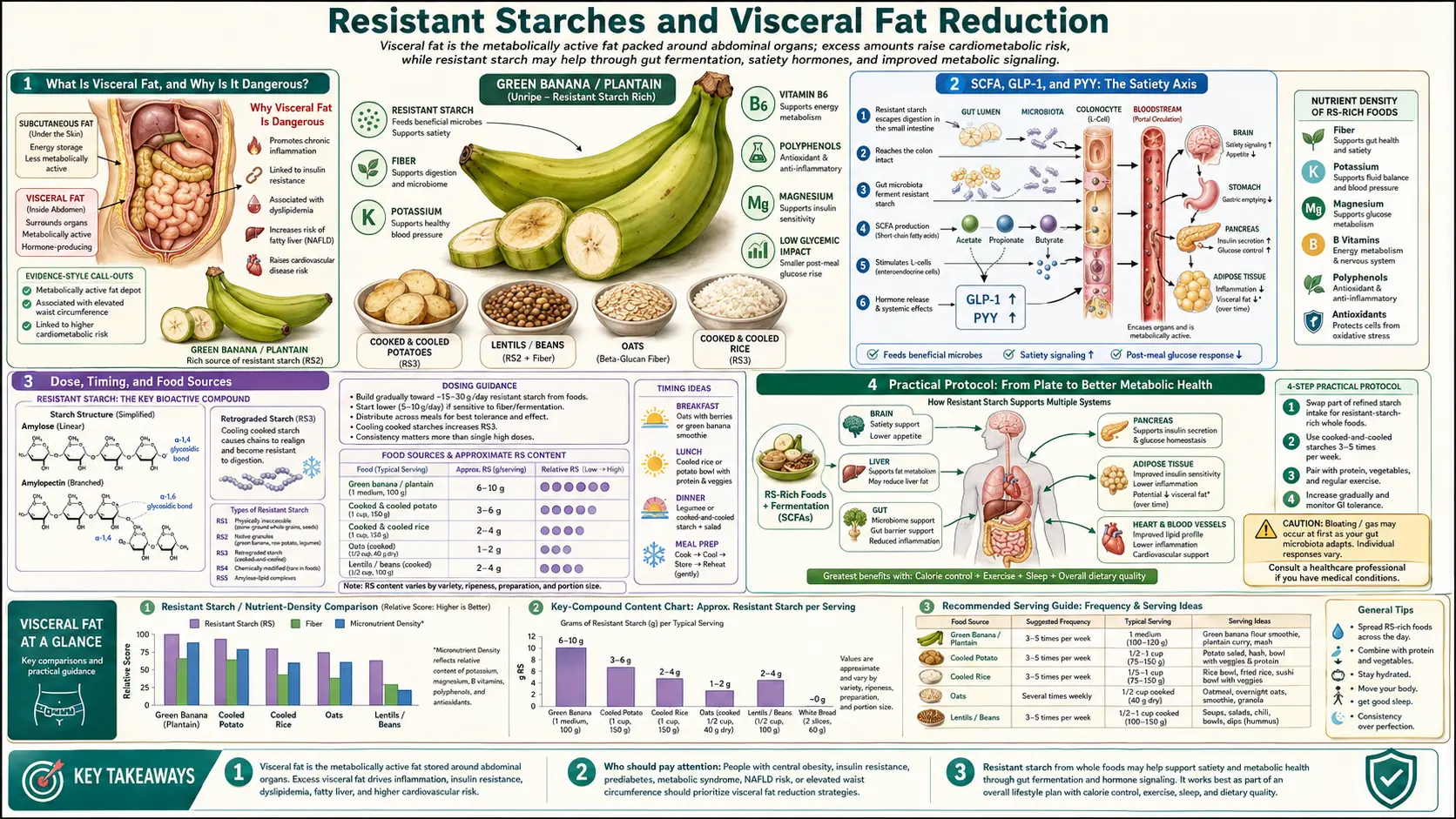
Visceral adipose tissue (VAT) is the deep abdominal fat that wraps around the liver, pancreas, and intestines, and it behaves very differently from the soft subcutaneous fat beneath the skin. Unlike subcutaneous fat, VAT is metabolically active in a damaging way: it secretes inflammatory cytokines, drains free fatty acids directly into the portal circulation, and drives insulin resistance, type 2 diabetes, non-alcoholic fatty liver disease, and cardiovascular events. Reducing VAT, even modestly, produces outsized improvements in cardiometabolic risk. Resistant starch (RS) — a class of fermentable carbohydrates that escape digestion in the small intestine — has emerged as one of the more interesting dietary levers for targeting VAT specifically, operating through short-chain fatty acids, satiety hormones, insulin sensitivity, and shifts in substrate oxidation rather than simple calorie restriction.
Table of Contents
- Visceral Fat and Why It Is Harmful
- Measuring Visceral Fat: DXA, MRI, and Waist Ratios
- Resistant Starch: A Brief Primer
- Mechanisms: How RS Targets Visceral Fat
- Short-Chain Fatty Acid, Glucagon-Like Peptide-1, and PYY: The Satiety Axis
- Butyrate, AMP-Activated Protein Kinase, and Fat Oxidation
- Insulin Sensitivity and De Novo Lipogenesis
- Human Trials: What the Data Actually Show
- The Second-Meal Effect
- Dose, Timing, and Food Sources
- Combining RS with Exercise
- Realistic Expectations and Limitations
- Safety, Tolerance, and Who the Research Raises Concerns For
- Practical Protocol
- Connections
- Key Research Papers
- Featured Videos
Visceral Fat and Why It Is Harmful
Body fat exists in two fundamentally different depots. Subcutaneous adipose tissue (SAT) lies just under the skin; it is the fat you can pinch on the thigh, hip, or flank. Visceral adipose tissue (VAT) lies deep inside the abdominal cavity, packed around and between the liver, stomach, intestines, pancreas, and omentum. Although VAT typically accounts for only 10–20 percent of total body fat in men and around 5–10 percent in women, it contributes a disproportionate share of cardiometabolic risk.
Several features make VAT uniquely harmful. First, visceral adipocytes are more lipolytically active than subcutaneous adipocytes, releasing free fatty acids (FFAs) at higher rates, especially under adrenergic stimulation. Second, VAT drains directly into the portal vein, meaning those FFAs and the inflammatory signals released with them reach the liver first, at high concentration, before they can be diluted by the systemic circulation. This portal exposure is central to the development of hepatic insulin resistance and non-alcoholic fatty liver disease.
Third, VAT is an endocrine organ that secretes pro-inflammatory cytokines and adipokines — tumor necrosis factor-alpha, interleukin-6 (IL-6), resistin, and plasminogen activator inhibitor-1 — while producing less of the protective adipokine adiponectin than subcutaneous fat. The result is chronic low-grade inflammation, endothelial dysfunction, and a prothrombotic state. Higher VAT predicts type 2 diabetes, coronary heart disease, stroke, certain cancers, and all-cause mortality independently of body mass index (BMI).
Measuring Visceral Fat: DXA, MRI, and Waist Ratios
Clinicians and researchers quantify visceral fat using several tools, each with different precision and cost.
- Magnetic resonance imaging (MRI) and computed tomography (CT) are the gold standards. A single cross-sectional slice at the L4-L5 level allows direct planimetry of visceral versus subcutaneous fat areas. Magnetic resonance imaging avoids radiation and is preferred for serial studies.
- Dual-energy X-ray absorptiometry (DXA) with dedicated visceral-fat analysis software estimates visceral fat mass within the android region and is accurate enough for clinical trials.
- Waist circumference and waist-to-hip ratio are crude but useful surrogates. A waist >102 cm in men or >88 cm in women signals excess central adiposity, and waist-to-height ratio above 0.5 is a simple, ethnicity-agnostic cutoff.
- Bioelectrical impedance analysis scales with visceral fat but is unreliable as an absolute measure.
Because VAT can change meaningfully without much movement on the scale, imaging-based endpoints matter when evaluating any intervention — including resistant starch.
Resistant Starch: A Brief Primer
Resistant starch is the fraction of dietary starch that resists digestion in the small intestine and reaches the colon intact, where it is fermented by gut bacteria. Five types are recognized:
- RS1 — physically inaccessible starch trapped in whole grains, seeds, and legumes.
- RS2 — native granular starch with a crystalline B- or C-type structure (raw potato, green banana, high-amylose maize).
- RS3 — retrograded starch formed when cooked starches (potatoes, rice, pasta) are cooled.
- RS4 — chemically modified starches.
- RS5 — amylose-lipid complexes.
The most-studied forms in metabolic trials are a commercial high-amylose maize starch (resistant starch type 2) and retrograded rice or potato starch. Typical experimental doses range from 15 to 40 grams per day, whereas average Western intake is roughly 3–8 grams per day.
Mechanisms: How RS Targets Visceral Fat
Resistant starch does not burn visceral fat directly. Instead, it sets off a cascade of hormonal and metabolic events that together can shift the body toward storing less fat in the visceral depot and oxidizing more. The major mechanisms are:
- Colonic fermentation to short-chain fatty acids (acetate, propionate, butyrate).
- Short-chain fatty acid-mediated release of the satiety hormones glucagon-like peptide-1 (GLP-1) and peptide YY from L-cells.
- Butyrate activation of AMP-activated protein kinase (AMPK) in liver, muscle, and adipose tissue.
- Improved peripheral and hepatic insulin sensitivity, lowering circulating insulin and curbing storage signaling.
- Reduced hepatic de novo lipogenesis and improved fat-oxidation capacity.
- Favorable shifts in the gut microbiome and reduced metabolic endotoxemia.
Short-Chain Fatty Acid, Glucagon-Like Peptide-1, and PYY: The Satiety Axis
When resistant starch reaches the colon, anaerobic bacteria ferment it to the short-chain fatty acids acetate, propionate, and butyrate. Short-chain fatty acids (SCFAs) bind free fatty acid receptors FFAR2 (GPR43) and FFAR3 (GPR41) on enteroendocrine L-cells lining the distal gut, triggering secretion of glucagon-like peptide-1 and peptide YY (PYY). Both hormones slow gastric emptying, enhance satiety in the hypothalamus, and reduce subsequent food intake.
In a single-day crossover study by Bodinham and colleagues, 20 young healthy men ate 48 grams of resistant starch or a matched placebo, split between two meals; after the resistant starch they ate less at an ad libitum test meal (5,241 versus 5,606 kilojoules) and over 24 hours (12,603 versus 13,949 kilojoules), although they did not report feeling less hungry. Subsequent work has shown increased postprandial glucagon-like peptide-1 and PYY concentrations after RS meals. Over weeks to months, even a small daily energy gap driven by improved satiety can favor VAT loss, because VAT is mobilized preferentially relative to subcutaneous fat during modest energy deficits.
Butyrate, AMP-Activated Protein Kinase, and Fat Oxidation
Butyrate is the short-chain fatty acid (SCFA) most tightly linked to RS, because amylose-derived fermentation is butyrogenic. Butyrate is the preferred fuel of colonocytes but a meaningful fraction reaches the portal circulation and beyond, where it activates AMP-activated protein kinase (AMPK) in liver, skeletal muscle, and adipose tissue. AMP-activated protein kinase is the master energy sensor of the cell: when activated, it promotes fatty acid oxidation, suppresses fatty acid and cholesterol synthesis, increases mitochondrial biogenesis, and improves insulin signaling.
In mouse studies, butyrate supplementation raised fat oxidation, prevented diet-induced obesity, and lowered hepatic triglyceride content through an AMP-activated protein kinase-dependent mechanism. In humans, chronic RS intake has been associated with increased postprandial fat oxidation and lower 24-hour respiratory quotient — consistent with a body that leans slightly more on fat and less on glucose as fuel, particularly during the post-absorptive period.
Insulin Sensitivity and De Novo Lipogenesis
Hyperinsulinemia is both a cause and a consequence of visceral adiposity. High circulating insulin suppresses lipolysis, drives de novo lipogenesis in the liver, and promotes storage of dietary carbohydrate as fat. Lowering basal and postprandial insulin concentrations is therefore one of the more efficient ways to nudge the body out of a storage-biased state.
The landmark 2005 study by Robertson and colleagues at the University of Oxford gave 10 healthy volunteers 30 grams per day of resistant starch for four weeks, compared with a placebo. On a hyperinsulinemic-euglycemic clamp, the gold-standard assessment, insulin sensitivity was higher after resistant starch than after placebo (9.7 versus 8.5 units, P = 0.03); during a meal tolerance test it was 33 percent higher, and forearm muscle glucose clearance also rose. Fatty acid release from abdominal fat under the skin fell, although fatty acid levels in the blood did not change significantly. A follow-up 2012 paper led by Robertson (15 insulin-resistant men and women, 40 grams per day for 8 weeks) used clamp studies with glucose tracers and found a 65 percent increase in glucose uptake into forearm muscle, stronger suppression of fatty acid release and higher expression of fat-handling genes in fat tissue, but no effect on liver insulin sensitivity or blood lipids; liver and visceral fat were not reported.
Lower insulin, less lipolysis from bloated visceral depots, and less hepatic lipogenesis are proposed to create a favorable environment for VAT reduction, although the imaging trials below did not find a visceral-fat change.
Human Trials: What the Data Actually Show
Human trials of resistant starch and fat mass are smaller and more heterogeneous than those for weight-loss drugs, and they show a consistent pattern: insulin sensitivity often improved, while visceral fat measured on scans did not change:
- Robertson 2005 (Am J Clin Nutr). In 10 healthy adults, 30 g/day resistant starch for 4 weeks raised insulin sensitivity on the clamp (P = 0.03) and by 33% during a meal test, and lowered fatty acid release from abdominal fat under the skin, although blood fatty acid levels did not change significantly.
- Robertson 2012 (J Clin Endocrinol Metab). In 15 insulin-resistant men and women, 40 g/day RS2 for 8 weeks in a crossover design raised glucose uptake into forearm muscle by 65% but did not change liver insulin sensitivity or blood lipids.
- Maki 2012 (J Nutr). A randomized crossover trial in 11 men and 22 women with large waists found that 15 or 30 g/day of high-amylose maize RS for 4 weeks improved insulin sensitivity in men, with no difference between the two doses; in women there was no difference among the treatments. The study was funded by the starch's producer.
- Johnston 2010 (Diabet Med). In 20 insulin-resistant adults with metabolic syndrome, 40 g/day RS2 for 12 weeks improved insulin sensitivity on the clamp (P = 0.023) but did not change body weight or fat stored in muscle, liver or visceral depots on whole-body magnetic resonance scanning.
- Higgins 2004 (Nutr Metab). In 12 adults, a single RS-enriched meal (5.4% of total carbohydrate as RS) raised postprandial oxidation of a labelled fat by 23%, with no effect on blood insulin, glucose or fats, suggesting a mechanism by which chronic intake could modestly reduce fat accumulation.
- Peterson 2018 (Am J Clin Nutr). In 68 overweight adults with prediabetes, 45 g/day RS2 for 12 weeks lowered HbA1c by a clinically insignificant 0.1% and lowered heart rate and the inflammatory marker tumor necrosis factor-alpha, but did not change insulin sensitivity or ectopic fat (visceral, liver and muscle fat on magnetic resonance imaging).
Pooling the evidence, resistant starch improved insulin sensitivity in most of these trials (not in the 12-week prediabetes trial), but the two 12-week trials that measured visceral fat by magnetic resonance scanning did not find a reduction. An effect of RS on visceral fat therefore remains a hypothesis based on the mechanisms above, not a trial finding.
The Second-Meal Effect
A distinctive feature of resistant starch is the second-meal effect, first described by Jenkins and later reinforced in RS trials. A breakfast containing resistant starch lowers the glycemic and insulinemic response not just to that meal, but to a lunch eaten 4–5 hours later, even when the lunch contains no RS. The mechanism is thought to involve colonic short-chain fatty acid production from the earlier meal, suppressing hepatic glucose output and improving peripheral glucose uptake at the subsequent meal, together with reduced postprandial free fatty acid excursions.
Clinically, the second-meal effect means that a single well-placed RS-containing meal — especially breakfast — can flatten the glucose and insulin curves for most of the day, reducing the hormonal pressure that drives visceral fat storage.
Dose, Timing, and Food Sources
Across trials, the metabolic effects described above were seen at 15–40 grams per day of added resistant starch. Below 10 g/day, results are inconsistent; above 50 g/day, gastrointestinal side effects become common without clear additional benefit.
Practical food sources and their approximate RS content per typical serving:
- Cooked-and-cooled rice, brown rice included (1 cup): 2–4 g
- Cooked-and-cooled potatoes (1 medium): 3–5 g
- Cooked lentils (1 cup): 3–4 g
- Cooked white beans (1 cup): 4–8 g
- Green (unripe) banana (1 medium): 4–6 g
- Rolled oats, raw in overnight oats (1/2 cup): 2–4 g
- Raw potato starch (1 tablespoon): ~8 g
- High-amylose maize starch powder (1 tablespoon): ~5 g
Cooling cooked starches overnight in the refrigerator retrogrades a meaningful fraction into RS3, and reheating gently (below ~130 °C) preserves most of it. Timing-wise, splitting intake between two meals avoids gas and bloating from a single large bolus; placing some RS at breakfast maximizes the second-meal effect.
Combining RS with Exercise
Visceral fat is exquisitely sensitive to aerobic exercise. Moderate-intensity cardio (150 min/week) and interval training both reduce VAT even without weight loss, largely via catecholamine-driven lipolysis and improved mitochondrial oxidative capacity. Resistant starch and exercise act on complementary pathways: exercise mobilizes VAT fatty acids, while RS lowers insulin and improves the fate of those fatty acids once they reach the liver and muscle.
No head-to-head trial has tested RS plus exercise versus exercise alone for VAT, but the mechanistic logic — lower insulin plus higher fat oxidation plus improved post-exercise glucose disposal — supports pairing them. On that logic an RS-containing breakfast would sit before or after a training session, though no trial has tested this timing.
Realistic Expectations and Limitations
Resistant starch is not a weight-loss drug. Read honestly, the trials cited here support the following:
- RS improved insulin sensitivity in several trials in healthy, overweight and insulin-resistant adults at doses of 15–40 g/day, though not in a 12-week trial in adults with prediabetes.
- RS modestly increases postprandial fat oxidation and satiety hormone output.
- The 12-week trials that measured visceral fat with magnetic resonance scanning did not find a reduction.
- Effects on total body weight are small and inconsistent; RS is not a substitute for energy balance.
- The metabolic benefits are most pronounced in people who start with insulin resistance, elevated VAT, or prediabetes.
RS is one dietary lever among several — alongside exercise, sleep, protein adequacy, sugar and alcohol moderation, and overall calorie control — that are thought to push the body toward a leaner, less inflamed visceral depot. The trials above lasted 4 to 12 weeks, and none showed a visceral-fat change in that time.
Safety, Tolerance, and Who the Research Raises Concerns For
Resistant starch has an excellent safety profile. The main side effects are gas, bloating, and mild cramping during the first one to two weeks of higher intake, caused by the rapid increase in colonic fermentation. These symptoms are commonly described as easing when intake starts at about 5 grams per day and rises over two to three weeks.
The research raises concerns for:
- People with small intestinal bacterial overgrowth (SIBO), where fermentable carbohydrates can worsen symptoms.
- Active flares of inflammatory bowel disease.
- Severe irritable bowel syndrome, particularly diarrhea-predominant irritable bowel syndrome (IBS-D).
- People on tight glycemic control with insulin or sulfonylureas — RS can lower glucose, adding to these drugs' glucose-lowering effect (low blood sugar is the risk).
For most healthy adults and for those with metabolic syndrome or type 2 diabetes, RS is safe, cheap, and well-tolerated when introduced gradually.
Practical Protocol
The amounts used in the human trials cited on this page:
- 30 g/day of resistant starch for 4 weeks in healthy adults (Robertson 2005).
- 15 or 30 g/day of high-amylose maize starch in 4-week periods in overweight and obese adults (Maki 2012).
- 40 g/day for 8 weeks (Robertson 2012) or 12 weeks (Johnston 2010) in insulin-resistant adults.
- 45 g/day for 12 weeks in adults with prediabetes (Peterson 2018).
- 48 g in a single day, split between two meals (Bodinham 2010).
- Whole-food sources such as cooled rice, cooled potatoes, lentils, and green bananas supply about 2–8 g per serving (see Dose, Timing, and Food Sources above).
- The two trials that measured visceral fat did so with magnetic resonance scanning at the start and after 12 weeks.
Connections
- All Food
- Metabolic Syndrome
- Diabetes
- Obesity
- Fatty Liver Disease
- Gut Microbiome
- High Resistant Starch Foods
- Resistant Starches
- Fermented Foods
- Insulin Resistance
- Glucagon-Like Peptide-1 Receptor Agonists
- Coffee and Type 2 Diabetes
- Non-Alcoholic Fatty Liver Disease
- Irritable Bowel Syndrome
- Lentils
- Oats
- Fasting
- Exercise and Muscle Insulin Sensitivity
- Reversal Protocol Diet and Fasting
- Conditions on this site that reference this page: Metabolic Syndrome and Cardiovascular Risk · Sleep, Stress & Cortisol in Insulin Resistance
- History
Key Research Papers
- Robertson MD, Bickerton AS, Dennis AL, Vidal H, Frayn KN. Insulin-sensitizing effects of dietary resistant starch and effects on skeletal muscle and adipose tissue metabolism. Am J Clin Nutr. 2005;82(3):559-567. — PubMed PMID: 16155268
- Robertson MD, Wright JW, Loizon E, et al. Insulin-sensitizing effects on muscle and adipose tissue after dietary fiber intake in men and women with metabolic syndrome. J Clin Endocrinol Metab. 2012;97(9):3326-3332. — PubMed PMID: 22745235
- Maki KC, Pelkman CL, Finocchiaro ET, et al. Resistant starch from high-amylose maize increases insulin sensitivity in overweight and obese men. J Nutr. 2012;142(4):717-723. — PubMed PMID: 22357745
- Johnston KL, Thomas EL, Bell JD, Frost GS, Robertson MD. Resistant starch improves insulin sensitivity in metabolic syndrome. Diabet Med. 2010;27(4):391-397. — PubMed PMID: 20536509
- Bodinham CL, Frost GS, Robertson MD. Acute ingestion of resistant starch reduces food intake in healthy adults. Br J Nutr. 2010;103(6):917-922. — PubMed PMID: 19857367
- Higgins JA, Higbee DR, Donahoo WT, Brown IL, Bell ML, Bessesen DH. Resistant starch consumption promotes lipid oxidation. Nutr Metab (Lond). 2004;1(1):8. — PubMed PMID: 15507129
- Keenan MJ, Zhou J, Hegsted M, et al. Role of resistant starch in improving gut health, adiposity, and insulin resistance. Adv Nutr. 2015;6(2):198-205. — PubMed PMID: 25770258
- Peterson CM, Beyl RA, Marlatt KL, et al. Effect of 12 weeks of resistant starch supplementation on cardiometabolic risk factors in adults with prediabetes: a randomized controlled trial. Am J Clin Nutr. 2018;108(3):492-501. — PubMed PMID: 30010698
- Bodinham CL, Smith L, Wright J, Frost GS, Robertson MD. Dietary fibre improves first-phase insulin secretion in overweight individuals. PLoS One. 2012;7(7):e40834. — PubMed PMID: 22815837
- Chambers ES, Viardot A, Psichas A, et al. Effects of targeted delivery of propionate to the human colon on appetite regulation, body weight maintenance and adiposity in overweight adults. Gut. 2015;64(11):1744-1754. — PubMed PMID: 25500202
- Tremaroli V, Bäckhed F. Functional interactions between the gut microbiota and host metabolism. Nature. 2012;489(7415):242-249. — PubMed PMID: 22972297
- Gao Z, Yin J, Zhang J, et al. Butyrate improves insulin sensitivity and increases energy expenditure in mice. Diabetes. 2009;58(7):1509-1517. — PubMed PMID: 19366864