Organ Meats: Nutrient Profile
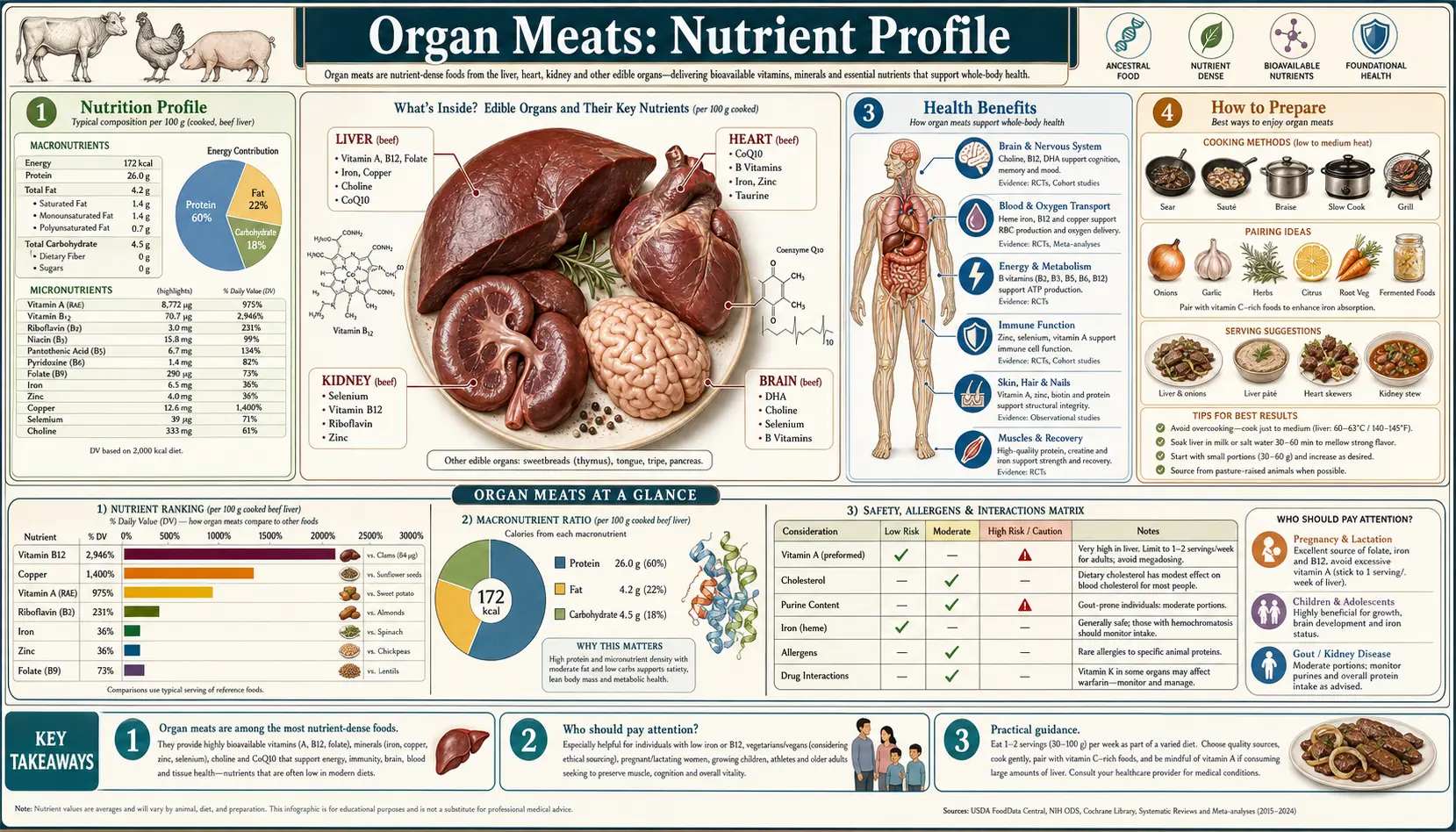
What is Organ Meats richest in? Below are the vitamins, minerals and amino acids that 100 g of Organ Meats delivers in the highest amounts. Each one links to that nutrient’s own page listing the best foods to get it from.
| Organ Meats: Richest Nutrients (per 100 g) | ||||
|---|---|---|---|---|
| Rank | Nutrient | Per 100 g | %DV / 100g | Purpose |
| Vitamins | ||||
| 1 | Vitamin B12 | 71 mcg | 🟢 2,942% | Nerves & red blood cells |
| 2 | Vitamin A | 9,440 mcg | 🟢 1,049% | Vision, skin & immunity |
| 3 | Vitamin B2 (Riboflavin) | 3.4 mg | 🟢 263% | Energy & cell health |
| 4 | Vitamin B5 (Pantothenic Acid) | 7.1 mg | 🟢 142% | Energy metabolism |
| 5 | Vitamin B3 (Niacin) | 18 mg | 🟢 109% | Energy, skin & nerves |
| 6 | Choline | 426 mg | 🟢 77% | Brain & liver |
| 7 | Vitamin B9 (Folate) | 253 mcg DFE | 🟢 63% | Cell division; pregnancy |
| 8 | Vitamin B6 | 1.0 mg | 🟢 60% | Brain & metabolism |
| 9 | Vitamin B1 (Thiamine) | 0.2 mg | 🟡 16% | Turns carbs into energy |
| Minerals | ||||
| 1 | Copper | 14 mg | 🟢 1,589% | Iron use; connective tissue |
| 2 | Selenium | 36 mcg | 🟢 66% | Antioxidant & thyroid |
| 3 | Zinc | 5.3 mg | 🟡 48% | Immunity & healing |
| 4 | Phosphorus | 497 mg | 🟡 40% | Bones & cellular energy |
| 5 | Iron | 6.5 mg | 🟡 36% | Carries oxygen in blood |
| 6 | Manganese | 0.4 mg | 🟡 15% | Bone & metabolism |
| Amino Acids — ranked by amount (no Daily Value) | ||||
| 1 | Glutamic acid | 3.6 g | 🟢 | Brain signaling (glutamate) |
| 2 | Aspartic acid | 2.7 g | 🟢 | Cellular energy & detox |
| 3 | Leucine | 2.7 g | 🟢 | Builds muscle (branched-chain amino acid, BCAA) |
| 4 | Lysine | 2.2 g | 🟢 | Collagen & immunity |
| 5 | Valine | 1.8 g | 🟡 | Muscle & energy (branched-chain amino acid) |
| 6 | Arginine | 1.7 g | 🟡 | Blood flow (nitric oxide) |
| 7 | Glycine | 1.6 g | 🟡 | Collagen, calm & sleep |
| 8 | Alanine | 1.6 g | 🟡 | Energy (glucose cycle) |
| 9 | Phenylalanine | 1.5 g | 🟡 | Dopamine & focus |
| 10 | Isoleucine | 1.4 g | 🟡 | Muscle & energy (branched-chain amino acid) |
| 11 | Proline | 1.3 g | 🟡 | Collagen & joints |
| 12 | Serine | 1.3 g | 🟡 | Cell membranes & brain |
| 13 | Threonine | 1.2 g | 🟡 | Collagen & gut lining |
| 14 | Tyrosine | 1.1 g | 🟡 | Dopamine & thyroid |
Values are per 100 g of the U.S. Department of Agriculture (USDA) FoodData Central record FDC 168626, “Beef, variety meats and by-products, liver, cooked, braised” (SR Legacy). %DV is the amount per 100 g divided by the adult Daily Value in 21 CFR 101.9.
Every figure in this table comes from one organ meat, braised beef liver (the USDA record above); it does not describe heart, kidney or other organ meats. For example, USDA lists copper at 14.3 mg per 100 g of braised beef liver, which the table rounds to 14 mg (1,589% of the Daily Value).
Vitamin A in Liver and the Upper Limit
USDA lists 9,440 mcg of vitamin A (as retinol activity equivalents) per 100 g of braised beef liver, of which 9,430 mcg is retinol, the preformed kind of vitamin A; in the older units that is 31,700 IU (FDC 168626).
In 2024 the European Food Safety Authority (EFSA) kept the adult tolerable upper intake level for preformed vitamin A at 3,000 mcg retinol equivalents a day. The limit applies to men and women, including women of child-bearing age and pregnant and breastfeeding women. EFSA chose birth defects (teratogenicity) as the critical effect on which to base the limit. Based on intake data, it found that European populations are unlikely to go above the limit if liver, offal and products made from them are eaten once a month or less, and its opinion states that women who are planning to become pregnant, or who are pregnant, are advised not to consume liver products.
The birth-defect concern rests on studies such as a 1995 US study of 22,748 pregnant women. For birth defects in body sites that come from the cranial neural crest, babies of women who took in more than 15,000 IU of preformed vitamin A a day from food and supplements had 3.5 times the prevalence of babies whose mothers took in 5,000 IU or less (95% confidence interval 1.7 to 7.3). The extra defects were concentrated among babies whose mothers had high intakes before the seventh week of pregnancy (Rothman and colleagues, 1995).
How Often Liver Pushes Intake Over the Limit
The 1992 Dutch national food consumption survey covered 1,725 women aged 16–50 and 58 pregnant women. Eating liver on one of the two surveyed days produced high intakes: 60% of the women in that group went above the then “safe upper intake limit” of 3,000 retinol equivalents, and 23% went above 7,500 retinol equivalents. Women who ate no liver or liver products on the surveyed days had relatively low average intakes: 540 retinol equivalents for women who were not pregnant and 720 for pregnant women (van den Berg and colleagues, 1996).
Key Research Papers
- EFSA Panel on Nutrition, Novel Foods and Food Allergens (NDA), Turck D, Bohn T, Castenmiller J, de Henauw S, Hirsch-Ernst KI, Knutsen HK, Maciuk A, Mangelsdorf I, McArdle HJ, Pentieva K, Siani A, Thies F, Tsabouri S, Vinceti M, Lietz G, Passeri G, Craciun I, Fabiani L, Horvath Z, Valtueña Martínez S, Naska A (2024). Scientific opinion on the tolerable upper intake level for preformed vitamin A and β-carotene. EFSA Journal; 22(6):e8814. — PubMed PMID: 38846679
- Rothman KJ, Moore LL, Singer MR, Nguyen US, Mannino S, Milunsky A (1995). Teratogenicity of high vitamin A intake. New England Journal of Medicine; 333(21):1369–1373. — PubMed PMID: 7477116
- van den Berg H, Hulshof KF, Deslypere JP (1996). Evaluation of the effect of the use of vitamin supplements on vitamin A intake among (potentially) pregnant women in relation to the consumption of liver and liver products. European Journal of Obstetrics, Gynecology, and Reproductive Biology; 66(1):17–21. — PubMed PMID: 8735753